http://dx.doi.org/10.5090/kjtcs.2013.46.2.98 ISSN: 2233-601X (Print) ISSN: 2093-6516 (Online)
Department of Thoracic and Cardiovascular Surgery, Samsung Medical Center, Sungkyunkwan University School of Medicine Received: August 13, 2012, Revised: October 17, 2012, Accepted: October 17, 2012
Corresponding author: Tae-Gook Jun, Department of Thoracic and Cardiovascular Surgery, Samsung Medical Center, Sungkyunkwan University School of Medicine, 81 Irwon-ro, Gangnam-gu, Seoul 135-710, Korea
(Tel) 82-2-3410-3484 (Fax) 82-2-3410-0089 (E-mail) [email protected]
C
The Korean Society for Thoracic and Cardiovascular Surgery. 2013. All right reserved.
CC
This is an open access article distributed under the terms of the Creative Commons Attribution Non-Commercial License (http://creative- commons.org/licenses/by-nc/3.0) which permits unrestricted non-commercial use, distribution, and reproduction in any medium, provided the original work is properly cited.
Efficacy of the Maze Procedure for Atrial Fibrillation Associated with Atrial Septal Defect
Hunbo Shim, M.D., Ji-Hyuk Yang, M.D., Ph.D., Pyo-Won Park, M.D., Ph.D., Dong Seop Jeong, M.D., Ph.D., Tae-Gook Jun, M.D., Ph.D.
Background: Atrial fibrillation (AF) is a common complication in elderly patients with atrial septal defect (ASD). The purpose of this study was to examine the efficacy of the maze procedure in these patients. Materials and Methods: Between February 2000 and May 2011, 46 patients underwent the maze procedure as a concomitant operation with ASD closure. Three patients who underwent a right-sided maze were excluded, and one patient was lost to follow-up. The mean follow-up duration was 3.2±2.5 years. Electrocardiography was performed 1 month, 3 months, 6 months, and 1 year after surgery, and checked annually after that. Results: AF persisted in 4 patients after surgery. One year after surgery, among 38 patients, 55.3% remained in sinus rhythm without antiarrhythmic drugs. However, when including the patients who took antiarrhythmic drugs, 92.1% were in sinus rhythm. Freedom from AF recurrence at 3 months, 6 months, 1 year, 2 years, 3 years, and 5 years after surgery were 97.4±2.6, 94.4±3.8, 91.2±4.9, 87.8±5.8, 79.5±7.6, and 68.2±12.4, respectively. There was no early mortality after operation.
Conclusion: Concomitant treatment with the maze procedure and ASD closure is safe and effective for restoring the sinus rhythm.
Key words: 1. Arrhythmia surgery 2. Atrial fibrillation 3. Anti-arrhythmic agents 4. Congenital heart disease 5. Heart septal defects, atrial 6. Survival analysis
INTRODUCTION
Atrial fibrillation (AF) occurs frequently in patients who have atrial septal defect (ASD), which causes heart failure in elderly patients. Murphy et al. [1] reported the incidence of AF among patients who had ASD. The range of age among patients was between 25 and 41 years old and the incidence was 41% [1]. However, surgical closure of ASD did not lead
to regression of the AF incidence [2]. In addition, AF is as-
sociated with a risk of thromboembolic complications, which
requires patients to take drugs chronically. Therefore, restor-
ing the sinus rhythm after ASD closure is crucial. During the
past decade, the maze operation was recommended to patients
with unsuccessful AF medication treatment. More recently, a
concomitant operation of the maze procedure with surgical
closure of ASD has been proposed [3]. However this treat-
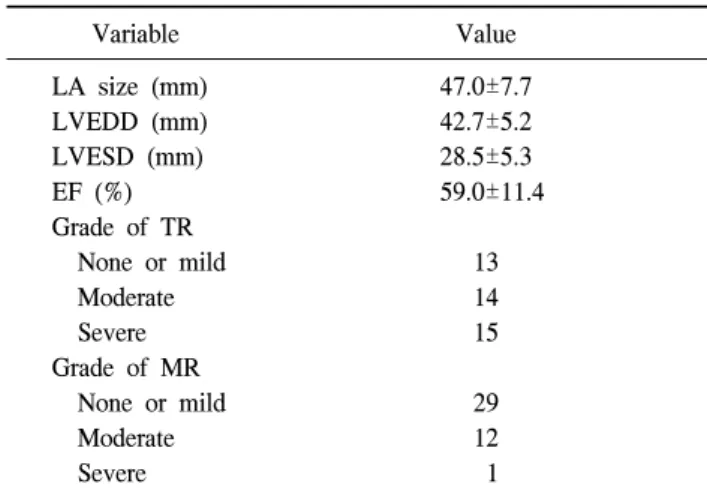
Table 1. Preoperative measurements in echocardiography
Variable Value
LA size (mm) LVEDD (mm) LVESD (mm) EF (%) Grade of TR None or mild Moderate Severe Grade of MR None or mild Moderate Severe
47.0±7.7 42.7±5.2 28.5±5.3 59.0±11.4
13 14 15
29 12 1
Values are presented as mean±standard deviation or number.
LA, left atrium; LVEDD, left ventricular end diastolic diame- ter; LVESD, left ventricular end systolic diameter; EF, ejection fraction; TR, tricuspid regurgitation; MR, mitral regurgitation.
ment strategy is controversial due to the technical complexity, which may lead to prolonged surgical time due to aortic cross-clamping and cardiopulmonary bypass. In this study, we examined the efficacy of the maze procedure on AF with ASD. In addition, we searched for factors that could affect the recurrence of AF after the maze procedure in these patients.
MATERIALS AND METHODS
From January 2000 to December 2011, 46 consecutive pa- tients with ASD and AF underwent the maze procedure com- bined with surgical closure of ASD. Among them, one pa- tient was lost to follow-up after discharge. Forty-two patients underwent the modified Cox maze III procedure. There were some cases where right atriotomy was used only for ASD. In such cases Maze procedure was limited to the right side.
However, since there were only three cases and such proce- dures were executed in the early stages of the study, they were excluded from the subject group. Medical and surgical records were reviewed retrospectively. The mean follow-up duration was 3.2±2.5 years. Electrocardiography (ECG) was routinely performed at 1 month, 3 months, 6 months, and 1 year after surgery, and checked annually from then on. The 3 month records were considered to be blank periods. During this 3 month period, transient rhythm change was not consid- ered to be a treatment failure, and amiodarone was prescribed as an antiarrhythmic drug in patients with AF. The success of the maze procedure was defined as any rhythm other than at- rial fibrillation, atrial flutter, and atrial tachycardia 3 months after the maze procedure. Junctional rhythm or atrioven- tricular block that required pacemaker insertion was regarded as a complication rather than a treatment failure.
The 42 patients who underwent the modified Cox maze III procedure as a concomitant operation with an ASD closure consisted of 25 men and 17 women. Their age at surgery ranged from 31 to 72 years with a mean±standard deviation of 52.5±9.5 years. Twenty-nine patients had persistent AF and 13 patients had paroxysmal AF. The average duration of AF was 27±29 months and average ASD size was 28.8±9.7 mm. Forty-one patients had ostium secundum type ASD and 1 had a sinus venosus type ASD. The cardiothoracic ratio
was measured by a chest X-ray taken before the operation.
The mean cardiothoracic ratio was 63.4%±7.5%. The left at- rial diameter, left ventricular end diastolic diameter, and left ventricular end systolic diameter were also measured with echocardiography before the operation (Table 1). The ASD was closed with a pericardial patch fixed with glutamine al- dehyde, which was harvested from the patients themselves in 38 cases, and direct primary closure was performed in 4 cases. The modified Cox maze III procedure was performed to achieve sinus rhythm with an energy source of cryoa- blation in 35 patients, radiofrequency in 1, and both in 5 patients. One patient underwent only the cut-and-sew technique. In most cases, maze lesions were made with the following protocol. The standard left atriotomy was extended slightly downwards. Around the pulmonary vein orifices, cry- oablation was performed with the cryoablation probe at -60
oC for 2 minutes 30 seconds. Thereafter, the lesion was extended to the annulus of the posterior leaflet at the mitral valve and left atrial auricle. Below the coronary sinus and upper part above the inferior vena cava, cryoablation was conducted per- pendicularly towards the tricuspid valve annulus. Accordingly, the final cryoablation proceeded from the counterpart of the standard right atriotomy to the tricuspid valve annulus.
Radiofrequency ablation was performed only for pulmonary
vein isolation when it was used as an energy source.
Fig. 1. Early results after surgery. SR, sinus rhythm; JR, junc- tional rhythm; AF, atrial fibrillation.
Table 2. Effects of maze procedure (last checked rhythm of pa- tients who regained sinus rhythm after maze procedure)
Last rhythm No. of patients (%) Sinus rhythm
Atrial fibrillation Junctional rhythm Pacemaker insertion Total no.
31 (81.6) 5 (13.2) 1 (2.6) 1 (2.6) 38
Simultaneous cardiac procedures were tricuspid regurgitation (TR) repair in 15 patients and TR repair with mitral regur- gitation repair in 20 patients.
In order to analyze the factors that influence restoration of sinus rhythm after the maze procedure, continuous variables were expressed as the mean±standard deviation. The Student’s t-test was used and categorical variables were ex- pressed in relative frequencies. Also, Fisher’s exact test was used at the p<0.05 level. The data from 38 patients who achieved a restored sinus rhythm after the modified Cox maze III procedure were analyzed to assess the correlation using Spearman’s rank correlation coefficient (ρ) and a Cox regression model at the significance level p<0.05 with IBM SPSS ver. 20.0 (IBM Co., Armonk, NY, USA). The sinus rhythm maintenance rate was calculated according to the Kaplan-Meyer method.
RESULTS
The mean cardiopulmonary bypass time was 134.7±41.8 minutes and mean aortic cross-clamp time was 104.9±33.4 minutes. AF persisted in 4 patients after the modified Cox maze III procedure. Three months after surgery, 35 patients achieved restored sinus rhythm (Fig. 1). One year after the operation, 21 patients (55.3%) remained in sinus rhythm with- out any antiarrhythmic drugs. However, when we included the patients who took antiarrhythmic drugs such as amiodar-
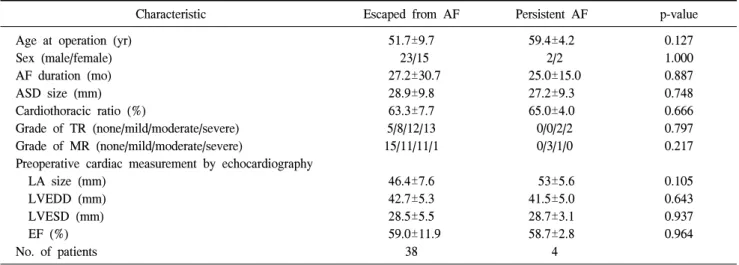
one, 35 patients (92.1%) were in sinus rhythm. The last fol- low-up ECG showed a sinus rhythm in 31 patients, AF in 9 (including 4 persistent AF patients), and junctional rhythm in 1. One patient needed implantation of a permanent pacemaker for tachy-brady syndrome (Table 2). There were no sig- nificant differences in patients’ characteristics between pa- tients who escaped from AF after the maze operation and pa- tients who did not (Table 3). Freedom from AF recurrence at 3 months, 6 months, and 1 year, 2 years, 3 years, and 5 years after surgery was 97.4±2.6, 94.4±3.8, 91.2±4.9, 87.8±
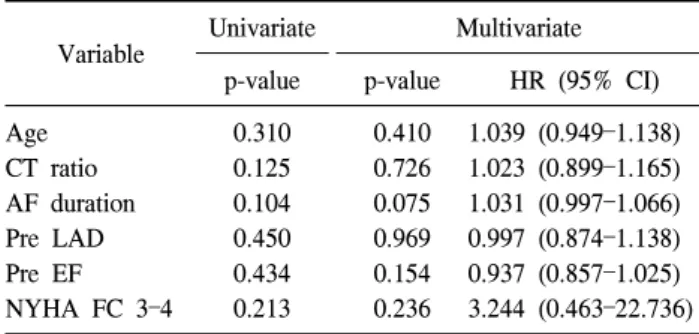
5.8, 79.5±7.6, and 68.2±12.4, respectively (Fig. 2). There was no relationship observed between the variables and recurrence of AF. Spearman’s correlation with a preoperative car- diothoracic ratio and recurrence of AF showed the smallest p-value of 0.058, but it was not statistically significant (Table 4). Additionally, Cox regression analysis showed that none of the variables were related to the recurrence (Table 5). There was no early mortality after surgery, but only two late mortalities. The first patient died from right heart failure four months after ASD closure during hospitalization. This patient had already had right heart failure and severe pulmonary hy- pertension preoperatively. The patient’s pulmonary arterial pressure was assumed using right ventricular pressure only with TR velocity. However, this patient had high right ven- tricular end diastolic pressure and the pulmonary arterial pres- sure was underestimated. The other patient died from diabetic nephropathy three years after surgery in another hospital.
DISCUSSION
Atrial arrhythmia including atrial flutter and fibrillation is
present in 14% to 22% of adult patients who have untreated
ASD [4-6]. Among patients older than 40 years old who un-
Table 3. Comparison of patients who escaped from AF and who have persistent AF
Characteristic Escaped from AF Persistent AF p-value
Age at operation (yr) Sex (male/female) AF duration (mo) ASD size (mm) Cardiothoracic ratio (%)
Grade of TR (none/mild/moderate/severe) Grade of MR (none/mild/moderate/severe)
Preoperative cardiac measurement by echocardiography LA size (mm)
LVEDD (mm) LVESD (mm) EF (%) No. of patients
51.7±9.7 23/15 27.2±30.7
28.9±9.8 63.3±7.7 5/8/12/13 15/11/11/1
46.4±7.6 42.7±5.3 28.5±5.5 59.0±11.9
38
59.4±4.2 2/2 25.0±15.0
27.2±9.3 65.0±4.0 0/0/2/2 0/3/1/0
53±5.6 41.5±5.0 28.7±3.1 58.7±2.8
4
0.127 1.000 0.887 0.748 0.666 0.797 0.217
0.105 0.643 0.937 0.964
Values are presented as mean±standard deviation or number.
AF, atrial fibrillation; ASD, atrial septal defect; TR, tricuspid regurgitation; MR, mitral regurgitation; LA, left atrium; LVEDD, left ventricular end diastolic diameter; LVESD, left ventricular end systolic diameter; EF, ejection fraction.
Fig. 2. Freedom from atrial fibrillation recurrence at 3 months, 6 months, and 1 years, 2 years, 3 years, and 5 years was 97.4±
2.6, 94.4±3.8, 91.2±4.9, 87.8±5.8, 79.5±7.6, and 68.2±12.4, re- spectively. AF, atrial fibrillation.
Table 4. Correlations between preoperative variables and recurr- ence rate of AF
p-value
a)ρ
b)CT ratio
Preoperative AF duration ASD size
Preoperative LAD Preoperative LVEDD Preoperative LVESD Preoperative EF
0.058 0.290 0.930 0.411 0.226 0.148 0.413
0.311 0.176 0.015 0.137 0.201 0.239 -0.137 AF, atrial fibrillation; CT ratio, cardiothoracic ratio; ASD, at- rial septal defect; LAD, left atrial diameter; LVEDD, left ven- tricular end diastolic diameter; LVESD, left ventricular end systolic diameter; EF, ejection fraction.
a)
Statistical significance level was defined at p-value <0.05.
b)