大 韓 不 妊 學 會 誌 : 第 32 卷 第 2 號 2005 Kor. J. Fertil. Steril., Vol. 32, No. 2, 2005, 6
한국에서 반복자연유산을 하는 535쌍의 부부에 있어서의 세포 유전학적 연구
연세대학교 의과대학 산부인과학교실
1, 임상의학 연구 센터 유전학 검사실
2황한성
1·양은석
1·홍원기
1·김미순
2·양영호
1,2Cytogenetic Study in 535 Couples with Recurrent Spontaneous Abortions in Korea Han Sung Hwang1, Eun Suk Yang1, Won Ki Hong1, Mi Soon Kim2, Young Ho Yang1,2
1Department of Obstetrics and Gynecology, 2The Genetic Laboratory of the Medical Research Center, College of Medicine, Yonsei University, Seoul, Korea
Objective: The purposes of this study were to investigate the types and the incidences of chromosomal abnormalities, and to provide an explanation for the genetic causations of recurrent spontaneous abortions in Korean population.
Methods: Cytogenetic studies were carried out in 535 couples with at least two spontaneous first trimester abortions from January 1981 to December 2003. For karyotype analysis, we used modified Moorhead method by Giemsa staining and Giemsa-Trypsin-Giemsa banding
Results: The overall incidence of chromosome abnormality was 32 out of 535 cases (5.98%). There were 25 cases (4.67%) of translocation and 7 cases (1.31%) of inversion. In translocation, 5 cases (0.93%) of Robertsonian translocation and 20 cases (3.74%) of reciprocal translocation were observed.
In inversion, 6 cases (1.12%) of inversion of chromosome 9 and one case (0.19%) of inversion of chromosome 18 were found.
Conclusion: In this study, overall chromosomal abnormality rate in couples with recurrent spontaneous abortions is much higher than that in the general population. So, chromosomal analysis should be offered for the prognostic information in genetic counseling such as prenatal diagnosis in couples with repetitive reproductive failure.
Key Words: Recurrent spontaneous abortion, Chromosomal abnormality, Translocation, Inversion
일반적으로 전체 임신한 산모 중 약 15~20%가 자연유산으로 임신이 종결 된다고 보고 되고 있다.
1,2
그리고, 이런 자연유산된 태아의 약 50% 이상에 서 염색체 이상이 나타난다고 알려져 있다.
3기존의 반복자연유산의 정의는 일반적으로 임신 제 20주 이내에 자연유산이 3회 이상 연속되는 경 우로 알려져 있으나, 최근에는 2회 이상의 연속 자
연유산이 있는 경우나, 연속성과 관련 없는 3회 이 상의 자연유산도 임상적으로 의미를 부여해 가는 추세이다.
4,5반복자연유산의 원인이 아직 완전히 규명된 것은 아니지만, 그 원인으로 부모나 태아의 염색체 이상, 자궁의 해부학적 이상, 내분비학적 호르몬 이상, 면 역학적 이상, 전염성 질환 등이 알려져 있다.
6이중
주관책임자: 양영호, 우) 120-752 서울특별시 서대문구 신촌동 134, 연세대학교 의과대학 산부인과학교실Tel: (02) 361-5490, Fax: (02) 313-8357, e-mail: [email protected]
가장 많은 부분을 차지하고 있는 염색체 이상에 의 한 것으로, 특히 양친의 염색체 이상으로 인한 반복 유산의 가능성이 Penrose 등에 의하여 처음으로 제 기되었으며,
7이후로 이에 대한 많은 세포 유전학 적 연구가 이루어 졌다.
반복자연유산을 하는 부부의 염색체 이상 중에서 전좌가 가장 많으나, 그 빈도는 저자에 따라 많은 차이를 보이고 있으며,
8,9이런 차이는 연구 대상의 지역 및 인종, 환경의 차이, 세포 유전학적 검사방 법의 차이 그리고 연구 대상자 수 등에 기인 한다고 볼 수 있다.
10본 연구의 목적은 반복자연유산을 경험한 부부에 대하여 단일 기관에서 광범위한 염색체 분석을 실 시함으로써, 빈도의 차이를 보일 수 있는 여러 요
인들을 가능한 제거한 후, 염색체 이상의 유형 및 빈도를 조사하여, 이를 바탕으로 보다 신뢰할 만한 우리나라만의 결과를 산출함으로써 한국인에 있어 서 반복자연유산의 유전적 원인을 이해하고, 또한 이들에 대해 적절한 유전학적 상담을 하는데 도움 이 되고자 함이다.
연구 대상 및 방법
1. 연구 대상
임신 20주 이내에 2회 이상의 연속적인 자연유 산을 경험한 부부를 대상으로 1981년 1월 1일부터 2003년 12월 31일까지 23년간 총 535쌍의 부부를 대상으로 말초혈액 임파구에 대한 염색체 분석을
Figure 1. A. Karyotyping of a female with a reciprocal translocation between the long arm of a chromosome 2 and
the long arm of a chromosome 4: 46,XX,t(2;4)(q33;q35). B. Diagram for reciprocal translocation between the long arm of a chromosome 2 and the long arm of a chromosome 4: 46,XX,t(2;4)(q33;q35).
A B
실시하여 핵형의 이상 유무를 확인하였다.
2. 연구 방법
대상 부부의 염색체 분석을 위하여 헤파린 처리 된 말초혈액 0.5 ml를 채취하여 배양액에 넣어서 37℃에서 72시간 배양하였다. 중기의 염색체 수확 을 위하여 colcemid를 최종농도 0.1 µg/ml로 1시간 30분 처리한 후, 세포수확을 위해 800 rpm으로 12 분간 원심분리 하였다. 0.075 M KCl로 저장액 처리 를 하고 Carney 고정액 (methanol; acetic acid=3:1)을 3회 이상 사용하여 고정한 후 공기건조법 (air dry- ing method)으로 표본을 작성, Giemsa염색 및 G- banding하여 현미경 하에서 중기상 염색체를 관찰 하여 핵형 분석을 실시 하였고, 이상 염색체의 변
곡점 (Breakpoint)은 다이아그램을 사용하여 관찰 하였다 (Figure 1, 2).
결 과
2회 이상의 연속된 반복자연유산을 경험한 535예 의 부부를 대상으로 세포유전자 검사를 시행한 결 과 총 32예의 염색체 이상 소견이 나타나서 5.98%
를 보였다. 이중 전좌가 25예(4.67%), 역위가 7예 (1.31%)였으며, 이들은 전체 32예의 염색체 이상 소 견 중 각각 78.1%, 21.9%를 차지 하였다 (Table 1).
염색체 이상 소견을 보인 32예 중 부부 모두 염 색체 이상을 보인 예는 단 1예도 나타나지 않았고, 이상 소견을 보인 남녀의 성비를 보면, 로버트슨 전
B A
Figure 2. A. Karyotyping of a female with a reciprocal translocation between the short arm of a chromosome 2 and
the short arm of a chromosome 8: 46,XX,t(2;8)(p14;p23). B. Diagram for reciprocal translocation between the short
arm of a chromosome 2 and the short arm of a chromosome 8: 46,XX,t(2;8)(p14;p23).
좌 (Robertsonian translocation)의 경우 5예 모두 부 인에게만 나타났고, 상호 전좌 (Reciprocal translo- cation)의 경우 여자 1명당 남자 0.67명의 비를 보여 여성에서 높았고, 역위 (Inversion)의 경우는 여자 1명당 남자 2.5명의 비를 보여 남성에서 높았다 (Table 2).
전좌를 보인 부부 25예 중에서 로버트슨 전좌는 5예로 이중 t(13;14)가 2예 나타났고, 나머지는 t (13;15), t(13;21), t(21;22)가 각각 1예씩 나타났다. 그
리고 상호 전좌의 경우 총 20예로 중복됨 없이 모 두 다른 유전자 형을 보였다 (Table 3).
염색체 이상 중 역위는 7예 모두 Pericentric in- version 소견을 보였고, 이들 중 9번 염색체의 역위 가 6예, 18번 염색체의 역위가 1예로 나타났다. 그 리고 9번 염색체의 역위 중에서 inv(9)(p11;q13)이 4예를 보였고, 나머지는 inv(9)(p11;q12), inv(9)(p13;
q21)가 각각 1예씩 나타났다. 또한 1예의 18번 염색 체 역위는 inv(18)(p11;q21)를 나타냈다 (Table 4).
Table 1. Frequency of chromosomal abnormalities in
couples with recurrent spontaneous abortions
Karyotype No Percent (%)
Normal couples 503 94.02 Abnormal couplces 32 5.98
Translocation 25 4.67
Inversion 7 1.31
Total patients 535 100.00
Table 3. Karyotypes in 25 couples with translocation
Karyotype No Percent (%)
Robertsonian translocation 5 0.93
45,XX,t(13;14)(p11;q11) 45,XX,t(13;14)(p11;q11) 45,XX,t(13;15)(p11;q11) 45,XX,t(13;21)(p11;q11)
45,XX,t(21;22)(p11;q11)
Reciprocal translocation 20 3.74
46,XX,t(1;2)(p36;q35) 46,XX,t(13;14)(q12;p23) 46,XX,t(13;14)(q14;q13) 46,XX,t(15;21)(q13;q21) 46,XY,t(2;11)(p23;q13) 46,XX,t(2;4)(q33;q35) 46,XX,t(2;8)(p14;p23) 46,XY,t(3;11)(p13;q23) 46,XY,t(3;14)(q11;q32) 46,XX,t(3;16)(q27;p13) 46,XY,t(4;13)(p14;q34) 46,XY,t(4;6)(p14;p25) 46,XX,t(5;10)(p15;p12) 46,XX,t(5;12)(p15;q15) 46,XY,t(5;15)(p15;q13) 46,XX,t(5;18)(p13;p11) 46,XY,t(6;7)(q23;p22) 46,XX,t(7;9)(p12;q22) 46,XY,t(8;13)(q24;q14) 46,XX,t(9;10)(q32;q26)
Total translocation cases 25 4.67
Total patients 535 100.00
Table 2. Sex ratio by chromosomal abnormalities in
couples with recurrent spontaneous abortions Chromosomal
abnormality types No of cases
Male carrier
Female carrier
Sex ratio Robertsonian
translocation 5 0 5 0
Reciprocal
translocation 20 8 12 0.67
Inversion 7 5 2 2.5
고 찰
임상적으로 임신이 확인된 산모 중 약 15~20%는 자연유산으로 임신이 종결 된다고 보고 되고 있으 며,
1,2이런 자연유산된 태아의 약 50% 이상에서 염 색체 이상이 나타난다고 알려져 있다.
3이런 이유로 그 동안 반복자연유산을 하는 부부에 있어서 유전 자 이상에 대한 많은 연구들이 이루어져 왔다.
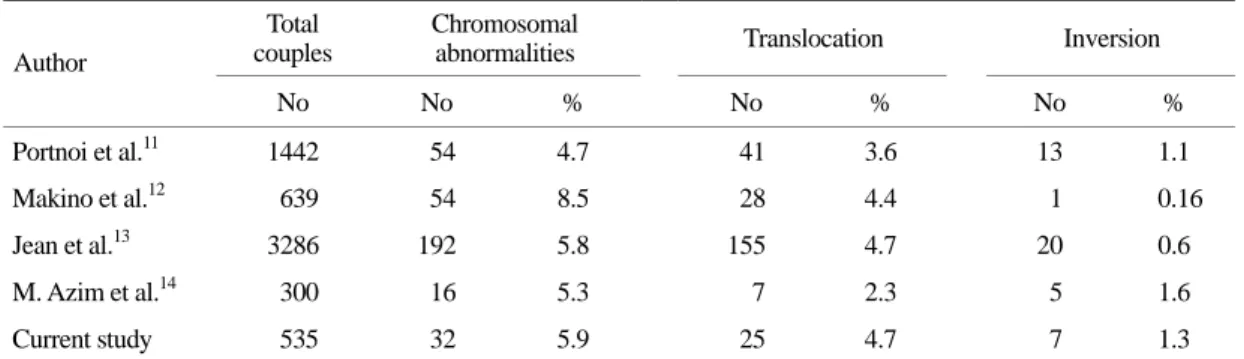
반복자연유산을 하는 부부의 유전자 이상은 대부 분 구조적 이상이라고 알려져 있다. 기존의 보고들 에 의하면 반복 자연유산을 하는 부부에 있어서 전 체 구조적인 염색체 이상의 빈도는 4.7~8.5%를 보 였고, 이들 중에서 전좌가 차지하는 빈도는 2.3~
4.7%를 보였으며, 역위가 차지하는 빈도는 0.2~
1.6%를 보였다.
11~14본 연구에서는 각각 5.98%, 4.67%, 1.31%를 보여 비슷한 결과를 보였다 (Table 5).
전좌 중 로버트슨 전좌는 신생아들 1000명당 1~
1.34명의 빈도로 발생하며,
15,16유전자 이상이 의심
되어 검사를 받는 일반 성인 1000명당 2.15명의 빈 도로 나타나는 염색체의 구조적인 이상으로,
17본 연구의 반복자연유산 부부에서 0.93%는 각각 약 9 배와 약 4.5배로 매우 높은 빈도라고 할 수 있다.
또한, 상호 전좌는 일반인 1000명당 1~1.25명의 빈 도를 보이고,
18,19유전자 이상이 의심되어 검사한 성 인 1000명당 3.2명의 빈도를 보이는 것으로,
19본 연 구에서 나타난 3.74%는 각각 약 37배와 약 12배로 일반인에 비해 매우 높은 빈도로 나타났다.
반복자연유산을 하는 부부에 있어서 전좌의 경우 에 부인이 보인자일 가능성이 더 높다는 기존 연구 들과 같이,
20본 연구에서도 로버트슨 전좌는 5례 모두 부인에게서 나타났고, 상호 전좌의 경우도 부 인이 12례, 남편이 8례를 보였다 (Table 2).
로버트슨 전좌 보인자의 경우 정상의 배우자 (ga- mete)와 결혼시에 자식은 1/3은 표현형은 정상으로 나오고 (그 중 반은 유전적 정상, 나머지 반은 로버 트슨 전좌 보인자임), 1/3은 trisomy, 1/3은 mono- somy를 보이게 되는데, 특히, 본 연구에서 나타난
Table 5. Frequency of chromosomal abnormalities in couples with recurrent spontaneous abortionsTotal couples
Chromosomal
abnormalities Translocation Inversion
Author
No No % No % No %
Portnoi et al.
111442 54 4.7 41 3.6 13 1.1
Makino et al.
12639 54 8.5 28 4.4 1 0.16
Jean et al.
133286 192 5.8 155 4.7 20 0.6
M. Azim et al.
14300 16 5.3 7 2.3 5 1.6
Current study 535 32 5.9 25 4.7 7 1.3
Table 4. Karyotypes in 7 couples with inversion
Karyotype No Percent (%)
46,XX,inv(9)(p11;p12) 46,XY,inv(9)(p11;q13) 46,XY,inv(9)(p11;q13) 46,XY,inv(9)(p11;q13) 46,XY,inv(9)(p11;q13) 46,XY,inv(9)(p13;q21)
46,XY,inv(18)(p11;q21)
Total inversion cases 7 1.31
Total patients 535 100.00
로버트슨 전좌의 경우 중에서 45,XX,t(13;21)(p11;
q11)의 경우는 자손의 경우에 trisomy 21 (Down syn- drome)과 trisomy 13 (Patau syndrome)이 모두 생존 출생 가능한 경우로, 이들이 모두 생존 출생한다면 이론적으로 유산의 확률은 monosomy로 1/3이 되고, 생존 출생아는 2/3이 된다. 이중 1/4은 trisomy 13, 1/4은 trisomy 21이 되어서 생존 출생아의 반은 tri- somy로 태어나게 된다. 본 연구에서는 나타나지 않 았지만, 만일 동일한 상염색체 사이의 로버트슨 전 좌가 있을 경우 자손은 항상 trisomy 또는 mono- somy 이어서 정상아를 출산할 수 없으므로, 그 보 인자는 공여 정자나 난자로 인공 수정을 하는 등의 유전 상담이 필요할 것이다.
상호 전좌 보인자의 경우는 이론적으로 감수분열 시에 생식 세포가 2:2로 분리가 된다면 자손의 2/3 에서 unbalanced translocation이 나타나 특정 유전자 의 중복 내지는 소실이 일어 나므로, 이들은 유산 된다. 그리고 생식세포의 분리가 3:1로 이루어 진다 면, 100% unbalanced translocation이 일어나서 자손 모두를 유산을 하게 된다.
최근에는 착상전 유전진단 (Pre-implantation Ge- netic Diagnosis: PGD)으로 정상배아를 선별하여 이 식함으로써 자연유산을 감소시킬 수 있는 방법이 보고 되고 있다.
21따라서, 반복 자연유산을 하는 부부에 있어서 염색체 검사상 전좌가 나온 경우, 그 종류가 어떤 것인지에 따라서 적절하게 유전상담 후 적절하게 착상전 유전진단을 하거나, 임신시 양 수검사나 융모막 융모 생검술을 시행할 수 있고, 부부 이외의 다른 남자나 여자에게서 정자나 난자 를 얻어서 임신을 하는 방법 등을 추천해 주어야 할 것이다.
역위는 크게 pericentric inversion과 paracentric in- version으로 분류하는데, 이중 paracentric inversion 은 매우 드물어서 일반인 1000명 당 0.03~0.05명의 발생률을 보고하고 있고,
22pericentric inversion은 일 반인 1000명당 0.13명,
23유전자 이상이 의심되어 검사한 사람 1000명당 0.46명의 발생률을 보고하고 있다.
24본 연구에서는 paracentric inversion은 나타 나지 않았고, pericentric inversion만이 1.31%의 발생 률을 나타내어 일반군의 28배에서 100배의 높은 발 생률을 보였다. 일반인에서 역위는 남녀 발생비가
비슷하다고 보고되고 있으나,
25본 연구에서는 남 자가 5명, 여자가 2명으로 나타났다.
본 연구에서 역위 중 6례를 차지한 9번 염색체의 pericentric inversion은 normal variants 중의 하나로, 표현형 또한 어떤 비정상적인 소견도 보이지 않 는다고 알려져 있으며, 다만 감수분열 과정에서 crossing-over가 일어나면서 unbalanced 생식세포가 만들어지면 임상적으로 문제가 된다고 알려져 있다.
25,26