• 검색 결과가 없습니다.

Neo-ostium Formation in Anomalous Origin of the Left Coronary Artery

N/A
N/A
Protected

Academic year: 2021

Share "Neo-ostium Formation in Anomalous Origin of the Left Coronary Artery"

Copied!
3
0
0

로드 중.... (전체 텍스트 보기)

전체 글

(1)

Korean J Thorac Cardiovasc Surg 2011;44:355-357 □ Case Report □ http://dx.doi.org/10.5090/kjtcs.2011.44.5.355 ISSN: 2233-601X (Print) ISSN: 2093-6516 (Online)

− 355 −

*Department of Thoracic and Cardiovascular Surgery, Samsung Medical Center, Sungkyunkwan University School of Medicine

**Department of Thoracic and Cardiovascular Surgery, Kosin University Gospel Hospital Received: May 31, 2011, Revised: June 16, 2011, Accepted: July 3, 2011

Corresponding author: Pyo Won Park, Department of Thoracic and Cardiovascular Surgery, Samsung Medical Center, Sungkyunkwan University School of Medicine, 50, Irwon-dong, Gangnam-gu, Seoul 135-710, Korea

(Tel) 82-2-3410-3481 (Fax) 82-2-3410-0089 (E-mail) [email protected]

C

The Korean Society for Thoracic and Cardiovascular Surgery. 2011. All right reserved.

CC
This is an open access article distributed under the terms of the Creative Commons Attribution Non-Commercial License (http://creative- commons.org/licenses/by-nc/3.0) which permits unrestricted non-commercial use, distribution, and reproduction in any medium, provided the original work is properly cited.

Neo-ostium Formation in Anomalous Origin of the Left Coronary Artery

Woo-Sik Han, M.D.*, Pyo Won Park, M.D.*, Seong-Ho Cho, M.D.**

Anomalous origin of a coronary aortic artery is a rare cardiac anomaly. Although it can cause angina, syncope, and palpitations, most patients are asymptomatic. This anomaly requires surgical treatment or intervention because it is associated with sudden death. Several surgical techniques, such as coronary reimplantation, coronary artery bypass grafting (CABG), unroofing, and neo-ostium formation, have been proposed as treatments. We report a case surgically treated with neo-ostium formation in anomalous origin of the left coronary artery from the right cor- onary sinus.

Key words: 1. Coronary artery anomaly 2. Ostium

CASE REPORT

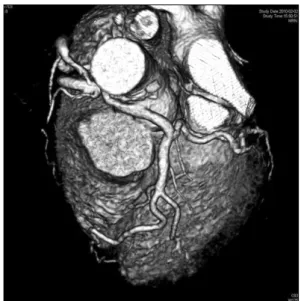
A 44-year-old man, who had a medical history of panic disorder, visited another hospital due to dyspnea on mild exertion. Computed tomography was performed and revealed a coronary anomaly (Fig. 1). The patient was then transferred to our hospital for further evaluation and treatment. A coro- nary angiography showed a single coronary artery originating from the right coronary ostium. A single coronary artery bi- furcated into the right coronary artery and left main coronary artery. The left main coronary artery coursed between the main pulmonary artery and aorta before bifurcating into the left descending artery and circumflex artery. We thought that panic symptoms or dyspnea on exertion might be a sign of myocardial ischemia due to compression of the left main cor- onary artery by the pulmonary artery and aorta. We decided that surgical treatment was the best option due to the high

risk of sudden death associated with a coronary anomaly.

Under general anesthesia, median sternotomy was per- formed. We dissected the left main coronary artery between the aorta and the main pulmonary artery on the beating heart.

The proximal left main coronary artery was bifurcated from a

single coronary artery that originated from the right coronary

sinus. Under cardiopulmonary bypass, cardioplegic solution

was infused, and aortic cross clamp was performed. Trans-

verse aortotomy was then performed. Only one coronary os-

tium was observed in the right coronary sinus, and a single

coronary artery originated from the ostium. We dissected the

left main coronary to allow separation from the aortic wall. A

5-mm arteriotomy was made to the left main coronary artery

at the site in which the left coronary ostium should have

been located. Neo-ostium formation was performed with a

5-mm puncher in the left coronary sinus. Anastomosis be-

tween the neo-ostium and the left main coronary arteriotomy

(2)

Woo-Sik Han, et al

− 356 − Fig. 1. Preoperative chest CT showing the left main coronary ar- tery originating from the right coronary sinus with the right coro- nary artery.

Fig. 2. Schematic review of the operative technique of neo-ostium formation on the left coronary sinus.

Fig. 3. Postoperative chest CT showing a well-connected left cor- onary artery system to the neo-ostium on the left coronary sinus.

site was performed using a 7-0 Prolene continuous running suture (Fig. 2). The aortic cross clamping time was 88 mi-

nutes, and total cardiopulmonary bypass time was 117 minutes.

The patient was discharged on the 11

th

postoperative day without any complications. Follow-up computed tomographic angiography before discharge showed good patency of the neo-ostium in the left coronary sinus without stenosis at the anastomosis site (Fig. 3). A treadmill test in the outpatient department after 3 months was negative. The patient re- mained asymptomatic without any complications or events for 15 months after the surgery.

DISCUSSION

Anomalous origin of a coronary aortic artery is a rare car- diac anomaly. Angelini reviewed 1,950 coronary angiog- raphies and reported that the incidence of right coronary ar- tery originating from the left coronary sinus was 0.92% and vice versa was 0.15%, with a total incidence of 1.07% [1].

Patients are usually asymptomatic. However, it may cause an- gina, syncope, and even life-threatening complications such as myocardial infarction or ventricular fibrillation. Thus, we must consider surgical treatment or intervention if signs of myocardial ischemia are present [2].

Several surgical techniques can be utilized to treat coronary

anomalies, such as coronary reimplantation to the original si-

(3)

Anomalous Origin of Left Coronary Artery

− 357 − nus, coronary artery bypass graft (CABG), pulmonary artery translocation, unroofing, and neo-ostium formation [3]. In this case, the left main coronary artery was bifurcated from a sin- gle coronary artery originating in the right coronary sinus.

Furthermore, the left main coronary artery passed between the pulmonary artery and aorta to reach the left heart. The pa- tient’s symptoms may be the result of compression by two great vessels [4]. CABG, coronary reimplantation, unroofing or neo-ostium formation could therefore have been considered as viable surgical options. Coronary reimplantation is one of the most physiologically beneficial repairs, but is technically difficult, and stenosis may occur at the site of anastomosis.

CABG is technically feasible, but the arterial conduit has a competitive flow problem if no stenotic lesions are present on the natural coronary artery. Also, a vein conduit may be problematic if the patient is young because of long-term pa- tency [5]. Romp et al. reported that favorable results were achieved with unroofing procedures [6]. However, extended unroofing may cause valve insufficiency if the anomalous coronary artery is located under the valve commissure [7].

Unroofing was not proper for our case because a separated left main coronary artery originated from a single coronary artery, not the right coronary sinus. Neo-ostium formation in the left coronary sinus without unroofing was considered to be a proper surgical treatment in this case.

Successful surgical treatment of anomalous of coronary anomaly depends on expertise in anatomic and hemodynamic pathophysiology, in addition to the selection of the appro-

priate surgical treatment option. We report that this case was successfully treated with neo-ostium formation in anomalous origin of the left coronary artery from the right coronary system.

REFERENCES

1. Angelini P. Coronary artery anomalies-current clinical is- sues: definition, classification, incidence, clinical relevance, and treatment guidelines. Tex Heart Inst J 2002;29:271-8.

2. Lee MK, Choi JB, Kim KH, Kim KS. Surgery for anom- alous origin of the left main coronary artery. Tex Heart Inst J 2009;36:309-12.

3. Gulati R, Reddy VM, Culbertson C, et al. Surgical manage- ment of coronary artery arising from the wrong coronary si- nus, using standard and novel approaches. J Thorac Cardio- vasc Surg 2007;134:1171-8.

4. Park JS, Park CH, Lee HL, et al. Extended unroofing proce- dure for creation of a new ostium for an anomalous right coronary artery originating from the left coronary sinus.

Korean J Thorac Cardiovasc Surg 2008;41:102-5.

5. Park CB, Jo MS, Kim YD, et al. Unroofing procedure in the treatment of a anomalous origin of right coronary artery from left sinus of Valsalva between aorta and pulmonary trunk. Korean J Thorac Cardiovasc Surg 2005;38:776-9.

6. Romp RL, Herlong JR, Landolfo CK, et al. Outcome of un- roofing procedure for repair of anomalous aortic origin of left or right coronary artery. Ann Thorac Surg 2003;76:589- 96.

7. Davies JE, Burkhart HM, Dearani JA, et al. Surgical man- agement of anomalous aortic origin of a coronary artery.

Ann Thorac Surg 2009;88:844-8.

수치

Fig. 2. Schematic review of the operative technique of neo-ostium  formation on the left coronary sinus

참조

관련 문서

In the change of physical strength, The exercise group showed statistically significant differences in muscle strength(right), muscle strength(left),

In 4-week group, the group filled with bone graft with decortication revealed larger new bone formation area than shown in the group that had a defect area

The locations of aneurysms were middle cerebral artery in 15 patients, cerebral artery in 15 patients, cerebral artery in 15 patients, cerebral artery in

Translate a known point P, that lies in the reflection plane, to the origin of the coordinate system2. of

systemic circulation, in the right ventricle and oxygenated blood from the lungs, or pulmonary circulation, in the left ventricle, as in birds and mammals.. Two vessels,

The index is calculated with the latest 5-year auction data of 400 selected Classic, Modern, and Contemporary Chinese painting artists from major auction houses..

1 John Owen, Justification by Faith Alone, in The Works of John Owen, ed. John Bolt, trans. Scott Clark, "Do This and Live: Christ's Active Obedience as the

core exercise program showed not only increasing peak torque of the right leg, left leg in Hip Extension of exercise group but also increasing peak torque of the right leg, left