• 검색 결과가 없습니다.

Minimally Invasive Approach for Redo Mitral Valve Replacement: No Aortic Cross-Clamping and No Cardioplegia

N/A
N/A
Protected

Academic year: 2021

Share "Minimally Invasive Approach for Redo Mitral Valve Replacement: No Aortic Cross-Clamping and No Cardioplegia"

Copied!
3
0
0

로드 중.... (전체 텍스트 보기)

전체 글

(1)

ISSN: 2233-601X (Print) ISSN: 2093-6516 (Online)

− 126 −

Department of Thoracic and Cardiovascular Surgery, Asan Medical Center, University of Ulsan College of Medicine Received: July 7, 2014, Revised: August 11, 2014, Accepted: September 3, 2014, Published online: April 5, 2015

Corresponding author: Jae Won Lee, Department of Thoracic and Cardiovascular Surgery, University of Ulsan College of Medicine, 88 Olympic-ro 43-gil, Songpa-gu, Seoul 138-736, Korea

(Tel) 82-2-3010-3584 (Fax) 82-2-3010-6966 (E-mail) [email protected]

C

The Korean Society for Thoracic and Cardiovascular Surgery. 2015. All right reserved.

CC
This is an open access article distributed under the terms of the Creative Commons Attribution Non-Commercial License (http://creative- commons.org/licenses/by-nc/3.0) which permits unrestricted non-commercial use, distribution, and reproduction in any medium, provided the original work is properly cited.

Minimally Invasive Approach for Redo Mitral Valve Replacement:

No Aortic Cross-Clamping and No Cardioplegia

Hong Rae Kim, M.D., Gwan Sic Kim, M.D., Jae Suk Yoo, M.D., Jae Won Lee, M.D.

A 75-year-old woman who had previously undergone a double valve replacement was admitted to Asan Medical Center because of severe bioprosthetic mitral valve dysfunction and tricuspid regurgitation. Under hypothermic fi- brillatory arrest without aortic cross-clamping, minimally invasive mitral and tricuspid valve surgery was performed via a right minithoracotomy.

Key words: 1. Minimal invasive surgery 2. Mitral valve, replacement 3. Aortic cross-clamping

CASE REPORT

A 75-year-old woman who had previously undergone a double valve replacement, tricuspid annuloplasty, and maze operation in 2005 presented with dyspnea (New York Heart Association Functional Class III). On examination, the patient had a cachectic appearance with a body mass index of 20.1.

An irregular heartbeat with a diastolic murmur was detected by auscultation. Laboratory tests revealed no remarkable find- ings, apart from an increased level of brain natriuretic peptide (120 pg/mL). A chest X-ray showed previous median sternal wiring, cardiomegaly, and pulmonary vascular engorgement.

A pulmonary function test showed a reduced forced ex- piratory volume indicative of obstructive lung disease (35%

of normal; 0.57 L). Transthoracic echocardiography revealed severe bioprosthetic mitral valve stenosis and severe tricuspid regurgitation. The prosthetic mitral valve was closed due to thickening of the leaflet, except on the anterior side.

Computed tomography showed mitral leaflet thickening and

calcification, which explained the early degeneration of the prosthetic valve. The patient’s European System for Cardiac Operative Risk Evaluation II was 9.51%.

We decided to perform minimally invasive mitral and tri- cuspid valve surgery via right minithoracotomy using the AESOP 3000 system (Automated Endoscope System for Optimal Positioning; Computer Motion Inc., Santa Barbara, CA, USA) through a sternotomy approach in order to avoid major vessel injury, despite the presence of extensive peri- cardial adhesions.

Under general anesthesia with double lumen intubation, the patient was positioned with the right chest slightly elevated.

External defibrillation pads were placed. After an anterolateral minithoracotomy was performed through the right fourth in- tercostal space via an 8-cm incision, cardiopulmonary bypass was initiated using peripheral cannulation through the right internal jugular vein, right femoral vein, and right femoral ar- tery, under transesophageal echocardiography guidance (Fig.

1). A videoscope of the AESOP 3000 was inserted through a

Korean J Thorac Cardiovasc Surg 2015;48:126-128 □ Case Report □

http://dx.doi.org/10.5090/kjtcs.2015.48.2.126

(2)

No Aortic Cross-Clamping and No Cardioplegia

− 127 −

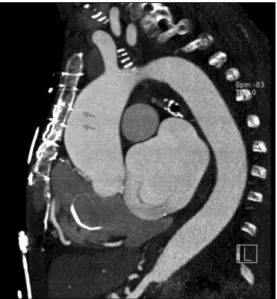
Fig. 2. Preoperative computed tomography scan showing sternal wire erosion (arrows) into the aorta.

Fig. 1. Photograph of the right minithoracotomy wound.

port placed in the third intercostal space on the anterior axil- lary line. The operative field was filled with carbon dioxide gas at the rate of 5 L/min throughout the surgery. Dissection of the ascending aorta for aortic cross-clamping was initially attempted, but was not possible due to severe periaortic adhe- sion and sternal wire erosion into the ascending aorta wall (Fig. 2). Therefore, we changed the operative strategy and performed the surgery without aortic cross-clamping. The pa- tient’s body temperature was lowered to 23

o

C to induce ven- tricular fibrillation. When hypothermic fibrillatory arrest was achieved, the superior vena cava and inferior vena cava were snared down. After a longitudinal right atriotomy, a trans-sep- tal incision was performed to obtain a surgical view of the mitral lesion. The previous mitral prosthesis showed structural valve deterioration involving leaflet thickening and calcifica- tion, as indicated by transthoracic echocardiography. The prosthetic valve was replaced with a 25-mm Epic valve (St.

Jude Medical Inc., St Paul, MN, USA). The tricuspid valvu- loplasty was performed using the Alfieri (edge-to-edge) method. To prevent possible left atrial air embolism, the left atrium was filled with blood before the trans-septal incision was closed. Intraoperative transesophageal echocardiography, which was performed by a cardiologist after weaning the pa- tient from cardiopulmonary bypass, revealed no paravalvular leakage of the mitral valve or interatrial shunt, although mild tricuspid regurgitation remained. The total cardiopulmonary

bypass and fibrillatory arrest times were 243 and 89 minutes, respectively.

Postoperative echocardiography showed a well-functioning prosthetic mitral valve with an ejection fraction of 55%. The patient recovered without major complications, such as low cardiac output syndrome or stroke.

DISCUSSION

Minimally invasive mitral valve surgery via right mini-

thoracotomy has grown in popularity over the last several

years [1]. Continuing technological development has facilitated

the implementation of minimally invasive approaches in car-

diac surgery, and our institution has published several studies

in which minimally invasive cardiac surgery has shown favor-

able results [2]. One of the advantages of the minimally in-

vasive approach is that in case of repeat mitral valve surgery,

the right thoracotomy approach can provide excellent ex-

posure of the mitral valve through a relatively clear plane

that is not influenced by the previous sternotomy. A sternot-

omy approach in the presence of extensive pericardial adhe-

sions carries a higher risk of major vessel injury and the dan-

ger of injuring a previous patent coronary artery bypass. Of

course, transapical transcatheter mitral valve-in-valve im-

plantation could be an alternate possibility, but our institution

(3)

Hong Rae Kim, et al

− 128 − has little experience with that technique. Therefore, in our in- stitution, the minithoracotomy approach is usually utilized when conducting a repeat mitral surgery. However, the dis- section of the ascending aorta to achieve aortic cross-clamp- ing is a major concern.

In the present case, dissecting the ascending aorta for aort- ic cross-clamping was not possible due to severe adhesion and sternal wire erosion into the ascending aorta. We there- fore decided to apply a strategy involving hypothermic fi- brillatory arrest without an aortic cross-clamp, which is known as the no-touch technique [3,4].

Adequate myocardial protection against both ischemic and distention injuries and reducing the risk of stroke are gen- erally major concerns in left heart surgery performed under fibrillatory arrest [5]. In order to achieve successful my- ocardial protection, we opened the left atrium immediately upon fibrillation in order to keep the left ventricle decom- pensated. Moreover, carbon dioxide gas was infused into the operative field to ensure that air did not enter the systemic circulation, and the mean arterial perfusion pressure was maintained at over 30 mmHg in order to keep the aortic valve closed. Transesophageal echocardiography confirmed that no intracardiac air was present before cardioversion.

Multiple potential contraindications exist for applying the no-touch technique. One is the presence of severe pulmonary adhesion, and the other is the presence of aortic regurgitation.

In conditions of severe aortic regurgitation, coronary perfu- sion cannot be sufficiently maintained and distention of the left ventricle can occur if no specific left ventricular venting procedure is followed. However, despite preoperative risk fac- tors such as mild aortic regurgitation and a low ejection frac- tion, our patient recovered well with no major complications.

Our case report demonstrates that in select cases, well-con- ducted fibrillatory arrest, careful left ventricular decom- pression, and air embolism can overcome these potential problems.

In conclusion, in cases of cardiac valve surgery performed via right thoracotomy, the no-touch technique using hypo- thermic fibrillatory arrest may be a useful alternative if aortic cross-clamping is unexpectedly impossible.

CONFLICT OF INTEREST

No potential conflict of interest relevant to this article was reported.

REFERENCES

1. Cohn LH, Adams DH, Couper GS, et al. Minimally invasive cardiac valve surgery improves patient satisfaction while re- ducing costs of cardiac valve replacement and repair. Ann Surg 1997;226:421-6.

2. Yoo JS, Kim JB, Jung SH, Choo SJ, Chung CH, Lee JW.

Echocardiographic assessment of mitral durability in the late period following mitral valve repair: minithoracotomy versus conventional sternotomy. J Thorac Cardiovasc Surg 2014;

147:1547-52.

3. Kitamura T, Stuklis RG, Edwards J. Redo mitral valve oper- ation via right minithoracotomy: “no touch” technique. Int Heart J 2011;52:107-9.

4. Chitwood WR Jr, Elbeery JR, Moran JF. Minimally invasive mitral valve repair using transthoracic aortic occlusion. Ann Thorac Surg 1997;63:1477-9.

5. Petracek MR, Leacche M, Solenkova N, et al. Minimally in-

vasive mitral valve surgery expands the surgical options for

high-risks patients. Ann Surg 2011;254:606-11.

수치

Fig. 2. Preoperative computed tomography scan showing sternal  wire erosion (arrows) into the aorta.

참조

관련 문서

Endoscopic spine surgery has become a practical, minimally invasive technique for decompression in patients with spinal disc herniation or stenosis.. However,

Percutaneous endoscopic cervical discectomy (PECD) is an effective minimally invasivesurgery for soft cervical disc herniation in properly selected cases..

Conclusion: The mean CGRP level in overweight and obese children with headache was not significantly higher than in overweight and obese children without headache. There

[r]

3.9 Bead and cross section profiles of welds in LASER welding. Bead

KEY WORDS Free trade agreement, FTA, KORUS FTA, New financial services, Cross-border trade, Oversea transfer of financial information, IOSCO MMoU, Boca Declaration,

5 ) Stop Light Switch (Mechanical) 6 ) Front/Rear Balance Valve 6 ) Front/Rear Balance Valve 7 ) Pressure Differentiavl Valve 8 ) Brake Warning Lamp.. 9 ) Brake Fluid

Typical trace of pacemaker potentials in current clamping mode (A) and spontaneous inward pacemaker currents in voltage clamping mode at a holding potential of -70 mV