Copyright ⓒ the Korean Society for Transplantation, 2014
보통염색체 우성 다낭신장 환자의 신장이식 수술 중 제거한 다낭신장에서 발견된 유두선종
연세대학교 원주의과대학 내과학교실
1, 외과학교실
2, 병리학교실
3채문희1ㆍ박현철1ㆍ김영섭1ㆍ김재석1ㆍ김성훈2ㆍ엄민섭3ㆍ양재원1ㆍ한병근1ㆍ최승옥1
Papillary Adenoma Identified in Removed Polycystic Kidneys during Kidney Transplantation in Autosomal Dominant Polycystic Kidney Disease Patient
Moon Hee Chai, M.D.1, Hyeoncheol Park, M.D.1, Youngsub Kim, M.D.1, Jae Seok Kim, M.D.1, Sung Hoon Kim, M.D.2, Minseob Eom, M.D.3, Jae Won Yang, M.D1,
Byoung Geun Han, M.D.1 and Seung Ok Choi, M.D.1
Departments of Internal Medicine
1, Surgery
2, and Pathology
3, Yonsei University Wonju College of Medicine, Wonju, Korea
Kidney transplantation is the preferred treatment in end stage renal disease for autosomal dominant polycystic kidney disease (ADPKD) patients. Removal of the native kidney is not usually recommended for ADPKD patients during a transplantation proce- dure because the operation time may be prolonged or the risk of bleeding may be higher. Therefore, native kidney removal is indicated for patients with chronic pain by enlarged kidney, frequent complications from cysts, such as infection or bleeding, and renal tumor development. Here, we report a case of a patient whose native kidneys were removed during a kidney trans- plantation procedure, and multifocal adenomas were identified in the removed kidneys after the procedure.
Key Words: Autosomal dominant polycytic kidney, Adenoma, Kidney transplantation
중심 단어: 보통염색체 우성 다낭신장, 선종, 신장이식Received September 1, 2014 Revised September 5, 2014 Accepted September 5, 2014
Corresponding author: Seung Ok Choi
Department of Internal Medicine, Yonsei University Wonju College of Medicine, 20 Ilsan-ro, Wonju 220-701, Korea
Tel: 82-33-741-0509, Fax: 82-33-741-5889 E-mail: [email protected]
This case report was presented in the 43nd Annual Congress of the Korean Society for Transplantation.
Case Report
서 론
신대체 요법이 필요한 말기 신부전 상태의 보통염색체 우 성 다낭신장(autosomal dominant polycystic kidney, ADPKD) 환자에서 신장이식은 우선적으로 고려될 수 있는 치료방
법이다. ADPKD 환자의 신장이식 수술 시에 이식 수여자 의 다낭신장은 일반적으로 제거되지 않는데, 이는 이식 수 술 중 다낭신장을 제거하는 것이 수술 시간의 연장과 출혈 의 위험성을 높일 수 있기 때문이다. 하지만 크기가 커진 다낭신장으로 인한 만성적인 통증과 복부 불편감, 신장낭 종의 반복적인 출혈과 감염으로 인한 잦은 합병증은 다낭 신장의 제거의 근거가 되며, 신장이식 수술 중 다낭신장 제거를 요하기도 한다(1). 저자들은 ADPKD를 가진 환자 가 말기 신부전에 이르러 신장이식을 하였을 때, 수술 중 제거한 다낭신장에서 전암성 병변인 유두상 선종(papillary adenoma)이 발견된 증례를 경험하고 ADPKD 환자에서 신 세포암(renal cell carcinoma) 발생 위험의 가능성에 대해 기 존 문헌의 고찰과 함께 보고하고자 한다.
J Korean Soc Transplant 2014;28:246-249
http://dx.doi.org/10.4285/jkstn.2014.28.4.246
247
Moon Hee Chai, et al: Adenoma in ADPKD Patient Receiving KT
Fig. 1. Gross appearance of polycystic kidney removed from recipient during kidney transplant procedure. The surface and internal part of polycystic kidney are composed of numerous cysts of variable sizes.
증 례
48세 남자가 신장이식 수술을 받기 위해 입원하였다. 환 자는 수십 년 전 ADPKD를 진단받았고 2003년부터 정기 적으로 진료를 받으며 경과를 추적하였다. 환자는 최근에 losartan 100 mg, amlodipine 10 mg, sodium bicarbonate 3 g, calcitriol 0.25 g을 하루 한번 복용하고 있었다. 신장 기 능은 최근까지 지속적으로 감소하여 입원 당시 혈중 요소 질소는 116 mg/dL였고 크레아티닌은 10.5 mg/dL이었다.
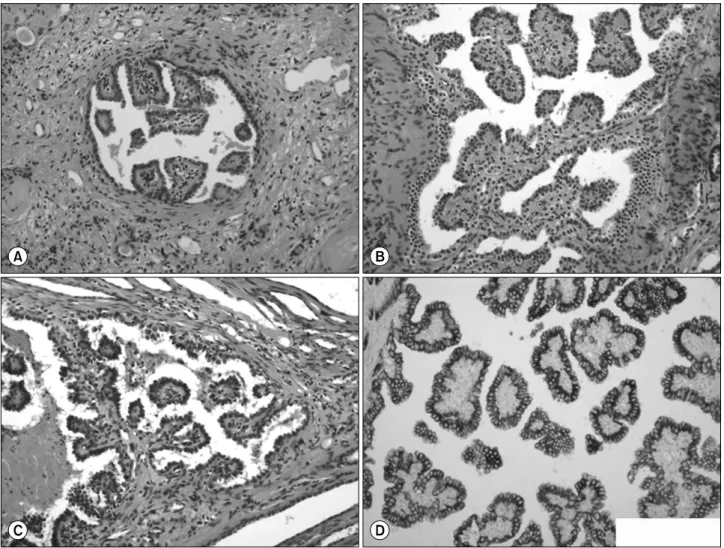
혈액검사에서 백혈구는 4,240/mm3, 혈색소 9.2 g/dL, 혈소 판 192,000/mm3이었다. 혈청 생화학검사에서 나트륨 135 mmol/L, 칼륨 5.0 mmol/L, 염소 111 mmol/L, 총이산화탄 소 10.8 mmol/L였으며, 총 단백 7.7 g/dL, 알부민 4.6 g/dL, 칼슘 8.5 mg/dL, 인 6.6 mg/dL, 아스파르테이트 아미노전 달효소 9 U/L, 알라닌 아미노전달효소 8 U/L, 총빌리루빈 0.3 mg/dL, C-반응단백 <0.3 mg/dL였다. 소변검사에서는 요비중 1.009, 단백 1+, 현미경검사에서는 적혈구 5∼9/고 배율, 백혈구 1∼4/고배율 소견을 보였다. 환자는 부인에 게서 신장을 공여받기로 하였으며 신장이식 전 검사에서 조직적합항원(human leukocyte antigen) 불일치는 6/6을 보였고 교차시험검사(cross-matching test)에서는 음성 소 견을 보였다. 복부 컴퓨터단층촬영(computed tomography) 에서는 비대해진 양측 신장이 복강의 대부분을 차지하고 골반강까지 내려간 소견이 보였으며 신장 내 종양의 소견 은 보이지 않았다. 환자는 입원 후 구토를 하는 등 요독증 상이 보여 수술 전 임시투석도관을 통해 3차례의 혈액투 석을 시행하였다. 입원 7일에 신장이식 수술을 시행하였 고, 환자가 평소 비대한 신장으로 복강 내 불편을 호소하여 신장이식 수술 중 양측 다낭신장을 제거하기로 하였다. 공 여자의 좌측 신장을 적출하여 수여자의 우측 장골 오목 (iliac fossa)으로 이식하였고 다낭신장은 수술 중 제거되었 다. 검체로 얻어진 양측 다낭신장은 병리 조직검사를 시행 하였다. 다낭신장의 크기는 좌, 우 각각 18×17×14 cm, 28×17×13 cm이었으며 무게는 좌, 우 각각 2.9, 2.8 kg였 다. 다낭신장의 내부와 외부는 수많은 크기의 낭종으로 이 루어져 있었으며 낭종은 노란 또는 갈색의 탁한 액체를 포 함하고 있었다(Fig. 1). 광학 현미경검사에서 낭종 사이의 정상 신장실질을 관찰할 수 있었으며 실질 내에 부분적으 로 유두상(papillary) 세포 증식을 보이는 다양한 크기의 종양을 관찰할 수 있었다(Fig. 2A∼C). 종양세포는 균일하 였고 이형성, 유사분열, 괴사는 관찰되지 않았다. 면역조직 화학 염색에서는 cytokeratin-7 양성으로 유두선종(papillary adenoma)에 합당하였다(Fig. 2D). 이러한 소견은 한군데
국한되어 있지 않고 양측 다낭신장의 실질에 다발성으로 분포해 있었다. 신장이식 후 약물로 tacrolimus, mycophe- nolate sodium, prednisolone을 복용하였다. 환자는 현재까 지 거부 반응을 포함한 이상 없이 경과 추적 중이다.
고 찰
유두선종은 선암(adenocarcinoma)의 전암성 병변이다(2).
따라서 본 증례와 같이 ADPKD 환자에서 보이는 다발성 의 선종은 신세포암의 위험인자로 생각된다. ADPKD 환 자의 다낭신장에 존재하는 선종은 기존의 문헌들에서도 보고하였는데(3-5), 그 중 Gregoire 등(6)은 78명의 부검표 본(autopsy specimen)과 이식 중 적출된 표본의 조직병리 검사를 통해 42개의 종양을 확인하였고 그 중 39개는 미세 선종(microscopic adenoma)인 것을 보고하였다. 이러한 결 과는 ADPKD에서 무증상의 잠재적인 선종이 생각했던 것 보다 흔한 것임을 시사하였다. 또한 몇 문헌들은 ADPKD 에서 신세포암이 발생한 증례들을 보고하였다(7,8). 그 중 Keith 등(9)은 ADPKD에서 신세포암이 일반인에 비해 어 린 나이에 발병하고 양측에 동시 발병하거나 다발성의 양 상으로 발생하는 비율이 높은 것을 볼 때 ADPKD가 일반 적인 신세포암의 발생 양상과 다른 것을 지적하였다. 또한 Hajj 등(10)은 투석을 하거나 이식 후 1년 이상 되는 만성 신부전을 동반하는 ADPKD 환자에서 신세포암의 발생이 높은 것을 보고하였고 ADPKD에서 Keith 등(9)의 보고와
248
J Korean Soc TransplantㆍDecember 2014ㆍVolume 28ㆍIssue 4
Fig. 2. Pathologic findings in the parenchyma of polycystic kidney. (A∼C) Light microscopy shows papillary proliferation of bland epithelial cells (HE stain, ×200). (D) Immunohistochemical stain for cytokeratin-7 is positive in the cytoplasm of tumor cells (×200).
같이 보다 젊은 나이에 발병하는 것과 다발성의 신세포암 의 발생률이 높은 것을 지적하였다. 그리고 신세포암의 전 암성 병변인 유두상 선종의 발생률이 높은 것과 신세포암 의 아형으로 유두상 신세포암의 비율이 높은 것을 볼 때 ADPKD는 신세포암의 위험인자라고 결론하였다. 다만 그 럼에도 ADPKD에서 다낭신장의 예방적 제거는 권고하지 않았는데, 이는 수술의 위험도가 높기 때문이라고 하였다.
신장이식 후 면역억제제의 사용은 이식 후 종양 발생률을 높이는 것으로 알려져 있는데, 신세포암도 예외는 아니다(11).
Filocamo 등(12)은 1.6%의 이식 후 신세포암 발생률을 보 고하였고 Ianhez 등(13)은 1.37%의 발생률을 보고하면서 이러한 발생률이 면역억제제를 사용하고 있지 않은 정상 성인의 15배에 이른다고 하였다. 국내에서도 Jung 등(14) 은 이식 후 신세포암 발생률을 약 1.6%로 보고하여 기존 문헌의 결과와 크게 다르지 않았다. 현재까지는 이식 후
종양의 발생이 높아지는 것이 면역억제제로 인한 종양발 생 감시의 저하와 직접적인 종양발생의 촉진, 종양발생 바 이러스에 대한 면역억제, 그리고 말기 신부전의 후천성 낭 성신질환과 같은 기존의 위험인자에 따른 것으로 알려져 있다(8). 따라서 ADPKD 환자에서 잠재적인 다발성의 선종은 신장이식 후 면역억제제를 복용하였을 때 신세포암의 발생에 유의한 위험인자로 보인다. 이와 관련하여 Misumi 등(15)은 ADPKD 환자의 신장이식 수술 중 제거한 다낭신장에서 우연히 발견한 신세포암의 증례를 보고하면서 다낭신장에 서 종양을 진단하기가 쉽지 않음을 지적하고 이식 수술 전 또는 이식 수술 중 이식 수여자의 다낭신장을 제거하는 것 이 잠재적 종양의 발견과 제거에 도움이 될 수 있다고 하 였다. 다만 신장이식 수술 중 다낭신장의 병행 제거는 아 직도 논란의 여지가 있는 상태이다. 기존의 문헌들에 의하 면 신장이식 수술 중 다낭신장을 제거하는 것은 수술시간
249
Moon Hee Chai, et al: Adenoma in ADPKD Patient Receiving KT
의 연장과 출혈의 위험 등으로 신장이식에 어려움을 초래 할 수 있어 권고되지 않는다고 하였다(1). 반면에 최근의 몇몇 연구들은 신장이식과 다낭신장 제거를 동시에 시행 하는 것이 수술 시간을 연장시키지만 합병증 및 수술 위험 도에 차이가 없음을 보고하였으며, 이식 후 강력한 면역억 제제의 사용이 다낭신장의 반복적인 감염과 심각한 패혈 증을 초래할 수 있으므로 다낭신장의 제거를 단점보다 장 점이 큰 치료방법으로 제시하기도 하였다(16-20).
저자들은 본 증례를 통해 이식 중 제거한 다낭신장의 실질 내에 다발성의 유두선종이 병발되어 있는 소견을 확 인하였으며, 문헌고찰을 통해 이러한 선종이 신세포암의 유의한 위험인자가 될 수 있음을 알 수 있었다. 향후 다낭 신장의 잠재병소로서 유두선종의 임상적 중요성은 더욱 고찰할 필요가 있겠다.
REFERENCES