• 검색 결과가 없습니다.

Characterization of EVA/PCM/Silica Compound using Silica

N/A
N/A
Protected

Academic year: 2021

Share "Characterization of EVA/PCM/Silica Compound using Silica"

Copied!
7
0
0

로드 중.... (전체 텍스트 보기)

전체 글

(1)

DOI: https://doi.org/10.7473/EC.2021.56.2.72

Characterization of EVA/PCM/Silica Compound using Silica

Tae-Hyun Kim *,*** , Kyung-Man Choi *** , Jong-Hwan Lee *** , Myeon-Cheon Choi ** , and Han-Seong Kim *,†

*

Department of Chemical Engineering, Pusan National University, Busandeahak-ro 63beon-gil, Geumjeong-gu, Busan 46241, Republic of Korea

**

Department of Polymer and Science Engineering, Pusan National University, Busandeahak-ro 63beon-gil, Geumjeong-gu, Busan 46241, Republic of Korea

***

Korea Institute of Footwear and Leather Technology, Dangganmseo-ro, Busanjin-gu, Busan 47154, Republic of Korea (Received March 31, 2021, 1st Revised April 21, 2021, 2nd Revised June 8, 2021, Accepted June 14, 2021)

Abstract: A phase-change material (PCM) is a material that has the ability to delay heat transfer by absorbing heat from its environment or releasing heat to its environment while its phase changes from solid to liquid or liquid to solid at a spe- cific temperature. As it is applied, it can contribute to environmental conservation such as energy savings and carbon diox- ide emission reduction. In order for a PCM to store and release heat, the volume change during its phase transition should be large, and thus a phase transition space is required. When a PCM is used as a polymer additive, it is confined within the polymer, and there is no phase transition space; thus, its ability to absorb and release heat is significantly reduced. There- fore, in this study, porous silica was used to provide EVA/PCM compounds with sufficient space for their phase transition, and to improve the compatibility between the EVA and PCM, modified silica is used: surface-modified 5 wt% silica with 3-methacryloxypropyltrimethoxysilane. The compound was prepared and compared with the silica compound. The presence or absence of the modified silica surface modification was confirmed using Fourier-transform infrared spectroscopy and thermogravimetric analysis, the heat capacity of the compound was evaluated based on a differential scanning calorimetry analysis, and its mechanical strength and morphology were determined using scanning electron microscopy.

Keywords: PCM, Silica, Modified silica, Silane, EVA

Introduction

상전이 물질(Phase Change Material, PCM)은 일반적으로 고체-액체 간 상이 변하면서 외부로부터의 열을 흡수하거나 내부의 열을 방출하여 열전달을 지연할 수 있는 성능이 큰 물 질로써 건축자재 및 냉난방 시스템 등에 적용하여 냉난방에 사용되는 에너지를 절감할 수 있다.

1-5

이런 분야에 상전이 물 질을 응용하면 이산화탄소 발생을 줄일 수 있어 환경 보전에 도 기여한다. 따라서 PCM은 에너지를 절약하는데, 필수적인 친환경 소재로 손꼽히고 있다.

이에 학계에서도 PCM을 이용하여 에너지 절약에 대한 연 구가 활발히 이루어지고 있다. 건축학에선 PCM을 시멘트와 혼합하여 열효율을 높이는 실험과 펠렛 형태의 PCM을 단열 재와 혼합, 외벽에 설치한 후 자연 기후 조건에서 현장 테스 트한 실험이 진행되었으며,

4-6

PCM으로 채워진 열저장 장치 (HSU)를 사용하여 PDA(personal digital assistant) 및 웨어러 블 컴퓨터와 같은 모바일 전자 장치의 냉각에 대한 실험 연

구가 수행되었다.

3

PCM이 에너지를 저장하고 방출하기 위해서는 상전이 할 때 밀도(부피)변화가 크므로 일정한 공간이 필요한데, PCM을 고분자 첨가제로 사용하면 고분자 내에서 구속돼 상전이 할 공간이 없어 에너지 흡수 및 방출할 성능이 현저히 떨어지게 된다. PCM을 첨가제용으로 사용하기 위해서, 유화 중합으로 PCM을 벽재로 감싸는 캡슐화법(encapsulation)이 이용되고 있는데 이와 같은 PCM 캡슐은 페인트와 같은 액상에 첨가되 어 사용되고 있다. 이와 같은 상전이 공간을 가진 PCM 캡슐 은 고분자 첨가제용으로 사용될 것 같지만, 가공(혼합) 중에 발생되는 마찰, 압력 및 전단력에 의해 캡슐이 쉽게 파괴되어 캡슐로 부여한 공간 효과가 매우 낮아진다. 또한, 파괴된 캡 슐 속의 상전이 물질은 고분자 표면으로 migration 된다. 이 를 해결하기 위하여 이중 셀 형성 캡슐화를 하거나

1

레진으로 캡슐 표면을 코팅 시킨 연구가 진행되었다.

2

본 연구에서는 EVA/PCM compound에 silica를 사용하여 상 전이 할 수 있는 공간을 부여하고, silica 첨가되지 않은 reference compound와 열용량을 비교하였으며 EVA와 PCM 간 상용성 을 개선하기 위하여 porous silica를 3-methacryloxypropyltri-

Corresponding author E-mail: [email protected]

(2)

methoxysilane으로 5 wt% 표면 건식 개질시킨 modified silica 를 제조, 첨가하여 compound를 제작, silica compound와 비교 평가하였다.

7,8

FT-IR, TGA 분석을 통해 modified silica 표면 개질유무를 확인하였으며, compound의 열용량은 DSC 분석, compound의 물리적 특성을 알아보기 위하여 기계적 강도를 평가하였으며 SEM을 이용하여 compound의 모폴러지를 평 가하였다.

Experimental

1. 실험 재료

Compound 제조를 위해 사용된 다공성 재료는 pore size 19.4 nm, surface area 184 m

2

/g을 갖는precipitated silica (Zeosil175, Rhodia Solvay, Belgium)를 사용하였고 실란커플 링제로는 메타크릴기(-methacryloxy)를 갖는 3-methacryloxy- propyltrimethoxysilane (KBM503, ShinEtsu, Japan) 사용하였 으며, 고분자 수지는 EVA (EVA1317, Hanwha solutions, Korea), PCM으로는 석유계 파라핀(RT24, Rubitherm, Germany)을 사 용하였다.

2. Modified silica 제조

본 실험에선 친수성기인 -OH기를 갖는 다공성 재료 silica 표면을 실란커플링제인 3-methacryloxypropyltrimethoxysilane 으로 소수성 표면개질하여 PCM과의 상용성을 개선하는 건 식 개질 공정으로, 120

o

C로 세팅되어 있는 고속교반기에 silica 투입한 후 100 rpm으로 교반 유지하면서 silica 고형분 대비 5 wt% 실란커플링제를 12 g/min의 속도로 drop한 후, 300 rpm 으로 3 min, 10 rpm으로 10 min 교반하여 표면개질하였다.

3. EVA/PCM/Silica compound 제조

EVA/PCM/Silica compound 제조 전 과정으로silica를 120

o

C 의 dry oven에서 3시간 이상 건조 후 수분 함량 1% 미만임을 확인 후, dry oven내에서 상온까지 냉각시켜 사용하였으며 PCM은 60

o

C의 dry oven에서 12시간 액화를 시킨 후 사용하 였다. EVA와 PCM을 70:30의 중량비로 배합함에 있어, 200 ml kneader에서 EVA 70g 투입 후 120 rpm으로 15분간

80

o

C 이상으로 충분히 혼련하고, PCM과 porous silica를 동시 투입, 20 rpm, 30분간 혼련하여 EVA/PCM/Silica compound 제조한 후 6inch roll-mill에서 약 1~2 mm 두께의 sheet로 만 들었다.

4. 실리카 개질 유무 분석

4.1. 퓨리에 변환 분광법(Fourier-transform infrared spectro- scopy, FT-IR)

Table 1. Sample Designation and Composition of EVA/PCM/Silica Compounds

Ref. A1 A2 A3 A4 A5

EVA 70 70 70 70 70 70

PCM 30 30 30 30 30 30

Silica 0 2 4 6 8 10

Table 2. Sample Designation and Composition of EVA/ PCM/

Modified Silica Compounds

Ref. B1 B2 B3 B4 B5

EVA 70 70 70 70 70 70

PCM 30 30 30 30 30 30

Modified silica 0 2 4 6 8 10

Figure 1. FT-IR spectra of modified and unmodified silica using silane.

Figure 2. TGA curve of modified and unmodified silica using

silane.

(3)

Modified silica의 개질 유무를 분석하기 위해 적외선분광광 도계(FT-IR Series 6200, JASCO, JAPAN)를 사용하여 확인하 였다. 시료를 0.03g의 펠렛 형태로 제작한 후 단위 시간당 32 scan, resolution 16 투과법으로 wavenumber 4000~400 cm

-1

범 위에서 특성 peak를 측정하였다.

4.2. 열중량 분석(Thermaogravimetric analysis, TGA) Modified silica의 개질 유무를 분석하기 위해 열중량 분석 기(Model Q-500, TA Instruments, USA)를 이용하여 modified silica의 온도에 따른 무게감소를 측정하였다. 시료는 N

2

분위 기하에서 20

o

C~700

o

C 범위에서 10

o

C/min의 속도로 modified silica 중량 변화를 측정하였다.

5. Compound의 열적 특성

5.1. 시차 주사 열량계 분석(Differential scanning calorimetry, DSC)

Compound의 열적 특성 분석을 위하여 시차주사 열량계 (Model Q-25, TA Instruments, USA)를 사용하였으며, 시료를 10.0±1.5 mg을 알루미늄 팬에 넣고 질소 분위기하에 10

o

C/

min의 속도로 -80

o

C~200

o

C 범위로 승온시키면서 compound 열량 변화를 측정하였다.

6. Compound의 기계적 특성

6.1. 인장강도(Tensile strength)

Compound의 실리카 함량별 인장강도를 측정하기 위하여 만능재료시험기(M-130, Instron, USA)를 사용하였다. 인장강 도는 ISO 527 규격에 준하여 100 mm/min의 시험 속도로 인 장강도를 측정하였다. 함량별 길이 20 mm, 폭 5 mm의 아령 형 시험편으로 제작, 3개를 시험하여 평균값을 사용하였다.

6.2. 연신율(Elongation)

Compound의 실리카 함량별 연신율을 측정하기 위하여 만

능재료시험기(M-130, Instron, USA)를 사용하였다. 인장강도 측정 시 함께 측정되는 것으로 인장강도 시험편과 동일한 시 험편이며 표점거리를 기준으로 (늘어난 길이 – 표점거리) × 100/표점거리로 계산하여 값을 내며 함량별 길이 20 mm, 폭 5 mm의 아령형 시험편으로 제작, 3개를 시험하여 평균값을 사용하였다.

6.3. 인열강도(Tear strength)

Compound의 실리카 함량별 인열강도를 측정하기 위하여 만능재료시험기(M-130, Instron, USA)를 사용하였다. 인열강 도는 ASTM D624 규격에 준하여 100 mm/min의 시험 속도 로 인열강도를 측정하였다. 함량별 3개의 V형 갈매기 시험편 으로 제작, 시험하여 평균값을 사용하였다.

7. Compound의 표면 분석

7.1. 전자주사현미경(Scanning Electron Microscope, SEM) Compound 표면의 분산성을 관찰하기 위하여 전자주사현 미경(S-4200, Hitach, Japan)으로 SEM 이미지를 촬영하였다.

Table 3. Heat Capacity of EVA/PCM/Silica Compounds (0 wt%) Ref. A1

(2 wt%) A2

(4 wt%) A3

(6 wt%) A4

(8 wt%) A5

(10 wt%)

Heat capacity (J/g) 9.38 24.88 30.02 31.27 29.26 21.74

Table 4. Heat Capacity of EVA/PCM/Modified Silica Compounds (0 wt%) Ref. B1

(2 wt%) B2

(4 wt%) B3

(6 wt%) B4

(8 wt%) B5

(10 wt%)

Heat capacity (J/g) 9.38 26.59 32.37 39.63 32.39 29.26

Figure 3. DSC curve of EVA/PCM/Silica compounds.

(4)

Results and Discussion

1. 실리카 개질 유무 분석

실란커플링제인 3-methacryloxypropyltrimethoxysilane을 이용하여 제조한 개질 실리카의 표면 개질을 확인하기 위해 서 FT-IR 측정 결과를 Figure 4에 나타내었다. 미 개질 실리 카의 경우 1,060 cm

-1

, 800 cm

-1

위에서의 peak가 강하게 나 타나며 이는 stretching of the Si-O-Si bonding의 stretching에 기인한 것으로 확인된다.

개질 실리카는 실란커플링제 3-methacryloxypropyltrimeth- oxysilane에서 나타난 2,946, 2,841, 1,718, 1,637 및 1,296 cm

-1

에서 새로운 peak가 나타났다. 2,946, 2,841 cm

-1

부근에서의 peak는 methacrylate기의 −CH

3

및 −CH

2

에 기인하여 intensity 가 증가함이 확인되었고, 1,718 및 1,637 cm

-1

peak는 3- methacryloxypropyltrimethoxysilane에서 도입된 C=O 및 C=C 결합을 각각 나타낸다. methacrylate기의 −CH

3

및 −CH

2

기의 도입과 C=O 및 C=C 결합의 생성을 통하여 개질의 진행을 확

인하였다.

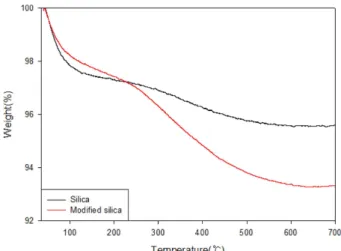
실란커플링제를 이용하여 제조한 개질 실리카의 표면개질 유무를 확인하기 위해서 온도에 따른 개질 실리카의 무게 변 화 TGA 측정 결과를 Figure 5에 나타내었다. TGA 그래프로 미 개질 실리카와 표면 개질 실리카의 온도에 따른 무게의 변 화를 확인한 결과, 미 개질 실리카의 무게 변화는 97.31  95.61(%)로 감소되었고 30에서 100

o

C 사이의 무게감소는 H

2

O의 탈착으로 인한 무게 감소이며, 100에서 200

o

C 사이에 서는 실리카 표면에 물리적 및 수소결합으로 흡착된 H

2

O의 탈착으로 인한 무게감소로 판단된다. 개질 실리카의 무게 변 화는 97.50  93.27(%)로 감소로 미 개질 실리카의 감소 비 율보다 큰 수치를 나타냈으며 30에서 100

o

C 사이의 무게감소 는 실리카 표면의 미 반응 실란올의 탈착으로 인한 무게감소 로 판단되며 200에서 700

o

C 사이에서는 실리카 표면의 친수 성실란올기가 실란과 반응하여 소수성으로 변화한 methacryl- oxy기의 흡착되는 수분의 양의 감소를 나타낸다. 이를 통하여 실리카 표면에 개질의 진행을 확인하였으며 개질의 진행 정 도는 2.53%였다.

Figure 4. DSC curve of EVA/PCM/Modified silica compounds.

Table 5. Mechanical Properties of EVA/PCM/Silica Compounds

(2 wt%) A1 A2

(4 wt%) A3

(6 wt%) A4

(8 wt%) A5

(10 wt%)

Tensile strength (kg

f

/cm

2

) 36.4 39.3 37.7 36.4 35.3

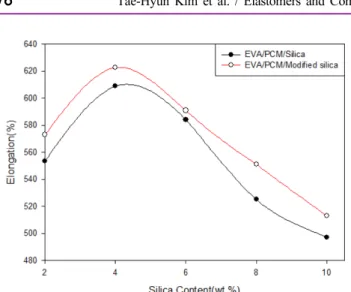
Elongation (%) 553.6 609.0 584.0 525.2 497.2

Tear strength (kg

f

/cm) 28.0 31.6 30.2 28.8 28.4

Table 6. Mechanical Properties of EVA/PCM/Modified Silica Compounds

(2 wt%) B1 B2

(4 wt%) B3

(6 wt%) B4

(8 wt%) B5

(10 wt%)

Tensile strength (kg

f

/cm

2

) 38.3 39.6 37.8 37.2 35.6

Elongation (%) 573.0 622.8 590.9 551.1 513.1

Tear strength (kg

f

/cm) 31.2 33.1 32.2 30.8 30.5

Figure 5. Tensile strength of EVA/PCM/Silica, modified silica

compounds.

(5)

2. Compound의 열적 특성

Compound의 열 흡수 및 방출 특성을 알아보기 위해서 DSC 분석 결과를 나타내었다. 실리카 함량별 compound의 흡열량 (Figure 6), 개질된 실리카를 첨가한 compound의 흡열량 (Figure 7)을 확인하고자 silica의 함량을 0, 2, 4, 6, 8, 10 wt%

로 변량하여 제조한 compound의 온도에 따른 흡열량을 측정 한 결과 흡열량은 실리카 함량이 6 wt%로 증가할수록 상전 이 온도가 높아지다 8 wt%에서 부터 낮아졌으며 이는 실리

카 첨가양이 6 wt%가 되면 PCM이 실리카 내부로 흡착, 결 정화된다고 판단되며 그 이상 첨가 시 실리카 표면에 PCM이 흡착되어 내부 결정화 진행은 어려워진다. 실리카 표면과 기 공 내부의 PCM은 bulk한 상태의 PCM과 달리 표면 거칠기 와 표면-PCM의 결합력, 기공 내, 외부의 온도 차, 압력 차로 인하여 결정화를 위한 핵생성과 PCM 확산이 방해받게 되므 로 PCM이 결정화에 제한된다. 개질 실리카 첨가 시 함량이 증가할수록 흡열량이 증가하다가 6 wt% 시점에서 최대 흡열 Figure 6. Elongation of EVA/PCM/Silica, modified silica compounds. Figure 7. Tear strength of EVA/PCM/Silica, modified silica

compounds.

Figure 8. SEM image of EVA/PCM/Silica (4 wt%) compound A2.

(6)

량을 보인 후 다시 낮아지는 경향성을 보였으며 개질 실리카 를 사용함으로써 미개질 실리카를 사용한 컴파운드 대비 상 전이 에너지가 향상된 결과를 얻을 수 있었다. 이는 실리카 표 면 개질로 인하여 EVA와 PCM의 상용성이 증대되고 혼련 과 정에서 표면에 존재하던 PCM이 실리카 기공 내부로 침투되 기 용이했다고 판단된다.

3. Compound의 기계적 특성

실리카의 함량별 compound와 개질 실리카 함량별 compound 의 인장강도와 연신율을 Figure 8, 9에 나타내었다. 실리카 4 wt% 첨가 시 최대값을 보이며 6 wt%부터 감소하는 경향을 보였다. 4 wt% 이상 첨가할 경우 PCM이 실리카 내부로 결 정화를 못하고 실리카 표면에 흡착되어 EVA 입자와 PCM 입 자가 혼련되는데 방해하는 잔여물로 존재하여 compound의 분산성을 떨어뜨려 인장강도의 저하를 초래하였다. 개질 실 리카가 첨가된 compound 또한 유사한 경향성을 띄었는데 개 선된 인장강도, 연신율 값을 나타내는 건 실리카 표면개질로 인하여 EVA와 PCM의 상용성이 증대되어 혼련과정에서 표 면에 존재하던 PCM이 실리카 기공 내부로 침투되었기 때문

으로 판단된다.

실리카의 함량별 compound와 개질 실리카 함량별 compound 의 인열강도 그래프를 Figure 7에 나타내었다. 인장실험 결과 와 마찬가지로 실리카 4 wt% 첨가 시 최대값을 보이며 6 wt%

부터 감소하는 경향을 보였다. 개질 실리카가 첨가된 compound 또한 유사한 경향성을 띄었는데 약 8% 개선된 인 열강도 값을 나타내었는데 실리카 표면개질로 인하여 EVA와 PCM의 상용성이 증대되어 혼련 과정에서 표면에 존재하던 PCM이 실리카 기공 내부로 침투되었기 때문으로 판단된다.

9,10

4. Compound의 표면 분석

Compound의 분산성을 확인하기 위해서 실란커플링제를 처리하지 않은 실리카를 투입한 EVA/PCM/Silica compound 샘플과 실란커플링제를 사용하여 표면개질한 실리카를 투입 한 EVA/PCM/Modified silica compound의 기계적 특성이 가 장 우수했던 A2, B2 샘플을 관찰한 SEM 분석 결과를 나타 내었다. 미개질 실리카 적용 시 상호 뭉침 현상이 나타났으며, 개질 실리카 적용한 샘플은 고분자 매트릭스 내에서 균일 분 산되어 상용성이 우수함을 확인할 수 있었다.

Figure 9. SEM image of EVA/PCM/Modified silica (4 wt%) compound B2.

(7)

Conclusions

본 연구에서는 EVA/PCM compound에 silica를 사용하여 상 전이 할 수 있는 공간을 부여하고, EVA와 PCM 간 상용성을 개선하기 위하여 silica를 3-methacryloxypropyltrimethoxy- silane으로 5 wt% 표면개질시킨 modified silica를 제조, 첨가 하여 compound를 제작, silica compound와 비교 평가하여 다 음과 같은 결론을 내렸다. FT-IR, TGA 분석을 통해 modified silica 표면개질유무를 확인하였으며, 약 2.53% 개질 진행을 확인하였다. DSC분석을 통한 compound의 열용량은 실리카 및 개질 실리카 6 wt% 첨가된 compound에서 가장 높았으며 6 wt% 첨가 시 PCM이 실리카 내부로 결정화된다고 판단되 며 그 이상 첨가 시 실리카 표면에 PCM이 흡착되어 내부 결 정화 진행은 어려워진다. Compound의 기계적 평가를 통해 실 리카 및 개질 실리카 4 wt% 첨가 시 가장 높은 기계적 강도 를 나타내었고 개질 실리카 첨가 시 더 우수한 분산이 가능 하다는 것을 SEM을 이용하여 확인하였다.

References

1. X. Shchukin, X. Wang, and D. Wu, “Design and synthesis of multifunctional microencapsulated phase change materials with silver/silica double-layered shell for thermal energy stor- age, electrical conduction and antimicrobial effectiveness,”

Energy, 111, 498 (2016).

2. Wenqiang Li, Duo Zhang, Tingting Jing, Mingyu Gao, Peijin Liu, Guoqiang He, and Fei Qin, “Nano-encapsulated phase change material slurry (Nano-PCMS) saturated in metal foam: A new stable and efficient strategy for passive thermal management”, Energy, 165, 743e751 (2018).

3. F. L. Tan and C. P. Tso, “Cooling of mobile electronic devices using phase change materials”, Applied Thermal Engineer-

ing, 24, 159 (2004).

4. B. M. Diaconu, “Transient thermal response of a PCS heat storage system”, Energy and Buildings, 41, 212 (2009).

5. L. F. Cabeza, A. Castell, C. Barreneche, A. de Gracia, and A.

I. Fernádez, “Materials used as PCM in thermal energy stor- age in buildings: A review”, Renewable and Sustainable Energy Reviews, 15, 1675 (2011).

6. X. Xu, Y. Zhang, K. Lin, H. Di, and R. Yang, “Modeling and simulation on the thermal performance of shape-stabilized phase change material floor used in passive solar buildings”, Energy and Buildings, 37, 1084 (2005).

7. Sun-Mi Choi, Eun-Kyoung Lee, and Seo-Young Choi,

“Effect of Silane-treated Siliica on the Cure Temperature and Mechanical Properties of Elastomeric Epoxy”, Elastomer, 43, 147 (2008).

8. Seong Kyu Song, Jung-Hye Kim, Ki-Seob Hwang, and Ki Ryong Ha, “Spectroscopic Analysis of Silica Nanoparticles Modified with Modified with Silane Couping Agent”, Korean Chem. Eng. Res., 49, 181 (2011).

9. Thai Hoang, Nguyen Thuy Chinh, Nguyen Thi Thu Trang, To Thi Xuan Hang, Dinh Thi Mai Thanh, Dang Viet Hung, Chang-Sik Ha, and Mäelenn Aufray, “Effects of maleic anhy- dride grafted ethylene/vinyl acetate copolymer (EVA) on the properties of EVA/silica nanocomposites”, Macromolecular Research, 21, (2013).

10. Do Quang Tham, Vu Manh Tuan, Dinh Thi Mai Thanh,

Nguyen Thuy Chinh, Nguyen Vu Giang, Nguyen Thi Thu

Trang, To Thi Xuan Hang, Ho Thu Huong, Nguyen Thi Kim

Dung, and Thai Hoang, “Preparation and Properties of Eth-

ylene Vinyl Acetate Copolymer/Silica Nanocomposites in

Presence of EVA-g-Acrylic Acid”, Journal of Nanoscience

and Nanotechnology, 15, 2777 (2015).

수치

Figure 1. FT-IR spectra of modified and unmodified silica using silane.
Table  3.  Heat  Capacity  of  EVA/PCM/Silica  Compounds (0  wt%)Ref. A1 (2  wt%) A2 (4  wt%) A3 (6  wt%) A4 (8  wt%) A5 (10  wt%) Heat  capacity  (J/g) 9.38 24.88 30.02 31.27 29.26 21.74
Figure  5.  Tensile  strength  of  EVA/PCM/Silica,  modified  silica compounds.
Figure  8.  SEM  image  of  EVA/PCM/Silica  (4  wt%)  compound  A2.
+2

참조

관련 문서

This study was conducted to examine the satisfaction of blended learning classes using online videos with Korean elementary and middle school students and

Objectives: The purpose of this study was to investigate the relationship between mental health and experience of falling in some local elderly people using the 2013

Economic Value Added (EVA), unlike the net income calculated accounting performances, is a measure of a firms’ financial profitability based on the

The purpose of this study was to investigate the leisure activities of secondary school students with mental retardation during the summer break and

Owens, "The structural coloration of textile materials using self-assembled silica nanoparticles," Journal of Nanoparticles Research, vol.. Yang,

• More reactive pozzolanic materials such as silica fume will reduce setting time and contribute to early

ƒ Flux lime silica manganese oxide calcium fluoride.. ƒ Flux - lime, silica, manganese

The purpose of the present study was to compare pulsatile type (TPLS) with rotary type (AK95) in order to reduce of dialysis time and to improve the