- 6 -
Milling Effects of Y
2BaCuO
5Precursor Powder with CeO
2Addition on the Critical Current Density of Liquid Infiltration Growth Processed YBa
2Cu
3O
7-yBulk Superconductors
Asif Mahmood
a,b, Byung-Hyuk Jun
a, Chan-Joong Kim
aa Neutron Science Division, Korea Atomic Energy Research Institute (KAERI), 150 Dukjin-dong, Yusong-gu, Daejon 305-353, Republic of Korea
b University of Science and Technology (UST), Yuseong-gu, 305-333 Daejon, Korea (Received 4 August 2010 revised or reviewed 11 October 2010 accepted 13 October 2010)
액상 침투 성장법으로 제조된 YBa2Cu3O7-y 벌크 초전도체의 임계전류밀도에 대한 CeO2 첨가된
Y2BaCuO5 분말의 밀링 효과
아시프 마흐무드
a,b, 전병혁
a, 김찬중
bAbstract
The milling effects of a precursor Y2BaCuO5 (Y211) powder having 1 wt.% CeO2 on the microstructure and critical current density (Jc) of liquid infiltration growth (LIG) processed YBa2Cu3O7-y (Y-123) bulk superconductors were investigated. The microstructure analysis revealed that the Y211 size in the final Y-123 products decreased with increasing the milling time and a relatively high density and uniform distribution of Y211 inclusions were observed in the sample prepared using 8 h milled powder. However, the unexpected Y211 particles coarsening was observed from the 4 h milled sample which was further increased for 10 h milled sample. Critical current density (Jc) of the LIG processed Y-123 bulk superconductors was found to be dependent on the milling time of the Y211 precursor powder. The Jc increased with the increase of milling time and reached up to a maximum at 8 h in the self field while 10 h milled sample showed lower Jc at the same field which might be due to the exaggerated growth and non-uniform distribution of Y211 particles.
Keywords : LIG process, Milling effect, CeO2 addition, Critical current density
I. Introduction
The Jc of Y-123 bulk material is strongly dependent on the microstructure of a superconducting grain. It is
* Corresponding author : Chan-Joong Kim
Fax : +82 42 868 8275 E-mail : [email protected]
well known that Y211 particles trapped in the melt-textured Y-123 superconducting phase and related defects act as strong pinning centers [1]. As the size reduction of Y211 inclusions led to an improvement in Jc, therefore, a further size reduction of Y211 particle is required for an enhancement in the Jc and field trapping capability of Y-123.
For achieving better flux pinning properties in this system, the size, the volume and the distribution of Y211 particles within the Y-123 superconducting matrix should be well controlled. Kim et al [2] and Nariki et al [3] reported that the number and the size of the Y211 particles trapped within the melt-textured Y-123 matrix can be varied by controlling the composition of the starting material. In other studies [4-6], it is proposed that the particle size and the morphology of Y211, which significantly affect the critical current properties, can be controlled via milled powder as a precursor. Among the ways of reducing the Y211 particle size, the addition of second phase elements such as PtO2 [7-9], CeO2 [10]
etc is also effective in suppressing the growth of Y211 particles. In consequences of many benefits of milled precursor powder, in this study, the milled Y211 powder with 1 wt.% CeO2 was used as a starting material for the fabrication of Y-123 oxide superconductors.
Along with control of precursor powders, the enhancement of Jc also depends on the processing techniques for the fabrication of Y-123 oxide superconductors. Among the fabrication processes of Y-123 superconductors, a modified melt process named LIG process was recently developed. Chen et al [11] initially reported the various advantages of the LIG process and several research groups studied its ability in order to optimize the processing parameters of the modified melt process [12-16].
In this paper, we investigate the effect of the initial Y211 particle size in the precursor composition having 1 wt.% CeO2 on the microstructure and superconducting properties of Y-123 single grains grown using LIG process.
II. Experimental
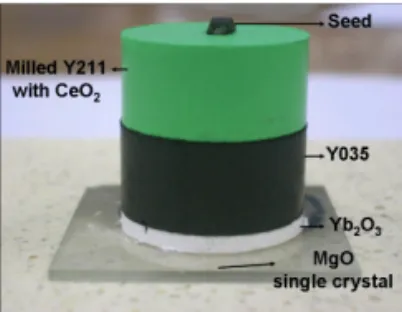
A commercially available Y211 powder (Solvay Company) was milled for 2, 4, 6, 8 and 10 h using attrition milling machine at a rotation speed of 400 rpm in ethanol using ZrO2 balls (7.5 mm dia.). After the completion of the milling process, the resultant slurry was dried in a vacuum oven to evaporate the solvent (ethanol). 1 wt% of CeO2 was also added to the fully reacted Y211 powders prior to pressing into pellets in order to suppress Y211 growth in the molten liquid during peritectic decomposition. The milled Y211 powders having 1 wt.% CeO2 and Ba3Cu5O8 (Y035, used as a liquid source) were pressed into pellets uniaxially using a steel mold of 20 mm diameter. In this study, the precursor pellet prepared from unmilled (0 h) commercially available Y211 powder was used as a reference sample. In order to control the porosity well, all the Y211 green compacts were sintered at 1200 oC for 2 h in air prior to the LIG process. The arrangement of the precursor compacts for LIG process is shown in figure 1.
By using cold seeding method, the LIG process was applied for the fabrication of single crystal Y-123 bulk superconductors. The detailed applied heating schedule for the LIG process in this study is shown in the figure 2.
Fig. 1. Photos of pre-form structure for LIG process
The interior microstructures related to the size and distribution of Y211 particles were investigated using a scanning electron microscope (SEM). After the annealing of rectangular shaped specimens with dimensions of about 2x2x1 mm3 at 500 oC for 300 h in pure oxygen atmosphere, the measurement of Jc
was evaluated from magnetization hysteresis curves
using a magnetic property measurement system (MPMS).
Fig. 2. Schematic illustration of the applied heating schedule.
III. Results and discussion
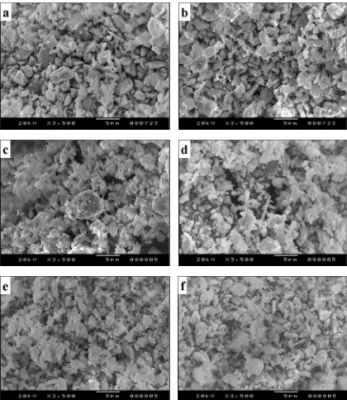
Figure 3 shows SEM micrographs of Y211 powders milled for (a) 0 h (b) 2 h, (c) 4 h, (d) 6 h, (e) 8 h and (f) 10 h. As can be seen in sample (a), the powders are irregular in shape and a several µm in size. As milling time increases, a part of the Y211 powders is changed into small powders by milling.
The fraction of the small Y211 powders increases as time increases, but all the original Y211 powders are not converted completely to the small Y211 powders even after 10 h milling. The precursor powders of this study were, therefore, mixtures of large Y211 powders of a several µm in size and submicron Y211 powders with various volume ratios.
To estimate an open porosity in the Y211 green compacts, the samples were sintered at high temperature. Figure 4 shows the variation of apparent and % theoretical density (TD) with milling time of the sintered Y211 pre-forms, estimated from the equation of
%TD = Sample (apparent) Density / TD (6.18 g/cm3) x 100
The %TD value for 0 h milled sample is around 85%, but it increases gradually with increasing the milling time even though all the Y211 green compacts were sintered at the same temperature
(1200 oC). For instance, the %TD value for 10 h milled sample is about 92%, which indicates 8% of the pre-form is an open porosity. Milling time dependence of the %TD is a result of the increased volume fraction of the fine Y211 powders by milling.
It can be expected from the density result that the Y211 pre-form prepared using the fine powder will have a relatively small amount of liquid due to the lack of open pores [17].
Fig. 3. SEM micrographs of Y211 powders attrition-milled for (a) 0 h, (b) 2 h, (c) 4 h, (d) 6 h, (e) 8 h and (f) 10 h.
Fig. 4.Variation of an Y211-pre-form density with milling time.
The size of Y211 particles and their distribution were also investigated from the top surface region far from the seed in the LIG processed Y-123 samples.
Figure 5 shows the SEM micrographs of polished/
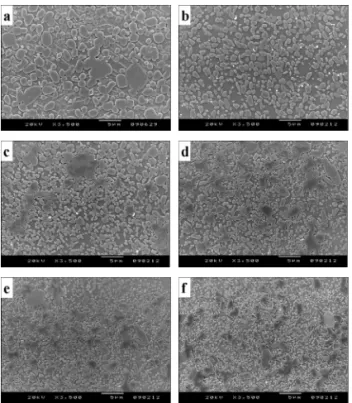
etched surfaces of LIG processed samples using Y211 powders milled for (a) 0 h, (b) 2 h, (c) 4 h, (d) 6 h, (e) 8 h, and (f) 10 h. The size of Y211 particles was found to be the function of milling time. A relatively high density of Y211 inclusions having uniform distribution compared to other samples, however, was observed in the microstructure of 8 h milled sample. The microstructure observed for 10 h milled sample was significantly less homogeneous and discontinuous compared to 8 h milled sample.
On the other hand, in figure 5 (c)-(f), the abnormally grown Y211 particles can be observed. The large plate-like Y211 particles of a several µm are present in a form of agglomerates, together with small granular Y211 particles.
Fig. 5. Y211 size and distributions in LIG processed Y-123 samples using Y211 powders milled for (a) 0 h, (b) 2 h, (c) 4 h, (d) 6 h, (e) 8 h and (f) 10 h.
The agglomeration and microstructural in- homogeneity in single grains fabricated from ball-milled Y-211 powder were observed. The agglomeration and microstructural in-homogeneity
can be considered due to two reasons. First reason is that since CeO2 acts as a growth inhibitor of Y211 in liquid phase [10], so the Y211 particle size further reduced due to CeO2 addition. Furthermore, using milled Y211 powder as a stating material [6], CeO2
addition [10] and using LIG process [11-17], all are the sources to reduce the Y211 size in the final Y-123 matrix. The appearance of large Y211 particles is a result of the exaggerated Y211 growth in a melt, which might be due to the high reactivity of the fine milled Y211 powder having a reaction route different from the large Y211 powder. The second reason may be attributed to zirconia (Zr) contamination of the precursor powder during the milling process [6]. This contamination is due to the balls and container of Zr used for the mixing process. Further study on the very fine Y211 powder with a high specific area should be carried out.
The Jc values were calculated from the magnetization data using Bean’s critical model [18]
at 77 K and H//c-axis. Figure 6 shows the Jc
increased gradually as milling time increased up to 8 h in the self field (0 T) while the 4 h milled sample showed the highest Jc in the high field (2.2 to 5 T). In the self field region, the maximum Jc value (7.8x10⁴ A/cm2) at 77 K for 8 h milled sample was achieved which is comparable to the 0 h milled sample (3.9x10⁴ A/cm2) in the same field. The decrease in Y211 size and their uniform distribution are responsible for the Jc improvement. Despite the remarkable enhancement of the low-field Jc, 8 h milled sample’s performance at a high magnetic field is disappointing. Therefore, it is necessary to further increase Jc in a high field in order to allow electrical engineering applications.
Although the exact flux pinning mechanism of Y211 is still unclear, it is widely accepted that both mechanical properties and flux pinning of YBCO are improved by the fine 211 embedding [1]. In case of 4 h milled sample as shown in figure 5 (c), the microstructure observed for that sample did not show the remarkable refinement of Y211 particles but that sample showed high Jc in the high magnetic field. By comparing Jc of that sample, it is concluded that
certain factor can obviously improve the magnetic properties of LIG processed YBCO, especially at higher magnetic field. Some researchers have proposed that the local inhomogeneities with weak superconductivity, which play the role of pinning centers, those inhomogeneities with weak superconductivity may be connected with secondary phases, defects or chemical inhomogeneities, which become normal with increasing magnetic fields [19], which can cause the high Jc. This may be the reason for the improvement of Jc in the high field for the 4 h milled sample.
As the milling time increased further to 10 h, the Jc
decreased to the level of the 4 h milled sample in the lower field (0-1 T) and its values more reduced with the increase of magnetic field. The reduction of Jc
values is attributed to the exaggerated Y211 growth.
As it is considered that milled precursor powder, CeO2 addition and LIG process, all are effective for the refinement of Y211 particle but extra ordinary refinement causes agglomeration, which might be due to the high reactivity of the fine Y211 particles having a reaction route different from the large Y211 particles. Further study on the very fine Y211 powder with a high specific area should be optimized to stop the agglomeration of Y211 particles.
Fig. 6. Jc-B curves of LIG processed Y-123 superconductors.
IV. Conclusions
In this study, single crystal Y-123 superconductors were fabricated by an LIG process with top seeding
using milled precursor Y211 powder having 1 wt.%
CeO2 addition. The Y211 size in the final LIG processed Y-123 product was gradually reduced with increasing the milling time. However, the unexpected Y211 particles coarsening was observed from the 4 h milled sample which was further increased for 10 h milled sample. The highest Jc (7.8x10⁴ A/cm2 in the self field (0 T) and 77 K) was achieved for 8 h milled sample but as the milling time increased further to 10 h, on the contrary, the Y211 size increased, and the Jc
decreased in the same field which might be due to the exaggerated Y211 growth.
Acknowledgements
This work was supported by the Power Generation
& Electricity Delivery of the Korea Institute of Energy Technology Evaluation and Planning (KETEP) Grant funded by the Korean Government Ministry of Knowledge Economy.
References
[1] M. Murakami, K. Yamaguchi, H. Fujimoto, N.
Nakamura, T. Taguchi and S. Tanaka, Cryogenics, 32, 930 (1992).
[2] C. J. Kim, H. W. Park, K. B. Kim and G. W. Hong, Supercond. Sci. Technol., 8, 652 (1995).
[3] S. Nariki, N. Sakai, M. Murakami and I. Hirabayashi, Supercond. Sci. Technol., 17, S30 (2004).
[4] C. Varanaci and P. J. McGinn, Mater. Lett., 17, 205 (1993).
[5] C. J. Kim, K. B. Kim and G. W. Hong, Mater. Lett., 21 9 (1994).
[6] S. Meslin, K. Iida, N. H. Babu, D. A. Cardwell and J. G.
Noudem, Supercond. Sci. Technol., 19, 711 (2006).
[7] N. Ogawa, and I. Hirabayashi, Physica C, 177, 101 (1991).
[8] M. Morita, M. Tanaka, S. Takebayashi, K. Miyamoto and K. Sawano, Japan. J. Appl. Phys., 30, L813 (1991).
[9] C. J. Kim, K. B. Kim, I. H. Kuk and G. W. Hong, Physica C, 281, 244 (1997).
[10] C. J. Kim, I. H. Kuk, G. W. Hong, T. H. Sung, S. C.
Han and J. J. Kim, Matter. Lett., 34, 392 (1998).
[11] Y. L. Chen, H. M. Chan, M. P. Harmer, V. R. Todt, S.
Sengupta and D. Shi, Physica C, 234, 232 (1994).
[12] K. Iida, N. H. Babu, Y. Shi and D. A. Cardwell, Supercond. Sci. Technol., 19, S478 (2006).
[13] H. Fang, Y. X. Zho, K. Ravi- chandar and K. Salama, Supercond. Sci. Technol., 17, 269 (2004).
[14] A. Mahmood, S. D. Park, B. H. Jun, J. S. Youn, Y. H.
Han, T. H. Sung and C. J. Kim, Physica C, 469, 1165
(2009).
[15] C. J. Kim, H. G. Lee, K. B. Kim and G. W. Hong, J.
Mater. Res., 10, 2235 (1995).
[16] A. Mahmood, B. H. Jun, C. J. Kim, Progress in Superconductivity, 11, 42 (2009).
[17] A. Mahmood, B. H. Jun, Y. H. Han and C. J. Kim, Supercond. Sci. Technol., 23, 065005 (2010).
[18] D. X. Chen, J. Appl. Phys., 66, 2489 (1989).
[19] M. Daeumling, J. Seuntijens and D. Larblestier, Nature, 346, 715 (1990).