Background and Purpose The US Food and Drug Administration approval for perampan- el has only recently been expanded to patients as young as 4 years, and so there have been few real-life studies of the effects of perampanel in pediatric patients. The aim of this study was to determine the long-term efficacy, factors affecting treatment response, and tolerability of per- ampanel as an add-on therapy in pediatric patients aged 4 years or older with epilepsy.
Methods This multicenter retrospective observational study collected data from pediatric ep- ilepsy centers of four Korean national universities. Changes in the seizure frequency from base- line, adverse events, and retention rates were obtained at 3, 6, and 12 months. Adverse events and discontinuation profiles were obtained to assess tolerability.
Results This study included 220 children and adolescents (117 males and 103 females) aged 4 to 20 years. The overall response rate was 43.6%, and the seizure-freedom rate was 17.7%.
Factors affecting a good treatment response were the absence of intellectual disability, small number of concomitant antiepileptic drugs, and low baseline seizure frequency. Eighty-eight patients (40%) experienced adverse events, but they mostly were of mild severity and resolved after the dose reduction or discontinuation of perampanel. The retention rates at 3, 6, and 12 months were 85.0%, 71.8%, and 50.5%, respectively.
Conclusions Adjunctive treatment with perampanel was efficacious and tolerated in pedi- atric patients aged 4 years or older with epilepsy. Early perampanel treatment may help to re- duce the burden of their seizures and improve their quality of life.
Key Words perampanel, children, treatment efficacy, adverse drug reactions.
Real-Life Effectiveness and Tolerability of Perampanel in Pediatric Patients Aged 4 Years or Older with Epilepsy:
A Korean National Multicenter Study
INTRODUCTION
There has always been a pressing need to develop new antiepileptic drugs (AEDs) due to 20–
30% of patients with epilepsy remaining refractory to medical or surgical treatment. AED development since 1990 has focused on specific therapeutic targets, but most of the new AEDs have not resulted in significant changes in the proportion of patients with refractory epilepsy. Glutamate, the main excitatory neurotransmitter, opens cation-permeable ion chan- nels that are abundantly expressed in the mammalian brain.1 The fast excitatory neurotrans- mission of glutamate is mediated by three classes of ionotropic receptors: α-amino-3-hydroxy- 5-methyl-4-isoxazolepropionic acid (AMPA), N-methyl-d-aspartate (NMDA), and kainite receptors.2 The AMPA receptor is the main excitatory postsynaptic receptor mediating nearly all fast excitatory neurotransmission, and is expressed throughout the CNS.3,4 Perampanel, the first selective AMPA receptor antagonist,5 is one of the latest AEDs. Neuronal excitation is reduced by inhibiting AMPA-induced increases in intracellular calcium,6 and this new Su-Kyeong Hwanga*
Yun-Jin Leeb,c* Sang Ook Namb,c Won Seop Kimd Jon Soo Kimd Sun Jun Kime Yun-Jeong Leea Soonhak Kwona
a Department of Pediatrics, School of Medicine,
Kyungpook National University, Daegu, Korea
b Department of Pediatrics, Pusan National University Children’s Hospital, Pusan National University School of Medicine, Yangsan, Korea
c Research Institute for Convergence of Biomedical Science and Technology, Pusan National University Yangsan Hospital, Yangsan, Korea
d Department of Pediatrics, College of Medicine, Chungbuk National University, Cheongju, Korea
e Department of Pediatrics, Chonbuk National University Medical School, Jeonju, Korea
pISSN 1738-6586 / eISSN 2005-5013 / J Clin Neurol 2020;16(1):53-59 / https://doi.org/10.3988/jcn.2020.16.1.53
Received April 23, 2019 Revised August 27, 2019 Accepted August 27, 2019 Correspondence Soonhak Kwon, MD Department of Pediatrics, School of Medicine,
Kyungpook National University, 807 Hoguk-ro, Buk-gu, Daegu 41404, Korea Tel +82-53-200-5704 Fax +82-53-425-6683 E-mail [email protected]
*These authors contributed equally to this work.
cc This is an Open Access article distributed under the terms of the Creative Commons Attribution Non-Com- mercial License (https://creativecommons.org/licenses/by-nc/4.0) which permits unrestricted non-commercial use, distribution, and reproduction in any medium, provided the original work is properly cited.
JCN
Open Access ORIGINAL ARTICLEPerampanel Use in Treatment of Pediatric Epilepsy
JCN
mechanism of action has greatly improved the quality of life of some patients with intractable epilepsy.
Perampanel was initially approved for adjunctive use in par- tial-onset seizures in 2012, and was subsequently approved as an adjunctive therapy for primary generalized tonic-clon- ic seizures in patients with epilepsy aged 12 years or older, and then as a monotherapy for partial-onset seizures with or with- out secondarily generalized seizures in patients with epilepsy of the same.7,8 The US Food and Drug Administration (FDA) expanded the approval of perampanel to the treatment of par- tial-onset seizures with or without secondary generalized sei- zures in patients as young as 4 years in 2018. This very recent expansion of approval means that there have been few real- life studies on pediatric patients.
The aim of the present study was to determine the long- term efficacy, factors affecting treatment response, and toler- ability of perampanel as an add-on therapy in pediatric pa- tients aged 4 years or older with epilepsy.
METHODS
This multicenter retrospective observational study collected data from pediatric epilepsy centers of four Korean national universities. The Institutional Review Board of each univer- sity approved the protocol that included patients with refrac- tory epilepsy aged 4 years or older. The IRB numbers for each institution are 2018-08-034 (Kyungpook National University Hospital); 05-2018-025 (Pusan National University Yangsan Hospital); 2018-04-003 (Chungbuk National University Hos- pital); 2018-09-016 (Chonbuk National University Hospital).
The need to obtain informed consent was waived due to the retrospective design of the study.
Perampanel was administered to patients aged 4 years or older who had been diagnosed with epilepsy in a pediatric neurology clinic at the participating university hospitals be- tween January 2016 and December 2017. The patients should have had recurrent seizures while taking at least one AED, and the concomitant AEDs had to have remained unchanged for the duration of the study. Due to this being a multicenter retrospective study, the criteria for the timing of add-on ther- apy had not been unified. The data collected included the fol- lowing information: sex, seizure types, presence of intellec- tual disability, etiology of epilepsy, history of ketogenic diet/
vagus nerve stimulation (VNS)/epilepsy surgery, age at seizure onset, age when started on AEDs, age when started on per- ampanel, duration of epilepsy, duration of perampanel treat- ment, number of concomitant AEDs, monthly seizure fre- quency, initial daily dose of perampanel, final daily dose of perampanel, retention at the end of the study, and number of adverse events. Seizure types were classified into generalized,
focal, and combined focal and generalized, while epilepsy eti- ologies were classified into genetic, infectious, metabolic, struc- tural, and unknown.9 The efficacy was assessed based on the mean monthly seizure frequency during the 3 months before starting perampanel treatment. A response was defined as a reduction of 50% or more in the monthly seizure frequency compared with the baseline. Perampanel was given once in the evening and its dosage was increased depending on the clinical response and tolerability. The 2-mg formulation was used in divided doses to increase the daily dose by 0.5 mg or 1 mg. The subjects were divided into two groups by age: A) 4–16 years and B) 17–20 years. Changes in the seizure fre- quency from baseline, adverse events, and retention rates were obtained at 3, 6, and 12 months. Adverse events and discon- tinuation profiles were obtained to assess tolerability. Wors- ening of seizures was classified as an adverse event.
All of the analyses in this study were performed using R software (version 3.2.1, meta package, R Foundation for Sta- tistical Computing, Beijing, China), and all statistical tests were two-sided. Odds ratios with 95% confidence intervals were utilized to evaluate the effect of AEDs for all dichotomous out- comes. The potential heterogeneity was assessed using the Q statistic, χ2-test, and I2. A random-effects model was used to pool the effect size if significant heterogeneity was detect- ed (p<0.05 or I2>50%); otherwise a fixed-effects model was adopted. The retention rate according to age when started on perampanel and according to seizure type were analyzed us- ing Kaplan-Meier survival analysis in SPSS software (ver- sion 23; IBM Corp., Armonk, NY, USA).
RESULTS
This study included 220 children and adolescents comprising 117 males and 103 females ranging in age from 4 to 20 years (15.4±2.9 years, mean±SD). Most (84%) of the patients had intractable epilepsy, and their duration of perampanel treat- ment was 11.5±6.9 months. The starting dosage of peram- panel was 2.0±0.2 mg/day and the final dosage was 5.5±2.8 mg/day. The retention rate at the end of the study was 70.5%.
Table 1 compares demographics and clinical features between the two age groups when they were started on perampanel.
There were no significant subgroup differences in sex ratio, seizure type, history of ketogenic diet, VNS, epilepsy surgery, age when started on AEDs, duration of perampanel treatment, number of concomitant AEDs, initial and final daily doses of perampanel, or retention rate. Patients in group A (aged 4–16 years) had more intellectual disability, more infectious or struc- tural etiologies, and a higher baseline monthly seizure fre- quency than those in group B (aged 17–20 years).
The overall response rate was 43.6%, and the seizure-free-
Hwang SK et al.
JCN
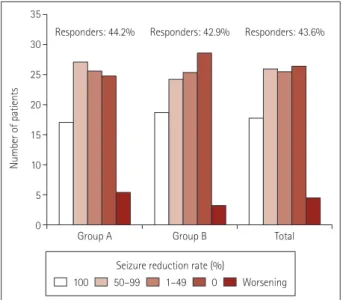
dom rate was 17.7%. The response rate did not differ signifi- cantly between group A (44.2%) and group B (42.9%) (Fig. 1).
The overall retention rate was 85.0% at 3 months, 71.8% at 6 months, and 50.5% at 12 months, and the retention rate ac- cording to age when started on perampanel did not differ sig- nificantly among the groups (Fig. 2).
Comparing demographics and outcomes between respond- ers and nonresponders (Table 2) revealed that both the age at seizure onset (p=0.005) and the age when started on AEDs (p=0.002) were significantly higher in responders than in non- responders. The duration of epilepsy (p=0.013) was signifi- cantly shorter and the duration of perampanel treatment (p<
0.001) was significantly longer in responders than in nonre- sponders. The number of patients with intellectual disability (p=0.003) and the number of concomitant AEDs (p<0.001) were significantly smaller in responders than in nonresponders.
The discontinuation rate was lower (p<0.001) and the point of discontinuation (p<0.001) was later in responders than in nonresponders.
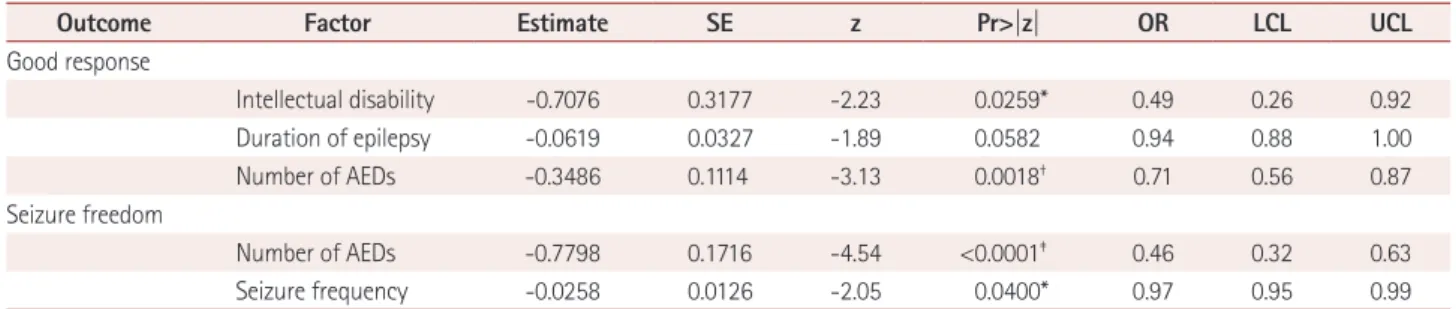
In a logistic regression model of factors affecting a good treatment response and seizure freedom (Table 3), a good treat- ment response was negatively correlated with the presence of intellectual disability (p=0.0259) and the number of AEDs (p=0.0018). Seizure freedom was negatively correlated with the number of AEDs (p<0.0001) and the baseline seizure fre- quency (p<0.04).
As indicated in Table 4, in terms of adverse events and dis- continuation profiles of treatment groups by age, 40% of pa- tients experienced adverse events, and some of the adverse events occurred simultaneously. The dosage when adverse events occurred was 5.3±3.2 mg/day. Perampanel was discon- tinued in 29.5% of the patients, and the rate of discontinua- Table 1. Comparison of demographics and clinical features between group A (aged 4–16 years) and group B (aged 17–20 years) when started on perampanel
Total (n=220) Group A (n=129) Group B (n=91) p
Sex, male 117 (53.2) 71 (55.0) 46 (50.5) 0.603
Seizure type 0.937
Generalized 118 (53.6) 69 (53.5) 49 (53.8)
Focal 58 (26.4) 35 (27.1) 23 (25.3)
Combined 44 (20.0) 25 (19.4) 19 (20.9)
Intellectual disability 131 (59.5) 86 (66.7) 45 (49.5) 0.015*
Etiology 0.018*
Genetic 3 (1.4) 0 (0.0) 3 (3.3)
Infection 17 (7.7) 14 (10.9) 3 (3.3)
Metabolic 2 (0.9) 1 (0.8) 1 (1.1)
Structural 64 (29.1) 43 (33.3) 21 (23.1)
Unknown 134 (60.9) 71 (55.0) 63 (69.2)
Ketogenic diet 18 (8.2) 15 (11.6) 3 (3.3) 0.083
VNS 24 (10.9) 15 (11.6) 9 (9.9) 0.851
Epilepsy surgery 3 (1.4) 2 (1.6) 1 (1.1) 1.000
Age at seizure onset, years 6.0±4.9 5.1±4.5 7.2±5.2 0.001†
Age when started on AEDs, years 6.1±4.9 5.3±4.5 7.4±5.1 0.001
Age when started on perampanel, years 15.4±2.9 13.6±2.5 18.0±0.8 <0.001†
Duration of epilepsy, years 9.5±5.0 8.5±4.5 10.9±5.4 <0.001†
Duration of perampanel treatment, months 11.5±6.9 11.6±6.8 11.4±6.9 0.843
Number of AEDs 3.2±1.5 3.2±1.4 3.3±1.6 0.690
Monthly seizure frequency 40.7±69.9 51.4±80.3 25.7±48.3 0.003†
Initial daily dose of perampanel, mg 2.0±0.2 2.0±0.2 2.0±0.2 0.721
Final daily dose of perampanel, mg 5.5±2.8 5.2±2.7 5.8±2.9 0.132
Retention rate 0.437
Maintenance 155 (70.5) 95 (73.6) 60 (65.9)
Discontinuation 60 (27.3) 31 (24.0) 29 (31.9)
Loss to follow-up 5 (2.3) 3 (2.3) 2 (2.2)
Data are n (%) or mean±SD values.
*p<0.05, †p<0.005.
AEDs: antiepileptic drugs, VNS: vagus nerve stimulation.
Perampanel Use in Treatment of Pediatric Epilepsy
JCN
tion due to side effects was higher in group B than in group A.
Somnolence was more common in group A than in group B, and it was the most common adverse event, followed by diz- ziness, ataxia, violence, anger, worsening of seizure, insom- nia, headache, depression, low appetite, cognitive decline, and nausea/vomiting, while there was one suicide attempt. The side effects (other than the single suicide attempt) were mild in severity and resolved after the dose reduction or discon- tinuation of perampanel. The patient who attempted suicide was a 16-year-old female with a history of impulse control disorder and anxiety. She had visited a psychiatrist but had never attempted suicide before taking perampanel. She cut her wrist while taking perampanel, was admitted to a psychi- atry department, and diagnosed with bipolar disorder. After
discontinuing perampanel she has not displayed any further suicidal tendencies. The wrist wound was nonlethal and she made a full recovery.
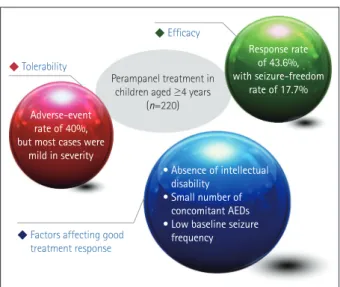
The efficacy, tolerability, and factors affecting a good treat- ment response of perampanel in pediatric patients aged 4 years or older with epilepsy are summarized in Fig. 3.
DISCUSSION
The efficacy of perampanel add-on therapy in children and adolescents in this study was similar to that found in previ- ous studies. The first multicenter study of children and ado- lescents aged 2–17 years with various types of epilepsy found a 31% response rate and 9% seizure-freedom rate, which are similar to adult data.10 In subsequent studies involving chil- dren and adolescents, the response rate has ranged from 42%
to 59% and the seizure-freedom rate has ranged from 5% to 12.5%.11-14 Children aged 6 years or older have tended to show better responses (36%) than very young children (9%),10 as also revealed by a comparison between children aged 12 years and older (54%) and younger (25%) children.12 However, no significant difference according to age groups was found in our study, which included a larger number of patients.
The factors affecting the treatment response based on a lo- gistic regression model indicated that good response can be expected in patients without intellectual disability and with a small number of concomitant AEDs. The factors affecting seizure freedom were a small number of concomitant AEDs and a low baseline monthly seizure frequency.
While the number of concomitant AEDs was related to the treatment response, the presence of enzyme-inducing AEDs was not. Perampanel is primarily metabolized by CYP3A4 of the P450 enzyme system, and enzyme-inducing drugs such
Fig. 2. Retention rate according to age when started on perampanel.
1.00
0.75
0.50
0.25
0.00
Retention rate
0
Age when starting perampanel (years)
p=0.0877
>17 12–16 4–11
3 6 9 12 15 18 21 24
Time (months) Fig. 1. Percentage reductions in seizure frequency and responder
rate in group A (aged 4–16 years) and group B (aged 17–20 years).
35 30 25 20 15 10 5 0
Number of patients
Group A
Seizure reduction rate (%)
100 50–99 1–49 0 Worsening
Group B Total
Responders: 44.2% Responders: 42.9% Responders: 43.6%
Hwang SK et al.
JCN
as carbamazepine, oxcarbazepine, and phenytoin significant- ly increase the clearance of perampanel and decrease its plas- ma concentration.15,16 Perampanel has been studied in the pres- ence of various AEDs, including enzyme-inducing AEDs, and there have been improved treatment outcomes regardless of the types of concomitant AEDs despite the known interaction between perampanel and enzyme-inducing AEDs.17,18 Unlike in previous studies, our patients were not affected by concomi-
tant enzyme-inducing AEDs. However, increased dosages and the faster titration of perampanel may be needed when a pa- tient is taking enzyme-inducing AEDs.19
The overall safety profile in our study was similar to pre- vious reports. The rate of adverse events occurring in children and adolescents ranged from 31% to 71%, and the most fre- quently reported ones include behavioral changes, dizziness, somnolence, and gait disturbance.10-13 Particular attention Table 2. Comparison of demographics and outcomes between responders and nonresponders
Responders (n=96) Nonresponders (n=124) p
Sex, male 46 (47.9) 71 (57.3) 0.215
Type 0.259
Generalized 55 (57.3) 63 (50.8)
Focal 20 (20.8) 38 (30.6)
Combined 21 (21.9) 23 (18.5)
Intellectual disability 46 (47.9) 85 (68.5) 0.003‡
Etiology 0.348
Genetic 3 (3.1) 0 (0.0)
Infection 6 (6.2) 11 (8.9)
Metabolic 1 (1.0) 1 (0.8)
Structural 27 (28.1) 37 (29.8)
Unknown 59 (61.5) 75 (60.5)
Ketogenic diet 5 (5.2) 13 (10.5) 0.243
VNS 6 (6.2) 18 (14.5) 0.083
Epilepsy surgery 1 (1.0) 2 (1.6) 1.000
Age at seizure onset, years 7.0±4.7 5.2±4.9 0.005†
Age when started on AEDs, years 7.3±4.8 5.2±4.8 0.002‡
Age when started on perampanel, years 15.6±2.6 15.3±3.2 0.378
Duration of epilepsy, years 8.6±4.9 10.2±4.9 0.013*
Duration of perampanel treatment, months 13.5±6.3 10.0±6.9 <0.001‡
Number of AEDs 2.8±1.6 3.5±1.3 <0.001‡
Monthly seizure frequency 34.2±60.1 45.8±76.5 0.208
Initial daily dose of perampanel, mg 2.0±0.2 2.0±0.2 0.733
Final daily dose of perampanel, mg 5.8±2.9 5.2±2.7 0.105
Retention <0.001‡
Maintenance 86 (89.6) 69 (55.6)
Discontinuation 8 (8.3) 52 (41.9)
Loss to follow-up 2 (2.1) 3 (2.4)
Discontinuation 10 (10.4) 55 (44.4) <0.001‡
Adverse events 8 (8.3) 31 (25.0)
Lack of efficacy 0 (0.0) 21 (16.9)
Loss to follow-up 2 (2.1) 3 (2.4)
Time of discontinuation, months <0.001‡
<3 1 (1.0) 29 (23.4)
3–6 5 (5.2) 11 (8.9)
6–12 3 (3.1) 12 (9.7)
>12 1 (1.0) 3 (2.4)
Data are n (%) or mean±SD values.
*p<0.05, †p<0.01, ‡p<0.005.
AEDs: antiepileptic drugs, VNS: vagus nerve stimulation.
Perampanel Use in Treatment of Pediatric Epilepsy
JCN
should be paid to younger patients because they are more susceptible to somnolence. Most adverse events were mild in severity, with the exception of a single suicide attempt; this potentially serious adverse event occurred in a patient with impulse control disorder and anxiety. Although she had un- derlying psychiatric problems, she had not had any suicidal tendencies before taking perampanel. She was started on a daily perampanel dose of 2 mg, and this was increased slow- ly by 1 mg per month before reaching 5 mg. While on a 5-mg dose of perampanel she cut her wrist and was admitted to a psychiatry department. The FDA lists ‘serious psychiatric and behavioral reactions’ as a potential adverse effect of perampan- el, and psychiatric adverse events including suicidal ideation are the most common reasons for withdrawal.20 In a retrospec-
tive study in Canada, 50% of pediatric patients experienced adverse behavioral events that resulted in perampanel with- drawal, and 58% of them had behavioral comorbidities.11 Thus, adverse events should be carefully monitored especially in patients with underlying behavioral/psychiatric problems, even when starting on a low dose and slowly increasing it un- til reaching the final dose.
By including 220 pediatric patients aged 4 years or older, this was the largest study to evaluate the efficacy, factors af- fecting treatment response, and tolerability of perampanel in epilepsy as an add-on therapy. It is suggested that adjunctive treatment with perampanel can be efficacious and tolerated, and that early perampanel treatment may help to lower the seizure burden and improve the quality of life in pediatric pa- Table 4. Adverse events and discontinuation profiles in treatment groups by age
Total (n=220) Group A (n=129) Group B (n=91) p
Discontinuation 65 (29.5) 34 (26.4) 31 (34.1) 0.022*
Adverse events 39 (17.7) 15 (11.6) 24 (26.4)
Lack of efficacy 21 (9.5) 16 (12.4) 5 (5.5)
Loss to follow-up 5 (2.3) 3 (2.3) 2 (2.2)
Patients with adverse events 88 (40.0) 45 (34.9) 43 (47.3) 0.088
Dose when adverse event occurred, mg 5.3±3.2 4.8±2.8 5.8±3.5 0.155
Adverse events 88 (40.0) 45 (34.9) 43 (47.3)
Somnolence 37 (42.1) 24 (53.3) 13 (30.2) 0.048*
Dizziness 19 (21.6) 6 (13.3) 13 (30.2) 0.096
Ataxia 18 (20.5) 6 (13.3) 12 (27.9) 0.153
Violence 18 (20.5) 10 (22.2) 8 (18.6) 0.876
Anger 14 (15.9) 7 (15.6) 7 (16.3) 1.000
Worsening of seizure 7 (8.0) 4 (8.9) 3 (7.0) 1.000
Insomnia 5 (5.7) 3 (6.7) 2 (4.7) 1.000
Headache 3 (3.4) 1 (2.2) 2 (4.7) 0.968
Depression 3 (3.4) 2 (4.4) 1 (2.3) 1.000
Low appetite 2 (2.3) 0 (0.0) 2 (4.7) 0.454
Cognitive decline 2 (2.3) 1 (2.2) 1 (2.3) 1.000
Nausea/vomiting 1 (1.1) 0 (0.0) 1 (2.3) 0.982
Suicide attempt† 1 (1.1) 1 (2.2) 0 (0.0) 1.000
Data are n (%) or mean±SD values.
*p<0.05, †Unsuccessful suicide attempt in a patient who had a psychiatric history.
Table 3. Results from the logistic regression model for factors affecting a good treatment response and seizure freedom
Outcome Factor Estimate SE z Pr>|z| OR LCL UCL
Good response
Intellectual disability -0.7076 0.3177 -2.23 0.0259* 0.49 0.26 0.92
Duration of epilepsy -0.0619 0.0327 -1.89 0.0582 0.94 0.88 1.00
Number of AEDs -0.3486 0.1114 -3.13 0.0018† 0.71 0.56 0.87
Seizure freedom
Number of AEDs -0.7798 0.1716 -4.54 <0.0001‡ 0.46 0.32 0.63
Seizure frequency -0.0258 0.0126 -2.05 0.0400* 0.97 0.95 0.99
*p<0.05, †p<0.005, ‡p<0.0001.
AEDs: antiepileptic drugs, LCL: lower 95% confidence limit, OR: odds ratio, Pr: probability, SE: standard error, UCL: upper 95% confidence limit.
Hwang SK et al.
JCN
tients with epilepsy. Further prospective studies of young chil- dren or even infants with refractory epilepsy are needed to elucidate the benefit of perampanel in those populations.
Author Contributions
Conceptualization: Soonhak Kwon. Data curation: Yun-Jin Lee. Methodol- ogy: Sang Ook Nam. Writing—original draft: Su-Kyeong Hwang, Yun-Jin Lee. Writing—review & editing: Sang Ook Nam, Won Seop Kim, Jon Soo Kim, Sun Jun Kim, Yun-Jeong Lee, Soonhak Kwon.
ORCID iDs
Su-Kyeong Hwang https://orcid.org/0000-0001-8294-7094 Yun-Jin Lee https://orcid.org/0000-0003-4727-7018 Sang Ook Nam https://orcid.org/0000-0003-1312-3483 Won Seop Kim https://orcid.org/0000-0003-4541-7902 Jon Soo Kim https://orcid.org/0000-0003-2586-1942 Sun Jun Kim https://orcid.org/0000-0002-7673-8728 Yun-Jeong Lee https://orcid.org/0000-0003-3472-5336 Soonhak Kwon https://orcid.org/0000-0002-0783-2243 Conflicts of Interest
The authors have no potential conflicts of interest to disclose.
REFERENCES
1. Bhandage AK, Jin Z, Hellgren C, Korol SV, Nowak K, Williamsson L, et al. AMPA, NMDA and kainate glutamate receptor subunits are expressed in human peripheral blood mononuclear cells (PBMCs) where the expression of GluK4 is altered by pregnancy and GluN2D by depression in pregnant women. J Neuroimmunol 2017;305:51-58.
2. Kim HD, Chi CS, Desudchit T, Nikanorova M, Visudtibhan A, Nabangchang C, et al. Review of clinical studies of perampanel in
adolescent patients. Brain Behav 2016;6:e00505.
3. Henley JM, Wilkinson KA. Synaptic AMPA receptor composition in development, plasticity and disease. Nat Rev Neurosci 2016;17:337- 4. Rogawski MA. Revisiting AMPA receptors as an antiepileptic drug350.
target. Epilepsy Curr 2011;11:56-63.
5. Plosker GL. Perampanel: as adjunctive therapy in patients with par- tial-onset seizures. CNS Drugs 2012;26:1085-1096.
6. Shih JJ, Tatum WO, Rudzinski LA. New drug classes for the treat- ment of partial onset epilepsy: focus on perampanel. Ther Clin Risk Manag 2013;9:285-293.
7. De Liso P, Moavero R, Coppola G, Curatolo P, Cusmai R, De Sarro G, et al. Current role of perampanel in pediatric epilepsy. Ital J Pediatr 2017;43:51.
8. Swiderska N, Tan HJ, Rajai A, Silwal A, Desurkar A, Martland T. Ef- fectiveness and tolerability of perampanel in children, adolescents and young adults with refractory epilepsy: a UK national multicentre study. Seizure 2017;52:63-70.
9. Falco-Walter JJ, Scheffer IE, Fisher RS. The new definition and clas- sification of seizures and epilepsy. Epilepsy Res 2018;139:73-79.
10. Biró A, Stephani U, Tarallo T, Bast T, Schlachter K, Fleger M, et al. Ef- fectiveness and tolerability of perampanel in children and adolescents with refractory epilepsies: first experiences. Neuropediatrics 2015;46:
110-116.
11. Datta AN, Xu Q, Sachedina S, Boelman C, Huh L, Connolly MB.
Clinical experience with perampanel for refractory pediatric epilepsy in one Canadian center. J Child Neurol 2017;32:834-839.
12. De Liso P, Vigevano F, Specchio N, De Palma L, Bonanni P, Osanni E, et al. Effectiveness and tolerability of perampanel in children and ad- olescents with refractory epilepsies—An Italian observational multi- center study. Epilepsy Res 2016;127:93-100.
13. Heyman E, Lahat E, Levin N, Epstein O, Lazinger M, Berkovitch M, et al. Tolerability and efficacy of perampanel in children with refrac- tory epilepsy. Dev Med Child Neurol 2017;59:441-444.
14. Lagae L, Villanueva V, Meador KJ, Bagul M, Laurenza A, Kumar D, et al. Adjunctive perampanel in adolescents with inadequately con- trolled partial-onset seizures: a randomized study evaluating behav- ior, efficacy, and safety. Epilepsia 2016;57:1120-1129.
15. Gidal BE, Laurenza A, Hussein Z, Yang H, Fain R, Edelstein J, et al.
Perampanel efficacy and tolerability with enzyme-inducing AEDs in patients with epilepsy. Neurology 2015;84:1972-1980.
16. Rudzinski LA, Vélez-Ruiz NJ, Gedzelman ER, Mauricio EA, Shih JJ, Karakis I. New antiepileptic drugs: focus on ezogabine, clobazam, and perampanel. J Investig Med 2016;64:1087-1101.
17. Gidal BE, Ferry J, Majid O, Hussein Z. Concentration-effect relation- ships with perampanel in patients with pharmacoresistant partial-on- set seizures. Epilepsia 2013;54:1490-1497.
18. Kwan P, Brodie MJ, Laurenza A, FitzGibbon H, Gidal BE. Analysis of pooled phase III trials of adjunctive perampanel for epilepsy: impact of mechanism of action and pharmacokinetics on clinical outcomes.
Epilepsy Res 2015;117:117-124.
19. Tsai JJ, Wu T, Leung H, Desudchit T, Tiamkao S, Lim KS, et al. Per- ampanel, an AMPA receptor antagonist: from clinical research to practice in clinical settings. Acta Neurol Scand 2018;137:378-391.
20. Coyle H, Clough P, Cooper P, Mohanraj R. Clinical experience with perampanel: focus on psychiatric adverse effects. Epilepsy Behav 2014;41:193-196.
Fig. 3. Summary of efficacy, tolerability, and factors affecting treat- ment response of perampanel in pediatric patients aged 4 years or older with epilepsy. AEDs: antiepileptic drugs.
Response rate of 43.6%, with seizure-freedom
rate of 17.7%
Perampanel treatment in children aged ≥4 years
(n=220)
Efficacy
Tolerability
Factors affecting good treatment response Adverse-event
rate of 40%, but most cases were
mild in severity
• Absence of intellectual disability
• Small number of concomitant AEDs
• Low baseline seizure frequency