Research Article Open Access
Effects of Step-up Training on Walking Ability of Stroke Patients by Different Support Surface Characteristics
Geun-Sik Oh, PT, BSc⋅Yu-Ran Choi, PT, MS⋅
Dae-Hyouk Bang, PT, PhD
1⋅Yong-Jun Cha, PT, PhD
2†Dept. of Physical Therapy, Graduate School, Daejeon University
1
Dept. of Physical Therapy, Oriental Hospital, Wonkwang University
2
Dept. of Physical Therapy, College of Health and Medical Science, Daejeon University
Received: July 19, 2017 / Revised: July 20, 2017 / Accepted: July 25, 2017
ⓒ 2017 J Korean Soc Phys Med
| Abstract |
1)PURPOSE: Gait disturbances in patients with hemiplegic stroke involve asymmetry of stance time. Step box training is used to supplement the limitations of stair walking training and increasing the torque value of the paralyzed lower leg's strength. This study aimed to investigate whether step-up training on unstable support could change walking ability in patients with chronic stroke.
METHODS: Thirty stroke patients were randomly assigned to the step-up training group (experimental group), that performed training on an unstable surface, and the control group, that performed training on a stable surface. Walking speed, step length, and cadence were measured before and after training. Paired t-tests were used to compare pre- and post-intervention data, while the independent samples t-test was used to determine intergroup differences. Values of p < .05 were considered statistically significant.
† Corresponding Author : [email protected]
This is an Open Access article distributed under the terms of the Creative Commons Attribution Non-Commercial License (http://creativecommons.org/licenses/by-nc/3.0) which permits unrestricted non-commercial use, distribution, and reproduction in any medium, provided the original work is properly cited.
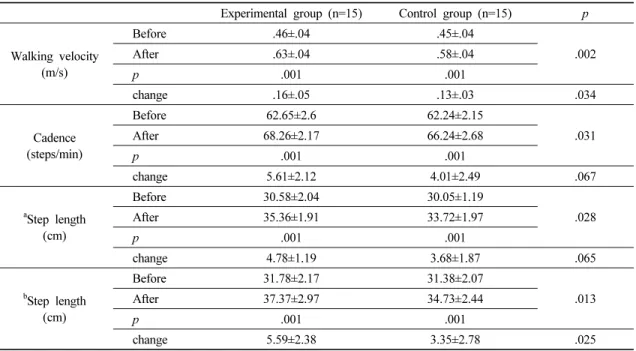
RESULTS: There was a significant difference in walking ability before versus after the intervention in both groups, although the experimental group showed greater differences than the control group (walking velocity by 8.1%; step length of the non-paralyzed side by 6.9%, respectively;
p<.05).
CONCLUSION: Step-up training might be more effective on an unstable surface than on a stable surface for increasing walking speed and step length of the non-paralyzed side.
Key Words: Step-up training, Stroke, Unstable surface, Walking ability
Ⅰ. Introduction
Stroke impairs motor, sensory, visual, and cognitive function, thus limiting daily life (Laver et al., 2015). More than 80% of stroke patients suffer from walking disorders at stroke onset involving muscle strength and coordination, mainly due to impaired motor function (Tyson et al., 2006;
de Rooij et al., 2016). Walking disorders not only cause
limitations in daily life activities but decrease quality of
life because they decrease independence (Khaw, 1996;
O'Brien et al., 1996). Therefore, the restoration of ability acts as an essential function restoration factor in the rehabilitation of stroke patients (Bohannon et al., 1991).
Gait disturbances in stroke patients involve asymmetry of stance time in which the stance of the non-paralyzed side becomes relatively long due to the short stance of the paralyzed side (Ryerson and Levit, 1997). Walking speed also decreases due to a decreased weight transfer ability (Sousa et al., 2011).
Walking on the stairs is a movement that requires greater lower-limb strength and balance than walking on the ground (Christina and Cavanagh, 2002). In particular, as stair height increases, increased strength and balance are needed (Eun, 2003). Therefore, stair walking training in the rehabilitation of stroke patients involves high exercise difficulty and a greater risk of falling than that of walking on a flat surface (Seo and Kim, 2013; Jun and Park, 2015).
Step box training is used to supplement the limitations of stair walking training. Stepping training using a step box is reportedly effective in increasing the muscle mass gain of the paralyzed lower limbs of stroke patients (Mansfield et al., 2011), improving walking speed and balance ability (Park, 2016) and increasing the torque value of the paralyzed lower leg's strength (Kim, 2014).
Functional training with unstable support is useful for increasing exercise difficulty because unexpected propri- etary sensory information and reaction forces in various directions are induced compared to training methods on a stable support surface (Di Fabio and Badke, 1990; Lee, 2007; Lee, 2009). In particular, walking on an unstable support surface such as a balance pad requires more muscle strength and movement around the ankle joint, thereby im- proving walking speed (Kim, 2009; Lee et al., 2010).
Step-up training is a way to supplement some of the limitations of gait training on the stairs, while functional training on an unstable support surface is the next step of the exercise training on a stable support surface.
However, studies on the improvement of walking ability
of stroke patients by combining the two intervention methods have not been conducted to date. The purpose of this study was to compare the effect of step-up training on walking ability in unstable and stable support training for chronic stroke patients to determine which is more effective.
Ⅱ. Methods
1. Subjects
The subjects of this study were adult stroke patients who were hospitalized at D hospital in J city for ≥6 months after receiving the diagnosis of stroke due to hemiplegia.
The inclusion criteria were receipt of the diagnosis of stroke
> 6 months prior, ability to walk > 15 m without the help of a walking aid, ability to complete the Korean Mini- Mental Status Test, and ability to understand and follow the directions of the researcher. The exclusion criteria included a visual or auditory abnormality, vertigo, orthopedic disorder, or cardiovascular disease.
A total of 30 subjects who fully understood the study purpose and contents and agreed to participate in the study were finally selected as target subjects. The participants were randomly divided into the experimental group (n = 15) with unstable support and the control group (n = 15) with stable support. The Daejeon University Institutional Ethics Committee approved this study.
2. Step-up training
In both groups, 1 hour of general neurological physi- otherapy plus step-up exercise was performed five times a week over a total of 5 weeks: physiotherapy was per- formed for 30 minutes, followed by 30 minutes of step-up training consisting of 10 minutes of warm-up exercise, 15 minutes of step-up training, and 5 minutes of cool-down exercise to reduce exercise fatigue and prevent accidents.
Balanced pads (Airex, Seoul, Korea; 50 cm × 41 cm
Experimental group (n=15) Control group (n=15) p
Gender (male/female) 7/8 9/6 .46
Paretic side (right/left) 8/7 7/8 .72
Stroke type
(hemorrhage/infarction) 6/9 5/10 .71
Onset (month) 11.47±2.45 12.13±2.88 .50
Age (years) 58.87±6.73 57.53±6.86 .60
Height (cm) 162.53±5.62 164±7.96 .56
Weight (kg) 64.8±5.14 64.13±5.59 .74
Values are expressed as means ± standard deviations or numbers.
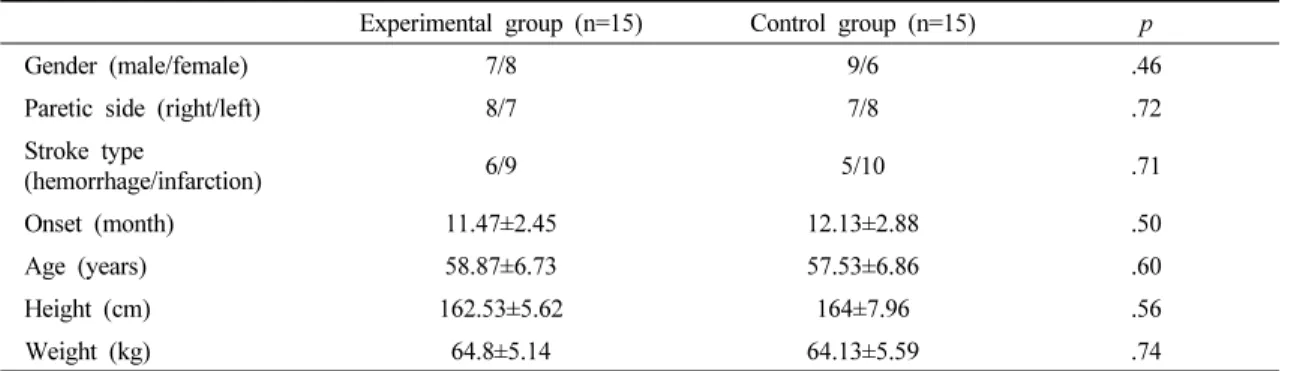
Table 1. General characteristics of the study subjects
× 6 cm) were used for step-up training on the unstable support surface, while wooden plates (45 cm × 35 cm × 6 cm) were used for step-up training on the stable support surface. On the unstable or stable support surface, the knee joint of the paralyzed lower limb was bent at 20-30 degrees, while foot on the non-paralyzed side was placed in the front aerobic step box (Body sculpture, China; 70 cm × 28 cm × 12 cm) and then returned to its original position.
A 30-sec rest period was allowed after 1 minute of training, and safety bars were used and trained supervisors were present on the paraplegic side to prevent falls.
3. Test of walking ability
Spatial gait variables were measured using the GAITRite system (CIR systems Inc., NJ, USA) to assess functional recovery and walking ability before and after step-up training in both groups. The gait analysis equipment used in this study collected the pressure information obtained from the electronic walking board on a computer connected with a serial interface cable at a sampling rate of 80 Hz.
The collected variables were automatically processed by GAITRite GOLD software.
In this study, data on the step lengths of paralyzed and non-paralyzed side and walking speed, which were judged to be most compatible with the study purpose, were analyzed. Each subject performed three round trips at a normal speed without a walking aid on a gait analysis
board 8.3 m long and .89 m wide. The average value of three walking values was calculated and analyzed.
4. Data analysis
The subjects' general characteristics are expressed as mean and standard deviation using descriptive statistics.
The Shapiro-Wilk test was used to verify the normality of the acquired data. A t-test was used to compare walking variables before and after the intervention, while an independent sample t-test was used to compare differences between the two groups before and after the intervention.
SPSS version 18.0 was used for the analysis, and all statistical significance levels were set at .05.
Ⅲ. Results
1. Subjects' general characteristics
Table 1 shows the subjects' general characteristics by group in this study. There were no significant intergroup differences in sex, age, body weight, height, paralysis, duration of stroke (p>.05).
2. Comparison of walking variables within and between groups
Table 2 shows the mean ± SD pre- and post-intervention
values in the experimental and control groups.
Experimental group (n=15) Control group (n=15) p
Walking velocity (m/s)
Before .46±.04 .45±.04
.002
After .63±.04 .58±.04
p .001 .001
change .16±.05 .13±.03 .034
Cadence (steps/min)
Before 62.65±2.6 62.24±2.15
.031
After 68.26±2.17 66.24±2.68
p .001 .001
change 5.61±2.12 4.01±2.49 .067
a
Step length (cm)
Before 30.58±2.04 30.05±1.19
.028
After 35.36±1.91 33.72±1.97
p .001 .001
change 4.78±1.19 3.68±1.87 .065
b
Step length (cm)
Before 31.78±2.17 31.38±2.07
.013
After 37.37±2.97 34.73±2.44
p .001 .001
change 5.59±2.38 3.35±2.78 .025
Values are expressed as means ± standard deviations.
a