Research Article Open Access
Effects of Bridge Exercise with Pelvic Compression Belt on Electromyographic Activities of Selected Lumbopelvic Muscles in Young Adults with Lumbar Instability
Hyun-Gyu Cha⋅Yu-Won Choe
1⋅Yan-Ting Wu
1⋅Myoung-Kwon Kim
2†Dept. of Physical Therapy, Joongbu University
1
Dept. of Rehabilitation Sciences, Graduate School, Daegu University
2
Dept. of Physical Therapy, College of Rehabilitation Sciences, Daegu University
Received: April 5, 2017 / Revised: April 6, 2017 / Accepted: May 22, 2017
ⓒ 2017 J Korean Soc Phys Med
| Abstract |
1)PURPOSE: This study assessed the effect of the pelvic compression belt on the electromyographic activity of erector spinae (ES), internal oblique (IO), rectus femoris (RF), and biceps femoris (BF) after bridge exercise with pelvic belt compression in subjects with lumbar instability.
METHODS: Forty subjects with lumbar instability volunteered for this study. We asked them to perform the bridge exercise while wearing a pelvic belt compression for 30 minutes five times weekly over a six week period. The pelvic compression belt was adjusted just below the anterior superior iliac spines with stabilizing pressure using elastic compression bands during bridge position. Surface electromyographic data were collected from the erector spinae (ES), internal oblique (IO), rectus femoris (RF) and biceps femoris (BF).
RESULTS: After the six week intervention, the ex- perimental group improved significantly. Muscle activation
† Corresponding Author : [email protected]
This is an Open Access article distributed under the terms of the Creative Commons Attribution Non-Commercial License (http://creativecommons.org/licenses/by-nc/3.0) which permits unrestricted non-commercial use, distribution, and reproduction in any medium, provided the original work is properly cited.
significantly decreased in the erector spinae, rectus femoris, and biceps femoris, and increased in the internal oblique mus- cle in bridge position while wearing a PCB (P <.01).
CONCLUSION: Our findings suggest that the bridge exercise with pelvic belt compression is helpful to reduce activation in superficial muscles and lower extremity muscles such as erector spinae (ES), rectus femoris (RF), biceps femoris (BF) and increase activation in deep trunk muscle such as the internal oblique (IO).
Key Words: Lumbar instability, Muscle activation, Pelvic compression belt
Ⅰ. Introduction
The pelvic compression belt (PCB) is effective for stability of the pelvic and lumbar, allowing exercises addressing coordination and stabilization (Vleeming et al., 1992). The PCB facilitates neuromuscular performance and decreases pain in patients with lumbopelvic problems (Lee, 2004).
Spinal instability is commonly considered a part of
chronic LBP (Fritz et al., 1998; Silfies et al., 2009) and
can have a negative effect on trunk alignment (Jeong and
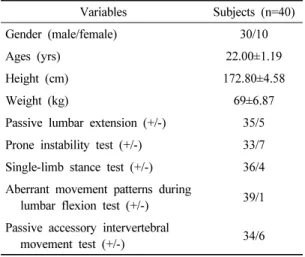
Variables Subjects (n=40)
Gender (male/female) 30/10
Ages (yrs) 22.00±1.19
Height (cm) 172.80±4.58
Weight (kg) 69±6.87
Passive lumbar extension (+/-) 35/5 Prone instability test (+/-) 33/7 Single-limb stance test (+/-) 36/4 Aberrant movement patterns during
lumbar flexion test (+/-) 39/1 Passive accessory intervertebral
movement test (+/-) 34/6
+: positive, -: negative
Table 1. Subject characteristics Kim, 2016). Lumbar segmental instability in the lack of
defects of stability of the lumbar spine has been cited as a main cause of chronic LBP. Abnormal inter-segmental motion and increased movement is frequent in subjects with chronic LBP, often in the absence of other radiological findings (O'Sullivan, 2000). Chronic LBP often causes dysfunction and de-conditioning as well as changes to the neural control system, which influence timing of co-contraction, balance, reflex and righting responses (O'Sullivan et al., 1997).
Proper activation of abdominal muscles is needed in patients with LBP (Bang, 2015; Cho, 2013; Cho et al., 2013; Hwang and Kim, 2011; Kim et al., 2016; van Dieen et al., 2013). Deep trunk muscles are important for trunk stabilization (Gong, 2013; Lee et al., 2016). Deep trunk muscles such as the internal oblique (IO), transverse abdominis (TrA), and lumbar multifidus (LM), important in lumbar stability, activate insufficiently in patients with low back pain (Butcher et al., 2007; Danneels et al., 2002;
Kim et al., 2016). Poor function of trunk deep muscles is associated with LBP (Abdelraouf and Abdel-aziem, 2016). Moreover, activation of deep abdominal muscles such as TrA and IO is delayed and co-activation is absent in patients with low back pain (Massé-Alarie et al., 2012).
Increased activation of deep local muscles could improve spinal joint stability (Vleeming et al., 2014; Unsgaard- Tøndel et al., 2016).
Hu et al. (2010) reported that a PCB during active straight leg raise test (ASLR) improves ASLR performance and reduces abdominal muscle activation. Lumbar stabilization can be achieved by either isometric action of the abdominal muscles or external pelvic compression. Park et al. (2010) and Takasaki et al. (2009) found that a PCB can improve neuromuscular control and prevent unwanted substitution movement during hip joint movement.
Therefore, use of a PCB might improve compensatory movement in a neutral position and provide proper load transfer to the lumbar in females with chronic LBP during
prone hip extension. Furthermore, application of PCB is a conservative method in sacroiliac joint pain therapy (Arumugam et al., 2012a). This belt is inexpensive and has no side effects. There are many studies investigating the muscle activity and mobilization pattern of trunk muscles after wearing a PCB.
Most studies observed immediate change in trunk muscle activity during straight leg raise and bridge exercise while wearing a PCB. However, research on whether any changes in muscle activity of the trunk and lower extremity in bridge position will occur in adults with spinal instability after wearing the PCB is lacking.
Therefore, the purpose of this study was to evaluate the effect of PCB on muscle activity of the trunk and lower extremity muscles in adults with lumbar instability after six week intervention.
Ⅱ. Methods
1. Subjects
Forty subjects with lumbar instability volunteered for
this study (Table 1). With the lumbar apprehension test,
we measured the muscle activity of pelvic limb and trunk
muscles for 40 adults with potentially unsafe vertebrae while wearing the pelvic compression belt (Kasai et al., 2006; Wadsworth et al., 1988; Tidstrand and Horneij, 2009). Our study is based on the inspection method used in previous research to select subjects with lumbar instability (Hidalgo et al., 2014).
Subjects were included if they scored positive on each of the following tests: passive lumbar extension, prone instability test, single-limb stance test, aberrant movement patterns during lumbar flexion test, and passive accessory intervertebral movement test.
Subjects were excluded if they have had orthopedic operations, neurological disorders, and difficulties performing the tasks required because of limitations in range of motion.
Information on the study and written informed consent according to the ethical standards of the Declaration of Helsinki were provided to all subjects prior to their participation, and all agreed to participate in the experiment.
2. Application of the Pelvic Compression Belt (PCB)
The pelvic compression belt (COMPRESSOR, OPTP, USA) consists of a main belt (body belt) and two compression bands. The main belt is attached to pass the anterior superior iliac spine (ASIS) (Damen et al., 2002), and the two compression bands are attached to the main belt to provide additional pressure. One compression band is attached toward the navel in ASIS to prompt transverse abdominals activity, and the other band to the mean physiognomy from anterior superior iliac spine (ASIS) to prompt multifidus muscles activity (Lee, 2004).
In passive lumbar extension test, the subjects are in prone position. An examiner passively elevates legs with knees extended to 30cm and gently pulls the legs. It is considered positive if pain is present during this test (Kasai et al., 2006). In prone instability test, the patient lies prone on the examining table with legs over the edge and feet resting on the floor. While the patient rests in this position with the trunk muscles relaxed, the examiner applies posterior
to anterior pressure to spinous process of the lumbar spine.
Any provocation of pain is reported. Then the subjects lift the legs off the floor and posterior to anterior compression is applied again to the lumbar spine while the trunk muscle is contracted. The test is considered positive if pain is present in the resting position but subsides in the second position, suggesting lumbopelvic instability. The reliability for this inspection is r=.089 (Wadsworth, 1988). The single leg stance test is considered positive if there is excessive pelvic displacement and there is compensatory movement of the upper and lower extremity while maintaining a one leg standing posture for 20 seconds. The reliability for this inspection is r=.88~1.00 (Tidstrand and Horneij, 2009).
For aberrant movement patterns during lumbar flexion test, we labeled the patient as positive when the patient felt pain at bending from a standing posture, and extending from bending, or reversal phenomenon of lumbopelvic rhythm, grower's sign or thigh climbing, or instability catch (Ahn et al., 2003).
The purpose of passive accessory intervertebral movements is to assess the amount and quality of movement at various intervertebral levels, and to treat pain and stiffness of the cervical and lumbar spine. A posterior to anterior force of varying strength is applied by the examiner either centrally onto the spinous process, or unilaterally on either the left or right articular pillar. The test is considered positive if there was excessive motion of the vertebral body and pain (Hidalgo et al., 2014).
3. EMG Recording and Data Processing
We collected the data using an electromyogram (EMG)
MP150 system (BIOPAC System Inc., CA, USA) to meas-
ure trunk muscle activity. With the subjects in the bridge
position, we obtained four analogue electromyography
signals using the MP 150, then digitized and filtered sig-
nals using Acknowledge 3.7.3 (BIOPAC System Inc.,
Santa Barbara, USA). We established a sampling rate of
electromyogram signals to 1,000 Hz, and filtered the am- plified waveform using 60~500 Hz band pass filter and 60 Hz notch filter. To quantify the signals, we used the average root-mean-square (%RVC) value, and normal- ized the signals collected from each muscle to reference voluntary contraction (%RVC) (Beimborn and Morrissey, 1988).
To reduce errors due to repeated measurements, we designated electrode sites of 1 cm in diameter and kept each electrode attachment distanced equally. To reduce electrode to skin contact errors, electrodes were attached after removing skin hair at measurement sites and cleaning skin with medical alcohol. The surface electrodes used for collecting electromyogram values were of the disposable Ag/Agcl type of diameter 11.4 mm. For surface EMG, 2-pole electrode shield cable, consisting of ground, active, and reference electrode, was connected to each electrode (Kasman et al., 1998).
We measured EMG electrode finding muscle positions by pressing the muscle to trace the grain direction of muscle fibers (Hungerford et al., 2003). The attachment sites of surface electrodes are as follows (Kasman et al., 1998).
1) for the elector spinae, 2 cm lateral to the spinous process at the L4-5 interspace; 2) for the oblique internal oblique (IO), in the center of the triangle formed by a horizontal line between the anterior superior iliac spine of the innominate and the umbilicus, midline, and the inguinal ligament; 3) for the rectus femoris, the midpoint between the upper margin of the patella and ASIS; and 4) for the long head of the biceps femoris, the midpoint between the gluteal fold and the knee joint.
To determine the pressure area of the pelvis belt, we conducted pre-pressing pelvis inspection in the supine position. We used the method suggested by Lee (1999).
There are four pressure techniques adapted for pelvis pressure method. For sacroiliac articulation pressure, 1) press both iliac spine of pelvis to rear and inner direction,
2) press both iliac spine of pelvis to front and inner direction, 3) press iliac spine of right pelvis to rear and inner direction and left iliac spine to front and inner, and 4) press iliac spine of right pelvis to front and inner direction, left iliac spine to rear and inner direction. We instructed the subjects to perform an active straight leg raise while pressing sacroiliac articulation in the above four ways. We applied pressure in a random sequence. We selected the appropriate way to fasten pelvis belts by how subjects felt it easiest to do active straight leg raises when pressure was applied randomly.
The bridging position method while wearing the pelvic belt is as follows. At the beginning position, subjects bend their knees to 90 degrees, open their arms to 30 degrees, and have their palms face the ground. The spacing between feet is 20 cm and subjects place their feet in a straight line. Subjects keep their head and neck straight and look at the ceiling while a supervisor instructs the subject to pull the navel toward the spine as if exhaling.
We conducted the bridge exercise to measure muscle activities for reference voluntary contraction (RVC) of pelvic limb and trunk muscles (Choi et al., 2015; Kim et al., 2013). We first obtain data value for five seconds at maximal voluntary isometric contraction, and we use the average of the EMG signal for three seconds, excluding the first and last second as %RVC. This procedure is conducted three times.
4. Procedures
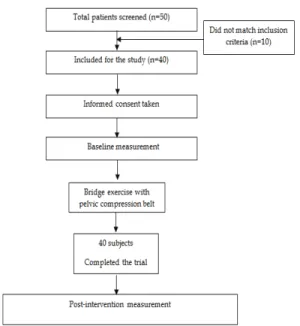
We asked subjects to perform the bridge exercise
with PCB for 30 minutes five times weekly over a six
week period (Fig. 1). All procedures for EMG measure-
ments were performed with the subject in the bridge po-
sition on the table. The EMG activities were measured
in the erector spinae (ES), internal oblique (IO), rectus
femoris (RF) and biceps femoris (BF) while performing
the bridge position.
Pre test Post test Change value Effect size t
Erector spinae 112.16±16.24
a85.16±13.80 27.00±13.42 2.84 9.00**
Internal oblique 81.16±12.52 96.30±12.19 15.13±15.24 1.40 4.44**
Rectus femoris 104.08±14.22 82.48±7.52 21.60±12.28 2.48 7.87**
Biceps femoris
(lateral) 106.98±16.35 88.48±10.17 18.50±16.03 1.63 5.16**
** Significant intergroup difference in the gains achieved ( p <.01)
a