Effect of Prophylactic Palivizumab on Admission Due to
Respiratory Syncytial Virus Infection in Former Very Low Birth Weight Infants with Bronchopulmonary Dysplasia
The aim of this study was to observe the effects of prophylactic palivizumab on
hospitalization secondary to respiratory syncytial virus (RSV) infection (RSVhospitalization) in former very low birth weight infants (VLBWI) with bronchopulmonary dysplasia (BPD).
This study also sought to identify the risk factors of RSVhospitalizationin this particular infant population. A prospective observational study was conducted between September 2007 and April 2008 in seven Korean hospitals. Children with a history of very low birth weight, a diagnosis of BPD and who were < 2 yr old at the onset of the RSV season were included in this study. Palivizumab injections were administered monthly for a maximum of five months during the RSV season. RSVhospitalization rates were reviewed, and RSVhospitalization rates between subgroups were categorized by gestational age, birth weight, and duration of ventilator care. A total of 90 subjects completed the follow-up interviews. The mean gestational age at birth was 26.1 ± 1.7 weeks, and the mean birth weight was 889.4 ± 222.2 g. The incidence of RSVhospitalization in the study population was 8.9% (8/90), and the mean hospital stay was 11.0 ± 5.5 days, including one death.
There were no statistically significant differences in the patients’ demographic characteristics or risk factors for RSV hospitalization. When subgroup analyses were conducted, there were still no statistically significant differences. The administration of palivizumab prophylaxis during the entire RSV season is important in VLBWI with BPD, regardless of their gestational age and birth weight, or previous ventilator dependency.
Keywords: Respiratory Syncytial Viruses; Palivizumab; Hospitalization; Bronchopulmonary Dysplasia; Preterm; Infant
Young Mi Han,1 Hyun Joo Seo,2 Seo Heui Choi,3 Yu Jin Jung,4 So Yoon Ahn,5 Hye Soo Yoo,5 Se In Sung,5 Jae Won Shim,6 Yeon Kyung Lee,7 Sun Young Ko,7 Son Moon Shin,7 Jong Hee Hwang,8 Jang Hoon Lee,9 Byung Min Choi,10 Eun Sun Kim,11 Ji Hyun Jeon,11 Sung Shin Kim,12 Yun Sil Chang,5 and Won Soon Park5
Department of Pediatrics, 1Pusan National University School of Medicine, Children’s Hospital, Yangsan;
2Seoul Medical Center, Seoul; 3Changwon Samsung Hospital, Sungkyunkwan University School of Medicine, Changwon; 4Inje University Haeundae Paik Hospital, Pusan; 5Samsung Medical Center, Sungkyunkwan University School of Medicine, Seoul; 6Kangbuk Samsung Hospital, Sungkyunkwan University School of Medicine, Seoul; 7Cheil General Hospital and Women’s Healthcare Center, Dankook University, College of medicine, Seoul; 8Ilsan Paik Hospital, Inje University School of Medicine, Goyang; 9Ajou University School of Medicine, Suwon; 10College of Medicine, Korea University, Seoul; 11Kangwon National University School of Medicine, Kangwon National University Hospital, Chuncheon; 12Soonchunhyang University Bucheon Hospital, Soonchunhyang University College of Medicine, Bucheon, Korea
Received: 12 November 2014 Accepted: 1 April 2015 Address for Correspondence:
Won Soon Park, MD
Department of Pediatrics, Samsung Medical Center, Sungkyunkwan University School of Medicine, 81 Irwon-ro, Gangnam-gu, Seoul 135-230, Korea
Tel: +82.2-3410-3523, Fax: +82.2-3410-0043 E-mail: [email protected]
Funding: This study was supported by a grant from the AbbVie (P06-145).
http://dx.doi.org/10.3346/jkms.2015.30.7.924 • J Korean Med Sci 2015; 30: 924-931
INTRODUCTION
The survival rate of extremely premature infants, including very low birth weight infants (VLBWI), has increased due to advances in maternal fetal medicine and neonatal in- tensive care unit (NICU) treatment. Regardless, the incidence of bronchopulmonary dysplasia (BPD), a major cause of postnatal mortality and morbidity, has not decreased in premature infants. The risk of BPD is even higher in infants with shorter gestational periods and lower birth weights (1, 2).
Even after discharge from the NICU, there is a high rehospitalization rate in VLBWI (3-5). Respiratory syncytial virus (RSV) infection in patients with BPD is known to in- crease the rehospitalization rate and mortality of VLBWI, because it leads to more se- vere complications (6-8). According to a Korean report, 38% of VLBWI were rehospital- ized within one year of discharge from the NICU, and 56% of cases were related to the respiratory system. Among these patients, 32% tested positive for RSV infection and 18% were rehospitalized within one year (9). In premature infants with BPD, the RSV hospitalization rate ranges between 8.8% (10) and 36.7% (11). RSV infection poses a risk of serious complications in premature infants, especially those with BPD. Unfortu- nately, an RSV vaccine has not yet been developed. However, palivizumab, a human monoclonal antibody with recombinant DNA technology, is a safe and effective (12,
13) method of preventing serious RSV disease. Palivizumab has been used in over 80 countries following its approval by the US Food and Drug Administration in 1998 (14-18).
Palivizumab has been marketed in Korea since 2005. It is the only preventive medication for RSV infection indicated for pre- mature infants with BPD in Korea. However, there are few do- mestic reports regarding RSV infection in infants with BPD who received palivizumab prophylaxis because it has only been cov- ered by medical insurance since January 2006. Prospective re- ports are lacking in regard to real-world RSV infection rates af- ter palivizumab prophylaxis in VLBWI with BPD. There is also little information regarding differences in the RSV hospitaliza- tion rate based on BPD, and the number of administered palivi- zumab injections. Therefore, a multi-center, national, prospec- tive study was conducted on RSV hospitalization rate after NICU discharge with the use of palivizumab in VLBWI with BPD. We also collected information on the following BPD risk factors:
gestational age, birth weight, ventilator dependency, and the number of palivizumab injections.
MATERIALS AND METHODS Study subjects
A multi-center, prospective, observational study was conducted to determine the rate of RSVhospitalization in VLBWI with BPD who received prophylaxis with palivizumab. Patients were pro- spectively recruited between September 2007 and April 2008 from the following seven tertiary care hospitals: Samsung Med- ical Center, Kangbuk Samsung Hospital, Cheil General Hospital
& Women’s Healthcare Center, Ilsan Paik Hospital, Korea Uni- versity Ansan Hospital, CHA Gangnam Medical Center, and Soonchunhyang University Bucheon Hospital. The participants and their legal representatives (as children are unable to make their own medical decisions) were educated about the nature of the study and the expected results. The principal investigator obtained written consent from the subject’s legal representa- tive. No procedure or test was conducted without consent. The study subjects included former-premature children (born at 35 weeks gestation or earlier) with birth weights of ≤ 1,500 g, who had been treated for BPD within 6 months of the RSV season and who were ≤ 24 months old at the time of the study’s onset.
A child who required oxygen up to 28 days after birth was de- fined as having BPD. Subjects were excluded from the study if any of the following criteria applied: required the use of a venti- lator at the start of the study, had a life expectancy of 6 months or less, had active RSV infection or a recent RSV infection, had liver or renal dysfunction, had history of seizure, immunodefi- ciency, or were allergic to IgG agents, received RSV immuno- globulin within three months of the study, or received any other RSV-directed monoclonal antibody or palivizumab.
Palivizumab administration
An initial dose of 15 mg/kg of palivizumab was administered to eligible study subjects. Two to five injections of palivizumab were administered monthly. In Korea, RSV season generally lasts from October to March; therefore, palivizumab adminis- tration started in September, one month before the beginning of the RSV season.
Data collection and analysis
Patient data including gestational age, birth weight, and known risk factors of RSV infection were elicited from caregiver inter- views and reviews of the medical records. All assessments were conducted in person or via phone at the time of palivizumab administration. Assessments were continued for 30 days after the last palivizumab administration. Medical records related to ventilator use or the need for oxygen were reviewed as needed.
The RSV rapid antigen test was performed and recorded if the subject was suspected to have been previously hospitalized with RSV.
The hospitalization rate due to lower respiratory infection with RSV after the administration of palivizumab was reviewed.
Patient demographic characteristics were collected. Subjects were separated into one of three groups: the “RSV hospitaliza- tion group” (hospitalized subjects with a positive RSV rapidan- tigen test), the “other lower respiratory tract infection (LRTI) hospitalization group” (subjects with a medical history of hos- pitalization due to unknown origin or a non-RSV infection), and the “non- hospitalization group.” Risk factors and the duration of hospital stays were recorded for patients with a history of palivi- zumab injections and RSV hospitalization.
Subjects were divided based on gestational age, birth weight, and the number of days on a ventilator. The difference in hospi- talization rates due to RSV infection was investigated. The risk factors for RSV hospitalization were also analyzed for each group.
Subjects were divided into the following groups based on their gestational age: < 26 weeks, 26-28 weeks, and 29-31 weeks. Sub- jects were also divided into the following groups based upon their birth weight: < 750 g, 750-999 g, 1,000-1,249 g, and 1,250- 1,500 g. In order to classify the severity of the subjects’ respira- tory states, they were placed into the following groups based upon how long they required ventilator use: < 30 days, 30-59 days, 60-89 days, and 90-120 days.
Statistical analysis
Statistical analyses sought to determine the factors related to RSV hospitalization, and were performed using SPSS version 18 (SPSS Inc., Chicago, IL, USA). SPSS was also used to analyze patient characteristics in those with RSV infection. The results are expre- ssed as means ± standard deviations. A Student t-test was used on a continuous scale, and a chi-square test was used on a nomi- nal scale. Statistical significance was defined by P values < 0.05.
Ethics statement
This study was approved by the institutional review board of the Samsung Medical Center (IRB No. 2006-11-025) and the other six participating hospitals and written informed consent was obtained from all parents.
RESULTS
Subject characteristics
Ninety children were enrolled in the study, with 44 male (48.9%), and 46 female (51.1%) participants. The subjects’ gestational ages ranged between 23 and 31 weeks (mean 26.1 ± 1.7 weeks).
Fifty-two subjects (57.8%) were 26 weeks or younger at birth.
The mean birth weight was 889.4 ± 222.2 g; 66 subjects (73.3%) weighed ≤ 1,000 g. All of the subjects received treatment in the NICU with a mean hospital stay of 93.5 ± 31.1 days. Eighty-nine subjects (98.9%) were on a ventilator after birth for a mean of 39.1 ± 30.4 days of use. All of the subjects who required ventila- tor support received oxygen treatment for a mean of 73.0 ± 41.1 days. At study enrollment, the mean subject age was 46.9 ± 15.9 weeks (ranging from 28 days to 17.8 months). The mean weight at enrollment was 3,781.9 ± 2,322.9 g.
Analysis of the risk factors for RSV hospitalization
Of the 90 subjects who received palivizumab, 17 subjects were hospitalized with 21 cases of respiratory infection. A RSV rapid antigen test was conducted in 14 of the 21 respiratory cases, and eight cases of RSV were confirmed in seven subjects. Seventeen (18.9%) subjects were hospitalized secondary to their respirato- ry infections. And among these subjects, RSV infection was con-
firmed in seven (7.8%). The demographic characteristics of the RSV hospitalization group, other LRTI hospitalization group, and non-hospitalization group is presented in Table 1. The fol- lowing previously reported risk factors of RSV hospitalization were not statistically associated with RSV hospitalization in our study: gestational age, weight, gender distribution, duration of hospital stay after birth, duration of ventilator and oxygen use, multifetal gestation, and the number of siblings attending pre- school/elementary school.
RSV hospitalization group
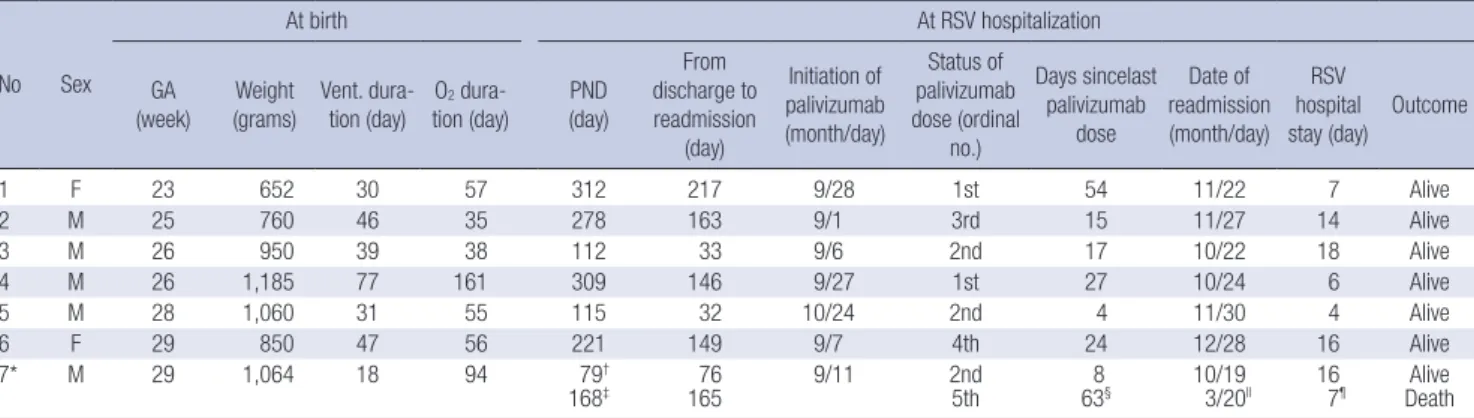
Seven subjects were hospitalized with RSV infections (5 male, 2 female). One subject had two RSV infections during the obser- vational period, making a total of eight cases. The mean gesta- tional age of this group was 26.6 ± 2.2 weeks (23-29 weeks); the mean birth weight was 931.6 ± 188.3 g (652-1,185 g). The mean hospital stay length in the NICU after birth was 100.0 ± 30.0 days (72-163 days). The mean duration of ventilator use was 40.3 ± 19.0 days (18-77 days). The mean duration of oxygen adminis- tration was 77.7 ± 41.9 days (35-161 days). Three subjects had a history of patent ductus arteriosus, all of which resolved prior to RSV infection. The mean postnatal ageat the time of RSVhos- pitalization was 199.3 ± 93.8 days (79-312 days), and the time from hospital discharge (after birth) to RSV hospitalization was 122.6 ± 67.6 days (32-217 days).
Eight cases of RSV hospitalization were observed in seven subjects. Six cases (75.0%) occurred between October and No- vember 2007, one case (12.5%) in December 2007, and one case (12.5%) in March 2008. There were two cases (25.0%) of RSV hos- pitalization following one palivizumab injection, three cases Table 1. Demographics and predicted risk factors related to RSV hospitalization in VLBWI with BPD
Parameters Total
(n = 90) RSV hospitalization
(n = 7) Other LRTI hospitalization
(n = 10) Non-hospitalization
(n = 73) P value
Gestational age (week) 26.1 ± 1.7 26.6 ± 2.2 26.5 ± 6.5 26.0 ± 6.0 0.610
Birth weight (g) 889.4 ± 222.2 931.6 ± 188.3 955.4 ± 55.4 879.7 ± 79.7 0.505
Male (n, %) 44 (48.9) 5 (71.4) 6 (60) 33 (45.2) 0.314
SGA (n, %) 8 (8.9) 1 (14.3) 1 (10) 5 (6.8) 0.858
Initial hospital stay (day) 93.5 ± 3.5 100.0 ± 30.0 89.5 ± 9.5 92.9 ± 2.9 0.802
Mechanical ventilation (day) 39.1 ± 30.4 40.3 ± 19.0 36.4 ± 6.4 40.6 ± 0.6 0.492
Oxygen therapy (day) CHD (n, %) PDA (n, %) ASD (n, %) VSD (n, %)
73.0 ± 41.1 11 (12.8)
6 (6.7) 4 (4.4) 1 (1.1)
77.7 ± 41.9 0 0 0 0
69 ± 9.9 0 0 2 (20)
0
82.1 ± 2.1 11 (15.1) 6 (8.2) 2 (2.7) 1 (1.4)
0.924 0.096 0.065 0.038 0.889
CA at enrollment (week) 46.9 ± 6.9 47.0 ± 12.4 51.2 ± 1.2 46.5 ± 6.5 0.659
Weight at enrollment (g) 3,781.9 ± 2,322.9 4,227.1 ± 2,455.8 3,926 ± 926 3,767.8 ± 767.8 0.843
Multiple birth (n, %) 25 (27.8) 1 (14.3) 1 (10) 22 (30.1) 0.257
Siblings (n, %) 49 (54.4) 4 (57.1) 5 (50) 40 (54.8) 0.949
Siblings attending childcare (n, %) 12 (13.3) 0 2 (20) 10 (13.7) 0.480
Smoke exposure (n, %) 14 (15.6) 1 (14.3) 1 (10) 12 (16.4) 0.866
Family history of atopy (n, %) 10 (12.5) 0 1 (10) 9 (12.3) 0.644
Values are mean ± standard deviation unless otherwise stated. RSV, respiratory syncytial virus; VLBWI, very low birth weight infants; BPD, bronchopulmonary dysplasia; LRTI, lower respiratory tract infection; SGA, small for gestational age; CHD, congenital heart disease; PDA, patent ductus arteriosus; ASD, atrial septal defect; VSD, ventricular septal defect; CA, chronological age.
(37.5%) after two injections, and one case each after three, four, and five. The incidence of RSV hospitalization based on the num-
ber of prior palivizumab injections is shown in Fig. 1. The mean number of palivizumab injections before RSV hospitalization was 2.3 ± 1.4, which is lower than the mean number of injections received by children who were hospitalized with non-RSV in- fections (4.0 ± 1.2); however, the difference was not statistically significant. The first injections were given in early September (three subjects), mid-September (one subject), late September (two subjects), and late October (one subject). The time from the last palivizumab injection to RSV hospitalization ranged from 4 to 63 days, with a mean of 21.3 ± 16.6 days (Table 2).
The mean duration of RSV hospitalization was 11.0 ± 5.5 days (4-18 days). There were two cases of ventilator use and oxygen treatment; among these subjects, one death occurred. The child that died was a male born at 29 weeks. His birth weight was 1,064 g, and he had received two doses of palivizumab in early Sep- tember and October 2007 during his first admission. His hospi- talization after birth was prolonged due to an RSV infection in mid-October. Oxygen and drug treatments with sildenafil, furo- semide, and spironolactone were continued after his discharge due to severe BPD and pulmonary hypertension. By mid-Janu- Fig. 1. Respiratory virus–related hospitalization rates according to the number of
palivizumab injections. V1, visit for first palivizumab injection; RSV RH, respiratory syncytial virus–related hospitalization; Palivizumab No., Number of patients who re- ceived the injection.
Number of patients
Visit for palivizumab injection V1 V2 V3 V4 V5 100
80 60 40 20 0
(2.2%) 2
90
3
88 (3.4%)
1
80 (1.3%)
1
69 (1.5%)
1
46 (2.2%)
RSV RH Palivizumab No.
Table 2. Characteristics of RSV hospitalization VLBWI with BPD
No Sex
At birth At RSV hospitalization
GA
(week) Weight
(grams) Vent. dura- tion (day) O2 dura-
tion (day) PND (day)
From discharge to readmission
(day)
Initiation of palivizumab (month/day)
Status of palivizumab dose (ordinal
no.)
Days sincelast palivizumab
dose
Date of readmission (month/day)
RSV hospital stay (day) Outcome
1 F 23 652 30 57 312 217 9/28 1st 54 11/22 7 Alive
2 M 25 760 46 35 278 163 9/1 3rd 15 11/27 14 Alive
3 M 26 950 39 38 112 33 9/6 2nd 17 10/22 18 Alive
4 M 26 1,185 77 161 309 146 9/27 1st 27 10/24 6 Alive
5 M 28 1,060 31 55 115 32 10/24 2nd 4 11/30 4 Alive
6 F 29 850 47 56 221 149 9/7 4th 24 12/28 16 Alive
7* M 29 1,064 18 94 79†
168‡ 76
165 9/11 2nd
5th 8
63§ 10/19
3/20ll 16
7¶ Alive Death
*Twice of RSV hospitalization; †, ‡First and second RSV hospitalization, respectively; §Days from last palivizumab injection to confirmation of RSV infection; llDate of RSV infection confirmation; ¶Days from RSV infection confirmation to expire. RSV, respiratory syncytial virus; VLBWI, very low birth weight infants; BPD, bronchopulmonary dysplasia; M, male;
F, femal; GA, gestational age; Vent, ventilator; PND, postnatal days.
Table 3. Subgroup analysis of RSV hospitalization in VLBWI with BPD according to gestational age, birth weight, and ventilator duration
Parameters Total
(n = 90)
RSV hospitalization (n = 7)
Other LRTI hospitalization (n = 10)
Non-hospitalization
(n = 73) P value
Gestational age, weeks (n, %) 23-25
26-28 29-31
36 46 8
2 (5.6) 3 (6.5) 2 (25.0)
1 (2.8) 9 (19.6)
0
33 (91.7) 34 (73.9) 6 (75.0)
0.036
Birth weight, gm (n, %) < 750
750-999 1,000-1,249 1,250-1,500
27 38 16 9
1 (3.7) 3 (7.9) 3 (18.8)
0
1 (3.7) 6 (15.8) 2 (12.5) 1 (11.1)
25 (92.6) 29 (76.3) 11 (68.7) 8 (88.9)
0.423
Ventilator duration, days (n, %) 0-29
30-59 60-89 90-120 Unknown
33 41 8 6 2
1 (3.0) 5 (12.2) 1 (12.5)
0 -
3 (9.1) 2 (4.9) 3 (37.5) 1 (16.7) 1 (50.0)
29 (87.9) 34 (82.9) 4 (50.0) 5 (83.3) 1 (50.0)
0.088
RSV, respiratory syncytial virus; VLBWI, very low birth weight infants; BPD, bronchopulmonary dysplasia; LRTI, lower respiratory tract infection.
ary 2008, he had received five palivizumab injections. Two days after the fifth palivizumab injection, he was rehospitalized with dyspnea and decreased feeding. Although the RSV rapid anti- gen test was negative at the time of rehospitalization, a test in late March was positive for RSV. The patient developed worsen- ing dyspnea and died after 7 days of pneumothorax.
Analysis of RSV hospitalization based on groups
RSV hospitalization was analyzed in each of the following groups:
gestational age (weeks), birth weight, and days on a ventilator (Table 3). There was a significantly higher RSV hospitalization rate in the gestational age group of 29- 31 weeks compared to that of the other gestational age groups (Fig. 2). In addition, there was a significantly higher rate of small for gestational age infants in this particular gestational age group compared to that found in other gestational age groups (Table 4). Each group was also
compared with regard to gestational age, birthweight, gender distribution, duration from birth to discharge, duration of ven- tilator and oxygen use, multi-fetal gestation, and the number of siblings attending preschool or elementary school. There were no other significant differences between the groups, which may have been a result of the small sample sizes.
DISCUSSION
Of the 90 subjects who received palivizumab, 17 subjects were hospitalized with 21 cases of respiratory infection. Of these 21 cases, an RSV rapid antigen test was conducted in 14 cases, and eight cases of RSV infection were confirmed in seven subjects.
Therefore, the overall rate of respiratory hospitalization was 23.3% (21/90), and the rate of RSV hospitalization was 8.9% (8/
90). RSV accounted for 38.1% (8/21) of the respiratory infections observed. This figure may actually underestimate the true val- ue, because one third of respiratory hospitalizations were not tested for RSV.
The rate of RSV hospitalizations in premature infants with BPD who did not receive palivizumab prophylaxis ranges from 8.8% (4) to 36.7% (5). A prior domestic study reported a rate of 22.2% (19). However, the RSV hospitalization rate after palivi- zumab in premature infants with BPD was found to be 5.8% (17) in the United States and 6.0% (20) in Canada. These studies in- cluded subjects at a more mature stage of development (mean gestational age of 30 weeks and mean birth weight of 1,500 g) compared to those in our study (26 weeks and 889 g, respective- ly). IMpact study (21) documented that after palivizumab ad- ministration in premature infants (mean gestational age of 29 weeks and mean birth weight of 1,300 g) with BPD lead to a de- crease in RSV infection rate from 12.8% to 7.9%. The RSV hospi- Fig. 2. Comparisons of RSV hospitalization in VLBWI with BPD according to gesta-
tional age groups (P = 0.023). RSV, respiratory syncytial virus; VLBWI, very low birth weight infants; BPD, bronchopulmonary dysplasia; RSV RH, respiratory syncytial vi- rus-related hospitalization.
Number of patients
Gestational age groups (week)
23-25 26-28 29-31
50 40 30 20 10 0
34
2
43
3 6
2
Non-RSV RSV RH Table 4. Demographics of subgroups according to gestational age in VLBWI with BPD
Parameters 23-25 weeks (n = 36) 26-28 weeks (n = 46) 29-31 weeks (n = 8) P value
Birth weight (g) 729.8 ± 115.1 979.9 ± 208.9 1,088.0 ± 225.5 0.000
Male (n, %) 14 (38.9) 25 (54.3) 5 (62.5) 0.275
SGA (n, %) 0 5 (10.9) 3 (37.5) 0.003
Initial hospital stay (day) 107.5 ± 29.1 85.6 ± 30.6 76.5 ± 17.4 0.001
Mechanical ventilation (day) 48.5 ± 27.4 34.3 ± 32.6 25.8 ± 19.0 0.048
Oxygen therapy (day) CHD (n, %) PDA (n, %) ASD (n, %) VSD (n, %)
88.1 ± 34.4 1 (2.8) 2 (5.6) 1 (2.8) 0
64.9 ± 44.2 4 (8.7) 3 (6.5) 3 (6.5) 1 (2.2)
52.5 ± 30.2 0 1 (12.5)
0 1 (12.5)
0.013 0.394 0.493 0.584 0.617
CA at enrollment (week) 45.9 ± 13.8 48.5 ± 18.3 41.6 ± 6.9 0.478
Weight at enrollment (g) 3,774.4 ± 2,246.4 3,959.4 ± 2,520.2 2,795.0 ± 1,107.6 0.429
Multiple birth (n, %) 8 (22.2) 16 (34.8) 1 (12.5) 0.271
Siblings (n, %) 19 (52.8) 27 (58.7) 3 (37.5) 0.522
Siblings attending childcare (n, %) 6 (16.7) 6 (13.0) 0 0.454
Smoke exposure (n, %) 9 (25.0) 4 (8.7) 1 (12.5) 0.126
Family history of atopy (n, %) 5 (16.1) 4 (9.8) 1 (12.5) 0.721
Values are mean ± standard deviation unless otherwise stated. VLBWI, very low birth weight infants; BPD, bronchopulmonary dysplasia; LRTI, lower respiratory tract infection;
SGA, small for gestational age; CHD, congenital heart disease; PDA, patent ductus arteriosus; ASD, atrial septal defect; VSD, ventricular septal defect; CA, chronological age.
talization rate in this study (8.9%) is relatively high compared to that of other studies. However, this study included subjects who were more premature with a mean gestational age of 26 weeks and a mean birth weight of 889.4 ± 222.2 g than were the sub- jects included in other studies (14, 17, 20).
Although one might hypothesize that low gestational age, low birth weight, and respiratory severity are important risk factors associated with RSV hospitalization, none of these factors was significantly associated with RSV hospitalization in our study.
When the subjects were divided into three groups based on ges- tational age, RSV hospitalization was significantly higher in the group of subjects in the 29-31 weeks group. However, the sub- jects from the younger gestational age groups had longer hospi- tal stays and spent more time on a ventilator than did those in the 29-31 weeks group. Interestingly, the proportion of small for gestational age infants was still significantly higher in the 29-31 weeks group compared to that of other groups.
At the time of RSV hospitalization, most children (5/8; 62.5%) had already received one or two injections of palivizumab. This finding is similar to the report from the Palivizumab Outcomes Registry (17) of high-risk children who received palivizumab at 35-day intervals and were hospitalized with RSV infection. They report that 75% (36/48) of RSV infections occurred prior to the third palivizumab injection. Some experts believe that three out of the five recommended administrations of palivizumab dur- ing the RSV season may be sufficient for prophylaxis. After the third palivizumab administration, the serum concentration de- creases by 52% at 4 months, and by 85% at 5 months after the initial administration. After the fifth administration, however, the serum concentration is reduced to less than the fifth percen- tile (21). Therefore, three injections are not sufficient for com- plete RSV prevention. One Japanese study (22) reported that RSV can be detected in infants within 5 days of palivizumab ad- ministration, and within 20-30 days in premature infants with chronic pulmonary diseases. Palivizumab produces a prophy- lactic effect via passive immunity. It has a half-life of 20 days;
therefore, its efficacy depends on the serum concentration that is maintained during the time of RSV exposure. Five adminis- trations at an appropriate time interval are the most efficacious for effective prophylaxis.
RSV hospitalization occurred from September to March. Pali- vizumab was administered to hospitalized patients in late Sep- tember (two patients) and in late October (one patient). Gener- ally, the RSV season in Korea occurs between October and March.
The incidence of infection is particularly high between Novem- ber and January. Still, the RSV season varies every year, and in- fections can occur as early as July and as late as May (23-25). The RSV detection rate in preterm infants and LBWI are significant- ly higher during both the RSV season and non-RSV season com- pared to the rates in full-term infants (26). The incidence of RSV hospitalization in those who already received palivizumab pro-
phylaxis may suggest that RSV exposure prior to achieving suf- ficient palivizumab serum concentrations may cause infection.
Comorbidities like BPD in premature infants also increase the risk of infection in this group. Risk of infection is also influenced by inter-patient variability with regard to serum trough concen- trations, inoculum of RSV exposure, number of palivizumab doses received and timing between the doses. It is difficult to determine the timing for optimal palivizumab prophylaxis, as the RSV season varies every year. However, the initial palivizum- ab administration should occur before the start of the RSV sea- son. The RSV season in Korea (October to March of the follow- ing year) starts even earlier in high-risk, premature infants.
In conclusion, this study prospectively evaluated the incidence of RSV hospitalization after palivizumab prophylaxis in VLBWI with BPD. This is the first prospective study of palivzumab pro- phylaxis in a population of purely VLBWI with BPD in Korea.
There are two main differences between our study andt he sim- ilar prior studies (27-29). In contrast to other groups, we con- ducted a prospective, observational study in formerly VLBWI with BPD, which is a very high-risk group for RSV infection. An- other difference is that the subjects included in our study were younger (and smaller) than were those included in prior stud- ies, with a mean gestational age of 26.1 ± 1.7 weeks, and a mean birth weight of 889.4 ± 222.2 g (14, 17, 20, 27-29). In this small group of Korean VLBWI with BPD, approximately 40% of respi- ratory infections were due to RSV. Even after one or two palivi- zumab injections, 62.5% of infants in this study still acquired RSV. With regard to this finding, it is clear that 1-2 injections are insufficient, and proper prophylaxis for high-risk children in- volves up to five monthly injections of palivizumab during the RSV season. Our findings can be generalized to other high-risk BPD patients who were formerly VLBWI (with similar gestation- al age and birth weight characteristics to those in this study) as a reference for appropriate palivizumab prophylaxis. The 29-31 weeks of gestational age group had a significantly higher RSV hospitalization rate compared to that of other groups. This par- ticular group also had a higher rate of small for gestational age infants than did other groups. In this respect, it may be worth studying underdevelopment for gestational age.
This study has several limitations. The small sample size may have prevented detection of significant differences in the risk factor analysis. In addition, there was no control group, and the study design itself was observational, which has its own inher- ent limitations. However, the number of premature infants with BPD who have been injected with palivizumab is increasing, and medical insurance coverage has been expanded to children born at ≤ 31 weeks of gestation and less than 6 months of age at the beginning of the RSV season. Therefore, we expect that future studies will have a larger sample of infants that will more accurately reflect the epidemiology and demographic charac- teristics of Korea. In this manner, the most effective palivizum-
ab administration schedule will be determined, and initiated in VLBWI to protect against RSV infection.
DISCLOSURE
Jae Won Shim, Yeon Kyung Lee, Jong Hee Hwang, Jang Hoon Lee, Ji Hyun Jeon, Sung Shin Kim, Yun Sil Chang, and Won Soon Park have received research funding from the AbbVie. The fun- der made no influence in this study. Young Mi Han, Hye SooYoo, So Yoon Ahn, Se In Sung, Eun Sun Kim, Hyun JooSeo, SeoHeui Choi, Jung Yu Jin,Son Moon Shin, and Byung Min Choi have nothing to disclose.
AUTHOR CONTRIBUTION
Study conception and coordination: Park WS, Shim JW, Lee JH, Lee YK, Hwang JH, Jeon JH, Kim SS. Design of ethical issues:
Shin SM, Choi BM, Ko SY. Data acquisition: Seo HJ, Choi SH, Jung YJ, Yoo HS, Sung SI, Kim ES, Shim JW, Lee YK, Hwang JH, Lee JH, Kim SS, Choi BM. Data review: Han YM, Ahn SY. Statis- tical analysis: Han YM, Ahn SY. Manuscript preparation: Chang YS, Han YM, Ahn SY. Manuscript approval: all authors.
ORCID
Won Soon Park http://orcid.org/0000-0002-8245-4692 Yun Sil Chang http://orcid.org/0000-0001-9201-2938 So Yoon Ahn http://orcid.org/0000-0002-1821-3173 Hye Soo Yoo http://orcid.org/0000-0001-7230-1839 Se In Sung http://orcid.org/0000-0002-8717-6142 Young Mi Han http://orcid.org/0000-0002-6120-0490 Hyun JooSeo http://orcid.org/0000-0001-7440-6503 Yu Jin Jung http://orcid.org/0000-0003-2711-4449 Jae Won Shim http://orcid.org/0000-0003-0101-3076 Yeon Kyung Lee http://orcid.org/0000-0001-8618-109X Jang Hoon Lee http://orcid.org/0000 0003 4765 9948 Byung Min Choi http://orcid.org/0000-0003-0931-2353 Eun Sun Kim http://orcid.org/0000-0003-1314-150X Ji Hyun Jeon http://orcid.org/ 0000-0002-4512-2728 Sung Shin Kim http://orcid.org/0000-0002-2669-9345 REFERENCES
1. Reiss I, Landmann E, Heckmann M, Misselwitz B, Gortner L. Increased risk of bronchopulmonary dysplasia and increased mortality in very pre- term infants being small for gestational age. Arch Gynecol Obstet 2003;
269: 40-4.
2. Bancalari E, Claure N, Sosenko IR. Bronchopulmonary dysplasia: chang- es in pathogenesis, epidemiology and definition. Semin Neonatol 2003;
8: 63-71.
3. McCormick MC, Shapiro S, Starfield BH. Rehospitalization in the first
year of life for high-risk survivors. Pediatrics 1980; 66: 991-9.
4. Morris BH, Gard CC, Kennedy K, NICHD Neonatal Research Network.
Rehospitalization of extremely low birth weight (ELBW) infants: are there racial/ethnic disparities? J Perinatol 2005; 25: 656-63.
5. Lamarche-Vadel A, Blondel B, Truffer P, Burguet A, Cambonie G, Sel- ton D, Arnaud C, Lardennois C, du Mazaubrun C, N’Guyen S, et al.; EPI- PAGE Study Group. Re-hospitalization in infants younger than 29 weeks’
gestation in the EPIPAGE cohort. Acta Paediatr 2004; 93: 1340-5.
6. Hack M, DeMonterice D, Merkatz IR, Jones P, Fanaroff AA. Rehospital- ization of the very-low-birth-weight infant. A continuum of perinatal and environmental morbidity. Am J Dis Child 1981; 135: 263-6.
7. Cunningham CK, McMillan JA, Gross SJ. Rehospitalization for respira- tory illness in infants of less than 32 weeks’ gestation. Pediatrics 1991; 88:
527-32.
8. Elder DE, Hagan R, Evans SF, Benninger HR, French NP. Hospital ad- missions in the first year of life in very preterm infants. J Paediatr Child Health 1999; 35: 145-50.
9. Kim SJ, Chae SH, Lee JH, Kim YJ, Koo SH, Jeon GW, Chang YS, Park WS.
Rehospitalization of very low birth weight infants in first year after dis- charge from NICU and risk factor of rehospitalization caused by respira- tory illness. J Korean Soc Neonatol 2006; 13: 17-23.
10. Thomas M, Bedford-Russell A, Sharland M. Hospitalisation for RSV in- fection in ex-preterm infants-implications for use of RSV immune globu- lin. Arch Dis Child 2000; 83: 122-7.
11. Groothuis JR, Gutierrez KM, Lauer BA. Respiratory syncytial virus infec- tion in children with bronchopulmonary dysplasia. Pediatrics 1988; 82:
199-203.
12. Johnson S, Oliver C, Prince GA, Hemming VG, Pfarr DS, Wang SC, Dor- mitzer M, O’Grady J, Koenig S, Tamura JK, et al. Development of a hu- manized monoclonal antibody (MEDI-493) with potent in vitro and in vivo activity against respiratory syncytial virus. J Infect Dis 1997; 176:
1215-24.
13. Young J. Development of a potent respiratory syncytial virus-specific mo- noclonal antibody for the prevention of serious lower respiratory tract disease in infants. Respir Med 2002; 96: S31-S5.
14. Oh PI, Lanctôt KL, Yoon A, Lee DS, Paes BA, Simmons BS, Parison D, Manzi P; Composs Investigators. Palivizumab prophylaxis for respira- tory syncytial virus in Canada: utilization and outcomes. Pediatr Infect Dis J 2002; 21: 512-8.
15. Sorrentino M, Powers T. Effectiveness of palivizumab: evaluation of out- comes from the 1998 to 1999 respiratory syncytial virus season. The Palivi- zumab Outcomes Study Group. Pediatr Infect Dis J 2000; 19: 1068-71.
16. Frogel M, Nerwen C, Cohen A, VanVeldhuisen P, Harrington M, Boron M; Palivizumab Outcomes Registry Group. Prevention of hospitaliza- tion due to respiratory syncytial virus: results from the Palivizumab Out- comes Registry. J Perinatol 2008; 28: 511-7.
17. Parnes C, Guillermin J, Habersang R, Nicholes P, Chawla V, Kelly T, Fish- bein J, McRae P, Goessler M, Gatti A, et al.; Palivizumab Outcomes Reg- istry Study Group. Palivizumab prophylaxis of respiratory syncytial vi- rus disease in 2000-2001: results from The Palivizumab Outcomes Regis- try. Pediatr Pulmonol 2003; 35: 484-9.
18. Saji BT. Indications, efficacy and safety of anti-RS virus monoclonal an- tibody palivizumab (Synagis) for pediatric patients with congenital heart diseases. J Korean Pediatr Cardiol Soc 2007; 11: 149-50.
19. Lee EA, Jeong JH, Yu ST, Lee CW, Yoon HS, Park DS, Oh YK. Incidence
and risk factors of rehospitalization with respiratory syncytial virus in- fection in premature infants. Korean J Pediatr 2004; 47: 510-4.
20. Palivizumab, a humanized respiratory syncytial virus monoclonal anti- body, reduces hospitalization from respiratory syncytial virus infection in high-risk infants. The IMpact-RSV Study Group. Pediatrics 1998; 102:
531-7.
21. La Via WV, Notario GF, Yu XQ, Sharma S, Noertersheuser PA, Robbie GJ. Three monthly doses of palivizumab are not adequate for 5-month protection: a population pharmacokinetic analysis. Pulm Pharmacol Ther 2013; 26: 666-71.
22. Kusuda S, Takahashi N, Saitoh T, Terai M, Kaneda H, Kato Y, Ohashi A, Watabe S, Joh-o K, Hirai K. Survey of pediatric ward hospitalization due to respiratory syncytial virus infection after the introduction of palivizu- mab to high-risk infants in Japan. Pediatr Int 2011; 53: 368-73.
23. Lim JS, Woo SI, Kwon HI, Baek YH, Choi YK, Hahn YS. Clinical charac- teristics of acute lower respiratory tract infections due to 13 respiratory viruses detected by multiplex PCR in children. Korean J Pediatr 2010; 53:
373-9.
24. Jeong JW, Hwang YH, Cho KS, Jung MJ, Min SK, Kim SJ, Chung WS. Vi- ral etiology and epidemiology of outpatients with acute respiratory ill- nesses in Busan: 2007-2008. Korean J Pediatr Infect Dis 2010; 17: 130-6.
25. Kim CK, Choi J, Callaway Z, Kim HB, Chung JY, Koh YY, Shin BM. Clini- cal and epidemiological comparison of human metapneumovirus and respiratory syncytial virus in Seoul, Korea, 2003-2008. J Korean Med Sci 2010; 25: 342-7.
26. Park KH, Shin JH, Lee EH, Seo WH, Kim YK, Song DJ, Choi BM, Choung JT, Hong YS. Seasonal variations of respiratory syncytial virus infection among the children under 60 months of age with lower respiratory tract infections in the capital area, the Republic of Korea, 2008-2011. J Korean Soc Neonatol 2012; 19: 195-203.
27. Chang SG, Park MS, Yu JE. Outcomes of palivizumab prophylaxis for re- spiratory syncytial virus infection in preterm children with bronchopul- monary dysplasia at a single hospital in Korea from 2005 to 2009. J Ko- rean Med Sci 2010; 25: 251-6.
28. Park SK, Jung YJ, Yoo HS, Ahn SY, Seo HJ, Choi SH, Kim MJ, Jeon GW, Koo SH, Lee KH, et al. Effect of Synagis® (palivizumab) prophylaxis on readmission due to respiratory syncytial virus in very low birth weight infants. Korean J Pediatr 2010; 53: 358-63.
29. Park HW, Lee BS, Kim AR, Yoon HS, Kim BI, Song ES, Kim WT, Lim J, Kim S, Jin HS, et al. Epidemiology of respiratory syncytial virus infection in infants born at less than thirty-five weeks of gestational age. Pediatr Infect Dis J 2012; 31: e99-104.