서 론
방사성 요오드(131-iodine, 131I) 치료는 갑상선 절제술 및 갑 상선 호르몬 억제요법과 더불어 분화 갑상선암 치료의 근간을
이루고 있으며, 잔여 정상 갑상선 조직과 숨어있는 미세암 조직 을 제거하고 재발 혹은 수술이 불가능한 암 조직을 치료하는데 사용되고 있다. 대부분의 분화 갑상선암 치료 가이드라인에서 는 하루 50 mg 미만으로 요오드(iodine, 127I) 섭취를 제한함으로 써 방사성 요오드(I) 치료의 효과를 최대화할 것을 권장하고 있 다[1-3]. 섭취된 I의 대사 경로는 크게 두 가지로써, 24시간 이 내에 소변으로 배설되거나 갑상선으로 흡수되는데, 섭취된 I는 90% 이상이 신장을 통해 제거된다. 따라서 최근 I 섭취 및 영양 상태 평가에는 소변 내 I 농도 측정이 가장 유용한 것으로 알려 져 있다[4-7]. 본 연구에서 소변 내 I 농도 측정에 이용한 induc- tively coupled plasma-mass spectrometry (ICP-MS)는 각 종 미량 원소의 분석에 있어 가장 우수한 참고 방법(reference method)이며 다른 검사 방법에 비해 측정 범위가 넓고 검출한 계가 낮다[8-10]. 이에 ICP-MS를 이용한 무작위 소변 내 I 농
351 351 351 351 Received :January 18, 2010 Manuscript No :KJLM10-017 Revision received :June 9, 2010
Accepted :July 19, 2010
Corresponding author :Soo-Youn Lee, M.D.
Department of Laboratory Medicine & Genetics, Samsung Medical Center, Sungkyunkwan University School of Medicine, 50 Irwon-dong, Gangnam-gu, Seoul 135-710, Korea
Tel : +82-2-3410-1834, Fax : +82-2-3410-2719 E-mail : [email protected]
*This study was supported by a grant from the Korean Ministry of Education, Science and Technology (FPR08A2-130 of the 21C Frontier Functional Proteomics Program) and a grant from the Korea Healthcare Technology R&D Project, Ministry of Health and Welfare, Republic of Korea (A070001).
ISSN 1598-6535 The Korean Society for Laboratory Medicine
Background : Thyroid cancer patients should be on low-iodine diet (LID) before radioactive iodine therapy (RAIT) to maximize the effect of RAIT. Urinary iodine excretion is the most accurate marker of very recent dietary iodine intake. We developed and evaluated the analytical performance of induc- tively coupled plasma-mass spectrometry (ICP-MS) to determine urinary iodine concentration.
Methods : We evaluated the linearity, precision, accuracy, and lower limit of quantification (LLOQ) of an ICP-MS method (Agilent 7500ce) to determine urinary iodine concentration in accordance with the Food and Drug Administration (FDA) guidelines for bioanalytical method validation. This method was used to determine and compare the iodine concentration in random urine samples of 120 thy- roid cancer patients on LID for 1 week and 80 healthy adults on normal diet.
Results : Our ICP-MS method showed good linearity (1.0-1,913 mg/L; R2>0.999). Both intra-day and inter-day precision CV were within 20% for the LLOQ (1 mg/L) and within 15% for the other concen- trations. Accuracy was 110-120% for the LLOQ and 95-115% for the other concentrations. The median concentration of iodine in random urine samples from thyroid cancer patients on LID (38.7 mg/L) was significantly lower than that of healthy subjects (238.8 mg/L) (P<0.0001).
Conclusions : Urinary iodine analysis by ICP-MS showed good linearity, precision, accuracy, wide measuring range of detection, and lower LLOQ. This method will be very useful to evaluate the sta- tus of dietary iodine intake and the appropriateness of LID in thyroid cancer patients, thereby maxi- mizing the effect of RAIT. (Korean J Lab Med 2010;30:351-6)
Key Words : ICP-MS, Urinary iodine, Low-iodine diet, Radioactive iodine therapy, Thyroid cancer
Determination of Urinary Iodine Concentration by Inductively Coupled Plasma-mass Spectrometry in Thyroid Cancer Patients on Low-iodine Diet
Ji Hyun Lee, M.D.
1, Ok-Ja Ji, M.T.
1, Min-Jung Song, M.D.
1, Hyung-Doo Park, M.D.
1, Hee Kyung Kim, M.D.
2, Sun Wook Kim, M.D.
2, Jae Hoon Chung, M.D.
2, and Soo-Youn Lee, M.D.
1Departments of Laboratory Medicine & Genetics1and Medicine2, Samsung Medical Center, Sungkyunkwan University School of Medicine, Seoul, Korea
도 분석법을 수립하고 그 분석능을 평가하였으며, 이 분석법으 로 1주일간 I 제한 식이를 시행한 성인 갑상선암 환자 120명의 무작위 소변 검체에서 I 농도를 측정하여 정상 식이 중인 성인 80명의 측정 결과와 비교함으로써 본 검사법의 임상적 유용성 도 확인하고자 하였다.
대상 및 방법 1. 분석 방법
무작위 소변 내 I 측정을 위해 Agilent 7500ce ICP-MS (Agilent Technologies, Inc., Tokyo, Japan) 장비를 이용하 였다. Iodide 표준물질로는 Potassium iodide (KI, 166 g/mol) (Samchun Chemical Co. Ltd., Seoul, Korea)을 사용하였다.
모든 표준물질과 정도관리물질 및 소변검체는 모두 Millipore MilliQTM system의 표준 정제수 시스템(Billerica, MA, USA) 을 이용하여 정제된 18 MWcm의 증류수를 사용하여 제조한 0.1%
Ammonium hydroxide (NH4OH) (Sigma-Aldrich, Inc., St.
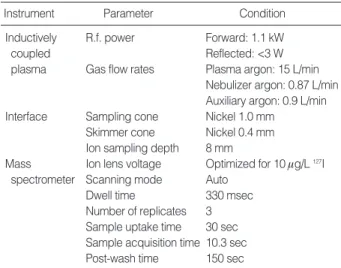
Louis, MO, USA) 용액으로 각각 50배 희석하여 측정하였으며, 내부표준물질로서 2 mg/L의 Indium (115In) (National Insti- tute of Standards and Technology, Gaithersburg, MD, USA) 을 첨가하였다. 임상검체를 이용하여 자가제조한 2가지 농도의 정도관리물질을 매 검사마다 측정하여 검사의 신뢰성을 확인하 였다. ICP-MS 분석 조건은 Table 1과 같았다.
2. ICP-MS
의 무작위 소변 내 요오드 농도 분석능 평가:정밀도, 정확도, 최저 정량한계, 직선성
ICP-MS의 모든 분석능 평가는 미국 식품의약국(Food and Drug Administration)의 Bioanalytical method validation 가이드라인을 기준으로 하였다[11].
KI로부터 제조한 3.8, 30, 200, 584, 1,000 mg/L의 5가지 농도의 iodide 표준물질을 5회씩 측정하여 일내 정밀도(변이계 수, CV로 표시)를 구하였고 3일 동안 실험을 반복 시행하여 일 간 정밀도를 구하였다. 정확성은 측정된 농도들의 평균값을 기 대값의 농도로 나눈 비의 백분율(%)로서 표현하였다. 0.5 mg/L 간격으로 제조한 0-3 mg/L 사이의 iodide 표준물질을 정밀도 평가와 동일한 방법으로 실험하여 CV 20% 이내이면서 정확도 80-120%를 벗어나지 않는 최저 농도를 최저 정량한계(lower limit of quantification)로 정의하였다. 직선성 평가는 내부 표 준물질만 포함된 0 mg/L 농도의 검체와 1, 3.8, 19.13, 38.25,
76.5, 382.5, 765, 1,530, 1,913 mg/L의 총 9가지 농도의 iodide 표준물질을 5회 반복 측정하여 각 농도의 평균값으로 검량선을 작성하였고, 일반선형모델로써 회귀방정식과 결정계수 R2을 구 하였다.
3.
정상인과 요오드 제한 식이 환자의 무작위 소변 내 요오드 농도 분석과거 질환력이 없으며 정상 식이 중인 건강한 성인 80명(20 세 이상 60세 이하의 남자 20명과 여자 60명)과, 방사성 I 치료 를 시작하기 전 1주일간 I 제한 식이를 시행한 성인 갑상선암 환 자 120명(20세 이상 60세 이하의 남자 35명, 여자 85명)의 무 작위 소변 검체에서 I 농도를 측정하였다. 통계적 분석을 위한 전산 프로그램으로는 MedCalc (version 10.22, MedCalc soft- ware, Mariakerke, Belgium)를 이용하였으며, 군 간 비교를 위하여 비모수적 통계방법(Mann-Whitney U test)을 적용하 였다. Pvalue 0.05 미만인 경우 군 간 유의한 차이가 있는 것 으로 간주하였다.
결 과 1. 정밀도 및 정확도
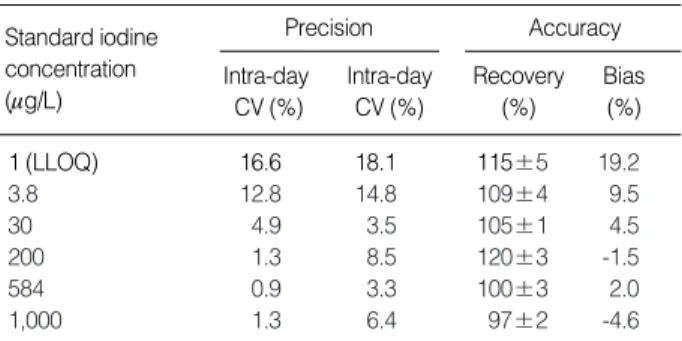
5가지 농도의 iodide 표준물질을 5회씩 3일간 반복 측정한 결과, 일내 정밀도와 일간 정밀도 모두 15% 이내였으며, 정확도 는 95-115% 사이로 우수하였다(Table 2).
Instrument Parameter Condition
Inductively R.f. power Forward: 1.1 kW
coupled Reflected: <3 W
plasma Gas flow rates Plasma argon: 15 L/min Nebulizer argon: 0.87 L/min Auxiliary argon: 0.9 L/min Interface Sampling cone Nickel 1.0 mm
Skimmer cone Nickel 0.4 mm Ion sampling depth 8 mm
Mass Ion lens voltage Optimized for 10 mg/L 127I spectrometer Scanning mode Auto
Dwell time 330 msec
Number of replicates 3 Sample uptake time 30 sec Sample acquisition time 10.3 sec Post-wash time 150 sec
Table 1. Instrumental parameters and measurement conditions
2.
최저 정량한계 및 직선성일 중 및 일간 정밀도 변이계수 20% 이내인 최저 정량한계는 1 mg/L임을 확인하였고 정확도는 110-120% 사이였다. Iodide 표준물질 농도 1-1,912 mg/L의 구간에서 직선성을 평가한 결과, R2결정계수는 0.999 이상으로 우수하였다(Fig. 1).
3.
정상인과 요오드 제한 식이 환자의 무작위 소변 내 요오드 농도 분석무작위 소변 내 I 농도의 중앙값은 정상 성인 대조군(238.8 mg/L)에 비해 1주일간 I 제한 식이를 시행한 성인 갑상선암 환 자군(38.7 mg/L)에서 유의하게 낮은 결과를 보였다(P<0.0001;
Fig. 2).
고 찰
I는 갑상선 호르몬 합성의 필수 영양소로로써 음식 섭취를 통 해서만 체내에 흡수된다. I 결핍으로 인한 갑상선 호르몬 결핍 은 갑상선종, 갑상선 기능 저하증, 정신 발달 장애 등을 일으킬 수 있다고 알려져 있다. 반면에, I 섭취과다는 여러 갑상선 질환 과 관련이 있으며 특히 I 섭취량이 많은 지역은 I 섭취량이 적은 지역에 비해 유두상 갑상선암 발생의 위험도가 더 증가하는 경 향이 있다고 보고된 바 있다[12-15]. 한국인의 연령별 갑상선암 유병률은 미국, 일본, 스웨덴, 인도 등에 비해 높은 편이며, 한
Standard iodine concentration (mg/L)
Precision Intra-day
CV (%)
Intra-day CV (%)
Recovery (%)
Bias (%) Accuracy
1 (LLOQ) 16.6 18.1 115±5 19.2
3.8 12.8 14.8 109±4 9.5
30 4.9 3.5 105±1 4.5
200 1.3 8.5 120±3 -1.5
584 0.9 3.3 100±3 2.0
1,000 1.3 6.4 97±2 -4.6
Table 2. Precision and accuracy data for standard iodine obtained by using inductively coupled plasma-mass spectrometry
Abbreviation: LLOQ, lower limit of quantification.
Fig. 2. Distribution patterns of urinary iodine in normal adults and thyroid cancer patients on low-iodine diet.
Abbreviation: ICP-MS, inductively coupled plasma-mass spectrometry.
Frequency
80
70 60 50 40 30 20 10
0 50 100 150 200 250 300 350 400 450 500 550 600 650 700 750 800 850 900 950 1,000 1,050 Measured iodine in random urine by ICP-MS (mg/L)
1,100 1,150 Healthy subjects (N=80, median 238.8 mg/L)
Thyroid cancer patients on low-iodine diet (N=120, median 38.7 mg/L)
Measured concentration of iodine by ICP-MS (mg/L)
2,200
2,000 1,800 1,600 1,400 1,200 1,000 800 600 400 200
00 200 400 600 800 1,000 1,200 1,400 1,600 1,800 2,000 2,200
Expected concentration of iodine (mg/L) y=1.0658x-7.3424 R2=0.999
Fig. 1. Linearity of standard iodine obtained by using inductively coupled plasma-mass spectrometry (ICP-MS).
국인의 하루 평균 I 섭취량(468.9 mg/day)은 미국(195 mg/day) 과 영국(166 mg/day), 아이슬란드(350 mg/day)보다 높다[15-18].
분화형 갑상선 암의 치료법 중의 하나인 방사성 I 투여는 체 내의 I 결핍 상태가 치료에 도움을 준다. 방사성 I 투여는 수술 후 잔여갑상선 제거 및 기능성 전이 병변 치료에 가장 효율적인 방법으로써 전세계적으로 사용되고 있다. 방사성 I 섭취효율을 높이기 위해서는 체내 I 농도를 감소시켜야 하는데 이를 위해 I 가 함유된 약물 및 조영제의 사용을 피하고 식이 섭취도 일정기 간 제한하는 전처치가 필요하다. 2006년 발표된 미국 갑상선 학회(American Thyroid Association)의 분화형 갑상선암에 대한 진단 및 치료 지침에서는 방사성 I 치료를 시작하기 전 1-2 주간 I 제한 식이를 시행하도록 권장하고 있으며 하루 50 mg 이 하의 I 섭취제한을 목표로 한다.
섭취한 I의 90% 이상이 소변으로 배설되기 때문에 I 섭취의 적절성 평가를 위해서는 소변 내 I 농도의 측정이 가장 정확하 다고 알려져 있다[19, 20]. 소변 내 I 농도의 측정은 본 연구에서 와 같이 무작위 소변 검체를 주로 사용하게 되는데 검체 채취 시점과 환자의 수분섭취량 등에 따라 일 중, 일간 변동성이 있다 는 문제가 있다[21, 22]. 또한 소변 내 I 농도는 나이나 성별에 의해서도 영향을 받기 때문에 소변 내 크레아티닌(Creatinine, Cr) 값으로 보정하는 것이 더 정확한 I 농도를 측정할 수 있다는 보고도 있으나, 여기에도 몇 가지 제한점이 있다. 무작위 소변 검체에서 측정한 Cr 자체도 일 중 변동성이 클 뿐만 아니라 단 백질 섭취 정도와 같은 영양 상태에 의해서도 크게 영향을 받을 수 있기 때문에 소변 내 I/Cr 비율(urine iodide/creatinine ratio) 도 정확성을 보증하기 어렵다[5, 6]. 소변 내 I/Cr 비율보다는 24시간 소변 검체에서의 I 측정이 더 정확한 방법으로 알려져 있긴 하지만, 이 역시 24시간 검체 수집의 어려움과 불편함이 크다는 단점 때문에 실제로 검사에 적용하기에 어려움이 있다 [5, 21, 23, 24].
본 연구에서 갑상선암 환자군의 무작위 소변 내 I 농도의 중 앙값은 38.7 mg/L으로 2007년 WHO에서 발표한 I 영양상태 평가법 상, 중등도 I 결핍 상태(중앙값 20-49 mg/L)에 있었으 며 이는 1주일간의 I 제한 식이 효과가 반영된 것으로 판단하였 다[25]. 반면에 정상 성인의 무작위 소변 내 I 농도의 중앙값의 경우 본 연구결과(238.8 mg/L)는 미국(167.8 mg/L)이나 중국 (198 mg/L), 덴마크(87 mg/L)보다도 높았다[12, 24, 26]. 따라서 한국인에서 하루 50 mg 이하의 I 섭취를 목표로 하는 식이요법 은 보다 엄격한 식습관의 개선이 요구될 수 있으며 특히 방사성 I 치료가 필요한 갑상선암 환자의 경우에는 최근 I 섭취상태를 정확히 모니터링함으로써 치료 효율을 높이는 방법이 모색될
필요가 있다.
ICP-MS는 각종 미량 원소의 분석의 참고 방법(reference method)이다[27]. ICP-MS를 이용한 소변 내 I 농도 분석은 본 연구가 국내에서는 처음이며, 분석능 평가 결과 우수한 직선성, 정밀성, 정확성과 매우 낮은 최저 정량한계를 확인할 수 있었 다. ICP-MS의 분석결과에 일부 영향을 미칠 수 있는 요소로는 기억효과(memory effect)와 분광학적 방해(spectral interfer- ence), 비분광학적 방해(nonspectral interference) 등이 있을 수 있으나, 본 연구에서는 0.1% NH4OH를 모든 검체와 표준물 질의 희석용매로 사용함으로써 위와 같은 방해요소로부터 영향 받지 않았다[28-30].
이전까지 I 측정법으로 널리 사용되었던 ion selectivity elec- trode (ISE)는 용액 내에 존재하는 유리 이온의 활성도를 측정 하는 것으로 이온 형태의 요오드(soluble iodide under acidic conditions)만을 감지하기 때문에 이온 이외의 형태로 존재하 는 요오드는 측정할 수 없고, 염소이온(Cl-)과 같은 측정 전극의 간섭물질의 농도가 높을수록 측정값에 오류가 발생할 수 있으 며, 수용액 중의 이온은 pH에 따라 활성도 차이를 나타낸다는 단점이 있다. 이러한 이유로 ISE는 HPLC에 비해 현저한 양의 오차(positive bias)를 보인다. HPLC는 크로마토그래피 기법 을 결합시켜 간섭물질로부터의 방해를 차단하는데 효과적이나 결합된 형태의 I (bound iodine)의 방해를 받지 않고 비결합 형 태의 I (unbound iodide, free ionic iodide)만을 선택적으로 측정할 수 있으며 최저 정량한계는 20 mg/L으로 보고된 바 있 다[31, 32]. 반면에 ICP-MS는 모든 형태의 I를 측정하여 검체 내의 총 I 양을 분석할 수 있다는 장점이 있으며 I 제한 식이로 인해 매우 낮은 값의 I 농도가 기대되는 검체를 분석하거나 체 내에 미량으로 존재하는 원소의 분석에 있어서는 최저 정량한 계가 더 낮고 측정 범위가 넓은 ICP-MS가 더 우수한 방법이라 할 수 있다. 비록 본 연구에서는 ICP-MS와 다른 검사 장비와 의 상관성 비교는 시행할 수 없었으나, 여러 문헌 고찰을 통해 다른 검사 장비와도 우수한 상관성을 보이고 있음을 확인하였 다[9, 30].
본 연구에서는 각종 미량원소 분석의 참고방법으로 알려져 있는 ICP-MS를 이용하여 국내에서는 최초로 소변 내 I 농도 분석방법을 수립하였으며, 특히 방사성 I 치료를 위해 I 제한 식 이를 시행한 갑상선암 환자들의 최근 I 섭취 상태를 정확히 확 인할 수 있었다. 따라서 본 검사법은 갑상선암 환자들의 방사성 I 치료 효과를 높이는데 기여할 수 있다는 점에서 임상적 유용 성 또한 클 것으로 평가하였다.
요 약
배경 : 갑상선암의 치료에 이용되는 방사성 요오드(I)의 섭취 효율을 높이기 위해서는 일정 기간 I 제한 식이를 해야 한다. 최 근 I 섭취 및 영양상태 평가에 있어서 소변 내 I 농도 측정이 가 장 정확한 것으로 알려져 있다. 이에 유도결합 플라즈마 질량 분석기(ICP-MS)를 이용한 소변 내 I 농도 분석법을 수립하고 그 분석능을 평가하였다.
방법 : 소변 내 I 분석법 수립을 위하여 Food and Drug Administration (FDA)의 bioanalytical method validation 가이드라인에 따라 ICP-MS (Agilent 7500ce, Agilent Tech- nologies, Inc., Japan)의 직선성 및 정밀성, 정확성, 최저 정량 한계 등을 평가하였다. 이 분석법으로 1주일간 I 제한 식이를 시 행한 성인 갑상선암 환자 120명의 무작위 소변 검체에서 I 농도를 측정하여 정상 식이 중인 성인 80명의 측정 결과와 비교하였다.
결과 : 측정 범위 구간 1-1,913 mg/L에서의 직선성 확인 결 과, 결정계수(R2)는 0.999 이상으로 우수하였다. 일 중 및 일간 정밀도 변이계수는 최저 정량한계(1 mg/L)에서 20% 이내였으 며, 그 외 농도에서 15% 이내로 확인되었다. 정확도는 최저 정 량한계에서 110-120%, 그 외 농도에서 95-115% 사이로 확인 되었다. 소변 내 I 농도의 중앙값은 정상 성인 대조군(238.8 mg/L) 에 비해 1주일간 I 제한 식이를 시행한 성인 갑상선암 환자군 (38.7 mg/L)에서 유의하게 낮은 결과를 보였다(P<0.0001).
결론 : ICP-MS를 이용한 소변 내 I 농도 분석 결과, 직선성 과 정밀성, 정확성 모두 우수하였으며 측정 범위가 넓고 검출 한계가 낮다는 장점을 확인할 수 있었다. 따라서 본 검사법은 방사성 I 치료를 위해 I 제한 식이를 해야 하는 갑상선암 환자의 최근 I 섭취 상태를 정확히 평가함으로써 치료 효과를 높이는데 기여할 수 있을 것이다.
참고문헌
1. Cooper DS, Doherty GM, Haugen BR, Kloos RT, Lee SL, Mandel SJ, et al. Management guidelines for patients with thyroid nodules and differentiated thyroid cancer. Thyroid 2006;16:109-42.
2. Luster M, Clarke SE, Dietlein M, Lassmann M, Lind P, Oyen WJ, et al. Guidelines for radioiodine therapy of differentiated thyroid can- cer. Eur J Nucl Med Mol Imaging 2008;35:1941-59.
3. Sawka AM, Thephamongkhol K, Brouwers M, Thabane L, Browman G, Gerstein HC. Clinical review 170: a systematic review and meta- analysis of the effectiveness of radioactive iodine remnant ablation
for well-differentiated thyroid cancer. J Clin Endocrinol Metab 2004;
89:3668-76.
4. Cavalieri RR. Iodine metabolism and thyroid physiology: current con- cepts. Thyroid 1997;7:177-81.
5. Andersson M, Takkouche B, Egli I, Allen HE, de Benoist B. Current global iodine status and progress over the last decade towards the elimination of iodine deficiency. Bull World Health Organ 2005;83:
518-25.
6. Zimmermann MB. Iodine requirements and the risks and benefits of correcting iodine deficiency in populations. J Trace Elem Med Biol 2008;22:81-92.
7. Demers LM and Spencer CA. Laboratory medicine practice guide- lines: laboratory support for the diagnosis and monitoring of thyroid disease. Clin Endocrinol (Oxf) 2003;58:138-40.
8. Caldwell KL, Maxwell CB, Makhmudov A, Pino S, Braverman LE, Jones RL, et al. Use of inductively coupled plasma mass spectrometry to measure urinary iodine in NHANES 2000: comparison with pre- vious method. Clin Chem 2003;49:1019-21.
9. Macours P, Aubry JC, Hauquier B, Boeynaems JM, Goldman S, Moreno-Reyes R. Determination of urinary iodine by inductively coupled plasma mass spectrometry. J Trace Elem Med Biol 2008;
22:162-5.
10. May SL, May WA, Bourdoux PP, Pino S, Sullivan KM, Maberly GF.
Validation of a simple, manual urinary iodine method for estimating the prevalence of iodine-deficiency disorders, and interlaboratory comparison with other methods. Am J Clin Nutr 1997;65:1441-5.
11. U.S. Food and Drug Administration, Center for Drug Evaluation and Research. Guidance for industry: bioanalytical method valida- tion. Rockville, MD: U.S. Department of Health and Human Services, Food and Drug Administration, 2001.
12. Guan H, Ji M, Bao R, Yu H, Wang Y, Hou P, et al. Association of high iodine intake with the T1799A BRAF mutation in papillary thyroid cancer. J Clin Endocrinol Metab 2009;94:1612-7.
13. Teng W, Shan Z, Teng X, Guan H, Li Y, Teng D, et al. Effect of iodine intake on thyroid diseases in China. N Engl J Med 2006;354:2783-93.
14. Harach HR and Ceballos GA. Thyroid cancer, thyroiditis and dietary iodine: a review based on the Salta, Argentina model. Endocr Pathol 2008;19:209-20.
15. Kim JY and Kim KR. Dietary iodine intake and urinary iodine excre- tion in patients with thyroid diseases. Yonsei Med J 2000;41:22-8.
16. Pennington JA and Young BE. Total diet study nutritional elements,
1982-1989. J Am Diet Assoc 1991;91:179-83.
17. Lee SM, Lewis J, Buss DH, Holcombe GD, Lawrance PR. Iodine in British foods and diets. Br J Nutr 1994;72:435-46.
18. Laurberg P, Pedersen KM, Hreidarsson A, Sigfusson N, Iversen E, Knudsen PR. Iodine intake and the pattern of thyroid disorders: a comparative epidemiological study of thyroid abnormalities in the elderly in Iceland and in Jutland, Denmark. J Clin Endocrinol Metab 1998;83:765-9.
19. Soldin OP. Controversies in urinary iodine determinations. Clin Biochem 2002;35:575-9.
20. Ristic-Medic D, Piskackova Z, Hooper L, Ruprich J, Casgrain A, Ash- ton K, et al. Methods of assessment of iodine status in humans: a systematic review. Am J Clin Nutr 2009;89:2052S-69S.
21. Rasmussen LB, Ovesen L, Christiansen E. Day-to-day and within- day variation in urinary iodine excretion. Eur J Clin Nutr 1999;53:
401-7.
22. Als C, Helbling A, Peter K, Haldimann M, Zimmerli B, Gerber H.
Urinary iodine concentration follows a circadian rhythm: a study with 3023 spot urine samples in adults and children. J Clin Endocrinol Metab 2000;85:1367-9.
23. Andersen S, Karmisholt J, Pedersen KM, Laurberg P. Reliability of studies of iodine intake and recommendations for number of sam- ples in groups and in individuals. Br J Nutr 2008;99:813-8.
24. Knudsen N, Christiansen E, Brandt-Christensen M, Nygaard B, Per- rild H. Age- and sex-adjusted iodine/creatinine ratio. A new stan- dard in epidemiological surveys? Evaluation of three different esti- mates of iodine excretion based on casual urine samples and com- parison to 24 h values. Eur J Clin Nutr 2000;54:361-3.
25. WHO; UNICEF; ICCIDD. Assessment of iodine deficiency disorders and monitoring their elimination: a guide for programme managers.
3rd ed. Geneva: WHO, 2007.
26. Caldwell KL, Jones R, Hollowell JG. Urinary iodine concentration:
United States National Health And Nutrition Examination Survey 2001-2002. Thyroid 2005;15:692-9.
27. Lee SY, Oh HJ, Choi YH, Kim JW, Kim SH. Trace metal analysis using inductively coupled plasma-mass spectrometry (ICP-MS).
Korean J Lab Med 2004;24:362-70. (이수연, 오현주, 최윤호, 김종원, 김선희. 유도결합플라즈마질량분석기를 이용한 체내 미량금속 분석.
대한진단검사의학회지 2004;24:362-70.)
28. Hsiung CS, Andrade JD, Costa R, Ash KO. Minimizing interferences in the quantitative multielement analysis of trace elements in bio- logical fluids by inductively coupled plasma mass spectrometry. Clin Chem 1997;43:2303-11.
29. Haldimann M, Zimmerli B, Als C, Gerber H. Direct determination of urinary iodine by inductively coupled plasma mass spectrometry using isotope dilution with iodine-129. Clin Chem 1998;44:817-24.
30. Pabla D, Akhlaghi F, Ahmed A, Zia H. Development and validation of an inductively coupled plasma mass spectrometry method for quantification of levothyroxine in dissolution studies. Rapid Com- mun Mass Spectrom 2008;22:993-6.
31. Melichercik J, Szijarto L, Hill AR. Comparison of ion-specific elec- trode and high performance liquid chromatography methods for the determination of iodide in milk. J Dairy Sci 2006;89:934-7.
32. Hammer D and Andrey D. Comparison of ion-selective electrode and inductively coupled plasma-mass spectrometry to determine iodine in milk-based nutritional products. J AOAC Int 2008;91:1397-401.