ISSN 2234-3806 • eISSN 2234-3814
150 www.annlabmed.org http://dx.doi.org/10.3343/alm.2013.33.2.150 Ann Lab Med 2013;33:150-152
http://dx.doi.org/10.3343/alm.2013.33.2.150
Case Report
Diagnostic Genetics
Identification of a GDF5 Mutation in a Korean Patient with Brachydactyly Type C without Foot Involvement
Soo Hyun Seo, M.D.1, Mi Jung Park, M.D.2, Shin-Hye Kim, M.D.2, Ok-Hwa Kim, M.D.3, Seungman Park, M.D.1, Sung Im Cho, M.T.1, Sung Sup Park, M.D.1, and Moon-Woo Seong, M.D.1
Department of Laboratory Medicine1, Seoul National University Hospital, Seoul; Department of Pediatrics2, Sanggye Paik Hospital, Inje University College of Medicine, Seoul; Department of Radiology3, Ajou University Hospital, Suwon, Korea
Brachydactyly type C (BDC) is characterized by shortening of the middle phalanges of the index, middle, and little fingers. Hyperphalangy of the index and middle finger and short- ening of the first metacarpal can also be observed. BDC is a rare genetic condition associ- ated with the GDF5 gene, and this condition has not been confirmed by genetic analysis so far in the Korean population. Herein, we present a case of a 6-yr-old girl diagnosed with BDC confirmed by molecular genetic analysis. The patient presented with shortening of the second and third digits of both hands. Sequence analysis of the GDF5 gene was per- formed and the pathogenic mutation, c.1312C>T (p.Arg438Cys), was identified. Interest- ingly, this mutation was previously described in a patient who presented with the absence of the middle phalanges in the second through fifth toes. However, our patient showed no involvement of the feet. Considering intrafamilial and interfamilial variability, molecular analysis of isolated brachydactyly is warranted to elucidate the genetic origin and establish a diagnosis.
Key Words: Brachydactyly, GDF5 gene, Mutational analysis
Received: August 3, 2012 Revision received: August 22, 2012 Accepted: November 15, 2012 Corresponding author: Moon-Woo Seong Department of Laboratory Medicine, Seoul National University Hospital, 101 Daehak-ro, Jongno-gu, Seoul 110-744, Korea Tel: +82-2-2072-4180
Fax: +82-2-747-0359 E-mail: [email protected]
© The Korean Society for Laboratory Medicine.
This is an Open Access article distributed under the terms of the Creative Commons Attribution Non-Commercial License (http://creativecom- mons.org/licenses/by-nc/3.0) which permits unrestricted non-commercial use, distribution, and reproduction in any medium, provided the original work is properly cited.
INTRODUCTION
Brachydactyly is a condition that results in the shortening of dig- its due to an abnormal development of the phalanges, metacar- pals, or both [1]. Brachydactyly may present as an isolated fea- ture or as a part of a complex malformation syndrome. Isolated brachydactyly can be classified into 5 types on the basis of anat- omy and genetics. Brachydactyly type A can be further classified into 5 subtypes. Brachydactyly type C (BDC) is characterized by the shortening of the middle phalanges of the index, middle, and little fingers. Hyperphalangy of the index and middle fingers can also be observed and is associated with the shortening of the first metacarpal. Usually, in BDC, the ring finger appears unaf- fected and is the longest digit in affected patients.
Growth differentiation factor-5 (GDF5) gene, also known as cartilage-derived morphogenetic protein-1 (CDMP1), is the only
gene known to be associated with BDC. BDC is associated with multiple inherited genotypes of the GDF5 gene including auto- somal dominant, autosomal recessive, and even a semidomi- nant pattern of inheritance has been reported [2]. Mutations in the GDF5 gene also result in recessive acromesomelic dyspla- sias of Hunter-Thompson type, Grebe type chondrodysplasia, and Du Pan syndrome, characterized by short stature, severe limb shortening, and profound brachydactyly [3]. Moreover, phenotypic variability is a typical hallmark of BDC, and variation is found in individuals of the same family harboring identical mutations [4]. Therefore, elucidating the genetic origin and es- tablishing a genetic diagnosis are important for understanding the role of GDF5 gene in cartilage and bone formation and the molecular pathogenesis of isolated brachydactyly.
Although the incidence and prevalence have not been well established, isolated brachydactyly is expected to be rare in the
Seo SH, et al.
GDF5 mutation in Brachydactyly type C
151
http://dx.doi.org/10.3343/alm.2013.33.2.150 www.annlabmed.org
Korean population [5]. To the best of our knowledge, no BDC case has been confirmed by molecular genetic analysis in this population. Herein, we report the GDF5 mutation identified in a Korean BDC patient with relevant clinical findings.
CASE REPORT
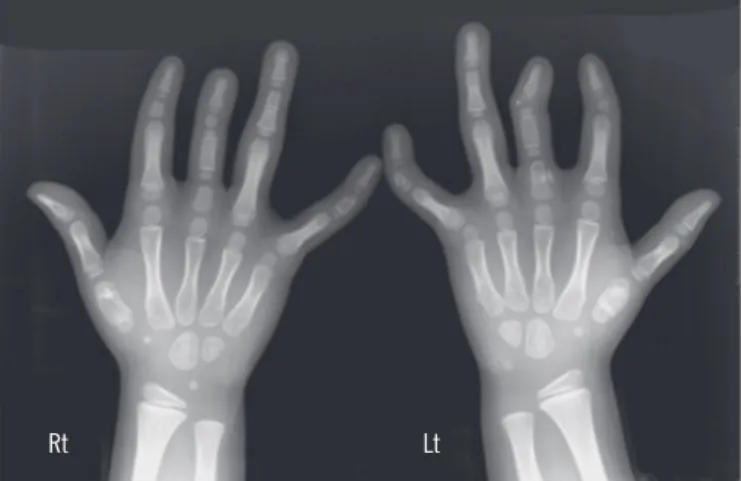
A 6-yr-old girl presenting with shortening of the second and third digits on both hands was admitted for evaluation. She had nor- mal stature and development compared to the general Korean standards. She had normal prenatal and birth history as well as no family history of shortened digits. Hand examination revealed that the first, second, and third digits were short. The fourth digit was the longest and appeared normal. The distal phalanx of the left second digit was deviated to the ulnar side and that of the left third digit was deviated to the radial side. Mild clinodac- tyly was present in the fifth digit of both hands. Range of motion of individual joints was normal and her feet were unaffected.
She had no other skeletal or non-skeletal dysmorphisms. Radio- graphs showed shortening of the thumb metacarpals and mid- dle phalanges of the second, third, and fifth digits (Fig. 1).
Informed consent was obtained and whole blood was col- lected from the patient in EDTA blood collection tubes. DNA was extracted and PCR was performed using primers specific
for 2 coding exons (data not shown). The amplified products were sequenced on an ABI 3730 analyzer (Applied Biosystems, Foster City, CA, USA) using a BigDye Terminator v3.1 Cycle se- quencing kit (Applied Biosystems,) (Reference cDNA sequence:
NM_000557.2). Sequence analysis of GDF5 revealed a mis- sense mutation at c.1312C>T that resulted in a change in the protein level of p.Arg438Cys (Fig. 2). Mutation analysis and clini- cal review of this patient were approved by the institutional re- view board of Inje University, Sanggye Paik Hospital.
DISCUSSION
This is the first genetically confirmed case of isolated brachydac- tyly in the Korean population. Isolated brachydactyly, including BDC, is a clinically and genetically heterogeneous disorder. In addition to the characteristic features of brachydactyly, BDC pa- tients may have ulnar deviation of the index finger as well as hy- persegmentation of the proximal or middle phalanges [6]. Inter- estingly, the first case report characterizing BDC with the same mutation identified in this study, described that the patient had no middle phalanges in their second through fifth toes [7]. Our patient showed no involvement of the feet. These findings sug- gest that this disorder may vary in its phenotype even within in- dividuals with the exact same gene mutation. Concerning intra- familial and interfamilial phenotypic variability, different genetic background and/or environmental factors associated with each patient are suggested to be involved in the pathogenesis [2].
The GDF5 gene may be associated with various types of dis- orders including BDC. Among the 34 known mutations of the GDF5 gene listed in the Human Gene Mutation Database (http://www.hgmd.cf.ac.uk/ac/gene.php?gene =GDF5), only 15 are known to cause BDC [2, 6-9]. In addition to BDC, other dis- orders such as brachydactyly type A2, Du Pan syndrome, Grebe type chondrodysplasia, Hunter-Thompson type acromesomelic
Fig. 1. Radiographic findings of both hands at age 5 yr and 7 months.
The bilateral short first metacarpals show large pseudoepiphyses.
The middle phalanges of the second, third, and fifth fingers are short, with clinodactyly of the fifth fingers. The fourth fingers are unaffected. The proximal phalanges of both third fingers are short.
Note the segmentation anomaly with accessory ossification along the proximal phalanx and an accessory ivory dense epiphysis at the base of the distal phalanx of the left third finger. Note the ulnar de- viation of the left second finger and radial curvature of the third fin- ger. The carpal bone age is retarded.
Abbreviations: Rt, right; Lt, left.
Rt Lt
Fig. 2. Sequence analysis of the GDF5 gene. A heterozygous muta- tion of c.1312C>T in exon 2 is noted.
Patient
Control
c.1312C>T
Seo SH, et al.
GDF5 mutation in Brachydactyly type C
152 www.annlabmed.org http://dx.doi.org/10.3343/alm.2013.33.2.150 dysplasia, multiple synostoses, and proximal symphalangism
are also associated with GDF5 gene abnormalities. Interestingly, while some mutations that decrease GDF5 expression seem to be the main basis for the development of brachydactyly, other mutations that increase the activity of GDF5 result in proximal symphalangism [10]. In a recent study, a novel missense muta- tion in GDF5 was shown to cause brachydactyly type A1 [11].
Furthermore, some heterozygous mutation carriers of GDF5 showed phenotypes similar to brachydactyly type E [2]. There- fore, molecular characterization of the GDF5 gene will be helpful to diagnose and reclassify isolated brachydactyly on the basis of genetic background rather than clinical phenotype. These find- ings will also help in understanding the role of GDF5 in normal cartilage and bone development.
Authors’ Disclosures of Potential Conflicts of Interest
No potential conflicts of interest relevant to this article were re- ported.
REFERENCES
1. Temtamy SA and Aglan MS. Brachydactyly. Orphanet J Rare Dis 2008;3: 15.
2. Schwabe GC, Türkmen S, Leschik G, Palanduz S, Stöver B, Goecke TO, et al. Brachydactyly type C caused by a homozygous missense muta- tion in the prodomain of CDMP1. Am J Med Genet A 2004;124A:356-63. 3. Seemann P, Schwappacher R, Kjaer KW, Krakow D, Lehmann K, Daw- son K, et al. Activating and deactivating mutations in the receptor inter- action site of GDF5 cause symphalangism or brachydactyly type A2. J Clin Invest 2005;115:2373-81.
4. Savarirayan R, White SM, Goodman FR, Graham JM Jr, Delatycki MB, Lachman RS, et al. Broad phenotypic spectrum caused by an identical heterozygous CDMP-1 mutation in three unrelated families. Am J Med Genet A 2003;117A:136-42.
5. Baek GH, Chung MS, Park YB, Yoo KH. The relative incidence of con- genital anomalies of the hand. J Korean Orthop Assoc 1997;32:796-801. 6. Everman DB, Bartels CF, Yang Y, Yanamandra N, Goodman FR, Men- doza-Londono JR, et al. The mutational spectrum of brachydactyly type C. Am J Med Genet 2002;112:291-6.
7. Polinkovsky A, Robin NH, Thomas JT, Irons M, Lynn A, Goodman FR, et al. Mutations in CDMP1 cause autosomal dominant brachydactyly type C. Nat Genet 1997;17:18-9.
8. Holder-Espinasse M, Escande F, Mayrargue E, Dieux-Coeslier A, Fron D, Doual-Bisser A, et al. Angel shaped phalangeal dysplasia, hip dysplasia, and positional teeth abnormalities are part of the brachydactyly C spec- trum associated with CDMP-1 mutations. J Med Genet 2004;41:e78. 9. Yang W, Cao L, Liu W, Jiang L, Sun M, Zhang D, et al. Novel point mu-
tations in GDF5 associated with two distinct limb malformations in Chi- nese: brachydactyly type C and proximal symphalangism. J Hum Genet 2008;53:368-74.
10. Dawson K, Seeman P, Sebald E, King L, Edwards M, Williams J 3rd, et al. GDF5 is a second locus for multiple-synostosis syndrome. Am J Hum Genet 2006;78:708-12.
11. Byrnes AM, Racacho L, Nikkel SM, Xiao F, MacDonald H, Underhill TM, et al. Mutations in GDF5 presenting as semidominant brachydacty- ly A1. Hum Mutat 2010;31:1155-62.