Living donor liver transplantation for patients with alcoholic liver disease
Yo-Han Park, Shin Hwang, Chul-Soo Ahn, Ki-Hun Kim, Deok-Bog Moon, Tae-Yong Ha, Gi-Won Song, Dong-Hwan Jung, Gil-Chun Park, Jung-Man Namgoong, Hyung-Woo Park,
Chun-Soo Park, Sung-Hwa Kang, Bo-Hyeon Jung, and Sung-Gyu Lee
Division of Hepatobiliary Surgery and Liver Transplantation, Department of Surgery, Asan Medical Center, University of Ulsan College of Medicine, Seoul, Korea
Backgrounds/Aims: Since most transplantation studies for alcoholic liver disease (ALD) were performed on deceased donor liver transplantation, little was known following living donor liver transplantation (LDLT). Methods: The clinical outcome of 18 ALD patients who underwent LDLT from Febraury 1997 to December 2004 in a large-volume liver transplantation center was assessed retrospectively. Results: The model for end-stage liver disease score was 23±11, and mean pretransplant abstinence period was 16±13 months, with 14 (77.8%) patients being abstinent for at least 6 months. Graft types were right lobe grafts in 11, left lobe grafts in 2 and dual grafts in 5. Graft to recipient body weight ratio was 0.94±0.16. The relapse rates in patients who did and did not maintain 6 months of abstinence were 7.1% and 50%, respectively (p=0.097). Younger recipient age was a significant risk factor for alcohol relapse (p=0.027).
Five recipients with antibody to hepatitis B surface antigen (HBsAg) received core antibody-positive liver graft, but two of them showed positive HBsAg seroconversion. Overall 5-year patient survival rate following LDLT was 87.8%, with a 5-year relapse rate of 16.7%. Conclusions: Pretransplant abstinence for 6 months appears to be benefical for preventing posttransplant relapse. Life-long prophylactic measure should be followed after use of anti-HBc-positive liver grafts regardless of hepatitis B viral marker status of the recipient. (Korean J Hepatobiliary Pancreat Surg 2013;17:14-20) Key Words: Living donor liver transplantation; Alcoholic liver disease; Relapse
Received: January 2, 2013; Revised: February 5, 2013; Accepted: February 18, 2013 Corresponding author: Shin Hwang
Division of Hepatobiliary Surgery and Liver Transplantation, Department of Surgery, Asan Medical Center, University of Ulsan College of Medicine, 388-1, Poongnap-dong, Songpa-gu, Seoul 138-736, Korea
Tel: +82-2-3010-3930, Fax: +82-2-3010-6701, E-mail: [email protected]
Copyright Ⓒ 2013 by The Korean Association of Hepato-Biliary-Pancreatic Surgery Korean Journal of Hepato-Biliary-Pancreatic Surgery ∙ ISSN: 1738-6349
INTRODUCTION
Alcoholic liver disease (ALD) has been one of the most common causes of end-stage liver disease in Western countries, resulting in very high mortality rate in patients with advanced alcoholic cirrhosis and 7.9 deaths per 100,000 individuals in the United States.1 As a result, al- coholic cirrhosis is one of the most common indications of liver transplantation in Western countries.
Since high prevalence of ALD and high volume of liver transplantation in Western countries, most clinical studies on liver transplantation for ALD have involved deceased donor liver transplantation (DDLT). Due to the shortage of deceased donor organs in Eastern countries, adult-to- adult living donor liver transplantation (LDLT) has been replacing DDLT since the late 1990s. However, ALD had
not been regarded as an optimal indication of LDLT be- cause of the self-inflicted nature of ALD and the risk of posttransplant relapse of alcohol abuse. On the other hand, special relationship between the recipient and living donor was considered to make some clinical latitude toward per- mitting LDLT in selected patients with pretransplant abstinence.
We have presented the importance of pretransplant ab- stinence before.2 In this study, we evaluated the long-term outcome of LDLT for ALD patients in a large-volume LDLT center.
METHODS
From February 1997 to December 2004, 789 adult-to- dult LDLTs were performed in our institution. Of these,
Table 2. Demographic characteristics of living donors Parameters
Age (years) Male sex
Relationship of donor to recipient Single graft donors
Son Daughter Wife Nephew Dual graft donors
Two sons Son and daughter Son and nephew Brother and aunt Two nephews
27±8 (range, 21-43) 15 (65.2%)
6 4 2 1 1 1 1 1 1 Table 1. Demographic characteristics of the 18 alcoholic liver
disease patients undergoing living donor liver transplantation Parameters
Age (years) Male sex
Child-Pugh classification Class B
Class C MELD score
Alcohol abstinence ≥6 months
Period of pretransplant abstinence
Hepatocellular carcinoma
52±8 (range, 35-62) 17 (94.4%) 2 (11.1%) 16 (88.9%) 23±11 (range, 9-40) 14 (77.8%)
16±12 (range, 2-48; median 13) 2 (11.1%)
MELD, model for end-stage liver disease
27 recipients were primarily diagnosed with ALD, but 9 were excluded due to concurrent association with viral hepatitis or other diseases. All 18 patients were confirmed as having ALD, by both a history of chronic alcohol in- take and a profile of biochemical parameters. Alcoholic cirrhosis was later confirmed by histological examination of the explanted liver. The surviving patients were moni- tored until September 2007 or their death, and their medi- cal records were retrospectively reviewed with special at- tention to the relapse incidents of alcohol abuse.
Indication criteria for liver transplantation consisted pri- marily of Child-Pugh class B or C and concurrent compli- cations of portal hypertension, such as esophageal variceal bleeding, hepatic encephalopathy, ascites or hepatorenal syndrome.
Pretransplant workup for hepatocellular carcinoma in- cluded multidetector dynamic liver computed tomography (CT) positron emission tomography, radioisotope bone scan, and chest CT. Multidetector CT scan was repeated 1 week before LDLT to confirm the suitability of the do- nor liver with regard to HCC extent and hepatic vasculature.
An independence from alcohol was confirmed by psy- chiatric assessment. Six months of alcohol abstinence was requested before LDLT.
Surgical procedures for LDLT were described in detail elsewhere.3,4 The immunosuppression regimen was the same as for other indications of adult LDLT, including anti-interleukin 2 induction, calcineurin inhibitor, myco- phenolate mofetil and corticosteroid.
Since it was not practical to define alcoholic relapse as
consumption of more than a given amount of alcohol, al- cohol relapse was arbitrarily defined as any consumption of alcohol. Surveillance of alcohol drinking has been per- formed routinely at follow-up during every outpatient visit.
Mean values with standard deviation and median values with ranges were used for numeric data. Independent t-test and Fisher’s exact test were used for comparisons.
Survival curves were estimated by the Kaplan-Meier method. A difference of p-value<0.05 was considered statistically significant.
RESULTS
Patient and donor demographics
The clinical profiles of the 18 patients are summarized in Table 1. Fifteen patients (83.3%) manifested complica- tions associated with portal hypertension. All patients un- derwent LDLT within 3 months of enrollment for LDLT.
Of the 18 patients, 4 (22.2%) did not meet the 6-month abstinence rule, but none of these underwent transplant- ation in urgent or emergency situations.
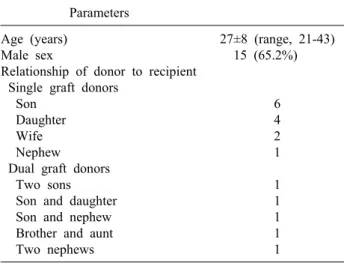
The demographic profiles of donors are summarized in Table 2. All living donors were consanguineously or mar- itally related to the recipients. There was no ABO blood group-incompatible donor. All of these donors recovered uneventfully after liver donation operations.
Operation and surgical complications
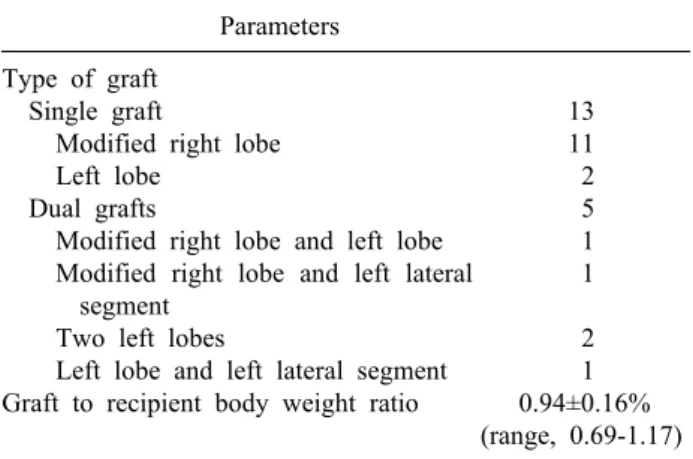
Thirteen patients (72.2%) received single grafts, and 5
Fig. 1. Cumulative overall and alcohol relapse-free survival curves of 18 alcoholic liver disease patients who underwent living donor liver transplantation. Overall 1-year, 3-year and 5-year patient survival rates were 100%, 100% and 87.8%, respectively (solid line). Relapse-free 1-year, 3-year and 5-year survival rates were 95.4%, 83.3% and 83.3%, re- spectively (dotted line).
Table 3. Surgical profiles for living donor liver transplantation Parameters
Type of graft Single graft
Modified right lobe Left lobe
Dual grafts
Modified right lobe and left lobe Modified right lobe and left lateral
segment Two left lobes
Left lobe and left lateral segment Graft to recipient body weight ratio
13 11 2 5 1 1 2 1 0.94±0.16%
(range, 0.69-1.17)
(27.8%) received dual grafts (Table 3). Total graft weight to recipient body weight ratio was 0.94±0.16 (range, 0.69- 1.17). All recipients recovered graft function uneventfully without perioperative mortality. During mean follow-up period of 57 months, biliary complications occurred in 6 patients (33.3%), all of whom were successfully treated by radiologic or endoscopic intervention. Within the first year, 3 patients experienced acute cellular rejection, which was successfully managed with steroid pulse therapy.
Three years later, another patient suffered from an episode of acute cellular rejection. One patient who underwent du- al-grafts implantation underwent hepatic vein emboliza- tion to facilitate unilateral graft atrophy due to intractable biliary complication.
Survival outcome
Patients were followed-up for 36-111 months (mean, 57±20 months; median, 49 months). One patient, who had experienced clinical complications requiring intensive care after alcohol relapse, died from aspergillus pneumonia 36 months after transplantation. Another patient who also showed alcohol relapse died from suspected intractable relapse. The other 16 patients remain alive to date, result- ing in overall 5-year survival rate of 87.8% (Fig. 1).
Two recipients who had concomitant hepatocellular car- cinoma meeting the Milan criteria had no evidence of tu- mor recurrence over each 48 and 36 months. One patient was diagnosed of early gastric cancer 45 months after LDLT. He underwent resection and is doing well to date.
Alcohol relapse
Three recipients (16.7%) relapsed to alcohol abuse, af-
ter a mean of 9±8 months and a median of 15 months (Table 4). One out of the 14 patients (7.1%) who had been abstinent for at least 6 months relapsed, but 2 out of the 4 patients (50%) who had been abstinent for less than 6 months relapsed (p=0.097). In contrast, younger age of recipients was a significant risk factor for alcohol relapse (41±8 years versus 53±6 years; p=0.027).
One-year and 3-year rates of alcohol relapse were 5.6%
and 16.7%, respectively (Fig. 1). Two patients drank mod- erate amounts of alcohol for a while, but their liver func- tion became unstable on occasion. Changes in their liver function around the time of alcohol relapse are summar- ized in Table 5.
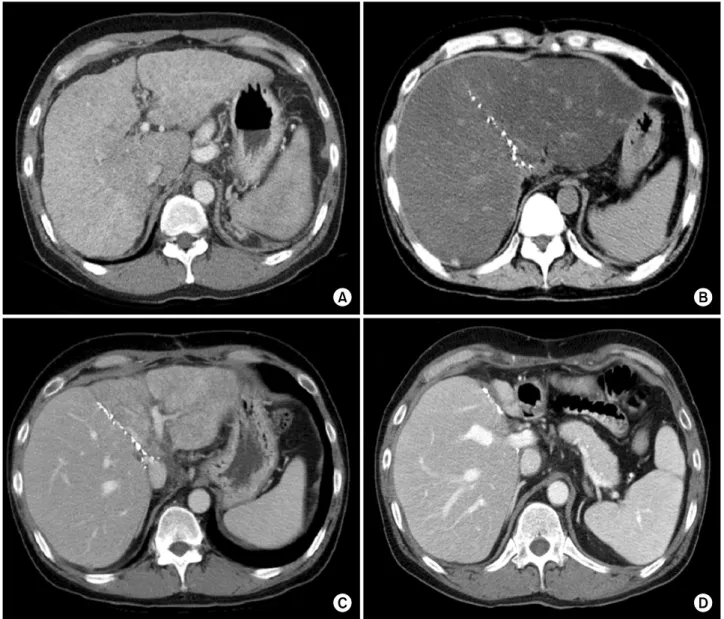
After these periods of resumed drinking, one of these 3 patients did not become abstinent, leading to graft fail- ure 44 months after LDLT. Another recipient start to drink at 2 months after LDLT, but he concealed it from us during monthly checkups. Five months after LDLT, this patient was admitted to hospital due to hepatorenal syndrome. After intensive care for 1 month, his liver func- tion recovered progressively. However, he died from as- pergillus pneumonia 36 months after LDLT (Fig. 2).
Prevention of de novo hepatitis B
Nine recipients received one or two liver grafts positive for hepatitis B core antibody (anti-HBc). Patients who re- ceived liver grafts from anti-HBc-positive donors were ad-
Table 4. Characteristics of the living donor liver recipients who showed relapse of alcohol abuse
Age Sex Donor relationship Type of graft Pretransplant abstinence Relapse timing Survival period 35
48 35
Male Male Male
Brother and aunt Son
Wife
Dual graft
Modified right lobe Modified right lobe
12 mos 5 mos 4 mos
2 mos 15 mos 18 mos
Dead, 36 mos Dead, 44 mos Alive, 56 mos
Table 5. Changes of graft liver function around the relapse timing of alcohol abuse in 3 relapsed recipients
Parameter Before relapse Peak value during relapse At 6-month abstinence after initial relapse Serum aspartate transaminase (IU/L)
Serum alanine transaminase (IU/L) Serum total bilirubin (mg/dl)
29.7±9.1 22.7±5.1 1.3±0.2
362.3±191.7 159.0±15.0
5.6±3.1
42.7±7.1 27.7±11.9
1.2±0.5
ministered short-term prophylaxis for hepatitis B infection soon after LDLT, during the time of treatment with potent immunosuppressive drugs. Recipients positive for hep- atitis B surface antibody (anti-HBs) were not administered long-term prophylactic regimens because we thought that the anti-HBs positivity in recipient per se would have a protective effect against de novo occurrence of hepatitis B infection. However, two out of the five anti-HBs-pos- itive recipients who received anti-HBc-positive grafts showed seroconversion to hepatitis B surface antigen (HBsAg) positivity 6 and 8 months after LDLT respec- tively. These patients became HBsAg-seronegative soon after treatment with antiviral drugs. Afterwards, recipients of anti-HBc-positive liver grafts received high-dose im- munoglobulin monotherapy to maintain serum anti-HBs titers greater than 500 IU/L, regardless of recipient’s an- ti-HBs status. No subsequent instances of de novo hep- atitis were observed in this series.
DISCUSSION
Although little is known about the optimal timing of liver transplantation in ALD patients, prognostic models such as MELD (model for end-stage liver disease) and Maddrey discriminant function are important tools for pre- dicting short-term mortality of patients with severe ALD.5-10 MELD is especially useful for assessing mortal- ity and guiding treatment decisions, particularly in ALD patients complicated by ascites and/or encephalopathy.5,9
Alcohol relapse is a potential problem in liver trans- plantation to ALD patients, in which it can induce liver
damage and deteriorate patient compliance to medications and clinic visits.11 In practice, many liver transplant pro- grams require 6 months of pretransplant abstinence prior to transplanation. However, many of these patients relapse to alcohol drinking, with some even returning to heavy alcohol consumption. However, there is little evidence showing that resumption of drinking has a significant det- rimental effect on graft or patient survival.12 Posttrans- plant alcohol relapse in ALD patients does not have a sig- nificant effect on liver function or morphology, and the survival rate of these patients does not differ from that of patients who received DDLT for primary diseases other than ALD.13 Furthermore, the long-term survival rates of relapsed and non-relapsed ADL patients were similar, suggesting that alcohol relapse did not decrease com- pliance with immunosuppressant medications.14
It was shown that the liver function of patients who were abstinent after a period of alcohol relapse did not show additional deterioration. Fatty changes and peri- cellular fibrosis are the most relevant histological signs of heavy alcohol intake.13 It was seen that alcoholic hepatic steatosis became reversed in this series. Although the 10-year survival rate of ALD recipients who relapsed has been reported to be significantly lower than that of in- dividuals who remained abstinent, this decrease was not related to graft evolution, rejection, infection, or metabolic disturbance, but rather to a higher incidence of malig- nancies and cardiovascular events.14
There are few reliable risk factors for alcohol relapse in ALD patients after liver transplantation. It has been suggested that the characteristics of pretransplant alcohol
Fig. 2. Computed tomography (CT) follow-up of a 35-year-old male patient who showed severe alcohol intake after living donor liver transplantation using dual liver grafts. (A) Preoperative CT scan showing cirrhotic changes. Model for end-stage liver dis- ease score was 30. (B) 3 month CT scan showing marked steatosis at both of the dual grafts. Liver biopsy confirmed severe fatty change, which was a result of posttransplant alcohol abuse for 2-3 months. Hepatorenal syndrome occurred at 5 months posttransplant. Serum total bilirubin concentration exceeded 40 mg/dl. Acute renal failure was managed with continuous venove- nous hemodiafiltration. (C) After 1 month of supportive care in the intensive care unit, the patient’s liver function recovered progressively. This CT scan was taken at posttransplant 8 months. The right-sided graft looked normal, but the left-sided graft revealed marked atrophic change. (D) At 2 years after liver transplantation, the left-sided graft was completely atrophied, whereas the right-sided graft became hypertrophied. This patient died from aspergillus pneumonia 36 months after transplantation.
consumption, such as length of abstinence, alcohol depen- dence, alcohol abuse in first degree relatives and younger age, are useful for detecting patients at high risk of severe posttransplant alcohol relapse.1,15,16 The results of this study show a close relation between younger age and risk of relapse.
Abstinence for less than 6 months prior to liver trans- plantation may predict relapse and is widely employed as a criterion for listing for DDLT.17 The result of this study
did not show that abstinence for 6 months before LDLT was a statistically significant risk factor. However, the re- laspe rate of 50% in the recipients who did not fulfill the 6-month abstistinence rule was definitely high comparing with 7.1% of recipients who met this rule. If the sample number had been a little larger than that in this study, there would be a statistically significant difference. We think that it is reasonable to emphasize the need to ob- serve the 6-month abstistinence rule in ALD patients un-
dergoing LDLT.18-20
Early recognition of alcohol relapse during clinic visits is important for its effective management. Since relapse is considered shameful, relapsed patients are not willing to admit to it during clinic visits. In one patient with se- vere steatosis, we initially failed to suspect alcohol relapse after LDLT due to a preconceived notion regarding the recipient-donor relationship. Reliable objective tests for monitoring abstinence are required. Standard liver func- tion tests are not helpful as they are non-specific, but defi- nite deterioration of liver profiles may suggest that the pa- tient has resumed drinking more than a moderate amount.
Assays of carbohydrate-deficient transferrin may be use- ful, because its concentration remains constant over weeks, comparable to that of hemoglobin A1c in diabetic pati- ents.21 This parameter, however, is not regarded as reli- able for pretransplant screening of ALD patient candi- dates. Measurements of alcohol in the breath, blood or urine have a limited role at best, because relapsed patients avoid any alcohol consumption in the few days before routine checkups.
When considering the ethical aspects of live organ don- ation, it is clearly reasonable to exclude recipient candi- dates who have a considerable risk for alcohol relapse. In contrast to DDLT, LDLT has unique aspects regarding donor-recipient relationships. A very close relationship be- tween the living donor and the recipient may be crucial in preventing alcohol relapse or at least a return to heavy drinking. Our 5-year relapse rate of 16.7% is lower than in most studies with DDLT.
The high prevalence of viral hepatitis B in the general population in Korea has resulted in a high prevalence of anti-HBc positivity in living donors. This anti-HBc pos- itivity can induce de novo hepatitis B in recipients pos- itive for anti-HBs-positive and in hepatitis B-naive recip- ients.22 Thus, a prophylactic regimen is mandatory to pre- vent de novo hepatitis in recipients.2,23,24 In our institution, high-dose hepatitis B immunoglobulin has been used pro- phylactically in these patients.
In conclusion, it was shown that 6 months of abstinence prior to LDLT appear to be benefical for prevention of posttransplant alcohol relapse. Overall 5-year patient sur- vival rate following LDLT was 87.8% in this series, with a 5-year relapse rate of 16.7%. Life-long prophylactic measure should be followed after use of anti-HBc-positive
liver grafts regardless of hepatitis B viral marker status of the recipient.
REFERENCES
1. Pageaux GP, Michel J, Coste V, et al. Alcoholic cirrhosis is a good indication for liver transplantation, even for cases of recidi- vism. Gut 1999;45:421-426.
2. Hwang S, Lee SG, Kim KK, et al. Efficacy of 6-month pretrans- plant abstinence for patients with alcoholic liver disease under- going living donor liver transplantation. Transplant Proc 2006;38:
2937-2940.
3. Lee SG, Park KM, Hwang S, et al. Adult-to-adult living donor liver transplantation at the Asan Medical Center, Korea. Asian J Surg 2002;25:277-284.
4. Hwang S, Lee SG, Lee YJ, et al. Lessons learned from 1,000 living donor liver transplantations in a single center: how to make living donations safe. Liver Transpl 2006;12:920-927.
5. Mathurin P. Is alcoholic hepatitis an indication for transplant- ation? Current management and outcomes. Liver Transpl 2005;
(11 Suppl 2):S21-24.
6. Veldt BJ, Lainé F, Guillygomarc’h A, et al. Indication of liver transplantation in severe alcoholic liver cirrhosis: quantitative evaluation and optimal timing. J Hepatol 2002;36:93-98.
7. Maddrey WC, Boitnott JK, Bedine MS, et al. Corticosteroid ther- apy of alcoholic hepatitis. Gastroenterology 1978;75:193-199.
8. Mathurin P, Mendenhall CL, Carithers RL Jr, et al. Corticoster- oids improve short-term survival in patients with severe alcoholic hepatitis (AH): individual data analysis of the last three random- ized placebo controlled double blind trials of corticosteroids in severe AH. J Hepatol 2002;36:480-487.
9. Dunn W, Jamil LH, Brown LS, et al. MELD accurately predicts mortality in patients with alcoholic hepatitis. Hepatology 2005;
41:353-358.
10. Burra P, Lucey MR. Liver transplantation in alcoholic patients.
Transpl Int 2005;18:491-498.
11. Mackie J, Groves K, Hoyle A, et al. Orthotopic liver trans- plantation for alcoholic liver disease: a retrospective analysis of survival, recidivism, and risk factors predisposing to recidivism.
Liver Transpl 2001;7:418-427.
12. Lim JK, Keeffe EB. Liver transplantation for alcoholic liver dis- ease: current concepts and length of sobriety. Liver Transpl 2004;
10(10 Suppl 2):S31-38.
13. Burra P, Mioni D, Cecchetto A, et al. Histological features after liver transplantation in alcoholic cirrhotics. J Hepatol 2001;34:
716-722.
14. Cuadrado A, Fábrega E, Casafont F, et al. Alcohol recidivism impairs long-term patient survival after orthotopic liver trans- plantation for alcoholic liver disease. Liver Transpl 2005;11:
420-426.
15. Jauhar S, Talwalkar JA, Schneekloth T, et al. Analysis of factors that predict alcohol relapse following liver transplantation. Liver Transpl 2004;10:408-411.
16. Perney P, Bismuth M, Sigaud H, et al. Are preoperative patterns of alcohol consumption predictive of relapse after liver trans- plantation for alcoholic liver disease? Transpl Int 2005;18:
1292-1297.
17. Miguet M, Monnet E, Vanlemmens C, et al. Predictive factors of alcohol relapse after orthotopic liver transplantation for alco- holic liver disease. Gastroenterol Clin Biol 2004;28:845-851.
18. Williams RS, Alisa AA, Karani JB, et al. Adult-to-adult living donor liver transplant: UK experience. Eur J Gastroenterol Hepa-
tol 2003;15:7-14.
19. Testa G, Malagó M, Nadalin S, et al. Right-liver living donor transplantation for decompensated end-stage liver disease. Liver Transpl 2002;8:340-346.
20. Kasahara M, Takada Y, Fujimoto Y, et al. Impact of right lobe with middle hepatic vein graft in living-donor liver transplant- ation. Am J Transplant 2005;5:1339-1346.
21. Berlakovich GA, Windhager T, Freundorfer E, et al. Carbohyd- rate deficient transferrin for detection of alcohol relapse after or- thotopic liver transplantation for alcoholic cirrhosis. Transplant- ation 1999;67:1231-1235.
22. Markowitz JS, Martin P, Conrad AJ, et al. Prophylaxis against
hepatitis B recurrence following liver transplantation using com- bination lamivudine and hepatitis B immune globulin. Hepatology 1998;28:585-589.
23. Takemura N, Sugawara Y, Tamura S, et al. Liver transplantation using hepatitis B core antibody-positive grafts: review and uni- versity of Tokyo experience. Dig Dis Sci 2007;52:2472-2477.
24. Prakoso E, Strasser SI, Koorey DJ, et al. Long-term lamivudine monotherapy prevents development of hepatitis B virus infection in hepatitis B surface-antigen negative liver transplant recipients from hepatitis B core-antibody-positive donors. Clin Transplant 2006;20:369-373.