www.kjfp.or.kr
467
서 론대사증후군은
1988
년Reaven
1)의 논문에서X syndrome
이라는 명 칭으로 처음 등장하였고1989
년Kaplan
2)에 의해The deadly quartet
또는 인슐린 저항 증후군으로 불리기도 하였다. 대사증후군은 정확한 병리기전은 알려져 있지 않으나 인슐린 저항으로 인한 혈당조절 장애, 혈압 상승, 중성지방 상승, 고밀도지질단백질 콜레스테롤 저 하 및 복부비만 등이 발생하는 것으로 알려져 있다.1,3) 이는 만성 신 장병, 심뇌혈관질환 및 전체 사망률 증가의 원인이 되는 위험인자로 여겨지고 있다.4-6) 대사증후군을 가진 사람들의 총 사망률은 대사증
Received June 24, 2019 Accepted July 29, 2019 Corresponding author Minsik Lee
Tel: +82-32-509-5555, Fax: +82-504-443-6880 E-mail: [email protected] ORCID: http://orcid.org/0000-0001-9276-0805
Copyright © 2019 The Korean Academy of Family Medicine
This is an open-access article distributed under the terms of the Creative Commons At- tribution Non-Commercial License (http://creativecommons.org/licenses/by-nc/4.0) which permits unrestricted noncommercial use, distribution, and reproduction in any medium, provided the original work is properly cited.
Original Article
https://doi.org/10.21215/kjfp.2019.9.5.467 eISSN 2233-9116
Korean J Fam Pract. 2019;9(5):467-470
Korean Journal of Family Practice
KJFP
50세 이상의 남성에서 대사증후군과 자가우울척도에 따른 우울 정도의 연관성
이민식*
세림병원 가정의학과
Association between Metabolic Syndrome and Severity of Depression Scored with Patient Health Questionnaire-9 in Men Older Than 50 Years
Minsik Lee*
Department of Family Medicine, Serim General Hospital, Incheon, Korea
Background: This study aimed to evaluate the association between metabolic syndrome and depression severity based on the Patient Health Questionnaire 9 (PHQ-9) score in men aged >50 years.
Methods: In this study, we used data of 1,230 individuals from the Sixth Korea National Health and Nutrition Examination Survey (KNHANES VII-1) 2016 conducted by the Korea Centers for Disease Control and Prevention. We diagnosed metabolic syndrome in accordance with National Cholesterol Education Program-Adult Treatment Panel III guidelines using waist circumference, blood pressure, fasting serum triglyceride level, high-density lipoprotein cholesterol level, and fasting glucose level in men aged >50 years (mean± standard deviation: 64.6±8.8 years), and their PHQ-9 scores were classified as mild and severe (cutoff, 10).
Results: The mean waist circumference, fasting glucose level, triglyceride level, and high-density lipoprotein cholesterol level were 87.1±8.2 cm, 109.8±28.3 mg/dL, 155.9±123.9 mg/dL, and 46.5±12.2 mg/dL, respectively. The mean systolic and diastolic blood pressures were 124.7±15.9 mmHg and 76.2±10.7 mmHg, respectively. The mean body mass index, was 24.2±2.9 kg/m2. The prevalence of metabolic syndrome was 43.7%. The mean PHQ-9 score was 2.0±3.3. The prevalence of severe depression with a score of >10 was 4.2%. Metabolic syndrome and depression were related (P<0.05). The adjusted odds ratio for metabolic syndrome was 0.5 (95% confidence interval [CI], 0.3–0.9). However, age (95% CI, 0.9–1.0), sleep duration during weekdays (95% CI, 0.9–1.0), and sleep duration during weekends (95% CI, 0.9-1.0) were not related.
Conclusion: Metabolic syndrome was associated with depression in men aged >50 years in this study.
Keywords: Metabolic Syndrome; National Institutes of Health; Depression; Patient Health Questionnaire; The Sixth Korea National Health and Nutrition Examina- tion Survey
Minsik Lee. Association between Metabolic Syndrome and Severity of Depression
www.kjfp.or.kr
468
Korean J Fam Pract. 2019;9(5):467-470Korean Journal of Family Practice
KJFP
후군 요소를 전혀 갖지 않는 사람보다 남자에서
1
.95
배, 여자에서2
.54
배 높았다.7) 또한 대사증후군이 있는 고혈압 환자의 경우 대사 증후군의 각 진단기준을 보정한 후에도 총 사망률이1
.35
배 증가하 였다.8)국내 대사증후군의 유병률은
24
.9
% (1998
년),29
.2
% (2001
년),30
.4
% (2005
년),31
.3
% (2007
년)로 지속적으로 증가되는 추세이며 동 반된 심뇌혈관 및 대사질환, 사망률 증가로 국민 건강의 치명적 악 화 인자가 되고 있다.9)섭식장애와 우울증은 동반되는 경우가 흔하다. 이는 장기적으로 대사장애로 이어질 수 있고 대사증후군과 관련된 다른 질환을 유 발할 수 있다.
대사증후군과 우울증간의 연관성을 찾으려는 연구가 외국에서 몇 차례 있었다.
17
세부터39
세의 비교적 젊은 성인6
천명을 대상으 로 한 연구에서 여성의 경우에는 연관이 있지만 남자는 연관이 없 는 것으로 나왔다.10) 국내에서 시행한 연구에서는40
세 이상의 여성 에서 우울과 대사증후군이 연관성이 있다고 알려져 있다.11) 하지만50
세 이상의 남성을 대상으로 대사증후군과 우울 정도의 연관성에 대한 연구는 알려진 바가 없었고 이는 이후에 우울증에 대한 치료 가 대사증후군에 대한 예방적 요인으로 작용할 수 있는지를 알아보 고자 하였다.방 법
1. 표본
질병관리본부에서 시행한 국민건강영양조사 제
7
기1
차년도(2016
년) 자료를 토대로 수행하였다. 이는192
개의 표본 조사구 내에서23
개 표본 가구를 계통추출법을 이용하여 선정하였고 표본 가구 내 에서 적정가구원 요건을 만족하는 만1
세 이상의 모든 가구 원을 조사대상자로 선정하였다. 총13
,248
가구가 조사되었다. 이 중50
세 이상의 남성 조사대상자를 추출하였다.2. 대사증후군의 정의
세계보건기구(
World Health Organization
)가 처음 대사증후군의 진단기준을 정의한 이후로12)European Group for the Study of Insulin Resistance
,National Cholesterol Education Program
’s Adult Treatment Panel III
(NCEP ATP III
),American Association of Clinical Endocrino
logists
및International Diabetes Federation
등이 차례로 진단기준을 제시하였다. 대한비만학회는1998
년 국민건강영양조사 자료를 이용 한 연구를 인용해 대한민국 성인에서 복부비만을 위한 허리둘레 절 단점을 남성≥90 cm
및 여성≥85 cm
로 정의하였다.13) 본 연구에서는NCEP ATP III
의 진단기준에서 복부비만 기준을 한국인 체형에 맞 춘 기준으로 사용하겠다(Table 1
).3. 우울 정도의 측정
현재 국내외 일차의료영역에서 널리 상용되고 있는 우울증 척도 로는
Zung
14)의Self-Rating Depression Scale
(SDS
)와Beck Depression Inventory
(BDI
) 등을 들 수 있다. 또한1999
년에Spitzer
등15)에 의해Patient Health Questionnaire
(PHQ
)도 있다. 그 중에 주요우울장애의 진단을 위해9
가지 문항으로 이루어진Patient Health Questionnaire-9
(PHQ-9
)는 각 항목당0
점에서3
점까지 증상의 발생 빈도에 따라 선 택을 하고 그 합을 점수로 내는 것으로 총점은27
점이 되고10
점 이 상 시 우울증으로 보았다. 이는SDS
와BDI
에 비해 우수한 민감도 (88
%)와 특이도(88
%)를 가진다.17) 국내 연구에서 번안된 한국판PHQ-9
은10
점 이상을 절단점으로 보았을 때81
.8
% 민감도와89
.9
% 특이도를 보였다.17) 본연구의 표본이 되는 국민건강영양조사에서는 번안된 한국판PHQ-9
로 우울증의 정도가 조사되었다.4. 통계 분석
통계 분석은
using IBM SPSS Statistics for Windows
,Version 25
.0
(IBM Co
.,Armonk
,NY
,USA
)를 이용하였고 대사증후군의 진단기 준에 포함되는 허리둘레, 혈중 중성지방, 고밀도지방 수치 및 혈압 과 공복혈당을 기술통계 분석하였다. 대사증후군 진단 기준에 부합 하는 집단과 그렇지 않은 집단으로 나눈 뒤에PHQ-9 10
점 이상인 집단과 카이제곱 검정을 통해 통계적으로 유의한지 알아보았다. 로 지스틱 회귀분석을 통해 우울증에 영향을 줄 수 있는 나이, 주중 또 는 주말 수면시간 등을 변수로 삽입하여adjusted odds ratio
(OR
)값 을 구하였다.Table 1. Diagnostic criteria for metabolic syndrome
Criterion Definition
Waist circumference Men ≥90 cm, women ≥85 cm Blood pressure Systolic pressure ≥130 mmHg or
Diastolic pressure ≥85 mmHg or On drug treatment
Fasting serum glucose ≥100 mg/dL or taking drugs High density lipoprotein cholesterol Men <40 mg/dL, women <50 mg/dL Fasting serum triglyceride ≥150 mg/dL or
On drug treatment
www.kjfp.or.kr 이민식. 50세 이상의 남성에서 대사증후군과 우울정도의 연관성
Korean J Fam Pract. 2019;9(5):467-470
469
Korean Journal of Family Practice
KJFP
결 과
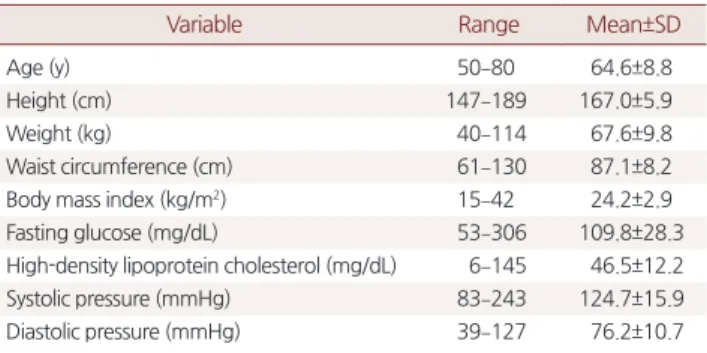
1. 일반적 특성
평균 나이는
64
.6
±8
.8
세이며 신장은167
.0
±5
.9 cm
, 체중은67
.6
±9
.8 kg
,body mass index
는24
.2
±2
.9 kg
/m
2, 허리둘레는87
.1
±8
.2 cm
, 공복혈당은109
.8
±28
.3 mg
/dL
, 중성지방은155
.9
±123
.9 mg
/dL
,high-density lipoprotein
은46
.5
±12
.2 mg
/dL
, 수축기 혈압124
.7
±15
.9 mmHg
, 이완기 혈압은76
.2
±10
.7 mmHg
이다(Table 2
).2. 대사증후군
대사증후군의 진단기준
5
가지 중3
가지 이상 조건을 만족하는 사 람은1
,230
명 중에 총538
명으로43
.7
%였다.3. 우울증
PHQ-9
총점이10
점 이상인 사람은52
명으로1
,230
명 중에4
.2
%였 다.4. 통계 검정
대사증후군이 진단된 사람과 그렇지 않은 사람을 명목변수로 잡 고
PHQ-9
총점10
점 이상 기준으로 두 그룹의 명목 변수로 나눈 뒤 에 카이제곱 검정을 통해 통계적으로 유의한 차이가 있는지 분석하 였다(Table 3
). 대사증후군이 있는 사람과 없는 사람은 우울 정도에 통계적으로 유의한 차이를 보였다.우울에 관련을 줄 수 있는 변수 중에 나이 및 주중 수면시간과 주 말 수면시간을 공변량으로 잡고 로지스틱 회귀분석을 하였다(
Table 4
).대사증후군은 우울증에 대해
OR 0
.55
(95
%confidence interval
,0
.31–0
.97
)을 가지고 이는 통계적으로 유의하였다. 반면에 나이와 수 면시간은 통계적으로 유의하지 못하였다.고 찰
기존의 연구에서는 여성을 대상으로 했을 때 대사증후군과 우울 증이 양의 상관관계를 가지는 것으로 여겨지고 있었다.11,12) 하지만 남성에 대한 연구는 젊은 층에서는 연관이 없는 것으로 밝혀졌고11) 중년 이후의 남성에 대해서는 연구가 부족했다. 본 연구에서는
50
세 이상의 한국 남성에서 대사증후군이 있는 사람이 상대적으로 덜 우울하다는 음의 상관관계를 밝혀냈다. 이는 대사증후군 집단이 남 성과 여성에서 다른 사회생물학적 특성을 가진다고 볼 수 있겠다.다만 이 연구는 비교적 많지 않은 표본을 대상으로 연구했다는 점과 로지스틱 회귀분석을 할 때 우울에 영향을 줄 수 있는 더 많은 변수를 제하지 못했다는 아쉬운 점이 있겠다. 향후 연구에서 성별 에 따라 대사증후군의 원인군이 다른 특징으로 분포하게 됨을 증명 하게 되길 기대하는 바이다.
요 약
연구배경: 한국에서 대사증후군의 유병률이 점차 증가하고 있고 심장 및 뇌혈관 질환을 유발하며 사망률을 증가시키는 주요 질환군 이다. 대사증후군이 발생하는 원인이 명확히 알려져 있지 않고 그 중 우울증과의 연관성이 여러 연구에서 밝혀졌다. 다만 대상이 여 성 한정적이거나 젊은 성인을 대상으로 하고 있기 때문에 본 연구에 서는
50
세 이상의 남성군을 대상으로 연구를 수행하였다.방법: 국민건강영양조사
2016
년 자료를 토대로50
세 이상의 남성을 대사증후군 진단기준에 따라 분류하였고 이를Patient Health Questionnaire 9
점수10
점 이상의 심한 우울의 집단과 통계적 유의 Table 2. Descriptive statisticsVariable Range Mean±SD
Age (y) 50–80 64.6±8.8
Height (cm) 147–189 167.0±5.9
Weight (kg) 40–114 67.6±9.8
Waist circumference (cm) 61–130 87.1±8.2
Body mass index (kg/m2) 15–42 24.2±2.9
Fasting glucose (mg/dL) 53–306 109.8±28.3
High-density lipoprotein cholesterol (mg/dL) 6–145 46.5±12.2
Systolic pressure (mmHg) 83–243 124.7±15.9
Diastolic pressure (mmHg) 39–127 76.2±10.7
SD, standard deviation.
Table 3. Correlation between metabolic syndrome and depression
Variable Severe depression
Metabolic syndrome
Pearson correlation 0.059
P-value 0.038a
aP-value<0.05.
Table 4. Logistic regression analysis of metabolic syndrome and de- pression
Variable P-value OR 95% CI
Metabolic syndrome 0.04a 0.55 0.31–0.97
Age 0.22 1.02 0.98–1.05
Sleep time in weekdays 0.87 1.00 0.99–1.00
Sleep time in weekends 0.61 0.99 0.99–1.00
OR, odds ratio; CI, confidence interval.
aP-value<0.05.
Minsik Lee. Association between Metabolic Syndrome and Severity of Depression
www.kjfp.or.kr
470
Korean J Fam Pract. 2019;9(5):467-470Korean Journal of Family Practice
KJFP
성을 분석했다.
결과:
50
세 이상의 남성 중 대사증후군으로 분류된 집단은 그렇지 않은 집단에 비해odds ratio 0
.55
로 심한 우울 집단과 통계적 유의성 을 가졌다.결론:
50
세 이상의 남성은 기존의 연구에서 밝혀진 여성을 대상으 로 한 대사증후군과 우울성의 결과와 다르게 음의 상관관계를 가지 고 있다. 이는 성별에 따라 대사증후군의 원인이 다른 사회생물학적 인 원인군을 가질 수 있음을 시사한다. 추후에 더 많은 표본과 변수 통제로 연구되기를 기대하는 바이다.중심단어: 대사증후군;
National Institutes of Health
; 우울증;Patient Health Questionnaire 9
; 국민건강영양조사CONFLICT OF INTEREST
No potential conflict of interest relevant to this article was reported
. ORCIDMinsik Lee
,http
://orcid
.org
/0000-0001-9276-0805
REFERENCES1. Reaven GM. Banting lecture 1988. Role of insulin resistance in human dis- ease. Diabetes 1988; 37: 1595-607.
2. Kaplan NM. The deadly quartet. Upper-body obesity, glucose intolerance, hypertriglyceridemia, and hypertension. Arch Intern Med 1989; 149: 1514- 20.
3. DeFronzo RA, Ferrannini E. Insulin resistance. A multifaceted syndrome responsible for NIDDM, obesity, hypertension, dyslipidemia, and athero- sclerotic cardiovascular disease. Diabetes Care 1991; 14: 173-94.
4. Singh AK, Kari JA. Metabolic syndrome and chronic kidney disease. Curr Opin Nephrol Hypertens 2013; 22: 198-203.
5. Sun F, Tao Q, Zhan S. Metabolic syndrome and the development of chronic kidney disease among 118 924 non-diabetic Taiwanese in a retrospective
cohort. Nephrology (Carlton) 2010; 15: 84-92.
6. Wong ND, Nelson JC, Granston T, Bertoni AG, Blumenthal RS, Carr JJ, et al.
Metabolic syndrome, diabetes, and incidence and progression of coronary calcium: the Multiethnic Study of Atherosclerosis study. JACC Cardiovasc Imaging 2012; 5: 358-66.
7. Trevisan M, Liu J, Bahsas FB, Menotti A. Syndrome X and mortality: a pop- ulation-based study. Risk Factor and Life Expectancy Research Group. Am J Epidemiol 1998; 148: 958-66.
8. Gupta AK, Dahlof B, Sever PS, Poulter NR; Anglo-Scandinavian Cardiac Outcomes Trial-Blood Pressure Lowering Arm Investigators. Metabolic syndrome, independent of its components, is a risk factor for stroke and death but not for coronary heart disease among hypertensive patients in the ASCOT-BPLA. Diabetes Care 2010; 33: 1647-51.
9. Lim S, Shin H, Song JH, Kwak SH, Kang SM, Won Yoon J, et al. Increasing prevalence of metabolic syndrome in Korea: the Korean National Health and Nutrition Examination Survey for 1998-2007. Diabetes Care 2011; 34:
1323-8.
10. Kinder LS, Carnethon MR, Palaniappan LP, King AC, Fortmann SP. Depres- sion and the metabolic syndrome in young adults: findings from the Third National Health and Nutrition Examination Survey. Psychosom Med 2004;
66: 316-22.
11. Jeon JH, Kim SH. Depression, stress and how they are related with health behaviors and metabolic syndrome among women over 40 years. J Korean Soc Matern Child Health 2012; 16: 263-73.
12. Alberti KG, Zimmet PZ. Definition, diagnosis and classification of diabetes mellitus and its complications. Part 1: diagnosis and classification of diabe- tes mellitus provisional report of a WHO consultation. Diabet Med 1998;
15: 539-53.
13. Korean Society for the Study of Obesity. Clinical obesity. 3rd ed. Seoul: Ko- rea Medical Book Publishing Company; 2008.
14. Zung WW. A self-rating depression scale. Arch Gen Psychiatry 1965; 12: 63- 70.
15. Spitzer RL, Kroenke K, Williams JB. Validation and utility of a self-report version of PRIME-MD: the PHQ primary care study. Primary Care Evalua- tion of Mental Disorders. Patient Health Questionnaire. JAMA 1999; 282:
1737-44.
16. Kroenke K, Spitzer RL, Williams JB. The PHQ-9: validity of a brief depres- sion severity measure. J Gen Intern Med 2001; 16: 606-13.
17. Choi HS, Choi JH, Park KH, Joo KJ, Ga H, Ko HJ, et al. Standardization of the Korean version of patient health questionnaire-9 as a screening instru- ment for major depressive disorder. J Korean Acad Fam Med 2007; 28: 114- 9.