PGHN
Review Article
Nutritional Screening Tools among Hospitalized Children:
from Past and to Present
Yeoun Joo Lee
Department of Pediatrics, Pusan National University Children’s Hospital, Yangsan, Korea
Increased awareness of the importance of nutrition among hospitalized children has increased the use of nutrition screening tool (NST). However, it is not well known the NST for hospitalized children. Therefore, the purpose of this study is to understand the past and present state of adult and child NST and discuss the pros and cons of each NST.
Key Words: Nutrition, Screening, Malnutrition, Child
Received:March 21, 2018, Accepted:March 26, 2018
Corresponding author: Yeoun Joo Lee, Department of Pediatrics, Pusan National University Children’s Hospital, 20 Geumo-ro, Mulgeum-eup, Yangsan 50612, Korea. Tel: +82-55-360-2180, Fax: +82-55-360-2181, E-mail: [email protected]
Copyright ⓒ 2018 by The Korean Society of Pediatric Gastroenterology, Hepatology and Nutrition
This is an openaccess article distributed under the terms of the Creative Commons Attribution NonCommercial License (http://creativecommons.org/licenses/by-nc/4.0/) which permits unrestricted noncommercial use, distribution, and reproduction in any medium, provided the original work is properly cited.
INTRODUCTION
Nutrition management is essential for the out- comes of patients receiving advanced medical care.
Nutritional support prevents complications from in- fections and shortens the length of hospital stay [1,2]. A recent study about medical cost related to malnourished hospitalized patients has proven that a comprehensive nutrition-focused quality improve- ment program reduced the per-patient healthcare cost [3].
Although there is a growing interest in preventing malnutrition in hospitalized patients, the recent study has also shown that the prevalence rate of mal- nutrition among hospitalized children ranged from 7.5% to 17% in Europe [4,5]. In a study in Korea, the prevalence of malnutrition among hospitalized chil- dren and adults were 12.5% and 22%, respectively
[6,7].
To systematically manage the nutrition of hospi- talized patients, the European Society for Parenteral and Enteral Nutrition (ESPEN) and American Soci- ety for Parenteral and Enteral Nutrition (ASPEN) rec- ommended the use of the guidelines on nutritional screening to identify hospitalized patients who are at risk for malnutrition [8,9]. The guidelines suggested the identification of patients at risk for malnutrition and provision of interventions and treatments to these patients with the help from a multidisciplinary team of doctors, dietitians, nurses, and pharmacists [10]. Furthermore, the Joint Commission in the United States proposed the nutritional screening of all patients within 24 hours after admission.
The use of appropriate nutrition screening tools (NSTs) is important. Overly complex NSTs are diffi- cult to access, whereas the simplicity but poorly vali-
dated still has limit. NSTs should be practical, reli- able, valid, and evidence based [11]. This study aimed at validating the characteristics, application, and validation results of the available NSTs that are used for hospitalized children.
NSTs FOR HOSPITALIZED ADULTS
A variety of NSTs that can be used to screen hospi- talized adult patients were developed. The main con- cept for nutrition screening had started from im- proving surgical outcomes. The prognostic nutri- tional index [12] and prognostic inflammatory and nutritional index [13] published in the 1980s were used as the primary index to screen for nutrition based on triceps skin fold, skin sensitivity, and albu- min, prealbumin, or transferrin level. With the em- phasis of the importance of nutritional screening, NSTs have been developed to improve its accessi- bility and validity. In the 1990s, several NSTs were developed such as the nutritional risk index (NRI) [14], Birmingham nutrition risk score [15], nu- trition risk classification (NRC) [16], and malnu- trition screening tool (MST) [17]. They had changed their focus on history taking and physical examina- tion findings. Appetite, dietary intake, weight loss, or body mass index was used as an index of NSTs.
Since 2000, representative screening tools, such as simple screening tool [18], malnutrition universal screening tool (MUST) [11], nutritional risk screening (NRS) 2002 [19], short nutritional assessment ques- tionnaire (SNAQ) [20], and recent Canadian nu- trition screening tool [21], have been developed and are still used. The presence of acute disease and se- verity of the diagnosis along with anthropometric measurements and dietary factors are considered important in the use of MUST and NRS 2002, which are among the NSTs developed since the 2000s.
Subjective global assessment (SGA) [22] and mini nutritional assessment (MNA) [23] are convenient assessment tools not only assessing but also screen- ing of the nutritional status. SGA is a method of nu- tritional assessment based on medical history (weight and diet changes, primary diagnosis, and stress lev-
el) and physical symptoms (presence of subcutaneous fat, muscle wasting, ankle edema, ascites, functional capacity, and gastrointestinal symptoms).
A validation study on the individual screening tool, medical environment, and population and age groups has been published in a variety of countries.
Moreover, several researches compared each screen- ing tool that was used in a limited setting [24-27].
Aside from the universal NSTs, NST for a specific disease has also been developed, considering the spe- cific nature of the disease. Several NSTs were devel- oped for specific diseases, such as cirrhosis [28], can- cers [29], and cerebral palsy [30], and critically-ill patient groups [31].
SCREENING TOOLS FOR HOSPITALIZED CHILDREN
Studies on NSTs for children are limited compared to those of adults. Secker and Jeejeebhoy [32] have used the SGA for hospitalized children who under- went major thoracic or abdominal surgery. A correla- tion was observed between malnourished children and a higher risk of developing nutrition-associated complications and prolonged hospitalizations. A Brazilian study that used SGA for children with acute illness had found an association between the SGA score and anthropometric measurement. How- ever, no association was observed between the SGA score and length of hospital stay [33].
In 2000, Sermet-Gaudelus et al. [34] have pub- lished the pediatric nutritional risk score (PNRS) by developing a unique equation with the study end- point at >2% weight loss during the first week of admission. The factors for PNRS are food intake
<50%, pain, and the presence of pathologic con- ditions. Each component can be assigned a score from 1 to 5. Unlike other NSTs, PNRS did not use an- thropometric data.
In the UK, the screening tool for the assessment of malnutrition in paediatrics (STAMP) [35] was estab- lished in 2004 and evaluated in 2007. To evaluate the quick and easy-to-use NSTs for hospitalized chil- dren, three factors were considered: diagnosis, nutri-
tional intake, as well as weight and height. After evaluating these factors, the sum was classified into low, medium, and high risk, and the TAMP also sug- gested that a care plan in the last step.
In a large tertiary children’s hospital in the UK, the pediatric Yorkhill malnutrition score (PYMS) [36]
was developed for nutritional screening, and the PYMS used four factors for the screening: body mass index, history of recent weight loss, changes in nutri- tional intake, and the predicted effect of the current medical condition on nutritional status. PYMS used anthropometric data for two of the four factors by placing weight on the anthropometric data, and sub- jective data were also used for the effect of the cur- rent medical condition.
In 2009, the Dutch Society published the national survey results to test their own NST for the screening tool for risk on nutritional status and growth (STRONGkids) [37]. They also focused on developing STRONGkids to improve its applicability. They used four factors for the subjective assessment, high-risk disease, nutritional intake/losses and weight loss/poor weight gain, and a score of 0 to 2 was provided. Like PYMS, STRONGkids also recommended a nutritional intervention for each risk.
Recently, the pediatric digital scaled malnutrition risk screening tool (PeDiSMART) [38] was introduced for hospitalized children by using computer-based information systems in Greece. One of the significant advantages of PeDiSMART is its high reproducibility.
Moreover, it can help professionals save time. The factors are weight-for-age z score, nutritional intake level, overall disease impact, and disease symptoms affecting intake. Weight loss might be significantly associated with nutrition support during hospital- ization in the PeDiSMART malnutrition risk group after adjusting anthropometric data.
Pediatric nutrition screening tool (PNST) [39]
consists of four simple questions that a child’s care- giver can answer with Yes or No. Among the four questions about recent weight loss, poor weight gain over the last few months, poor oral intake within the last few weeks, and obvious weight loss or gain based on the PNST, two affirmative responses can identify
patients who are at risk. Moreover, a correlation be- tween nutrition risk identified using the PNST and pediatric SGA was observed. PNST also correlated with nutritional status using z-score. PNST may be the easiest NST that can be used. However, interrater reliability or reproducibility data are limited.
Except for PNST, most of the NSTs established the nutritional risk based on three categories: low (mild or grade 1), medium (moderate or grade 2), and se- vere (grade 3). All the NSTs used to monitor intake evaluate at least one factor for nutritional screening.
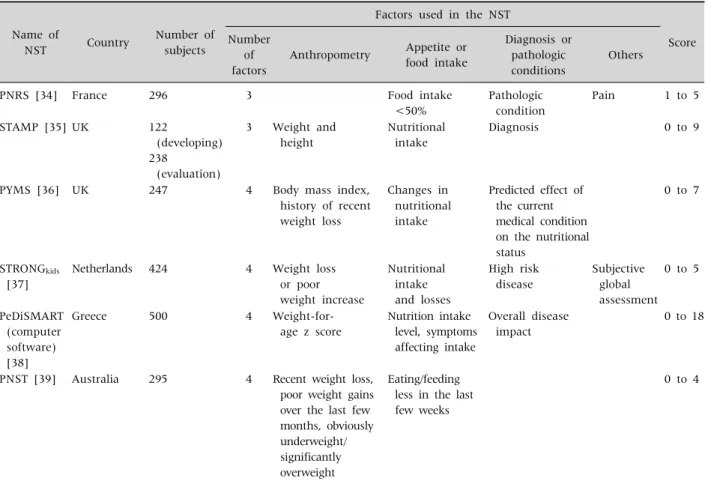
Although PNRS did not focus on anthropometric da- ta, all the other NSTs focused on weight and height or recent weight loss. NSTs for hospitalized children are summarized in Table 1 [34-39].
VALIDATION STUDY ABOUT NSTs FOR HOSPITALIZED CHILDREN
A limited number of studies about NSTs for hospi- talized children compared with those for adults are available. There are studies that compared several representative NSTs [40-46]. Although some studies considered that the PNRS is the most suitable for clinical practice since the results of high sensitivity and specificity in PNRS compared with SGA [40,43].
However, in New Zealand, a study has shown that STRONGkids was the most reliable NST in their clin- ical setting [45]. Moreover, there are other reports that have reported that the STRONGkids was the most suitable for clinical use [42,46]. Even in studies about acute burn injuries, it is difficult to conclude that one NST is superior than the other [47]. A study that used PeDiSMART has shown a correlation among PYMS, STRONGkids, and STAMP. In addition, the area under the curve for weight loss/nutrition support and the length of hospital stay (>7 days) was superior to that of the other three indicators [38]. However, newly developed NSTs, such as PeDiSMART and PNST, have not been fully validated.
Table 1. Nutrition Screening Tools Made for Hospitalized Children and Representative Validation Study of Each NST
Name of
NST Country Number of
subjects
Factors used in the NST
Score Number
of factors
Anthropometry Appetite or food intake
Diagnosis or pathologic conditions
Others
PNRS [34] France 296 3 Food intake
<50%
Pathologic condition
Pain 1 to 5
STAMP [35] UK 122
(developing) 238
(evaluation)
3 Weight and height
Nutritional intake
Diagnosis 0 to 9
PYMS [36] UK 247 4 Body mass index,
history of recent weight loss
Changes in nutritional intake
Predicted effect of the current medical condition on the nutritional status
0 to 7
STRONGkids
[37]
Netherlands 424 4 Weight loss
or poor weight increase
Nutritional intake and losses
High risk disease
Subjective global assessment
0 to 5
PeDiSMART (computer software) [38]
Greece 500 4 Weight-for-
age z score
Nutrition intake level, symptoms affecting intake
Overall disease impact
0 to 18
PNST [39] Australia 295 4 Recent weight loss, poor weight gains over the last few months, obviously underweight/
significantly overweight
Eating/feeding less in the last few weeks
0 to 4
NST: nutrition screening tool, PNRS: pediatric nutritional risk score, STAMP: screening tool for the assessment of malnutrition in paediatrics, PYMS: pediatric Yorkhill malnutrition score, STRONGkids: screening tool for risk on nutritional status and growth, PeDiSMART: pediatric digital scaled malnutrition risk screening tool, PNST: pediatric nutrition screening tool.
DISEASE-SPECIFIC SCREENING TOOLS
A study on paradigm shift was also conducted for the evaluation and treatment of children with dis- ease-specific malnutrition [48]. Since malnutrition is a serious health problem in children with cancer, malnutrition in these children has been a topic of interest. The nutrition screening tool for childhood cancer (SCAN) was developed in Australia and had an excellent accuracy in term of pediatric SGA [49].
It is difficult to identify poor nutritional status with a simple method, and researchers attempted to as- sess and treat poor nutrition in pediatric patients with cancer [50,51]. Although this tool is not only for hospitalized children, a NST for children with cystic
fibrosis is also available [52].
CAN THE NST OBTAIN SIMILAR RESULTS REGARDLESS OF PERFORMER?
Nutritional screening after hospitalization is usu- ally performed by nurses. However, nutritional as- sessment in hospitalized children is usually con- ducted by a clinical dietitian. Several screening tools that can be used by nurses during the developmental stage have been developed [11,36]. In addition, a validation study is usually performed by research di- etitians [36]. Good reproducibility without obtain- ing different results depending on the performers is
one of the important factors of a good screening tool.
A study about the validity and reliability of nutri- tional screening in adults by two independence nurses within 24 hours of admission was conducted.
The article reported that even within the same occu- pation, inter-observer agreement showed 78.3%, though 100% agreement in detecting severely mal- nourished patients [53]. To overcome these differ- ences in the performer's distinction, PeDiSMART at- tempted to increase its reproducibility by using a computer software [38]. Whether NST can reproduce similar results regardless of the performer must be highly considered.
CONCLUSION
To date, the performance accuracy of NSTs for children and adults are still being developed.
Previous studies do not show that any screening tool is superior than the other. Screening tools that tail- ored for each hospital and diagnosis and those with excellent reproducibility regardless of performers must be developed. However, in actual settings, this cannot be easily performed. Therefore, health care professionals in hospitals must identify and use screening tools that are the most appropriate and suitable for their hospital setting.
Moreover, the sensitivity and specificity of the tools must be re-evaluated compared with the actual outcomes in hospital settings. Most importantly, pa- tients who are at risk for malnutrition should be treated, and malnutrition must be prevented in these patients [54].
REFERENCES
1. Zhang H, Wang Y, Jiang ZM, Kondrup J, Fang H, Andrews M, et al. Impact of nutrition support on clinical outcome and cost-effectiveness analysis in patients at nutritional risk: a prospective cohort study with pro- pensity score matching. Nutrition 2017;37:53-9.
2. Hecht C, Weber M, Grote V, Daskalou E, Dell'Era L, Flynn D, et al. Disease associated malnutrition corre- lates with length of hospital stay in children. Clin Nutr 2015;34:53-9.
3. Pimenta FS, Oliveira CM, Hattori WT, Teixeira KR.
Agreement between the methods: Subjective Global Nutritional Assessment and the nutritional assess- ment of the World Health Organization. J Pediatr (Rio J) 2017. doi: 10.1016/j.jped.2017.09.007.
4. Sissaoui S, De Luca A, Piloquet H, Guimber D, Colomb V, Peretti N, et al. Large scale nutritional status assess- ment in pediatric hospitals. e-SPEN J 2013;8:e68-72.
5. Freijer K, van Puffelen E, Joosten KF, Hulst JM, Koopmanschap MA. The costs of disease related malnu- trition in hospitalized children. Clin Nutr ESPEN 2018;23:228-33.
6. Kang MC, Kim JH, Ryu SW, Moon JY, Park JH, Park JK, et al. Prevalence of malnutrition in hospitalized pa- tients: a multicenter cross-sectional study. J Korean Med Sci 2018;33:e10.
7. Hwang EH, Park JH, Chun P, Lee YJ. Prevalence and risk factors for the weight loss during hospitalization in children: a single Korean children's hospital ex- perience. Pediatr Gastroenterol Hepatol Nutr 2016;
19:269-75.
8. Kondrup J, Allison SP, Elia M, Vellas B, Plauth M.
ESPEN guidelines for nutrition screening 2002. Clin Nutr 2003;22:415-21.
9. Mehta NM, Compher C; A.S.P.E.N. Board of Directors.
A.S.P.E.N. Clinical Guidelines: nutrition support of the critically ill child. JPEN J Parenter Enteral Nutr 2009;33:260-76.
10. Agostoni C, Axelson I, Colomb V, Goulet O, Koletzko B, Michaelsen KF, et al. The need for nutrition support teams in pediatric units: a commentary by the ESPGHAN committee on nutrition. J Pediatr Gas- troenterol Nutr 2005;41:8-11.
11. Elia M. The "MUST" Report. Nutritional screening of adults: a multidisciplinary responsibility. Redditch, UK: British Association for Parenteral and Enteral Nutrition; 2003 [cited 2009 Mar]. Available from:
http://www.bapen.org.uk/pdfs/must/must_exec_sum.
pdf.
12. Buzby GP, Mullen JL, Matthews DC, Hobbs CL, Rosato EF. Prognostic nutritional index in gastrointestinal surgery. Am J Surg 1980;139:160-7.
13. Ingenbleek Y, Carpentier YA. A prognostic in- flammatory and nutritional index scoring critically ill patients. Int J Vitam Nutr Res 1985;55:91-101.
14. Veterans Affairs Total Parenteral Nutrition Cooper- ative Study Group. Perioperative total parenteral nu- trition in surgical patients. N Engl J Med 1991;325:
525-32.
15. Reilly HM, Martineau JK, Moran A, Kennedy H.
Nutritional screening--evaluation and implemen-
tation of a simple Nutrition Risk Score. Clin Nutr 1995;14:269-73.
16. Kovacevich DS, Boney AR, Braunschweig CL, Perez A, Stevens M. Nutrition risk classification: a reproducible and valid tool for nurses. Nutr Clin Pract 1997;12:20-5.
17. Ferguson M, Capra S, Bauer J, Banks M. Development of a valid and reliable malnutrition screening tool for adult acute hospital patients. Nutrition 1999;15:458- 64.
18. Laporte M, Villalon L, Thibodeau J, Payette H. Validity and reliability of simple nutrition screening tools adapted to the elderly population in healthcare facilities. J Nutr Health Aging 2001;5:292-4.
19. Kondrup J, Rasmussen HH, Hamberg O, Stanga Z; Ad Hoc ESPEN Working Group. Nutritional risk screening (NRS 2002): a new method based on an analysis of con- trolled clinical trials. Clin Nutr 2003;22:321-36.
20. Kruizenga HM, Van Tulder MW, Seidell JC, Thijs A, Ader HJ, Van Bokhorst-de van der Schueren MA.
Effectiveness and cost-effectiveness of early screening and treatment of malnourished patients. Am J Clin Nutr 2005;82:1082-9.
21. Laporte M, Keller HH, Payette H, Allard JP, Duerksen DR, Bernier P, et al. Validity and reliability of the new Canadian Nutrition Screening Tool in the ‘real-world’
hospital setting. Eur J Clin Nutr 2015;69:558-64.
22. Detsky AS, McLaughlin JR, Baker JP, Johnston N, Whittaker S, Mendelson RA, et al. What is subjective global assessment of nutritional status? JPEN J Parenter Enteral Nutr 1987;11:8-13.
23. Guigoz Y. The Mini Nutritional Assessment (MNA) re- view of the literature--What does it tell us? J Nutr Health Aging 2006;10:466-85; discussion 485-7.
24. Rabito EI, Marcadenti A, da Silva Fink J, Figueira L, Silva FM. Nutritional risk screening 20, short nutri- tional assessment questionnaire, malnutrition screen- ing tool, and malnutrition universal screening tool are good predictors of nutrition risk in an emergency service. Nutr Clin Pract 2017;32:526-32.
25. Chi J, Yin S, Zhu Y, Gao F, Song X, Song Z, et al. A com- parison of the nutritional risk screening 2002 tool with the subjective global assessment tool to detect nutri- tional status in Chinese patients undergoing surgery with gastrointestinal cancer. Gastroenterol Nurs 2017;40:19-25.
26. Fiol-Martínez L, Calleja-Fernández A, Pintor de la Maza B, Vidal-Casariego A, Villar-Taibo R, Urioste- Fondo A, et al. Comparison of two nutritional screening tools to detect nutritional risk in hematologic inpa- tients. Nutrition 2017;34:97-100.
27. Koren-Hakim T, Weiss A, Hershkovitz A, Otzrateni I,
Anbar R, Gross Nevo RF, et al. Comparing the adequacy of the MNA-SF, NRS-2002 and MUST nutritional tools in assessing malnutrition in hip fracture operated eld- erly patients. Clin Nutr 2016;35:1053-8.
28. Schneider AC, Pinto RB, Silveira TR. Nutritional risk and malnutrition determination by anthropometry in cirrhotic children and adolescents. Arq Gastroenterol 2007;44:345-9.
29. Decoster L, Van Puyvelde K, Mohile S, Wedding U, Basso U, Colloca G, et al. Screening tools for multi- dimensional health problems warranting a geriatric as- sessment in older cancer patients: an update on SIOG recommendations†. Ann Oncol 2015;26:288-300.
30. Benigni I, Devos P, Rofidal T, Seguy D. The CP-MST, a malnutrition screening tool for institutionalized adult cerebral palsy patients. Clin Nutr 2011;30:769- 73.
31. Rahman A, Hasan RM, Agarwala R, Martin C, Day AG, Heyland DK. Identifying critically-ill patients who will benefit most from nutritional therapy: further vali- dation of the “modified NUTRIC” nutritional risk as- sessment tool. Clin Nutr 2016;35:158-62.
32. Secker DJ, Jeejeebhoy KN. Subjective Global Nutri- tional Assessment for children. Am J Clin Nutr 2007;
85:1083-9.
33. Vermilyea S, Slicker J, El-Chammas K, Sultan M, Dasgupta M, Hoffmann RG, et al. Subjective global nu- tritional assessment in critically ill children. JPEN J Parenter Enteral Nutr 2013;37:659-66.
34. Sermet-Gaudelus I, Poisson-Salomon AS, Colomb V, Brusset MC, Mosser F, Berrier F, et al. Simple pediatric nutritional risk score to identify children at risk of malnutrition. Am J Clin Nutr 2000;72:64-70.
35. McCarthy H, Dixon M, Crabtree I, Eaton-Evans MJ, McNulty H. The development and evaluation of the Screening Tool for the Assessment of Malnutrition in Paediatrics (STAMP©) for use by healthcare staff. J Hum Nutr Diet 2012;25:311-8.
36. Gerasimidis K, Keane O, Macleod I, Flynn DM, Wright CM. A four-stage evaluation of the Paediatric Yorkhill Malnutrition Score in a tertiary paediatric hospital and a district general hospital. Br J Nutr 2010;104:751-6.
37. Hulst JM, Zwart H, Hop WC, Joosten KF. Dutch na- tional survey to test the STRONGkids nutritional risk screening tool in hospitalized children. Clin Nutr 2010;29:106-11.
38. Karagiozoglou-Lampoudi T, Daskalou E, Lampoudis D, Apostolou A, Agakidis C. Computer-based malnu- trition risk calculation may enhance the ability to iden- tify pediatric patients at malnutrition-related risk for unfavorable outcome. JPEN J Parenter Enteral Nutr
2015;39:418-25.
39. White M, Lawson K, Ramsey R, Dennis N, Hutchinson Z, Soh XY, et al. Simple nutrition screening tool for pe- diatric inpatients. JPEN J Parenter Enteral Nutr 2016;40:392-8.
40. Lestari NE, Nurhaeni N, Wanda D. The pediatric york- hill malnutrition score is a reliable malnutrition screening tool. Compr Child Adolesc Nurs 2017;40 (sup1):62-8.
41. Chourdakis M, Hecht C, Gerasimidis K, Joosten KF, Karagiozoglou-Lampoudi T, Koetse HA, et al. Malnu- trition risk in hospitalized children: use of 3 screening tools in a large European population. Am J Clin Nutr 2016;103:1301-10.
42. Márquez Costa MV, Alberici Pastore C. Nutritional screening tool versus anthropometric assessment in hospitalized children: which method is better asso- ciated to clinical outcomes? Arch Latinoam Nutr 2015;65:12-20.
43. Huysentruyt K, Devreker T, Dejonckheere J, De Schepper J, Vandenplas Y, Cools F. Accuracy of nutri- tional screening tools in assessing the risk of under- nutrition in hospitalized children. J Pediatr Gastroenterol Nutr 2015;61:159-66.
44. Wonoputri N, Djais JT, Rosalina I. Validity of nutri- tional screening tools for hospitalized children. J Nutr Metab 2014. doi: 10.1155/2014/143649.
45. Moeeni V, Walls T, Day AS. Nutritional status and nu- trition risk screening in hospitalized children in New Zealand. Acta Paediatr 2013;102:e419-23.
46. Huysentruyt K, Alliet P, Muyshont L, Rossignol R, Devreker T, Bontems P, et al. The STRONG(kids) nutri-
tional screening tool in hospitalized children: a vali- dation study. Nutrition 2013;29:1356-61.
47. Bang YK, Park MK, Ju YS, Cho KY. Clinical sig- nificance of nutritional risk screening tool for hospital- ised children with acute burn injuries: a cross-sectional study. J Hum Nutr Diet 2017. doi: 10.1111/jhn.12518.
48. Mehta NM, Corkins MR, Lyman B, Malone A, Goday PS, Carney LN, et al. Defining pediatric malnutrition:
a paradigm shift toward etiology-related definitions.
JPEN J Parenter Enteral Nutr 2013;37:460-81.
49. Murphy AJ, White M, Viani K, Mosby TT. Evaluation of the nutrition screening tool for childhood cancer (SCAN). Clin Nutr 2016;35:219-24.
50. Murphy AJ, White M, Davies PS. The validity of simple methods to detect poor nutritional status in paediatric oncology patients. Br J Nutr 2009;101:1388-92.
51. Robinson DL, Loman DG, Balakas K, Flowers M.
Nutritional screening and early intervention in chil- dren, adolescents, and young adults with cancer. J Pediatr Oncol Nurs 2012;29:346-55.
52. McDonald CM. Validation of a nutrition risk screening tool for children and adolescents with cystic fibrosis ages 2-20 years. J Pediatr Gastroenterol Nutr 2008;
46:438-46.
53. Lim SL, Ang E, Foo YL, Ng LY, Tong CY, Ferguson M, et al. Validity and reliability of nutrition screening ad- ministered by nurses. Nutr Clin Pract 2013;28:730-6.
54. Weekes CE, Spiro A, Baldwin C, Whelan K, Thomas JE, Parkin D, et al. A review of the evidence for the impact of improving nutritional care on nutritional and clinical outcomes and cost. J Hum Nutr Diet 2009;22:324-35.