Original Article: Food science/Microbiology
Bacillus subtilis Fermentation for Enhancement of Feed Nutritive Value of Soybean Meal
Moo-Chang Kook · Seok-Cheol Cho · Young-HoHong · Hoon Park*
Received: 17 November 2013 / Accepted: 18 December 2013 / Published Online: 30 June 2014
© The Korean Society for Applied Biological Chemistry 2014
Abstract In order to increase the nutritional quality of soybean meal (SBM) as an animal feed, Bacillus subtilis TP6, a previously isolated strain from an Indonesian traditional fermented soybean food, Tempeh, was used as a starter organism for solid-state fermentation. In the pre-treated SBM with water content of 60%
(v/w), B. subtilis TP6 was grown to a maximum viable cell number of 3.5×10⁹ CFU/g. Compared to control, crude protein in Bacillus fermented SBM was increased by 16%, while raffinose, stachyose, and trypsin inhibitors were reduced by 31, 37, and 90%, respectively. The Sodium dodecyl sulfate-polyacrylamide gel electrophoresis analysis showed that proteins in the fermented SBM were remarkably hydrolyzed into smaller molecular masses, resulting in a decrease in large sized proteins. Our data suggested that B. subtilis fermentation could increase the nutritive value of SBM through reduction of anti-nutritive factors and improvement of protein quality by hydrolysis of soy protein. In addition, B.
subtilis TP6 produced a functional ingredient, poly-γ-glutamic acid which has various health benefits.
Keywords animal feed · Bacillus subtilis · soybean meal · trypsin inhibitor
Introduction
Soybean (Glycine max) is an oilseed crop belonging to the family Leguminosae and one of the world’s largest and most efficient sources of plant protein. Soybean meal (SBM), which is a byproduct remaining after extraction of oil from soybean, has become the most important source of protein for poultry and other livestock, due to its high concentration of protein and excellent profile of essential amino acids in comparison to other plant protein sources (Park, 1987; Adeola, 1996; Emmert and Baker, 1997;
Boonyaratpalin et al., 1998). SBM contains around 40−50%
protein and is a rich source of the amino acids including lysine, tryptophan, threonine, isoleucine, and valine that are deficient in corn, grain sorghum and other cereal grains used for animal feed (Emmert and Baker, 1997; Kim et al., 2012).
Nutritive value of SBM is limited by several anti-nutritional factors such as protease inhibitor, oligosaccharide, and phytic acid that interfere with digestion, absorption, and utilization of nutrients in the diet (Liener, 1981; Grant, 1989). SBM possesses high content of protease inhibitors that adversely affect protein digestibility and amino acid availability. Especially, the presence of trypsin inhibitors in animal feed has been implicated in growth inhibition and pancreatic hypertrophy (Liener, 1981; Grant, 1989; Gumbmann et al., 1989; Friedman et al., 1991). Oligosaccharides such as raffinose and stachyose are also poorly utilized by some species of animals, and fermentation of these oligosaccharides in the lower gut causes the production of gastrointestinal gases (Krause et al., 1994). Most phosphorus present in SBM is in the form of phytic acid, which is generally indigestible by monogastric animals such as poultry and swine (Grant, 1989). The level of anti-nutritional factors can be reduced by heating during the processing of soybean (Ratner and Crawford, 1955; Friedman et al., 1991). However, an excess of heat may increase Maillard reactions between amino acids and M.-C. Kook
Depratment of Marine Biotechnology, Anyang University, Incheon, 417- 833, Republic of Korea
R&D Division, Biovan Co., Ltd., Seoul 120-749, Republic of Korea S.-C. Cho
Department of Food Science & Engineering, Seowon University, Cheongju 361-742, Republic of Korea
Y.-H.Hong
Food Ingredients R&D center,CJ Co. Ltd. Seoul, Republic of Korea H. Park
Department of Food Science, Sun Moon University, Asan, 336-708, Republic of Korea
*Corresponding author (H. Park: [email protected])
This is an Open Access article distributed under the terms of the Creative Commons Attribution Non-Commercial License (http://creativecommons.
org/licenses/by-nc/3.0/) which permits unrestricted non-commercial use, distribution, and reproduction in any medium, provided the original work is properly cited.
reducing sugars, and consequently decrease the digestibility of amino acid (Parsons et al., 1992; Friedman and Brandon, 2001).
Therefore, the conditions applied during heat processing must be carefully monitored to prevent the loss of essential available nutrients.
Treatment of SBM with either of protein hydrolysis (Caine et al., 1998; Dierick et al., 2004) or fermentation (Feng et al., 2007;
Jones et al., 2010) increases the proportions of soluble proteins and small peptides, which may be potential to improve health status of animals. Hong et al. (2004) showed that fermentation of SBM with Aspergillus oryzae improved the nutritive value of soybeans, and suggested that fermented SBM can be used as a feed ingredient, especially for young animal diets. Several studies reported that during fermentation of SBM, the size of the peptides decreased, which could improve amino acid digestibility in young animals (Hong et al., 2004; Chen et al., 2010; Feng et al., 2010).
So far, there is little information available on the nutritional quality of SBM fermented by Bacillus strains. Bacillus fermentation technology has been widely applied in preparation of industrial proteinases as well as fermented soy foods such as Chungkookjang, a Korean traditional fermented food, and Natto, a Japanese traditional fermented food (Lee, 1998; Kim et al., 1999; Degering et al., 2010). Previously, B. subtilis TP6 was isolated from the Indonesian fermented soybean, Tempeh and found to possess strong protease activity (Kim et al., 2006). It is expected that fermentation of SBM by the Bacillus strain can reduce anti- nutritional factors, especially trypsin inhibitors and improve protein quality by the hydrolysis of soy protein. Thus, the purposes of this study were to investigate the applicability of a solid state fermentation of SBM by B. subtilis TP6 and to evaluate the nutritional quality of fermented SBM.
Materials and Methods
Preparation of strains. B. subtilis TP6 isolated from the Indonesian fermented soybean, Tempeh (Kim et al., 2006), was used as a starter organism. The stock cultures were maintained at
−70oC in a modified Nutrient broth (pH 7.0), which contains soytone (5 g/L), beef extract (5 g/L), and glucose (20 g/L). Before use in experiments, the culture was propagated twice in the modified Nutrient broth at 37oC for 24 h.
Pre-treatment of SBM and solid state fermentation. In the present study, SBM, which served as the fermentation substrate, was obtained from CJ (Korea). SBM was washed and soaked in water by spraying adequate amount of water to achieve final water contents of 30−60% (v/w). The soaked SBM was heated at 60, 80, 105, and 121oC for 10−30 min. After cooling, the heat-treated SBM was inoculated with B. subtilis TP6 to have a final viable cell number of 1.0×10⁷ CFU/g. After a thorough mixing, the inoculated SBM was incubated at 37oC for 24 h. Bacterial growth was determined by plating 0.1-mL portions of appropriately diluted culture on the modified Nutrient agar plates and incubating the plates at 37oC for 48 h. The pH of fermented SBM was measured
using a pH meter (MP 220 pH meter, Mettler Toledo, Switzerland).
Chemical analysis. Dry matter and crude protein were determined according to the method of AOAC (2006). The oligosaccharide composition was analyzed by high performance liquid chromatography according to the method of Delente and Ladenburg (1972). Determination of poly-γ-glutamic acid was carried out by the method of Choi et al. (2004). Amino acids were measured by the method of Hong et al. (2004).
Trypsin inhibitor assay. Trypsin inhibitor assay was carried out by the modified method of Hamerstrand et al. (1981). An aliquot (1 mL) of trypsin enzyme solution was mixed with 0.1 mL of crude extract of sample and pre-incubated in shaking water bath at 37oC for 10 min. After pre-incubation, 0.6 mL of 0.1 M phosphate buffer (pH 7.5) and 0.3 mL of BApNA (α-Benzoyl-DL-arginine-p- nitroanilide) were added. The reaction mixture was incubated at 37oC in shaking water bath for 10 min and reaction was stopped by adding 0.5 mL of 30% acetic acid. The optical density was measured at 410 nm using UV/VIS spectrophotometer to determine trypsin inhibitor activity.
Protease assay. Protease activity was measured using the modified method of Hagihara (Hagihara, 1958). The crude enzyme was obtained by fermenting soybean meal. The fermented soybean meal sample (10 g) and 90 mL of 0.85% (w/v) NaCl solution were mixed for 30 min at room temperature, and then cell-free extract was used as a crude enzyme solution. The enzymatic reaction mixture consisted of 1 mL of crude enzyme solution, 1 mL of 0.6% (w/v) azocasein (Sigma, USA), and 1 mL of 0.1 M phosphate buffered saline (pH 7.0). The enzymatic reaction was performed at 37oC for 10 min. The reaction was stopped by addition of 3 mL of 5% (w/v) trichloroacetic acid (TCA; Sigma, USA) followed by centrifugation (12,000 rpm, 15 min). Hydrolyzed casein was measured by a folin-ciocalteu method. One unit of enzyme activity was defined as the amount of protease which produced 1 µg tyrosine per min at 37oC.
KOH solubility. KOH solubility of protein was determined as described by Parsons et al. (1991). The protein sample mixture (1.5 g of sample and 75 mL of 0.2% KOH solution) was stirred for 20 min at 22oC, and then centrifuged at 12,000 rpm for 10 min. The supernatant was collected and the nitrogen content was determined by the Kjeldahl method (AOAC, 2006). The protein solubility was calculated as a percentage of the total in the original SBM sample.
Sodium dodecyl sulfate-polyacrylamide gel electrophoresis (SDS-PAGE). SDS-PAGE was carried out in 12.5% separating gel and 5% stacking gel according to the method of Hames and Rickwood (1990). Gels were run at 20oC for 6 h at 80 mA. After electrophoresis, the gel was stained with Coomassie blue according to the method of Reed et al. (1998). Relative molecular weight of each protein was determined using a standard protein marker.
Results and Discussion
Pre-treatment of SBM. Solid state fermentation is performed on
a non-soluble material that acts both as physical support and source of nutrients under low moisture content. From the ancient, solid state fermentation has been used to prepare traditional fermented soy foods such as Chungkookjang, Natto, Tempeh, soybean paste, and soy sauces which are highly digestible and nutritious (Lee, 1998; Kim et al., 1999). Previously, B. subtilis TP6 was isolated from the Indonesian fermented soybean, Tempeh and found to produce a serine protease of subtilisin family consisting of 275 amino acid residues (Kim et al., 2006).
In this study, B. subtilis TP6 was selected as a starter organism to ferment SBM because the strain has been shown to have a strong proteolytic activity.
A limited amount of usable water is present in SBM and thus the adjustment of water content by soaking is important for the growth of starter organism. Moisture content is also one of the most critical factors influencing protease production in solid state fermentation. To determine the influence of water content on cell growth of B. subtilis TP6, SBM was soaked in water to achieve water contents of 30−60% (v/w). The hydrated SBM was autoclaved at 121oC for 15 min. After cooling, the heat-treated SBM was inoculate with B. subtilis TP6 (1.0×10⁷ CFU/g), mixed, and fermented for 37oC for 24 h. The effect of water content on growth of B. subtilis TP6 on SBM was present in Table 1. The cell growth of B. subtilis TP6 was not observed in SBM with 30%
water, whereas the strain was able to grow in SBM with 40%
water and its viable cell number reached 7.0×10⁸ CFU/g. The maximum cell growth (3.5×10⁹ CFU/g) was observed in SBM with 60% water. The growth profile of B. subtilis TP6 on SBM with 60% water was similar to that of the strain grown in modified Nutrient Broth (Data not shown). Our data suggest that SBM as a substrate for the growth of the bacterial strain is required to have 60% of water content for industrial application.
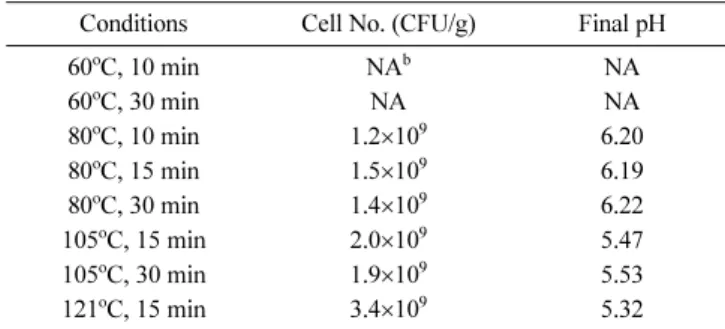
In order to remove undesirable microorganisms from SBM that could interfere with fermentation, SBM was soaked to have water content of 60% (v/w), and subsequently heated at 60, 80, 105, and 121oC for 10−30 min. After heat treatment at 60°C, undesirable microorganisms were detected in the SBM. In the SBM treated at 80oC for 10 min, microbial contamination was not observed during 72-h fermentation, and the viable cell number of B. subtilis TP6 reached 1.2×10⁹ CFU/g. However, the maximum cell growth (3.4×10⁹ CFU/g) was observed in the heat-treated SBM at 121oC for 15 min (Table 2). Therefore, the SBM, which was soaked to have water content of 60% and heated at 121oC for 15 min, was used as a substrate for solid-state fermentation in subsequent
experiments.
Physical and nutritional characteristics of fermented SBM.
Characteristics of solid-stated fermented SBM are shown in Table 3. The final pH was decreased from pH 6.5 to pH 5.3, probably due to the production of organic acids during the fermentation.
Crude protein was increased from 48.5 to 56.4%, while the total carbohydrate dropped from 32.5 to 25.3%. The increase in crude protein appears to be resulted from the digestion of carbohydrate in SBM for microbial growth during fermentation. Similar findings were observed by other studies that showed an increase in crude protein content and a decrease in carbohydrate content after fermentation of SBM (Chen et al., 2010; Teng et al., 2012; Gao et al., 2013).
The KOH protein solubility of heat-treated plus non-fermented SBM and fermented SBM was 77 and 79%, respectively and was slightly lower than that of the untreated raw SBM (85%), due to the application of heat process. However, the solubility of fermented SBM is still above 75%, indicating that the fermented SBM maintains high quality of soluble protein. The KOH protein solubility is a good index of in vivo soybean quality for animal feeding. Parsons et al. (1991) suggested that feed efficiency could decrease significantly when the solubility was below 66%. Willis (2003) reported that 18 minutes of autoclaving raw soybeans were Table 1 Effect of water content on growth of B. subtilis TP6 on soybean
meala
Water content (%) Cell No. (CFU/g) Final pH
30% 1.0×10⁷ 6.12
40% 7.0×10⁸ 5.90
50% 2.5×10⁹ 5.55
60% 3.5×10⁹ 5.26
aValues are the means of three replicated measurements.
Table 2 Effect of heat treatment on growth of B. subtilis TP6 on soybean meala
Conditions Cell No. (CFU/g) Final pH
60oC, 10 min NAb NA
60oC, 30 min NA NA
80oC, 10 min 1.2×10⁹ 6.20
80oC, 15 min 1.5×10⁹ 6.19
80oC, 30 min 1.4×10⁹ 6.22
105oC, 15 min 2.0×10⁹ 5.47
105oC, 30 min 1.9×10⁹ 5.53
121oC, 15 min 3.4×10⁹ 5.32
aValues are the means of three replicated measurements.
bNA: not applicable due to microbial contamination.
Table 3 Physical and nutritional characterization of fermented soybean meala
Items Non-fermented SBMb Fermented SBM
Dry matter (%) 88.04±1.21 89.68±0.640
Final pH 06.51±0.14 5.28±0.09
Crude protein (%) 48.53±0.52 56.42±2.080
KOH solubility 77.37±3.07 79.25±1.820
Total carbohydrate (%) 32.50±0.31 25.29±0.110
Raffinose (%) 01.26±0.04 0.87±0.06
Stachyose (%) 03.47±0.06 2.19±0.05
Poly-γ-glutamic acid (%) NDc 0.60±0.03
Protease activity (U/mg) ND 25.1±0.20
aValues are the means of three replicated measurements and standard deviations.
bSBM: soybean meal.
cND: No detection.
required to maximize the growth of chicks and there was very little change in KOH solubility value during the heat treatment.
SBM contains raffinose and stachyose, the anti-nutritive oligosaccharides that cause osmotic problems in animals (Krause et al., 1994). After fermentation, raffinose and stachyose were lowered by 31 and 37%, respectively. Possible explanation from the decrease in the oligosaccharides is probably due to the release of exogenous enzymes hydrolyzing the oligosaccharides from the Bacillus strain during the fermentation.
Fermentation resulted in the production of poly-γ-glutamic acid, an anionic polypeptide, in which D-and/or L-glutamic acid units are polymerized via γ-amide linkages (Kang et al., 2005). Poly-γ- glutamic acid is a major component of the extracellular mucilage produced by some strains of B. subtilis and is found in the Korean traditional soy product, Cheongkukjang (Shih and Van, 2001; Lee et al., 2010). Several studies have shown that poly-γ-glutamic acid increases calcium absorption in small intestine, intensifies femur strength, enhances immune-stimulating activity, and potentially promotes antitumor activity (Lee et al., 2006; Kim et al., 2007).
It is well established that Bacillus strains have the ability to secrete large amounts of extracellular proteases and are recognized as important sources of commercial proteases. In this study, B.
subtilis TP6 grown in SBM exhibited protease activity of 25.1 U/
mg.
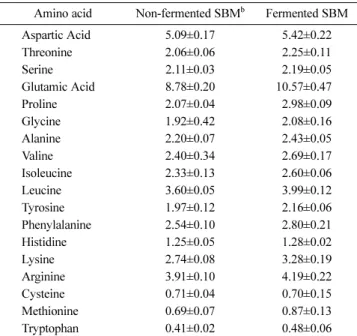
Table 4 presents the amino acid profile of non-fermented and fermented SBM. The contents of most amino acids in SBM were increased by the fermentation with B. subtilis TP6. This consists with the results of the previous studies on the fermentation of SBM with fungi or bacteria (Hong et al., 2004; Chen et al., 2010;
Gao et al., 2013), suggesting that the increase in amino acid
content could be attributed to the simple protein constituents of microbial mass as well as microbial metabolism during fermentation.
Profiles of cell growth, trypsin inhibitor, protein distribution during fermentation. To determine the growth of B. subtilis TP6 during fermentation, SBM was soaked in water to achieve water contents of 60% (v/w), heated at 121oC for 15 min., inoculate with the Bacillus strain (1.0×10⁷ CFU/g), and fermented at 37oC for 24 h. Growth profile of B. subtilis TP6 in SBM was presented in Fig.
1. The growth of B. subtilis TP6 was increased rapidly after 6-h fermentation, and the maximum viable cell number (3.5×10⁹ CFU/g) was obtained at 12 h. On the other hand, trypsin inhibitor started to decrease after 3-h fermentation, and gradually decreased until 18 h (Fig. 1). The trypsin inhibitor content in fermented SBM was decreased from 3.2 to 0.33 mg/g after 18 h, resulting in almost 90% reduction.
Fig. 2 presents the SDS-PAGE analysis of raw SBM, non- fermented SBM and fermented SBM. The protein profile of heat- Table 4 Amino acid composition in fermented soybean meal (mg/g) a
Amino acid Non-fermented SBMb Fermented SBM
Aspartic Acid 5.09±0.17 5.42±0.22
Threonine 2.06±0.06 2.25±0.11
Serine 2.11±0.03 2.19±0.05
Glutamic Acid 8.78±0.20 10.57±0.470
Proline 2.07±0.04 2.98±0.09
Glycine 1.92±0.42 2.08±0.16
Alanine 2.20±0.07 2.43±0.05
Valine 2.40±0.34 2.69±0.17
Isoleucine 2.33±0.13 2.60±0.06
Leucine 3.60±0.05 3.99±0.12
Tyrosine 1.97±0.12 2.16±0.06
Phenylalanine 2.54±0.10 2.80±0.21
Histidine 1.25±0.05 1.28±0.02
Lysine 2.74±0.08 3.28±0.19
Arginine 3.91±0.10 4.19±0.22
Cysteine 0.71±0.04 0.70±0.15
Methionine 0.69±0.07 0.87±0.13
Tryptophan 0.41±0.02 0.48±0.06
aValues are the means of three replicated measurements and standard deviations.
bSBM: soybean meal.
Fig. 1 Time profile of cell growth and trypsin inhibitor during soybean meal fermentation by Bacillus subtilis TP6. Filled diamond; cell growth, filled square; trypsin inhibitor. Data points are the means of three replicated measurements. Error bars represent standard deviations.
Fig. 2 Protein pattern of fermented soybean meal. Lane 1; size marker, lane 2; raw soybean meal, lane 3; non-fermented soybean meal, lane 4;
fermentation for 3 h, lane 5; fermentation for 6 h, lane 6; fermentation for 9 h, lane 7; fermentation for 12 h, lane 8; fermentation for 18 h, lane 9;
fermentation for 24 h.
treated plus non-fermented SBM exhibited similar to that of raw SBM, although larger proteins with MW above 66 kDa were decreased slightly in the non-fermented SBM. The profile of raw SBM was in agreement with the study of Feng et al. (2007). After 9-h fermentation, the large proteins in SBM were remarkably hydrolyzed into smaller molecular masses, resulting in a decrease in large sized proteins. The proteins with MW above 31 kDa were almost hydrolyzed at 24-h fermentation. Our data suggested that Bacillus fermentation could increase the nutritive value of SBM and enhance the content of small-size peptides, due to hydrolysis of large size proteins by protease secreted from B. subtilis during fermentation. The result of SDS-PAGE was consistent with previous studies of SBM fermented with fungi or bacteria (Hong et al., 2004; Chen et al., 2010). It is expected that an increase in small size peptides by fermentation may improve health status of animals because soybean-derived peptides have been shown to have many health benefits such as antimicrobial, antioxidant, anticancer, antihypertensive, anti-inflammatory, hypocholesterolemic, and immunostimulatory activities (Wang and De Mejia, 2005).
In conclusion, Bacillus subtilis fermentation could increase the nutritive value of SBM in which fermentation increased in protein content, reduced trypsin inhibitor content, produced poly-γ- glutamic acid, and improved protein quality by the hydrolysis of soy protein. Therefore, SBM fermented with B. subtilis is a promising alternative protein source to improve health status of animals and potentially reduce the cost of animal production. The effectiveness of fermented SBM on piglet growth is still pending to be confirmed in the near future.
References
Adeola O (1996) Bioavailability of tryptophan in soybean meal for 10-kg pigs using slope-raito assay. J Animal Sci 74, 2411–9.
AOAC (2006) Official Methods of Analysis. Association of Official Analytical Chemists, USA.
Boonyaratpalin M, Suraneiranat P, and Tunpibal T (1998) Replacement of fish meal with various types of soybean products in diets for the Asian easbass, Lates calcarifer. Aquaculture 161, 67–78.
Caine WR, Verstegen MWA, Sauer WC, Tamminga S, and Schulze H (1998) Effect of protease treatment of soybean meal on content of total soluble matter and crude protein and level of soybean trypsin inhibitors. Anim Feed Sci Technol 71, 177–83.
Chen CC, Shih YC, Chiou PWS, and Yu B (2010) Evaluating nutritional quality of single stage- and two stage-fermented soybean meal. Asian- Aust J Anim Sci 23, 598–606.
Choi SH, Park JS, Whang KS, Yoon MH, and Choi WY (2004) Production of Microbial Biopolymer, Poly(γ-glutamic acid) by Bacillus subtilis BS 62.
Agric Chem Biotechnol 47, 60–4.
Degering C, Eggert T, Puls M, Bongaerts J, Evers S, Maurer KH et al. (2010) Optimization of protease secretion in Bacillus subtilis and Bacillus licheniformis by screening of homologous and heterologous signal peptides. Appl Environ Microbiol 76, 6370–6.
Delente J and Ladenburg K (1972) Quantitative determination of the oligosaccharides in defatted soybean meal by gas-liquid chromatography.
J Food Sci 37, 372–4.
Dierick N, Decuypere J, Molly K, and Vanderbeke E (2004) Microbial protease addition to a soybean meal diet for weaned piglets: effects on performance, digestion, gut flora and gut function. In Recent advances of research in antinutritional factors in legume seeds and oilseeds, (4th ed),
pp. 229−33. EAAP publication, Italy.
Emmert JL and Baker DH (1997) A chick bioassay approach for determining the bioavailable choline concentration in normal and overheated soybean meal, canola meal and peanut meal. J Nutr 127, 745–52.
Feng J, Liu X, Liu YY, Xu ZR, and Lu YP (2007) Effects of Aspergillus oryzae 3.042 fermented soybean meal on growth performance and plasma biochemical parameters in broilers. Anim Feed Sci Technol 134, 235–42.
Feng J, Liu X, Xu ZR, Lu YP, and Liu YY (2010) The effect of Aspergillus oryzae fermented soybean meal on growth performance, digestibility of dietary components and activities of intestinal enzymes in weaned piglets. Anim Feed Sci Technol 134, 295–303.
Friedman M and Brandon DL (2001) Nutritional and health benefits of soy proteins. J Agric Food Chem 49, 1069–86.
Friedman M, Brandon DL, Bates AH, and Hymowitz T (1991) Comparison of a commercial soybean cultivar and an isoline lacking the Kunitz trypsin inhibitor: composition, nutritional value, and effects of heating. J Agric Food Chem 39, 327–35.
Gao Y, Wang C, Zhu Q, and Qian G (2013) Optimization of solid-state fermentation with Lactobacillus brevis and Aspergillus oryzae for trypsin inhibitor degradation in soybean meal. J Integr Med 12, 869–76.
Grant G (1989) Anti-nutritional effects of soyabean, a review. Prog Food Nutr Sci 13, 317–48.
Gumbmann MR, Dugan GM, Spangler WL, Baker EC, and Rackis JJ (1989) Pancreatic response in rats and mice to trypsin inhibitors from soy and potato after short- and long-term dietary exposure. J Nutr 119, 1598–609.
Hagihara B (1958) In The Enzymes, (4th ed). Academic press Inc., USA.
Hamerstrand GE, Black LT, and Glover JD (1981) Trypsin inhibitors in soy products: Modification of the standard analytical procedure. Cereal Chem 58, 42–5.
Hames BD and Rickwood D (1990) In Gel electrophoresis of proteins. A practical approach. Oxford University Press, UK.
Hong KJ, Lee CH, and Kim SW (2004) Aspergillus oryzae GB-107 fermentation improves nutritional quality of food soybeans and feed soybean meals. J Med Food 7, 430–5.
Jones CK, DeRouchey JM, Nelssen JL, Tokach MD, Dritz SS, and Goodband RD (2010) Effects of fermented soybean meal and specialty animal protein sources on nursery pig performance. J Anim Sci 88, 1725–32.
Kang SE, Rhee JH, Park C, Sung MH, and Lee IH (2005) Distribution of poly-γ-glutamate (γ-PGA) producers in Korean fermented foods, Cheongkukjang, Doenjang, and Kochujang. Food Sci Biotechnol 14, 704–8.
Kim EJ, Utterback PL, and Parsons CM (2012) Comparison of amino acid digestibility coefficients for soybean meal, canola meal, fish meal, and meat and bone meal among 3 different bioassays. Poult Sci 91, 1350–5.
Kim N, Yang JL, and Song YS (1999) Physiological functions of chongkukjang. Food Ind Nutr 4, 40–6.
Kim SB, Lee DW, Cheigh CI, Choe EA, Lee SJ, Hong YH et al. (2006) Purification and characterization of a fibrinolytic subtilisin-like protease of Bacillus subtilis TP-6 from an Indonesian fermented soybean, tempeh.
J Ind Microbiol Biotechnol 33, 436–44.
Kim TW, Lee TY, Bae HC, Hahm JH, Kim YH, Park C et al. (2007) Oral administration of high molecular mass poly-γ-glutamate induces NK cell-mediated antitumor immunity. J Immunol 179, 775–80.
Krause DO, Easter RA, and Mackie RI (1994) Fermentation of stachyose and raffinose by hindgut bacteria of the weanling pig. Lett Appl Microbiol 18, 349–52.
Lee H, Chang MJ, and Kim SH (2010) Effects of poly-γ-glutamic acid on serum and brain concentrations of glutamate and GABA in diet-induced obese rats. Nutr Res Pract 4, 23–9.
Lee HJ (1998) Health functional peptides from soybean foods. Korea Soybean Digest 15, 16–22.
Lee MS, Jang JI, and Kim HS (2006) Effect of γ-PGA (Poly-γ-glutamic acid) supplement on calcium absorption and bone metabolism in rats. J Korean Soc Food Sci Nutr 35, 255–61.
Liener IE (1981) Factors affecting the nutritional quality of soya products. J Am Oil Chem Soc 58, 406–15.
Park HS (1987) Soybean meal production and the use in animal feeding.
Korea Soybean Digest 4, 20–6.
Parsons CM, Hashimoto K, Wedekind KJ, and Baker DH (1991) Soybean protein solubility in potassium hydroxide: An in vitro test of in vivo protein quality. J Anim Sci 69, 2918–24.
Parsons CM, Hashimoto K, Wedekind KJ, Han Y, and Baker DH (1992) Effect of over-processing on availability of amino acids and energy in soybean meal. Poultry Sci 71, 133–40.
Ratner B and Crawford LV (1955) Soybean: anaphylactogenic properties. Ann Allergy 13, 289–95.
Reed R, Holmes D, Weyers J, and Jones A (1998) Practical Skills in Biomolecular Sciences, Longman, Hongkong.
Shih IL and Van YT (2001) The production of poly-(-glutamic acid) from microorganisms and its various applications. Bioresour Technol 79, 207–
25.
Teng D, Gao M, Yang Y, Liu B, Tian Z, and Wang J (2012) Bio-midification of soybean meal with Bacillus subtilis or Aspergillus oryzae. Biocatal Agric Biotechnol 1, 32–8.
Wang W and De Mejia EG (2005) A new frontier in soy bioactive peptides that may prevent age-related chronic diseases. Compr Rev Food Sci Food Saf 4, 63–78.
Willis S (2003) The use of soybean meal and full fat soybean meal by the animal feed industry. Proc Aust Soybean Conference-2003, 1–8.