고초균에 의한 탈지대두 Grits 발효물의 항산화 및 항암 활성
이성규1․김현정2․이삼빈1,2․이인선1†
1계명대학교 식품가공학과
2계명대학교 전통 미생물자원 개발 및 산업화 연구센터
Antioxidant and Anticancer Activities of Defatted Soybean Grits Fermented by Bacillus subtilis NUC1
Sung-Gyu Lee1, Hyun-Jeong Kim2, Sam Pin Lee1,2, and In-Seon Lee1†
1Dept. of Food and Technology and 2The Center for Traditional Microorganism Resources, Keimyung University, Daegu 704-701, Korea
Abstract
Antioxidant and anticancer activities of water and ethanol extracts of defatted soybean grits (DSG) fermented Bacillus subtilis NUC1 were determined and compared with those of the raw DSG. The fermented defatted soy- bean grits (FDSG) exhibited higher total polyphenols and flavonoids contents than DSG. The ethanol extracts of FDSG (FD-E) showed the highest polyphenol and flavonoid contents with 23.35 mg/g and 3.48 mg/g, respectively. Particularly, FD-E showed higher DPPH radical scavenging activities with RC50 of 0.32 mg/mL than other samples with RC50 of 1.10~3.89 mg/mL. The water and ethanol extracts of FDSG and DSG showed growth inhibitory effects against AGS, A549 and Hela cancer cells in a dose-dependent manner, and especially FD-E showed the highest growth inhibition effects. FD-E induced apoptosis in Hela cells through an increased activation of caspase-3 and caspase-3 target protein, PARP, but rarely affected caspase-7.
Key words: fermented defatted soybean grits, antioxidant, anticancer, apoptosis
†Corresponding author. E-mail: [email protected]
†Phone: 82-53-580-5538, Fax: 82-53-580-5538
서 론
암과 심장병을 포함하는 만성적인 질환들은 생체내의 산 화적 스트레스에 의해 생성되는 free radical에 의해 기인된 다. 즉 free radical들은 세포 구성성분과 강하게 반응하여 세포와 조직에 손상을 가하고 지속적인 DNA 손상은 암, 노 화, 심장병 등을 유발하게 된다(1,2). 생체 내에는 이러한 free radical에 방어하는 superoxide dismutase(SOD), glu- tathione peroxidase(GPX), catalase(CAT), glutathione re- ductase, glutathione-S-transferase 등의 항산화 효소를 가 지고 있어 DNA 손상에 대한 방어기능을 하고 있지만(3), 과도한 스트레스에 노출되어 있는 현대인에게는 더욱 효과 적이고 안전한 식이성 항산화제가 필요하다.
최근 대두를 Bacillus subtilis 균으로 발효시켜 제조한 우 리나라 전통 발효식품인 청국장은 대두에 함유되어 있는 항 산화 물질 뿐만 아니라 발효를 통해 새롭게 생성된 항산화 물질인 펩타이드, 유리아미노산, isoflavone의 aglycone 등 을 함유하게 된다(4,5). 이러한 물질들은 항암작용, 혈전 용 해능, 항돌연변이, 면역증강 효과, 혈중 콜레스테롤 저하, 심 장병 예방 등의 다양한 생리활성(6-9)이 밝혀지면서 새로운
건강기능식품으로 관심을 받고 있다.
특히 청국장이 발효되면서 항산화 관련성분의 변화는 genistin과 daidzin과 같은 배당체의 형태로 존재하는 iso- flavones들이 발효과정 중에 aglycone인 genistein과 daid- zein으로 변화한다는 것이다(10). 배당체의 형태로 존재하던 isoflavone들이 당이 분리되어 aglycone의 형태가 되면 더욱 강한 항산화효과를 나타내는 것으로 알려져 있고 특히 아시 아 지역에서 많이 섭취되고 있는 대두 발효식품인 된장, 미 소 등은 발효과정 중 흡수하기 쉬운 aglycone의 형태로 변화 되어 genistein 및 daidzein의 함량이 높아진다는 보고가 있 다(11,12). 또한 이러한 성분들은 유방암과 전립선암의 예방 효과가 높으며 생체외 이물질이 발암물질로 전환되는데 관 련된 생체 내 효소계를 억제시키는 것으로(13) 알려져 있다.
한편 대두 발효식품의 항암성은 원료 콩에서 유래하는 것 과 발효과정에서 분해되거나 새롭게 합성되는 성분에 의해 나타난다. 대두에서 유래하는 항암활성물질로는 protease inhibitor(14), phytic acid(15), isoflavone(11) 등이 보고되었 다. 특히 청국장에는 대두가 갖고 있는 원래의 유익한 물질 과 더불어 단백질 분해효소, 고분자 핵산, 갈변물질, 점질성 ployglutamic acid(16-18) 등이 새로 생기고, 그중에서 tryp-
sin inhibitor는 항암효과가 있다(19)고 보고되었다. 또한 대 두가 발효되면서 새로 생성되는 이들 성분들은 사용하는 균 주에 따라 성분의 함량이나 생리활성에서 차이가 난다(20) 고 한다.
따라서 본 연구에서는 단백질 분해 및 점질물 생성능이 우수한 (주)NUC전자 보유균주를 이용하여 단백질을 60%
이상 함유하고 있는 탈지대두 grits(defatted soybean grits, DSG)를 발효시킨 다음 이 발효물이 항산화 및 항암 활성을 가지는 새로운 소재가 될 수 있는지를 검토해 보았다. 이에 DSG를 B. subtilis NUC1균주로 발효시켜 DSG 발효물을 제조한 다음, 물 혹은 에탄올로 각각의 추출물을 제조한 후 이들 DSG 발효 추출물의 항산화 및 항암 활성을 살펴보았으 며, 나아가 발효하지 않은 DSG 추출물과 비교 분석함으로써 발효에 의한 이들 활성의 차이도 확인해 보았다.
재료 및 방법
DSG 발효물 및 추출물 제조
탈지대두 grits(defatted soybean Grit, DSG)는 ADM사 (Decatur, IL, USA)에서 구입하여 사용하였고, B. subtilis NUC1 균주는 (주)NUC전자 바이오연구소로부터 분주 받아 사용하였다. 먼저 DSG 원료를 40oC에서 12~18시간 동안 증자하거나, 증류수를 원료대비 2.5배 중량비로 첨가한 후 고압멸균기(JP/MIR 551, SANYO, Tokyo, Japan)로 121oC 에서 15분간 증자하였다. 증자된 DSG를 실온에서 50~60oC 로 냉각하여 실험에 사용하였다. B. subtilis NUC1균의 접종 을 위해 5%의 대두분말 용액에서 48시간 배양한 배양액을, 증자한 DSG에 B. subtilis NUC1균이 2%가 되게 각각 접종 후 40oC에서 24시간 발효시켜 DSG 발효물을 제조한 다음 동결건조 하였다.
동결건조된 DSG 및 DSG 발효물의 물 추출물 제조는 각 각의 시료에 10배의 증류수를 첨가하여 상온에서 2시간 동 안 추출한 후 15,000 rpm에서 15분간 원심분리한 다음 여과 하여 실험에 사용(21)하였다. 그리고 에탄올추출물은 시료 에 10배량의 80% 에탄올을 혼합(w/v)하여 상온에서 3회 추 출하고 여과지(Whatman No.3, Mailstone, England)를 사용 하여 여과한 후 감압농축한 후 동결건조 하여 사용하였다.
이들 시료들은 증류수에 녹여 실험에 사용하였다.
총 폴리페놀 함량 측정
총 폴리페놀 함량은 Folin-Denis법(22)을 응용하였다. 각 시료의 1 mg을 증류수 1 mL에 녹이고 10배 희석한 희석액 2 mL에 2배 희석한 Folin 시약 2 mL을 첨가하고 잘 혼합한 후 3분간 방치한 후 10% Na2CO3 2 mL을 넣고 1시간 반응시 킨 후 UV/Visible spectrophotometer(UVIKON 922, Kontron, Milan, Italy)를 사용하여 700 nm에서 흡광도를 측정하여 작성한 표준곡선으로부터 함량을 구하였다. 이 때 tannic acid를 이용한 표준곡선은 tannic acid의 최종농도가 0, 5,
25, 50, 75 μg/mL가 되도록 하여 위와 같은 방법으로 700 nm에서 흡광도를 측정하여 작성하였다.
총 플라보노이드 함량 측정
시료의 총 플라보노이드 함량은 Moreno 등(23)의 방법을 응용하여 측정하였다. 각 샘플 0.1 mL와 80% 에탄올 0.9 mL을 혼합한 혼합물 0.5 mL에 10% aluminium nitrate와 1 M potassium acetate 0.1 mL 그리고 80% 에탄올 4.3 mL을 가하여 실온에 40분 방치한 뒤 415 nm에서 흡광도를 측정하 였다. 이때 총 플라보노이드 함량은 quercetin을 이용하여 작성한 표준곡선으로부터 함량을 구하였다.
α-α-Diphenyl-β-picrylhydrazyl(DPPH) radical 소거 활성 측정
시료의 free radical 소거활성은 stable radical인 DPPH에 대한 환원력을 측정한 것으로 99% 메탄올에 각 시료를 녹 여 농도별로 희석한 희석액 800 μL와 메탄올에 녹인 0.15 mM DPPH 용액 200 μL를 가하여 실온에 30분 방치한 후 517 nm에서 흡광도를 측정하였다. 각 시료의 유리라디칼 소거활성은 시료를 첨가하지 않은 대조구의 흡광도를 1/2 로 환원시키는데 필요한 시료의 농도인 RC50 값으로 나타내 었다. 이때 활성 비교를 위하여 BHA와 ascorbic acid를 사용 하였다.
세포주 배양
본 실험에 사용된 3가지의 암세포주는 한국세포주은행으 로부터 분양받아 사용하였다. 인간 유래 위암 세포주 AGS 와 폐암 세포주 A-549는 RPMI 1640 배지(Gibco, BRL, Grand Island, USA)를 사용하였고, 인간 유래 자궁암 세포 주 Hela는 MEM 배지(Gibco, BRL)를 사용하였다. 각각의 배지에는 10% fetal bovine serum(FBS; Gibco, BRL), 100 μg/mL penicillin(Gibco, BRL) 그리고 100 μg/mL strepto- mycin(Gibco, BRL)을 첨가하여 사용하였고, 모든 세포주는 37oC의 5% CO2 배양기에서 2~3일에 한 번씩 계대 배양하 였다.
MTT assay
암세포주의 증식 정도를 Carmichael 등(24)의 방법에 따 라 MTT assay로 측정하였다. 즉 암세포주를 96 well plate 에 1×10⁴ cells/well이 되게 180 μL 분주하고 24시간 배양 후 시료를 일정농도로 제조하여 20 μL 첨가하여 37oC의 5%
CO2 배양기에서 24시간 배양하였다. 여기에 phosphate buf- fer saline(PBS, pH 7.4)로 5 mg/mL의 농도로 제조한 MTT 용액 20 μL를 첨가하고 동 배양조건에서 4시간 더 배양하였 다. 이를 상등액을 제거하고 각 well 당 DMSO 100 μL를 가하여 30분간 교반한 후 550 nm에서 흡광도를 측정하였다.
Growth inhibition effects (%)=1- S C ×100 S: ΔO.D. of sample, C: ΔO.D. of control
Apoptosis 유도 효과
시료에 의한 성장 저해 효과가 가장 우수한 세포주를 6-well plate에 5×10⁵ cells/2 mL로 분주하고 시료를 처리한 후 24시간 배양하였다. 배양한 세포를 120×g에서 1분간 원 심분리 하여 상등액을 제거한 다음 그 침전물에 lysis buf- fer(50 mM Tris-Cl, 1 mM EDTA, 1% Triton X-100, 0.16 uM PMSF) 100 μL를 첨가하여 ice 상에서 lysis시켰다. 4oC 에서 16,609×g로 10분간 원심분리 하여 그 상등액으로 BCA kit를 사용하여 단백질을 정량하여 western blotting법 을 이용하여 apoptosis 유도 효과를 관찰하였다. 이때 cleaved caspase-3(Cell Signaling Technology, Inc., Beverly, USA), cleaved caspase-7(Cell Signaling Technology, Inc.), cleaved PARP(Cell Signaling Technology, Inc.) 발현을 측정하였 다.
결과 및 고찰
폴리페놀 및 플라보노이드 함량
식물에 존재하는 많은 phytochemical 중 폴리페놀화합물 은 여러 가지 식품에 널리 분포되어 있으며 천연항산화제로 써 작용할 수 있다(25). DSG와 DSG 발효물의 물 및 에탄올 추출물에 존재하는 총 폴리페놀 및 플라보노이드 함량은 각 각 tannic acid, quercetin을 기준물질로 하여 측정하였다 (Table 1). 그 결과, 시료들의 총 폴리페놀 함량은 DSG를 발효시키기 전보다 발효시킨 후에 폴리페놀 함량이 더 증가 되는 것을 확인하였으며, 특히 DSG 발효물의 80% 에탄올 추출물(FD-E)의 폴리페놀 함량이 25.35 mg/g으로 가장 높 았다. 그리고 총 플라보노이드 함량도 폴리페놀 함량과 유사 하게 DSG보다 DSG 발효물이 4~8배정도 플라보노이드 함 량이 증가하였고, 물 추출물보다 80% 에탄올 추출물이 가장 높은 플라보노이드 함량을 보였다. 그러나 플라보노이드 함 량은 폴리페놀 함량에 비해 아주 낮은 함량이었다. 이는 원 료 콩의 폴리페놀 함량이 304.18 μg/g의 함량을 나타냈지만
Table 1. Total polyphenols and flavonoids contents in water and ethanol extracts from DSG and FDSG
Sample Total polyphenols1) (mg/g)
Total flavonoids2) (mg/g) DW
DE
2.73±0.08 6.63±0.05
0.61±0.07 0.72±0.07 FD-W
FD-E
15.35±0.3 25.35±0.09
2.62±0.22 3.48±0.28
1)Milligrams of total polyphenol content/g of samples based on tannic acid as standard.
2)Milligrams of total flavonoid content/g of samples based on quercetin as standard.
Each value is mean±SD (n≥3).
D: DSG, DW: DSG-water extract, DE: DSG-ethanol extract, FD: Fermented DSG, FD-W: Fermented DSG-water extract, FD-E: Fermented DSG-ethanol extract.
40oC에서 48시간 발효시킨 청국장의 폴리페놀 함량은 419.91 μg/g으로 발효하기 전보다 약 1.4배 증가하였다는 보 고(26)와 유사하였다. 특히 원료인 일반 콩을 사용하여 발효 시킨 결과와 비교했을 때 DSG를 사용하여 발효했을 경우 폴리페놀 함량이 약 60배로 많아 DSG 발효물은 우수한 항산 화 소재로 여겨진다.
DPPH free radical 소거활성
활성산소는 생체막의 구성성분인 불포화지방산을 공격하 여 지질과산화를 형성하고, 축적된 과산화지질이 생체의 기 능 저하 또는 노화 및 각종 질병의 유발 요인으로 알려져 있다(27). DSG 발효물의 free radical 소거활성 측정은 sta- ble radical인 DPPH를 소거하는 항산화물질 활성을 측정하 는 것으로 DPPH는 짙은 자색을 띄는 비교적 안정한 free radical로서 항산화제, 방향족 아민류 등에 의해 환원되어 색이 탈색되는 것을 이용하여 항산화물질을 검색하는데 이 용되고 있다.
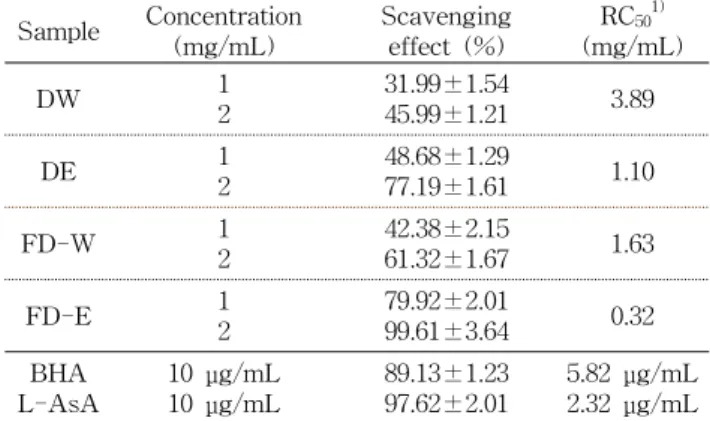
DSG 및 DSG 발효물의 추출물과 합성 및 천연 항산화제 로 알려진 BHA, L-ascorbic acid의 DPPH 소거활성을 측정 한 결과는 Table 2와 같다. 그 결과, BHA 및 L-ascorbic acid는 10 μg/mL 농도에서 각각 89.13, 97.63% 정도의 우수 한 DPPH 소거활성을 보였다. DSG 및 DSG 발효물의 처리 농도가 증가할수록 DPPH 소거활성도 증가하였으며, DSG 에 비해 DSG 발효물의 추출물이 DPPH 소거활성이 더 높게 측정되었고, 그중에서 DSG 발효물의 에탄올 추출물(FD-E) 2 mg/mL 농도에서 99.61%의 우수한 DPPH 소거능을 보였 으며, RC50 값도 0.32 mg/mL으로 나타났다. 이는 폴리페놀 함량과 플라보노이드의 함량이 DSG보다 DSG 발효물에서 증가된 결과와 일치하고, 특히 DSG 발효물의 경우 DSG보
Table 2. DPPH radical scavenging effects of water and ethanol extracts from DSG and FDSG
Sample Concentration (mg/mL)
Scavenging effect (%)
RC501)
(mg/mL)
DW 1
2
31.99±1.54
45.99±1.21 3.89
DE 1
2
48.68±1.29
77.19±1.61 1.10
FD-W 1
2
42.38±2.15
61.32±1.67 1.63
FD-E 1
2
79.92±2.01
99.61±3.64 0.32
BHA L-AsA
10 μg/mL 10 μg/mL
89.13±1.23 97.62±2.01
5.82 μg/mL 2.32 μg/mL
1)Concentration required for 50% reduction of DPPHㆍ at 30 min after starting the reaction.
Each value is mean±SD (n≥3).
t-Butylatedhydroxyanisole (BHA) and L-ascorbic acid (L- AsA) were used as positive references.
D: DSG, DW: DSG-water extract, DE: DSG-ethanol extract, FD: Fermented DSG, FD-W: Fermented DSG-water extract, FD-E: Fermented DSG-ethanol extract.
다 유리아미노산과 isoflavone의 함량이 더 증가하였다는 보 고(28)와 일치되게, DSG의 발효로 인해 항산화능을 나타내 는 이들 물질의 증가로 DPPH 소거활성이 더 증가한 것으로 생각된다. Ryu(29)가 콩 및 청국장 80% 메탄올 추출물 5 mg/mL의 농도로 DPPH 소거활성을 측정한 결과 콩의 경우 26.6%를 소거시켰으며, 청국장의 경우 28.2%를 소거시킨 결 과보다 본 실험의 DSG 발효물의 DPPH 소거활성이 더 우수 함을 알 수 있었다.
암 세포주 성장 저해효과
인간 유래의 위암세포주 AGS, 폐암세포주 A-549, 자궁암 세포주 Hela에 대해 DSG 및 DSG 발효 추출물의 성장 저해 효과를 측정한 결과는 Fig. 1과 같다. 이들 암세포주에 대해 시료 처리 농도가 증가할수록 성장 저해효과가 증가하였고, DSG군보다 DSG 발효물군에서 성장 저해효과가 더 큰 것으 로 나타났다. 이는 폴리페놀과 플라보노이드 함량, DPPH 소거활성과 유사한 경향을 나타내는 것을 알 수 있었다. 특
0 20 40 60 80 100 120
D FD DW FD-W DE FD-E
Inhibition rate (%)
1 mg/mL 2.5 mg/ml 5 mg/mL 1 mg/mL 2.5 mg/ml 5 mg/mL
c c c
b b
c c
c ab
b b
b c
c a
a a
ab
A
Inhibition rate (%)
0 20 40 60 80 100 120
D FD DW FD-W DE FD-E
0 20 40 60 80 100 120
D FD DW FD-W DE FD-E
1 mg/mL 2.5 mg/ml 5 mg/mL 1 mg/mL 2.5 mg/ml 5 mg/mL
e d
b b
c bc
c
a a
a
b c c
d d
d
d e
B
C 1 mg/mL
2.5 mg/ml 5 mg/mL 1 mg/mL 2.5 mg/ml 5 mg/mL
Inhibition rate (%)
0 20 40 60 80 100 120
D FD DW FD-W DE FD-E
0 20 40 60 80 100 120
D FD DW FD-W DE FD-E
b
b b
c
a
a
b b
c d
b
d d
b
a
c c c
Fig. 1. Growth inhibition effects of extracts from DSG and FDSG against human cancer cells (A: AGS, B: A-549, C:
Hela). D: DSG, FD: Fermented DSG, DW: DSG-water extract, FD-W: Fermented DSG-water extract, DE: DSG-ethanol extract, FD-E: Fermented DSG-ethanol extract.
히 DSG 발효물의 에탄올 추출물(FD-E)은 2.5 mg/mL의 농도 이상에서 이들 세포주에 대해 95% 이상의 가장 큰 성 장 저해효과를 보였고, 1.0 mg/mL의 처리농도에서도 AGS 및 Hela 세포주에 대해서 35~40% 정도의 성장 저해효과를 보였다. 청국장의 세포주 성장 저해능에 대한 연구로는 B.
licheniformis를 이용하여 제조한 청국장이 유선암 세포주인 MDA-MB-231와 악성피부암세포인 SK-MEL 31에 대해 청국장 1.0 mg/mL의 처리농도에서 각각 17.20%와 24.23%
의 저해율을 보였고(30) 대장암세포주인 HT-29와 위암세 포주인 AGS에 청국장의 메탄올 추출물을 0.25 mg/mL의 농도로 처리한 결과 각각 25%와 11%의 저해율을 보였다는 보고(31)도 있다. 이와 같이 DSG 발효물의 에탄올 추출물도 위 청국장과 유사한 암세포 성장저해 효능을 가지며, 세포주 에 따라 성장 저해효과가 차이 남을 알 수 있었다. 따라서 DSG 발효물의 에탄올추출물은 항산화 활성 및 암세포 성장 저해효과가 가장 우수한 소재임을 알 수 있었다.
Apoptosis 유도 효과
세포들은 외부의 여러 자극들의 변화에 의해 민감하게 반 응하며, 자극의 종류나 강도에 따라 필요시 매우 정밀한 세 포사멸 신호 전달 과정을 작동하게 된다. 많은 연구를 통하 여 세포사멸(apoptosis) 과정을 유도하거나, 조절할 수 있는 여러 세포 인자들이 밝혀졌다(32). 세포사멸 기전은 caspase 라고 하는 단백질 분해효소에 의해 세포 내 단백질이 분해되 면서 신호가 전달되는 과정으로 여러 종류의 caspase들이 세포사멸에 관여하며 caspase의 활성을 통해 세포사멸의 정 도를 파악할 수 있다(33). 최종적으로 활성화된 caspase-3은 바로 PARP를 활성화시키기도 하고, caspase-7을 활성화시 킨 후 활성화된 caspase-7이 PARP를 활성화시키기도 한다.
이렇게 활성화된 PARP는 DNA 분절화 현상과 핵의 응축을 유도하면서 세포사멸을 일으키는 것으로 보고되고 있다(34).
암세포 성장 저해효과가 가장 우수했던 DSG 발효물의 에탄올 추출물(FD-E)이 Hela 세포주에 대해 apotosis를 유 도하는지 알아보기 위해, 먼저 DSG 발효물의 에탄올 추출물 을 0.5~2.5 mg/mL 농도로 Hela 세포에 처리하여 24시간 배양하여 세포독성이 없는 처리 농도를 확인하였다. 그 결과 2.5 mg/mL 농도를 제외한 0.5~2.0 mg/mL 농도에서는 40%
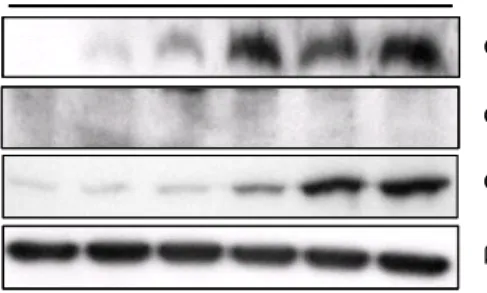
이하의 세포독성을 나타내었다(data not shown). 이에 DSG 발효물의 에탄올 추출물을 Hela 세포에 1.0, 1.25, 1.50, 1.75, 2.0 mg/mL 농도별로 처리하여 24시간 배양한 다음 세포사 멸에 관련된 단백질 발현 정도를 측정해 보았다. Fig. 2와 같이 Hela 세포주에서 DSG 발효물의 에탄올 추출물(FD-E) 의 처리 농도가 증가할수록 농도 의존적으로 caspase-3 단 백질의 발현은 증가되었으며 아울러 세포사멸 기전의 최종 단계인 PARP 단백질의 발현도 증가하였다. 그러나 cas- pase-7의 발현에는 아무런 영향을 미치지 않았다. 이는 DSG 발효물의 에탄올 추출물(FD-E)은 caspase-3를 활성 화시키고 활성화된 caspase-3이 직접적으로 PARP를 활성
Concentration (mg/mL)
Cleaved caspase 3
Cleaved caspase 7
Cleaved PARP
β-actin 0 1.0 1.25 1.5 1.75 2.0
Concentration (mg/mL)
Cleaved caspase 3
Cleaved caspase 7
Cleaved PARP
β-actin 0 1.0 1.25 1.5 1.75 2.0
Fig. 2. Effects of ethanol extract of FDSG (FD-E) on protein levels of caspase-3, caspase-7 and PARP in Hela cells. Cells were treated with FD-E at different concentrations (0~2 mg/mL) for 24 hr.
화시켜 세포사멸을 유도한 것으로 보인다. 앞으로 DSG 발효 물의 활성성분들의 규명 및 인체실험과 더불어 독성평가가 병행된다면 항산화 및 항암과 관련된 기능성 식품의 개발에 있어 천연소재로서 DSG 발효물의 유용성을 기대할 수 있을 것으로 생각된다.
요 약
본 연구에서는 탈지대두 grits(DSG)를 사용하여 B. sub- tilis NUC1균주로 발효시켜 DSG 발효물을 제조한 다음 물 혹은 에탄올로 추출하여 이들 DSG 발효 추출물의 항산화 및 항암 활성을 살펴보았으며, 이때 발효하지 않은 DSG와 비교 분석하였다. 그 결과, DSG 발효물의 총 폴리페놀 및 총 플라보노이드 함량은 DSG보다 더 증가되었다. 특히 DSG 발효물의 에탄올 추출물(FD-E)에서 총 폴리페놀 및 총 플라보노이드 함량이 각각 23.35 mg/g, 3.48 mg/g으로 가장 높게 나타났다. 또한 DSG 발효물의 에탄올 추출물은 가장 우수한 DPPH 소거활성을 보였으며, RC50값도 0.32 mg/mL이었다. 인간유래 암세포주인 AGS, A-549, Hela에 대해 DSG 및 DSG 발효 추출물의 처리 농도가 증가할수록 농도 의존적으로 성장 저해효과가 증가하였고, DSG보다 DSG 발효물에서 더 큰 성장저해 효과를 보였다. 특히 Hela 세포에서 가장 우수한 성장저해 효과를 보인 DSG 발효물 에탄올 추출물은 1.25 mg/mL의 농도에서부터 caspase-3과 PARP 단백질들의 발현을 유도하여 apoptosis가 일어남을 확인하였다. 따라서 DSG 발효물은 항산화 및 항암 활성을 가지는 우수한 천연소재가 되리라 기대된다.
감사의 글
본 연구는 지식경제부와 한국산업기술재단의 지역혁신인 력양성사업 및 지식경제부 지원 계명대학교 전통미생물자 원개발 및 산업화연구센터의 지원으로 수행되었음에 감사 드립니다.
문 헌
1. Lee JH, Min DB. 2006. Nutraceuticals, aging, and food oxidation. In Handbook of Functional Lipids. Taylor &
Francis Group, LLC, CRC Press, USA. p 325-350.
2. Fang YZ, Yang S, Wu G. 2002. Free radicals, antioxidants, and nutrition. Nutrition 18: 872-879.
3. Aischer RG, Hess JL. 1993. Antioxidants in higher plants.
CRC Press, Boca Raton. p 1-17.
4. Park KY, Jung KO. 2005. Fermented soybean products as functional food: Functional properties of Doenjang (fer- mented soybean paste). In Asian Functional Foods. Taylor
& Francis Group, LLC, CRC Press, USA. p 555-596.
5. Park GS. 2004. Cookwise approach of slow food: Focused on traditional fermented sauces. Korean J Soc Food Cookery Sci 20: 317-334.
6. Kim SH. 1998. New trends of studying on potential activ- ities of Doenjang, fibrinolytic activity. Korea Soybean Digest 15: 8-15.
7. Kwon SH, Shon MY. 2004. Antioxidant and anti- carcinogenic effects of traditional doenjang during matura- tion periods. Korean J Food Preserv 11: 461-467.
8. Yoo JY. 1997. Present status of industries and research ac- tivities of Korean fermented soybean products. Korean J Appl Micrombiol Biotechnol 23: 13-30.
9. Messina M. 1995. Modern applications for ac ancient bean:
Soybeans and the prevention and treatment of chronic disease. J Nutr 125: 567-569.
10. Wang HJ, Murphy PA. 1994. Isoflavone composition of American and Japanese soybeans in Iowa: Effects of varie- ty, crop year, and location. J Agric Food Chem 42: 1674- 1677.
11. Coward L, Barnes S. 1993. Genistein, daidzein and their β- glycoside conjugates: Antitumor isoflavones in soybean foods from American and Asian diets. J Agric Food Chem 41: 1961-1967.
12. Kim JS, Yoon S. 1999. Isoflavone contents and β-glucosi- dase activities of soybeans, meju and doenjang. Korean J Food Sci Technol 31: 1405-1409.
13. Benjamin H, Storkson J, Tallas PG, Pariza MW. 1988.
Reduction of benzo(α)pyrene-induced forestomach neo- plasms in mice given nitrite and dietary soy sauce. Fd Chem Toxic 26: 671-682.
14. Yavelow J, Finlay T, Kennedy AR, Troll W. 1983. Bowman- Brik soy bean protease inhibitor as an anticarcinogen.
Cancer Res 43: 2454-2459.
15. Shamsuddin AM, Elsayed AM, Ullah A. 1988. Supression of large intestinal cancer in F344 rats by inositol hexaphos- phate. Carcinogenesis 9: 577-580.
16. Urano TH, Ihara K, Umemura Y, Suzuki M, Oike S, Akita Y, Tsukamoto I, Suzuki A. 2001. The profibrinolytic en- zyme subtitisin NAT purified from Bacillus subtilis cleaves and inactivates plasminogen activator inhibitior type 1. J Biol Chem 278: 24690-24696.
17. Kambourova MM, Tangney FG. 2001. Regulation of ploy- glutamic acid synthesis by glutamate in Bacillus lichen- iformis and Bacillus subtilis. Appl Environ Microbiol 67:
1004-1007.
18. Lee JO, Ha SD, Kim AJ, Yur CS, Bang IS, Park SH. 2005.
Industrial application and physiological functions of chungkukjang. Food Science and Industry 38: 69-78.
19. Mivagi YS, Shinjo R, Nishida C, Miyagi K, Takamatsu T, Yamamoto S. 1997. Trypsin inhibitor activity in commercial soybean products in Japan. J Nutr Sci Vitaminol (Tokyo)
43: 575-580.
20. Shon MY, Seo KI, Park SK, Cho YS, Sung NJ. 2001. Some ciological activities and isoflavone content of Chungkugjang prepared with black beans and Bacillus strains. J Korean Soc Food Sci Nutr 30: 662-667.
21. Byun MW, Son JH, Yook HS, Jo C, Kim DH. 2002. Effect of gamma irradiation on the physiological activity of Korean soybean fermented foods, Chungkookjang and Doenjang. Radiat Phys Chem 64: 245-248.
22. Folin O, Denis W. 1912. On phosphotungstic-phosphomo- lybdic compounds as color reagents. J Biol Chem 12:
239-249.
23. Moreno MI, Isla MI, Sampietro AR, Vattuone MA. 2000.
Comparison of the free radical-scavenging activity of prop- olis from several regions of Argentina. J Ethnopharmacol 71: 109-114.
24. Carmichael J, Degraff WG, Gazdar AF, Minna JD, Michell JB. 1987. Evaluation of a tetrazolium based semiautomated colorimetric assay, assessment of chemosensitivity testing.
Cancer Res 47: 936-942.
25. Cho SY, Han YB, Shin KH. 2001. Screening for antioxidant activity of edible plants. J Korean Soc Food Sci Nutr 30:
133-137.
26. Baek LM. 2009. Effect of soybean germination on the qual- ity characteristics of Cheongkookjang inoculated with Bacillus licheniformis B-59 isolated from rice straw. MS Thesis. Catholic University of Daegu, Korea. p 34.
27. Ancerewicz J, Migliavacca E, Carrupt PA, Testa B, Bree
F, Zini R, Tillement JP, Labidalle S, Guyot D, Chauvet- Monges AM, Crevat A, Le-Ridant A. 1998. Structure- property relationships of trimetazidine derivatives and model compounds as potential antioxidants. Free Radic Biol Med 25: 113-120.
28. Kim HJ, Lee SG, Ji YJ, Hwangbo MH, Lee EJ, Lee SP, Lee IS. 2008. Quality characteristics of defatted soybean grits fermented by Bacillus subtilis NUC1. J Korean Soc Food Sci Nutr 37: 1479-1484.
29. Ryu SH. 2001. Studies on antioxidative effects and anti- oxidative components of soybean and Chongkukjang. PhD Dissertation. Inje University, Korea. p 46-47.
30. Jang Ym. 2004. Research on quality improvement of chung- kookjang (fermented soybean pastes) by Bacillus subtilis.
PhD Dissertation. Sungshin Women's University, Korea.
p 34-36.
31. Lee KB. 2005. Studies on the enhancement of cancer pre- ventive effects and antiobestic activities of Korean soy- bean-fermented foods. PhD Dissertation. Pusan National University, Korea. p 37-38.
32. Wyllie AH, Kerr JFR, Currie AR. 1980. Cell death: The sig- nificance of cell death. Int Rev Cytol 68: 251-306.
33. Alnemri ES. 1997. Mammalian cell death proteases: a family of highly conserved aspartate specific cysteine proteases.
J Cell Biochem 64: 33-42.
34. Soldani C, Scovassi AI. 2002. Poly(ADP-ribose) polymer- ase-1 cleavage during apoptosis: an update. Apoptosis 7:
321-328.
(2009년 4월 3일 접수; 2009년 5월 4일 채택)