151
중성 Lipase를 생산하는 Bacillus subtilis JKA-3의 분리 동정 및 효소 특성
조지원1·허성호2·한용수3·김지연4*
1인제대학교대학원분자의생명공학과, 2동의과학대학임상병리과, 3광양보건대학 피부미용과,
4인제대학교대학원분자의생명공학과, 기초대학
Isolation of Lipase Producing Bacillus subtilis and Some Characteristics of the Enzyme
Ji-Won Jo
1, Sung-Ho Hur
2, Yong-Soo Han
3, and Ji-Yeon Kim
4*1Graduate School of Molecular & Biomedical Technology, Inje University, Gimhae 621-749, Korea
2Department of Clinical Laboratory Science, Dong-eui Institute of Technology, Busan 614-715, Korea
3Department of Cosmetology, Gwangyang Health College, Gwangyang 545-703, Korea
4Graduate School of Molecular & Biomedical Technology, College of General Education, Inje University, Gimhae 621-749, Korea
Received August 28, 2009; Accepted September 8, 2009
As part of an investigation to identify microorganisms that are biotechnologically interesting for industrial application, we isolated a bacterial strain from
Chungkookjangthat produces extracellu- lar neutral lipase. In addition, the crude enzyme was characterized. This isolated strain, designated as JKA-3 was identified as
Bacillus subtilisJKA-3 based on morphological, physiological and bio- chemical characteristics, as well as phylogenetic analysis using 16S rRNA gene sequence. The cells were rod-shaped and 0.6-0.8
×2.0-2.3
µm in size. Optimal growth conditions were 35-40
oC and pH 6.0-8.0. The isolate was able to grow in up to 0-10.0% (w/v) NaCl. Optimal activity conditions of the crude lipase fraction of
B.
subtilisJKA-3 were pH of 7.0 at 35
oC. This enzyme was stable in the pH ranging 6.0-8.0.
Key words: B. subtilis JKA-3, characterization, enzyme production, identification, neutral lipase
Lipase(glycerol ester hydrolase, triacylglycerol lipase, E.C.
3.1.1.3)
는triglyceride
의ester
결합을 가수분해하여glycerol
과지방산
(fatty acid)
을생성하는효소로서생물계전반에널리분포되어 있으며
,
특히다양한 종류의lipase
가 미생물로부터 발견되었다
[Jaeger
등, 1994].
산업적으로응용되고있는많은효소들가운데
lipase
가 차지하는역할은 매우중요하며,
급속히성장하고있는 생물산업에서주목받고있는효소 중하나이다
. Lipase
는촉매반응의다양성과특수성(hydrolysis, alcoholysis, acidolysis, esterification, aminolysis
등)
을 갖고 있으며,
수용액 상태에서뿐만아니라유기용매에서도활성을나타내어사용할 수 있는반응의 범위가넓다
.
또한조효소(cofactor)
가 필요 하지 않아 촉매반응을진행하는 데 편리하고,
기질 특이성이매우넓다
.
그리고광학이성질체중어느한쪽에대해서만활 성을 나타내는이성질체선택성도지니고있다.
이러한특성으로 인해
lipase
는 여러산업분야에서다양하게이용되고있으며
,
점차 그 응용범위가 확대되어 가고 있다[Jaeger
와Reetz,
1998].
이밖에도반응공정 후처리가깨끗하여환경오염이적고
,
생산물과촉매의분리가쉬워분리과정에들어가는비용을 절감시킬수있으며,
촉매의재사용이가능하기때문에많은비 용을 절감시킬수있다는장점을가지고있다[Schmidt-Dannert, 1999].
미생물 중
lipase
를 생산하는 것으로 알려진 세균으로는Staphylococcus속
(genus)
과 Chromobacterium속,
Achromobacter속
,
Micrococcus속,
Bacillus속,
Pseudomonas속,
Alcaligenes속 등이 있다[Lin
등, 1996].
미생물이생산하는lipase
는기질특이성이넓고
,
유기용매에서 안정하며,
다양한pH
와 온도에적용 할 수 있어 널리 이용되어 왔다[Demirjian
등, 2001; Schmid
등
, 2001; Jaeger
와Eggert, 2002].
따라서상업적으로잠재력이*Corresponding author
Phone: +82-55-320-3737; Fax: +82-55-339-3734 E-mail: [email protected]
Abbreviations:
LB, Luria Bertani; PCR, polymerase chain reac- tion; pNPP, p-nitrophenyl palmitate
doi:10.3839/jabc.2009.026
152 조지원·허성호·한용수·김지연
큰미생물유래의
lipase
에 대한연구가활발히진행되고있으며
,
앞으로더욱그 필요성이요구된다.
실제로미생물유래의
lipase
는지방제거와촉매제로서의이용범위가확대되어식품첨가물
(food additive material)
과산업용시약
(Industrial reagents),
세탁첨가제(detergent additives),
의약 용진단시약(diagnostic reagent),
유지제품(cocoa butter equivalent)
등에서 다양하게 사용되고 있다
[Schmidt-Dannert, 1999].
미생물유래의
lipase
는공급되는영양소에따라기질특이성과작용기작등이다양하고
[Park
등, 2004] lipase
의역가도배양조건에 따라다르므로,
미생물유래lipase
의생산성에관한 연구를위 해서는우수 균주의분리와 동정,
배양조건등에대한 전반적 인지식이뒷받침되어야할것이다.
더욱이산업적으로유용한lipase
는 생산 단가가 비싸고,
고온이나 유기용매상에서 불활성화되는단점을 지니고있다는 것이문제로 제시되고있어
,
이를극복하기위해서는
lipase
의대량발현시스템구축과그효소특성에대한분석이필요하다
.
본연구에서는 산업적으로주목받고있는
lipase
를 탐색하던중
lipase
활성을나타내는 Bacillussp.
를청국장으로부터분리 동정하였고,
분리균주가 생산하는lipase
의 조효소에대한일반적인특성을조사하였기에 보고하고자한다
.
청국장 시료
(
우호한의원 제공)
를 희석하여LB[0.5%(w/v) yeast extract, 1.0%(w/v) tryptone, 1.0%(w/v) NaCl, 1.5%(w/v)
agar]
배지에서균체 생육이 우수하고서로 다른형태적 특징을 가진 것만을 선별하여순수 분리하였다
.
이들을1.0%(v/v) tributyrin(ACROS, USA)
이 함유된LB
배지에서 배양하여tributyrin
분해능이가장우수한분리균주JKA-3
를최종적으 로선발,
본실험에 사용하였다[Diaz
등, 1999](Fig. 1).
최종선정된
JKA-3
를관찰한결과그람양성의간균(0.6-0.8
×
2.0-2.3
µm)
으로포자와협막를형성하였고,
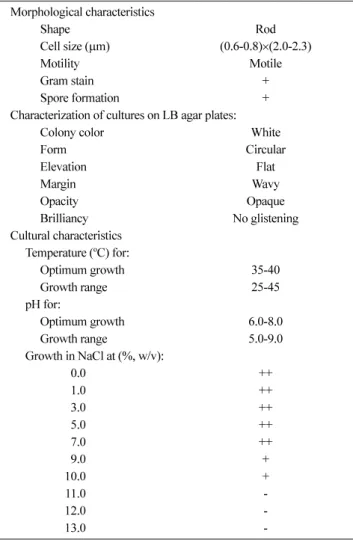
운동성을지닌호 기성의 세균이었다(Table 1).
그리고25-45
oC
에서잘 생장하였으며
,
최적생장온도는35-40
oC
였다. pH 5.0-9.0
에서잘생장하 였으며,
생장을위한최적pH
는6.0-8.0
로중성영역의환경에서잘생장함을알수있었다
.
이러한결과는 Bacillussp.
가생산하는
lipase
가30
oC
와pH 6.0
에서최적의 생장을나타낸 보 고와는 상이하였다[Erturula
등, 2007].
또한 이균주는 다양한NaCl
농도(0-10.0%, w/v)
에서도생장하였으며,
항생제optochin
과
bacitracin
에대해 내성을나타내었다(Fig. 2).
그리고자동화균주동정기계
VITEK system(VITEK 2 Compact 60, bioMerieux Inc., Hazelwood, MO)
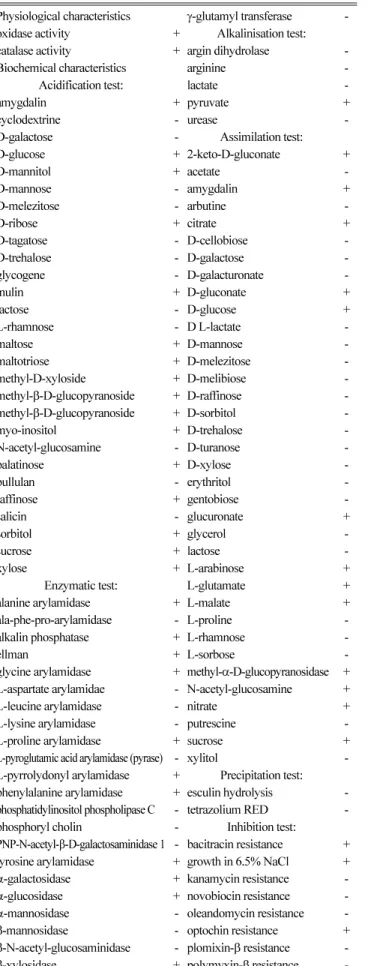
을 이용하여분리균주의 생화학적특성들을 조사한 결과 B
.
subtilis와98%
의matching level
을 나타 내었다(
자료미제시).
위와같은형태적,
생리·생화학적특성 등을 종합하고Bergey’s Manual of Systematic Bacteriology [Claus
와Berkeley, 1986]
에기술된분류기준을참조하여 동정 한 결과분리균주는 Bacillus속으로추정되었다.
분리균주
JKA-3
의유전학적특성에따른동정과계통적유연관계를 알아보기 위하여
PCR
로 증폭 생산된1.4 kb
의16S
rRNA
유전자염기서열을결정하여분석을시도하였다(Fig. 3).
이때
PCR
에사용된primer
는16S rDNA
염기서열결정에사용하는
universal primer
인27f(5'-AGA GTT TGA TCC TGG CTC AG-3')
와1492r(5'-GGC TAC CTT GTT ACG ACT T- 3')
이었다[Weisburg
등, 1991].
결정된염기서열의상동성분 석은GenBank
의database
에 등록된16S rDNA
염기서열들의Fig. 1. Halo formation by strain JKA-3. The cells were streaked and grown on LB agar supplemented with 1.0%(v/v) tributyrin at 35oC for 16 h. (A) strain JKA-3 (B) B. megaterium (lipase positive, control) (C) B. megaterium (lipase negative, control)
Table 1. Characteristics of the isolated strain JKA-3 Morphological characteristics
Shape Rod
Cell size (µm) (0.6-0.8)×(2.0-2.3)
Motility Motile
Gram stain +
Spore formation +
Characterization of cultures on LB agar plates:
Colony color White
Form Circular
Elevation Flat
Margin Wavy
Opacity Opaque
Brilliancy No glistening
Cultural characteristics
Temperature (oC) for:
Optimum growth 35-40
Growth range 25-45
pH for:
Optimum growth 6.0-8.0
Growth range 5.0-9.0
Growth in NaCl at (%, w/v):
0.0 ++
1.0 ++
3.0 ++
5.0 ++
7.0 ++
9.0 +
10.0 +
11.0 -
12.0 -
13.0 -
+, positive; -, negative
정보를대상으로
BLAST
프로그램(http://www.ncbi.nlm.nih.gov/
BLAST/, NCBI, Bethesda, MD)
을 이용하여 수행하였다[Altschul
등, 1997].
계통분석은CLUSTAL-X
의Multiple Sequence Alignment Program(Strasburg, France)
을 이용하여정 렬하였고[Thompson
등, 1997], GenBank
에 등록된 다른균 주들의16S rDNA
염기서열정보와TreeView program
을이용하여
neighbor-joining method
에 의해 염기서열간의 유전적거 리와phylogenetic tree
를 얻었다[Saitou
와Nei, 1987]. Branch
의신뢰도는
100
회의 재구성된 자료로부터 새로운tree
를 작성하 여계산하였다.
분리균주의16S rDNA
염기서열을기존에등록된다양한세균들의상응하는염기서열과상동성을조사하여 본 결과 B. subtilis
strain(Genbank accession number EF541144),
B. subtilis(Genbank accession number M74010),
B. subtilis(Genbank accession number EF567418),
B. subtilisstrain 361(Genbank accession number EF538417)
과99
%의유 사성을보였다(
자료미제시).
이들분석결과를토대로하여분 리 균주JKA-3
는 B. subtilis로 최종 동정되었으며,
B.
subtilisJKA-3
로 명명하였다.
분리동정된균주의
lipase
활성을 조사하기위하여종배양액을
LB
액체배지에0.1%(v/v)
접종하여35
oC
에서16
시간동안 본배양하고, 13,400
×g
로10
분간 원심분리한후 상등액을조효소액으로사용하였다
. Lipase
활성측정은표준물질로pNPP
를 사용한colorimetric
방법에의하여수행하였다[Reetz, 2002]. A
용액
[10 mL isopropanol(Duksan, Ansan, Korea)+30 mg pNPP (Sigma, St. Louis, MO)]
과B
용액[0.2 M phosphate
완충용액(pH 7.0) +207 mL Na-DOC(Duksan, Ansan, Korea)+100 mg
의
gum arabic(Duksan, Ansan, Korea)]
의 비율을1:9
로 한D
용액을 조효소액과
2:1
의비율로각각혼합하였다.
혼합용액은10
분동안항온수조에서 효소활성의최적 온도로반응시킨후C
용액[2 M NaCO
3(Duksan, Ansan, Korea)]
으로반응을정지시 켰다.
이반응 정지액을원심분리하여상등액을취하고410 nm
에서 흡광도를측정하였다
.
효소활성도(Unit)
는위의조건에서1
분 동안에1
µmole
의palmitic acid
를생성하는효소의양으로하였다
.
B. subtilis
JKA-3
가 생산하는lipase
의 최적pH
는0.2 M glycine-HCl
완충용액(pH 2.0-3.0)
과0.2 M sodium acetate
완 충용액(pH 3.0-5.0), 0.2 M Tris-malate
완충용액(pH 5.0-7.0), 0.2 M phosphate
완충용액(pH 7.0-9.0), 0.2 M glycine-NaOH
완충용액
(pH 9.0-10.0)
을사용하여효소활성을측정하고,
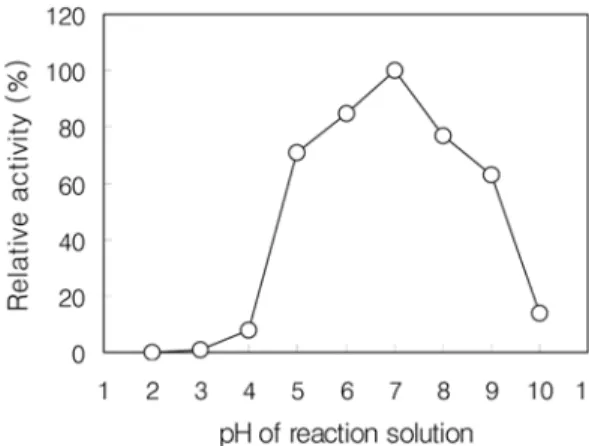
그효 소의 상대활성으로표시하였다(Fig. 4).
본효소는pH 5.0
에서부터
9.0
까지의범위에서60%
이상의 활성도를나타내었으며,
특히 반응 최적
pH
는7.0
으로 나타나 중성lipase
임을 알 수 있었다.
이러한결과는Khyami-Horani[1996]
의 B. licheniformis유래
lipase(pH 10.0), Meghwanshi
등[2006]
의 Bacillus 유래lipase(pH 9.0), Erturula
등[2007]
의 Bacillus 유래lipase(pH 6.0)
와상이하였다.
또한
pH 2.0
에서10.0
까지의각pH
별 완충용액에 조효소액 을첨가하여4
oC
에서24
시간동안방치한후각각의효소를회수하였다
.
이를35
oC, pH 7.0
에서10
분동안기질용액과 반응 시켜pH
에대한효소의안정성을측정하였다. Fig. 5
에서 보는 Fig. 2. Susceptibility test of the isolated strain JKA-3 to various antibiotics (bacitracin, ciprofloxacin, clindamycin, gentamicin, optochin, sulphamethoxazole/trimethoprim, vancomycin).154 조지원·허성호·한용수·김지연
바와같이 B. subtilis
JKA-3
가생산하는lipase
는pH 6.0-8.0
에 서80
% 이상의높은안정성을유지하였다.
이는Meghwanshi
등
[2006]
의 Bacillus 유래lipase
가pH 8.0-11.0
에서 안정하게 나타난결과와는상이하였다.
B. subtilis
JKA-3
가 생산하는중성lipase
의최적 활성온도 를검토하기위해0.2 M phosphate
완충용액(pH 7.0)
에조효소용액과 기질용액을혼합한 후
,
온도를10
oC
부터60
oC
로변화시키면서효소활성을측정하여상대활성으로표시한결과는
Fig. 6
과같다.
본 균주가생산하는lipase
의최적반응온도는35
oC
였고, 25-45
oC
에서도60%
이상의 효소 활성을 나타내었 다. Meghwanshi
등[2006]
이분리한 Bacillus가생산하는lipase
의활성은
37
oC
에서가장우수하였고, Khyami-Horani [1996]
의B. licheniformis 유래
lipase
는55
oC
에서최적의 활성을나타내Fig. 3. Phylogenetic tree based on partial 16S rDNA sequences, showing the relationship between the isolated strain JKA-3 and other species belong to the genus Bacillus. The accession numbers are in parentheses. The tree was constructed using the CLUSTAL-X and neighbour-joining method. Scale bar corresponds to 0.01 subscriptions per nucleotide position. Numbers at nodes indicate levels of bootstrap support (%) determined from 100 resampled data.
Fig. 4. Effect of pH on activity of the lipase produced by B. subtilis
JKA-3. The enzyme reaction was carried out at 35oC for 10 min in 0.2 M glycine-HCl (pH 2.0-3.0), 0.2 M sodium acetate (pH 3.0-5.0), 0.2 M Tris-malate (pH 5.0-7.0), 0.2 M phosphate (pH 7.0-9.0) and 0.2 M glycine-NaOH (pH 9.0-10.0) buffer.
Fig. 5. pH stability of the lipase produced by B. subtilis JKA-3.
The enzyme reaction was carried out at 35oC for 10 min after 24 h preincubation at 4oC at the various pH [0.2 M glycine-HCl (pH 2.0- 3.0), 0.2 M sodium acetate (pH 3.0-5.0), 0.2 M Tris-malate (pH 5.0- 7.0), 0.2 M phosphate (pH 7.0-9.0) and 0.2 M glycine-NaOH (pH 9.0- 10.0)] buffer.
Fig. 6. Effect of temperature on activity of the lipase produced by
B. subtilis JKA-3. The enzyme reaction was carried out at various temperatures for 10 min in 0.2 M phosphate buffer (pH 7.0).
Fig. 7. Thermal stability of the lipase produced by B. subtilis JKA- 3. The enzyme reaction was carried out at optimal condition after preheating of the enzyme solution at the indicated temperatures for the different time periods. Symbols: ○-○, 20oC; ●-●, 30oC; △-△, 40oC;
▲-▲, 50oC
고 있는데
,
본 균주가 생산하는lipase
의 최적 온도는35
oC
로 이들에 비해낮다.
이상의 결과에 따라 본 실험의 효소활성측정조건은최적조건인
pH 7.0, 35
oC
에서행하였다. 0.2 M phosphate
완충용액(pH 7.0)
에조효소액을첨가하여일정 온도에서
10-60
분까지10
분 간격으로효소액을 미리반응시킨후최적온도에서
10
분동안잔여효소활성을측정하는방법을 이용하여효소의 열안정성을측정하여그효소의상대 활성으로표시하였다
.
그결과Fig. 7
에서보는바와같이20
oC
에서는
60
분동안90%
이상의안정성을유지하였으며, 30
oC
에 서60
분간 열처리로80%
이상 잔존활성을 보였고, 40
oC
에서60
분간열처리 시50%
이상의 효소활성을나타내었다. 50
oC
의 온도에서는
10
분간 열처리 시75%
의 효소활성이 존재하 였으며20
분 가열한결과50%
의 잔여활성을유지하였다.
이는
Khyami-Horani[1996]
의 B. licheniformis 유래lipase
가37- 60
oC
의 범위에서90%
이상안정하였다는결과와Meghwanshi
등
[2006]
이 보고한 Baciilussp.
유래lipase
의 경우30-50
oC
에 서 높은열안정성을보인결과와는상이한것으로확인되었다.
참고문헌
Altschul SF, Madden TL, Schffer AA, Zhang J, Zhang Z, Miller W, and Lipman DJ (1997) Gapped BLAST and PSI-BLAST: a new generation of protein database search programs. Nucleic Acids Res 25, 3389-3402.
Claus D and Berkeley RCW (1986) Genus Bacillus. In Bergey’s Manual of Systematic Bacteriology, pp. 1105-1139, Williams &
Wilkins, Baltimore, MD, U.S.A.
Demirjian DC, Francisco MV, and Cassidy CS (2001) Enzymes from extremopiles. Curr Opin Biotechnol 5, 144-151.
Diaz P, Prim N, and Pastor FIJ (1999) Direct fluorescence based lipase activity assay. Biotechniques 27, 697-699.
Erturula S, Dnmeza G, and Takab S (2007) Isolation of lipase producing Bacillus sp. from olive mill wastewater and improving its enzyme activity. J Hazard Mater 149, 720-724.
Jaeger KE and Reetz MT (1998) Microbial lipases from versatile tools for biotechnology. Trends Biotechnol 16, 396-403.
Jaeger KE and Eggert T (2002) Lipase for biotechnology. Curr Opin Biotechnol13, 390-397.
Jaeger KE, Ransac S, Dijkstra BW, Colson C, Heuvel M, and Misset O (1994) Bacterial lipases. FEMS Microbiol Rev 15, 29-63.
Khyami-Horani H (1996) Thermotolerant strain of Bacillus licheniformis producing lipase. World J Microbiol Biotechnol
12, 399-401.
Lin SF, Chiou CM, Yeh CM, and Tsai YC (1996) Purification and partial characterization of an alkaline lipase from Pseudomonas pseudoalcaligenes F-111. Appl Environ Microbiol 62, 1093- 1095.
Meghwanshi GK, Agarwal L, Dutt K, and Saxena RK (2006) Characterization of 1,3-regiospecific lipases from new Pseudomonas and Bacillus isolates. J Mol Catal B Enzym 40, 127-131.
Park MH, Ryu HJ, and Oh KK (2004) Isolation of lipase producing yeast and optimization of cultivation condition.
Table 2. Physiological and biochemical characteristics of the isolated strain JKA-3
Physiological characteristics γ-glutamyl transferase - oxidase activity + Alkalinisation test:
catalase activity + argin dihydrolase -
Biochemical characteristics arginine -
Acidification test: lactate -
amygdalin + pyruvate +
cyclodextrine - urease -
D-galactose - Assimilation test:
D-glucose + 2-keto-D-gluconate +
D-mannitol + acetate -
D-mannose - amygdalin +
D-melezitose - arbutine -
D-ribose + citrate +
D-tagatose - D-cellobiose -
D-trehalose - D-galactose -
glycogene - D-galacturonate -
inulin + D-gluconate +
lactose - D-glucose +
L-rhamnose - D L-lactate -
maltose + D-mannose -
maltotriose + D-melezitose -
methyl-D-xyloside + D-melibiose -
methyl-β-D-glucopyranoside + D-raffinose - methyl-β-D-glucopyranoside + D-sorbitol -
myo-inositol + D-trehalose -
N-acetyl-glucosamine - D-turanose -
palatinose + D-xylose -
pullulan - erythritol -
raffinose + gentobiose -
salicin - glucuronate +
sorbitol + glycerol -
sucrose + lactose -
xylose + L-arabinose +
Enzymatic test: L-glutamate +
alanine arylamidase + L-malate +
ala-phe-pro-arylamidase - L-proline -
alkalin phosphatase + L-rhamnose -
ellman + L-sorbose -
glycine arylamidase + methyl-α-D-glucopyranosidase + L-aspartate arylamidae - N-acetyl-glucosamine +
L-leucine arylamidase - nitrate +
L-lysine arylamidase - putrescine -
L-proline arylamidase + sucrose +
L-pyroglutamic acid arylamidase (pyrase) - xylitol - L-pyrrolydonyl arylamidase + Precipitation test:
phenylalanine arylamidase + esculin hydrolysis - phosphatidylinositol phospholipase C - tetrazolium RED -
phosphoryl cholin - Inhibition test:
PNP-N-acetyl-β-D-galactosaminidase 1 - bacitracin resistance + tyrosine arylamidase + growth in 6.5% NaCl +
α-galactosidase + kanamycin resistance -
α-glucosidase + novobiocin resistance -
α-mannosidase - oleandomycin resistance -
β-mannosidase - optochin resistance +
β-N-acetyl-glucosaminidase - plomixin-β resistance -
β-xylosidase + polymyxin-β resistance -
VITEK system was used; +, positive; -, negative
156 조지원·허성호·한용수·김지연
Korean J Biotechnol Bioeng 19, 148-153.
Reetz MT (2002) Lipases as practical biocatalysts. Curr Opin Chem Biol6, 145-150.
Ruiz C, Pastor FIJ, and Diaz P (2002) Analysis of Bacillus megaterium lipolytic system and cloning of LipA, a novel subfamily I.4 bacterial lipase. FEMS Microbiol Lett217, 263- Saitou N and Nei M (1987) The neighbor-joining method: a267.
new method for reconstructing phylogenetic tree. Mol Biol Evol 4, 406-425.
Schmid A, Dordick JS, Hauer B, Kiner A, Wubbolts M, and Witholt B (2001) Industrial biocatalysis today and tomorrow.
Nature409, 258-268.
Schmidt-Dannert C (1999) Recombinant microbial lipase for biotechnological applications. Bioorg Med Chem 7, 2123-2130.
Thompson, JD, Gibson TJ, Plewniak F, Jeanmougin F, and Higgins DG (1997) The CLUSTAL-X windows interface:
flexible strategies for multiple sequence alignment aided by quality analysis tools. Nucleic Acids Res 25, 4876- 4882.
Weisburg WG, Barns SM, Pelletier A, and Lane DJ (1991) 16S ribosomal DNA amplification for phylogenetic study.
J Bacteriol 173, 697-703.