측인두간극에 발생한 신경초종: 증례보고
문찬웅1), 권지은2), 김철환1)
1)단국대학교 치과대학 구강악안면외과학교실, 2)단국대학교 의과대학 병리학교실
<Abstract>
Neurilemmoma Located in the Parapharyngeal Space: A Case Report
Chan-Woong Moon
1), Ji-Eun Kwon
2), Chul-Hwan Kim
1)*1)
Department of Oral and Maxillofacial Surgery, College of Dentistry, Dankook University,
2)
Department of Pathology, College of Medicine, Dankook University
Neurilemmomas, also known as schwannomas, are typically benign, well-encapsulated, slow-growing tumors originating from Schwann cells which encompass peripheral motor and sensory nerves. Neurilemmomas in parapharyngeal space (PPS) are very rare, but they can occasionally originate from the last four cranial nerves and autonomic nerves. In this article, we report the rare case of a 47-year-old male presenting solitary neck swelling and hoarseness. After computed tomography and magnetic resonance imaging, we performed complete surgical excision by a transcervical approach under general anesthesia. In the histologic examination, Neurilemmoma was diagnosed. The patient did not complain of any specific complications, showed good prognosis without recurrence or pain up to date.
Key words : Neurilemmoma, Parapharyngeal space, Cervical sympathetic chain
Korean Journal of Oral and Maxillofacial Pathology 2017;41(4):181-187 ISSN:1225-1577(Print); 2384-0900(Online) Available online at http://journal.kaomp.org https://doi.org/10.17779/KAOMP.2017.41.4.005
* Correspondence: Chul-Hwan Kim, Department of Oral and Maxillofacial Surgery, College of Dentistry, Dankook University, 119 Dandae-ro, Dongnam-gu, Cheonan, Chungnam, Korea TEL: +82-41-550-0271, FAX: +82-41-551-8988
E-mail: [email protected] ORCID : 0000-0002-5199-2420
Ⅰ. INTRODUCTION
Neurilemmomas, also known as schwannomas, are typically benign, well-encapsulated, slow-growing tumors originating from Schwann cells which encompass peripheral motor and sensory nerves1). Neurilemmomas in parapharyngeal space (PPS) are very rare, but they can occasionally originate from the last four cranial nerves and autonomic nerves, while a vagus nerve origin is most common2). Computed tomography (CT) and magnetic resonance
imaging (MRI) are critical assessments for evaluating tumors preoperatively and neurilemmomas can be diagnosed only by surgical biopsy3). In this article, we report the rare case of a 47-year-old male presenting solitary neck swelling who was diagnosed after excisional biopsy with neurilemmomas originating from a cervical sympathetic chain in PPS.
Ⅱ. CASE REPORT
A 47–year-old man with no unusual medical history presented a gradual onset of swelling on the left neck and hoarseness. He also complained of worsening dysphagia and stated that this symptom had occurred several years
Fig. 1. Preoperative photograph of the patient. (A) Showing left-sided neck swelling. (B) Showing bulge of the left tonsil.
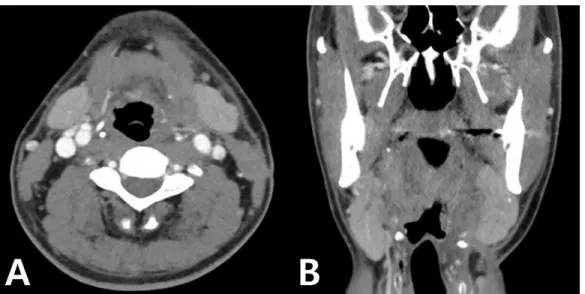
Fig. 2. Enhanced computed tomography showing a well-defined enhancing lesion. (A) Axial view. (B) Coronal view.
ago. On neck examination, a mass was palpated and mass-induced swelling detected in the left submandibular region (Figure 1A). On intraoral examination, a mass was detected in the left oropharynx wall which induced tonsil displacement to the right and left posterior pillar to medial side (Figure 1B).
The patient also underwent contrast-enhanced computed tomography and magnetic resonance imaging (MRI). An image study revealed a well-demarcated mass of 9.5 x 6 cm in the left parapharyngeal space and central necrosis of the mass (Figure 2, 3). The common carotid artery and internal jugular vein were posteriorly displaced and the left submandibular gland to the left, due to the mass. The pharynx was also narrowed. Hypertrophy of lymph nodes
was not observed. By clinical and radiologic examinations, the patient was diagnosed with a left parapharyngeal neurilemmoma.
He underwent complete surgical excision by a transcervical approach under general anesthesia (Figure 4A). The tumor was localized, encapsulated, and invaded the cervical sympathetic chain (Figure 4B). The posteriorly displaced internal carotid artery and internal jugular vein were exfoliated and the tumor completely resected (Figure 4C). The removed specimens were immediately biopsied.
On gross examination, the mass was grayish-yellow, ovoid-shaped, encapsulated, and showed cystic appearance with myxoid degeneration. Its measured size was 9.5 x 6 x 4.4 cm (Figure 5).
Fig. 3. T2-weighted magnetic resonance imaging showing a well-defined heterogeneous lesion. (A) Axial view. (B) Coronal view.
Fig. 4. Intraoperative clinical photograph. (A) The mass was exposed through a transcervical approach. (B) The mass was well-encapulated and dissected from the cervical sympathetic chain. (C) The mass was resected as a whole.
Fig. 5. Gross images of the excised specimen. (A) The mass was grayish-yellow, ovoid-shaped, encapsulated. (B) The mass showed
cystic appearance with myxoid degeneration.
Fig. 6. Microscopic examination features. (A) Antoni A pattern was well-organized, high-celluarity. Antoni B pattern with less cellularity was exsisted between Antoni A pattern (H&E staining, x40). (B) Higher magnification view of characteristic Verocay bodies. Palisading typical, elongated nuclei disposed in concentric row around eosinophilic material (H&E staining, x100). (C) Immunohistochemistry shows diffuse positive staining for S-100 protein (S-100 immunostaining, x200). (D) Some part of the tumor displayed high Ki-67 labeling index (Ki-67 immunostaining, X200).
Fig. 7. Three-month follow-ups enhanced computed tomography showing mass disappeared after surgery and no recurrence. (A)
Axial view. (B) Coronal view.
Fig. 8. Three-month follow-ups T2-weighted magnetic resonance imaging showing mass disappeared after surgery and no recurrence.
(A) Axial view. (B) Coronal view.
On microscopic examination, a hypercellularity zone, Antoni A and a hypocellularity zone, Antoni B were clearly present (Figure 6A). Also, verocay bodies of a palisading Antoni A pattern were detected (Figure 6B).
Immunohistochemistry displayed a diffuse positive sign of S-100 protein (Figure 6C) and some part of the tumor displayed high Ki-67 labeling index, but the overall Ki-67 labeling index was low (Figure 6D). Contrast-enhanced computed tomography and magnetic resonance imaging (MRI) revealed no recurrence at the three-month and six-month follow-ups (Figure 7, 8).
Ⅲ. DISCUSSION
A tumor in PPS is rare, accounting for approximately 0.5% of all head and neck tumors4). Most common in PPS tumors are salivary tumors (40-50%), followed by those of neurogenic origin (20%), and lymph node abnormalities (15-20%)5). When a tumor develops in PPS, patients complain of symptoms such as dysphagia, dyspnea, nerve deficits, pain, and trismus6).
Neurilemmomas are benign, slow-growing, encapsulated
tumors with solitary lesions. They originate from the Schwann cells of nerve sheaths that surround cranial, peripheral, and autonomic nerves, except olfactory and optic nerves which lack the Schwann cells7). The majority of neurogenic tumors in PPS originate from the vagus nerve;
Neurilemmomas of the sympathetic chin or of hypoglossal origin are less common8). Clinical findings differ according to the nerve origin.
PPS neurilemmomas occur predominantly in middle-aged adults in their 30~70s with no gender difference9). Typical mass sizes range from 0.5 to 3 cm and those over 5 cm are rare10) which would be very large with a maximum diameter of 9.5 cm.
Since the differential diagnosis of PPS tumors has many limitations, imaging is critical for differential diagnosis.
Computed tomography (CT) and magnetic resonance imaging (MRI) are helpful for diagnosis and the lesions should be differentiated from deep lobe tumors of the parotid gland, minor salivary gland tumors, metastatic cervical nodes, paragangliomas, branchial cysts, lymphomas, and neurofibromas9).
Contrast-enhanced computed tomography (CT) provides information about the tumors’ origins according to the
displacement direction of the internal carotid artery and internal jugular vein. A salivary gland tumor grows anteriorly while the internal carotid artery is posteriorly displaced11). In case of a neurogenic tumor, the tumor’s origin can be distinguished by the displacement direction of the internal carotid artery and internal jugular vein11). It is critical to distinguish the origin of nerves in preoperative imaging because complications can be predicted that may arise after surgery and nerve injuries can be prevented.
In case of neurilemmomas with a vagus nerve origin, tumors grow between the internal carotid artery and internal jugular vein, displacing the internal carotid artery anteriorly and medially and the internal jugular vein posteriorly and laterally. On the other hand, in case of neurilemmomas with a cervical sympathetic chain origin, tumors induce displacement of both the internal carotid artery and the internal jugular vein in the same direction12). Here, contrast-enhanced computed tomography (CT) exhibits displacement of the internal carotid artery and internal jugular vein in same direction. Therefore, the patient underwent surgery with a provisional neurilemmoma diagnosis of cervical sympathetic chain origin.
Surgical excision is known to be the best treatment for PPS neurilemmomas6). And Transoral, transcervical, transparotid-transcervical, transcervical-transmandibular, or transparotid approaches are also available13). A decision about the surgical approach should be determined by the tumor’s size and location14). In our case, the transcervical approach was chosen to secure accessibility in a minimally invasive way. Neurilemmomas are encapsulated tumors that can be completely resected by surgery.
The histology of a neurilemmomas is divided into two categories, known as Antoni A (hypercelluarity zone) and Antoni B (hypocelluarity zone). Antoni A is closely packed with monomorphic spindle-shaped Schwann cells and frequently forms parallel palisading arrays (verocay bodies)12).
Verocay bodies are dense cellular, non-atypical areas filled with fibrillar, eosinophilic material formed between two tightly aligned palisading nuclei and are observed at the tumor’s periphery15). Antoni B has a small number of spindle cells randomly arranged in a loose myxomatous stroma16). In case of neurilemmomas, Antoni A comprises the majority and Antoni B is located in the center.
Immunohistochemical staining is also helpful to diagnose neurilemmomas. Positive results for S-100 protein suggest a tumor of neuroecto-dermal origin12. Neurilemmomas are characterized by diffuse and intense tumors with homogenous nuclear and notable immunostaining results of cytoplasmic S-100. Neurofibromas are localized and have a variety of immunostaining patterns, which are helpful for differential diagnosis17). In our patient, fibrosarcoma and non-neural tumors were ruled out, because of diffuse positive signs on the immunostaining test of S-100 protein.
Immunohistochemical staining results of low Ki-67 levels help to diagnose benign tumor despite the neurilemmomas’
polymorphous feature and atypical appearance12).
The recurrence rate after surgical excision of PPS neurilemmomas is very low and malignant transformations are rare18), although several cases have been reported19). Complications that may arise after cervical sympathetic chain neurilemmoma surgery include Honer's syndrome with miosis, anhydrosis, enophthalmos, and ptosis8). Honer's syndrome is common during the postoperative period, but often resolves over time20). In our case, there were no recurrence signs on follow-up CTs and MRIs. Also, no complications due to cervical sympathetic chain injury were observed.
ACKNOWLEDGMENTS
The authors claim to have no financial interests, either
directly or indirectly, in the products or information listed in this article.
Written informed consent was obtained from the patient for the publication of this report and any accompanying images.