INTRODUCTION
Postnatal thyroid function of preterm infants differs from that of term infants. Blunted postnatal thyrotropin (TSH) su- rges and low serum T4 levels are frequently observed in pr- eterm neonates; this is generally referred to as hypothyroxi- nemia of prematurity (1). In contrast to typical congenital hypothyroidism, a normal TSH level upon initial screening followed by delayed TSH elevation is observed in some pre- term infants (2).
The main factors that influence thyroid function in preterm infants are immaturity of the hypothalamic-pituitary-thyroid axis, immature thyroid hormone synthesis, immature thyroid hormone metabolism, and systemic diseases. Insufficient or excessive iodine intakes also influence preterm thyroid func- tion (3).
Although the survival rate of very low birth weight infants has increased in recent years, guidelines for thyroid function monitoring have not been established for preterm infants. The aims of this study were to examine the characteristics of thy- roid function of preterm infants, to determine the validity of a repeat thyroid function test for preterm infants, and to inves- tigate factors that influence thyroid function of preterm in- fants.
MATERIALS AND METHODS Patients and data
One hundred five preterm infants who were born at <32 weeks’ estimated gestational age (GA) at the Seoul National University Children’s Hospital and the Seoul National Uni- versity Bundang Hospital between July 2004 and May 2006, and who underwent repeat thyroid function tests were includ- ed in the study. Infants with maternal thyroid diseases, mul- tiple congenital anomalies, or who died within a month af- ter birth were excluded from the study. The mean gestation- al age of these 105 infants was 28.4±2.2 weeks, and mean birth weight was 1,112±320 g.
We had routinely performed thyroid function test more than twice for preterm infants who were born at <32 weeks’
GA. Initial serum levels of free thyroxine (fT4), triiodothy- ronine (T3), and thyrotropin (TSH) were measured within the first 10 days of life using radioimmunoassays and were repeated every 2 to 4 weeks after the first test.
Clinical data were retrospectively analyzed in terms of ge- stational age, birth weight, Apgar score at 5 min, the devel- opment of respiratory distress syndrome requiring surfactant supplementation, chronic lung disease (duration of oxygen requirement ≥4 weeks), necrotizing enterocolitis (Bell stage
627
Hye Rim Chung1, Choong Ho Shin2, Sei Won Yang2, Chang Won Choi1, Beyong Il Kim1, Ee Kyung Kim2, Han Suk Kim2, and Jung Hwan Choi2
Department of Pediatrics1, Seoul National University Bundang Hospital, Seongnam; Department of Pediatrics2, Seoul National University Children’s Hospital, Seoul, Korea
Address for correspondence Choong Ho Shin, M.D.
Department of Pediatrics, Seoul National University Children’s Hospital, 28 Yeongeon-dong, Jongno-gu, Seoul 110-744, Korea
Tel : +82.2-2072-3570, Fax : +82.2-743-3455 E-mail : [email protected]
DOI: 10.3346/jkms.2009.24.4.627
High Incidence of Thyroid Dysfunction in Preterm Infants
To determine the validity of a repeat thyroid function test for preterm infants, and to investigate factors that influence thyroid function of preterm infants, thyroid functions of 105 infants born at <32 weeks’ gestational age were evaluated. Initial serum free thyroxine (fT4) and thyrotropin (TSH) levels were measured during the first 10 days of life, and repeated tests were performed more than 2 weeks apart. We analyzed the effects of gestational age, systemic diseases, and nutrition on the development of thyroid dysfunction. Thirty-one infants (30%) had low fT4 levels (<0.7 ng/dL) in the absence of elevated TSH levels (<7 μU/mL). Thirteen infants (12%) had hypothy- roidism (fT4 <0.7 ng/dL, TSH ≥≥10 μU/mL) and mean age at diagnosis was 28±17 days. Twelve infants had moderately elevated TSH (TSH 10-30 μU/mL) with nor- mal fT4 levels after 1 week of postnatal life. The history of undergone surgical pro- cedure which needed iodine containing disinfectants was significantly frequent in the infant with hypothyroidism and transient TSH elevation. Repeated thyroid func- tion tests are necessary for preterm infants, even though they initially show normal thyroid function, and are especially important for infants who have been exposed to excessive or insufficient levels of iodine.
Key Words : Preterm Infant; Thyroid hormones; Hypothyroidism
Received : 11 June 2008 Accepted : 3 September 2008
≥IIA), intraventricular hemorrhage (grade ≥3), and the history of surgical procedures. We obtained information on prenatal treatment with dexamethasone and the use of dopa- mine, dobutamine or morphine on the day on which the thy- roid function test was performed. Nutritional status was esti- mated from the interval until tolerable feeding (≥100 mL/
kg per day) was achieved. The study was approved by the institutional ethics committee of participating institution.
Definitions
Hypothyroxinemia of prematurity was defined as a free T4 level <0.7 ng/dL and a TSH level <7 μU/mL in the initial test. Hypothyroidism was defined as a free T4 level <0.7 ng/
dL in conjunction with a TSH level ≥10 μU/mL or as a TSH level ≥30 μU/mL in conjunction with any level of free T4.
Transient TSH elevation was defined as normal fT4 levels with moderately elevated TSH levels (TSH 10-30 μU/mL ) after 1 weeks of postnatal life and TSH level was eventually normalized in the follow-up test without treatment. Prete- rm infants who did not have apparent thyroid dysfunction were included as controls.
Statistics
Data were expressed as means±standard deviations. Sta- tistical analyses were performed using the t test or the Mann- Whitney U test. The Pearson chi-square test was used to co- mpare categorical data. All calculations were performed us- ing SPSS 12.0 (SPSS, Inc., Chicago, IL, U.S.A.), and a P value
<0.05 was considered statistically significant.
RESULTS
Postnatal changes in thyroid function according to gestational age
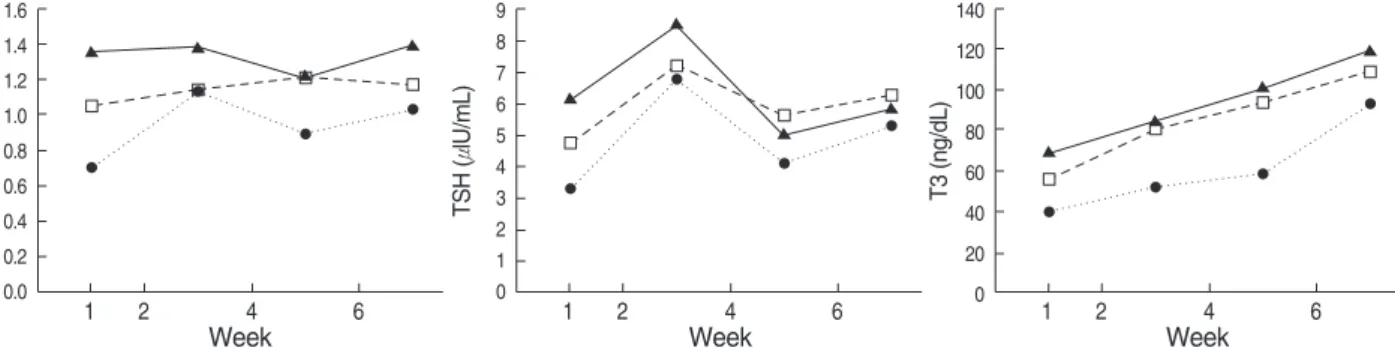
Most infants born at <28 weeks’ gestation had low free T4 concentrations during the first week of postnatal life. Serum free T4 levels gradually increased, and at 2 months of life,
reached levels equal to those of term infants. Infants of low gestational age had a tendency to show low TSH concentra- tions during the first week of postnatal life. TSH levels had a tendency to increase transiently between the second and fourth weeks of life in all groups. T3 concentrations gradu- ally increased during the first 2 months after birth in all in- fants (Fig. 1).
Thyroid function during the first 10 days of life
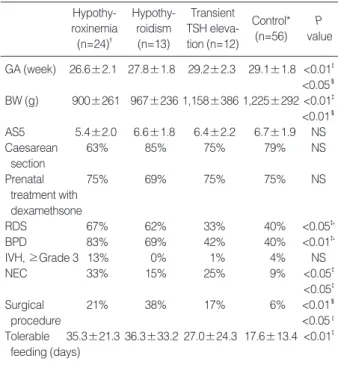
Hypothyroxinemia of prematurity was observed in 31 pre- term infants (28%). Gestational age, birth weight, and Apgar score at 5 min were significantly lower in preterm infants with hypothyroxinemia than in the controls (P<0.01) (Table 1). Pre- natal treatment with dexamethasone had no significant effect on the results of the initial thyroid function test. The incidence of respiratory distress syndrome and the incidence of brocho- pulmonary dysplasia were significantly greater in preterm in- fants with hypothyroxinemia than in the controls (P<0.05;
P<0.01).
Among 31 infants with hypothyroxinemia of prematuri- ty, 7 infants received L-thyroxine supplementation; the re- maining 24 infants did not receive L-thyroxine supplemen- tation. Of 24 infants with hypothyroxinemia who did not receive L-thyroxine supplementation, three were diagnosed with overt hypothyroidism during follow-up; free T4 levels of the remaining 21 infants normalized (≥0.7 ng/mL) dur- ing the first 3 weeks of postnatal life.
Hypothyroidism
Of 105 infants, 13 (12%) were diagnosed with hypothy- roidism. Their mean age at diagnosis was 28±17 days. Pret- erm infants with hypothyroidism had significantly lower ges- tational age and birth weights than the controls (P<0.05;
P<0.01) (Table 1). Among these 13 infants, 8 infants who did not have overt hypothyroidism on the first thyroid func- tion test were diagnosed as hypothyroidism on the repeated test. Especially infants of case 8 and 10 showed normal thy- roid function on first test but turned out to have hypothy- roidism on about 6 weeks of life (Table 2).
Fig. 1. Serum free T4, TSH, T3 concentration of 85 preterm infants during first 2 months after birth, grouped by gestational age. 20 infants who received L-thyroxine replacement were excluded. ●, <28 weeks (n=27); , 28-30 weeks (n=32); , 30-32 weeks (n=26).
Free T4 (ng/dL)
1.6 1.4 1.2 1.0 0.8 0.6 0.4 0.2
0.0 1 2 4 6
Week
TSH (μlU/mL) 9 8 7 6 5 4 3 2 1
0 1 2 4 6
Week
T3 (ng/dL)
140 120 100 80 60 40 20
0 1 2 4 6
Week
Of 105 infants, 12 (11%) showed moderately elevated TSH levels (TSH 10-30 μU/mL) with normal fT4 levels (>0.7 ng/
dL) after 1 week of postnatal life and their clinical findings were not significantly different from controls. The history of undergone surgical procedure which needed iodine contain- ing disinfectants was significantly frequent in the infant with hypothyroidism and transient TSH elevation (P<0.01; P<
0.05) (Table 1).
In preterm infants with hypothyroidism, the interval until tolerable feeding was achieved tended to be prolonged, but the increase was not statistically significant (Table 1).
DISCUSSION
The incidence of thyroid dysfunction, especially hypothy- roidism in preterm infants was high in this study. Thyroid hormone is associated with the neurodevelopment of pret- erm infants (4, 5). Despite many studies on thyroid function in preterm infants, its significance is still debated. Moreover, there has been much debate about the need for routine repeat thyroid function tests for preterm infants (6, 7) and thyroid hormone replacement in hypothyroxinemia of prematurity.
In term neonates, filter paper blood specimens are used to measure TSH levels and screen for congenital hypothyroidi- sm during the first 2 to 5 days of postnatal life. However, the TSH surge and pituitary feedback for thyroid hormone are limited and TSH may not be increased even though serum thyroid hormone is low in preterm infants (8). In addition, very low birth weight infants usually have various systemic diseases and are given various drugs such as dopamine, dobu- tamine and morphine that affect the hypothalamic-pituitary-
*Control: Preterm infants without hypothyroxinemia of prematurity, hypothy- roidism and transient TSH elevation; �Among 31 infants who had hypothy- roxinemia, 7 infants who were diagnosed as hypothyroidism or transient TSH elevation during follow-up were excluded; �P value: Between infants with hypothyroxinemia and controls;�P value: Between infants with hy- pothyroidism and controls; ‖P value: Between infants with transient TSH elevation and controls.
GA, gestational age; BW, birthweight; AS5, Apgar score at 5 min; RDS, respiratory distress syndrome; BPD, bronchopulmonary dysplasia; IVH, intraventricular hemorrhage; NEC, necrotizing enterocolitis; NS, not sig- nificant.
Hypothy- roxinemia (n=24)�
Hypothy- roidism
(n=13)
Transient TSH eleva- tion (n=12)
Control*
(n=56) P value
GA (week) 26.6±2.1 27.8±1.8 29.2±2.3 29.1±1.8 <0.01�
<0.05� BW (g) 900±261 967±236 1,158±386 1,225±292 <0.01�
<0.01� AS5 5.4±2.0 6.6±1.8 6.4±2.2 6.7±1.9 NS
Caesarean 63% 85% 75% 79% NS
section
Prenatal 75% 69% 75% 75% NS
treatment with dexamethsone
RDS 67% 62% 33% 40% <0.05�‘
BPD 83% 69% 42% 40% <0.01�‘
IVH, ≥Grade 3 13% 0% 1% 4% NS
NEC 33% 15% 25% 9% <0.05�
<0.05�
Surgical 21% 38% 17% 6% <0.01�
procedure <0.05‖
Tolerable 35.3±21.3 36.3±33.2 27.0±24.3 17.6±13.4 <0.01� feeding (days)
Table 1. Comparison between infants with hypothyroxinemia of prematurity, hypothyroidism, transient TSH elevation and control
No. GA
(week) BW (g)
Age at diagnosis
(days)
Surgical procedure (Age at operation,
days)
Tolerable feeding
(days) Initial
free T4 (ng/dL)
TSH (μU/mL)
At diagnosis free T4 (ng/dL)
TSH (μU/mL)
1 24+6 510 30 0.35 1.4 0.2 237 PDA ligation (10) >100
2 25+3 680 45 0.6 2.4 <0.1 479 PDA ligation (24) 44
3* 25+5 710 64 0.26 9.4 0.5 41.7 Colostomy for NEC (17)
EVD (31, 40, 54) 29
4 26+1 970 7 0.59 13.5 - - - 26
5 27+1 965 10 0.29 17.48 - - Colostomy for NEC (5)
PDA ligation (14) 29
6 27+1 870 20 0.64 4.3 0.8 58.5 - 18
7 28+3 1,140 21 0.91 30.5 0.54 111 - 12
8 28+4 1,320 42 2.1 6.5 0.31 67.5 - 9
9 29+1 1,075 19 0.66 7 0.38 126.3 - 9
10 29+1 1,100 45 1.29 2.3 0.61 26.8 - 15
11 29+1 1,275 24 0.7 10.9 0.45 94.7 - 31
12 30+1 870 28 1.42 20.1 0.42 95 PDA ligation (4) 16
13 30+1 1,080 9 0.54 37.62 0.56 113.4 - 11
Table 2. Clinical characteristics of 13 infants with overt hypothyroidism
*Case 3: On 26 days of life,free T4 0.98 ng/dL, TSH 6.0 μU/mL.
GA, gestational age; BW, birthweight; TSH, thyrotropin; PDA, patent ductus arteriosus; NEC, necrotizing enterocolitis; EVD, external ventricular drain.
thyroidal axis. Thus, TSH levels are not representative of over- all thyroid function in preterm infants.
In this study, eight preterm infants with hypothyroidism exhibited delayed TSH elevation and 2 of them showed nor- mal thyroid function on the first test. The age at which hy- pothyroidism developed varied, and we could not anticipate which infants were at risk. Our findings justify repeated th- yroid screening tests, including TSH and T4 measurements, in preterm infants.
The incidence of persistent hypothyroidism among pre- term infants does not differ from that among term newborns, but transient hypothyroidism is considerably more preva- lent (1). Mandel et al. reported that the incidence of hypothy- roidism in very low birth weight infants is 1:153 and that about half of these infants had atypical hypothyroidism (2).
Larson et al. reported the incidence to be 1:250 (9). In stud- ies conducted in Belgium, 5% to 18% of preterm infants had hypothyroidism, which was caused by an iodine deficiency (10, 11). The daily iodine requirement of preterm infants is more than twice that of term infants (12), and studies con- ducted in Europe demonstrated that most preterm infants have iodine deficiency (13-15).
In our study, the incidence of hypothyroidism was 12%, which was much higher than expected. Iodine intakes in Korea are thought to be sufficient because most Koreans eat vari- ous kind of seaweed, and the iodine content of human milk from lactating mothers is higher than that in other countries (12, 16). However, it takes about one month to achieve full enteral feeding in extreme preterm infants, before which most nutrition is supplied parenterally. According to Ibrahim et al., most extremely preterm infants who receive parenteral nutrition have iodine deficiency (14). It is thought that pret- erm infants in Korea also have iodine deficiency, which mi- ght explain the high incidence of hypothyroidism in our pa- tients.
In contrast, there is some evidence that the preterm neo- nate is more sensitive to the thyroid-suppressive effects of iodine exposure than the full-term neonate (17, 18). Escape from the Wolff-Chaikoff effect, that is the capacity of thyroid to reduce iodide trapping in response to excess iodine, does not appear until 36 to 40 weeks’ gestation (19). The safe up- per limit for daily iodine intake is lower for preterm infants than for term infants (20). Topical iodine can be absorbed th- rough the skin. The skin of preterm infants is thin and may absorb iodine easily, and preterm infants have many chances that can be exposed to iodine-containing disinfectants. In ad- dition, lactating women in Korea have seaweed soup conta- ining abundant iodine traditionally and iodine concentration of breast milk of Korean women was reported very high (12).
Although it is not clear whether such exposure to iodine can cause overt hypothyroidism in preterm infants, it may be one of the reasons for the high incidence of hypothyroidism.
Transient hypothyroxinemia is common in preterm infants and is more severe in infants born at a low gestational age.
Some studies suggest that low serum concentrations of thy- roid hormone in the early period of life are associated with poor developmental outcomes (4, 5), although a definitive causal relationship between them is unclear. Thyroid hormone supplementation is frequently used for treatment of hypothy- roxinemia, but there is no conclusive evidence that it is be- neficial. Some authors have recommended that thyroid hor- mone supplementation should not be used for infants with low thyroid hormone levels unless they have elevated TSH levels (21, 22). However, in preterm infants born at <28 weeks’ gestation, it usually takes more than one month for free T4 levels to reach levels equal to those of term infants.
It has been reported that thyroxine supplementation of in- fants born at <28 weeks’ gestation results in a better neuro- developmental outcome at 2, 5, and 10 yr of age (23-25).
These findings suggest that thyroxine supplementation may be beneficial for preterm infants born at <28 weeks’ gestation who have hypothyroxinemia.
In our study, free T4 levels increased in most infants who had hypothyroxinemia and did not receive thyroxine suppl- ementation during the first 3 weeks of postnatal life. This suggests that thyroxine supplementation should be consid- ered if free T4 levels are persistently low during the first 3 weeks after birth. Further studies are needed before clinical application of this finding.
It has been reported that low thyroid hormone levels are associated with the development of respiratory distress syn- drome (26). In this study, respiratory distress syndrome was more frequent in preterm infants with hypothyroxinemia.
However, gestational age was lower in preterm infants with hypothyroxinemia and specimens were obtained between 4 and 10 days of postnatal life. Thus, the low free T4 and T3 levels might have been caused by euthyroid sick syndromes or the low gestational age.
In conclusion, preterm infants born at <32 weeks’ gesta- tion have a high incidence of hypothyroidism. Repeated thy- roid function tests are necessary for preterm infants, even th- ough they may initially show normal thyroid function. The high incidence of hypothyroidism in preterm infants may be associated with excessive or insufficient iodine intake. Further studies are needed to elucidate the causal relationship between iodine balance and thyroid function in preterm infants.
REFERENCES
1. Uhrmann S, Marks KH, Maisels MJ, Friedman Z, Murray F, Kulin HE, Kaplan M, Utiger R. Assessment of Thyroid function in the pre- term infant: a longitudinal assessment. J Pediatr 1978; 92: 968-73.
2. Mandel SJ, Hermos RJ, Larson CA, Prigozhin AB, Rojas DA, Mi- tchell ML. Atypical hypothyroidism and the very low birthweight infant. Thyroid 2000; 10: 693-5.
3. van Wassenaer AG, Kok JH. Hypothyroxinaemia and thyroid func- tion after preterm birth. Semin Neonatol 2004; 9: 3-11.
4. Perlman JM. Neurobehavioral deficits in premature graduates of intensive care-potential medical and neonatal environmental risk factors. Pediatrics 2001; 108: 1339-48.
5. Gressens P, Rogido M, Paindaveine B, Sola A. The impact of neona- tal intensive care practices on the developing brain. J Pediatr 2002;
140: 646-53.
6. Rapaport R. Thyroid function in the very low birth weight newborn:
rescreen or reevaluate? J Pediatr 2002; 140: 287-9.
7. Vincent MA, Rodd C, Dussault JH, Van Vliet G. Very low birth weight newborns do not need repeat screening for congenital hypothyroidism.
J Pediatr 2002; 140: 311-4.
8. Frank JE, Faix JE, Hermos RJ, Mullaney DM, Rojan DA, Mitchell ML, Klein RZ. Thyroid function in very low birthweight infants:
effects on neonatal hypothyroidism screening. J Pediatr 1996; 128:
548-54.
9. Larson C, Hermos R, Delaney A, Daley D, Mitchell M. Risk factors associated with delayed thyrotropin elevations in congenital hypothy- roidism. J Pediatr 2003; 143: 587-91.
10. Delange F, Dalhem A, Bourdoux P, Lagasse R, Glinoer D, Fisher DA, Walfish PG, Ermans AM. Increased risk of primary hypothy- roidism in preterm infants. J Pediatr 1984 ; 105: 462-9.
11. Rooman RP, Du Caju MV, De Beeck LO, Docx M, Van Reempts P, Van Acker KJ. Low thyroxinaemia occurs in the majority of very preterm newborns. Eur J Pediatr 1996; 155: 211-5.
12. Delange F. Optimal iodine nutrition during pregnancy, lactation and the neonatal period. Int J Endocrinol Metab 2004; 2: 1-12.
13. Ares S, Escobar-Morreale HF, Quero J, Duran S, Presas MJ, Herru- zo R, Morreale de Escobar G. Neonatal hypothyroxinemia: effects of iodine intake and premature birth. J Clin Endocrinol Metab 1997;
82: 1704-12.
14. Ibrahim M, de Escobar GM, Visser TJ, Duran S, van Toor H, Stra- chan J, Williams FL, Hume R. Iodine deficiency associated with par- enteral nutrition in extreme preterm infants. Arch Dis Child Fetal Neonatal Ed 2003; 88: F56-7.
15. van Wassenaer AG, Stulp MR, Valianpour F, Tamminga P, Ris Stal- pers C, de Randamie JS, van Beusekom C, de Vijlder JJ. The quan- tity of thyroid hormone in human milk is too low to influence plas- ma thyroid hormone levels in the very preterm infant. Clin Endocrinol
(Oxf) 2002; 56: 621-7.
16. Moon S, Kim J. Iodine content of human milk and dietary iodine intake of Korean lactating mothers. Int J Food Sci Nutr 1999; 50:
165-71.
17. Smerdely P, Lim A, Boyages SC, Waite K, Wu D, Roberts V, Leslie G, Arnold J, John E, Eastman CJ. Topical iodine-containing antisep- tics and neonatal hypothyroidism in very-low-birthweight infants.
Lancet 1989; 2: 661-4.
18. Linder N, Davidovitch N, Reichman B, Kuint J, Lubin D, Meyerovitch J, Sela BA, Dolfin Z, Sack J. Topical iodine-containing antiseptics and subclinical hypothyroidism in preterm infants. J Pediatr 1997;
131: 434-9.
19. Brown R, Huang S. Thyroid and its disorders. In; Brook C, Clayton P, Brown R, eds. Brook’s clinical endocrinology. 5th ed. Malden, Mass; Blackwell Publishing; 2005; 218-53.
20. FAO/WHO. Vitamin and mineral requirements in human nutrition, 2nd ed. Geneva: WHO publication; 2005; 303-17.
21. Rapaport R, Rose SR, Freemark M. Hypothyroxinemia in the preterm infant: the benefits and risks of thyroxine treatment. J Pediatr 2001;
139: 182-8.
22. Ogilvy-Stuart AL. Neonatal thyroid disorders. Arch Dis Child Fetal Neonatal Ed 2002; 87: F165-71.
23. van Wassenaer AG, Kok JH, de Vijlder JJ, Briet JM, Smit BJ, Tam- minga P, van Baar A, Dekker FW, Vulsma T. Effects of thyroxine supplementation on neurologic development in infants born at less than 30 weeks’ gestation. N Engl J Med 1997; 336: 21-6.
24. van Wassenaer AG, Briet JM, van Baar A, Smit BJ, Tamminga P, de Vijlder JJ, Kok JH. Free thyroxine levels during the first weeks of life and neurodevelopmental outcome until the age of 5 years in very preterm infants. Pediatrics 2002; 110: 534-9.
25. van Wassenaer AG, Westera J, Houtzager BA, Kok JH. Ten-year follow-up of children born at <30 weeks’ gestational age supplement- ed with thyroxine in the neonatal period in a randomized, controlled trial. Pediatrics 2005; 116: e613-8.
26. Abbassi V, Adams J, Duvall D, Phillips E. Prenatal thyroid function abnormalities in infants with idiopathic respiratory distress syndrome.
Pediatr Res 1984; 18: 926-8.