INTRODUCTION
Antibiotic-associated diarrhea or colitis (AAD or AAC) can be caused by nearly all kinds of antibiotics. While Clostridi- um difficile is the most frequently identified cause of AAC, Clostridium perfringens, Staphylococcus aureus, drug-resistant Salmonella species, and Candida species were reported to cause AAC (1). Although Pseudomonas aeruginosa is not generally considered as a cause of AAC, several cases of diarrhea prob- ably caused by P. aeruginosa have been reported (2-4). We experienced seven cases of nosocomial diarrhea presumably caused by P. aeruginosa.
PATIENTS AND METHODS
To investigate the clinical relevance of Pseudomonas-induced diarrhea, microbiologic reports of stool cultures were reviewed at a university hospital (Samsung Medical Center, Seoul, Korea) from January 1997 to June 1999. Stool cultures were done on blood agar plates and MacConkey agar plates. To
detect etiologic organisms of diarrhea, direct microscopy of stool, stool cultures for Salmonella and Shigella, and tests for C. difficile toxin (Vidas�, bioMerieux, MO, U.S.A.) were done at the same time. The sensitivity and specificity of Vidas for C. difficile toxin are higher than 90%. Detection of enteric virus was not done. Our clinical microbiology isolat- ed P. aeruginosa, S. aureus, or Candida spp. from stool if they were the only predominant organisms. P. aeruginosa was identified by automated MicroScan�system and Vitek�sys- tem. P. aeruginosa was the only predominant organism iso- lated from stool cultures in seven patients. Medical records of these patients were reviewed retrospectively. We defined any diarrhea as nosocomial if the onset was 48 hr or later after admission.
RESULTS
All of the seven patients had nosocomial diarrhea when P.
aeruginosa was isolated from their stool cultures. Among seven patients, four were males and three were females. The
Shin Woo Kim, Kyong Ran Peck*, Sook-In Jung*, Yeon-Sook Kim*, Sungmin Kim*, Nam Yong Lee�, Jae-Hoon Song*
Division of Infectious Diseases, Department of Medicine, Kyungpook National University School of Medicine, Taegu; Division of Infectious Diseases, Department of Medicine*and Department of Clinical Pathology�, Samsung Medical Center, Sungkyunkwan University School of Medicine, Seoul, Korea
Received : 22 March 2001 Accepted : 27 August 2001
Address for correspondence Kyong Ran Peck, M.D.
Division of Infectious Diseases, Department of Medicine, Samsung Medical Center, Sungkyunkwan University School of Medicine, 50 Ilwon-dong, Kangnam-gu, Seoul 135-710, Korea Tel : +82.2-3410-0322, Fax : +82.2-3410-3849 E-mail : [email protected]
*Part of this data was presented at the ASM confer- ence on Pseudomonas ’99 in Hawaii (September 1-5, 1999). Abstract No. 117
742 J Korean Med Sci 2001; 16: 742-4
ISSN 1011-8934
Copyright � The Korean Academy of Medical Sciences
Pseudomonas aeruginosa as a Potential Cause of Antibiotic- Associated Diarrhea
Although Pseudomonas aeruginosa is not generally considered as a cause of antibiotic-associated diarrhea, several cases of diarrhea caused by P. aerugi- nosa have been reported. We experienced seven cases of nosocomial diarrhea presumably caused by P. aeruginosa, which was the predominant organism iso- lated from stool cultures. Clostridium difficile toxin was also positive in one patient.
No other potential or recognized enteropathogens were identified from stools.
All patients had underlying diseases and had been receiving antibiotics before the diarrheal onset. All of the seven P. aeruginosa isolates were resistant to pre- viously given antibiotics. Diarrhea stopped three days after withdrawal of proba- ble offending antibiotics without specific treatment in two patients. The other five patients having continuous diarrhea despite withdrawal of probable offending antibiotics, were successfully treated with antipseudomonal agents. The median duration of diarrhea after the initiation of treatment was 6.3 days. These data suggest that P. aeruginosa can be a potential cause of antibiotic-associated diarrhea. Further investigations are warranted to evaluate the possible etiologic role of P. aeruginosa in antibiotic-associated diarrhea.
Key Words : Pseudomonas aeruginosa; Diarrhea; Colitis
median age of patients was 58 (41-71) yr. All patients had various underlying diseases: acute myelogenous leukemia, myelofibrosis, rectal cancer, sepsis, hemorrhagic fever with renal syndrome, subarachnoid hemorrhage, and rheumatoid arthritis. The median duration of hospitalization before the onset of nosocomial diarrhea was 19 (4-148) days (Table 1).
All patients had been receiving antibiotics and median dura- tion of antibiotics before diarrheal onset was 6 (3-21) days.
No patients had concomitant infections caused by Pseudomonas other than diarrhea.
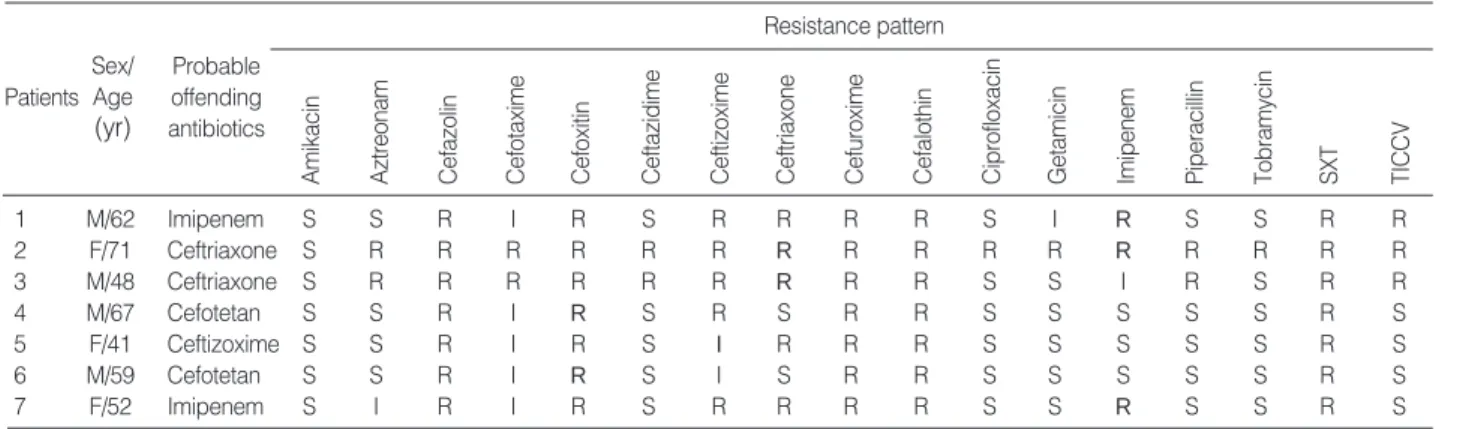
All isolates of P. aeruginosa from stool cultures were not susceptible to previously given antibiotics (Table 2). No other potential or recognized enteropathogens were identified from stools except one patient whose stool was also positive for C. difficile toxin at the same time. Sigmoidoscopy, which was done in four patients, revealed nonspecific colitis with edematous, hyperemic mucosa, erosion, and several hemor- rhagic spots.
Diarrhea stopped three days after withdrawal of probable offending antibiotics without specific treatment in two patients. The other five patients with continuous diarrhea
despite withdrawal of probable offending antibiotics, were treated with antipseudomonal agents (Table 1). The median duration of diarrhea after the initiation of treatment was 6.3 (1-9) days. Antipseudomonal agents were given 2-4 more days after resolution of diarrhea. One patient with positive C. difficile toxin was treated with metronidazole and ami- kacin. No patient died of AAC.
DISCUSSION
P. aeruginosa is one of the most important nosocomial pa- thogens. Even though P. aeruginosa is not generally consid- ered as a cause of AAC, there are evidences that Pseudomonas can cause the infections of gastrointestinal tracts with diar- rhea in infants. Pseudomonas septicemia in infants was mani- fested as necrotizing bowel lesions with a history of diarrhea (5). There have been some reports on community-acquired Pseudomonas infection of the gastrointestinal tract causing diarrhea in infants (6, 7).
Seven patients in the present report developed diarrhea
P. aeruginosa and Antibiotic-Associated Diarrhea 743
Sex/Age (yr)
Patients Underlying diseases and infectious diseases
Probable offending antibiotics (duration: days)
C.difficile
Toxin assay* Antibiotics for AAD
1 M/62 Acute myelogenous leukemia, CRBSI Imipenem (21),
Vancomycin (21) - Ciprofloxacin
2 F/71 Sepsis Ceftriaxone (4),
+ Amikacin, metronidazole Imipenem (7)
3 M/48 HFRS, possible sepsis Ceftriaxone (5) ND -
4 M/67 Rectal cancer, perioperative Cefotetan (6) - -
prophylactic antibiotics
5 F/41 Subarachnoid hemorrhage, pneumonia Ceftizoxime (19) - Ceftazidime, tobramycin
6 M/59 RA, possible sepsis Cefotetan (3) - Ciprofloxacin
7 F/52 MF, BMT, neutropenic fever Imipenem (5) - Ciprofloxacin
Table 1.Characteristics of the patients
*done at the same time with stool cultures.
Abbreviations: CRBSI: Catheter-related blood stream infection caused by Staphylococcus aureus, HFRS: Hemorrhagic fever with renal syndrome, RA: Rheumatoid arthritis, MF: Myelofibrosis, BMT: Bone marrow transplantation, ND: not done.
Sex/
Age (yr)
Probable offending antibiotics Patients
1 M/62 Imipenem S S R I R S R R R R S I R S S R R
2 F/71 Ceftriaxone S R R R R R R R R R R R R R R R R
3 M/48 Ceftriaxone S R R R R R R R R R S S I R S R R
4 M/67 Cefotetan S S R I R S R S R R S S S S S R S
5 F/41 Ceftizoxime S S R I R S I R R R S S S S S R S
6 M/59 Cefotetan S S R I R S I S R R S S S S S R S
7 F/52 Imipenem S I R I R S R R R R S S R S S R S
Table 2. Antibiograms of Pseudomonas aeruginosa isolated from stool cultures of the patients
SXT: trimethoprim/sulfamethoxazole, TICCV: ticarcillin/clavulanic acid, S: susceptible, I: intermediate, R: resistant.
Resistance pattern
Amikacin Aztreonam Cefazolin Cefotaxime Cefoxitin Ceftazidime Ceftizoxime Ceftriaxone Cefuroxime Cefalothin Ciprofloxacin Getamicin Imipenem Piperacillin Tobramycin SXT TICCV
after the administration of antibiotics and in five patients thereof, diarrhea persisted without improvement 3-5 days after cessation of offending antibiotics. Diarrheas in these five patients were successfully controlled by antipseudomonal agents. This time sequence of treatment and resolution of diarrhea raised the probability of P. aeruginosa as the cause of diarrhea. Porco and Visconte reported a patient with P. aerugi- nosa-induced enteritis whose symptoms rapidly resolved with oral ciprofloxacin therapy (4). P. aeruginosa was suggested to cause diarrhea in a report of 23 patients with diarrhea that developed after use of antibiotics (3).
The pathogenetic mechanism by which antibiotics cause AAC is a disturbance of the composition and function of the normal intestinal flora, followed by an overgrowth of pathogenic microorganisms. Drug-resistant P. aeruginosa could be selected by antibiotics. Antibiotic susceptibility patterns of P. aeruginosa strains in these cases support the good relationship between antibiotic pressure and selection of resistant organism (8, 9). Cellular adhesion and cytotoxic activity of P. aeruginosa could be a putative mechanism of enterotoxigenicity and Pseudomonas-induced enterocolitis (3), although no enterotoxin was documented from P. aerug- inosa isolates in a patient with AAC (2).
For the treatment of Pseudomonas-induced AAC, oral cipro- floxacin therapy was recommended (4). Other antipseudo- monal agents, such as ceftazidime, aztreonam, and aminogly- cosides, seem to be effective based on our experience.
Our data have several limitations because it is a retrospec- tive study: there are no stool culture data at the time of admis- sion to assure the nosocomial acquisition of P. aeruginosa; no follow-up cultures of stool to demonstrate the eradication of P. aeruginosa after treatment and no bacteriologic study on the isolated P. aeruginosa is available because the strains were not saved. However, our data and several other reports suggest
that P. aeruginosa could be a potential cause of AAD on the basis of the clinical courses. Further investigations are war- ranted to evaluate the possible etiologic role of P. aeruginosa in antibiotic-associated diarrhea.
REFERENCES
1. Hogenauer C, Hammer HF, Krejs GJ, Reisinger EC. Mechanisms and management of antibiotic-associated diarrhea. Clin Infect Dis 1998; 27: 702-10.
2. Allen SD, Dunn GD, Page DL, Wilson FA. Bacteriological studies in a patient with antibiotic-associated pseudomembranous colitis.
Gastroenterology 1977; 73: 158-63.
3. Adlard PA, Kirov SM, Sanderson K, Cox GE. Pseudomonas aerugi- nosa as a cause of infectious diarrhoea. Epidemiol Infect 1998; 121:
237-41.
4. Porco FV, Visconte EB. Pseudomonas aeruginosa as a cause of infectious diarrhea successfully treated with oral ciprofloxacin. Ann Pharmacother 1995; 29: 1122-3.
5. Tsai MJ, Teng CJ, Teng RJ, Lee PI, Chang MH. Necrotizing bowel lesions complicated by Pseudomonas septicaemia in previously healthy infants. Eur J Pediatr 1996; 155: 216-8.
6. Yeung CK, Lee KH. Community acquired fulminant Pseudomonas infection of the gastrointestinal tract in previously healthy infants. J Paediatr Child Health 1998; 34: 584-7.
7. Hendricks MK, Senekal M. Community-acquired Pseudomonas aerug- inosa infection in an infant. Ann Trop Paediatr 1996; 16: 203-6.
8. Alonso A, Campanario E, Martinez JL. Emergence of multidrug- resistant mutants is increased under antibiotic selective pressure in Pseudomonas aeruginosa. Microbiology 1999; 145: 2857-62.
9. Austin DJ, Kristinsson KG, Anderson RM. The relationship between the volume of antimicrobial consumption in human communities and the frequency of resistance. Proc Natl Acad Sci USA 1999; 96: 1152-6.
744 S.W. Kim, K.R. Peck, S.-I. Jung, et al.