Vol. 26, No. 6, 2017, 58-64
≫ 연구논문 ≪
염산용액에 의한 블랙드로스의 침출
Thi Thuy Nhi Nguyen*·Thi Hong Nguyen*
,**·
§이만승*
*목포대학교 신소재공학과, **베트남 Can Tho대학교 자연과학대학
Leaching of Black Dross by Hydrochloric Acid Solutions
Thi Thuy Nhi Nguyen *, Thi Hong Nguyen*
,** and
§Man Seung Lee *
*Department of Advanced Materials Science & Engineering, Institute of Rare Metal, Mokpo National University, Chonnam 534-729, Korea
**College of Natural Sciences, Can Tho University, Can Tho City, Viet Nam
요 약
블랙드로스에 함유된 유가성분을 회수하기 위한 공정을 개발하기 위해 염산용액으로 침출실험을 수행했다. 블랙드로스와 물로 처 리한 잔사의 침출거동을 비교했다. 본 연구의 실험범위에서 블랙드로스에 함유된 성분중 TiO2를 제외한 모든 성분이 염산에 용해 되었다. 물로 블랙드로스를 처리하면 알루미나, 마그네시아, 실리카의 침출율이 저하되었으며, 침출반응을 고찰했다. 3M의 염산과 반응온도 90oC에서 알루미나, 마그네시아, 실리카의 침출율은 85, 100, 40%이었다.
주제어 : 알루미늄 드로스, 침출, 염산, 처리
Abstract
Leaching of black dross with HCl solution was conducted to find a suitable process to recover valauble materials. In this work, the leaching behavior of the components was compared between black dross and the residues after water treatment. All the com- ponents except TiO2 in the black dross were dissolved by HCl solution in the experimental ranges. Treatment of the black dross with water to recover the salts has negative effect on the leaching of Al2O3, MgO and SiO2. The reactions occuring during the leaching were discussed. At an optimum leaching condition of 3 M HCl and 90oC, the leaching percentage of Al2O3, MgO and SiO2 was 85, 100 and 40%, respectively.
Key words : Aluminum dross, leaching, HCl, treatment
1. Introduction
Black dross is resulted from secondary recycling process and contains 12 - 18% recoverable aluminum.
The main components of black dross are salts, metallic aluminum, alumina, silica, magnesium oxide, potassium and sodium chlorides. Moreover, the release of dangerous gases such as ammonia, methane and hydrogen in contact
· Received : September 21, 2017 · Revised : October 20, 2017 · Accepted : October 25, 2017
§Corresponding Author : Man-Seung Lee (E-mail : [email protected])
Department of Advanced Materials Science & Engineering, Mokpo National University, 1666 Yeongsan-ro, Cheonggye-myeon, Muan-gun, Chonnam, 58554, Korea
ⓒThe Korean Institute of Resources Recycling. All rights reserved. This is an open-access article distributed under the terms of the Creative Commons Attribution Non-Commercial License (http://creativecommons.org/licenses/by-nc/3.0/), which permits unrestricted non-commercial use, distribution and reproduction in any medium, provided the original work is properly cited.
with moisture from aluminum dross is harmful to the environment
1). Due to increasing demand of aluminum and environmental concern, the recovery of aluminum, other metals and salts attracts much attention. In general, hydrometallurgical process is employed for the recovery of metals and salts from black dross owing to recovery efficiency and process economics. Hydrometallurgical leaching processes can be carried out either by alkaline
2)or acid leaching
3). Alkaline leaching of aluminum dross followed by precipitation of aluminum hydroxide has been reported in many literatures
2,4-8). High leaching per- centage of aluminum is obtained by alkaline leaching but impurities such as silica and other metals are dissolved together, leading to low purity of final pro- ducts
8,9). In order to avoid co-dissolution of silica, other metals and salts, acid leaching has been chosen as an alternative
3,10-17).
Treatment of the black dross by water leaching is first done at 90
oC to dissolve salts. Sulfuric acid leaching of the residue after water treatment has been tried to produce aluminum sulfate. Other processes are proposed to recover alumina by leaching with sulfuric acid followed by heat treatment of the aluminum hydroxide.
The recovery of aluminum from black dross by two steps has been proposed
11). The leach solution obtained from acid leaching contains about 93.2% of Al. Then, precipitation of aluminum hydroxide is performed (pH
= 8) using NaOH solution. Subsequently, aluminum hydroxide powders are calcined at 600
oC to obtain γ- Al
2O
3. Upendra Singh et al.
13)has used hydrochloric and sulfuric acid solutions for leaching of metals in black dross. High purity alumina (Al
2O
3> 99.5%) is recovered from the leaching solution after precipitation and calcination. Liu Qingsheng et al.
14)reported that impurity metals in acid leaching can be removed by ethylenediamine tetraacetic acid (EDTA) and water washing. Then, NH
4HCO
3is added to the solution to
precipitate the aluminum.
It has been reported that hydrochloric acid is more favorable than sulfuric acid on the basis of environmental burden. In fact, few literatures have been reported on employing hydrochloric acid for the recovery of aluminum from black dross. A process has been proposed on the recovery of Al from black dross by water treatment followed by HCl leaching (see Fig. 1) but the experimental details on the leaching of other metals except Al were not mentioned
19). In order to investigate leaching efficiency of Al and other metals from black dross, hydrochloric acid leaching was carried out in the present work. Effects of reaction temperature and acid concentration on the leaching behavior of metals from black dross were investigated.
2. Experimental
The black dross supplied by a company in Korea was used in this experiments without any treatment. A small amount of metallic aluminum together with lots of the salt-flux mixtures were main components in the back dross. The composition of the black dross (particle size lower than 100 µm) is represented in Table 1.
Leaching experiments were conducted by pouring 250 mL of HCl solution to a 2.5 L three- neck round bottom flask equipped with a magnetic stir bar in heating mantle.
Teflon tape was also used to seal the outside joints of the glassware to avoid evaporation loss. In leaching experiments, pulp density of 120 g/L was employed and the slurry was stirred with 200 rpm throughout the leaching experiments. The slurry samples at desired time intervals were taken and the solution was separated from solids by using vacuum filtration. The concentration of metals in the leaching solutions was measured by ICP- OES (Spectro Arcos).
Table 1. The chemical composition of black dross
Element Fe Ca Al Mg Na K Si Ti
Contents, wt.% 0.31 0.10 5.42 1.10 3.84 8.72 6.89 0.63
3. Results and Discussion
3.1. Leaching of black dross with HCl without water pretreatment
Effect of HCl concentration on leaching behavior was studied in HCl concentration range of 1-5 M. All experiments were carried out at pulp density of 120 g/L, stirring speed of 200 rpm and 2 h leaching time. The reaction temperature was varied from 25
oC to 90
oC. The leaching behavior of metals is shown in Figs. 1-4. HCl concentration and reaction temperature affected a little the leaching behavior of metals except Ti. Most of Fe,
Al, Mg, Ca, K, Na and Si were leached at any HCl concentration and reaction temperature. The leaching percentage of Ti steadily increased from around 30%
to 65% with increase of HCl concentration from 2 to 5 M (see Figs. 2-5). The difference in leaching percentage of Ti was small when the reaction temperature increased from 25 to 90
oC.
Fe, Mg, Ca, K and Na exist as salts in black dross and thus they can be easily dissolved by HCl solution
19). The leaching reactions between Al
2O
3/Ti
2O and HCl are represented in Eqs. (1) and (2)
20). Dissolution of NaCl
Fig. 2. Effect of HCl concentration on the leaching percent- age of metals from black dross without water pre- treatment at 25oC (reaction time, 2 h; stirring speed, 200 rpm; pulp density, 120 g/L).
Fig. 1. Recovery of metals from black dross after pre- treatment with water by HCl leaching19).
Fig. 3. Effect of HCl concentration on the leaching percent- age of metals from black dross without water pretreatment at 50oC (reaction time, 2 h; stirring speed, 200 rpm; pulp density, 120 g/L).
Fig. 4. Effect of HCl concentration on the leaching percent- age of metals from black dross without water pretreatment at 75oC (reaction time, 2 h; stirring speed, 200 rpm; pulp density, 120 g/L).
and KCl salts resulted in an increase in the concentration of chloride ion in which circumstances Al
2O
3can be dissolved by Eq. (3)
21). Eq. (3) indicates that the dissolution of alumina would be favored as pH decreases.
Eqs. (1)-(2) can explain the dissolution of alumina in the HCl concentration range employed in this work and the leaching percentage of Ti increased as HCl concen- tration increased from 2 to 5 M. In addition, the presence of Fe in black dross was the main reason to enhance the leaching percentage of Ti. In aqueous solution, Ti (IV) can be reduced to Ti (III) by iron
22)and possible chemical reaction is represented as Eq. (4). TiO
2is predominant in alkaline solution or moderate HCl concentration, while TiOCl
2is formed in the concentrated HCl solution (see Eq. (2)). The formation of TiOCl
2in HCl solution and the presence of Fe may be responsible for the enhancement of leaching percentage of Ti in the present study.
2Al
2O
3+ 6HCl = 2AlCl
3+ 3H
2O (1) TiO
2+ 2HCl = TiOCl
2+ H
2O (2) Al
2O
3+ 2Cl
–+ 3H
2O = 2Al(OH)
2Cl + 2OH
–(3) 2Ti
4++ Fe = 2Ti
3++ Fe
2+(4) High leaching efficiency obtained from the present study might be related to the breaking of silicon–oxygen bonds. The oxygen atoms react with the silicon to form the anionic species SiO
44−23). During leaching process,
H
+ions form the activated complex at the SiO
44−sites.
The formation of these activated complexes during the breaking of the critical bonds with surface atoms is a possible reason why silicon were leached by HCl solu- tion. Tanaka and Takahashi
24)also indicated that the concentration of dissolved silica in aqueous sodium chloride strongly depend on concentration of sodium ion.
Therefore, it might be said that the presence of H
+and Na
+in leaching solution can promote the dissolution of silica from black dross. The obtained results indicated that all metals were dissolved by weak HCl solution and thus other methods should be employed to selectively dissolve Al and Mg in the black dross in further experiments.
3.2. Leaching of black dross with HCl after water pretreatment
In order to improve the leaching efficiency and prevent contamination of leach liquor from the soluble salts
25), pretreatment of black dross was carried out in some reports
26,27,28). For the purpose of removing salts and selective leaching of target metals, leaching of black dross was conducted by two consecutive steps. Black dross was firstly leach by water to remove soluble salts and then the residue was leached by HCl solution.
The leaching with water was conducted by adding 250 g of black dross to 2.5 L water at 90
oC for 2 h under stirring speed of 300 rpm. The obatined results showed that most of K, Na, Ca and Fe from black dross were dissolved by water, while the leaching percentage of Al, Si, Mg and Ti was negligible in the same condition. The residue after water pretreatment is used for further acid leaching experiments. The effects of HCl concentration (1-5 M) and reaction temperature (25-90
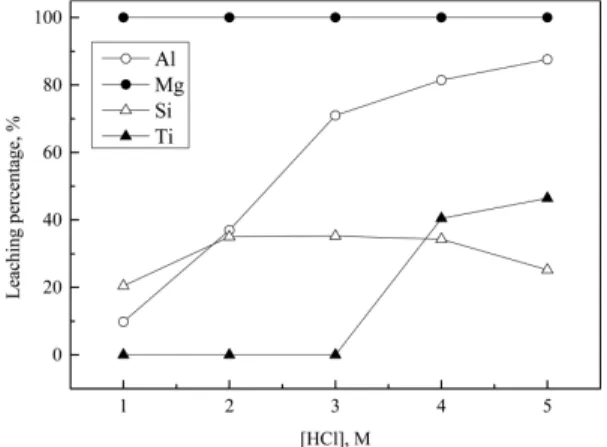
oC) on leaching percentage of Al, Mg, Si and Ti was investigated under the stirring speed of 300 rpm for reaction time of 2 h. The obtained results are presented in Figs. 6-9. Most of Mg was dissolved in HCl solution at any reaction temperature, indicating that Mg exits as MgO in black dross so it was not dissovled in water leaching process. The leaching reaction of Mg by HCl solution is shown in Eq. (5)
20). Reaction temperature affected slightly the leaching percentage of Al accoring
Fig. 5. Effect of HCl concentration on the leaching percent-age of metals from black dross without water pretreatment at 90oC (reaction time, 2 h; stirring speed, 200 rpm; pulp density, 120 g/L).
to Figs. 6-9. Whilst, leaching behavior of Al sharply rose with the increase of HCl concentration from 1 to 5 M. In the case of Si and Ti, the leaching percentage of Ti and Si was low in HCl solution. No Ti was dissolved when HCl concentration was lower than 3 M and the leaching percentage of Ti increased slightly with the further increase of HCl concentration.
Comparing to the results obtained from black dross without water treatment, the leaching efficiency of Al, Si and Ti from the black dross after water treatment was much lower. Because most NaCl and KCl salts
were removed by water leaching, the sodium and chloride ion concentration in HCl leaching solution was not high and thus Eq. (3) might not occur
21). It has been reported that the concentration of the dissolved silica decreased with the decrease of sodium ion concentration
29). It can be concluded that low leaching percentage of Al and Si from black dross after water treatment might be ascribed to low concentration of sodium and chloride ion in the residue. In the case of Ti, the lower leaching percentage of Ti can be explained by the absence of Fe in the black dross after water treatment. Based on
Fig. 6. The effect of HCl concentration on the leachingpercentage of metals from black dross with water pretreatment at 25oC (reaction time, 2 h; stirring speed, 200 rpm; pulp density, 120 g/L).
Fig. 7. The effect of HCl concentration on the leaching percentage of metals from black dross with water pretreatment at 60oC. (reaction time, 2 h; stirring speed, 200 rpm; pulp density, 120 g/L).
Fig. 8. The effect of HCl concentration on the leaching percentage of metals from black dross with water pretreatment at 80oC. (reaction time, 2 h; stirring speed, 200 rpm; pulp density, 120 g/L).
Fig. 9. The effect of HCl concentration on the leaching percentage of metals from black dross with water pretreatment at 90oC. (reaction time, 2 h; stirring speed, 200 rpm; pulp density, 120 g/L).
the obtained results, 3 M HCl at 90
oC was suggested as an optimum condition for the leaching of Al and Mg from black dross after water treatment.
MgO + 2HCl = MgCl
2+ H
2O (5)
4. Conclusions
The leaching of back dross in hydrochloric acid solution was investigated as a function of hydrochloric acid concentration (1-5 M) and reaction temperature (25
oC-90
oC). Most of Al, Mg, K, Na, Ca and Fe from black dross without treatment were dissolved in HCl solution at any temperature, while the leaching percentage of Ti increased to around 70% with the increase of HCl concentration. During the treatment of the black dross with water, most of the salts were dissolved at 90
oC. The leaching of residue containing Al, Mg, Si and Ti using HCl solution indicated that the absence of salts and iron in black dross after water treatment suppressed the leaching percentage of Al, Si and Ti.
The leaching percentage of Al increased with the increase of HCl concentration but reaction temperature did not have a significant effect. The optimum condition for leaching of Al and Mg from black dross after treatment by water was found to be 3M HCl and 90
oC.
Acknowledgements
This work was supported by the Global Excellent Technology Innovation of the Korea Institute of Energy Technology Evaluation and Planning (KETEP), granted financial resource from the Ministry of Trade, Industry
& Energy, Republic of Korea (No. 20165010100880).
References
1. Tsakiridis, P. E., 2012 : Aluminium salt slag characteri- zation and utilization – A review, J. Hazard. Mater, 217- 218, pp. 1-10.
2. Ahmad, Z. N. S., Zakaria, M. Z. H., Baini, R., Rahman, M. R., and Mohamed, N., 2016 : Influence of alkali treat- ment on the surface area of aluminium dross, Adv.
Mater. Sci. Eng, pp. 1-4.
3. Dash, B., Das, B. R., Tripathy, B. C., Bhattacharya, I. N.,
and Das, S. C., 2008 : Acid dissolution of alumina from waste aluminum dross, Hydrometallurgy, 92, pp. 48-53.
4. Tsakiridis, P. E., Oustadakis, P., and Agatzini, L. S., 2013 : Aluminium recovery during black dross hydrothermal treatment, JECE, 1, pp. 23-32.
5. Lucheva, B., Tsonev, T., and Petkov, R., 2005 : Non- waste aluminum dross recycling, JUCTM, 40(4), pp.
335-338.
6. El-Katatny, E. A., Halawy, S. A., Mohamed, M. A., and Zaki, M. I., 2003 : Surface composition, charge and tex- ture of active alumina powders recovered from alumi- num dross tailings chemical waste, Powder. Technol, 132(2-3), pp. 137-144.
7. El-Katatny, E. A., Halawy, S. A., Mohamed, M. A., and Zaki, M. I., 2000 : Recovery of high surface area alu- mina from aluminium dross tailings, J. Chem. Technol.
Biotechnol, 75(5), pp. 394-402.
8. Gil, A., 2005 : Management of the salt cake from sec- ondary aluminum fusion processes, Ind. Eng. Chem.
Res., 44, pp. 8852-8857.
9. Pickens, J. W. and Waite, M. D. 1999 : Recovery of products from non-metallic products derived from alu- minum dross, WO. Patent 44615.
10. Das, B. R., Dash, B., Tripathy, B. C., Bhattacharya, I. N., and Das, S. C., 2007 : Production of η-alumina from waste aluminium dross, Miner. Eng, 20, pp. 252-258.
11. Lai, F. H., Islam, A., Jaafar, M. S., and Taufiq-Yap, I. H., 2017 : Extraction and Characterization of γ-Alumina from waste aluminum dross, Waste Biomass Valoriza- tion, 8(2), pp. 321-327.
12. Amer, A. M., 2002 : Extracting aluminum from dross tailings, JOM, 54(11), pp. 72-75.
13. Singh, U., Ansari, M. S., Puttewar, S. P., and Agnihotri, A., 2016 : Studies on process for conversion of waste aluminium dross into value added products, Russ. J.
Non-Ferr Met, 57(4), pp. 296-300.
14. Qingsheng, L., Chunming, Z., Hui, F., and Jilai, X., 2011 : High purity alumina powers extracted from aluminum dross by the calcining leaching process, TMS, pp. 197- 200.
15. Mukhopadhyay, J., Ramana, Y. V., and Singh, U., 2005 : Extraction of value added products from aluminium dross material to achieve zero waste, TMS Light Metals, pp. 1209-1212.
16. Huckabay, D. A. and Skiathas, A. D., 1981 : Aluminum dross processing, U.S. Patent No. 4,252,776.
17. Durward, A. and Arthur, D. S., 1982 : Aluminum sulfate manufacture from aluminum dross tailings, U.S. Patent No. 4,320,098.
18. Singh, U., Ansari, M. S., Puttewar, S. P., and Agnihotri,
A., 2016 : Studies on Process for Conversion of Waste Aluminium Dross into Value Added Products, Russian Journal of Non-Ferrous Metals, 57(4), pp. 296-300.
19. Sarker, R. S. M. D., Zahangir Alam, M. D., Rakibul Qadir, M. D., Gafur, M. A., and Mohammad, M., 2015 : Extraction and characterization of alumina nanopowders from aluminum dross by acid dissolution process, Int. J.
Miner. Process, 22(4), pp. 429-436.
20. Li, C., Yan, X. G., Wang, X., Du, Z., and Cheng, F., 2015 : Dissolution kinetics of aluminum and iron from coal mining waste by hydrochloric acid, Chin. J. Chem.
Eng, 23, pp. 590-596.
21. Lucheva, B., Petkov, R., and Tzonev, T., 2003 : Method for auminum dross utilition, Proc. 3rd BMC, Ohrid, R.
Macedonia, pp. 259-264.
22. Zhong, B., Xue, T., Zhao, L., Zhao, H., Qi, T., and Chen, W., 2014 : Preparation of Ti-enriched slag from V-bear- ing titanomagnetite by two-stage hydrochloric acid leaching route, Sep. Purif. Technol, 137, pp. 59-65.
23. Crundwell, F. K., 2014 : The mechnism of dissolution of minerals in acidic and alkaline solution: Part II applica- tion of a new theory to silicates, aluminosilicates and quartz, Hydrometallurgy, 149, pp. 265-275.
24. Tanaka, M. and Takahashi, K., 2001 : Characterization of Salting-out Effect for Silicate Complexes in Sodium
Chloride and Nitrate Solutions Using a FAB-MS, The Japan Society for Analytical Chemistry, 17, pp. i21-i23.
25. Beheshti, R. and Bustnes, J. M., 2014 : Black Dross: Pro- cessing Salt Removal from Black Dross by Thermal Treatment, JOM, 66(11), pp. 2243-2252.
26. Tsakiridis, P. E., Oustadakis, P., and Agatzini-Leonardou, S., 2013 : Aluminium recovery during black dross hydro- thermal treatment, JECE, 1, pp. 23-32.
27. Xing, W. D., Ahn, B. D., and Lee, M. S., 2017 : Treat- ment of black dross with water and NaOH solution, J.
KIRR, 26(3), pp. 53-60.
28. Nguyen, T. T. N. and Lee, M. S., 2017 : Review Treat- ment and recovery of valuable materials from aluminum dross by leaching, J. KIRR, 26(5), pp. 1-8.
29. Tanaka, M. and Takahashi, K., 2005 : Characterization of Silicate Complexes in Aqueous Sodium Sulfate Solu- tions by FAB-MS, J. Solution Chem, 34(6), pp. 617-630.
Thi Thuy Nhi Nguyen
• 2014 베트남 Can Tho대학교 물리학과 학사
• 2016 베트남 Can Tho대학교 물리학과 석사
• 현재 목포대학교 신소재공학과 박사과정
Thi Hong Nguyen
• 목포대학교 신소재공학과 박사
• 현재 Can Tho University, College of Natural Sciences, Associate Professor
이 만 승
• 현재 목포대학교 신소재공학과 교수
• 당 학회지 제11권 1호 참조