Clinical Trial Results
A Phase II Study of Ifosfamide, Methotrexate, Etoposide, and
Prednisolone for Previously Untreated Stage I/II Extranodal Natural Killer/T-Cell Lymphoma, Nasal Type: A Multicenter Trial of the Korean Cancer Study Group
TAEMINKIM,aDONG-WANKIM,aYOON-KOOKANG,bJOOSEOPCHUNG,cHONG-SUKSONG,dHYOJUNGKIM,eBYUNGSOOKIM,f JONG-SEOKLEE,gHAWKKIM,hSUNGHYUNYANG,iYOUNGJINYUH,jSUNGHWABAE,kMYUNGSOOHYUN,lYOONKYUNGJEON,a CHULWOOKIM,aDAESEOGHEOa
aSeoul National University Hospital, Seoul, Republic of Korea;bAsan Medical Center, University of Ulsan College of Medicine, Seoul, Republic of Korea;cPusan National University Hospital, Busan, Republic of Korea;dKeimyung University Dongsan Medical Center, Daegu, Republic of Korea;eHallym University Sacred Heart Hospital, Seoul, Republic of Korea;fKorea University Medical Center, Seoul, Republic of Korea;gSeoul National University Bundang Hospital, Gyeonggi-do, Republic of Korea;hUlsan University Hospital, Ulsan, Republic of Korea;
iKorea Cancer Center Hospital, Seoul, Republic of Korea;jInje University Sanggye Paik Hospital, Seoul, Republic of Korea;kDaegu Catholic University Medical Center, Daegu, Republic of Korea;lYeungnam University College of Medicine, Daegu, Republic of Korea
Access the full results at: Heo-14-305.theoncologist.com
AUTHORSUMMARY
ABSTRACT
Background. Combination chemotherapy consisting of ifosfa- mide, methotrexate, etoposide, and prednisolone (IMEP) was active as first-line and second-line treatment for extranodal natural killer/T-cell lymphoma (NTCL).
Methods. Forty-four patients with chemo-na¨ıvestageI/IINTCL were enrolled in a prospective, multicenter, phase II study and received six cycles of IMEP (ifosfamide 1.5 g/m2on days 1–3; methotrextate 30 mg/m2on days 3 and 10; etoposide 100 mg/m2on days 1–3; and prednisolone 60 mg/m2per day on days 1–5) followed by involved field radiotherapy (IFRT).
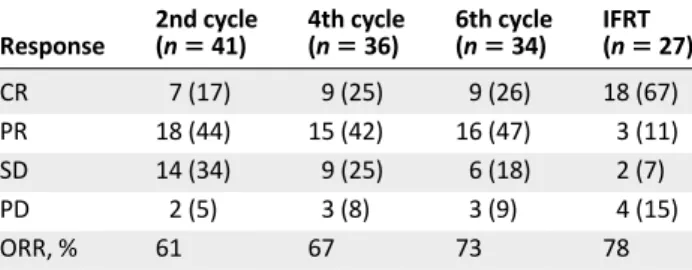
Results. Overall response rates were 73% (complete remission [CR] in 11 of 41 evaluable patients [27%]) after IMEP chemo- therapy and 78% (CR 18 of 27 evaluable patients [67%]) after IMEP followed by IFRT. Neutropenia and thrombocytopenia were documented in 33 patients (75%) and 7 patients (16%), respectively. Only 8 patients (18%) experienced febrile neu- tropenia. Three-year progression-free survival (PFS) and over- all survival (OS) were 66% and 56%, respectively. High Ki-67 ($70%) and Ann Arbor stage II independently reduced PFS (p 5 .004) and OS (p 5 .001), respectively.
Conclusion. Due to the high rate of progression during IMEP chemotherapy, IFRT needs to be introduced earlier. Moreover, active chemotherapy including anL-asparaginase-based reg- imen should be use to reduce systemic treatment failure in stage I/II NTCL. The Oncologist 2014;19:1129–1130
DISCUSSION
Our trial was based on the scheme of chemotherapy followed by radiotherapy (sequential). However, other trials used con- current chemoradiation followed by ifosfamide plus etoposide- based combination chemotherapy [4, 5]. Although the designs of two concurrent chemoradiation trials [4, 5] were very similar, large differences were observed regarding survival data. We chose the JCOG0211 study [4] for comparison with our data because the other study provided limited infor- mation on patterns of failure due to short-term follow-up [5].
Our study showed a relatively higher locoregional failure rate (18% vs. 4%) but lower rates of systemic failure than in the JCOG0211 study (14% vs. 33%). These data suggest that upfront chemoradiation is favorable for locoregional con- trol, but it is unfavorable for systemic failure in stage I/II natural killer/T-cell lymphoma (NTCL). Extended chemo- therapy of up to six cycles in our study might be a factor for the high incidence of locoregional failure. Better coordina- tion of the sequence between chemotherapy and radiother- apy might reduce both locoregional and systemic failures.
A reduced number of cycles of chemotherapy, for example, followed by involved field radiotherapy (IFRT), concurrent chemoradiation, or sandwich radiotherapy during chemo- therapy may be more efficacious for untreated stage I/II NTCL. Considering that the planned doses were reduced for
Correspondence: Dae Seog Heo, M.D., Ph.D., Seoul National University Hospital, 101 Daehak-ro, Jongno-gu, Seoul, 110-744, Republic of Korea.
Telephone: 82-2-2072-2857; E-Mail: [email protected] Received August 11, 2014; accepted for publication September 1, 2014; first published online in The OncologistExpress on October 3, 2014. ©AlphaMed Press; the data published online to support this summary is the property of the authors. http://dx.doi.org/10.1634/theoncologist.2014-0305
Trial Registry: Korean Cancer Study Group: KCSG LY04-03 Sponsor(s): Seoul National University Hospital
Principal Investigator: Dae Seog Heo IRB Approved: Yes
The Oncologist 2014;19:1129–1130 www.TheOncologist.com ©AlphaMed Press 2014
by guest on November 2, 2016http://theoncologist.alphamedpress.org/Downloaded from
11 patients (25%) in 35 of 229 cycles (15%) in our study, the ifosfamide, methotrexate, etoposide, and prednisolone (IMEP) regimen was safe and relatively well tolerated.
Recently, regimens based onL-asparaginase (L-asp) have shown promising efficacy in patients with refractory/relapsed or newly diagnosed advanced NTCL (overall response rate of
78%–81% and complete response [CR] of 45%–66%) [6–8] and with untreated stage I/II NTCL (CR of 90%, 2-year overall survival [OS] of 88%, and 2-year progress-free survival [PFS] of 90%) [10]. Furthermore, gemcitabine, which is active against NTCL [11], plus oxaliplatin andL-asp followed by IFRT resulted in a CR rate of 74% and 2-year PFS of 86% in stage I/II upper aerodigestive tract NTCL [12]. Furthermore, sandwichL-asp, vincristine, and prednisolone chemotherapy with IFRTshowed a promising outcome (2-year OS of 88.5% and 2-year PFS of 80.6%) [13]. Consequently, more activeL-asp-based regimens should be introduced in patients with stage I/II NTCL.
The IMEP regimen is effective and safe in patients with stage I/II NTCL before the introduction of L-asp, and IMEP followed by IFRT resulted in improved treatment outcomes in localized NTCL (Table 1). However, a short-course of theL-asp- based regimen followed by IFRT or concurrent or sandwich radiation with anL-asp-based regimen should be introduced in patients with untreated stage I/II NTCL.
Author disclosures and references available online.
For Further Reading:
Xi Li, Xiaobo Tian, Bo Zhang et al. Polymorphisms in MicroRNA-Related Genes Are Associated With Survival of Patients With T-Cell Lymphoma. The Oncologist 2014;19:243–249.
Implications for Practice:
Besides the characteristics of a tumor itself, genetic polymorphisms in relevant genes are considered to be important in influencing the clinical outcomes of patients. Previous studies have suggested that microRNAs are associated with survival of patients with T-cell lymphoma (TCL); therefore, we performed association analyses of 13 carefully selected polymorphisms in microRNA-related genes. The results suggested that four polymorphisms in microRNA-related genes are associated with survival of patients with TCL. These polymorphisms may be used to predict the survival of patients with TCL individually or collectively. Although the results are exploratory, they provide clues to warrant further investigation.
Table 1. Treatment outcomes after completion of each treatment
Response
2nd cycle
(n5 41) 4th cycle
(n5 36) 6th cycle (n5 34) IFRT
(n5 27)
CR 7 (17) 9 (25) 9 (26) 18 (67)
PR 18 (44) 15 (42) 16 (47) 3 (11)
SD 14 (34) 9 (25) 6 (18) 2 (7)
PD 2 (5) 3 (8) 3 (9) 4 (15)
ORR, % 61 67 73 78
Data are shown asn (%) unless specified otherwise.
Abbreviations: CR, complete response; IFRT, involved field radiotherapy;
ORR, overall response rate; PD, progressive disease; PR, partial response;
SD, stable disease.
©AlphaMed Press 2014 The
O ncologist®
1130 IMEP for Stage I/II Extranodal NK/T-Cell Lymphoma
by guest on November 2, 2016http://theoncologist.alphamedpress.org/Downloaded from