• 검색 결과가 없습니다.

The Application of the Next-generation Medium Satellite C-band Radar Images in Environmental Field Works

N/A
N/A
Protected

Academic year: 2021

Share "The Application of the Next-generation Medium Satellite C-band Radar Images in Environmental Field Works"

Copied!
7
0
0

로드 중.... (전체 텍스트 보기)

전체 글

(1)

1. Introduction

Water resource disasters are occurring frequently worldwide due to climate change, and the extent of such disasters is also expanding; According to the 2018

IPCC report, global temperatures have risen by about 1°C due to human industrial activity, it can rise to about 1.5°C between 2030 and 2052. As a result, disasters such as heavy rain, heat waves, and droughts can occur frequently and cause a lot of damage. South Korea has

The Application of the Next-generation Medium Satellite C-band Radar Images

in Environmental Field Works

Hyeon-gyeong Han

1)

· Moungjin Lee

2)†

Abstract: Numerous water disasters have recently occurred all over the world, including South Korea, due to global climate change in recent years. As water-related disasters occur extensively and their sites are difficult for people to access, it is necessary to monitor them using satellites. The Ministry of Environment and K-water plan to launch the next-generation medium satellite No. 5 (water resource/water disaster satellite) equipped with C-band synthetic aperture radar (SAR) in 2025. C-band SAR has the advantage of being able to observe water resources twice a day at a high resolution both day and night, regardless of weather conditions. Currently, RADARSAT-2 and Sentinel-1 equipped with C-band SAR achieve the purpose of their launch and are used in various environmental fields such as forest structure detection and coastline change monitoring, as well as for unique purposes including the detection of flooding, drought and soil moisture change, utilizing the advantages of SAR. As such, this study aimed to analyze the characteristics of the next-generation medium satellite No. 5 and its application in environmental fields. Our findings showed that it can be used to improve the degree of precision of existing environmental spatial information such as the classification accuracy of land cover map in environmental field works. It also enables us to observe forests and water resources in North Korea that are difficult to access geographically. It is ultimately expected that this will enable the monitoring of the whole Korean Peninsula in various environmental fields, and help in relevant responses and policy supports.

Key Words: C-band, SAR, Water hazards, Water resources, Environmental spatial information

https://doi.org/10.7780/kjrs.2019.35.4.10 ISSN 2287-9307 (Online)

Letter

Received August 14, 2019; Revised August 20, 2019; Accepted August 26, 2019; Published online August 27, 2019

1)

Researcher, Center for Environment Assessment Monitoring, Korea Environment Institute

2)

Research Fellow, Center for Environment Assessment Monitoring, Korea Environment Institute

Corresponding Author: Moungjin Lee ([email protected])

This is an Open-Access article distributed under the terms of the Creative Commons Attribution Non-Commercial License

(http://creativecommons.org/licenses/by-nc/3.0) which permits unrestricted non-commercial use, distribution, and reproduction in

any medium, provided the original work is properly cited.

(2)

experienced a growing frequency and extent of flooding and drought due to changes of extreme climate events, as well as abnormal natural phenomena such as sea level rise (Lee, 2017). Such natural disasters occur on a vast scale and their sites can be difficult for people to access, so monitoring them using a satellite is necessary.

The Ministry of Environment and K-water are developing the next-generation medium satellite No. 5 (Water resource/water disaster satellite) with the goal of launching it in 2025, and the relevant satellite will be equipped with high resolution C-band Synthetic Aperture Radar (SAR). SAR is an active sensor using microwaves that passes through clouds, and can capture a ground image regardless of weather or solar altitude (Curlander et al., 1991). It is used in various fields including ground, sea, polar region and the atmosphere both domestically and internationally (Waske et al., 2009; Soh et al., 1999).

Overseas satellites equipped with C-band SAR include RADARSAT-1, RADARSAT-2 and Sentinel- 1, and these satellites are used in various environmental fields including the monitoring of forest change and fuel contamination spread in addition to their original purposes (water and moisture related monitoring, etc).

Therefore, it is necessary to find a way to actively utilized the next-generation medium satellite No. 5 (Water resource/water disaster satellite) in different

environmental fields while achieving its original purpose.

To this end, this study presented the characteristics and application of the water resource/water disaster satellite equipped with C-band SAR.

2. Compare to characteristics of C-band SAR satellite

Key duties of the next-generation medium satellite No. 5 are the acquisition of information in the event of a disaster in East Asia, the establishment of a flood forecasting system, detection of signs of disaster (flooding, drought, green tide/red tide, earthquake, maritime disaster, etc.), national security in the event of a disaster, and accumulation of national land information in order to secure public safety. The specifications of the payload in the RADARSAT-1, RADARSAT-2, next-generation medium satellite are as follows (Table 1). The center frequency, temporal resolution and spatial resolution of the next- generation medium are 5.4 GHz, twice a day and less than 10 m, respectively. The target operation period is 4 years or more, and this satellite will create and provide a thematic map related to water resource and water disaster after obtaining the image data of the entire Korean Peninsula. This helps to ensure more efficient and scientific response and management of flood Table 1. Specifications of C-band SAR satellite payload

Specifications of payload The next generation medium satellite RADARSAT-1 RADARSAT-2

Type of payload C-band SAR (imaging radar) C-band SAR C-band SAR

Central Frequency 5.4 GHz 5.3 GHz 5.405 GHz

image swath 120 km or wider 35-500 km 150 km

Resolution 10 m × 10 m or less 8-100 m 3-100 m

Orbital altitude 562 km 793 km 798 km

Revisit cycle 2 day 24 day 24 day

payload weight Under 150 kg 2,750 kg 2,200 kg

Operation period Over 4 years 5 years 7 years

Source: K-water (https://www.kwater.or.kr/news/repoView.do?brdId=KO26&s_mid=36& seq=104217) https://en.wikipedia.org/wiki/Radarsat-1#cite_note-characteristics-1

https://directory.eoportal.org/web/eoportal/satellite-missions/r/radarsat-2

(3)

hazard areas.

Compared to satellites of other institutions, the RADARSAT-1 and RADARSAT-2 satellites equipped with C-band SAR have a limit of 24 days for the revisit cycle, which cannot be monitored in real time in the event of a disaster. But, the next-generation medium satellite is characterized by a two-day revisit cycle that enables rapid monitoring of disasters. Satellites are also classified as large satellites, medium satellites and small satellites depending on their weight, of which the next- generation medium satellite, though small in size and weight, has a C-band with similar performance and Operation period.

SAR combines and composes data obtained from each antenna position using sequential antenna position changes caused by the movements of the payload. Also, this sensor is an active sensor that is powered by the satellite’s own energy source, so it can obtain data with almost no weather effect. And SAR can obtain amplitude and phase data from an image, unlike a normal optical image, which can only obtain the brightness of an image. The physical characteristics of a target object can be extracted from amplitude and phase data; amplitude data are used to recognize targets, detect the changes, and create a stereo map; and phase data are used to extract precise altitude information and detect and classify according to changes in altitude value (Kwak, 2011).

3. Application of C-band SAR satellite in the environmental fields

1) Application of C-band radar images in other countries

Typical satellites equipped with C-band SAR include RADARSAT-1, RADARSAT-2 and Sentinel-1. The purpose and fields of application of these three satellites are as follows. RADARSAT-1 was developed by the Canadian Space Agency (CSA) in 1995 (CSA, 2014),

and its operation was suspended in 2013. Its main duties were monitoring of local damage spread in the event of a disaster, monitoring of crop conditions, map production and glacier study, and it was used in a range of fields. It was also used in South Korea for studying ocean current movement and the effects of sea surface wind (Yoon et al., 2006; Kang et al., 2007).

RADARSAT-2 is a successor of the RADARSAT- 1, and this satellite was launched in 2007 by CSA. It was developed for monitoring of environments, such as monitoring of oceans and thawing around the world, disaster management and vegetation status analysis, resource management and map production (CSA, 2017). In addition, it enables the detection of the forest succession structure in the forests that cover more than 30% of the world’s total land area using RADARSAT- 2, helping improving mapping by forest type, and is also effective for mapping flooded areas in forests when flooding occurs (Townsend, 2001; CSA, 2017).

Finally, Sentinel-1 consists of Sentinel-1A launched in 2014 and Sentinel-1B launched in 2016 and was launched from the European Space Agency (ESA).

And it is developed for continuous ground and maritime monitoring using C-band SAR (ESA, 2014). Data collected by this satellite are utilized in various fields including emergency responses to disasters (monitoring earthquake and volcano, etc.) and short-term and long-term water-related monitoring such as flooding and river inundation caused by localized torrential downpours, and soil drought (measuring soil moisture, etc.). Recently, various utilizations of Sentinel-1 in environmental fields have been attracting attention, as many papers have been presented indicating that it was helpful for evaluating soil moisture (Hornacek et al., 2012; Paloscia et al., 2013; Gao et al., 2017).

In summary, other countries have used satellites

equipped with C-band radar in forest and environmental

fields, such as the analysis of ocean current movement

and forest vertical structure using SAR images, based on

its water-related utilization such as flooding, overflow

(4)

and drought. Accordingly, before the water resource/

water disaster satellite equipped with SAR is launched, the applicability of the satellite in environmental fields was reviewed and utilization measures were explored without limiting its application to water resource/water disaster.

2) Status of environmental spatial information in South Korea, and C-band radar image convergence

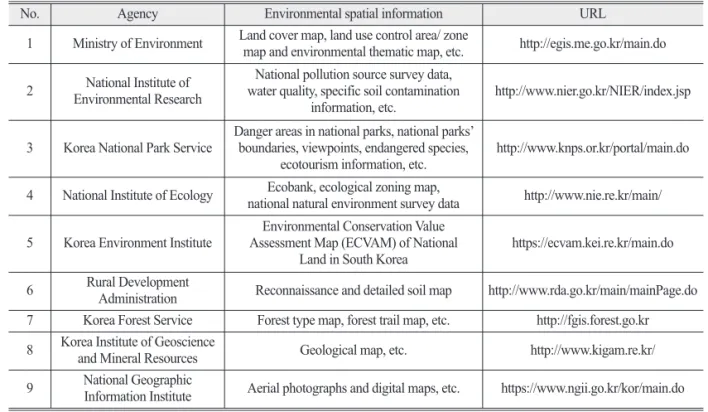
South Korea’s environmental spatial information is established based on the thematic map for each environment-related medium (water quality, atmosphere, ecology, etc.). Various government agencies establish information for each medium according to their own purposes, and while such information may have similar contents, the form and structure of established information vary. The government agencies that establish and provide environmental spatial information include the Ministry of Environment, National Institute of Environmental Research, National Institute of Ecology, Korea National Park Service and Korea

Environment Institute. Nine government agencies indirectly establish environmental spatial information, including the Korea Forest Service, Ministry of Land, Infrastructure, and Transport and Statistics Korea (Lee, 2017). The systems that provide investigated environmental spatial information are summarized based on the final results (Table 2). Direct environmental spatial information consists of land cover map, land use control area/zone map and ecological zoning map.

Indirect environmental spatial information includes soil map, forest type map and geological map, etc.; aerial photographs and digital maps are used as basic data.

Table 2 is a list of the current status of Environmental spatial information, Agency, URL in South Korea.

Although various institutions provide a lot of spatial information like this, if the C-band image is used to generate spatial information, more precise and accurate theme maps can be generated. In addition, InSAR (SAR Interferometry) and PolSAR (Polarimetric SAR) are possible through the use of phase and amplitude.

InSAR has the advantage of obtaining precise DEM or surface microdisplacement using phase information of Table 2. Current status of environment spatial information in South Korea

No. Agency Environmental spatial information URL

1 Ministry of Environment Land cover map, land use control area/ zone

map and environmental thematic map, etc. http://egis.me.go.kr/main.do 2 National Institute of

Environmental Research

National pollution source survey data, water quality, specific soil contamination

information, etc. http://www.nier.go.kr/NIER/index.jsp 3 Korea National Park Service Danger areas in national parks, national parks’

boundaries, viewpoints, endangered species,

ecotourism information, etc. http://www.knps.or.kr/portal/main.do 4 National Institute of Ecology Ecobank, ecological zoning map,

national natural environment survey data http://www.nie.re.kr/main/

5 Korea Environment Institute Environmental Conservation Value Assessment Map (ECVAM) of National

Land in South Korea https://ecvam.kei.re.kr/main.do 6 Rural Development

Administration Reconnaissance and detailed soil map http://www.rda.go.kr/main/mainPage.do 7 Korea Forest Service Forest type map, forest trail map, etc. http://fgis.forest.go.kr 8 Korea Institute of Geoscience

and Mineral Resources Geological map, etc. http://www.kigam.re.kr/

9 National Geographic

Information Institute Aerial photographs and digital maps, etc. https://www.ngii.go.kr/kor/main.do

(5)

two or more SAR data obtained from the same scatterer.

PolSAR has the advantage of being able to classify the properties of scatterers using polarization of electromagnetic waves. Therefore, these technologies will increase the accuracy of forest vegetation structures, surface changes and coastline monitoring.

The existing environmental spatial information has been built up in the form of specific thematic maps on the environment, and remote sensing data such as satellite images and aerial photographs are used as raw data. For example, land cover maps were produced, mainly taking advantage of Landsat 30 m for large category, SPOT 5 m for intermediate category and Korean Multi-Purpose Satellite (KOMPSAT) 1 m for detailed category, which are the most frequently used of the environmental spatial information types.

Recently, 25 cm aerial photographs are mainly being used for land cover maps. Spatial resolution-based application is not limited to land cover maps, and it is also used in the field survey for forest type maps and ecological zoning maps. Since remote sensing in environmental fields has been developed mainly based on spatial resolution, the classification was mainly focused on an object’s morphological characteristics rather than its physicochemical characteristics. Today, aircraft hyperspectral data are applied to the monitoring of green tide in the basin of Korea’s four main rivers.

C-band radar images can be utilized in various environmental fields by extending their usage. For example, LULUCF (Land Use, Land-Use Change and Forestry) is state-certified data which the Ministry of Environment should submit to UNFCCC (United Nations Framework Convention on Climate Change).

Such data are currently submitted after needle-leaf tree, broad-leaf tree, mixed forest and agricultural area (fields and paddies), which are among the classification items of the land cover map, are adjusted. However, if C-band image radar is utilized, the forest’s vertical structure can be analyzed more clearly by applying the characteristics of reflectance. This type of application

could improve the classification accuracy and precision of thematic maps, such as land cover maps and LULUCF.

Beyond this, ridgelines and ecological axes are very important areas, as areas worth preserving are selected in environment-related field works for these areas, and these serve as an ecological corridor for animals and plants. For this reason, it is important to accurately select ridgelines and ecological axes and extract their accurate spatial position. However, currently analysis is carried out using a fragmented combination of forest distribution status, relevant past drawings and DEM.

Using C-band radar images enables a more accurate analysis of height values, leading to better analysis of ridgelines.

Eventually, C-band radar images will be used as a priority for improving the accuracy and precision of existing environmental spatial information in environmental field works. They can also be used for items (landslide, slope stabilization, prevention of soil disasters, etc.) in environmental fields that require an accurate analysis of height difference (Jung et al., 2004;

Alessandra et al., 2019). In addition, C-band radar can be applied for observing land cover changes including the forest status and wildfire in North Korea where field survey cannot be conducted; and monitoring flooding and drought in the Korean Peninsula intensively; and is considered to be helpful for the prevention and restoration of relevant damage and the formation of related policies.

4. Summary and Conclusion

Recently, water-related disasters have been increasing

worldwide due to climate change, and Korea is also

experiencing a rise in the occurrence of flooding and

drought. For this reason, the importance of accurate and

continuous monitoring is being emphasized. Natural

disasters occur extensively and often are in sites that

(6)

are difficult for people to access, so monitoring them using a satellite is required. The Ministry of Environment and K-Water have been preparing the next-generation medium satellite No. 5 (Water resource/water disaster satellite) which will be equipped with high resolution C-band SAR. Other countries’ C-band radar images are used in water-related fields as well as in various environmental fields, both directly and indirectly. This study analyzed the characteristics of the C-band radar images application in environmental fields.

Water resource/water disaster satellite base on C-band is a high resolution satellite with a temporal resolution of twice a day and a spatial resolution of 10 m. Unlike an optical satellite, C-band SAR can observe flooding in real time and has an advantage when it comes to estimating urban and agricultural damages incurred by stream and river flooding. It can also observe the water resource information required for water management twice a day regardless of weather conditions, both during the day and at night. To utilize such information in on-site environments, it can first be applied to improve the classification accuracy and precision of existing environmental spatial information.

It can also be used to analyze environmental status in inaccessible areas that require an analysis of precise physical height change, among various environmental issues (landslide, slope stability, etc.). Using the water resource/water disaster satellite will enable the monitoring of flooding and drought in the Korean Peninsula as well as in various environmental areas, and will be helpful for prevention and restoration of relevant damages and policy establishment.

Acknowledgements

This research was conducted at Korea Environment Institute (KEI) with support from ‘The Application technology and system of satellite image radar in the environmental’ by Korea Environment Industry &

Technology Institute (KEITI), and funded by Korea Ministry of Environment(MOE) (2019002650001).

References

Alessandro, C. M., S. Michele, R. Margherita, R.

Enrica, M. Andrea, and M. Oriol, 2019.

Sentinel-1 SAR Amplitude Imagery for Rapid Landslide Detection, Remote Sensing, 11(7):

760.

Canada Space Agency (CSA), 2014. RADARSAT-1, http://www.asc-csa.gc.ca/eng/satellites/radarsat1/, Accessed on Jul. 30, 2019.

Canada Space Agency (CSA), 2017. RADARSAT-2, http://www.asc-csa.gc.ca/eng/satellites/radarsat2/

Default.asp, Accessed on Jul. 30, 2019.

Curlander, J. C. and R. N. McDonough, 1991. Synthetic Aperture Radar Systems and Signal Processing, John Wiley & Sons Inc., New York, NY, USA.

European Space Agency, 2014. What is Sentinel-1, https://earth.esa.int/web/guest/missions/esa- operational-eo-missions/sentinel-1;jsessionid

=EDC269F8102CDE3BE586F4DE7BEEF 965.jvm2, Accessed on Jul. 30, 2019.

Gao, Q., M. Zribi, M. Escorihuela, and N. Baghdadi, 2017.

Synergetic use of Sentinel-1 and Sentinel-2 data for soil moisture mapping at 100 m resolution, Sensors, 17(9): 1966.

Hornacek, M., W. Wagner, D. Sabel, H. L. Truong, P. Snoeij, T. Hahmann, E. Diedrich, and M. Doubková, 2012. Potential for high resolution systematic global surface soil moisture retrieval via change detection using Sentinel-1, IEEE Journal of Selected Topics in Applied Earth Observations and Remote Sensing, 5(4): 1303-1311.

Jung, H. C., S. W. Kim, B. C. Kim, K. D. Min, and J.

S. Won, 2004. Observation of the Ground

Subsidence in the Abandoned Gaeun Coal

Mining Area using JERS-1 SAR, Economic

(7)

and Environment Geology, 37(5): 509-519 (in Korean with English abstract).

Kang, M. G., Y. Y. Park, M. J. Lee, and H. Y. Lee, 2007.

Study on the Extraction of Ocean Wind, Wave and Current using SAR, Korean Institute of Navigation and Port Research, 31(1): 35-42 (in Korean with English abstract).

Kwak, W. G., 2011. Satellite Image Radar (SAR) Technology Trends, The Proceedings of the Korea Electromagnetic Engineering Society, 22(6): 4-16.

Lee, M. J., W. Park, and W. K. Song, 2017. Present Condition of Environment Geospatial Information and Its Application, Korean Journal of Remote Sensing, 33(5-3): 763-771 (in Korean with English abstract).

Lee, S. W., 2017. A Study on the Systematic Inspection of the Measures for Flood and Drought, Audit and Inspection Research Institute, Jongno-gu, Seoul, Korea.

Paloscia, S., S. Pettinato, E. Santi, C. Notarnicola, L.

Pasolli, and A. Reppucci, 2013. Soil moisture mapping using Sentinel-1 images: Algorithm and preliminary validation, Remote Sensing of Environment, 134: 234-248.

Soh, L. K. and C. Tsatsoulis, 1999. Texture analysis of SAR sea ice imagery using gray level co- occurrence matrices, IEEE Transactions on Geoscience and Remote Sensing, 37(2): 780-795.

Townsend, P. A., 2001. Mapping seasonal flooding in forested wetlands using multi-temporal Radarsat SAR, Photogrammetric Engineering and Remote Sensing, 67(7): 857-864.

V. Masson-Delmotte, P. Zhai, H. O. Pörtner, D. Roberts, J. Skea, P. R. Shukla, A. Pirani, W. Moufouma- Okia, C. Péan, R. Pidcock, S. Connors, J. B. R.

Matthews, Y. Chen, X. Zhou, M. I. Gomis, E.

Lonnoy, T. Maycock, M. Tignor, T. Waterfield (eds.), 2018. IPCC: Summary for Policymakers, In: Global warming of 1.5°C. An IPCC Special Report on the impacts of global warming of 1.5°C above pre-industrial levels and related global greenhouse gas emission pathways, in the context of strengthening the global response to the threat of climate change, sustainable development, and efforts to eradicate poverty, World Meteorological Organization, Geneva, Switzerland, p. 32.

Waske, B. and M. Braun, 2009. Classifier ensembles for land cover mapping using multitemporal SAR imagery, ISPRS Journal of Photogrammetry and Remote Sensing, 64(5): 450-457.

Yoon, H. J., K. S. Kwang, and S. I. Kim, 2006. Ocean

Wind Retrieval from RADAR SAR image in

Korean seas, Journal of the Korea Institute of

Information and Communication Engineering,

10(4): 706-711 (in Korean with English abstract).

수치

Table 2 is a list of the current status of Environmental spatial  information, Agency,  URL  in  South  Korea.

참조

관련 문서

Böcher, 2008, Integrated Rural Development Policy In Germany and its Potentials for new Modes of Forest Governance, Institute of Forest, Environmental, and

1 John Owen, Justification by Faith Alone, in The Works of John Owen, ed. John Bolt, trans. Scott Clark, "Do This and Live: Christ's Active Obedience as the

The study derived the problems according to results of field-centered synthetic analysis on yellow croakers of fishery system currently used in Chujado, Korea

- The level of radioactivation, along with other radioactivity aspects such as the T inventory will be a key factor in determining the environmental impact of fusion

- The level of radioactivation, along with other radioactivity aspects such as the T inventory will be a key factor in determining the environmental impact of fusion

The world is facing environmental problems such as global warming due to the excessive use of fossil energy and energy issues, expanding the use and de-

Command and control type environmental policies such as regulation of technology and standard on the emission per unit of fuel used have different effects

As can be seen from examples of convergence with other fields already attempted in various fields of society and the integratio n of liberal arts and