• 검색 결과가 없습니다.

Influence of Tibial Rotation on EMG Activities of Medial and Lateral Hamstrings During Maximal Isometric Knee Flexion

N/A
N/A
Protected

Academic year: 2021

Share "Influence of Tibial Rotation on EMG Activities of Medial and Lateral Hamstrings During Maximal Isometric Knee Flexion"

Copied!
7
0
0

로드 중.... (전체 텍스트 보기)

전체 글

(1)

Influence of Tibial Rotation on EMG Activities of Medial and Lateral Hamstrings During Maximal Isometric Knee Flexion

Woo-taek Lim

1,2

, PhD, PT

11

1Dept. of Physical Therapy, College of Health and Welfare, Woosong University

2Advanced Institute of Convergence Sport Rehabilitation, Woosong University

Abstract 1)

Background: The hamstring muscles in the lower extremity are highly important for knee joint stability and can be classified into medial and lateral hamstrings according to the anatomical position, which have some different functions. To measure the strength of the individual hamstring muscles, manual muscle testing is clinically performed by dividing rotation postures into internal and external postures. However, this has no sufficient scientific background.

Objects: This study aimed to test the difference that the tibial rotation would cause in the muscle activity of the medial and lateral hamstrings.

Methods: The muscle activities of the biceps femoris, semitendinosus, and semimembranosus were measured in a total of three different postures (neutral position and internal and external rotations) with 3 replications. During the maximal isometric contraction, resistance was constantly provided by the string attached to the strap, not by manual resistance of the examiner. Before and after electromyography measurements, the participants underwent hamstring flexibility measurement using the active knee extension test in the supine position on the treatment table.

Results: The semitendinosus had a 12.56% reduction in muscle activity in external rotation as compared with that in neutral position. The biceps femoris and semimembranosus showed reduced muscle activities in both external and internal rotations as compared with those in neutral position. Only the women showed significant decreases in the comparison between pre and post-active knee extension.

Conclusion: Only the semitendinosus muscle was consistent with the anatomical speculation. However, the reduction in the muscle activity of the semitendinosus as compared with that in neutral position was only 12.56%, the clinical value of which may be difficult to justify.

Key Words: Electromyography; Hamstrings; Isometric contraction; Tibial rotation.

Introduction

The lower extremities are more developed than the rest of the body parts to support the entire body against gravity and to maintain the standing position.

In the lower extremities, the hamstring muscles par- ticularly maintain the stability of the knee joints during movement, enabling smooth motions. Thus, in case of anterior cruciate ligament injuries, strength- ening the hamstring muscles is considered the most

important factor in the rehabilitation of the lower extremities (Li et al, 1999; Pandy and Shelburne, 1997; Wilk and Andrews, 1992). The hamstring mus- cles are composed of four muscles, namely the bi- ceps long and short heads, semitendinosus (ST), and semimembranosus (SM). While simultaneous con- tractions of all the hamstring muscles produce flex- ion of the knee joint, each muscle has a different orientation from the origin to the insertion, which, accordingly, makes a difference in individual func- Corresponding author: Woo-taek Lim [email protected]

The research was supported by 2018 Woosong University Academic Research Funding and Basic Science Research

Program through the National Research Foundation of Korea (NRF) funded by the Ministry of Education

(NRF-2017R1C1B5076885)

(2)

tions (Lewek et al, 2004; Lynn and Costigan, 2009).

In detail, the hamstring muscles are largely divided into the medial hamstring (MH) and lateral ham- string (LH) based on the anatomical location. The biceps femoris originates from the ischial tuberosity and inserts in the lateral side of the head of the fib- ula, whereas the ST and SM originate from the is- chial tuberosity surface and attached to the medial tibia and medial tibial condyle, respectively. Owing to the attached site, the biceps femoris rotates laterally during flexion of the knee joint, while the ST and SM medially rotate on the femur.

To configure clinical rehabilitation programs ap- propriate for individual patients, the extent of the injury and the resulting muscle strength deficits must be accurately assessed. Currently, muscle strength is measured in various ways, using a wide range of measuring devices, from specialized devices such as Biodex, which has high validity and reli- ability for measurement, to portable devices such as a handheld dynamometer. However, manual muscle testing (MMT), in which therapists manually apply resistance for measurement, is used widely in clin- ical practices owing to its convenience for measure- ment and affordability. MMT is a highly valuable method that can easily measure the force generated in the contractile unit of the muscle. It has been in use since the early 1900 and is now widely applied in clinical practice (Martin and Lovett, 1915). In general, in MMT, measurements are performed in a single posture predetermined for each muscle, except for the hamstring muscles, which are sometimes measured in external or internal rotation owing to their anatomical characteristics.

For MMT measurement, many clinicians include Daniels and Worthingham’s Muscle Testing and Muscles: Testing and Function, with Posture and Pain (Avers and Brown, 2018; Kendall et al, 2005).

For measurement of the biceps femoris, the authors described that the knee joint needs to be externally rotated so that the toes face outside while bending the knee <90˚, and then, the subject should induce

contraction of the LH to isolate it with downward resistance in inward directions. At this point, the biceps femoris must be maintained with the foot ends facing outward during knee flexion. By con- trast, the ST and SM are measured while applying downward resistance in outward directions after in- ternal rotation of the knee joint. Although the two references are widely used in clinical practice and cited in many papers, they do not describe the sci- entific evidence for these measurements. Wide clin- ical use cannot be used as a logical basis. In other words, whether different amounts of muscle activity are actually generated in the MH and LH according to tibial rotation must be quantitatively measured.

The present study aimed to investigate if the me- dial and lateral compartments of the hamstring muscles have differences in quantitative contractions in tibial torsion, for which an electromyography de- vice was used.

Methods

Subjects

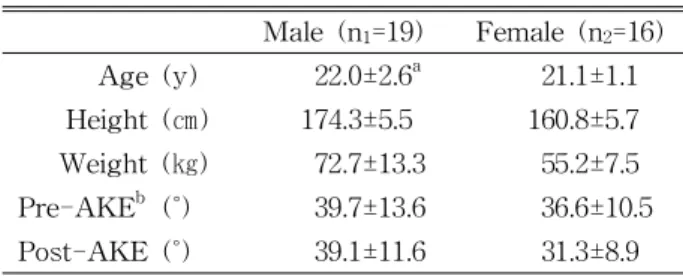
Thirty-five young and healthy college students participated in the study (Table 1). They had no in- jury or disease in the hip and knee joints and were given a full explanation about the study. They pro- vided informed consent prior to participation in the study. This study was approved and monitored by the Institutional Review Board of Woosong University (approval number: 1041549-180419-SB-59).

Instrumentation

Surface electromyography (EMG) signal was col-

lected using a Trigono™ Wireless EMG system

(Delsys Inc., Boston, MA, USA). The EMG data

were collected from the selected Hamstrings. Delsys

EMGworks® Acquisition and Analysis software was

used for the analysis. The raw EMG signals were

sampled 2,000 ㎐ and were processed into a root

mean square with a window of 125 ms. A band pass

(3)

Male (n

1

=19) Female (n

2

=16) Age (y) 22.0±2.6

a

21.1±1.1 Height (㎝) 174.3±5.5 160.8±5.7 Weight (㎏) 72.7±13.3 55.2±7.5 Pre-AKE

b

(˚) 39.7±13.6 36.6±10.5 Post-AKE (˚) 39.1±11.6 31.3±8.9

a

mean±standard deviation,

b

active knee extension.

Table 1. Subjects characteristics and changes in

hamstring flexibility (N=35)

fileter of 20-450 ㎐ was used together with notch filters at 60 ㎐.

Procedure

The participants comfortably lied down in the prone position on the treatment table and bent the knee joint to 60˚ (Albertus-Kajee et al, 2011; Fauth et al, 2010; Onishi et al, 2002). The pelvis and con- tralateral lower extremity were fastened to the table with a belt. As for the long head of biceps femoris (BF), the electrodes of the EMG sensor were placed at 50% on the line between the ischial tuberosity and the lateral epicondyle of the tibia. For the ST, the electrodes must be placed 50% on the line be- tween the ischial tuberosity and medial epicondyle of the tibia. For the SM, the electrodes were attached laterally to the ST tendon in the apex of the “V”

between ST tendon and the biceps femoris. Sensor was placed in accordance with SENIAM (surface EMG for non-invasive assessment of muscles) guide- lines and the text book of Anatomical guide for the electromyopgapher (Perotto, 2011). Before EMG at- tachment, the skin was fully shaved. During meas- urement of the maximal isometric contraction of the hamstring muscles, resistance was constantly pro- vided by the string attached to the strap, not by manual resistance of the examiner. One end of the strap was tied at 3 ㎝ below the lateral malleolus, and the other end was tied to a fixed post to pre- vent movement during contraction. The string con- nected to the strap was made perpendicular to the ankle. The three measurement postures were neu-

tral position and internal and external rotations.

Each subject was measured in a random order of the postures. The value measured in neutral posi- tion was set as the maximum voluntary isometric contraction (MVIC), and values obtained in internal and external rotations were calculated as the

%MVIC relative to that in neutral position. In flex- ion, the subjects were instructed to maximally con- tract the leg after internal or external rotation, in which resistance was applied in the opposite direc- tion to the contraction. The MVIC was measured 3 times per posture (5 sec/time, 15 sec in total), and the mean value was used. Before and after the EMG measurements, the participants were also subjected to the hamstring flexibility measurement in the supine position on the treatment table using the active knee extension test (AKE). The AKE defined by the longitudinal axes of the tibia and femur was recorded at maximal knee extension and was subtracted from 180˚.

Data Analyses

All the statistical analyses were performed us- ing IBM SPSS Statistics ver. 23 experimental data (IBM Corp., Armonk, NY, USA). One-sample t-test was performed to test the difference in %MVIC de- pending on the tibial torsion within individual mus- cles (internal or external rotation), and the Bonferroni correction was applied. Pre- and post-AKE were compared using the paired sample t-test. Statistical significance was set at p values of <.025. All the re- sults were expressed as mean ± standard deviation.

Results

When the %MVIC of the hamstring muscles in

the knee joint was examined during rotation in com-

parison with that in neutral position, statistically sig-

nificant differences were found in the BF and ST,

but not in the SM. First, the BF showed a sig-

nificant decrease in %MVIC in both external (p=.006)

(4)

Biceps femoris Semitendinosus Semimembranosus

External rotation 92.13±15.84

a

* 87.44±17.47* 91.81±18.20*

Internal rotation 88.94±14.85* 106.77±18.06 95.86±16.58

a
mean±standard deviation, *significant different compared with neutral position (p<.025).

Table 2. Changes in %MVIC of medial and lateral hamstrings at external and internal rotation

and internal rotations (p<.001) as compared with that measured in neutral position, with greater MVIC re- duction in internal rotation (Table 2). Second, the ST showed a significant reduction in %MVIC measured in external rotation (p<.001) in comparison with that in neutral position, while the %MVIC measured in internal rotation had no significant difference (p=.033).

Increased %MVIC value in internal rotation was only observed in the ST. Finally, the SM had decreased

%MVIC measured both in internal and external rota- tions in comparison with that in neutral position, but the difference was statistically significant in internal rotation (p=.012). Only the women showed significant decreases (p=.020) in the comparison between pre and post-AKE (Table 1).

Discussion

As the lower extremities must continuously per- form high-intensity activities during movement and tolerate resistance against strain, they often sustain injuries due to overload or overuse. The hamstrings maintain stability by controlling the movements of the lower extremities during eccentric contraction. In addition, it plays a role in shock absorption during high-intensity exercise, thereby relieving shock trans- mission to the trunk (LaStayo et al, 2003; Roberts and Azizi, 2010). The hamstring muscles have already been studied extensively owing to their importance.

Despite the anatomical difference between the mus- cles, only few studies have examined the performance of individual muscles. This study examined how the muscle activities of the medial and lateral hamstrings change in external and internal rotations in compar- ison with the changes in the neutral position.

Theoretically, the medial compartment of the ham-

string should have a higher muscle activity in in- ternal rotation than in external rotation. This also ap- plies to the lateral compartment of the hamstring.

However, the present study found that the anatomical characteristics of the muscles except the ST were not consistent with the corresponding prediction of their muscle activities. As for the ST, which showed sim- ilar results with the theoretical prediction, the ST and SM, a medial compartment, showed a reduction in muscle activity of 12.56% in external rotation as compared with that in neutral position. However, it was not statistically significant in internal rotation as compared with that in neutral position. Unexpectedly, the BF had reduced muscle activities both in external and internal rotations relative to the neutral position.

As for the difference between the two muscles, the

BF had a statistically significant reductions in both

external and internal rotations, whereas the SM had

no statistically significant reductions. In general, the

attachment position of the muscles on the bone de-

termines the direction of joint motion. For example,

the biceps brachii muscle of the upper limb muscles

is attached to the part of the posterior aspect of the

radial tuberosity and bicipital aponeurosis (Landin et

al, 2017). A study proved that it generated the largest

torque in the forearm supination state, aligning the

direction in parallel (ter Haar Romeny et al, 1982; ter

Haar Romeny et al, 1984). As the radius of the fore-

arm rotates around a fixed ulna during pronation, the

muscle activity of the brachialis muscle, which was

attached to the coronoid process and the tuberosity of

the ulna, was relatively higher than that of the biceps

brachii. In addition, muscle elongation makes it diffi-

cult to effectively contract the contractile proteins of

the muscle (Gielen and van Zuylen, 1986). Therefore,

a full supination motion of the forearm is added to

elbow flexion during the MMT of the biceps brachii.

(5)

However, the lower leg, unlike the forearm, has only a little rotation movement. Although the rotation range-of-motion (ROM) angle seems to be large be- cause of the additional rotation of the toes inward or outward during tibial rotation, the angle of rotation in the knee joint alone is not large. The potential ROM angle of knee joint rotation is considerably smaller than the pronation-supination ROM angle (Iwaki et al, 2000; Johal et al, 2005; Ristanis et al, 2003). In other words, we speculated that because the tibial rotation angle was not large, the anatomical location of muscle attachment was not significantly associated with the difference in muscle activity depending on tibial torsion. In the lower extremities, the knee joints are bent to approximately 40˚ in the standing position to independently activate the soleus from the triceps sur- ae (Perry et al, 1981). In this case, the soleus main- tained the maximum muscle activity, whereas the gastrocnemius had a reduction in muscle activity by approximately 21% from the maximum activity. Most studies on the lower extremities have focused on ab- normal or excessive torsion in gait or single-limb stance rather than tibial torsion (Hicks et al, 2007;

Passmore et al, 2016). Only few studies on muscle ac- tivity were based on the understanding of the anatomi- cal location characteristics of the hamstring muscles.

Nevertheless, some studies, similar to the present study, were performed in the submaximal position us- ing surface EMG. In a study by Fiebert et al, the muscle activity of medial hamstring decreased in ex- ternal rotation, which is similar to the result of the present study. In addition, the muscle activity of the lateral hamstring was also significantly reduced in in- ternal rotation (Fiebert et al, 1997). However, Fiebert et al (1997) set resistance as low as 5% of the body weights of subjects, which implies that it may not be much meaningful clinically. Although muscle activity might have a significant difference under a weak re- sistance depending on posture, the difference might have been masked under maximum contraction, as in this study. Perhaps, this may be because the ROM of the knee joint was limited as described earlier.

In the present study, the subjects were provided with resistance to prevent them from moving during maximum contraction in prone posture to measure the MVIC of the hamstring muscles. Although the posture was not a common stretching posture to increase the flexibility of the hamstring muscles, the muscles are contracted at maximum intensity against the resist- ance during the MMT, similarly to the hold-relax procedure in proprioceptive neuromuscular facilitation techniques. In the present study, the hamstring mus- cles were expected to have a higher flexibility after isometric contraction (Ferber et al, 2002). The actual flexibility measurement resulted in a significant in- crease in flexibility in the women, whereas no sig- nificant change was observed in the men. We specu- lated that because females have a lower muscle pro- portion than males, their soft tissues have a generally low stiffness, which increases flexibility.

As the subjects of the present study were healthy adults in their early 20 s, the results would be diffi- cult to generalize to healthy people in other age groups, athletes, or patients who have limitations in tibial rotation due to anterior cruciate ligament re- construction (Bush-Joseph et al, 2001; Hara et al, 2000; Reinschmidt et al, 1997; Steiner et al, 1990). In addition, with the surface EMG device used in the present study, the short head of biceps femoris was difficult to measure, and the device had a cross-talk problem (Fiebert et al, 1997). Thus, more accurate measurements using intramuscular EMG will be re- quired in the future.

Conclusion

Studies have different recommendations regarding

the MMT measurement posture for the medial or

lateral compartment, which may be because the low-

er extremities, unlike the forearm, have not been

fully studied concerning the difference in muscle ac-

tivity depending on knee joint rotation. Thus, the

MMT has been performed in clinical practice under

(6)

the assumption that muscle activity would differ by rotation, in the absence of accurate and clear evi- dence or scientific experimentation. Some of the re- sults in this study were consistent with the existing assumption, while the others were inconsistent. The experimental results did not agree with the assump- tion, which may be due to the anatomical and func- tional characteristics of the knee joint.

The results of this study are controversial with regard to the adequacy of the posture for MMT, which is widely used in clinical practice, of the hamstring muscles. In addition, it may be difficult to give a clinical significance because of the small dif- ference in the actual internal and external rotations in comparison with the neutral position, if any. In case of adult subjects with neither disease nor injury in clinical practice, measurement for the hamstring only once in neutral posture, rather than in two dif- ferent postures, may be sufficient.

References

Albertus-Kajee Y, Tucker R, Derman W, et al.

Alternative methods of normalising EMG during running. J Electromyogr Kinesiol. 2011;21(4):

579-586. https://doi.org/10.1016/j.jelekin.2011.03.009 Avers D, Brown M. Daniels and worthingham’s muscle testing: Techniques of manual examina- tion and performance testing. 10th ed. Saunders, 2018:266-267.

Bush-Joseph CA, Hurwitz DE, Patel RR, et al.

Dynamic function after anterior cruciate ligament reconstruction with autologous patellar tendon.

Am J Sports Med. 2001;29(1):36-41. https://do- i.org/10.1177/03635465010290011101

Fauth ML, Petushek EJ, Feldmann CR, et al.

Reliability of surface electromyography during maximal voluntary isometric contractions, jump landings, and cutting. J Strength Cond Res. 2010;

24(4):1131-1137.

Ferber R, Osternig L, Gravelle D. Effect of PNF

stretch techniques on knee flexor muscle emg activity in older adults. J Electromyogr Kinesiol.

2002;12(5):391-397. https://doi.org/10.1519/JSC.0b01 3e3181cc2353

Fiebert IM, Roach KE, Fingerhut B, et al. EMG activ- ity of medial and lateral hamstrings at three po- sitions of tibial rotation during low-force iso- metric knee flexion contractions. J Back Musculo- skelet Rehabil. 1997;8(3):215-222. https://doi.org/

10.3233/BMR-1997-8306

Gielen CC, van Zuylen EJ. Coordination of arm mus- cles during flexion and supination: Application of the tensor analysis approach. Neuroscience. 1986;

17(3):527-539.

Hara K, Kubo T, Suginoshita T, et al. Reconstruc- tion of the anterior cruciate ligament using a double bundle. Arthroscopy. 2000;16(8):860-864.

https://doi.org/10.1053/jars.2000.7679

Hicks J, Arnold A, Anderson F, et al. The effect of excessive tibial torsion on the capacity of mus- cles to extend the hip and knee during sin- gle-limb stance. Gait posture. 2007;26(4):546-552.

https://doi.org/10.1016/j.gaitpost.2006.12.003 Iwaki H, Pinskerova V, Freeman MA. Tibiofemoral

movement 1: The shapes and relative movements of the femur and tibia in the unloaded cadaver knee. J Bone Joint Surg Br. 2000;82(8):1189-1195.

Johal P, Williams A, Wragg P, et al. Tibio-femoral movement in the living knee. A study of weight bearing and non-weight bearing knee kinematics using ‘interventional’ MRI. J Biomech. 2005;38(2):

269-276. https://doi.org/10.1016/j.jbiomech.2004.02.008 Kendall FP, McCreary EK, Provance PG, et al.

Muscles: Testing and function, with posture and pain. 5th ed. LWW, Baltimore, MD, 2005:418-419.

Landin D, Thompson M, Jackson MR. Actions of the biceps brachii at the shoulder: A review. J Clin Med Res. 2017;9(8):667-670. https://doi.org/10.14740/

jocmr2901w

LaStayo PC, Woolf JM, Lewek MD, et al. Eccentric

muscle contractions: Their contribution to injury,

prevention, rehabilitation, and sport. J Orthop

(7)

This article was received October 10, 2018, was re- viewed October 10, 2018, and was accepted November 13, 2018.

Sports Phys Ther. 2003;33(10):557-571. https://do- i.org/10.2519/jospt.2003.33.10.557

Lewek MD, Rudolph KS, Snyder-Mackler L. Control of frontal plane knee laxity during gait in pa- tients with medial compartment knee osteoarthritis. Osteoarthritis Cartilage. 2004;12(9):

745-751. https://doi.org/10.1016/j.joca.2004.05.005 Li G, Rudy TW, Sakane M, et al. The importance of

quadriceps and hamstring muscle loading on knee kinematics and in-situ forces in the ACL.

J Biomech. 1999;32(4):395-400.

Lynn SK, Costigan PA. Changes in the medial-later- al hamstring activation ratio with foot rotation during lower limb exercise. J Electromyogr Kinesiol. 2009;19(3):e197-205. https://doi.org/10.1016/

j.jelekin.2008.01.007

Martin E, Lovett RW. A method of testing muscular strength in infantile paralysis. JAMA. 1915;65(18):

1512-1513.

Onishi H, Yagi R, Oyama M, et al. EMG-angle rela- tionship of the hamstring muscles during max- imum knee flexion. J Electromyogr Kinesiol. 2002;

12(5):399-406.

Pandy MG, Shelburne KB. Dependence of cru- ciate-ligament loading on muscle forces and ex- ternal load. J Biomech. 1997;30(10):1015-1024.

Passmore E, M. P, H.K. G, et al. The effect of femo- ral and tibial torsion on muscle and joint function during walking in typically developing children.

Gait posture: ESMAC 2016. 2016;49(2):41.

Perotto AO. Anatomical guide for the electro- myographer: The limbs and trunk. 5 edition ed.

Charles C Thomas Pub Ltd, 2011:244-246.

Perry J, Easterday CS, Antonelli DJ. Surface versus intramuscular electrodes for electromyography of superficial and deep muscles. Phys Ther. 1981;

61(1):7-15.

Reinschmidt C, van den Bogert AJ, Nigg BM, et al.

Effect of skin movement on the analysis of

skeletal knee joint motion during running. J Biomech. 1997;30(7):729-732.

Ristanis S, Giakas G, Papageorgiou CD, et al. The ef- fects of anterior cruciate ligament reconstruction on tibial rotation during pivoting after descending stairs. Knee Surg Sports Traumatol Arthrosc.

2003;11(6):360-365. https://doi.org/10.1007/s00167- 003-0428-x

Roberts TJ, Azizi E. The series-elastic shock absorber:

Tendons attenuate muscle power during eccentric actions. J Appl Physiol(1985). 2010;109(2):396-404.

https://doi.org/10.1152/japplphysiol.01272.2009 Steiner ME, Brown C, Zarins B, et al. Measurement

of anterior-posterior displacement of the knee. A comparison of the results with instrumented de- vices and with clinical examination. J Bone Joint Surg Am. 1990;72(9):1307-1315.

Surface electromyography for the non-invasive assess- ment of muscles (SENIAM). Sensor location, Recommendations [Internet]. Cited 2018 Oct.

Available from: http://www.seniam.org/

ter Haar Romeny BM, Denier van der Gon JJ, Gielen CC. Changes in recruitment order of motor units in the human biceps muscle. Exp Neurol.

1982;78(2):360-368.

ter Haar Romeny BM, van der Gon JJ, Gielen CC.

Relation between location of a motor unit in the human biceps brachii and its critical firing lev- els for different tasks. Exp Neurol. 1984;85(3):

631-650.

Wilk KE, Andrews JR. Current concepts in the treat- ment of anterior cruciate ligament disruption. J Orthop Sports Phys Ther. 1992;15(6):279-293.

https://doi.org/10.2519/jospt.1992.15.6.279

수치

Table  1.  Subjects characteristics and changes in
Table  2.  Changes in %MVIC of medial and lateral hamstrings at external and internal rotation

참조

관련 문서

- quadriceps tendon 이 슬개골 하연에서 tibial tuberocity에 부착.

The index is calculated with the latest 5-year auction data of 400 selected Classic, Modern, and Contemporary Chinese painting artists from major auction houses..

1 John Owen, Justification by Faith Alone, in The Works of John Owen, ed. John Bolt, trans. Scott Clark, &#34;Do This and Live: Christ's Active Obedience as the

The greater tubercle is palpable on the line from the lateral epicondyle of the distal humerus in the direction of the humeral longitudianl axis and just below the acromion

Injury is a burden on athletes, but the rehabilitation exercise of this study suggests that the improvement of knee muscle function and knee function

Dance and rhythmic activities contribute to achieve the purpose of balanced dance education in infancy. These activities develop the level of physical

This study the changes in structure and mechanical characteristics by the analysis on mechanical characteristics of the welding part and the post weld

The purpose of this study is to investigate how participation in 8-week swimming and resistance exercise programs affects changes in health fitness and
