• 검색 결과가 없습니다.

A Study on the Actual Condition of Smartphone Usage and the Influential Variables of 3 to 5 Years Old Children

N/A
N/A
Protected

Academic year: 2021

Share "A Study on the Actual Condition of Smartphone Usage and the Influential Variables of 3 to 5 Years Old Children"

Copied!
6
0
0

로드 중.... (전체 텍스트 보기)

전체 글

(1)

A Study on the Actual Condition of Smartphone Usage and the Influential Variables of 3 to 5 Years Old Children

1)

Dea-Hun Choi*

Abstract

As the tendency of children's overdependence on smart phones increased, it was obligatory to carry out preventive education more than once a year in kindergarten and day care center, but there is no specific guidance on contents and method of preventive education. This is due to the lack of prior studies on the actual use of smartphones and the influence variables of infants and young children. The purpose of this study was to investigate the effects of use time, frequency of use, and sociological background variables on the actual situation of smartphone usage and overdependency on smartphone among 3-5 year old children nationwide. For the analysis, the frequency of the use of smartphone for 3-5 year old children was analyzed by frequency analysis, and the influence variables were correlated and multiple regression analysis. Research shows that smartphone overdependence of 3-5 year old children have an influence on the use time and frequency of use. The results should include content that restricts the use time and frequency of use of smartphones and prevention education programs for 3-5 year olds and young children. Suggesting a need for a transition to the educational method used.

▸Keyword: Smartphone overdependence, Preventive education content, Actual state of children's use of Smartphone, Contents factors, Smartphone environment,

I. Introduction

최근 정부는 영유아의 스마트폰의 과도한 이용이 영유아의 언어능력, 신체발달 등에 부정적인 영향을 우려하여 ‘국가정보 화 기본법’ 제 30조 8제2항을 개정(2018.02.21)하고 과거 유 치원으로 한정하였던 과이용 예방교육 의무대상기관을 어린이 집까지 확대 년 1회 이상 예방교육을 실시하는 것을 의무화 하 도록 하였다. 이는 영유아의 스마트 기기에 대한 과의존이 심화 됨[1]에 따른 바른 양육환경 조성을 위한 추가 조치라 할 수 있다. 이미 많은 연구들에서 영유아의 스마트폰 이용은 자조행 동, 소근육 운동, 언어 및 발달수준, 뇌 발달, 정서, 사회, 신체 등에 부정적이라는 견해가 발표된 바 있다[2],[3],[4],[5],[6].

특히 오래전부터 영유아의 미디어사용에 부정적인 기조를 가져 왔던 미국의 AAP(American Academy of Pediatrics)에서는

‘영아 및 유아를 위한 건강한 디지털 미디어 사용습관’ 이라는

권고사항에 아래 <그림 1>과 같은 사용 기준을 제시하면서 스 마트폰 및 미디어이용의 부정적 측면을 강조한바 있다[7].

지침에 따르면 만 2세 미만의 영아들의 미디어사용은 제한 되어야 하며 2~5세 유아들에게 제공되는 미디어 역시 하루 1 시간 이내로 폭력성이 없고 교육적이며 상호작용성이 높은 콘 텐츠에 한정할 것을 제안하고 있다. 이는 영유아의 과도한 미디 어 사용은 일상생활의 혼란과 학습 및 사회적 기술의 지연, 비 만과 문제행동의 증가를 가져오기 때문이며, 가족과 함께하는 바람직한 미디어사용 계획을 수립하여 부정적인 결과를 방지할 것을 제안하고 있다. 불행히도 우리나라의 경우 영유아의 스마 트폰 과이용에 대하여서는 구체적인 지침이나 공식적인 견해는 합의된바 없다. 다만 2012년부터 시행된 유치원과 어린이집의 공통교육과정인 3~5세 누리과정의 교육내용에서 아래 <표1>

∙First Author: Dea-Hun Choi, Corresponding Author: Dea-Hun Choi

*Dea-Hun Choi ([email protected]), Assistant Professor, Dept. of Early Childhood Education, Seowon University.

∙Received: 2019. 01. 23, Revised: 2019. 02. 08, Accepted: 2019. 02. 08.

(2)

과 같이 건강생활영역 – 안전하게 생활하기 – 안전하게놀이하 기 -(3,4,5세) TV-인터넷, 통신기기 바르게 사용하기와 자연 탐구 – 과학적 탐구하기 – 간단한 도구와 기계 활용하기 - (5 세) 변화하는 새로운 도구와 기계에 관심을 갖고 장단점을 안 다 등에서 습관형성, 바른 이용방법, 바른 사용기술 등을 다루 고 있으나 구체적인 내용과 방법은 제시하고 있지 않고 있으며 또한 영유아의 스마트폰 사용에 대한 일상생활 환경변화가 반 영된 내용개선이 요구된다.

Fig. 1. American Academy of Pediatrics Media Use Guidelines for Young Children

Domain category contents Details

Health Life

Living safely

Play safely

(3years old)

TV, Internet, and communication devices are used properly.

(4·5 years old)

Know the risks of TV, internet and communication devices and use them properly.

Nature Research

Scientific exploration

Using simple tools and machines

(5 years old)

I am interested in changing new tools and machines and I know the pros and cons.

Table 1. Smartphone prevention education contents in Nuri education course for 3 to 5 years old

한편, 앞서 언급한 바와 같이 ‘국가정보화기본법’ 일부개정으 로 어린이집과 유치원의 교사 ․ 유아를 대상 예방교육 및 바른 사용교육 등을 강화하는 정책이 시행되고 있으며 전국의 스마 트 쉼 센터 등을 중심으로 기관 방문교육과 문화체험공연(인형 극)이 이루어지고 있다. 그러나 사업량이나 수행이 매우 부족한 실정이며 특히 어린이집 방문교육에 사용되는 교수매체가 아래

<그림 2>, <그림 3>과 같이 애니메이션 동영상 중심의 콘텐츠 로 구성되어 있다는 점은 교육의 취지와 어긋나 있어 교육콘텐 츠의 매체수정이 요구된다.

Fig. 2. 2018’ Smartphone overdependence prevention education contents.

Fig. 3. 2017’ Smartphone overdependence prevention education contents.

최근의 미디어 매체 노출연령의 하향화에도 불구하고 유아 교육기관 교육과정에서의 스마트폰 과이용 예방에 대한 콘텐츠 의 부재나 정부제공 예방교육의 교수매체의 미디어 활용 등의 인식부재는 유아의 스마트폰 이용에 대한 이용실태 및 직접적 영향요인에 대한 연구부족에 기인한 것이라 사료된다[8]. 무엇 보다도 스마트폰 과의존 예방·해소를 위한 정책성과 평가와 효 과적인 정책 수립 및 개선방안 도출을 위한 기초정책 통계생산 을 위해 실시되는 ‘스마트폰 과의존 실태조사’가 학제나 사용환 경의 차이에도 불구하고 만3세~9세를 1개의 조사 집단인 유·

아동으로 설정하고 있어 학령전기 영유아를 대상으로 하는 정 책적 방향성 수립에 혼미를 가져온 것이라 사료된다.

이 같은 연구의 필요성에 따라 본 연구에서는 2017년 스마

트폰 과의존 실태조사[6]를 3-5세 영유아를 대상으로 재구성

하여 영유아의 스마트폰 이용실태 분석과 스마트폰 과의존과

사회학적 영향변인을 탐색을 중심으로 연구방향과 목적을 수립

(3)

하였다. 본 연구는 3-5세 영유아를 대상으로 스마트폰 과이용 과 관련한 변인들을 탐색하는 선행연구로서 가치를 가지며 연 구결과는 유아교육기관의 스마트폰 예방교육의 교육내용과 교 육방법에 대한 이론적 기초를 제공할 수 있을 것이라 기대된다.

이와 같은 연구목적을 위하여 다음과 같은 연구문제를 설정 하였다.

첫째, 3-5세 유아의 스마트폰 사용실태는 어떠한가?

둘째, 3-5세 유아의 스마트폰 과의존은 영유아의 이용시간, 이용횟수, 사회학적 배경변인과 어떠한 관계가 있는가?

셋째, 3-5세 유아의 스마트폰 이용시간, 이용횟수, 사회학적 배경변인과 스마트폰 과의존에 미치는 영향은 어떠한가?

Ⅱ. Methods

1. Participants

본 연구는 과학기술정보통신부와 한국정보화 진흥원의 2017 스마트폰 과의존 실태조사를 활용하여 수행되었다. 이 조 사는 2017년 9월~11월의 기간 동안 전국 17개 광역시도 10,000개 가구 내 만3~69세 스마트폰 이용자를 대상으로 실 시 되었으며 모집단은 ‘2015년 인구주택총조사’로 구축된 조사 구(680,795개)를 표본으로 표본오차는 ±0.57(신뢰수준 95%) 이다. 자료 수집은 훈련된 조사자가 직접 가구를 방문하는 면접 조사방식으로 이루어 졌으며 본 연구의 대상인 3-5세 영유아 에 대한 조사는 부모 및 조부모 등 성인 가족 구성원(관찰자)을 통해 이루어졌다. 본 연구에서는 3~5세 986명 중 응답자가 부 모인 경우로 한정한 822명의 자료를 분석에 사용하였다. 조사 대상자의 일반적 특성은 <표 2>와 같다.

Division N %

Gender Male 364 44.3

Female 458 55.7

Age

3 years old 221 26.9

4 years old 265 32.2

5 years old 336 40.9

Family income (won)

Less than 2,000,000 25 3.0

Less than 4,000,000 356 43.3

Less than 6,000,000 222 27.0

Less than 8,000,000 86 9.7

Less than 10,000,000 50 6.1

10,000,000 and more 89 10.8

Addiction group

Risk group 14 1.7

Potential risk group 130 15.8

Gneral user group 678 82.5

Single parent

Yes 200 24.3

No 622 75.7

Smrtphone Using

Yes 820 100

No - -

Table 2. Participants’ Profiles( N =822)

2. Research Tools

2.1 Actual use of Smartphone

스마트폰 사용실태는 스마트폰 사용 횟수와 사용시간, 콘텐 츠 이용현황 등으로 구분하여 조사된다. 스마트폰 사용횟수는 주중평균 사용횟수와 주말평균 사용 횟수로 스마트폰 사용시간 은 주중사용시간과 주말사용시간으로 분리되어 조사되었다.

2.2 Smartphone Overdependence Scale

스마트폰 과의존은 스마트폰 이용의 조절실패(self–control failure), 과도한 사용인 현저성(salience), 스마트폰 사용으로 인한 문제적 결과 등의 요인으로 구성되며 각각의 용어정의는

<표 3>과 같다[9].

Factors Term Definition

Self-control Failure The ability of self-regulation of smartphone use is lower than the user's subjective goal

Salience

Living patterns using smartphones are more prominent and most important than other behaviors

Serious Consequences

Despite experiencing negative physical, psychological and social consequences due to the use of smartphones, the continued use of smartphone

Table 3. Three factors of Smartphone Overdependence

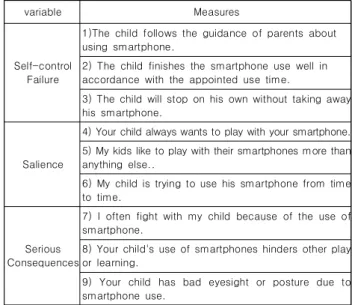
3-5세 영유아의 스마트폰 과의존의 정도는 한국정보화진흥 원이 2017년 전국 실태조사[1]에서 사용한 유아동 스마트폰 과 의존 척도를 사용하였으며 요인별 문항은 아래 <표 4>와 같다.

variable Measures

Self-control Failure

1)The child follows the guidance of parents about using smartphone.

2) The child finishes the smartphone use well in accordance with the appointed use time.

3) The child will stop on his own without taking away his smartphone.

Salience

4) Your child always wants to play with your smartphone.

5) My kids like to play with their smartphones more than anything else..

6) My child is trying to use his smartphone from time to time.

Serious Consequences

7) I often fight with my child because of the use of smartphone.

8) Your child's use of smartphones hinders other play or learning.

9) Your child has bad eyesight or posture due to smartphone use.

Table 4. Smartphone Overdependence Scale

3. Data Analysis

본 연구의 조사를 위하여 연구대상자로 부터 수집된 자료를

통계프로그램 SPSS 22.0으로 분석하였다. 3-5세 영유아의 일

반적 배경 및 스마트폰 사용실태는 빈도분석과 백분율을 실시

(4)

하였다. 영유아의 스마트폰 과의존과 사회학적 변인간의 상관 관계를 살펴보기 위하여 Pearson의 적률 상관관계를 실시하였 고 영유아의 사회학전 변인과 스마트폰 과이용과의 영향력 탐 색을 위해 다중회귀분석을 실시하였다.

Ⅲ. Research Results

1. Actual Condition of Smartphone Usage of 3 to 5 Years Old Children

weekday weekend

N % N %

fre- quency

1 time 110 13.4 - -

2 time 146 17.8 167 20.3

3 time 174 21.2 149 18.1

4 time 109 13.3 - -

5 time 99 12.0 164 19.9

Less

10time 72 8.7 192 23.4

Less

20time 53 6.4 56 6.8

Less

30time 43 5.2 36 4.4

more

30time 16 1.9 58 7.0

total M SD M SD

7.4 17.0 10.4 19.2

usage time

1 minute 20 2.4 - -

2 minute 9 1.1 167 20.3

3 minute 18 2.2 149 18.1

4 minute 13 1.6 - -

5 minute 201 24.5 164 20.0

6 minute 16 1.9 109 13.3

8 minute 76 9.2 78 9.5

10 minute 153 18.6 5 0.6

Less

15 minute 219 26.6 2 0.2

Less

20 minute 52 6.3 56 6.8

Less

30 minute 42 5.0 36 4.4

Less

60 minute 4 0.5 49 6

More

60 minute - - 9 1.1

total M SD M SD

11.1 7.3 13.2 10.7

Table 5. Actual Condition of Smartphone Usage( N = 822)

3~5세 영유아의 스마트폰 사용 횟수 및 이용시간은 <표 5>

와 같이 나타났다. 영유아들은 주중 하루 평균 7.4회, 주말 평 균은 10.4회의 스마트폰을 사용하고 있었으며 이용시간은 주중 1회 평균 11.1분, 주말 1회 평균 13.2분을 사용하고 있는 것으 로 나타났으며 주로 이용하는 콘텐츠는 전자책, 동영상, 게임, 인터넷 검색, 교육학습콘텐츠 순으로 이용하고 있었다.

2 Relationship between Smartphone overdepen dence and Sociological variable

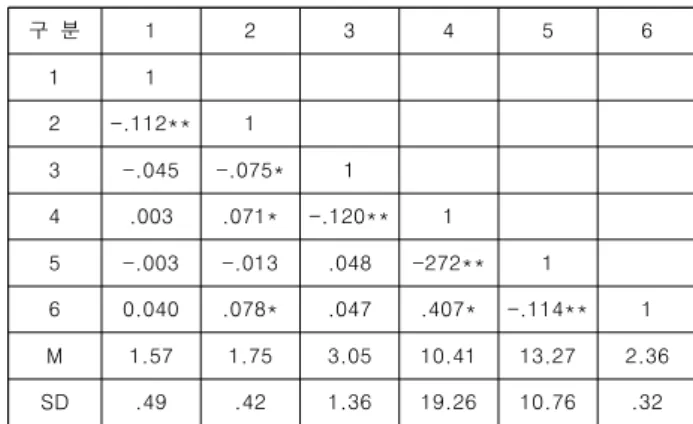
3-5세 영유아의 스마트폰 과의존과 성별, 한부모 가정, 평균소 득, 이용시간, 이용횟수 간의 상관관계 분석결과는 다음 <표 6>에 제시한 내용과 같으며 상관관계 범위는 -.272 ~ .407로 한부모 가정, 이용횟수, 이용시간 등의 일부 변수는 스마트폰 과의존과 관련성이 높은 것으로 나타났다. 이들 변수와 스마트폰 과의존의 관련성을 구체적으로 살펴보면 한부모 가정(r=.078, p<.05), 스마 트폰 이용회수(r=-.407, p<.05), 스마트폰 이용시간(r=-.114, p<.01)은 통계적으로 유의한 관련성을 확인할 수 있었다.

구 분   1 2 3 4 5 6

1 1

2 -.112** 1

3 -.045 -.075* 1

4 .003 .071* -.120** 1

5 -.003 -.013 .048 -272** 1

6 0.040 .078* .047 .407* -.114** 1

M 1.57 1.75 3.05 10.41 13.27 2.36

SD .49 .42 1.36 19.26 10.76 .32

1= Gender, 2= Single Parent, 3= Family Income 4= Frequency, 5= Usage Time,

6= Smartphone Overdependence *p<.05,**p<.01,

Table 6. Correlation analysis ( N = 822)

3. The effect of Sociological variable on smart phone overdependence

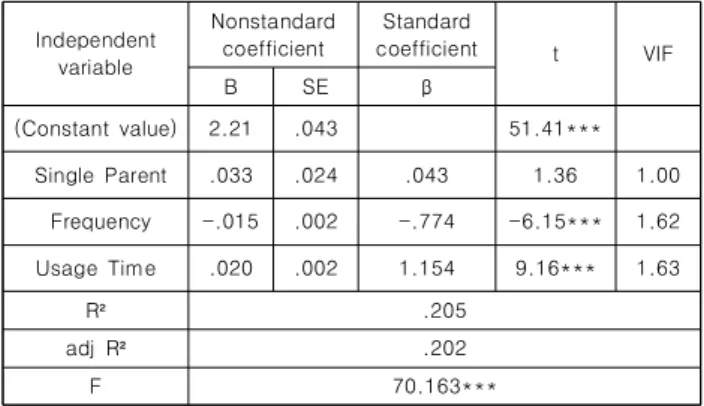
3-5세 유아의 사회학적 변인이 스마트폰 과의존에 미치는 영향을 확인하기 위하여 상관관계가 확인된 한부모 가정, 스마 트폰 이용횟수, 이용시간을 독립변인으로 스마트폰 과의존을 종속변수로 하여 다중회기분석 한 결과는 <표 7>과 같다.

분산팽창계수(VIF) 값은 각 변인별로 1.00 ~ 1.63의 범위로 10이하로 나타나 다중공선성 위험이 없는 것을 확인할 수 있었다.

상관관계가 확인된 3-5세 유아의 사회학적 변인인 한부모가정, 스마트폰 이용횟수, 이용시간을 독립변인으로 투입한 결과 영유아 의 스마트폰 과의존과의 영향을 약 20.2%를 설명하였다. 특히 스마트폰 이용횟수(β=-.6.15, p<.001),와 이용시간(β=.9.16, p<.001)은 통계적으로 많은 영향을 미치는 것을 확인 할 수 있었다.

다만, 한부모 여부는 영향을 미치는 변인이 아닌 것으로 나타났다.

(5)

이는 3-5세 영유아의 스마트폰 과의존은 이용횟수 및 이용시간에 유의한 영향을 미치는 요인이며 스마트폰 과의존 예방을 위해서는 이용횟수나 이용시간을 제한하여야 할 것이라 추론할 수 있다.

Independent variable

Nonstandard coefficient

Standard

coefficient t VIF

B SE β

(Constant value) 2.21 .043   51.41***

Single Parent .033 .024 .043 1.36 1.00

Frequency -.015 .002 -.774 -6.15*** 1.62

Usage Time .020 .002 1.154 9.16*** 1.63

R² .205

adj R² .202

F 70.163***

*p<.05,**p<.01,***p<.001

Table 7. Regression analysis ( N = 822)

IV. Conclusions

본 연구는 영유아의 양육환경 변인과 스마트폰 과의존과 관 련성을 확인하기 위한 목적에서 실시되었다. 영유아의 스마트 폰 과이용에 대한 심각한 우려에 따라 유아교육기관의 스마트 폰 예방교육이 의무화되었음에도 불구하고 교육내용이나 방법 적 측면이 논의되지 않고 있다는 점에서 추가 논의를 위한 기 초연구 제공이 필요하다는 판단에서 연구의 필요성을 착안하였 다. 특히 정부가 추진하고 있는 스마트폰 과의존 예방교육의 주 요 교수매체가 동영상에 기반 한 미디어 활용교육이라는 점은 방법적 개선이 시급하다.

이같은 연구목적에 따라 2017년 실시된 스마트폰 과의존 실 태조사의 데이터 중 3-5세 882명의 자료를 활용 스마트폰 이 용실태, 사회학적 변인과의 상관관계 및 회귀분석을 활용 영향 관계를 확인하였다.

연구문제를 중심으로 결과를 요약하고 논의하면 다음과 같다.

첫째, 3-5세 유아의 스마트폰 이용회수는 하루 평균 7회에 서 10회 내외였으며 1회 평균 사용시간은 10~13분 내외인 것 으로 나타났다. 스마트폰 이용콘텐츠는 전자책, 동영상, 게임, 인터넷 검색, 교육학습콘텐츠 순이었다. 이용횟수와 이용시간 콘텐츠 이용내용을 바탕으로 추론하면 3-5세 영유아의 1일 스 마트폰 사용시간은 하루 한 시간 이상으로 외국의 경우보다 사 용시간이 많은 것을 알 수 있다. 또한 가정과 유아교육기관에서 의 TV나 컴퓨터 등의 미디어 이용시간을 함께 고려한다면 영 유아의 스마트폰 사용은 많은 수준 제한되어야 할 것이다.

둘째, 3-5세 유아의 스마트폰 과의존은 가족형태와 이용횟 수와 시간 등과 상관관계가 있는 것으로 나타났다. 이는 스마트 폰이 널리 대중화되어 있는 상황에서 유아의 성별이나 가정의

소득수준 같은 사회학적 변인보다는 부모의 스마트폰 허용 태 도 및 양육행동과 인과관계가 있다라고 추론 할 수 있다.

셋째, 3-5세 유아의 스마트폰 과의존의 영향변인은 스마트 폰 이용횟수와 이용시간인 것으로 나타났으며 두 변인 모두 높 은 수준의 영향력을 가지고 있음이 확인되었다. 즉, 영유아의 스마트폰 예방교육의 내용 및 교수학습방법은 이용횟수와 이용 시간 기준 등을 중심한 내용과 동영상 같은 뉴미디어가 아닌 동화나 인형극 등을 사용하고 약속 만들기나 조절력 강화 같은 습관형성 체험활동의 교수학습방법이 적절하다 하겠다. 특히 스마트폰 제공자가 주로 부모이며 가정에서 스마트폰 사용이 높다는 점에서 인식전환을 위한 부모교육과 가정 내 이용지침 등이 함께 제공되어야 함을 시사한다 하겠다.

REFERENCES

[1] Ministry of Science and ICT & National Information Society Agency. “2017’ The survey on smart phone overdependence” Ministry of Science and ICT & National Information Society Agency. 2017

[2] Byun, Hye-Weon, Sung, Jih-yun & Yi, Kwang-Oh, “ An exploratory study of the associations between the use of smart devices and preschoolers` developmental level and empathy”, Journal of Early Childhood Education, Vol.

35, No2, pp.369-394, 2015.

[3] You, Ji-Hyung & Moon, Hae-Lyun, “The Relationships between the Children’s smartphone Over- immersion and their Hyperactivity, Impulsivity and Inattention", Journal of Early Childhood Education & Educare Welfare. Vol.

21, No. 1, pp.36-63, 2017.

[4] Kim, Yeon-Soo & Jeong, Yoon-Kyung, “Short-term Longitudinal Study about Relationship between Mother's Smart-Phone Addiction Tendency and Mother-Child Interaction”, The Korean Journal of the Human Development. Vol. 25, No. 1, pp.25-42, 2018.

[5] Kim, Hey, Young, “The Effect of Infants and Mothers Smartphone Usage Habits on Infants Social Emotional Development”, Journal of Early Childhood Education &

Educare Welfare, Vol. 20, No4, pp.457-485, 2016.

[6] Park, So-young, “Study of young children's use of smart media and variables affecting overuse.”, Ph.D. thesis, Catholic University. 2015.

[7]The American Academy of Pediatrics, “Healthy Digital Media Use Habits for Babies, Toddlers & Preschoolers”, HealthyChildren.org- E-Newsletter Archives Focus on Food and Media, Issue No. 171, September 2018.

[8]Lee, Jeong-Rim, “Exposure condition of the smartphone

for infants and young children and measures for

(6)

protection”, Child care policy forum. Vol 40. pp.17-26, Summer 2014.

[9]National Information Society Agency. “The concept of internet overdependence as alternative term of internet addiction”, National Information Society Agency. 2017

Authors

Dea-Hun Choi recevied the Ph.D. degree in Early Childhood Education from Chung-Ang university, Korea. Dr. Choi is currently an assistant professor of early childhood education at Seowon University.

He is interested in Early Childhood

Teacher Training Course, Administration and management

for early childhood programs and Multimedia Education for

Early Childhood Teachers.

수치

Fig.  1.  American  Academy  of  Pediatrics  Media  Use  Guidelines  for  Young  Children
Table  3.  Three  factors  of  Smartphone  Overdependence
Table  6.  Correlation  analysis  ( N =  822)
Table  7.  Regression  analysis  ( N =  822)

참조

관련 문서

Table 3-4 Design parameters of the superconducting resonance coil according to the number of turns ··· 16.. Table 3-5 Inductance and capacitance value by the number of

In the future, we need further studies on prevention of illegal copy and settlement of legal software products by analysing use characteristics of softwares and

The proliferations of MC3T3-E1 cell seeded on pristine PCL scaffold and surface modified scaffolds for 1, 3, and 5 days... ALP activity of the MC3T3-E1 cell seeded

이하선의 실질 속에서 하악경의 후내측에서 나와 하악지의 내측면을 따라 앞으로 간다. (귀밑샘 부위에서 갈라져 나와

It considers the energy use of the different components that are involved in the distribution and viewing of video content: data centres and content delivery networks

GDP impact of COVID-19 spread, public health response, and economic policies. Virus spread and public

1 John Owen, Justification by Faith Alone, in The Works of John Owen, ed. John Bolt, trans. Scott Clark, &#34;Do This and Live: Christ's Active Obedience as the

The purpose of the present study was to elucidate the effect of photography and reporting activities conducted at a day care center on 5-year-old