Received: July 14, 2021 Revised: August 05, 2021 Accepted: August 07, 2021
dental hygiene students for COVID-19
Seung-Hun Lee
Department of Dental Hygiene, Cheongam College
Corresponding Author: Seung-Hun Lee, Department of Dental Hygiene, Cheongam College, 1641, Noksae-ro, Suncheon, 57997, Korea. Tel : +82-61-740-7382, Fax : +82-61-740-7418, E-mail : [email protected]
ABSTRACT
Objectives: The objectives of this study were to verify the level of ethical consciousness and decision-making of dental hygiene students in pandemic as coronavirus disease 2019 (COVID-19).
Methods: This study included 249 college students who were interested in new infectious diseases.
They completed a questionnaire on a 5-point scale, and data were analyzed by independent t-test, ANOVA, and correlation. Results: The perception of COVID-19 was moderate at 3.42 points. This was higher among males, first graders, emergency management students, those who received education and experienced self-quarantine. The level of ethical consciousness was moderate (3.89 points), which was higher in sophomores, emergency management students. Ethical decision- making was moderate, with a score of 3.44, and was higher in those with first grade, field practice training, and self-quarantine experience. The level of perception positively correlated with ethical consciousness (α=0.310, p<0.01). In addition, as the degree of ethical consciousness increased, the degree of decision-making also increased (α=0.539, p<0.01). Conclusions: In a crisis, involving the spread of COVID-19, providing prospective dental hygienists accurate information and an experience similar to that faced by patient is necessary for raising the level of ethical consciousness and decision-making.
Key Words: Communicable diseases, COVID-19, Decision making, Dental hygienists, Pandemics
J Korean Soc Dent Hyg 2021;21(4):357-66 https://doi.org/10.13065/jksdh.20210035 pISSN : 2287-1705 eISSN : 2288-2294
Introduction
The Central Disaster Management Headquarters reported that the number of coronavirus disease 2019 (COVID-19) cases confirmed as of July 6, 2021, was 161,541 [1]. They are appealing for compliance with quarantine guidelines, saying that delta mutations with high transmission power are rapidly spreading affecting the patients [2]. Even if vaccines have been developed, a new paradigm shift is required beyond the era of new infectious diseases [3].
If this crisis continues, the interests and opinions of individuals and the public may conflict, but
effective quarantine must also be based on public health. In addition, the ethical aspect should be
considered [4]. Medical institutions face ethical issues while actively treating patients. For example,
forced isolation, use of patient personal information, and distribution of resources in emergency situations [5,6]. Despite there ethical dilemma, prioritization that reflects both infectious disease management and ethical issues is of paramount [4,6].
Medical professionals responding to infectious diseases make decisions based on ethical principles while risking social isolation and infection [7]. Dental hygienists are also expected to make decisions though critical thinking, advocating for the benefit of patients in situations that involve more expensive procedures and those who need treatment, compared to other health care disciplines, further having an ethical or legal responsibility in the event of medical incident.
Therefore, it is necessary to raise ethical consciousness regarding the oral health of patients and education them on dental hygiene ethics for decision-making [8]. This must be reinforced through education. Dental hygienists must have ongoing experience, and students must be educated at school.
Recently, ethics courses have been newly established in school, but as of 2017, only 14.6% of 82 schools were teaching ethics courses [9]. The ethical consciousness and decision-making of dental hygienists are important factors in managing infectious diseases, but education is lacking. In particular, considering the COVID-19 pandemic, it is necessary to understand the role of dental hygienists through education and establish correct ethical values.
There have been previous studies of the ethical aspects of medical professionals exposed to novel infectious diseases, education, and infection control [6,10], as well as studies on the epidemiology of COVID-19 and patient management [11,12]. In Korea, there have been studies on responses to infectious diseases [13] and studies on ethical awareness and decision-making of nurses [14-17]. In addition, there have been studies on the current status of dental hygiene ethics education, ethical consciousness of dental hygienists or students, and the level of behavior [9,18- 20]. However, studies of ethical consciousness and decision-making targeting dental hygiene college students for new infectious diseases, are still insufficient.
Therefore, it is necessary to identify the ethical consciousness and decision-making level of dental hygiene students in a situation where new infectious disease such as COVID-19 are pandemic. It also aims to provide the basis for the development of educational programs for infectious disease management.
Methods
1. Subjects
The subjects of this study were college students who were interested in new infectious diseases.
This study was conducted from June 7 to 11, 2021, with the approval of the college 00 Institutional
Review Board (CA17-201224-HR-012-01). The sample size was calculated as 226 using the G*power
3.1 program [21,22] using an independent t test with a significance level of 0.05, a power of 80%,
and an effect size of 0.375. The effect size was referred to the degree of ethical awareness according
to educational experience in the study of Park [17].
For ethical consideration, the purpose and method of the study were explained to the students before the study, and only those who agreed to the survey participated.
2. Methods
The questionnaire consisted of 37 items, including 6 items on general characteristics of the study subject, 8 items on the perception of new infectious diseases, 5 items on ethical consciousness, and 8 items on decision making. They were measured on a Likert 5-point scale, with higher scores demonstrating a more positive result. Based on study of Park [17], the questionnaire has been modified and adapted for this study.
3. Analysis method
Independent t-test and ANOVA were used to compare the differences between ethical consciousness and decision-making according to general characteristics. Additionally, their correlation was analyzed.
Data were analyzed using SPSS (ver. 18.0, Chicago, IL, USA). The Cronbach’s alpha coefficient was calculated for item consistency. The cronbach’ α of perception, ethical consciousness, and decision-making was 0.661, 0.880, and 0.615, respectively.
Results
1. General characters of study subjects
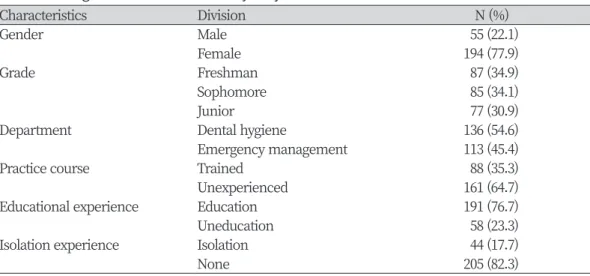
The general characters of study subjects are shown in <Table 1>. The final number of individuals was 249, excluding 21 who did not complete the questionnaire. Of these, 77.9% were female, 34.9%
were freshman, 34.1% sophomore, 30.9% were junior, and 54.6% belonged to department of dental hygiene. In addition, 64.7% received field training in their major, 76.7% received infection control education, and 17.7% had experience in self-quarantine due to a new infectious disease.
Table 1. The general characters of study subjects (N=249)
Characteristics Division N (%)
Gender Male 55 (22.1)
Female 194 (77.9)
Grade Freshman 87 (34.9)
Sophomore 85 (34.1)
Junior 77 (30.9)
Department Dental hygiene 136 (54.6)
Emergency management 113 (45.4)
Practice course Trained 88 (35.3)
Unexperienced 161 (64.7)
Educational experience Education 191 (76.7)
Uneducation 58 (23.3)
Isolation experience Isolation 44 (17.7)
None 205 (82.3)
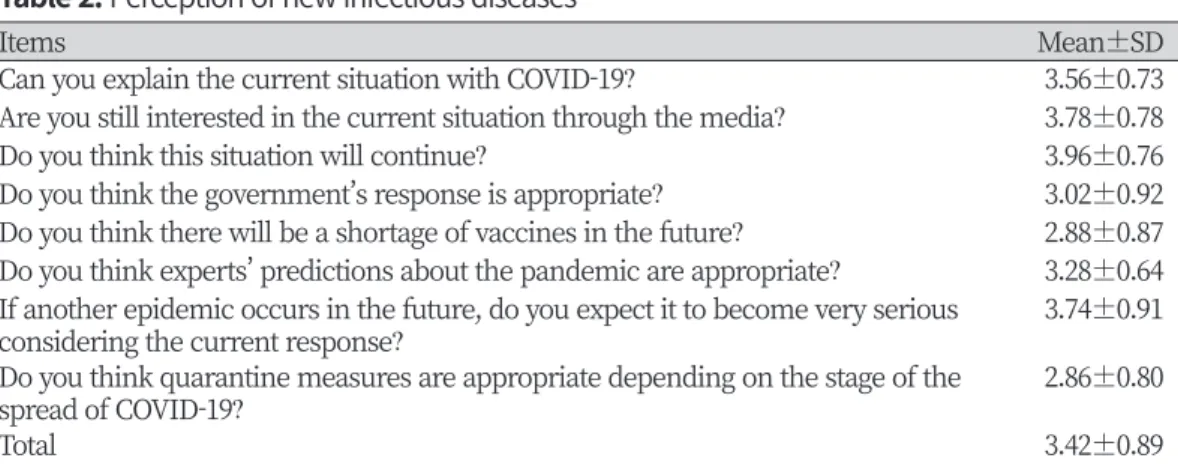
Table 2. Perception of new infectious diseases
Items Mean±SD
Can you explain the current situation with COVID-19? 3.56±0.73 Are you still interested in the current situation through the media? 3.78±0.78
Do you think this situation will continue? 3.96±0.76
Do you think the government’s response is appropriate? 3.02±0.92 Do you think there will be a shortage of vaccines in the future? 2.88±0.87 Do you think experts’ predictions about the pandemic are appropriate? 3.28±0.64 If another epidemic occurs in the future, do you expect it to become very serious
considering the current response? 3.74±0.91
Do you think quarantine measures are appropriate depending on the stage of the
spread of COVID-19? 2.86±0.80
Total 3.42±0.89
2. Perception of new infectious diseases
As shown in <Table 2>, the perception of new infectious diseases was moderate (3.42 points).
Perception of the prolonged COVID-19 (3.96 points) and media interest (3.78 points) scored relatively high, but that of quarantine measures (2.86 points) at each stage of spread and vaccines supply (2.88 points) scored low.
Table 3. Ethical consciousness for new infectious diseases
Items Mean±SD
I acknowledge that my daily life can be controlled by policy. 3.65±0.78
New ethical guidelines are needed. 3.94±0.79
Equipment must be provided first to protect medical staff. 4.04±0.84 We have the right to receive accurate information about the pandemic. 3.91±0.80 We agree to government personal controls to prevent the spread (e.g. restrictions on
international travel, prohibition of assembly, personal quarantine, etc.). 3.90±0.81
Total 3.89±0.81
3. Ethical consciousness for new infectious diseases
The level of ethical consciousness was 3.89 points, as shown in <Table 3>. The provision of protective equipment for medical staff was rated high (4.04 points), but the government’s daily life restrictions were rated low (3.65 points).
4. Ethical decision-making on new infectious diseases
As shown in <Table 4>, the ethical decision-making for new infectious diseases was moderate,
with a score of 3.44. The decision-making regarding self-isolation (3.98 points) and confidentiality
of infected persons (3.74 points) scored relatively high, but was relatively low for vaccine supply
(2.79 points) and volunteer service without compensation (3.06 points).
Table 4. Ethical decision-making on new infectious diseases
Items Mean±SD
If the vaccine were not made available to the general public by government decision,
it will not be delivered, even at request of a close friend. 2.79±1.04 If a close person asks for a secret to be infected, I will accept it.* 3.74±1.09 Even if there is an important schedule, I will serve people with infectious diseases. 3.34±0.83 Without compensation, I will not work for patients.* 3.06±1.01 If a patient refuses to be vaccinated, the patient’s rights must be respected. 3.67±0.88 If infection is suspected, self-isolation should be decided by themselves.* 3.98±0.81 If there is a shortage of vaccines, it is given on a first-come, first-served basis without
priority.* 3.35±0.90
Even if the situation is difficult due to the new infectious disease, I will do my part for
the patient. 3.63±0.82
Total 3.44±1.01
*reverse coding
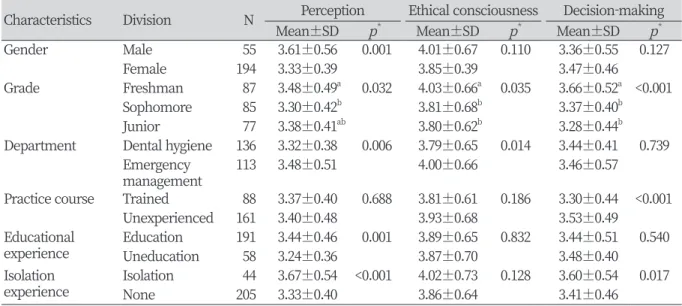
Table 5. Differences in perception, ethical consciousness, and decision-making according to the characteristics of study subjects (N=249)
Characteristics Division N Perception Ethical consciousness Decision-makingMean±SD p* Mean±SD p* Mean±SD p*
Gender Male 55 3.61±0.56 0.001 4.01±0.67 0.110 3.36±0.55 0.127
Female 194 3.33±0.39 3.85±0.39 3.47±0.46
Grade Freshman 87 3.48±0.49a 0.032 4.03±0.66a 0.035 3.66±0.52a <0.001
Sophomore 85 3.30±0.42b 3.81±0.68b 3.37±0.40b
Junior 77 3.38±0.41ab 3.80±0.62b 3.28±0.44b
Department Dental hygiene 136 3.32±0.38 0.006 3.79±0.65 0.014 3.44±0.41 0.739 Emergency
management 113 3.48±0.51 4.00±0.66 3.46±0.57
Practice course Trained 88 3.37±0.40 0.688 3.81±0.61 0.186 3.30±0.44 <0.001
Unexperienced 161 3.40±0.48 3.93±0.68 3.53±0.49
Educational
experience Education 191 3.44±0.46 0.001 3.89±0.65 0.832 3.44±0.51 0.540
Uneducation 58 3.24±0.36 3.87±0.70 3.48±0.40
Isolation
experience Isolation 44 3.67±0.54 <0.001 4.02±0.73 0.128 3.60±0.54 0.017
None 205 3.33±0.40 3.86±0.64 3.41±0.46
*by independent t-test or ANOVA
a,bThe same characters was not significant by duncan’s multiple comparison at α=0.05.
5. Differences in perception, ethical consciousness, and decision- making according to the characteristics of study subjects
There was a statistically significant difference in perception, ethical consciousness, and decision-
making according to the general characteristics of the study subjects <Table 5>. The perception
was high among males, first graders, emergency management students, students with education
and students experiencing self-quarantine. Ethical consciousness was higher in the second graders,
emergency management students, and decision making was higher in the first graders, those with
field training experience and having experienced self-isolation.
Table 6. Correlation between variables
Variables Perception Ethical consciousness Decision-making
Perception 1.000
Ethical consciousness 0.310* 1.000
Decision-making 0.112 0.539* 1.000
*p<0.01, by pearson’s correlation coefficient
6. Correlation between variables
<Table 6> shows the correlation between perception, ethical consciousness, and decision- making. As the perception increased, the ethical consciousness increased (α=0.310, p<0.01). In addition, the higher the ethical consciousness, the higher the decision-making (α=0.539, p<0.01).
Discussion
The researcher identified the degree of perception of new infectious diseases among college students in the COVID-19 pandemic situation and analyzed the degree of ethical consciousness and decision-making.
Due to the circumstances of the training institution, emergency management students were not trained at the fire department but were trained at a medical institution, and dental hygiene students were not trained at a university hospital, but were trained at a dental clinic. In addition, infection control education was provided remotely before training.
The perception level of COVID-19 was moderate 3.42 points. This was lower than the 3.63 points obtained in the previous study [17] for nursing students; however, it was higher than the 3.10 points obtained in the study [16] targeting medical personnel. These results suggest that the greater the number of victims and damage caused by recent pandemic, the higher the perception of disaster risk [23]. In this study, the perception that such pandemic would continue was the highest (3.96 points), whereas, in previous studies [16,17], the perception that the pandemic would become more serious was the highest. The items with the low perception were the appropriateness of quarantine measures according to the spread (2.86 points) and the supply of vaccines (2.88 points).
These results are similar to those of previous studies [16,17]. The response to the pandemic of Middle East Respiratory Syndrome (MERS) in 2015 was not appropriate. This time, inadequate quarantine measures and a low vaccination rate compared to other countries are considered to be the cause of the spread of COVID-19. To improve this perception, the government should apply consistent quarantine standards and increase the supply of vaccines.
In this study, the perception level was significantly higher among males, first graders, department
of emergency management, students with education experience, and students with self-isolation
experience. It is thought that the high level of perception among first-grade students means that
they are unable to receive in-person lectures due to the corona virus and want to improve their
current condition. It is thought that the higher the number of emergency management students,
the greater the anxious about infection. In the study of Park [17], students with high levels of major
satisfaction were higher in number. In the study of Park [16], the perception level was high in those in their 40s or older, and it was higher for those with education level beyond graduate school, and a lot of work experience. These differences are thought to be due to differences in the study subjects, study methods, and study timing.
Ethical consciousness was moderate, with a score of 3.89. This was lower than the score of 4.59 in Park’s study for nursing students [17], but it was higher than the score of 3.72 in Park’s study for medical professionals [16]. In this current study, the need to provide equipment to protect medical staff (4.04 points) was high, and the daily control according to the spread was relatively low (3.65 points). The low ethical consciousness of daily life control may be due to increased fatigue as COVID-19 continues for a long time. These results are similar to those of Park’s study [17]. In the study of Park [16], the right to receive information is high, and the assignment and guarantee of medical personnel were low. These differences were presumed to be due to differences in study subjects.
Ethical consciousness was higher in students of emergency management, and there was a significant difference according to grade level. The grade of the emergency management students are high because they feel that their treatment has a great impact on the patient’s life. In a study targeting nursing students [17], it was found that clinical practice experience and major satisfaction were high when a family member or student experienced an infectious disease. In a study [16] of medical personnel, those with more clinical experience have higher the level of ethical consciousness. This study differed from previous studies [16,17].
Ethical decision-making was moderate, with a score of 3.44. The decision regarding self-isolation was highest. The participants seem to think that adherence to government guidelines for public health is more important than autonomy. Decision-making regarding vaccine delivery was the lowest. The participants believed that even if there is a shortage of vaccines, they should be provided on priority basis. In park’s study [17], the corresponding score was 6.65 out of 8, which depict a high level. The decision to continue caring for patients during a pandemic scored the highest, and the patients' right to refuse the vaccines scored the lowest. Taken together, the general belief is that government guidelines should be followed for public health rather than individual autonomy and confidentiality, and vaccines should be provided on a priority basis.
The decision-making in this study was higher among first grader, students without field training,
and students who experienced self-isolation. In a study [17] targeting college student in nursing,
satisfaction with the major was high, with higher satisfaction in the group in which student or
family experienced an infectious disease. In a study with medical personnel [16], it is higher in the
group with direct experience of managing a patient. Summing up the studies, it is thought that
ethical decision-making is affected when experiencing an actual infectious disease or felling a
crisis. Therefore, to enhance ethical decision-making, it is necessary to conduct education and
practice that simulates real disaster situation.
In this study, the higher the perception of COVID-19, the higher the ethical consciousness. As the level of ethical consciousness increased, ethical decision-making increased. This is similar to the results of previous studies [17,24]. Ethical decisions require educating students to be informed, and fostering ethical consciousness by providing realistic experiences.
COVID-19 is a global infectious disease that has caused a crisis like never before. In this crises, we experience an ethical dilemma. As prospective dental hygienists, students should be expect to recognize and improve their ethical consciousness and decision-making skills.
Although this study examined dental hygiene and students' perception, ethical consciousness, and decision-making level of COVID-19, even in a crisis situation, it is difficult to generalize these results as the study subjects and regions are limited. Therefor, it is necessary to expand the nubmer of subjects and regions in a follow-up studies. Nevertheless, the results of this study can be used as basic data for development of educational programs for communicable diseases.
Conclusions
This study was conducted to verify the ethical consciousness and decision-making level of dental hygiene students during a pandemic of infectious disease, such as COVID-19, and the following conclusions were obtained.
1. The perception of the new infectious disease was moderate (3.42 points). The prolonged COVID-19 pandemic and media interest scored relatively high, but the level of perception about the quarantine measures for each stage of the spread and the vaccine supply was relatively low.
2. The level of ethical consciousness was high and moderate (3.89 points). The provision of protective equipment for medical staff scored relatively high, but the government's restrictions on daily life scored relatively low.
3. Ethical decision-making was mediocre (3.44 points). Decision-making regarding self-isolation (3.98 points) and confidentiality of infected persons was relatively high; but, it was relatively low for vaccine supply and volunteer service without compensation.
4. As the perception increased, the ethical consciousness increased (α=0.310, p<0.01). In addition, the higher the ethical consciousness, the higher the level of decision-making (α=0.539, p<0.01).
As a prospective dental hygienist, in order to reinforce ethical decisions in the future, students should be educated based on accurate information on new infectious diseases and experience similar to reality to raise their ethical consciousness.
Conflicts of Interest
The author have no financial or personal relationships with any individuals or organizations that
could influence work.
Acknowledgements
This research was supported by the Cheongam college research grants in 2021. The funders had no role in the study design, data collection and analysis, or preparation of the manuscript.
References
[1] Central Disaster Management Headquarters. Coronavirus disease-19, Republic of Korea [Internet]. Central Disaster Management Headquarters.[cited 2021 July 06]. Available from: http://
ncov.mohw.go.kr/en/.
[2] MBC news. Minister Kwon Deok-cheol “A major crossroads in quarantine. you must not let go of alertness” [Internet]. MBC news.[cited 2021 July 06]. Available from: http://imnews.imbc.com/
news/2021/society/article/6284082_34873.html.
[3] Oh EG. Perspectives on nursing profession for a post-COVID-19 new normal. Korean J Adult Nurs 2020;32(3):221-2. https://doi.org/10.7475/kjan.2020.32.3.221
[4] Bae JM. Establishing public health ethics related to disclose information for controlling epidemics on 2015 MERS epidemics in Korea. Korean Public Health Research 2015;41(4):15-20.
[5] Gostin LO, Berkman BE. Pandemic influenza: ethics, law and the public’s health. Administrative law review 2007;59(1):121-75.
[6] Devnani M, Gupta AK, Devnani B. Planning and response to the influenza A (H1N1) pandemic: ethics, equity and justice. Indian J Med Ethics 2011;8(4):237-40. https://doi.org/10.20529/ijme.2011.088 [7] Park HJ, Lee OC. Ethical awareness and decision-making of healthcare providers in response
to pandemic influenza: focused on middle east respiratory symptom coronavirus. Crisisonomy 2019;15(1):19-29. https://doi.org/10.14251/crisisonomy.2019.15.1.19
[8] Hong JS, Lee YS. The effect of dental hygienist’s on the medical ethics course in college on medical information protection agreement and practice. J Korean Soc Oral Health Sci 2020;8(2):38-44. https://
doi.org/10.33615/jkohs.2020.8.2.38
[9] Ahn SY, Jeong EY. The present status and recommendation of dental hygiene ethics education in Korea. J Korean Acad Dent Assoc 2017;19(2):79-90.
[10] Thompson AK, Faith K, Gibson JL, Upshur REG. Pandemic influenza preparedness: an ethical framework to guide decision-making. BMC Medical Ethics 2006;7(12):12-23. https://
doi.org/10.1186/1472-6939-7-12
[11] McCreary EK, Pogue JM. Coronavirus disease 2019 treatment: a review of early and emerging options.
Open Forum Infectious Diseases 2020;7(4):1-11. https://doi.org/10.1093/ofid/ofaa105
[12] Tobaiqy M, Qashqary M, Al-Dahery S, Mujallad A, Hershan AA, Kamal MA, at al. Therapeutic management of patients with COVID-19: a systematic review. Infection Prevention in Practice 2020;2(3):1-26. https://doi.org/10.1101/2020.04.02.20051029
[13] Choi JW, Kim KH, Cho YM, Kim SH. Current epidemiological situation of middle east respiratory syndrome coronavirus clusters and implications for public health response in South Korea. J Korean Med Assoc 2015;58(6):487-97. https://doi.org/10.5124/jkma.2015.58.6.487
[14] June JA, Choi ES. Infection control of hospital nurses: cases of middle east respiratory syndrome.
Korean J Occup Health Nurs 2016;25(1):1-8. https://doi.org/10.5807/kjohn.2016.25.1.1
[15] Choi JS, Kim JS. Factors influencing emergency nurses’ ethical problems during the outbreak of MERS-CoV. Nurs Ethics 2018;25(3):335-45. https://doi.org/10.1177/0969733016648205
[16] Park HJ, Lee OC. Ethical awareness and decision-making of healthcare providers in response to pandemic influenza: focused on middle east respiratory symptom coronavirus. Crisisonomy 2019;15(1):19-29. https://doi.org/10.14251/crisisonomy.2019.15.1.19
[17] Park MW. Awareness about pandemic influenza, ethical awareness, and ethical decision-making among nursing students in the situation of COVID-19 pandemic. J Digit Converg 2020;18(10):335-44.
https://doi.org/10.14400/JDC.2020.18.10.335
[18] Cheon SH, Lee HY, Cho MS. The relationship between vocational calling and ethical inclination in clinical dental hygienists. J Korean Soc Dent Hyg 2014;14(6):813-20. https://doi.org/10.13065/
jksdh.2014.14.06.813
[19] Lee SM, Chen SY. The levels of the vocational awareness and the professional ethics recognition in clinical dental hygienists. J Korean Soc Dent Hyg 2017;17(3):515-26. https://doi.org/10.13065/
jksdh.2017.17.03.515
[20] Jang JH, Woo HS. A study on ethical job behavior level of some dental hygiene students. JKSCI 2019;24(6):135-40. https://doi.org/10.9708/jksci.2019.24.06.135
[21] Faul F, Erdfelder E, Lang AG, Buchner A. G*power 3: a flexible statistical power analysis program for the social, behavioral, and biomedical science. Behav Res Methods 2007;39(2):175-91. https://
doi.org/10.3758/bf03193146
[22] Cohen J. Statistical power analysis for behavioral sciences. Academic press: Elsevier; 1977:19-74.
https://doi.org/10.1016/C2013-0-10517-X
[23] Lee YJ. Impact of disaster awareness on government trust. J Korean Soc Disaster Secur 2020;13(4):47- 63. https://doi.org/10.21729/ksds.2020.13.4.47
[24] Kim YS, Hong SS. Awareness about pandemic infectious diseases, ethical awareness, and ethical decision-making among nursing students. J Korean Pubilc Health Nurs 2019;33(3):326-39. https://
doi.org/10.5932/JKPHN.2019.33.3.326
코로나바이러스감염증-19에 대한 치위생과 학생의 윤리적 의사 및 의사결정
초록
연구목적: 본 연구의 목적은 2019년 코로나바이러스감염증(COVID-19) 팬데믹 상황에서 치위생학 학생들의 윤리적 의식과 의사결정 수준을 검증하는 것이다. 연구방법: 본 연구의 대상은 COVID-19에 관심이 있는 대학생 249명을 대상으로 하였다.
대상자는 5점 척도의 설문지를 작성하였으며, 자료는 독립 t-검정, ANOVA, 상관분석법으로 분석하였다. 연구결과: COVID- 19에 대한 인식은 3.42점으로 보통 수준이었다. 그리고 남학생, 1학년, 응급구조과 학생, 교육받은 학생, 자가격리 경험이 있는 학생이 더 높았다. 윤리의식 수준은 3.89점으로 보통이었으며, 2학년, 응급구조학과 학생에게서 높게 나타났다. 윤리적 의사결정은 3.44점으로 보통 수준으로 1학년, 현장실습, 자가격리 경험이 있는 학생에게서 높았다. 인식 수준은 윤리의식과 양의 상관관계가 있었다(α=0.310, p<0.01). 또한 윤리의식의 정도가 높을수록 의사결정의 정도도 증가하였다(α=0.539, p<0.01). 결론: COVID-19가 확산되고 있는 위기 상황에서 치과위생사 학생을 대상으로 정확한 정보를 교육하고 이를 실제와 유사하게 체험하여 윤리적 의식과 의사결정 수준을 높일 필요가 있다.
색인: 감염성 질환, 의사결정, 치과위생사, 팬데믹, 코로나바이러스감염증-19