• 검색 결과가 없습니다.

A Study on the Customer Experience Design through analyzing Smart Hotels in China

N/A
N/A
Protected

Academic year: 2021

Share "A Study on the Customer Experience Design through analyzing Smart Hotels in China"

Copied!
10
0
0

로드 중.... (전체 텍스트 보기)

전체 글

(1)

A Study on the Customer Experience Design through analyzing Smart Hotels in China

Luo Xuan 1 , Yonghwan Pan 2*

1

Ph.D, Dept. of Experience Design, Techno Design, Kookmin University

2

Professor, Dept. of Experience Design, Techno Design, Kookmin University

중국 스마트 호텔의 사례 연구를 통한 사용자 경험 연구

루쉬안 1 , 반영환 2*

1

국민대학교 테크노디자인전문대학원 경험디자인학과 박사,

2

국민대학교 테크노디자인전문대학원 경험디자인학과 교수

Abstract The outbreak of covid-19 has brought the characteristics and advantages of non-contact services to increased prominence, and the development of smart hotels”has accelerated. This study aims to identify, categorize and define the smart service experience at different touch points of the customer experience. The concept and characteristics of the smart hotel were examined based on existing research and literature. An analytical framework was designed using smart experience factors and customer touch points of smart hotels. Selected Chinese smart hotels were then examined under this framework. The case analysis results show that the customer experience design of smart hotels has developed to different degrees, in terms of interactivity, personalization, accessibility, information and privacy security. Based on the above findings, this article suggests that the design of smart hotels should use integrated data to further enhance personalized service experience.

Key Words : Smart hotel, Customer experience, UX touch point, Contactless serivce, Smart experience element

요 약 코로나(COVID-19) 폭발로 인해 비접촉 서비스의 특징과 장점이 갈수록 두드러졌고 스마트호텔의 발전이 가속 화되었다. 본 연구는 서로 다른 접촉점에서고객 체험 과정에 발생하는 스마트 서비스 체험을 식별, 분류 및 정의하는 데에 목적을 두고 있다. 기존 연구와 문헌을 바탕으로 스마트 호텔의 개념과 특징에 대해 연구 토론해 보았다. 스마트 호텔의 스마트 체험 인자와 고객 접촉점을 활용하여 분석 프레임 워크를 디자인하였다. 이로써 중국에서 선별된 스마트 호텔에 대해 현장 조사 및 분석을 수행한다. 사례 분석 결과를 보면 스마트 호텔의 고객 체험 디자인이 교호성, 개별화, 접근 가능성, 정보성, 프라이버시 안전성에 어느 정도 발전하고 있다는 것을 알 수가 있다. 위의 결과를 바탕으로 본 논문에서는 미래의 스마트 호텔 CX 디자인이 개인화된 서비스 관련 체험을 개발하기 위해 데이터를 통합하는 방향으 로 발전하는것을 제안한다.

주제어 : 스마트 호텔, 고객 체험, UX 접촉점, 비접촉 서비스, 스마트 체험 요소

*Corresponding Author : Yonghwan Pan([email protected]) Received December 29, 2020

Accepted March 20, 2021 Revised February 2, 2021

Published March 28, 2021

(2)

1. Introduction

The spread of COVID-19 has been detrimental and continues to wreak havoc on the global tourism and hospitality industry. Considering to reduce the risks of transmission and infection, the contactless service became the center of public discussion. as it primarily reduces direct physical contact between individuals. Therefore, the way services are provided to tourists is changing. Hotel companies' service delivery systems are likely to undergo major changes to include physical distance as an integral part of hotel services[1]. Many hotels have undergone a series of upgrades. They are adopt “unmanned”

devices and use robots to provide completely contactless service. It can thusbe expected that contactless services will replace human-to- human contact services in the near future[2]. In recent years, smart hotels that have been advanced with the progress of smart tourism now have greater developing opportunities.

Prior research has already recognised the strategic role of information and communication technologies AI company Saviok devoted into robot developing since 2014. After that, Starwood Hotels & Resorts Worldwide, Inc., InterContinental Hotels Group PLC, Japanese Henna Hotel, and JW Marriott Hotel all have paid attention and to development in the intellectualization of the hotel. They put in robotic waiters or built a voice-controlled room system. In China, a few high-end hotels have begun to study the direction of low-carbon environmental protection and intelligent information since 2009. In 2015, Ali Group began to enter the field of smart life and established the Smart Life Division. In 2018, FLYZOO hotel opened to explore the future of hotel experience with the help of AI. In 2018, AT-LAB of Atour Hotel Group cooperated with Tencent Cloud to create smart experience rooms explore the temperature and personality that technology should have in the AI era.

While these hotels offer convenience experience is more complex than Smart Tourism Technology and physical environment etc. The application of AI and robotics in hotels represents a new service concept[3]. Therefore, exploring the factors which constitute customers' experience with the smart hotel technologies is an important research issue. Tung&Law[4]

identified future research directions pertaining to the consumer experience with human-robot interaction. Researchers should dive deeper into the applications of mechanical AI, thinking AI and feeling AI in the delivery, creation, and interaction of hotel services[5].

The scarcity of systematic scholarly research on the customer smart experience construct and management calls for a theory-based conceptual framework that can serve as a stimulus and foundation for such research. Thus, we have pursued the following objectives in this study:

(1) To analyze the elements of customer experiences in smart hotel setting.

(2) To identify the constituents of smart customer experience.

2. Customer Experience Design of Smart Hotel

2.1 Smart hotel concept

The use of AI technologies in hospitality industry has led to the emergence of a new concept called “smart hotel”[6].et al. The attempt to define a smart hotel category requires explaining the significance of the term “smart”.It originates from English, means clever, intelligent, ingenious and slick. If smart attributes are assigned to a specific device, it means that it is easier to use, manipulate or program. In addition, it usually has higher safety and cost-effectiveness.

Many researchers consider that the idea of

(3)

Keywords in Smart Experience B Neuhofer

2015 R Micera

2016 SK Roy

2017 M Jeong

2019 S Kabadayi

2019 WanPeng

2020 FSeyitoğlu

2020 Freq.

Benefit ● ● ● 3

Enjoyment ● ● 2

Interactivity ● ● ● ● ● ● 6

Personalization ● ● ● ● ● 5

Accessibility ● ● ● ● 4

Informativeness ● ● ● ● 4

Privacy safety ● ● ● ● ● 5

Accuracy ● ● 2

Seamless ● ● ● 3

Table 1. Keywords in Smart Experience

smart hotel does not represent a theoretical concept. Instead,it is a practical business model[7], which describes a hotel enterprise adopting new information and communication technology in the hospitality business.

According to another definition, the smart hotel is an integrated concept which represents a technical integration system that provides hotel service. A smart space is not an electronic device attached between physical spaces, but a phenomenon in which the physical space and the electronic space, and the space where humans and things communicate are superimposed[8].

The function is based on information and communication technology. They respond to the signals from the internal and external context and adjust their activities befittingly, either by themselves or with a small amount of human participation [9].

Based on these definitions, smart hotels can be expounded as a comprehensive system for hotel service provision. It is based on new information and communication technology, using "unmanned"

equipment and robots, etc., which work together to provide non-contact service and create an accommodation environment that can meet the individual expectations of guests.

Smart hotel is an important part of smart tourism and smart city in the future. The experience service process of smart hotel is a

comprehensive digital intelligent model.

2.2 Smart Experience Concept 2.2.1 Service experience design

Experience design is a method of establishing an emotional connection with customers by carefully planning tangible and intangible service elements. This method has been popularized in many hotels and retail enterprises [10]. When customers have a certain sense of the context elements created by the service provider or acquire knowledge from some degree of interaction, an experience will occur [11].

Service experience (also referred to as customer experience) embodies the perception formed when consumers integrate the sensory information formed by consumer’s encounters with business products and services[12].

Academics and industry practitioners agree that smart services create a entirely different customer experience[13].

It is the main antecedent of the smart service

experience, while those focus largely on service

delivery and the binary interaction between

service providers and customers, smart services

emphasize the interactions among the service

providers, customers, smart technology, services

(intra- and inter) and delivery channels[14].

(4)

Dimensions of smarthotel

experience Characteristics

Interactivity Smart services are characterized by easy to use and get enjoyment derived from their use.

Personalization Personalized services satisfy tourists' needs and maximize their travel experience as well as their satisfaction with smart tourism destinations.

Accessibility It refers to how easily an individual can access and use the information offered.

Informativeness Information quality and credibility are critical factors that can affect tourists' overall experience at the destination.

Privacy safety Protecting and securing personal and private information is a required feature in the technology-mediated environment.

Table 2. Five dimensions of smart hotel experience

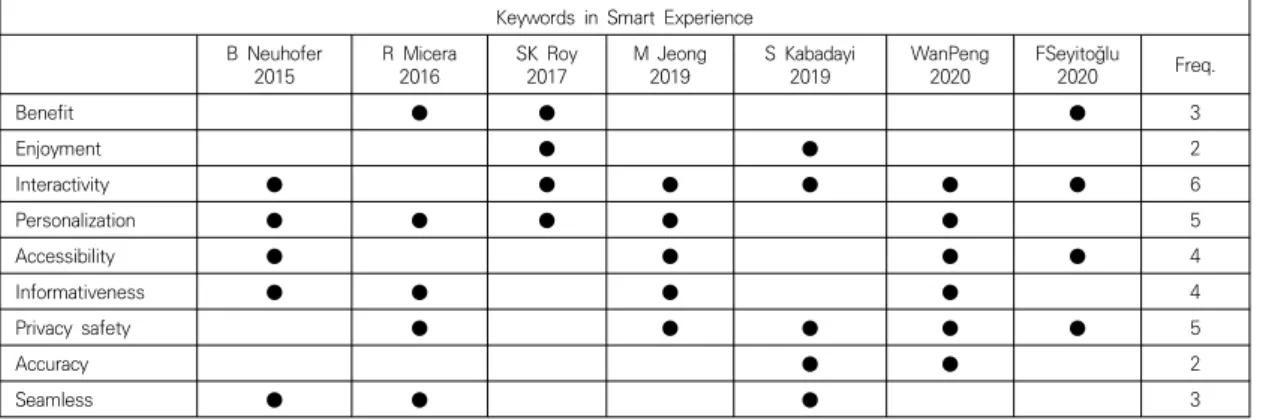
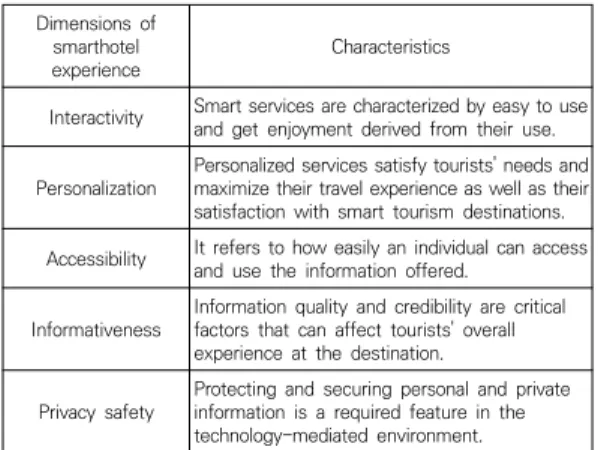
2.2.2 Customer smart experience design Numerous researchers have made efforts to investigate smart technologies’ effect on service experience. In order to obtain the components of customer intelligent experience, there is a collection of keywords mentioned in previous research papers, and their frequencies are shown in the following Table 1 in the table below. There are nine elements extracted from previous papers, and five of them have frequencies of four or more times. Finally, the key component of the customer’s intelligent experience has been found.And sorted out the specific meaning explanation Table 2.

Taking all of these studies into consideration, this paper defines the smart service experience as: smart service experience is customers’ subjective response to smart services and is shaped by interactivity, personalization, accessibility, informativeness and privacy safety. this paper conceptualizes the smart service experience as a higher order construct with those.

3. Customer experience touch points 3.1 Importance of Touch Point Analysis in

Smart Hotel Service Design

Customer experience develops throughout all

touch points and episodes encountered during the service delivery process[15]. In order to enhance the value of service, an important factor to consider is the customer feeling and experience within any touch point. Therefor, an important concept in service design is a touchpoint[16]. Touchpoint is a kind of service interface. It represent what actually happens from customer's perspective. Adequate touchpoints can reflect the experience people expect at any time. This means that service touch points must be developed and designed in detail, while also balancing integrity and production. Ultimately, it can create a clear and coherent customer experience.

3.2 Types of touchpoints in Smart Hotel Meyer and Schwager (2007) point out that touch points may not be necessary or directly linked to the company, suggesting that indirect interactions also occurs in the process of recommendation or comment[17]. Verhoef(2009) point out that touch points occur at all stages of the customer journey including the search, evaluation, purchase and after-sale phases of the experience[18].

In the engagement consumer period,what are the most important touchpoints? As Nicholas talks about in book, What Customers Crave, we need to be aware of five key touchpoints:1. The Pre-Touchpoint Moment (mostly digital —before the customer has sought you out), 2. The First Touchpoint Moment (the first impression usually one of the five senses), 3. The Core Touchpoint Moment (what you do for them day in, day out—

online and off), 4. The Perfect Last Touchpoint Moment (that surprising bit of value you add at delivery), 5. The In-Touchpoint Moment (how do you keep in touch with customers on an ongoing basis)[19].

Experience mapping is foundational to

understanding not only existing pain points,

behaviors, preferences, and needs but also where

(5)

Fig. 1. Application of Visibility Line to touch point research.

the opportunities are to empower customers[20].

Altimeter Group developed the customer experience life cycle model map in order to serve customers at each stage of their journey, be it awareness, consideration, purchase, experience, support, or loyalty.

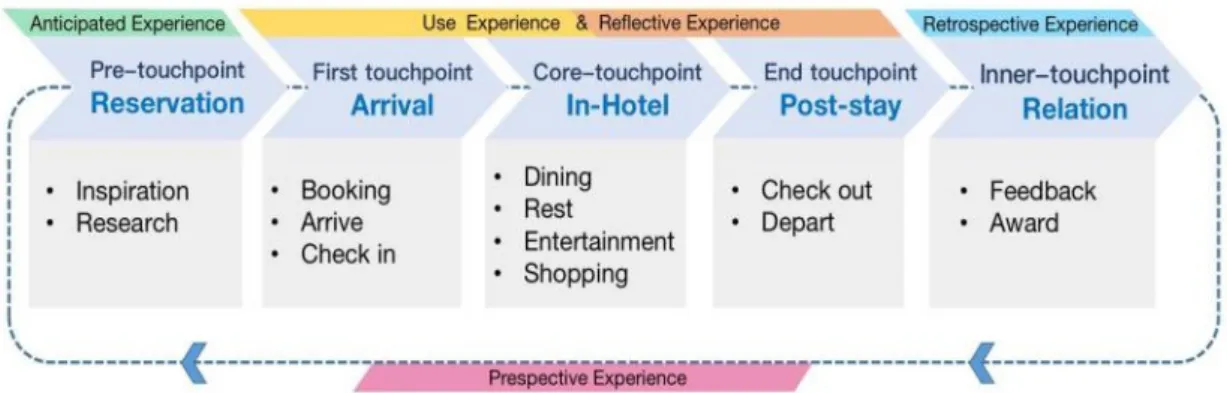
From these perspectives, touch points appear at all stages of the customer’s smart hotel journey including “Make reservation”, "arrival", “stay in”,

“post-stay”,and "Relation”(Fig. 1). Conduct these touchpoints research to understand pain points in customer journey where connected devices, infrastructure, and it’scan best serve customer experience.

4. Case study 4.1 Method

This research has been conducted using both literature reviews and case studies. Referred to books and articles on consumer psychology, marketing, design psychology, and designology.

Then qualitative case analyses were also conducted, and for those analyses, chinese brand smart hotels were chosen, in order to check the applicability of research results. The consumer groups of these highly intelligent hotels are mostly after 80, 90 and 00. They have high quality and cultural level, are good at exploring

and accepting new things, and have a high understanding and support for the Internet and intelligent terminals. The related information was gathered through Field studies, interviews, and internet search for case analyses. The five analysis items: Reservation, arrival, stay in, post-stay and relation, which are the characteristics of touch points appear at all stages of the customer’s smart hotel journey analyzed in Chapter 3, are defined as an analysis frame, matrix X-axis standard, and the characteristics of interactivity, personalization, accessibility, informativeness and privacy safety of the smart service experience analyzed in Chapter 2,are used as the Y-axis and the characteristics of each case are used as a framework for analysis.

The elements of each category are evaluated as (○: low) when the experiential element of a smart hotel cannot be found, and if there is more than one (◎: normal), and if there are two or more, (●: high).

4.2 Case study:

4.2.1 Case1:Alibaba FlyZoo Hotel

Alibaba Group applying artificial intelligence

technology to the hotel, it has created the world's

first unmanned physical hotel to support facial

recognition: Fly Zoo Hotel. Located in Hangzhou,

China, the 290-room FlyZoo Hotel was built by

(6)

Shenzhen Yaduo QQSVIP Hotel Image

Dimensions of smarthotel experience

Customer Touchpoints forSmart Hotel

●:Strong ◎: medium ○: weak Reservation Arrival Stay in Post

-

stay Relation

Interactivity ◎ ◎ ◎ ○ ◎

Personalization ● ◎ ● ● ●

Accessibility ◎ ● ● ◎ ○

Informativeness ◎ ○ ◎ ◎ ◎

Privacy safety ◎ ◎ ● ◎ ◎

Comprehensive Analysis

- The location of the hotel is excellent, the QQ Super Member Hotel is full of penguin cartoon elements, and the lobby space is rich in functions, such as office area, book bar, retail area, etc.

- MIGO robot leads the way and delivers articles. AI speaker system is set in the room.

- Personalized service is outstanding. It is a hotel that combines smart facilities and human services.

- The hotel has developed an online retail business. The furniture and bedding in the guest room can be ordered and purchased online.

Table 4. Shenzhen Yaduo QQSVIP Hotel

Chengdu Leyizhu Smart Hotel Image

Dimensions of smarthotel experience

Customer Touchpoints forSmart Hotel

●:Strong ◎: medium ○: weak Reservation Arrival Stay in Poststay Relation

Interactivity ◎ ● ◎ ○ ◎

Personalization ◎ ◎ ◎ ○ ○

Accessibility ◎ ● ● ◎ ○

Informativeness ◎ ○ ◎ ◎ ◎

Privacy safety ◎ ◎ ● ◎ ◎

Comprehensive Analysis

- After booking, the hotel will send a text message with the room number and password to the customer's mobile phone.

- When checking in, the customer uses his ID card to register on the self-service registration terminal and perform "face recognition".There are vending machines and information kiosks in the lobby.

- The guest room uses AI speaker and automatic induction system.

Leyizhu APP is simple and easy to use. In addition to self-service booking and check-out, customer can also unlock the door directly on the app and make reservations for room cleaning services.

Table 5. Chengdu Leyizhu Smart Hotel Alibaba’s online travel platform, Fliggy, along

with other Alibaba Group business units, such as Alibaba A.I. Labs and Alibaba Cloud. A complete service system has been formed through the collaboration of various departments.This is a different service system from traditional hotels.They designed the hotel user experience process, a complete set of digital operation platforms, intelligent service centers and scenarios, and released different types of guest rooms, , everything was handed over to AI. Fly Zoo features a range of artificial intelligence-powered services to create a convenient, seamless experience for guests.

Alibaba Fly Zoo Hotel Image

Dimensions of smarthotel experience

Customer Touchpoints forSmart Hotel

●:Strong ◎: medium ○: weak Reservation Arrival Stay in Post

-

stay Relation

Interactivity ● ◎ ● ◎ ◎

Personalization ◎ ◎ ◎ ◎ ◎

Accessibility ● ○ ◎ ◎ ◎

Informativeness ◎ ◎ ◎ ◎ ◎

Privacy safety ● ◎ ● ● ◎

Comprehensive Analysis

- Self-registration and room card collection still need staff guidance.

Only when you book on Alipay or the hotel app, you can fully self-check in.

- The entire room is served by "Tmall Genie", an intelligent system that can voice control curtains, TV, lights, etc.

- There are many robots can provide services. They can lead the way, deliver meals and articles, mix drinks, make ice cream, etc.

- For contactless shopping, customers can operate directly on Alipay, and then be delivered to the room by a robot, or they can make self-service purchases in unmanned stores.

Table 3. Alibaba Fly Zoo Hotel

4.2.2 Case 2:Shenzhen Yaduo QQSVIP Hotel

This QQ Super Member Hotel will be deeply

integrated with Tencent's QQ Super Member

System. From registration, booking to check-in,

(7)

Dimensions of smarthotel experience

Customer Touchpoints forSmart Hotel

●:Strong ◎: medium ○: weak

Reservation Arrival Stay in Post-stay Relation

Ali QQ Le Ali QQ Le Ali QQ Le Ali QQ Le Ali QQ Le

Interactivity ● ◎ ◎ ◎ ◎ ● ● ◎ ◎ ◎ ○ ○ ◎ ◎ ◎

Personalization ◎ ● ◎ ◎ ◎ ◎ ◎ ● ◎ ◎ ● ○ ◎ ● ○

Accessibility ● ◎ ◎ ○ ● ● ◎ ● ● ◎ ◎ ◎ ◎ ○ ○

Informativeness ◎ ◎ ◎ ◎ ○ ○ ◎ ◎ ◎ ◎ ◎ ◎ ◎ ◎ ◎

Privacy safety ● ◎ ◎ ◎ ◎ ◎ ● ● ● ● ◎ ◎ ◎ ◎ ◎

Table 6. Analysis chart of smart hotel experience

Analysis of smart service experience factors

Table 7. Smart hotel's smart service experience factor analysis diagram

QQ Super Members will enjoy the corresponding privileged membership services of Atour Hotel. In this hotel, the latest technologies, including online AR viewing, self-service face check-in, smart door locks, etc., will be readily available, and traditional hotels will be transformed into smart hotels. Coupled with the data obtained by both parties in operations, they will be able to provide users with more targeted personalized services.

4.2.3 Case 3:Chengdu Leyizhu Smart Hotel This is an economical unmanned hotel in Chengdu. The brand's headquarters are located in Shenzhen, Guangdong. Le Yizhu has opened a number of hotels in many cities in China, with extremely high cost performance. Business travelers are the main customer group. Le Yizhu has developed its own APP and intelligent service system, the main purpose is to simplify the check-in procedure, and design the entire online operation process from booking, registration, checkout; every hotel in Le Yizhu has no front desk Waiter, customer can make online room selection and reservation through APP or WeChat official account, and support mobile payment.

When checking in, customer use their own ID card to complete the operation on the self-service terminal.

5. Results and Discussion

5.1 Resaults

(8)

Smart devices still need to supplement manual services while providing services. They have been able to solve the basic tasks of booking, check-in, and checkout. The investment of smart devices enhances the safety experience of customers.

Ali Future Hotel invested more smart devices in all touch points, but after they made mistakes, they led to low efficiency and poor barrier-free experience. On the contrary, Chengdu Hotel focuses its investment in intelligence on the booking and check-in stage. And the response is timely, the error rate is low, and the barrier-free experience is very nice.

Personalized experience is the current weakness. In order to make up for this weakness, QQsvip combines smart technology and personalized services through the cooperation of well-known boutique hotel brands, and therefore develops a balanced sense of experience. This provides a very valuable idea.

5.2 Discussion

5.2.1 Balance safety & privacy

The ability to execute and protect personal information has become a key factor in enhancing customers' intelligent experience.

Since everyone's view of security/privacy is highly subjective, this study considers security &

privacy not a core attribute, but a condition variable. In the context of technology mediation, the protection of personal and private information is a required feature. We should base on customer experience and use emotional design to strengthen the establishment and improvement of security system so that make smart service more reliable and establish a good relationship of trust with customer.

The technology still has the problem of stability. The accuracy and sensitivity of voice interaction and face recognition in hotel rooms cannot perfectly identify user behaviors in a timely and accurate manner. Cutting-edge

technologies such as speech recognition, deep learning, and biometrics all need to constant improving.

5.2.2 Integrate data to improve personalized service

From the user's perspective, digital and smart experiences are currently only operated in hotel reservations. Obviously, the application of big data should never be limited to the digital management and marketing . Big data should play a greater value and role in providing customers with intelligent and customized services to enhance user experience. With a big data-based approach to hotel customer segmentation, we can gain insight into the interests and consumption trends of each market segment and manage the hotel customer life cycle for each type of customer. The hotel can provide classified products and services for specific customers.

In the new consumer era, young groups demand personalized and diversified services, so smart hotels may become the choice of more users. With the help of intelligent technologies such as machine learning and deep learning, we can continuously analyze and understand user behaviors, gain insights and meet the real needs of users, optimize user emotions and living experience continuously. By providing smart, safe and reliable personalized services to cater to consumers' intelligent taste, while creating  a new lifestyle for young groups.

5.2.3 Social activities in the context of contactless services

For a long time, hotels have provided an open

and connected platform for direct

communication between people, with strong

social attributes. Technologies such as facial

recognition, moving keys, and cashless payments

in smart hotels have enabled human-machine

(9)

cooperation when customer reservation, check-in and check-out. However, it also weakens the original social attribute of the hotel to some extent. Therefore, it can be seen that the hotel in the future needs humanized human-computer interaction service experience, rather than just cold machines.

Hotels should consciously strengthen their social functions while upgrading their intelligence.

Hotels can develop apps to interact with customers in a timely manner to solve users' additional needs, such as recommendation, direction and other social services. It can also provide more humanized public areas for guests through space design, function creation and theme activities.

6. Conclusion

COVID-19 can be expected to have far-reaching impacts on tourists' consumption behaviour. In the process of designing the smart hotel customer experience architecture, how to visualize and clarify the "touchpoint" between the smart hotel and customers is a problem that every experience designer has to face. This research aims to identify, categorize and define the smart service experience that occur during customer experience at different touch points.

We developed a holistic understanding of a situation (i.e., touch point) through an in-depth analysis of recalled accounts of customer experiences from informants by using the sequential incident technique. Through thematic analysis of the case studies, five dimensions of the smart hotel experience can be identified:

interactivity, personalization, accessibility, informativeness and privacy safety .The analysis also shows that different touch points comprise distinct elements, which may vary based on the service interface of the touch point and the stage in the customer journey where the touch point

occurs.

This study has contributed to the operation and management of smart hotels. The high labor cost in the hotel industry is promoting the industrial transformation and the development of new smart hotels can solve this pain point well. The construction of smart hotel will comprehensively and systematically improve the management and service level, and fundamentally subvert the operation management mode and business profit mode of traditional hotel industry.

Different types of hotels can be upgraded intelligently according to their own positioning, understand the needs of the consumer groups for transformation. High-end hotel groups can set up a professional R&D department like Alibaba to optimize and improve the system based on the characteristics of their own hotels. Small and medium hotels can also use the equipment and systems provided by Internet companies to customize smart services according to their own needs. The development of smart technology also provides more research directions for the further exploration of smart experience design solutions in the coming years. we can continue to study the sustainable design and emotional experience design of smart hotels.

REFERENCES

[1] M. A. Christiansen. (2014). Inverted teaching: Applying a new pedagogy to a university organic chemistry class. Journal of Chemical Education, 91(11), 1845-1850.

DOI : 10.1021/ed400530z

[2] F. Seyitoğlu. (2020).Framework of the service delivery system design for hospitality firms in the (post-)viral world: The role of service robots. International Journal of Hospitality Management, 91, 102661.

DOI : 10.1016/j.ijhm.2020.102661

[3] Y. Y. Jiang. (2020). Effects of COVID-19 on hotel marketing and management: aperspective article.

Tourism Review.

DOI : 10.1108/TR-03-2020-0110

[4] H. I. Kuo, C. C. Chen, W. C. Tseng, L. F. Ju & B. W.

(10)

Huang. (2008), Assessing impacts of SARS and avian flu on international tourism demand to Asia. Tourism Management, 29(5) , 917-928.

[5] V. W. S. Tung & R. Law. (2017). The potential for tourism and hospitality experience research in human-robot interactions. International Journal of Contemporary Hospitality Management , 29(10), 2498-2513.

[6] J. Wen & S. Huang. (2020), Chinese tourists' motivations of visiting a highly volatile destination: a means-end approach. Tourism Recreation Research, 45(1) , 80-93.

[7] D. Buhalis & A. Amaranggana. (2013). Smart tourism destinations. In: Z. Xiang, I. Tussyadiah (eds.), Information and communication technologies in tourism 2014. (pp. 553−564). 


[8] D. E. Jeremen, M. Jędrasiak & A. Rapacz. (2016). The Concept of Smart Hotels as an Innovationon the Hospitality Industry Market –Case Study of Puro Hotel in Wrocław. Ekonomiczne Problemy Turystyki, 36, 65–

75. DOI : 10.18276/ept.2016.4.36-06

[9] B. Petrevska, V. Cingoski & S. Gelev. (2016). From Smart Rooms to Smart Hotels. Informacione tehnologije IT’16, February 29-March 5, Podgorica, Proceedings, 201-204.

[10] J. Teixeira, L. Patrcio, N. J. Nunes, L. Nbrega, R. P.

Fisk & L. Constantine. (2012). Customer experience modeling: from customer experience to service design. Journal of Service Management, 23(3). 362-376.

[11] G. Zomerdijk, Leonieke & A. Voss Christopher. (2010).

Service-Designfor Experience-Centric Services.

Journal of Service Research, 13(1), 67–82.

[12] L. P. Carbone & S. H. Haeckel. (1994). Engineering Customer Experiences," Marketing Management, 3(3), 8-19.


[13] S. Kabadayi, F. Ali, H. Choi, H. Joosten & C. Lu. (2019),

"Smart service experience in hospitality and tourism services: A conceptualization and future research agenda. Journal of Service Management, 30 (3), 326-348.

[14] S. K. Roy, M. S. Balaji, S. Sadeque, B. Nguyen & T. C.

Melewar. (2017). Constituents and consequences of smart customer experience in retailing. Technological Forecasting and Social Change, 124(C), 257-270.

[15] P. Frow & A. Payne. (2007). Towards the ‘perfect’customer experience. In Brand Management, 15(2), 89-101.

[16] J. M. Lee. (2018). Servicizing of Product Brand and Analyses of UX Touchpoints for Flagship Store.

Journal of the Korea Institute of Spatial Design, 13(3), 29-44. 


DOI : 10.35216/KISD.2018.13.3.29

[17] C. Meyer & A. Schwager. (2007). Understanding Customer Experience. Harvard Business Review, 85(2),

116–26.

[18] A. Parasuraman, A. Roggeveen, M. Tsiros & L. A.

Schlesinger. (2009). Customer Experience Creation:

Determinants, Dynamics, and Management Strategies.

Journal of Retailing, 85(1), 31–41.

[19] N. J. Webb. (2016). What Customers Crave: How to Create Relevant and Memorable Experiences at Every Touch-point. AMACOM Div. American Mgmt. Assn.

[20] J. Groopman. (2015). Customer Experience in the Internet of Things. Altimeter Group, March 2015,http://tinyurl.com/ze8bj23. A digital consulting firm researches how the Internet of Things will affect the customer experience.

루 쉬 안(Luo Xuan) [정회원]

․ 2006년 6월 : 센트럴 사우스 임업 및 기술 대학교 디자인전공(학사)

․ 2009년 6월 : 센트럴 사우스 임업 및 기술 대학교 디자인 공학 전공(석사)

․ 2019년 3월 ~ 현재 : 국민대학교 테크노디자인 전문대학원(박사)

․ 관심분야 : UX, UCD, 공간 디자인

․ E-Mail : [email protected]

반 영 환(Yonghwan Pan) [정회원]

․ 1991년 2월 : 한국과학기술원 산업공 학과(공학사)

․ 1993년 2월 : 한국과학기술원 인간공학 (공학석사)

․ 1999년 8월 : 한국과학기술원 인간공학 (공학박사)

․ 2006년 9월 ~ 현재 : 국민대학교 테크노디자인전문대학원 교수

․ 관심분야 : 인터랙션 디자인, 사용자경험(UX)

․ E-Mail : [email protected]

수치

Table  1.  Keywords  in  Smart  Experience
Table  2.  Five  dimensions  of  smart  hotel  experience
Fig.  1.  Application  of  Visibility  Line  to  touch  point  research.
Table  5.  Chengdu  Leyizhu  Smart  HotelAlibaba’s  online  travel  platform,  Fliggy,  along
+2

참조

관련 문서

Consider a cross section of large flow through which all streamlines are precisely straight and parallel. i) Forces, normal to the streamlines, on the element of fluid

This study the changes in structure and mechanical characteristics by the analysis on mechanical characteristics of the welding part and the post weld

A A A A Study Study Study Study Analysis Analysis Analysis Analysis of of of of the the the the J. Bach, a representative composer in Baroque period. Composed

This study realigns the core brand touch points with the design perspective, and shows key experience triggers for each contact points.. It is conducted based

Comparison of the groups’ awareness to the herpes zosterin relation to characteristics of the study papulation. † Statistical analysis performed

This study suggested diversity in the configuration of expression through expression of abstract images, the style of modern painting, which are expressed

Edit the layout in the design magazine, the nature of the design, the designers are trying to convey the power of the message depends on the magazine

The purpose of study are analyzing the effects of dance majors' self-management on dance performance ability, self-efficacy and concentration, In the future,