522
JOURNAL OF KOREAN FOREST SOCIETY
적외선등을 이용한 실외 실험적 온난화 처리가 소나무 묘목의 생장과 생리적 특성에 미치는 영향
이선정·한새롬·윤태경·한승현·정예지·윤순진·손요환*
고려대학교 환경생태공학과
Growth and Physiological Characteristics of Pinus densiflora Seedlings in Response to Open-field Experimental Warming
using the Infrared Lamp
Sun Jeoung Lee, Saerom Han, Tae Kyung Yoon, Seung Hyun Han, Yejee Jung, Soon Jin Yun and Yowhan Son
*Department of Environmental Science and Ecological Engineering, Korea University, Seoul 136-713, Korea
요 약: 기후변화는 수목의 생장과 생리적 특성에 영향을 미칠 것으로 예상되고 있다. 본 연구는 인위적 온난화에 의한 소나무 묘목의 생장과 생리적 반응을 알아보기 위한 목적으로 수행되었다. 이를 위하여 2010년 4월 고려대학 교 구내 묘포장에 1년생 소나무 묘목을 식재하고 당해 11월부터 적외선등을 이용하여 3oC 온도를 증가시키는 온난 화 처리를 하였으며, 2011년부터 3월부터 2013년 3월까지 묘고 및 근원경, 지상부 및 지하부 생물량, 잎의 엽록소 함량 및 질소 농도 등을 측정하였다. 묘고와 근원경의 경우 2012년 6월에 측정한 근원경을 제외하고 온난화 처리구 와 대조구간 유의한 차이를 보이지 않았다. 그러나 2013년 묘목 개체당 잎의 생물량은 온난화 처리구(23.94±2.10 g) 에서 대조구(26.08±1.72 g)보다 낮게 나타났으며, 줄기와 뿌리의 생물량 비율(S/R율)은 2013년에 온난화 처리구(1.09
±0.07)에서 대조구(1.31±0.10)보다 낮게 나타났다. 한편 잎의 엽록소 함량 및 질소 농도는 2011년 잎의 질소 농도 를 제외하고 온난화 처리와 대조구간 통계적으로 유의한 차이를 보이지 않았다. 그리고 잎의 C/N율은 2012년에 온 난화 처리구에서 대조구보다 높게 나타났다. 온난화 처리에 따른 소나무 묘목의 일부 생장 및 S/R율 감소는 온도 및 수분 스트레스와 관련이 있을 것으로 추정된다. 본 연구결과 향후 온난화가 지속되면 국내 소나무는 온도 및 수분 스트레스로 인해 지하부로의 탄소 분배를 확대시킬 가능성이 있는 것으로 사료된다.
Abstract: Climate change will affect the physiological traits and growth of forest trees. This study was conducted to investigate the effects of an experimental warming on growth and physiological characteristics of Pinus densiflora S. et Z. seedlings. One-year-old P. densiflora seedlings were planted in control and warmed plots in April 2010. The air temperature of warmed plots was increased by 3oC using infrared lamps from November 2010. We measured shoot height, root collar diameter, above and below ground biomass, chlorophyll contents and leaf nitrogen concentration from March 2011 to March 2013. Seedling height and root collar diameter showed no significant difference between warmed and control plots except for root collar diameter measured in June 2012. Seedling leaf biomass was lower in the warmed (23.94±2.10 g) than in the control (26.08±1.72 g) plots in 2013. Shoot to root ratio (S/R ratio) was lower in the warmed (1.09±0.07) than in the control (1.31±0.10) plots in 2013. Leaf nitrogen concentrations and chlorophyll contents were not significantly different between warmed and control plots except for leaf nitrogen concentration in 2011. Leaf C/N ratio was increased in 2012 under the warming treatment. Low growth and S/R ratio in warmed plots might be related to the higher temperature and water stress. In the future, the below-ground carbon allocation of P. densiflora might be increased by global warming due to temperature and water stress.
Key words : biomass, carbon allocation, global warming, height, leaf chlorophyll contents, pine, root collar diameter
*Corresponding author E-mail: [email protected]
서 론
산림은 우리나라 국토 면적의 약 64%를 차지하며 탄소 순환과 생태계 기능에 큰 역할을 하고 있다(Korea Forest Research Institute, 2012). 최근 기후변화로 인한 기온과 강 수량 변화에 따라 산림생태계 내 수종 구성, 식생대, 생산 성 등의 구조와 기능이 변화될 것으로 예측되고 있기 때 문에 기후변화에 의한 산림생태계 변화를 연구하는 것이 필요하다(Rustad et al., 2001; Wu et al., 2011). 한편 전 세계적으로 기후변화에 대한 생태계 반응을 연구하기 위 해 실외 실험적 연구와 모델 혹은 메타분석 등을 이용한 연구가 이루어지고 있다(Arend et al., 2011; Euskirchen et al., 2006; Rustad et al., 2001).
특히 온도는 식물의 생장과 생리적 특성에 영향을 미치 기 때문에 온도 상승에 따른 식물의 생장 및 생리적 반응 에 대한 연구는 많이 이루어져 왔다. 온도 상승에 대한 실 험적 연구와 모델 모의에 따르면 온난화에 의한 식물의 생장은 수종에 따라 증가하거나(Danby and Hik, 2007), 오히려 감소하거나(Barber et al., 2000) 변화가 없는 (Volder et al., 2004) 등 다양하게 나타나고 있다. 한편 온 난화는 기온 상승 이외에도 토양 수분 함량에 영향을 미 치는 것으로 알려져 있으며(De Boeck et al., 2007;
Rustad et al., 2001), 온난화에 대한 식물 생장 반응이 수 분 및 건조 스트레스에 영향을 받기도 한다(Barber et al., 2000; Yin et al., 2008).
소나무는 우리나라의 대표적인 조림 및 자생 수종으로 기후변화에 의한 소나무의 생장 및 생리적 변화는 생태적 인 측면에서 뿐 아니라 사회경제적 측면에서도 중요하다 (Byun et al., 2010). 이와 관련하여 국내에서 소나무림의 탄소 저장량(Noh et al., 2010b), 탄소 순환(Noh et al., 2010a), 고사목 동태(Yoon et al., 2011), 산림시업에 따른 탄소 순환(Kim et al., 2008; Kim et al., 2009), 토양 탄 소 모형 개발 및 적용(Yi et al., 2013) 등의 연구 결과가 보고되었으며, 소나무림의 기초적인 탄소 순환 연구도 일 부 진행된 상태이다. 그러나 기후변화, 특히 온도 증가에 따른 소나무림의 생장 및 생리적 반응에 대한 연구는 부 족한 실정이다. 한편 국내에서 모형을 이용한 선행 연구 에 의하면 기후변화에 따라 소나무림의 면적이 점차 줄어 들 것으로 예측되고 있으며, 참나무류에 비해 소나무림이 온도 상승에 대해 취약한 것으로 보고된 바 있다(Byun et al., 2010). 그런데 이와 같은 모형에 의한 결과를 검증하 고 실제 기후변화에 따른 소나무의 반응과 그 변화 기작 을 구명하기 위해서는 실험적으로 기후변화에 따른 소나 무의 생장 반응을 연구할 필요가 있다.
기후변화 실험적 연구는 실외 실험과 실내 실험으로 나 눌 수 있고, 실외 실험은 실내 실험에 비해 실제 기후변화
와 유사한 환경을 조성할 수 있기 때문에 생태계 반응을 보다 정확하게 예측할 수 있다는 장점을 가진다(Jo et al., 2011; Lee et al., 2012). 실외 실험에는 오픈탑챔버, 토양 열선, 적외선등을 이용한 온난화 방법 등이 있으며, 이 가 운데 적외선등을 이용한 온난화 방법이 자연 생태계와 가 장 유사한 조건을 모의할 수 있는 것으로 알려져 있다 (Kimball et al., 2008). 한편 실외에서 성목을 대상으로 온 난화 처리를 하는 것은 기술적으로 매우 어렵기 때문에 묘목을 대상으로 연구하는 것이 현실적인 방법이다 (Cavender-Bares and Bazzaz, 2000). 따라서 본 연구는 소 나무를 대상으로 적외선등을 이용한 실외 실험적 온난화 처리가 묘목의 생장과 생리적 특성에 미치는 영향을 알아 보고자 수행되었다.
재료 및 방법
1. 연구 대상지 및 온난화 처리
2010년 4월에 서울시 성북구 안암동 고려대학교 녹지캠 퍼스 내(N 37° 35' 36", E 127° 1' 31")에 실외 묘포장을 조성하였다. 묘포장의 초기 토양성질은 산도(pH)는 6.85, 양이온 치환 용량은 5.12 cmol kg−1, 탄소 농도는 2.18%, 질소 농도는 0.16% 등이었으며, 토양 입경의 평균 비율 (%)은 모래, 미사, 점토가 각각 82.3, 11.7, 6.0 이고 토성 은 사양토이다(Jo et al., 2011). 온난화 처리구와 대조구 (n=4)의 묘상(1 m×1 m)을 난괴법으로 배치하고 1년생 소 나무 묘목을 Lee et al.(2009)에 따라 90본씩 정방형으로 식재하였다. 2010년 11월부터 적외선등(FTE-1000, Mor Electric Heating Association Inc., USA)을 작동시켰다.
IPCC SRES 국내 시나리오를 바탕으로 본 연구 시점 기 준 약 50년 후의 예측 온도 값을 참고하여 온난화 처리구 의 대기 온도를 설정하였으며(http://www.climate.go.kr), 온
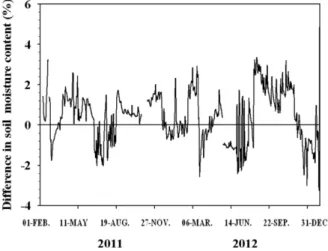
Figure 1. Differences in soil moisture content between control and warmed plots for Pinus densiflora seedlings.
도는 적외선 온도 센서(SI-111, Campbell Inc., USA), 데 이터 로거(CR-3000, Campbell Inc., USA), 릴레이를 이용 하여 자동으로 조절할 수 있도록 설계하였다. 온난화 처 리구의 온도를 대조구에 비해 3oC 높게 처리하였을 때 일 평균 온난화 처리구의 대기 온도는 대조구보다 약 2-3oC 높게 유지되었으며(Lee et al., 2012), 토양 수분 함량은 측 정시기에 따라 다르지만 생육기에 해당하는 5월에서 10 월까지는 대체로 온난화 처리구에서 대조구보다 낮은 경 향을 보였다(Figure 1). 적외선등은 Kimball et al.(2008) 방법에 따라 조사구의 평균 묘고로부터 60 cm 높이로 조 절하였다. 2011년과 2012년 3월 두 차례에 걸쳐 각 조사 구 묘목 본수의 약 50%씩을 솎아내었다. 이때 조사구 내 의 평균적인 묘목의 크기보다 크거나 작은 것을 선정하여 굴취하였고, 남은 묘목간의 거리가 일정하게 유지되도록 하였다.
2. 묘목의 생장 및 생물량 측정
지상부 생장으로 묘고와 근원경은 각 조사구 내 16-22 본의 묘목을 대상으로 2011년 3월, 그리고 2012년 6월과 11월에 각각 측정하였다. 묘고는 지상으로부터 가장 긴 줄 기의 길이를 1 mm 단위까지 측정하였으며, 근원경은 지 표로부터 2 cm 위 묘목 부위에 표시를 하여 고정된 위치 의 직경을 디지털 캘리퍼(500-101, Mitutoyo, Japan)를 이 용하여 0.1 mm 단위까지 측정하였다.
지하부 뿌리 생장은 미니라이조트론(CI-600, CID Bio- Science, USA)을 이용하여 측정하였다. 이를 위하여 2011 년 4월에 각 조사구별로 한 개씩 투명 아크릴 튜브(길이 30 cm × 지름 7 cm)를 45° 각도로 15 cm 깊이까지의 토 양에 매설하고, 튜브의 지상부로 노출된 부분은 검은색 테 이프 및 마개를 이용하여 햇빛과 수분 유입을 차단하였다.
뿌리 영상은 2012년 3월 20일, 5월 9일, 6월 5일, 7월 3일, 8월 14일, 그리고 10월 25일에 각각 측정하였고, WinRHIZO Tron MF(Regent, Canada) 프로그램을 이용하여 뿌리의 길 이를 분석하였다.
지상부 및 지하부의 생물량은 2011년과 2012년 3월에 는 조사구 당 10본, 2013년 3월에는 조사구당 5본의 묘목 을 굴취하여 측정하였다. 굴취한 묘목 시료를 뿌리, 줄기, 잎 등으로 분리하고, 뿌리는 흐르는 물에 씻어 토양을 제 거한 다음 65oC에서 건조시켜 0.01 g 단위까지 무게를 측 정하였다. 또한 줄기 생물량을 뿌리 생물량으로 나누어 S/
R율(shoot to root ratio)을 계산하였다.
3. 잎의 엽록소 함량 및 질소 농도 측정
각 조사구에서 3본씩의 묘목을 선정하여 2011년에 발 달한 잎을 대상으로 2012년 5월, 7월, 8월, 9월, 10월에 각 각 엽록소 함량을 측정하였다. 채취한 시료는 2 mm 이내
로 잘게 자르고 20 mg을 정량하여 DMSO(dimethyl sulfoxide) 5 mL에 침전시켰다. 이후 중탕기에서 65oC로 1시간 중탕한 뒤 분광광도계(U-1100, Hitachi, Japan)를 이 용하여 648 nm와 665 nm의 파장에서 흡광도를 측정하고, 엽록소 a와 b 그리고 총 엽록소 함량을 구하였다(Barnes et al., 1992).
잎의 질소 농도는 2011년 3월에는 조사구 당 5본, 2012년과 2013년 3월에는 조사구 당 3본씩의 묘목에서 잎 시료를 채취하여 측정하였다. 시료는 65oC에서 건조 시킨 후 분쇄하여 원소 분석기(Vario Macro CHN, Elementar Analysensysteme GmbH, Germany)로 분석하였다.
3. 통계분석
실외 실험적 온난화 처리에 의한 소나무 묘목의 생장 및 엽록소 함량과 질소 농도 차이의 유의성은 분산분석을 이 용하여 검정하였다. 모든 분석에 SAS 9.2 software를 사용 하였다(SAS Institute Inc., USA).
결과 및 고찰
1. 묘목의 생장 및 생물량
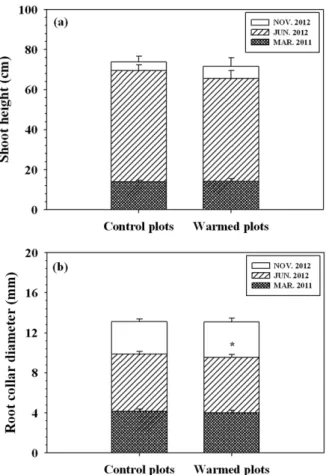
소나무의 묘고와 근원경(mm)은 2012년 6월의 근원경 (대조구: 9.9±0.3, 온난화 처리구: 9.5±0.3)을 제외하고 온 난화 처리구와 대조구 간 통계적으로 유의한 차이를 보이 지 않았다(Figure 2). 그리고 2011년 3월부터 2012년 11월 까지의 소나무 묘목 묘고(cm)와 근원경(mm)의 생장량은 온난화 처리구(57.4±3.9, 8.9±0.7)에서 대조구(59.8±2.8, 9.0±0.3)보다 낮은 경향을 보였으나, 통계적으로 유의한 차 이를 나타내지 않았다. 온난화에 의한 생장 반응은 온난 화 처리 기간, 부위, 수종, 연구지 등에 따라 다양하게 나 타나는 것으로 보고되고 있다(Arend et al., 2011; Barber et al., 2000; Bronson et al., 2009; Kellomäki and Wang, 2001). 온난화에 따른 Pinus sylvestris의 생장 반응을 관찰 한 연구에 의하면 1-4oC 온도 상승 시 북위 57° 이상 지역 유럽의 경우 수고 생장이 증가한 반면, 북위 54° 미만 지 역 유럽에서는 수고 생장이 감소되는 것으로 보고되었다 (Reich and Oleksyn, 2008). 이와 같이 북유럽과는 반대로 중앙 및 남부 유럽에서 나타나는 생장 감소 현상은 온난 화에 따른 온도 및 수분 스트레스와 관련이 있는 것으로 보고되었다(Kjellström, 2004; Reich and Oleksyn, 2008).
한편 초본을 대상으로 한 다른 연구에도 고온 건조한 토 양 조건에서 식물의 생장과 광합성률이 감소되었는데, 이 는 높은 온도와 수분 스트레스가 광합성과 관련이 있는 생리적 기작을 제한하기 때문으로 보고된 바 있다(Xu and Zhou, 2006). 한편 본 연구지의 굴참나무를 대상으로 한 온난화 연구에서 온난화 처리 후 묘목의 생장이 촉진되었
고, 이는 온난화 처리에 의해 묘목의 생장기간이 증가하 고, 온도 상승에 따라 광합성이 촉진되기 때문으로 보고 되었다(Jo et al., 2011; Lee et al., 2012; Lee et al., 2013).
그러나 본 연구에서 통계적으로 유의하지는 않지만 온난 화 처리후 묘고와 근원경 생장량이 오히려 감소하는 경향
을 보였는데, 이와 같은 현상은 수종에 따라 생육 적정 온 도가 다르기 때문인 것과 관련이 있는 것으로 판단된다 (Gunderson et al., 2010; Zhou et al., 2007). 한편 본 연 구에서 2012년 6월에 측정한 근원경만 온난화 처리구에 서 대조구보다 통계적으로 유의하게 낮게 나타났는데, 이 는 온도 증가에 따른 온도 및 토양 수분 스트레스 때문인 것으로 사료된다(Barber et al., 2000; Reich and Oleksyn, 2008).
소나무 묘목의 세근 길이 생장량은 모든 측정시기에서 온난화 처리구와 대조구간 통계적으로 유의적 차이를 보 이지 않았다. 한편 세근 길이 생장량(µm cm−2 day−1)은 대 조구와 온난화 처리구 모두 6월에 가장 높은 값인 36.48±21.99과 24.99±4.50를 보였고, 10월에 가장 낮은 값 인 3.44와 3.70±0.26을 나타내었다(Figure 3). 다른 연구에 서는 온난화 처리에 따라 뿌리 혹은 세근의 길이 생장이 증가하거나(Kellomäki and Wang, 2001) 감소하는(Arend Figure 3. Fine root (≤ 2 mm diameter) production of Pinus densiflora seedlings at 0-15 cm soil depth in control and warmed plots from May 2012 to October 2012. Vertical bars indicate the standard errors of means (n=1-11). No error bars reported when the value is within the limits of the symbol.
Table 1. Biomass and shoot to root ratio (S/R) of Pinus densiflora seedlings in control and warmed plots. The values in parentheses are standard errors of four replicates (n=10 per replicate in 2011, 2012, n=5 per replicate in 2013).
Biomass 2011 2012 2013
Control Warmed P Control Warmed P Control Warmed P
Total
(g)
3.71 (0.45)2.99 (0.52)
0.3334 22.55 (0.82)
21.77 (0.75)
0.5902 77.56 (4.78)
75.51 (4.47)
0.5111
Root
(g)
1.37 (0.10)1.20 (0.17)
0.3219 5.03
(0.19)
4.18 (0.32)
0.1689 22.89 (1.90)
24.99 (1.17)
0.2683
Shoot
(g)
0.64 (0.10)0.55 (0.06)
0.4837 5.90 (0.46)
5.16 (0.36)
0.2540 28.59 (1.73)
26.59 (1.85)
0.3004
Leaf
(g)
1.70 (0.28)1.24 (0.30)
0.3369 11.61 (0.50)
12.44 (0.25)
0.2570 26.08 (1.72)
23.94 (2.10)
0.0212
S/R 0.49
(0.06)
0.50 (0.03)
0.8860 1.20
(0.12)
1.33 (0.11)
0.3910 1.31
(0.10)
1.09 (0.07)
0.0151 Figure 2. Shoot height (a) and root collar diameter (b) of
Pinus densiflora seedlings in control and warmed plots. Error bars indicate standard errors of four replicates (n=16-22 per replicate). The asterisk denotes a significant difference between control and warmed plots at the level of P=0.05 by analysis of variance.
et al., 2011) 등 상반된 결과가 보고되고 있다. 한편 온난 화 처리에 따른 세근 길이 생장량의 차이가 통계적으로 유의하지는 않았지만 여름철에 증가하고, 가을철 이후에 는 감소하는 계절적인 경향을 관찰할 수 있었고, 이러한 경향은 국내 소나무림을 대상으로 한 이전 연구에서도 보 고된 바 있다(Noh et al., 2012).
소나무 묘목의 지상부 및 지하부 생물량(g)은 2013년 잎 의 생물량에서만 온난화 처리구(23.94±2.10)에서 대조구 (26.08±1.72)보다 낮게 나타났으며(P<0.05), 다른 연도와 부위에서는 통계적으로 유의한 차이를 보이지 않았다(Table 1). 잎 생물량이 감소된 것은 온도 상승에 따른 눈(芽)의 반응과 관련이 있을 것으로 사료된다. 즉 침엽수의 생장 과 발달은 눈과 밀접한 관련이 있으며, 눈의 형성과 개아 는 온도에 민감하게 반응한다(Lee, 1997; Slaney et al., 2007). 한편 다른 연구에서도 온도 상승에 따라 비정상적 인 눈의 발달 혹은 조기 개아로 봄철 서리 피해를 입어 잎 의 생물량이 감소되거나, 나무의 구조가 변화한 것으로 보 고된 바 있어(Apple et al., 1998; Olszyk et al., 1998;
Olszyk et al., 2003), 본 연구 결과도 이와 유사한 영향을 받은 것으로 판단된다. 이외에도 식물은 수분 결핍시 잎 의 탈리와 엽면적의 감소 등과 같은 적응 기작을 나타내 는 것으로 보고되어(Lincoln and Eduardo, 2010), 본 연구 에서의 잎 생물량 감소 결과도 이와 관련이 있을 것으로 추정된다.
한편 소나무 묘목의 S/R율은 2013년에 온난화 처리구 (1.09±0.07)에서 대조구(1.31±0.10)보다 낮게 나타났다 (P<0.05; Table 1). 온난화 처리에 따라 소나무 묘목의 S/R 율이 감소한 것은 수분 스트레스와 관련이 있는 것으로 보인다. 특히 본 연구의 2012년 여름철과 가을철 토양 수 분 함량은 대체로 온난화 처리구에서 대조구보다 낮은 것 으로 관찰되었다(Figure 1). 이전 연구에도 온난화 처리에 따라 Picea asperate의 S/R율이 낮아졌고, 이는 초기 묘목 발달시기에 일어나는 수분 스트레스와 관련이 있는 것으 로 보고된 바 있다(Yin et al., 2008). 특히 뿌리는 토양 수 분 결핍 조건에서 수분 조건이 양호한 토양 쪽으로 뿌리 의 발달이 일어나기 위해 근단으로 양분이 분배되는 것으 로 알려져 있어(Lincoln and Eduardo, 2010), 본 연구에서 온난화 처리에 따른 소나무 묘목의 S/R율 감소는 토양 수 분 결핍에 따른 뿌리의 적응 기작과 관련이 있을 것으로 사료된다.
2. 잎의 엽록소 함량 및 질소 농도
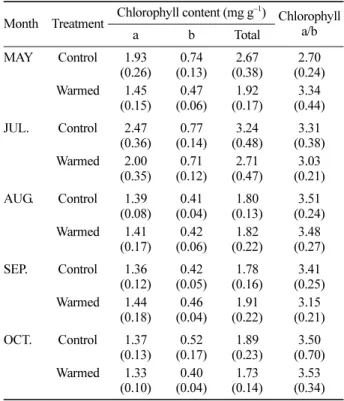
소나무 묘목의 생리적 특성으로 엽록소 함량은 온난화 처리에 따라 뚜렷한 차이를 보이지 않았다(Table 2). 또한 총 엽록소 함량은 온난화 처리구와 대조구 모두에서 생육 기인 5월에서 7월까지는 증가하다가 가을철인 10월에는
감소하는 계절적 경향을 보였다. 엽록소 함량은 온난화 처 리에 따라 증가하거나(Jo et al., 2011; Lee et al., 2013;
Zhao and Liu, 2009) 감소하는(Han et al., 2012) 등 다양 하게 나타나고 있으며, 이는 수종에 따라 온도에 대한 생 리적 반응이 다르기 때문으로 보고되고 있다.
잎의 질소 농도는 2011년을 제외하고 온난화 처리구와 대조구간에 뚜렷한 차이를 보이지 않았다(Table 3). Van Cleve et al.(1990)은 토양 온난화 처리에 따라 Picea mariana 잎의 질소 농도가 증가하였으며, 이러한 결과는 온도 상승에 따라 낙엽층의 분해가 촉진되었기 때문이라 고 보고하였다. 그러나 다른 연구에 의하면 온난화 처리 는 잎의 질소 농도를 감소시켰으며(An et al., 2005), 이는 온난화 처리구에서 토양의 질소 무기화가 감소된 것과 관 련이 있을 것으로 보고하였다(Wan et al., 2005). 보통 잎 의 질소 농도는 토양 내 이용 가능한 질소 양분과 밀접한 관련이 있는데, 본 연구지 묘포 토양은 질소 농도가 매우 낮으며(Jo et al., 2011) 일반 산림 생태계와는 달리 미생물 의 활동이 제한적으로 일어나고 있고 이들이 온난화에 의 해 거의 변하지 않고 있기 때문에(Unpublished data) 온난 화에 의한 토양 양분 변화 효과는 없는 것으로 보인다. 그 러나 질소 무기화가 온난화 처리 1차년에는 증가하고, 2 차년에는 감소한 결과도 있어(Wang et al., 2005), 온난화 에 의한 토양 양분 변화를 질소 무기화를 측정함으로써 직접 관찰할 필요가 있는 것으로 사료된다.
Table 2. Leaf chlorophyll contents of Pinus densiflora seedlings in control and warmed plots. The values in parentheses are standard errors of four replicates (n=3 per replicate).
Month Treatment Chlorophyll content (mg g−1) Chlorophyll
a b Total a/b
MAY Control 1.93 (0.26)
0.74 (0.13)
2.67 (0.38)
2.70 (0.24) Warmed 1.45
(0.15)
0.47 (0.06)
1.92 (0.17)
3.34 (0.44) JUL. Control 2.47
(0.36)
0.77 (0.14)
3.24 (0.48)
3.31 (0.38) Warmed 2.00
(0.35)
0.71 (0.12)
2.71 (0.47)
3.03 (0.21) AUG. Control 1.39
(0.08)
0.41 (0.04)
1.80 (0.13)
3.51 (0.24) Warmed 1.41
(0.17)
0.42 (0.06)
1.82 (0.22)
3.48 (0.27) SEP. Control 1.36
(0.12)
0.42 (0.05)
1.78 (0.16)
3.41 (0.25) Warmed 1.44
(0.18)
0.46 (0.04)
1.91 (0.22)
3.15 (0.21) OCT. Control 1.37
(0.13)
0.52 (0.17)
1.89 (0.23)
3.50 (0.70) Warmed 1.33
(0.10)
0.40 (0.04)
1.73 (0.14)
3.53 (0.34)
한편 잎의 C/N율은 2012년에 온난화 처리구(44.01±1.55) 에서 대조구(36.05±2.07)보다 높게 나타났다(P<0.05, Table 3). 이전 연구에서도 온난화 처리에 따라 잎의 C/N율이 증 가하는 것으로 관찰된 바 있다(Sardans et al., 2008;
Wang et al., 2012). 본 연구에서 잎의 C/N율이 증가한 것 은 통계적으로 유의하지는 않지만 잎의 질소 농도가 감소 한데 따른 것으로, 다음과 같은 다양한 요인과 관련이 있 는 것으로 보고되었다. 첫째, 높은 온난화 처리에 따라 잎 에 질소 함량이 낮고 탄소 함량이 높은 구조물을 만들어 잎 조직을 보호하기 때문이다(Busotti et al., 2000; Sardans et al., 2008). 둘째, 잎의 질소가 건조한 조건에서 다른 목 질부로 이동하는 가뭄 회피 기작에 의해 감소하기 때문이 다(Sardans et al., 2008). 셋째, 잎의 질소 농도와 밀접한 관련이 있는 토양 내 질소 양분은 질소 무기화에 결정되 는데(An et al., 2005; Van Cleve et al., 1990), 일정한 범위 내에서 토양 수분 함량이 감소할수록 질소 무기화도 감소하기 때문이다(Emmett et al., 2004). 본 연구에서도 측정시기에 따라 차이가 있으나 생육기에 해당하는 5월에 서 10월까지는 대체로 온난화 처리구에서 토양 수분 함량 이 감소하는 것으로 관찰되었고(Figure 1), 일반적으로 온 난화 처리에 따라 토양 수분이 감소하는 것으로 보고되고 있다(De Boeck et al., 2007; Rustad et al., 2001). 따라 서 온난화 처리에 따른 2012년 잎의 C/N율 증가도 이와 같은 요인들과 관련이 있는 것으로 추측된다(Busotti et al., 2000; Emmett et al., 2004; Sardans et al., 2008).
결 론
온난화 처리는 소나무 묘목의 일부 생장을 감소시켰으 나, 2011년 잎의 질소 농도와 2012년 잎의 C/N율을 제외 하고 생리적 특성에는 뚜렷한 영향을 미치지 않는 것으로 나타났다. 특히 본 연구에서 온난화 처리에 따라 소나무 묘목의 2012년 6월의 근원경과 2013년 잎의 생물량과 S/
R율이 감소하였다. 즉 온난화 처리는 소나무 묘목의 지하 부 탄소 분배를 촉진시켰으며, 이는 온난화 처리에 의한 온도 및 수분 스트레스와 관련이 있을 것으로 사료된다.
한편 2011년 잎의 질소 농도는 온난화 처리구에서 대조구 보다 높게 나타났는데, 이는 질소 무기화를 측정함으로써 정확한 원인을 구명할 수 있을 것으로 판단된다. 또한 2012 년의 잎의 C/N율이 온난화 처리구에서 높게 나타난 것은 온난화 처리구에서 토양의 수분이 감소하는 것과 관련이 있는 것으로 추측된다. 이와 같이 식물의 생장 반응은 토 양 수분 함량과도 밀접한 관련이 있기 때문에 향후 온도 외에 수분조건을 달리하는 기후변화 실험이 필요할 것으 로 사료된다.
감사의 글
본 논문은 한국연구재단 중견연구자지원사업(과제번호 : 2010-0014620)의 지원에 의한 연구 결과의 일부입니다.
인용문헌
An, Y., Wan, S., Zhou, X., Subedar, A.A., Wallace, L.L., and Luo, Y. 2005. Plant nitrogen concentration, use effi- ciency, and contents in a tallgrass prairie ecosystem under experimental warming. Global Change Biology 11(10):
1733-1744.
Apple, M.E., Lucash, M.S., Olszyk, D.M., and Tingey, D.T.
1998. Morphogenesis of Douglas-fir bud is altered at ele- vated temperature but not at elevated CO2. Environmen- tal and Experimental Botany 40(2): 159-172.
Arend, M., Kuster, T., Günthardt-Goerg, M.S., Dobbertin, M., and Abrams, M. 2011. Provenance-specific growth responses to drought and air warming in three European oak spe- cies (Quercus robur, Q. petraea and Q. pubescens). Tree Physiology 31(3): 287-297.
Barber, V.A., Juday, G.P., and Finney, B.P. 2000. Reduced growth Alaskan white spruce in the twentieth century from tempera- ture-induced drought stress. Nature 405: 668-673.
Barnes, J.D., Balaguer, L., Manrique, E., Elvira, S., and Davison, A.W. 1992. A reappraisal of the use of DMSO for the extraction and determination of chlorophylls a and b in lichens and higher plants. Environmental and Experimen- tal Botany 32(2): 85-100.
Table 3. Carbon and nitrogen concentrations and C/N ratios in leaves of Pinus densiflora seedlings in control and warmed plots.
The value in parentheses are standard errors of four replicates (n=5 per replicate in 2011, n=3 per replication in 2012 and 2013).
The asterisk denotes a significant difference between control and warmed plots at the level of P=0.05 by analysis of variance.
Treatment 2011 2012 2013
C (%) N (%) C/N C (%) N (%) C/N C (%) N (%) C/N
Control 50.59
(0.15)
1.49 (0.07)
35.08 (1.82)
50.24 (0.22)
1.46 (0.13)
36.05 (2.07)
50.84 (0.28)
1.32 (0.05)
38.77 (1.41)
Warmed 48.56
(1.59)
1.84* (0.05)
26.84 (1.55)
50.11 (0.40)
1.16 (0.04)
44.01* (1.55)
51.09 (0.15)
1.25 (0.06)
41.44 (2.17)
Bronson, D.R., Gower, S.T., Tanner, M., and Van Herk, I.
2009. Effect of ecosystem warming on boreal black spruce bud burst and shoot growth. Global Change Biology 15(6):
1534-1543.
Bussotti, F., Borghini, F., Celesti, C., Leonzio, C., and Bruschi, P.
2000. Leaf morphology and macronutrients in broadleaved trees in central Italy. Trees 14(7): 361-368.
Byun, J., Lee, W., Nor, D., Kim, S., Choi, J., and Lee, Y.
2010. The relationship between tree radial growth and topographic and climate factors in red pine and oak in central regions of Korea. Journal of Korean Forest Soci- ety 99(6): 908-913 (in Korean).
Cavender-Bares, J. and Bazzaz, F.A. 2000. Changes in drought response strategies with ontogeny in Quercus rubra: implica- tions for scaling from seedlings to mature trees. Oecolo- gia 124(1): 8-18.
Climate Change Information Center. 2013. SRES South Korea (10 km). http://www.climate.go.kr (2013. 09. 09).
Danby, R.K. and Hik, D.S. 2007. Responses of white spruce (Picea glauca) to experimental warming at a subarctic alpine treeline. Global Change Biology 13(2): 437-451.
De Boeck, H.J., Lemmens, C.M.H.M., Gielen, B., Bossuy, H., Malchair, S., Carnol, M., Merckx, R., Ceulemans, R., and Nujs, I. 2007. Combinaed effects of climate warming and plant diversity loss on above- and below-ground grass- lang productivity. Enviromental and Experimental Botany 60(1): 95-104.
Emmett, B.A., Beier, C., Estiarte, M., Tietema, A., Kris- tensen, H.L., Williams, D., Peñuelas, J., Schmidt, I. and Sowerby, A. 2004. The response of soil processes to cli- mate change: results from manipulation studies of shru- blands across an environmental gradient. Ecosystems 7(6):
625-637.
Euskirchen, E.S., McGuire A.D., Kicklighter, D.W., Zhuang, Q., Clein, J.S., Dargaville, R.J., Dye, D.G., Kimball, J.S., McDonald, K.C., Melillo, J.M., Romanovsky, V.E., and Smith, N.V. 2006. Importance of recent shifts in soil ther- mal dynamics on growing season length, productivity, and carbon sequestration in terrestrial high-latitude ecosystems.
Global Change Biology 12(4): 731-750.
Gunderson, C.A., O'Hara, K.H., Campion, C.M., Walker, A.V., and Edwards, N.T. 2010. Thermal plasticity of pho- tosynthesis: the role of acclimation in forest responses to a warming climate. Global Change Biology 16(8): 2272- 2286.
Han, S., Kim, D., Kim, G., Lee, J., and Yun, C. 2012. Changes on initial growth and physiological characteristics of Larix kaempferi and Betula costata seedlings under elevated temperature. Korean Journal of Agricultural and Forest Meteorology 14(2): 63-70 (in Korean).
Jo, W., Son, Y., Chung, H., Noh, N.J., Yoon, T.K., Han, S., Lee, S.J., Lee, S.K., Yi, K., and Jin, L. 2011. Effect of artificial warming on chlorophyll contents and net photosynthetic
rate of Quercus variabilis seedlings in an open-field experi- ment. Journal of Korean Forest Society 100(4): 733-737 (in Korean).
Kellomäki, S. and Wang, K.Y. 2001. Growth and resource use of birch seedlings under elevated carbon dioxide and tem- perature. Annals of Botany 87(5): 669-682.
Kim, C. 2008. Soil CO2 efflux in clear-cut and uncut red pine (Pinus densiflora S. et Z.) stands in Korea. Forest Ecol- ogy and Management 255(8-9): 3318-3321.
Kim, C., Son, Y., Lee, W.K., Jeong, J., and Noh, N.J. 2009. Influ- ences of forest tending works on carbon distribution and cycling in a Pinus densiflora S. et Z. stand in Korea.
Forest Ecology and Management 257(5): 1420-1426.
Kimball, B.A., Conley, M.M., Wang, S., Lin, X., Luo, C., Mor- gan, J., and Smith, D. 2008. Infrared heater arrays for warm- ing ecosystem field plots. Global Change Biology 14(2):
309-320.
Kjellström, E. 2004. Recent and Future Signatures of Cli- mate Change in Europe. Ambio 33(4): 193-198.
Korea Forest Research Institute. 2012. The forest and human in climate change. Korea Forest Research Institute. Seoul.
pp. 360 (in Korean).
Lee, K.J. 1997. Tree physiology. Seoul National University Press. Seoul. pp 504 (in Korean).
Lee, S.W., Kim, J.W., Kim, W.K., and Jo, M.S. 2009. The techniques and handling for major seedlings in Korea. Korea Forest Research Institute. Seoul. pp. 51 (in Korean).
Lee, S.J., Han, S., Yoon, T.K., Chung, H., Noh, N.J., Jo, W., Park, C. Ko, S., Han, S.H., and Son, Y. 2012. Effects of experimental warming on growth of Quercus variabilis seedlings. Journal of Korean Forest Society 101(4): 722- 728 (in Korean).
Lee, S.J., Han, S., Yoon, T.K., Jo, W., Han, S.H., Jung, Y., and Son, Y. 2013. Changes in chlorophyll contents and net pho- tosynthesis rate of 3-year-old Quercus variabilis seed- lings by experimental warming. Journal of Korean Forest Society 102(1): 156-160 (in Korean).
Lincoln, T. and Eduardo, Z (translation of Jun, B.O.). 2010. Plant physiology. Life Science. Seoul. pp. 751 (in Korean).
Noh, N.J., Son, Y., Jo, W., Yi, K., Park, C.W., and Han, S. 2012.
Preliminary study on estimating fine root growth in a nat- ural Pinus densiflora forest using a minirhizotron tech- nique. Forest Science and Technology 8(1): 47-50.
Noh, N.J., Son, Y., Lee, S.K., Yoon, T.K., Seo, K.W., Kim, C., Lee, W.K., Bae, S.W., and Hwang, J. 2010a. Influence of stand density on soil CO2 efflux for a Pinus densiflora foreat in Korea. Journal of Plant Research 123(4): 411- 419.
Noh, N.J., Son, Y., Lee, S.K., Seo, K.W., Heo, S.J., Yi, M.J., Park, P.S., Kim, R.H., Son, Y.M., and Lee, K.H. 2010b.
Carbon and nitrogen storage in an age-sequence of Pinus densiflora stand in Korea. Science China Life Science 53(7): 822-830.
Olszyk, D., Johnson, M.G., Tingey, D.T., Rygiewicz, R.T., Wise, C., VanEss, E., Benson, A., Storm, M.J., and King, R. 2003. Whole-seedling biomass allocation, leaf area, and tissue chemistry for Douglas-fir exposed to elevated CO2 and temperature for 4 years. Canadian Journal of Forest Research 33(2): 269-278.
Olszyk, D., Wise, C., VanEss, E., and Tingey, D. 1998. Ele- vated temperature but not elevated CO2 affects long-term patterns of stem diameter and height of Douglas-fir seed- lings. Canadian Journal of Forest Research 28(7): 1046- 1054.
Rustad, L.E., Campbell, J.L., Marion, G.M., Norby, R.J., Mitchell, M.J., Hartley, A.E., Cornelissen, J.H.C., Gure- vitch, J., and GCTE-NEWS. 2001. A meta-analysis of the response of soil respiration, net nitrogen mineralization, and aboveground plant growth to experimental ecosys- tem warming. Oecologia 126(4): 543-562.
Reich, P.B. and Oleksyn, J. 2008. Climate warming will reduce growth and survival of Scots pine except in the far north.
Ecology Letters 11(6): 588-597.
Sardans, J., Peñuelas, J., Marc, E., and Patricia, P. 2008.
Warming and drought alter C and N concentration, allo- cation and accumulation in a Mediterranean shrubland.
Global Change Biology 14(10): 2304-2316.
SAS Institute Inc., 2009. SAS/STAT® 9.2 user’s guide. SAS Institute Inc., Cary.
Slaney, M., Wallin, G., Medhurst, J., and Linder, S. 2007.
Impact of elevated carbon dioxide concentration and tem- perature on bud burst and shoot growth of boreal Nor- way spruce. Tree Physiology 27(2): 301-312.
Van Cleve, K., Oechel, W.C., and Hom, J.L. 1990. Response of black spruce (Picea mariana) ecosystems to soil tempera- ture modification in interior Alaska. Canadian Journal of Forest Research 20(9): 1530-1535.
Volder, A., Edwards, E.J., Evans, J.R., Robertson, B.C., Schorte- meyer, M., and Gifford, R.M. 2004. Does greater night- time, rather than constant, warming alter growth of man- aged pasture under ambient and elevated atmospheric CO2? New Phytologist 162(2): 397-411.
Wan, S., Hui, D., Wallace, L., and Luo, Y. 2005. Direct and indi- rect effects of experimental warming on ecosystem car- bon processes in a tallgrass prairie. Global Biogeochemical Cycles 19: GB2014.
Wang, J., Duan, B., and Zhang, Y. 2012. Effects of experi- mental warming on growth biomass allocation, and nee- dle chemistry of Abies faxoniana in even-aged monospecific stands. Plant Ecology 213(1): 47-55.
Wu, Z., Dijkstra, P., Koch, G.W., Peñuelas, J., and Hungate, B.A. 2011. Responses of terrestrial ecosystems to temper- ature and precipitation change: a meta-analysis of experi- mental manipulation. Global Change Biology 17(2): 927- 942.
Xu, Z.Z. and Zhou, G.S. 2006. Combined effects of water stress and high temperature on photosynthesis, nitrogen metabo- lism and lipid peroxidation of a perennial grass Leymus chinensis. Planta 224(5): 1080-1090.
Yi, K., Park, C., Ryu, S., Lee, K., Yi, M., Kim, C., Park, G., Kim, R., and Son, Y. 2013. Simulating the soil carbon dynamic of Pinus densiflora forests in central Korea. Scandinavian Journal of Froest Research 28(3): 241-256.
Yin, H.J., Liu, Q., and Lai, T. 2008. Warming effects on growth and physiology in the seedlings of the two conifers Picea asperata and Abies faxoniana under two contrasting light conditions. Ecological Research 23(2): 459-469.
Yoon, T.K., Chung, H., Kim, R., Noh, N.J., Seo, K.W., Lee, S.K., Jo, W., and Son, Y. 2011. Coarse woody debris mass dynamics in temperate natural forests of Mt. Jumbong, Korea. Journal of Ecology and Field Biology 34(1): 115-125.
Zhao, C. and Liu, Q. 2009. Growth and photosynthetic responses of two coniferous species to experimental warming and nitrogen fertilization. Canadian Journal of Forest Research 39(1): 1-11.
Zhou, X., Liu, X., Wallace, L.L., and Luo, Y. 2007. Photosyn- thetic and respiratory acclimation to experimental warm- ing for four species in a tallgrass prairie ecosystem.
Journal of Integrative Plant Biology 49(3): 270-281.
(2013년 7월 1일 접수; 2013년 9월 23일 채택)