JESK
http://jesk.or.kr eISSN:2093-8462Comparison of Vertical and Horizontal Eye Movement Times in the Selection of Visual Targets by an Eye Input Device
Seung Kweon Hong
Department of Industrial and Management, Korea National University of Transportation, Chungju, Chungbuk, 380-702
Corresponding Author Seung Kweon Hong Department of Industrial and
Management, Korea National University of Transportation, Chungju, Chungbuk, 380-702
Mobile : +82-10-9797-5389 Email : [email protected]
Received : October 23, 2014 Revised : December 23, 2014 Accepted : December 26, 2014
Copyright@2015 by Ergonomics Society of Korea. All right reserved.
○ccThis is an open-access article distributed under the terms of the Creative Commons Attribution Non-Commercial License (http://
creativecommons.org/licenses/by-nc/3.0/), which permits unrestricted non-commercial use, distribution, and reproduction in any medium, provided the original work is properly cited.
Objective: The aim of this study is to investigate how well eye movement times in visual target selection tasks by an eye input device follows the typical Fitts' Law and to compare vertical and horizontal eye movement times.
Background: Typically manual pointing provides excellent fit to the Fitts' Law model.
However, when an eye input device is used for the visual target selection tasks, there were some debates on whether the eye movement times in can be described by the Fitts' Law. More empirical studies should be added to resolve these debates.
This study is an empirical study for resolving this debate. On the other hand, many researchers reported the direction of movement in typical manual pointing has some effects on the movement times. The other question in this study is whether the direction of eye movement also affects the eye movement times.
Method: A cursor movement times in visual target selection tasks by both input devices were collected. The layout of visual targets was set up by two types. Cursor starting position for vertical movement times were in the top of the monitor and visual targets were located in the bottom, while cursor starting positions for horizontal movement times were in the right of the monitor and visual targets were located in the left.
Results: Although eye movement time was described by the Fitts' Law, the error rate was high and correlation was relatively low (R2 = 0.80 for horizontal movements and R2 = 0.66 for vertical movements), compared to those of manual movement.
According to the movement direction, manual movement times were not significantly different, but eye movement times were significantly different.
Conclusion: Eye movement times in the selection of visual targets by an eye-gaze input device could be described and predicted by the Fitts' Law. Eye movement times were significantly different according to the direction of eye movement.
Application: The results of this study might help to understand eye movement times in visual target selection tasks by the eye input devices.
Keywords: Eye input device, Fitts' Law, Movement direction, Selection task
1. Introduction
An eye tracker is a measurement device to measure the positions of eye-gaze and the time duration that the eyes stay in a position. As the eye tracker technology
improves, eye-gazes' positions and duration times can be reported in the real time nowadays. The technological advance allowed people to use the eye tracker as a computer input device. Recording the positions of eye-gaze in the real time indicates that users are able to point visual targets on the monitor by an eye tracker. However, there are indeed many arguments against the use of eye tracker as a pointing device. Vetegaal (2008) summarized four weak points as a pointing device. Firstly, eye trackers are very sensitive to user head movements. Secondly the accuracy of eye trackers in pointing is about 1 degree on screen, indicating the inaccuracy of measuring eye-gaze position. Thirdly, eye trackers need to be calibrated. Finally, eye trackers suffer from Midas Touch Effects (Jacob, 1991), namely that selections can happen unintentionally. However, some researchers consider that the eye tracker can be a useful pointing device with the advance of computer vision technology in the future, in particular for the disabled people.
The first goal of this study is to investigate whether the eye movement times in visual target selection tasks by an eye input device can be described by the Fitts' law model. Typically, Fitts' law is a robust model that describes the relationship between the movement time and the index of difficulty (Fitts, 1954; MackKenzie, 1992). Fitts (1954) proposed that MT = a + b log2(2A/W), where a and b are empirical constants, A is a movement amplitude, W is a target width and where log2(2A/W) is termed as the index of difficulty (ID). It has been reported that the movement times in the visual target selection tasks by a hand mouse is high fit with Fitts' Law model. However, there were just a few studies that investigated how well eye movement times in visual target selection tasks by the eye input device follow typical Fitts' Law.
Ware and Mikaelian (1987) assessed the use of an eye tracker in a selection task, using a Fitts' Law experimental paradigm. They did not compare the performance of selection tasks by a hand mouse with that of an eye input device. However, they suggested that movement times for eye input were significantly affected by target width, particularly with smaller than 1.5 degrees for visual angle. Error rates were high in all eye tracking conditions, with about 12% of trials. Chi and Lin (1997) suggested that the eye-movement time was significantly related to the target size and distance between targets, but the speed-accuracy trade-off was significantly different from that predicted by Fitts' Law. They also reported the reaction time was not significantly changed by the direction of eye movement. Zhai (1999) found correlations that were very low in the order of R2 = .75. The most likely cause for this was the presence of eye tracker noise in their experiment. Miniotas (2000) reported the highest fit with an R2 = 0.98.
Unfortunately, there are few empirical studies on the efficiency of eye input devices in visual target selection tasks. They did not provide consistent results to ensure that the eye movement times are described by Fitts' law model. Therefore additional investigation is required to understand the eye movement times in visual target selection tasks, analyzing the fit with the Fitts' law model.
Another goal of this study is to investigate whether eye movement times in visual target selection tasks are different according to the direction of eye movement. There were a few studies on the effect of movement direction on the manual movement times.
However, their results were not consistent. Gan & Hoffman (1988) reported that movement times were not significantly changed with the movement direction. However, Murata & Iwase (2001) proposed an extended Fitts' law for three-dimensional pointing task, on the assumption that manual movement time is changed with the movement direction. A question in this study is whether the direction of eye movement affects the eye movement time in the visual target selection tasks by the eye input device.
2. Method
2.1 ParticipantsTen paid volunteers (5 males, 5 females) were recruited from Korea National University of Transportation. Participants ranged from 22 to 28 years old (mean = 25). All were daily user of computers. None had prior experience with eye tracker. All participants
had normal, or corrected to normal vision. They took part in all experimental conditions.
2.2 Stimuli and apparatus
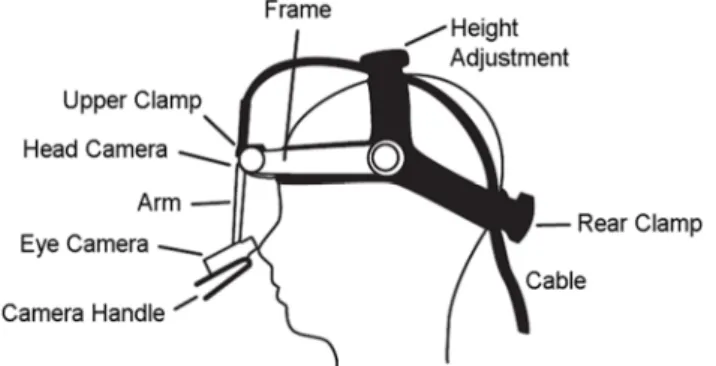
Input devices used in this experiment were a hand mouse and an eye input device. Typical optical mouse was used for a hand mouse. A head-mounted eye tracking systems, EyeLink II from SR Research Ltd, served as the eye input device (Figure 1). The measurement method was Pupil and Corneal Reflection for greater tolerance to head movements. A chin rest was used to minimize participants' head movements. The monitor was a 21-inch 1,280 ⅹ 2,014 pixel LCD. Participants sat at a viewing distance of approximately 60cm. The eye tracker sampled at 250Hz with an accuracy of 0.25° - 1.0° visual arc. Calibration was performed at the beginning the experiment using a 9-point calibration, with re-calibration as needed. Raw eye data and event data were collected using the software provided from EyeLink II system. When the fixation time on the target is longer than 100msec, the device recognized as the target was selected.
Figure 2 shows an example of stimuli for visual target selection tasks. The same stimuli were used for a hand mouse as well as an eye input device. Participants moved a cursor from starting position to a visual target. In case of vertical movement, the visual target was presented as a box with W width in the bottom of the monitor and the starting point was located in the top of the
monitor. In case of horizontal movement, the visual target was presented in the left of the monitor and the starting point was located in the right of the monitor. Position and width of visual target were changed according to the experimental conditions.
When a visual target selection task by a hand mouse starts, the position of cursor is automatically fixed on the starting point.
However, in order to start a visual target selection task by an eye input device, participants using their eyes moved the position of cursor to the circle around the starting point.
2.3 Tasks
All participants performed visual target selection task, moving a cursor to the visual target in vertical and horizontal direction.
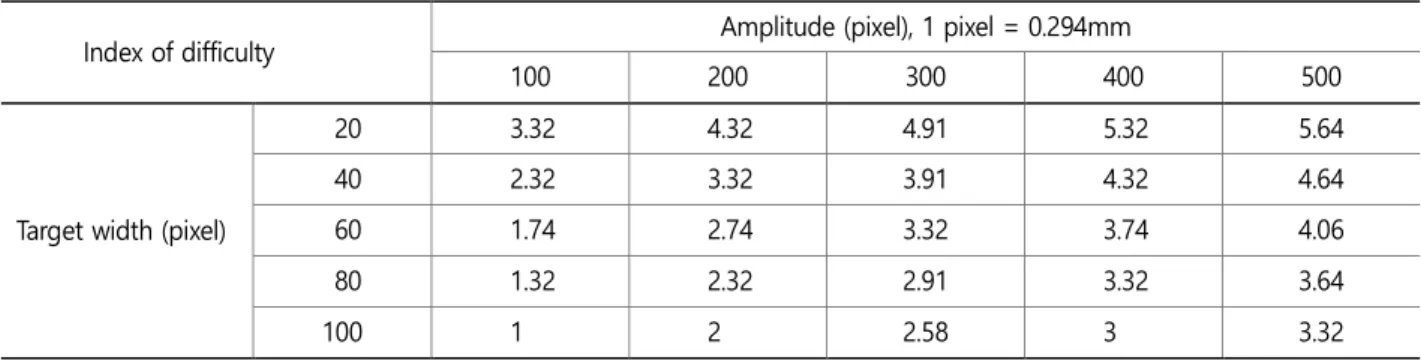
For the one direction and one input device, target width and amplitude in a stimulus set were varied as shown in Table 1. The index of difficulty was not evenly distributed and was ranged between 1 and 5.64. The experimental condition shown in each cell of the Table 1 was repeated two times by the each participant. The total number of trials by the each participant was 200 for two input devices and two movement direction.
3. Results
3.1 Error ratesThe input error is an important factor to measure the efficiency of input systems. This study defined the input error as an outlier of observation points. First of all, the observations were flagged based on measures such as the interquartile range. An outlier was defined as any observation outside the range in the following.
[Q1 - 1.5(Q3 - Q1), Q3 + 1.5(Q3 - Q1)] (1)
Table 2 shows the error rates as a percentage of trials per input technique and movement direction. The error rate in an eye Table 1. Experimental conditions of visual target selection task by each input device for each movement direction
Index of difficulty Amplitude (pixel), 1 pixel = 0.294mm
100 200 300 400 500
Target width (pixel)
20 3.32 4.32 4.91 5.32 5.64
40 2.32 3.32 3.91 4.32 4.64
60 1.74 2.74 3.32 3.74 4.06
80 1.32 2.32 2.91 3.32 3.64
100 1 2 2.58 3 3.32
Table 2. Error rates during vertical and horizontal movements
Error rate Vertical movement Horizontal movement
Hand mouse 11 out of 500 (2.2%) 22 out of 500 (4.4%)
Eye input device 49 out of 500 (9.8%) 33 out of 500 (6.6%)
input device was higher than that of a hand mouse. This may mean that it is difficult to control the eye input device, compared to a hand mouse.
3.2 Factors influencing on eye movement time
Generally, the times of visual target selection by the hand mouse can be described by the Fitts' law. The time is positively in proportion to the distance (amplitude) of visual target, while the time is in inverse proportion to the width of visual target. A question is whether or not such a relationship exists in the times of visual target selection by the eye input device. The analysis of variance was performed on the input times measured in the experiment. The main factors considered were direction eye movement (vertical and horizontal), target width (20, 40, 60, 80, 100 pixels), and target amplitude (100, 200, 300, 400, 500 pixels).
There were outliers defined as errors in input times. The outliers were removed for the analysis of variance. The missing data regarded as errors were substituted into the mean value at the corresponding experimental condition. The results of ANOVA showed that the effect of 3 main factors were significant. Eye movement times significantly changed according to the amplitude (F(4, 966) = 8.46, p<0.001) and the width of the visual target (F(4, 966) = 17.14, p<0.001) and the direction of eye movements (F(1, 966) = 166.75, p<0.001). The interactions were not significant.
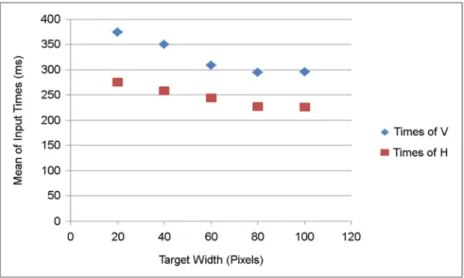
Figure 3 shows the relationship of mean of input times with the target width (20 to 100 pixels), while Figure 4 shows the relationship of mean of input times with the target amplitude (100 to 500 pixels). Regardless of the direction of eye movement, the mean times were positively in proportion to the distances (amplitude) of visual target, while the times were in inverse proportion to the widths of visual target.
3.3 Fitts' model fit
It was analyzed whether the input times for visual target selection can be described by the Fitts' law model. In case of the hand mouse, the mean of input times followed Fitts' law model as expected (c.f. Figure 5). The mean of input times in the vertical movements changed with the index of difficulty (R2 = 0.95), while that of horizontal movements also changed with the index of
difficulty (R2 = 0.97). However, the input time gap in between vertical movement and horizontal movement was not noticeable.
The mean input time in vertical movement was 790ms, while that of horizontal movement was 773ms.
Vertical hand movement :
MT
v= 375.8 + 124.7 × ID
(R2 = 0.95) (2)Horizontal hand movement:
MT
H= 378.5 + 199.0 × ID
(R2 = 0.97) (3)The mean of input times by the eye input system also followed Fitts' law model (c.f. Figure 6). The mean of input times in the vertical movements changed with the index of difficulty (R2 = 0.66), while that of horizontal movements also changed with the index of difficulty (R2 = 0.80). Although the obtained data indicated the relatively low fit to Fitts' model, it may suggest that input times by the eye input device still follow the Fitts' model. The input time gap in between vertical movement and horizontal movement was noticeable. The mean input time in vertical movement was 319ms, while that of horizontal movement was 238ms.
It may indicate that input times in case of eye movement in different directions can be described by the same Fitts' model.
Vertical eye movement :
MT
v= 219.4 + 29.9 × ID
(R2 = 0.66) (4)Horizontal eye movement :
MT
H= 189.1 + 17.7 × ID
(R2 = 0.80) (5)4. Conclusion
Eye movement times in visual target selection tasks by eye input device were influenced by amplitude as well as target width.
The eye movement times also provided a good fit to the Fitts' Law Model (R2 = 0.66 for the vertical movement and R2 = 0.80 for the horizontal movement). However, compared to visual target selection by a hand mouse (R2 = 0.95 for the vertical movement and R2 = 0.97 for the horizontal movement), the eye movement times provided lower correlations.
Vertical eye movement time was significantly longer than horizontal eye movement times. Fitts' law model for the vertical eye movement time also was different from that of the horizontal eye movement time. This result might be caused by the fact that human move their eyes more naturally in the horizontal direction than in the vertical direction. However, movement time by the hand mouse was not significantly changed according to the movement direction. The results of a few previous studies also indicated that the effect of movement direction in the selection tasks by a hand mouse was not statistically significant (Gan &
Hoffman, 1988). Nevertheless, Murata and Iwase (2001) suggested an extended Fitts' law with new type of ID, adding a direction factor to typical ID.
ID = Typical ID + c sinθ (6)
According to the results of this study, it might be desirable to apply this extension of Fitts' law model to the selection tasks by an eye input device, rather than the selection tasks by a hand mouse. Since this study only investigated the vertical and horizontal eye movement times, the extended Fitts' law model was not applied. In the future study, eye movement times in the diverse directions would be measured in order to apply the extended Fitts' model in the selection tasks by the eye input device.
Acknowledgements
This research was supported by Basic Science Research Program through the National Research Foundation of Korea (NRF) funded by the Ministry of Education (Grant-#NRF-2011-0023681).
References
Chi, C.F. and Lin, C.L., "Speed and Accuracy of Eye-Gaze Pointing", Perceptual and Motor Skills: 85, 705-718, 1997.
Fitts, P.M., The information capacity of the human motor system in controlling the amplitude of movement, Journal of Experimental Psychology, 47, 381-391, 1954.
Gan, K-C. and Hoffmann, E.R., Geometrical conditions for ballistic and visually controlled movements, Ergonomics, 31(5), 829- 839, 1988.
Jacob, R.J.K., The Use of Eye Movements in Human-Computer Interaction Techniques: What You Look At is What You Get, ACM Transactions on Information Systems, 9(3), 152-169, April 1991.
MacKenzie, I.S., Fitts' law as a research and design tool in human-computer interaction. Human-Computer Interaction, 7, 91-139, 1992.
Miniotas, D., Application of Fitts' Law to Eye Gaze Interaction. In Extended Abstracts of ACM CHI 2000 Conference on Human Factors in Computing Systems. The Hague, The Netherlands: ACM Press, 339-340, 2000.
Murata, A. and Iwase, H., Extending Fitts' law to a three-dimensional pointing task, Human Movement Science, 20, 791-805, 2001.
Vertegaal, R., A Fitts' Law Comparison of Eye Tracking and Manual Input in the Selection of visual Targets". Proceedings of the 10th international conference on Multimodal Interface, Chania, Krete, Greece, 241-248, Oct 20-22, 2008.
Ware, C. and Mikaelian, H.T., "An Evaluation of an Eye Tracker as a Device for Computer Input". Proceedings of the ACM CHI + GI'87 Human Factors in Computing Systems Conference. Toronto, Canada: ACM Press, 183-188, 1987.
Zhai, S., Morimoto, C. and Ihde, S., Manual and Gaze Input Cascaded (MAGIC) Pointing. In Proceedings of CHI'99 Conference on Human Factors in Computing Systems. Pittsburgh, PA: ACM Press, 246-253, 1999.
Author listings
Seung Kweon Hong: [email protected]
Highest degree: PhD, Department of Industrial Engineering, State University of New York
Position title: Professor,Department of Industrial & Management Engineering, Korea National University of Transportation Areas of interest: Cognitive Engineering, HCI