• 검색 결과가 없습니다.

A Study on the Reliability Improvement of the Turbine Control Valve System in Nuclear and Thermal Power Plants

N/A
N/A
Protected

Academic year: 2021

Share "A Study on the Reliability Improvement of the Turbine Control Valve System in Nuclear and Thermal Power Plants"

Copied!
8
0
0

로드 중.... (전체 텍스트 보기)

전체 글

(1)

ISSN 2671-7972(print) ISSN 2671-7980(online) http://dx.doi.org/10.7839/ksfc.2019.16.4.093

원자력/화력발전소의 터빈제어밸브시스템의 신뢰성 향상에 관한 연구 A Study on the Reliability Improvement of the Turbine Control Valve System in Nuclear and Thermal Power Plants

양종대

1

․양석조

2

․이용범

3*

Jong Dae Yang

1

, Seok Jo Yang

2

and Yong Bum Lee

3*

Received: 24 Oct. 2019, Revised: 01 Nov. 2019, Accepted: 05 Nov. 2019

Key Words:Power Plant(발전소), Turbine Control Valve(터빈제어밸브), Hydraulic Servo Actuator(유압서보 액 추에이터 ), Failure Analysis(고장분석), Air & Gas(기체)

Abstract: Nuclear and thermal power plants must provide the turbines with an appropriate degree of high temperature and high pressure steam, to produce the optimum electricity. Additionally, in the event of system and power system failure during electrical production, the steam is immediately disabled, to protect the turbines and generators rotating at high speed. The plant thus uses a special steam control valve system for turbine control, which is opened by force of the hydraulic servo actuator and closed by a large steel spring force. In this study, the causes of failure of the turbine control valve system, a key device of the power plants, were analyzed, and the causes of failure were improved relative to reliability of the equipment.

* Corresponding author: [email protected]

1 EnesG Co., Ltd., 8, Techno 10-ro, Yuseong-gu Daejeon, 34026, Korea

2 Department of Mechatronics Engineering, Chungnam National University, Daejeon 34134, Korea

3 Department of Reliability Assessment, Korea Institute of Machinery & Materials, Daejeon 34103, Korea

Copyright Ⓒ 2019, KSFC

This is an Open-Access article distributed under the terms of the Creative Commons Attribution Non-Commercial License(http://

creativecommons.org/licenses/by-nc/3.0) which permits unrestricted non-commercial use, distribution, and reproduction in any medium, provided the original work is properly cited.

기호 설명

 : Adiabatic index, air, =1.4

 : Pressure, 

T : Temperature,  or ℃

V

: Air volume, 

 : mass of armature, 

 : upper

 : lower

1. 서 론

국내전력공급에 대부분(97.3%)을 차지하고 있는

원자력과 화력발전소에서는 고압스팀터빈과 저압스 팀터빈에 초대형발전기 (500~1000 MW)를 직렬로 연 결하여 발전을 한다. 전력소비의 패턴에 따라서 안정 적이고 최적의 발전을 위해서는 적정량의 고온고압 (high temperature & high pressure)의 스팀을 터빈에 공급하여야하고, 발전 중에는 시스템이나 전력계통에 이상이 발생 했을 때 즉시 스팀을 차단하여 고속(원 자력 1800 rpm, 화력 3600 rpm)으로 회전하던 터빈과 발전기가 설계속도를 초과한 과속(over running)으로 회전중심을 잃고 이탈(flying)되는 사고를 방지해야 한다. 원자력발전소에서는 Fig. 1과 같이 20개의 스팀 제어밸브를 직병렬로 설치하여 사용하고, 화력발전소 에서는 Fig. 2와 같이 10개의 스팀제어밸브를 직병렬 로 설치하여 사용한다. 터빈스팀제어밸브는 유압서보 액추에이터(hydraulic servo actuator)의 힘으로 열고 (open), 큰 강철 스프링의 힘으로 차단하는(close) 제 어를 한다.

1)

터빈스팀제어밸브는 발전소의 발전운전과 시스템

안전에서 매우 중요한 핵심시스템이며, 고장이 발생

하거나 비정상 작동이 될 경우 발전정지로 정전이

발생하여 큰 사회적 혼란과 피해는 물론 발전량의

감소에 따른 큰 손실이 발생된다.

(2)

Fig. 1 Schematic of steam control valve of nuclear power plant

Fig. 2 Schematic of steam control valve of thermal power plant

Fig. 3 Damage on the contact surface of steam valve poppet & seat

본 연구에서는 스팀제어밸브의 Poppet과 Seat 접촉 면에 Fig. 3과 같이 흠집 및 균열 (scratch & crack)이 발생하는 고장원인분석과 Fig. 4와 같이 유압서보액 추에이터의 Oil Seal이 타고(burning) 튜브 표면 손상

과 마모(damage and wear)가 발생하는 고장원인을 분 석한 후 각각 문제점을 개선함으로서 발전소 핵심기 기의 신뢰성을 향상시키고, 발전소의 운영안정화에 기여한 결과를 기술하였다.

Fig. 4 Scratch & wear failure on the tube of hydraulic servo actuator

2. 고장원인 분석

2.1 스팀밸브 Poppet과 Seat의 고장원인분석 Poppet과 Seat 접촉면의 흠집과 파손 고장발생 원 인을 분석하기 위하여 Fig. 5의 (a)스팀밸브의 대하여 (b) 터빈제어계통도의 기능을 재현할 수 있는 동역학 적 시뮬레이션모델을 (c)와 같이 구성하였다.

M&S 해석결과 Fig. 6과 같이 발전소에서 시행하는 스팀밸브의 급속 닫힘 (quick closing test)을 하였을 때 실린더 튜브 내에 있던 유압유가 덤프밸브를 통 해서 매우 빠르게 배출되어 정지 부(end stop)인 스팀 밸브의 Poppet과 Seat접촉면에 큰 기계적 충격이 발 생되는 것으로 분석되었다.

이와 같은 스팀밸브의 급속 닫힘 작동은 발전소계

통에 이상이 발생 했을 경우를 가정하여, 비상정지기

능이 정상적으로 작동되는지 정기적인 급속 닫힘 시

험을 하고 있다. 이때 스팀밸브의 실린더 로드 및 피

스톤의 관성력과 큰 스프링 힘에 의해서 운동에너지

가 과대하게 발생하여 기계적 충격적으로 접촉하여

접촉면을 흠집 및 파손 등의 손상이 발생한 것으로

분석되었다.

2)

(3)

(a) Turbine steam control valve

(b) Servo actuator fluid flow diagram

(c) Simulation model

Fig. 5 Servo actuator system for turbine control

Fig. 6 Simulation result of quick closing operation of steam valve

2.2 유압서보 액추에이터의 Seal 고장원인 국내 원자력 발전소에서는 핵연료 교체시기와 맞 춰서 약 18개월 주기로 정기적 정비를 실시하고, 화 력발전소에서는 약 2년 주기로 정기정비를 실시한다.

동시에 스팀밸브와 유압서보액추에이터의 정비를 실 시하는데 이때 유압배관과 액추에이터내부에 많은 양의 기체가 유입되고, 발전 중에도 유압작동 유에 미량의 기체가 유입된다.

Fig. 7과 같이 유압서보액추에이터내부로 유입된 기체(air & gas)는 기하학적 설치특성으로 완전하게 배출되지 못하고 비중 차에 따라서 Oil seal 부분에 누적되고, 높은 작동압력에 의해서 쌓인 기체는 단열 압축이 일어난다.

일반적으로 발전소에서는 유압작동유의 온도를 50

℃ 로 관리하고 있으며, 비상정지를 고려한 급속 닫 힘 시험을 할 때 쿠션부분의 최고압력은 21 MPa까지 상승된다. 따라서 서보액추에이터내부의 기체의 온도 는 식 1과 같이 약 500 ℃까지 높게 상승하고 Oil Seal과 Tube 표면과의 윤활을 방해하여 마찰을 크게 증가시킬 것으로 분석하였다. 따라서 50 ℃로 관리 되고 있는 유압유 내부에 접촉되는 Oil Seal과 접촉 면이 기체의 단열 압축열과 표면마찰열로 Fig. 8과 같이 타는(burning)현상이 발생된다.

3)

 

 

 

  

(1)

(4)

    

 

  

≒    ≒ ℃

Fig. 7 The air introduced into the hydraulic servo actuator

Fig. 8 Burning damage on the surface of the rod

& cylinder of the hydraulic servo actuator

3. 주 고장 모드 개선

3.1 충격을 완화시키기 위한 유압쿠션 채용 스팀밸브의 Poppet과 Seat가 충격적으로 접촉되는 것을 방지하기 위하여 유압실린더 하부에 Fig. 9와 같이 2단 테이퍼와 원통틈새 그리고 오리피스가 포 함된 유압쿠션을 설치하였다.

4,5)

Fig. 10과 같이 M&S(modeling & simulation) 해석모 델을 개발하여 쿠션플런저 길이와 테이퍼형상, 원통 형틈새와 길이, 오리피스지름 등의 파리미터를 변경 하며 유압쿠션을 최적화하였다.

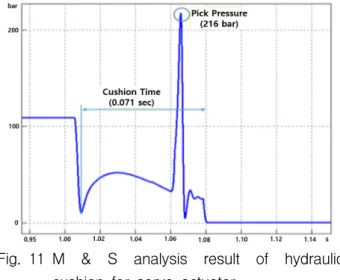
Fig. 11과 같이 M&S 해석결과 스팀밸브의 급속 닫 힘 허용시간 0.3 s에서 약 77%는 급속하게 닫히고 71 ms 동안 쿠션이 작동하였으며 이때 피크압력은 216 bar이였다. 따라서 발전소에서 비상시 스팀을 급속하 게 차단하면서 Poppet과 Seat의 접촉을 지연하여 충 격을 완화 할 수 있게 되었다.

Fig. 9 Operating characteristics of hydraulic cushion of servo actuator

Fig. 10 M&S model of servo actuator system for the turbine control with cushion

Fig. 11 M & S analysis result of hydraulic

cushion for servo actuator

(5)

3.2 압력 감지 형 공기배출 밸브 채용

정기적으로 액추에이터의 정비 후 유입되어있는 많은 양의 공기를 시운전 또는 발전초기에 배출하고, 발전 중에 유압유에 유입되는 매우 적은 양의 기체 를 배출시키기 위해서 압력감응형 공기배출밸브를 Fig. 12와 같이 설계 하였다.

이 밸브는 스프링 힘에 의하여 초기에 열린 상태 에서 스풀의 양측 단면적 차에 압력을 곱한 힘이 높 아지면서 스프링 힘보다 커질 때 스풀이 스프링을 압축시키면서 유로를 차단하는 작동을 한다.

6)

설계압력(30 bar) 이하에서 오리피스 지름에 비례 하여 많은 유량을 통과 시켜 빠르게 상부에 누적된 기체를 배출하고, 설정압력을 초과하면 통과유량을 차단하고 밸브스풀의 노치(notch)를 통하여 미량의 유량(약 0.07 l/min)만 배출함으로써 발전소의 유압시 스템의 유량손실을 최소화 하였다.

Fig. 13은 압력감응형 공기배출밸브를 최적화하기 위한 시뮬레이션해석 모델로서 오리피스형상, (choke or Orifice) 오리피스의 수량(4개), 스프링사양(k=3.924), 2단 스풀의Damping Volume(로드지름 9 mm,피스톤지 름 11.3mm, 변위 3.5mm), 밸브스풀과 하우징사이의 원통형틈새(9μm), 노치형상변화에 따라서 작동압력 과 유량특성성능을 해석하기 위한 동역학적 모델링 이고, Fig. 14는 M&S 해석결과로서 압력을 140 bar까 지 2초 동안 서서히 상승시킬 때 최대 1.35 l/min가 토출되어 유입된 많은 양의 공기를 배출하고, 약 25.16 bar에 큰 유량이 차단된 후에 밸브스풀과 하우 징사이의 원통형틈새와 노치를 통해 미소유량인 약 0.07 l/min만 통과하여 에너지 절감과 빈번한 작동에 따른 전기모터와 유압펌프 및 밸브고장을 방지하게 되었다.

Fig. 12 Air vent valve mechanism for hydraulic servo actuator

Fig. 13 Modeling of the air vent valve

Fig. 14 Simulation result of air vent valve

4. 실험 및 결과분석

4.1 유압쿠션 시험장치 구축

유압에 열리고 강철스프링에 의해서 닫히는 싱글 액추에이터의 특성을 재현하기 위하여 Fig. 15과 같 이 피스톤 지름 63.5mm, 행정거리 130 mm에 유압유 의 온도가열 및 냉각과 펌프 흡인라인에 공기공급이 가능한 발전소액추에이터 전용 유압쿠션시험 장치를 구축 하였다.

쿠션 특성의 측정은 유압유의 점도특성과 기체함 유량에 따른 마찰특성을 분석하기 위하여 액추에이 터가 전 행정거리를 전진시킬 때 로드에 연결된 스 프링이 큰 힘으로 압축된 상태에서 공급압력을 제거 하면 압축된 스프링의 힘으로 빠르게 후진하게 된다.

이때 변위와 압력을 측정하여 쿠션특성을 분석하였 으며, 유압쿠션 시험조건은 Table 1과 같다.

Table 1 Specification of test condition

Item Specifications Supply pressure [bar] 60

Stroke [mm] 130

Oil temperature [℃] 20 & 50

Gas content [ ] 0 & 6

(6)

Fig. 15 Test of hydraulic cylinder cushioning device

4.2 유압쿠션 시험결과

액추에이터에 60 bar압력을 공급하여 130 mm를 전진 시킨 후 공급압력을 제거하여 스프링의 힘으로 후진 할 때의 쿠션특성을 시험결과 쿠션 피크압력과 Fig. 16과 같이 압력유지파형이 M&S해석결과와 유사 하게 측정되었다.

8,9)

세부적으로 유압유의 온도 20 ℃에서 쿠션지속시 간은 1.7초, 피크압력은 205 bar이었으며, 유압유의 온도 50 ℃에서는 쿠션지속시간은 1.0 s 이고, 피크 압력은 223 bar이였으며, 유압유의 30 ℃온도변화에 쿠션유지시간이 약 40 % 변화를 확인하였다. 또한 액추에이터에 공급되는 유압유에 약 6 %의 공기를 투입하면서 시험한 결과 기체함유량이 유압쿠션에 미치는 특성은 나타나지 않았다.

Fig. 16 Hydraulic cushion test results according to oil temperature change

4.3 공기배출밸브의 시험장치의 구축

공기배출밸브의 시험장치구축은 유압동력발생장치 로부터 유압동력을 서보밸브로 정밀한 압력제어가 가능하게 하였다. Flow Sensor는 공기배출밸브의 전 단부에 설치되어 서보밸브를 통하여 공급되는 유량

을 측정 할 수 있도록 하였으며, 압력센서는 공기배 출밸브의 스풀작동 압력을 측정할 수 있도록 하였으 며, 공기밸브교체가 용의하게 Test Block을 설계하여 Fig. 17과 같이 구성하였다.

Fig. 17 Test equipment of the Air Vent Valve

4.4 공기배출밸브의 시험결과

Fig. 18는 코일지름 0.8 mm의 밸브를 실험한 결과 로서 공급압력 25.1 bar에서 스풀이 작동되었고 최대 유량은 1.351 l/min이였다. 코일지름 1.0 mm의 밸브 를 실험한 결과로서 공급압력 31.6 bar에서 스풀이 작동되었고 최대 유량은 1.842 l/min이였다. 또한 밸 브가 닫히는 압력 이상에서는 노치의 면적에 따른 매우적은 유량(약 0.07 l/min) 배출되는 것을 확인 하 였다.

Fig. 18 The test results of the air vent valve

(7)

또한 Fig. 19와 같이 원자력/화력발전소에서 사용 중인 소형 5인치와 대형 10인치 유압서보액추에이터 의 피스톤에 각각공기배출밸브를 장착한 후 Fig. 20 과 같이 전체 행정거리의 (80±1) %로 8.5×10

4

사이클 (20±1) %로 1.15×10

4

사이클 총 발전소의 5년 등가 수명인 20만 사이클

10)

동안 연속내구성시험 실시하고, 피스톤 Seal & Tube 표면을 분석한 결과 Fig. 21과 같이 Seal과 Tube 표면에 이상이 없어 공기배출밸브 의 유효성이 입증되었으며 전발전소에서 채용되었다.

Fig. 19 Durability test equipment for the servo actuators

Fig. 20 Durability test conditions (long stroke and short stroke)

Fig. 21 Photo of seal & tube after 200,000 cycles durability life test

4. 결 론

원자력발전소와 화력발전소의 터빈제어용 스팀밸 브의 Poppet과 Seat 접촉면의 흠집과 파손 고장은 급

속 닫힘에서 Poppet이 Seat에 부딪치면서 고체충격에 의한 것으로 분석하고, 스팀밸브를 작동시키는 유압 서보액추에이터의 하단에 유압쿠션을 설치하여, Poppet과 Seat가 접촉직전에 관성에너지를 유체에너 지로 변환하고 다시 유체에너지를 열에너지로 전환 시켜 충격을 흡수시켰다.

유압서보액추에이터의 Oil Seal과 튜브 표면이 타 고, 마찰마모의 고장은 정비 후 실린더 내부에 누적 된 기체(Air & Gas)와 유압유에 혼입된 기체가 Oil Seal 주변에 누적된 후 단열 압축에 의한 높은 온도 가 발생한 것으로 분석하고, 저압에서 많은 유량이 통과 되고 상시 운전 중에는 최소 유량만 통과되는 압력감응형 공기배출밸브를 개발하여 해결 하였다.

발전소의 운영에 핵심기기인 터빈제어용 스팀밸브 와 스팀밸브를 구동하는 유압서보액추에이터의 고장 원인을 정확하게 분석하고, 문제점을 개선함으로서 발전소 핵심기기의 신뢰성을 향상시키고, 발전소의 운영안정화에 기여하였다.

후 기

본 연구는 MW급 풍력발전기의 Yaw & Pitch Drive 개발사업(과제번호: NM 6480)과 발전소 축류 팬 액 추에이터 기술개발(과제번호: IN 5580)의 일환으로 추진되었습니다.

참고 문헌

1) Y. B. Lee et al., "A Study on the Analysis and Improvement of Failure Cause of Steam Control Valve and Hydraulic Servo Actuator for Power Plant", Proceedings of 2019 Spring Conference on Drive and Control, pp.333~338, 2019.

2) Y. B. Lee et al., "A Study on the Main Failure Mode Analysis and Lifetime Improvement of Hydraulic Servo Actuators", Journal of Drive and Control, Vol.15, No.4, pp. 48~54, 2018.

3) Y. B. Lee and J. J. Lee, "A Study on the Seal Life Improvement of the Hydraulic Servo Actuator for Steam Control of Power Plants", Journal of Drive and Control, Vol.15, No.2, pp.32~37, 2018.

4) S. D. Kim, S. H. Jeon and J. S. Yun, "A Study on

the Phase Bandwidth Frequency of a Directional

Control Valve based on the Metering Orifice",

(8)

Journal of Drive and Control, Vol.15, No.1, pp.1-9, 2018.

5) I.-K. Choi et al, "Selection of Operating Parameters and Management of Operation Console for Protection and Control of Steam Turbine in a Korea Standard Type Nuclear Power Plant", Journal of the Korean Institute of Illuminating and Electrical Installation Engineers, Vol.25, No.4, pp.71-78, 2011.

6) Y. B. Lee and D. S. Jung, "Secure Reliability of Turbine Power Control Actuator for Power Plants", Journal of the Korea Fluid Power Systems Society, Vol.7, No.1, pp.22-26, 2010.

7) W. Chengbin and Q. Long, "Study on simulation and experiment of hydraulic excavator's work device based on simulation X", Proceedings of 2011 International

Conference on Electric Information and Control Engineering, 2011.

8) J. S. Jang and Y. H. Yoon, "Analysis Model Development for Designing of Hydraulic Power Steering System", Transactions of the Korean Society for Automotive Engineers, Vol.16, No.1, pp.158-165, 2008.

9) H. J. Kim et al., "Service Life Analysis of Control Valve for Automatic Turbine Srartup of Thermal Power Plant", Transactions of the Korean Society of Mechanical Engineers A, Vol.26, No.1, pp.1-6, 2002.

10) J. H. Roh et al., "The development of turbine valve

actuator efficiency analysis system for the standard

power plants", Proceedings of KIEE Annual

Autumn Conference 2002, pp.537-541, 2002.

수치

Fig. 1 Schematic  of  steam  control  valve  of  nuclear  power  plant
Fig.  6  Simulation  result  of  quick  closing  operation  of  steam  valve 2.2  유압서보  액추에이터의  Seal  고장원인  국내 원자력 발전소에서는 핵연료 교체시기와 맞 춰서 약 18개월 주기로 정기적 정비를 실시하고,  화 력발전소에서는 약 2년 주기로 정기정비를 실시한다
Fig.  10  M&S  model  of  servo  actuator  system  for  the  turbine  control  with  cushion
Fig. 12 Air  vent  valve  mechanism  for  hydraulic  servo  actuator
+3

참조

관련 문서

S., An Experimental Study on the Cooling and Heating Performance of a Residential Ground Source Heat Pump System, Korean Journal of Air-Conditioning

Waste lubricating oil, which is radioactive waste generated from nuclear power plants, is a lubricant for major equipment of nuclear power plants, and is incinerated

A Study on the Temperature Dependent for Reliability Improvement of SMPS for LED Lamp.. 2017

This study makes use of statistical method in estimating the spread of oil supply disruption, which will be the starting point of analysis on oil

For example, the public’s sentiments of risk regarding nuclear power plants exceeds the risk felt by an expert in the area, and therefore the public sentiment is a negative

In this study, the mercury in exhaust gas was measured from three large coal-fired power plants in Korea using the continuous emission monitoring system

This study attempts to quantify the economic effects of increases in international oil prices on Korea’s energy and biodiesel industry by using a small open computable

설비에 의하여 완전히 회수한 후 작업을 실시하고 용기 내부에 들어 있는 기체 , 상태의 가스는 잔가스연소장치에 의하여 완전히 연소를 시킨 후 용기부속품을