Effects of Long-Term Fertilization on Microbial Diversity in Upland Soils Estimated by Biolog Ecoplate and DGGE
Nan-Hee AN*, Sang-Min Lee, Jung-Rai Cho, Byung-Mo Lee, Jae-Hun Shin, Jung-Hun Ok, and Seok-Cheol Kim
National Academy of Agricultural Science, RDA, Jeonju, 565-851, Korea (Received: September 25 2014, Revised: December 22 2014, Accepted: December 22 2014)
Organic amendment practices can influence diversity and activities of soil microorganisms. There is a need to investigate this impact compared with other types of materials. This study was carried out to evaluate the long term effects of chemical and organic fertilizer on soil microbial community in upland field. During the last 11 years green manure, rice straw compost, rapeseed cake, pig mature compost, NPK, and NPK + pig mature compost were treated in upland soil. Organic fertilizer treatment found with high bacterial colony forming units (CFUs) as compared to chemical and without fertilizer treatment. There was no significant difference in the actinomycetes and fungal population. The average well color development (AWCD) value was the highest in green manure and, the lowest in without fertilizer treatment. Analyses based on the denaturing gradient gel electrophoresis (DGGE) profile showed that rice straw compost and pig mature compost had a similar banding pattern while rapeseed cake, NPK, NPK + pig mature compost and without fertilizer treatment were clustered in another cluster and clearly distinguished from green manure treatment. Bacterial diversity can be highly increased by the application of organic fertilizer while chemical fertilizer had less impact. It can be concluded that green manure had a beneficial impact on soil microbial flora, while, the use of chemical fertilizer could affect the soil bacterial communities adversely.
Key words: Microbial diversity, Upland soil, Long-term fertilization, Ecoplate, DGGE
Comparison of utilized substrates of the upland soil samples under different treatments. GM: green manure, RSC: rice straw compost, RC: rapeseed cake, PMC: pig manure compost, NPK: chemical fertilizer, CON: without fertilizer. Data with the same letter indicates no significant difference at 5 % level DMRT.
1)
*Corresponding author : Phone: +82632382566, Fax: +82632383284, E-mail: [email protected]
§Acknowledgement: This study was carried out with the support of “Research Program for Agricultural Science & Technology Development (Project No. PJ008590022014)”, National Academy of Agricultural Science, Rural Development Administration, Republic of Korea.
Introduction
국내의 농업은 1980년대까지 증산위주 농업정책이었으나 1990년대부터 고품질 농산물 및 농산물 안전성에 초점이 맞 춰지면서 친환경농업으로 농업 정책 및 기술이 변하게 되었 다. 그로 인하여 유기농산물의 소비가 급증하고 있으며, 친 환경농산물 및 생산면적이 매년 급격한 증가를 보이고 있 다. 유기농업은 기본적으로 녹비작물, 두과작물 등으로 지 력을 유지하고, 윤작 및 적절한 퇴비의 시용 그리고 유기물 의 공급이 필수적이다 (Willer, 1998). 유기물의 시용 효과 는 입단 형성, 보수력 증가, 통기성 향상 등 토양의 물리성 개선 효과와 각종 무기양분의 중요한 공급원으로 질소 공 급, 염기 보유력과 완충능 증대 등 화학적 개량 효과가 큰 것으로 알려져 있다 (Recel, 1994). 또한 유기물 시용구은 토 양 중 유기탄소와 미생물체량을 높인다고 보고하였다 (Zang et al., 2014).
토양 미생물상은 육안으로 관찰하기 어려우므로 다양한 방법을 이용하여 분석한다. Biolog Ecoplate를 활용한 방법 은 31기질을 유일 탄소원으로 이용하여 미생물에 의한 이용 도를 평가하는 방법으로 측정법이 매우 간단하고 편리한 장 점이 있다 (Knight, et al., 1997). 또한 분자생물학적 기법 중의 하나인 denaturing gradient gel electrophoresis (DGGE) 방법은 전기 영동시 gel 내에 존재하는 denaturant의 gradient 에 따른 핵산의 이중나선 구조와 변성구조 차이에 의해 핵 산의 이동속도가 달라지는 점을 이용한 것이다. 이 방법은 전체적인 DNA에 대한 질적 그리고 양적 변화를 하나의 gel 상에서 관찰 할 수 있는 장점이 있으며, DGGE fingerprint 상의 band로 부터 직접 DNA를 회수한 후 염기서열을 확인 할 수 있는 장점을 가지고 있어 환경시료의 미생물 군집분 석에 유용하게 활용 가능하다 (Lee et al., 2013).
이에 본 연구는 유기농업체계에서 다양한 유기자원이 장 기 연용된 밭토양을 대상으로 미생물 군집의 차이를 알아보 기 위하여 Biolog와 DGGE 방법을 이용하여 토양 미생물 군 집 특성을 조사하였다.
Materials and Methods
시험 토양 및 처리내용 시험토양은 옥수수 (광평옥) 를 재배한 동일비료 연용 밭 토양 (국립농업과학원 시험포) 이었으며 무비 (대조구), NPK, NPK+돈분퇴비, 돈분퇴비, 유 기질비료 (채종유박), 볏짚퇴비, 녹비 (헤어리벳치) 처리가 매년 동일하게 11년 동안 시용하였다. 각각의 시비 처리는 NPK구의 경우 10 a 당 질소, 인산, 칼리를 각각 17.4, 3.0, 6.9 kg, NPK+가축분퇴비구는 10 a 당 질소, 인산을 각각 15.5, 2.4 kg, 퇴비구는 1,370 kg을 시용하였다. 채종유박과 볏짚퇴비는 질소 17.4 kg에 해당하는 유기물을 각각 290
kg, 3,480 kg을 시용하였으며 녹비구는 헤어리베치 수확량 2,567kg을 전량 시용하였다. 시료구 재료 처리는 2010년 5 월 2일에 하였으며, 토양 시료는 5월 30일에 채취하였다.
토양 분석 토양 화학성 분석을 위해 채취한 토양은 그 늘에서 풍건하여 2 mm 체를 통과된 것을 화학성분 분석에 사용하였다. 화학성분 분석은 농촌진흥청 농업과학기술원 에서 발간한 토양 및 식물체 분석법 (RDA, 2000)을 적용하 여 pH는 토양과 증류수의 비율을 1:5로 추출하여 초자전극 법 (Orion star A211, Thermo, USA)으로 측정하였다. 총 질 소와 탄소함량은 음건 토양 (2 g)을 C/N 자동분석기 (Vario MAX CN, Elementar, Germany)로 측정하였다. 유효인산은 Lancaster법으로 UV-Spectrophotometer (UV-2450, Shimadzu, Japan)를 이용하여 720 mm에서 측정하였다. 치완성 양이 온 (K, Ca, Mg, 및 Na)은 단일침출액 (1 N CH3COONH4, PH 7.0) 추출 후 ICP (GBC, Australia)로 분석하였다.
토양미생물 밀도 조사 및 미생물체량 분석 습토 30 g 을 270 mL의 멸균수에 넣고 왕복진탕기에서 10분간 진탕하 여 희석 평판법으로 토양내의 미생물의 밀도를 조사하였다.
일반 세균은 Yeast glucose agar, 방선균에는 Starch-casein agar, 사상균에는 Rose bengal agar에 30 mg/L의 strep- tomycin을 첨가하였다. 배양조건은 세균과 방선균은 28°C 에서 4~7일, 사상균은 25°C에서 5일간 이며 각 시료당 미 생물 계수는 3개의 Petridish에 나타난 colony를 각각 계수 한 평균값을 생균수 (colony forming unit: cfu g-1 건토)로 계산하였다 (Suh et al, 2010). 토양 미생물체량 (Microbial biomass C)은 훈증 추출법 (Vance et al., 1897)을 이용하여 분석하였다. 비훈증시료는 습윤토양 15 g에 0.5 M K2SO4
60mL를 첨가하여 30분간 진탕하여 추출하였고, 훈증시료 는 습윤토양 15 g을 클로로포름 하에서 24시간 훈증시킨 후 0.5 M K2SO4 60mL를 첨가하여 30분간 진탕하여 추출하였 다. 미생물체량은 TOC분석기 (TOC-5050, Shimadzu, Japan) 로 측정하였다. 미생물체량은 훈증된 분석값에서 비훈증된 분석값을 감하는 것으로 계산하였다.
BIOLOG를 이용한 생화학적 다양성 분석 토양 미
생물군집의 유일탄소원 이용능 차이는 31개의 각기 다른 탄 소화합물을 가진 BIOLOG EcoplateTM (Biolog Inc., Hayward, CA)를 이용하여 측정하였다. 냉장 보관된 토양을 1주일 내 에 꺼내어 토양시료와 멸균수를 1:10 (W/V)의 비율로 희석 한 후 200 rpm으로 10분간 교반하였다. 교반된 시료는 10-3 배로 희석한 후 EcoPlate의 well에 150 ㎕씩 접종한 후 25°C 에서 배양하면서 24시간 간격으로 각 well의 색 변화를 590 nm 파장에서 측정하여 분석하였다. 측정된 분석치는 평균 발색량 (average well color development, AWCD)를 다음의
Table 1. The Chemical properties of soil under long term fertilizer treatments.
Treatment pH T-C T-N Avail. P2O5
Exch. Cation
K Ca Mg
(1:5) g kg-1 g kg-1 mg kg-1 cmolc kg-1
Green manure 5.5 13.5 1.3 130 0.09 6.32 0.64
Rice Straw compost 5.4 17.1 1.5 169 0.64 8.51 1.40
Rapeseed cake 6.1 11.7 1.1 100 0.14 5.57 1.21
Pig manure compost 5.7 17.7 1.5 177 0.44 6.6 1.57
NPK+ Pig manure compost 5.5 12.0 1.1 122 0.24 6.87 1.40
NPK 5.4 9.4 0.9 106 0.17 6.95 1.38
Without fertilizer 5.2 7.4 0.8 60 0.14 6.27 1.77
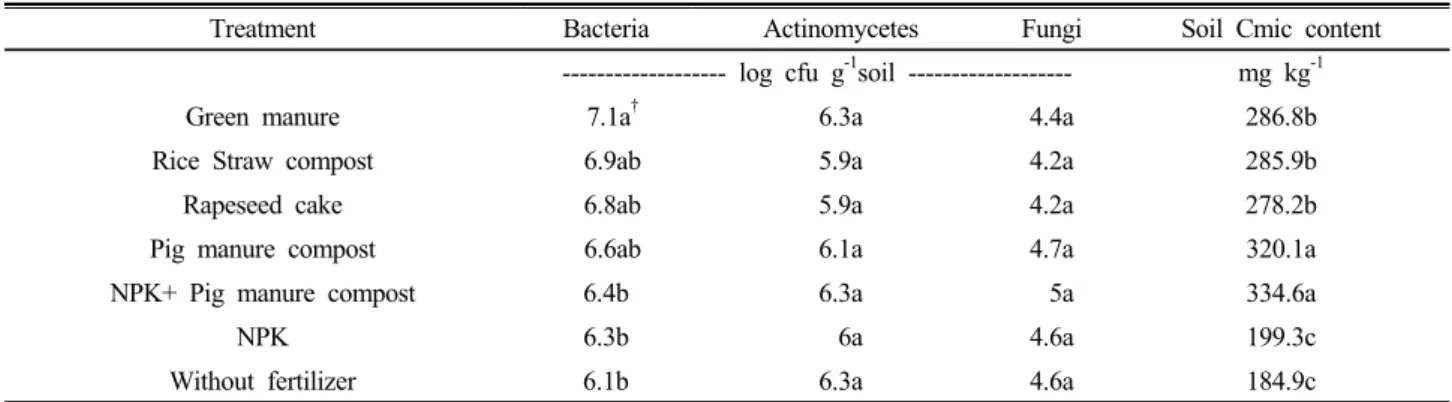
Table 2. Microbial populations and soil microbial biomass carbon under long term fertilizer treatment.
Treatment Bacteria Actinomycetes Fungi Soil Cmic content
--- log cfu g-1soil --- mg kg-1
Green manure 7.1a† 6.3a 4.4a 286.8b
Rice Straw compost 6.9ab 5.9a 4.2a 285.9b
Rapeseed cake 6.8ab 5.9a 4.2a 278.2b
Pig manure compost 6.6ab 6.1a 4.7a 320.1a
NPK+ Pig manure compost 6.4b 6.3a 5a 334.6a
NPK 6.3b 6a 4.6a 199.3c
Without fertilizer 6.1b 6.3a 4.6a 184.9c
†Values within a column followed by the same letter are not significantly different at 5% level by DMRT.
식으로 계산하였다 (Garland et al., 1991).
AWCD = ∑(C - R)/n (1)
C: 각 well의 OD590nm값 R: Control well의 OD590nm값 n: 기질의 수 (31)
DGGE (Denaturing gradient gel electrophoresis) 분석 토양미생물로부터 DNA는 FastDNA Spin kit (Qbiogen, U.S.A.) 를 사용하여 추출하였으며, 16S rRNA 유전자를 PCR 증폭하 였다. PCR을 위한 프라이머는 Eubacteria의 V3부위 (F352T- 519r)을 사용하였다 (Sohn et al., 2010). PCR 반응물은 50 μl로 하여, 5 μl의 10×PCR buffer, 10 ng의 주형 DNA, 각 25 pmol의 양방향 프라이머, 200 µM의 각각의 dNTP, 2.5 U의 Taq DNA polymerase (Solgent, Korea)를 첨가하였다.
PCR 조건은 95°C에서 5분간 변성과정을 거친 후, 95°C에서 1분, 55°C에서 1분, 72°C에서 1분의 조건으로 30 cycle을 수 행하였으며, 마지막으로 72°C에서 7분간 반응시켰다. PCR 산물은 Dcode Universal Mutation Detection System (Bio-Rad, U.S.A)을 사용하여 변성제인 formamide가 40-70%로 농도 구배된 8% 아크릴아미드젤에서 전기영동하였다. 전개된 DNA
는 SYBR Green I로 염색하여 UV transilluminator하에서 관찰하였다. DGGE 패턴 분석은 Quantity OneⓇ 1-D Analysis Software (Bio-rad, USA)을 이용하였다.
Results and Discussion
유기자원 처리별 토양 특성 동일한 유기자원을 11년 동안 연용한 밭토양의 화학적 특성은 Table 1과 같았다. 유 기자원 시용구는 무비구와 비교하여 pH가 높으며, 총탄소 와 총질소, 인산 함량이 높은 경향을 보였다. 인산함량은 돈 분퇴비 > 볏짚퇴비 > 녹비 > NPK+돈분퇴비 > NPK > 채종 유박 > 무비 순으로 높았다. 치환성 양이온 중 칼륨은 볏짚 퇴비구가 가장 높았으며 녹비 처리구가 가장 낮았다. 녹비 의 경우 장기 연용시 토양 중 치환성 칼륨 함량이 감소하므 로 이에 대한 적절한 관리가 필요한 것으로 사료된다.
토양미생물 군집 밀도 분석 유기자원 처리별 호기성 세균, 방선균, 사상균 밀도 및 미생물체량은 Table 2과 같았 다. 세균은 녹비 > 볏짚 > 채종유박 > 돈분퇴비 > NPK+돈 분퇴비 > NPK > 무비 순으로 높았으며 녹비를 제외한 유기 물 처리구간의 유의적인 차이는 보이지 않았다. 또한 방선 균과 사상균은 처리구간에 유의적인 차이가 없었다. 밭토양
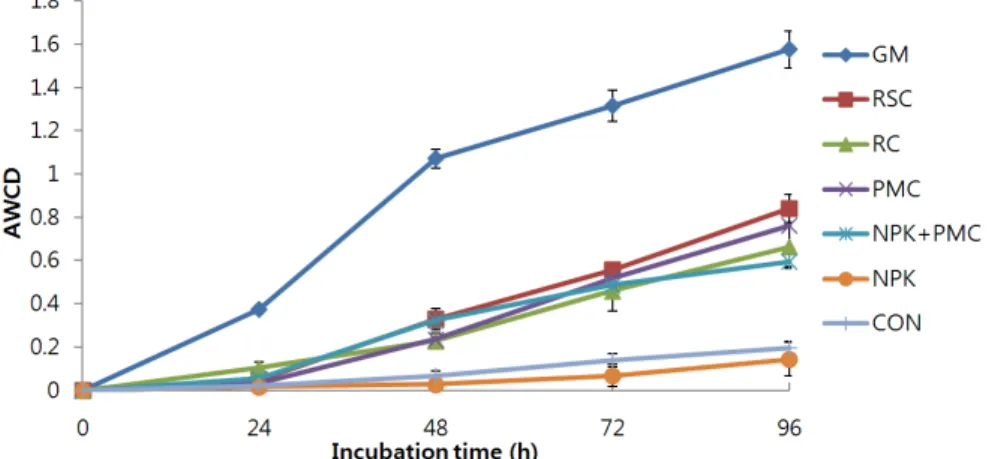
Fig. 1. Average well color development (AWCD) of soil bacterial community with incubation time for different treatments. GM:
green manure, RSC: rice straw compost, RC: rapeseed cake, PMC: pig manure compost, NPK: chemical fertilizer, CON: without fertilizer. The variation bar represents standard error (n=3).
Fig. 2. Comparison of utilized substrates of the upland soil samples under different treatments. GM: green manure, RSC: rice straw compost, RC: rapeseed cake, PMC: pig manure compost, NPK: chemical fertilizer, CON: without fertilizer. Data with the same letter indicates no significant difference at 5% level DMRT.
에서 곰팡이를 제외한 세균 개체수가 관행에 비해 유기 재 배에서 높게 보고되었는데 (Lee et al., 2011) 본 연구 결과 에서도 유사한 경향을 나타냈다. 유기물이 분해되면 탄소와 질소성분의 일부는 미생물 몸체 구성에 이용되는데 미생물 체량 C와 N은 미생물의 밀도를 나타내어 미생물의 활성을 평가하는 지표가 된다 (Joa et al., 2009). 미생물체량 C는 NPK+돈분퇴비 > 돈분퇴비 > 녹비 > 볏짚퇴비 > 채종유박>
NPK > 무비 순으로 높게 나타났으며 유기물 종류에 따라 차이가 있지만 무비구나 화학비료 처리구에 비해 유기물 공 급이 미생물체량 C를 증가시킨 것으로 사료된다. 이러한 결 과는 유기물 시용으로 화학비료보다 미생물체량을 증가시 켰다는 보고와 일치하며 유기물 시용에 따라 미생물체량이 증가하는 원인은 토양내 가용성 탄소 함량이 증가하기 때문 이라고 하였다 (Goyal et al., 1992). Fauci and Dick (1994) 은 유기질소와 무기질소의 장단기적 효과를 검토하였으며
유기물을 장기 시용한 경우 biomass C가 80-400% 증가되 었고, 장기간의 화학비료 시용은 유기물함량과 생물활성을 감소시킨다고 보고하였다.
미생물 군집의 생화학적 다양성 분석 Biolog microplate 는 1991년에 처음 이용하기 시작하여 배양된 세균을 대상으 로 빠르고 간편하게 기능적 다양성을 조사하는 토양미생물 분석법이 되었다 (Dick et al., 1996). Biolog Ecoplate의 배 양시간에 따른 평균발색량 (average well color development, AWCD)은 시간이 증가할수록 모든 처리에서 증가함을 확인 할 수 있었으며 녹비 > 볏짚퇴비 > 돈분퇴비 > 채종유박V >
NPK+돈분 퇴비 > NPK > 무비구 순으로 미생물 군집의 유 일 탄소원 이용에 대한 생화학적 활성이 높게 나타났다 (Fig.
1). 각 토양의 기질 이용률 (utilized substrates= O. D. >
0.25 well의 수/31)을 알아보기 위해 대수기 (96hr)를 기준
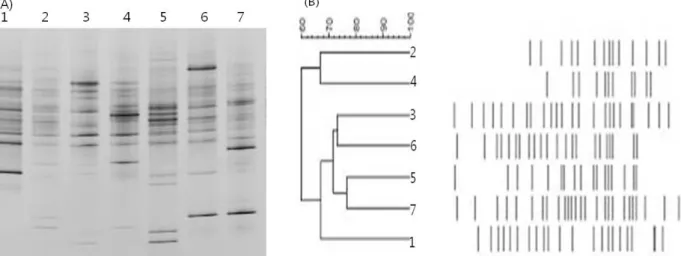
Fig. 3. (A) DGGE profile of bacterial 16S rRNA gene fragments of soil samples under different fertilization treatments and (B) cluster analysis of DGGE banding patterns. Lane: 1 green manure, 2 rice straw compost, 3 rapeseed cake, 4 pig manure compost, 5 NPK + pig manure, 6 NPK, 7 without fertilizer.
으로 기질의 발색반응 정도인 O. D. 값이 0.25이상일 때를 각 토양에 분포하는 다양한 미생물들에 의해 이용된 기질로 판단하였다 (Garland, 1997). 각 토양의 기질 이용률을 살펴 본 결과, 녹비 처리구의 미생물 군집의 기질 이용률은 다른 처리구에 비해 높고 가용 유일탄소원의 종류가 다양하였으 며 NPK 그리고 무비구의 기질 이용률은 가장 낮았다 (Fig. 2).
본 연구에서는 동일 유기물이 장기 연용된 밭토양의 미생물 군집의 탄소원 이용과 활성 비교를 통해 차이가 있음을 확 인하였다. 유일 탄소원 이용능은 유기물 처리구가 화학비료 나 무비 처리구에 비해 높으며 유기물 중 녹비 처리구가 가 장 높게 나타났다. 이러한 결과는 작물 잔사에 존재하는 탄 수화물, 단백질 등과 같은 이분해성 유기화합물들이 토양처 리 후 식물 잔사로부터 빠르게 용출되면서 미생물 증식에 영향을 미친 것으로 사료된다. 본 연구에서는 동일 유기물 이 장기 연용된 밭토양의 미생물 군집의 탄소원 이용과 활 성 비교를 통해 유일 탄소원 이용능은 녹비 처리구가 가장 높으며 다른 유기물 처리와 비교하여 화학비료 처리구는 현 저하게 떨어졌다. 이는 화학비료가 종속영양세균과 빠르게 성장하는 미생물의 활성을 감소시키는 요인으로 작용하며 (Wei et al., 2008) 유기물의 장기 연용 효과는 토양미생물 군집에 영향을 미치며 화학비료 처리에 비해 토양미생물 다 양성을 향상시킨다고 보고되었다 (Wang et al., 2008: He et al., 2008).
미생물 군집의 유전적 다양성 분석 DGGE 분석을 통한 각 유기물 장기 연용 토양의 다양성을 비교한 결과 (Fig. 3) 크게 2개의 클러스터를 형성하였다. 클러스터 1은 볏짚퇴비와 돈분퇴비 처리구이며, 클러스터 2는 채종유박, NPK+돈분퇴비, NPK, 무비구, 녹비구 토양의 세균군집으로 나누어 졌다. 또한 클러스터 2 안에서도 녹비 처리구 토양
의 세균 군집이 다른 처리구와 구별됨을 알 수 있었다. 본 연구에서 수행한 16S rDNA의 DGGE는 실질적으로 토양의 모든 미생물의 genomic DNA를 표현하지 못하며 단지 세균에 대한 특징만을 나타내었다. 추후 균류 (fungi)의 18S rDNA 분 석과 함께 수행된다면 토양미생물 군집의 구조적 특징을 좀 더 명확히 규명할 수 있을 것이라 사료된다.
Conclusions
본 연구는 유기농업체계에서 다양한 유기자원이 장기 연 용된 밭토양을 대상으로 Biolog와 DGGE 방법을 이용하여 토양 미생물 군집 특성을 비교하였다. 유기자원 처리별 세 균, 방선균, 사상균 밀도 및 미생물체량을 조사한 결과, 세 균 밀도는 녹비구가 가장 높았으며 방선균과 사상균의 경우 통계적인 유의차는 없었다. 미생물 군집의 생화학적 다양성 분석을 위해 Biolog Ecoplate를 수행한 결과, 평균 발색량 (average well color development, AWCD)과 기질 이용률은 녹비 처리구가 다른 처리구에 비해 높게 나타났으며 다른 유기물 처리와 비교하여 화학비료 처리구는 현저하게 떨어 졌다. 또한 유전적 다양성 분석을 위해 DGGE를 수행한 결 과, 녹비 처리구가 다른 처리구와 패턴의 차이가 있음을 확 인할 수 있었다.
References
Dick, R.P., D.P. Breakwell, and R.F. Turco. 1996. Soil enzyme activities and biodiversity measurement as integrative micro- biological indicators, In Doran, J.W. and A.J. Jones (eds) Methods for assessing soil quality. Soil Sci. Soc. Am. pp.
247-271.
Fauci, M.F. and R.P. Dick. 1994. Soil microbial dynamic: short
and long-term effects of inorganic and organic nitrogen. Soil Sci. Soc. Am. J. 58:801-806.
Garland, J.L. 1997. Analysis and interpretation of community-level physiological profiles in microbial ecology. FEMS Microbiol.
Ecol. 24:289-300.
Garland, J.L. and A.L. Mills. 1991. Classification and Charac- terization of heterotrophic microbial communities on the basis of patterns of community level sole carbon source utilization.
Appl. Envioron. Microbiol. 57:2351-2359.
Goyal, S., M.M. Mishira, I.S. Hooda, and R. Singh. 1992.
Organic matter-microbial biomass relationships in field experiments under tropical condition: effect of inorganic fertilization and organic amendments. Soil Biol. Biochem. 24:1081-1084.
He, J.Z., Y. Zheng, C.R. Chen, Y.Q. He, and L.M. Zhang. 2008.
Microbial composition and diversity of an upland red soil under long-term fertilization treatments as revealed by culture- dependent and culture-independent approaches. J. Soil Sediment.
8:349-358.
Joa, J.H., D.G. Moon, S.J. Chun, C.H. Kim, K.S. Choi, H.N.
Hyum, and U.G. Kang. 2009. Effect of temperature on soil microbial biomass, enzyme activities, and PLFA content during incubation period of soil treated with organic materials.
Korean J. Soil Sci. Fert. 42:500-512.
Knight, B.P., S.P. McGrath, and A.M. Chaudri. 1997. Biomass carbon measurements and substrate utilization patterns of microbial populations from soils amended with cadmium, copper or zinc. Appl. Environ. Microbiol. 63:39-43.
Lee, Y.H., Y.K. Son, B.K. Ahn, S.T. Lee, M.A. Shin, W.S. Kim, W.D. Song, and Y.S. Kwak. 2011. Impacts of organic farming system on the soil microbial population in upland soil. Korean J. Soil Sci. Fert. 44:819-823.
Lee, E.Y. and S.H. Hong. 2013. Assessment of the changes in the Microbial Community in Alkaline Solis using Biolog Ecoplate
and DGGE. KSBB J. 28:275-281.
RDA (Rural Development Administration). 2000. Analyses of soil and plant. RDA. Korea.
Recel, M.R. 1994. International seminar on the use of microbio and organic fertilizers in ageiculture production. RDA &
FFTC.
Suh, J.S., J.S. Kwon, and H.J. Noh. 2010. Effect of the long-term application of organic matters on microbial diversity in upland soils. Korean J. Soil Sci. Fert. 43:987-994.
Sonh, S.I., Y.J. Oh, S.D. Oh, M.K. Kim, T.H. Ryu, K.J. Lee, S.C.
Suh, H.J. Baek, and J.S. Park. 2010. Molecular analysis of microbial community in soils cultivating BT Chinese cabbage.
Korean J. Environmental Agriculture. 29(3):293-299.
Thorup-Kristensen, K. 1994. The effct of nitrogen catch crop species on the nitrogen nutrition of succeeding crops. Fertilizer Research. 37:227-234.
Vance, E.D., P.C. Brookes, and D.S. Jenkinson. 1987. An extraction method for measuring soil microbial biomass carbon.
Soil Biol. Biochem. 19:703-707.
Willer, H. 1998. Orgaic in Europe. SOEL. Germany.
Wang, G., J. Liu, X. Qi, J. Jian, U. Wang, and X. Liu. 2008.
Effects of fertilization on bacterial community structure and function in a black soil of Dehui resgion estimated by Biolog and PCR-DGGE methods. Acta Ecologica Sinica. 28:220-226.
Wei, D., Q. Yang, J.Z. Zhang, S. Wang, X.L. Chen, X.L. Zhang, and W.Q. Li. 2008. Bacterial community structure and diversity in a black soil as affected by long-term fertilization. Pedosphere.
18:582-592.
Zhang, X., X.S. Zhang, Y. Xing, R. Wang, and W. Liang. 2014.
Organic amendment effects on aggregate-associated organic C, microbial biomass C and glomalin in agricultural soils.
Catana. 123:188-19.