Effect of Methylobacterium oryzae CBMB20 Inoculation and Methanol Spray on Growth of Red Pepper (Capsicum annuum L.) at Different Fertilizer levels
Puneet Singh Chauhan, Gil-Seung Lee, Min-Kyoung Lee, Woo-Jong Yim, Gyeong-Ja Lee1, Young-Sang Kim1, Jong-Bae Chung2, and Tong-Min Sa*
Department of Agricultural Chemistry, Chungbuk National University, Cheongju 361-763, Korea
1Chungbuk Agricultural Research and Extension Services, Cheongweon 361-883, Korea
2Division of Life and Environmental Sciences, Daegu University, Gyeongsan 712-714, Korea
Fertilizers, plant growth promoting microbes and plant growth regulators should be combined together and used in order to achieve a maximal plant growth and yield in modern sustainable and ecological agricultural systems. In this study rhizosphere inoculation of Methylobacterium oryzae CBMB20 and foliar application of methanol were tested for their ability to promote the growth of red pepper plant at different levels of organic fertilizer. Rhizosphere inoculation of M. oryzae CBMB20 and foliar spray of methanol could promote red pepper plant growth and yield, and the growth promoting effect induced by the combined treatment of M.
oryzae CBMB20 inoculation and foliar spray of methanol was more distinctive. This result suggests that a synergistic growth promoting effect of methanol spray and M. oryzae CBMB20 inoculation can be obtained in the combined treatment of the two growth promoting factors. The growth promoting effect was more significant in the lower fertilization rate, and the plant growth was not significantly different between 100 and 300% fertilizer treatments where both M. oryzae CBMB20 inoculation and foliar spray of methanol were included. This result indicates that, with the plant growth promoting effect of M. oryzae CBMB20 and methanol, fertilizer application rate can be profoundly reduced without any significant decreases in biomass accumulation and yield of crops.
Key words: M. oryzae CBMB20, Foliar application of methanol, Organic fertilizer, Red pepper, Plant growth promotion
Received : August 7. 2010 Accepted : August 17. 2010
*Corresponding author : Phone: +82432612561 E-mail: [email protected]
Introduction
Methylobacterium spp. are a group of bacteria known as pink-pigmented facultative methylotrophs (PPFMs) (Austin and Goodfellow, 1979), and they are capable of growth on C1 compounds such as formate, formaldehyde, and methanol as well as on a variety of C2-C4 compounds (Lidstrom, 2001). They were reported to distribute ubiquitously in the plant phyllosphere and rhizosphere, and have been isolated from many species of plants (Corpe and Basile, 1982).
Basile et al. (1969) first demonstrated the growth enhancing effects of PPFMs on plants in a tissue culture system where they produced vitamin B12 and stimulated the growth of a liverwort. They were also reported to have many plant growth promoting abilities including N fixation,
P solublization, production of plant growth hormones cytokinins and auxins, and biological disease control (Madhaiyan et al., 2004, 2006a, 2007, 2009; Omer et al., 2004; Ryu et al., 2006). Corpe and Basile (1982) reported the stimulating effect of Methylobacterium in seed germination and plant growth. The plant growth promotion effects of Methylobacterium have attracted increasing interest in recent years. Methylobacterium inoculation induces the rapid establishment of roots, whether by the elongation of primary roots or proliferation of lateral and adventitious roots (Ryu et al., 2006). The rapid root establishment is advantageous for plant seedlings, as it increases their ability to anchor themselves in the soil and obtain water and nutrients from their environment, thereby enhancing their chances for survival and growth.
Methylobacterium on plant surfaces benefits from methanol produced by plants by means of methylotrophy (Fiala et al., 1990; Fall and Benson, 1996; Abanda-Nkpwatt et al., 2006). Methanol emission probably occurs as a
Table 1. Chemical properties of soil used in the study.
pH
(1:5) EC Organic
C
Available P2O5
Exchangeable cation
K Ca Mg Na CEC
dS m-1 g kg-1 mg kg-1 --- cmolc kg-1 ---
7.8 0.9 17.2 287 0.27 8.3 1.5 0.2 9.4
by-product of pectin metabolism in the cell walls of roots, stems, leaves, and fruits catalyzed by pectin methyle- sterase (Frenkel et al., 1998). Methylobacterium strains colonized on leaves can nourish themselves using the methanol released by the stomata and contribute in promoting plant growth through various biological actions (Abanda-Nkpwatt et al., 2006). Foliar application of methanol promotes the growth and yield of C3 plants, although the mechanism responsible for this phenomenon is uncertain (Madhaiyan et al., 2006b; Makhdum et al., 2002;
Mortensen, 1995; Nonomura and Benson, 1992; Rowe et al., 1994). Although Nonomura and Benson (1992) reported foliar applied methanol increased cotton growth, development and yield, such positive effects of methanol on the same crop cotton could not be observed in other researches (Mauney and Gerik, 1994; van Iersel et al., 1995; Faver and Gerik, 1996; Rajala et al., 1998). Although the mechanisms responsible for these results are uncertain, methanol application may increase populations of methylotrophs on plant leaves, resulting in indirect increases in stomatal conductance to CO2 and assimilation (Faver and Gerik, 1996). Reduced photorespiration or water use and stimulated ATP and NADH production should be further considered to evaluate the plant growth promotion effect of methanol application (Nonomura and Benson, 1992; Faver and Gerik, 1996).
The use of adequate fertilization is essential in modern intensive crop production farming systems, where harmful environmental impacts of fertilization should be minimized.
Fertilizers, plant growth promoting microbes and plant growth regulators should be combined together and used in order to achieve a maximal plant growth and yield.
Using the combined foliar application of Methylobacterium and methanol, the colonized microbes are expected to utilize the methanol as carbon and energy source and to promote the growth of their host through the release of various growth factors.
The purpose of this study was to investigate the effect of rhizosphere inoculation of Methylobacterium oryzae CBMB20 and foliar application of methanol on red pepper growth at different levels of organic fertilizers.
Materials and Methods
Soil The soil used in this study was collected from an experimental field of Chungbuk Agricultural Research Institute. Some characteristics of the soil are shown in Table 1. Soil pH was measured in 1:5 water suspensions using a glass electrode, and electrical conductivity (EC) was determined in 1:5 water extracts using a conductivity meter (Check mate 90, Corning, NY, USA). Organic matter was analyzed by Tyurin method. Available phosphorus was extracted using Lancaster procedure and analyzed by UV/Vis spectrophotometer (UV-1800, Shimadzu, Kyoto, Japan). Exchangeable cations were extracted with 1 M ammonium acetate (pH 7.0) after the soil was pre-washed with glycol-ethanol, and analyzed using an inductively coupled plasma optical emission spectrometer (ICP-OES, Optima 5300 DV, Perkin Elmer, USA). Cation exchange capacity was measured using ammonium acetate method.
The detail analytical procedures were followed the standard methods of the Rural Development Administration (NAIST, 1988).
Bacterial strain and inoculum culture The pink-pigmented facultative methylotrophic bacteria Methylobacterium oryzae strain CBMB20 (AY683045) was isolated from rice tissues, and its beneficial traits related to plant growth promotion was previously studied (Madhaiyan et al., 2007).
For inoculum preparation, a single colony of bacterial strain grown on ammonium mineral salts (AMS) agar amended with 0.5% sodium succinate was transferred to 25 mL of AMS broth and incubated at 30℃ on a shaker (120 rpm) for 72 h. After 72 h of incubation, 2.5 mL of the culture (1 × 10⁸ cells mL-1) was transferred to 250 mL fresh AMS broth, and allowed to grow for another 72 h.
Pot trial plant growth experiment For evaluating the effect of methanol spray and M. oryzae CBMB20 inoculation on the growth of red pepper plants at different fertilizer levels, a pot trial experiment was conducted in a greenhouse of Chungbuk Agricultural Research Institute. Plastic pots
(bottom diameter: 25 cm, top diameter: 28 cm, height: 30 cm) were filled with 15 kg soil.
The treatments consisted of two different levels of organic fertilizer application, i.e. 100 and 300%. Each fertilizer treatment set was further divided into those with or without M. oryzae CBMB20 inoculation and foliar spray of methanol. In the 100% organic fertilizer treatment set, oil cake (N:P:K ratio 4:2.1:1 with 70% organic matter content) was applied at the rate of 2.54 g kg-1 soil and K was amended with 0.042 g K2O kg-1 soil with fertilizer KCl. Organic fertilizer application rate was determined based on the recommended basal chemical fertilizer application rate for red pepper (N:P:K=12.2:6.4:6.1, kg per 10a). Compost, prepared with 30% saw dust, 40% cow dung, 10% pig dung, 10% chicken dung and 10% rice bran, was also amended as 14.93 g kg-1 soil. For 300% organic fertilizer treatment sets, each fertilizer application rate was calculated accordingly based on the 100% treatment set.
Thirty five days old red pepper (Capsicum annum L. cv.
Daetong) seedlings grown in a nursery were transplanted to pots. At the time of transplanting, 20 mL of M. oryzae CBMB20 inoculum was introduced into the soil around roots of red pepper plant. During the experiment, plants were re-inoculated with M. oryzae CBMB20 at 12, 26, 40, 54, 68, 85 and 96 days after transplant. Twenty mL of the inoculum was applied on the soil surface and enough water was applied to facilitate the flow of bacterial inoculum down to the root zone soil. Plants were treated with aqueous methanol (5%) at 31, 41, 52, 61, 73, 88, and 99 days after transplant. Solution was applied with a hand- held sprayer until it began to drip from the leaves. Pots, each with a single plant, were arranged in a completely randomized design with six replications in each treatment.
Plant height was recorded at 20, 40, 60, 80 and finally at 113 days after transplant. Dry weight of fruits was collected three times at 58, 87 and 113 days after transplant, and the sum was used to get the total fruit dry weight. Root and shoot dry weights were recorded at 113 days after transplant.
Enumeration of total methylotrophic bacterial population in rhizosphere soil Rhizosphere soil of red pepper plants, tightly adhering to roots, was collected 113 days after transplant. AMS agar containing 0.5% methanol was used for the determination of methylotrophic bacterial population. Ten g of rhizosphere soil was added to 90 mL of sterile distilled water and shaken for 30 min at 150 rpm at 28℃. Ten fold serial dilutions of the respective
suspensions were then plated onto the AMS agar amended with 10 μg mL-1 of cycloheximide to inhibit fungal growth.
The plates were then incubated at 28℃ for 3-10 days, and after which bacterial colonies were counted. Bacterial population was expressed as log cfu g-1 soil.
Statistical analyses Significant differences among the treatments were calculated by Duncan’s multiple range tests using SAS software, version 9.1 (SAS, Cary, NC).
Results
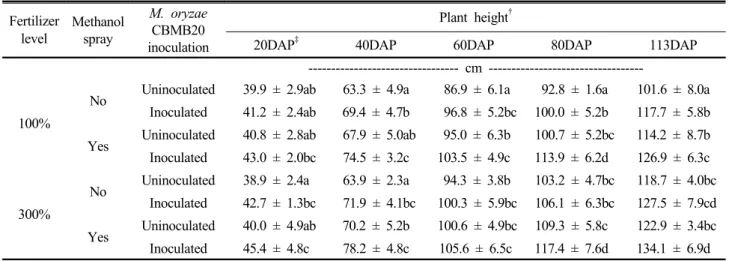
Effect of methanol spray and M. oryzae CBMB20 inoculation on red pepper plant height at different fertilizer application levels During the experiment plant height of red pepper was measured five times to evaluate the plant growth promoting effect of methanol spray and M. oryzae inoculation, and the results are shown in Table 2.
In the 100% fertilizer level, inoculation of M. oryzae CBMB20 significantly increased the plant height of red pepper, except for the height of 20DAP, with or without foliar spray of methanol. Also foliar spray of methanol significantly increased the height of red pepper plant, except for the height of 20 and 40DAP, in both with or without inoculation of M. oryzae CBMB20. The highest red pepper plant height was found in the treatment of methanol spray and M. oryzae CBMB20 inoculation, and in this treatment the plant height was increased by 4.8- 24.9% over the height of red peppers in which both methanol and M. oryzae CBMB20 were not treated.
In the 300% fertilizer level, the effect of M. oryzae CBMB20 inoculation on the plant height was mostly not significant when the foliar spray of methanol was omitted.
However, in the treatments including foliar spray of methanol, inoculation of M. oryzae CBMB20 significantly increased the plant height of red pepper. In the treatments of foliar spray of methanol higher plant heights were observed as compared with their respective treatments of no methanol spray at 300% fertilizer level. But the differences were mostly not significant. Among the treatments in 300% fertilizer level, the highest red pepper plant height was found in the treatment of both methanol spray and M. oryzae CBMB20 inoculation. In this treatment the plant height was increased by 12.0-22.3% over the height of red pepper plant in which methanol and M.
oryzae CBMB20 were not treated.
Comparing the plant heights of red pepper at different
Table 2. Effect of foliar spray of methanol and phyllosphere and rhizosphere inoculation of Methylobacterium oryzae CBMB20 on the red pepper plant height at different fertilizer levels.
Fertilizer
level Methanol spray
M. oryzae CBMB20 inoculation
Plant height†
20DAP‡ 40DAP 60DAP 80DAP 113DAP
--- cm ---
100%
No Uninoculated 39.9 ± 2.9ab 63.3 ± 4.9a 86.9 ± 6.1a 92.8 ± 1.6a 101.6 ± 8.0a Inoculated 41.2 ± 2.4ab 69.4 ± 4.7b 96.8 ± 5.2bc 100.0 ± 5.2b 117.7 ± 5.8b Yes Uninoculated 40.8 ± 2.8ab 67.9 ± 5.0ab 95.0 ± 6.3b 100.7 ± 5.2bc 114.2 ± 8.7b Inoculated 43.0 ± 2.0bc 74.5 ± 3.2c 103.5 ± 4.9c 113.9 ± 6.2d 126.9 ± 6.3c
300%
No Uninoculated 38.9 ± 2.4a 63.9 ± 2.3a 94.3 ± 3.8b 103.2 ± 4.7bc 118.7 ± 4.0bc Inoculated 42.7 ± 1.3bc 71.9 ± 4.1bc 100.3 ± 5.9bc 106.1 ± 6.3bc 127.5 ± 7.9cd Yes Uninoculated 40.0 ± 4.9ab 70.2 ± 5.2b 100.6 ± 4.9bc 109.3 ± 5.8c 122.9 ± 3.4bc Inoculated 45.4 ± 4.8c 78.2 ± 4.8c 105.6 ± 6.5c 117.4 ± 7.6d 134.1 ± 6.9d
†Each value represents mean ± standard deviation of 6 replicates. In the same column, significant differences at p = 0.05 are indicated by different letters using Duncan's multiple range test.
‡DAP, days after transplant.
fertilizer levels, significantly higher plant heights were observed in the late period of experiment with increased fertilizer application in the treatments in which both methanol and M. oryzae CBMB20 were not treated.
However, with methanol foliar spray and/or M. oryzae CBMB20 inoculation, plant heights of red pepper were not significantly different between the fertilizer appli- cation levels of 100 and 300%.
The combined treatment of methanol foliar spray and M. oryzae CBMB20 inoculation was effective in promoting red pepper plant growth, and the highest height was found in those treatments at both 100 and 300% fertilizer levels.
However, though the plant height was higher in 300%
fertilizer levels, the differences were not significant between 100 and 300% fertilizer levels.
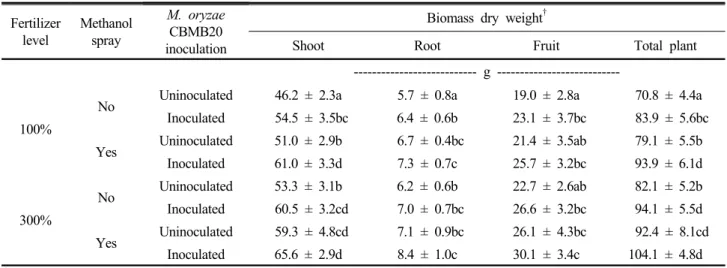
Effect of methanol spray and M. oryzae CBMB20 inoculation on red pepper plant biomass at different fertilizer application levels Effect of methanol spray and M. oryzae CBMB20 inoculation on the red pepper biomass accumulation was observed at different fertilizer levels (Table 3).
In the 100% fertilizer level, inoculation of M. oryzae CBMB20 increased the red pepper plant biomass (shoot, root, and fruit) with or without foliar spray of methanol.
The increases in shoot, root, and fruit were all significant in the treatments in which methanol spray was not included, but in the treatment of methanol spray alone the increase in shoot biomass was significant. Also foliar spray of methanol significantly increased the biomass of shoot and
root of red pepper plant in the treatments with or without M. oryzae CBMB20 inoculation. In the treatments of methanol spray, a little higher fruit yields were obtained when compared with no methanol spray treatments, but the differences were not significant. The highest biomass accumulations and fruit yield were found in the treatment of methanol spray and M. oryzae CBMB20 inoculation, and in this treatment increases of 32, 28, 35 and 32% were observed in the shoot, root, fruits and total plant biomass, respectively, when compared with the data obtained in the treatment where both methanol and M. oryzae CBMB20 were not treated.
In the 300% fertilizer level, the effect of M. oryzae CBMB20 inoculation could increase average shoot and root biomass and fruit yield, but the increases were mostly not significant whether methanol was sprayed or not. In the treatments of foliar spray of methanol higher plant biomasses and fruit yields were observed as compared with their respective treatments of no methanol spray at 300% fertilizer level. But the differences were mostly not significant. Among the treatments in 300% fertilizer level, the highest biomass accumulations and fruit yield were found in the treatment of both methanol spray and M.
oryzae CBMB20 inoculation. In this treatment increases of 23, 35, 32 and 27% were observed in the shoot, root, fruits and total plant biomass, respectively, when compared with the data obtained in the treatment where both methanol spray and M. oryzae CBMB20 inoculation were not included.
As found in the observation of red pepper plant height
Table 3. Effect of foliar spray of methanol and phyllosphere and rhizosphere inoculation of Methylobacterium oryzae CBMB20 inoculation on the red pepper plant biomass at different fertilizer levels.
Fertilizer level
Methanol spray
M. oryzae CBMB20 inoculation
Biomass dry weight†
Shoot Root Fruit Total plant
--- g ---
100%
No Uninoculated 46.2 ± 2.3a 5.7 ± 0.8a 19.0 ± 2.8a 70.8 ± 4.4a
Inoculated 54.5 ± 3.5bc 6.4 ± 0.6b 23.1 ± 3.7bc 83.9 ± 5.6bc Yes Uninoculated 51.0 ± 2.9b 6.7 ± 0.4bc 21.4 ± 3.5ab 79.1 ± 5.5b
Inoculated 61.0 ± 3.3d 7.3 ± 0.7c 25.7 ± 3.2bc 93.9 ± 6.1d
300%
No Uninoculated 53.3 ± 3.1b 6.2 ± 0.6b 22.7 ± 2.6ab 82.1 ± 5.2b Inoculated 60.5 ± 3.2cd 7.0 ± 0.7bc 26.6 ± 3.2bc 94.1 ± 5.5d Yes Uninoculated 59.3 ± 4.8cd 7.1 ± 0.9bc 26.1 ± 4.3bc 92.4 ± 8.1cd
Inoculated 65.6 ± 2.9d 8.4 ± 1.0c 30.1 ± 3.4c 104.1 ± 4.8d
†Biomass data were collected at the time of harvest (113 days after transplant), and each value represents mean ± standard deviation of 6 replicates. In the same column, significant differences at p = 0.05 are indicated by different letters using Duncan's multiple range test.
Table 4. Effect of foliar spray of methanol and inoculation of Methylobacterium oryzae CBMB20 on the methylotrophic bacterial population in the red pepper rhizosphere at different fertilizer levels.
Fertilizer level Methanol spray M. oryzae CBMB20 inoculation Total Methylotrophic bacterial population†
log cfu g-1 soil
100%
No Uninoculated 0.97 ± 0.08a
Inoculated 2.65 ± 0.35b
Yes Uninoculated 0.82 ± 0.42a
Inoculated 2.73 ± 0.20b
300%
No Uninoculated 0.65 ± 0.51a
Inoculated 2.78 ± 0.24b
Yes Uninoculated 0.59 ± 0.37a
Inoculated 2.66 ± 0.28b
†Bacterial populations were measured at the time of harvest (113 days after transplant), and each value represents mean ± standard deviation of 6 replicates. In the same column, significant differences at p = 0.05 are indicated by different letters using Duncan's multiple range test.
(Table 2), the combined treatment of methanol foliar spray and M. oryzae CBMB20 inoculation was effective in promoting red pepper plant growth, and the highest biomass and fruit yield were found in those treatments at both 100 and 300% fertilizer levels. However, though the plant biomass and fruit yield were higher in 300% fertilizer levels, the differences were not significant between 100 and 300% fertilizer levels.
Effect of compost level, methanol spray and M. oryzae CBMB20 inoculation on the methylotrophic bacterial population in the red pepper rhizosphere Total hetero- trophic methylotrophic bacterial population was monitored at the time of harvesting from the rhizosphere soil for all
treatments, and the data are shown in Table 4. In M. oryzae CBMB20 inoculated plants total methylotrophic bacterial population ranged from 2.51 to 2.57 log cfu g-1 soil, whereas population in rhizosphere soils of uninoculated plants was less than 1.0 log cfu g-1. There was no statisti- cally significant difference in total heterotrophic methylo- trophic bacterial populations among the treatments of different fertilizer levels and with or without foliar spray of methanol.
Discussion
Fertilizer is an essential component of modern agri- culture because it provides essential mineral nutrients
for plant growth. However, overuse of fertilizers can cause undesirable environmental impacts. One potential way to decrease negative environmental impacts resulting from continued use of chemical fertilizers is inoculation with plant growth promoting rhizobacteria (PGPR).
These bacteria exert beneficial effects on plant growth and development and many different genera have been commercialized for use in agriculture. Enhanced nutrient availability and nutrient use efficiency is the important mechanisms for PGPR-elicited beneficial effects.
As reported in various previous researches (Madhaiyan et al., 2006b, 2010; Omer et al., 2004; Ryu et al., 2006), inoculation of M. oryzae could promote red pepper plant growth and yield with or without additional methanol spray. The inoculated M. oryzae CBMB20 was effectively colonized in the rhizosphere soil of red pepper plants (Table 4), and the better growth of red pepper plants observed under M. oryzae CBMB20 inoculation could be due to the growth promoting effects of this rhizobacteria.
Our results also demonstrate that foliar spray of methanol enhances the plant biomass accumulation as found by Madhaiyan et al. (2006b) and Abanda-Nkpwatt et al.
(2006). The plant growth promoting effect of combined treatment of M. oryzae CBMB20 inoculation and foliar spray of methanol was more distinctive than the effects found in the treatments of M. oryzae CBMB20 inoculation or foliar methanol spray in separate. This result was found at both of the 100 and 300% fertilizer application levels, and suggests that a synergistic growth promoting effect of methanol foliar spray and rhizosphere inoculation of M. oryzae CBMB20 can be obtained in the combined treatment of the two growth promoting factors. In rhizosphere root growth and nutrient uptake can be enhanced by the inoculation of M. oryzae CBMB20 (Madhaiyan et al., 2010; Omer et al., 2004; Ryu et al., 2006). And in phyllosphere CO2 assimilation, ATP and NADH production, and reduced photorespiration can be induced by the foliar application of methanol (Abanda- Nkpwatt et al., 2006; Madhaiyan et al., 2006b; Makhdum et al., 2002; Nonomura and Benson, 1992; Rowe et al., 1994).
Comparing the plant growth promoting effects of M.
oryzae CBMB20 inoculation and/or foliar spray of methanol in the 100 and 300% fertilizer levels, the effects were more significant in the lower fertilizer application level. And the biomass accumulation and fruit yield were not significantly different between 100 and 300%
fertilizer treatments where both M. oryzae CBMB20 inoculation and foliar spray of methanol were included.
The less growth promotion effects of M. oryzae inoculation and/or foliar spray of methanol found in the 300%
fertilizer level could be mostly due to the ample supply of mineral nutrients in rhizosphere soil. These results suggest that the plant growth promoting effect of M. oryzae CBMB20 and methanol can be maximized in a certain level of soil fertility, and further growth promoting effect can not be expected beyond the critical level of fertilization.
In the 100% fertilizer level with methanol foliar spray and M. oryzae CBMB20 inoculation, as presented in Table 3, the biomass accumulation of red pepper plant was signifi- cantly greater compared with that found in the plants treated with 300% fertilizer alone. This result indicates that, with the plant growth promoting effect of M. oryzae CBMB20 and methanol, fertilizer application rate can be profoundly reduced without any significant decreases in biomass accumulation and yield of crops.
Conclusions
The results of the present study suggested that inoculation of Methylobacterium oryzae CBMB20 in rhizosphere soil and methanol foliar spray in combination have a great potential to increase the growth and yield of red pepper plant. Therefore, they may be utilized as biofertilizer for production of various crops in sustainable agricultural systems with much reduced chemical or organic fertilizer application rate. However, further studies are needed for successful large-scale use.
Acknowledgements
This work was supported by Korea Institute of Planning
& Evaluation for Technology in Food, Agriculture, Forestry and Fisheries (ipet), Republic of Korea.
References
Abanda-Nkpwatt, D., M. Musch, J. Tschiersch, M. Boettner, and W. Schwab. 2006. Molecular interaction between Methylo- bacterium extorquens and seedlings: growth promotion, methanol consumption, and localization of the methanol emission site.
J. Exp. Bot. 57:4025-4032.
Basile, D.V., L.L. Slade, and W.A. Corpe. 1969. An association between a bacterium and a liverwort, Scapania nemorosa.
Bull. Torrey Bot. Club 96:6711-6714.
Corpe, W.A. and D.V. Basile. 1982. Methanol-utilizing bacteria associated with green plants. Dev. Indust. Microbiol. 23:
483-493.
Fall, R. and A.A. Benson.1996. Leaf methanol: the simplest natural product from plants. Trends Plant Sci. 1:296-301.
Faver, K.L. and T.J. Gerik. 1996. Foliar-applied methanol effects on cotton Gossypium hirsutum L. gas exchange and growth. Field Crops Res. 47:227-234.
Fiala, V., C. Glad, M. Martin, E. Jolivet, and S. Derridj. 1990.
Occurrence of soluble carbohydrates on the phylloplane on maize (Zea mays L.): variations in relation to leaf hetero- geneity and position on the plant. New Phytol. 115:609-615.
Frenkel, C., J.S. Peters, D.M. Tieman, M.E. Tizanado, and A.K.
Handa. 1998. Pectin methylesterase regulates methanol and ethanol accumulation in ripening tomato (Lycopersicon esculentum) fruit. J. Biol. Chem. 273:4293-4295.
Lidstrom, M.E. 2001. The aerobic methylotrophic bacteria. p.
223-244. In M. Dworkin (eds.) The prokaryotes. Springer- Verlag, New York, USA.
Madhaiyan, M., S. Poonguzhali, M. Senthilkumar, S. Seshadri, H.K. Chung, J.C. Yang, S.P. Sundaram, T.M. Sa. 2004. Growth promotion and induction of systemic resistance in rice cultivar Co-47 Oryza sativa L. by Methylobacterium spp.
Bot. Bull. Acad. Sin. 45:315-324.
Madhaiyan, M., S. Poonguzhali, J.H. Ryu, and T.M. Sa. 2006a.
Regulation of ethylene levels in canola Brassica campestris by 1-aminocyclopropane-1-carboxylate deaminase-containing Methylobacterium fujisawaense. Planta 224:268-278.
Madhaiyan, M., S. Poonguzhali, S.P. Sundaram, and T.M. Sa.
2006b. A new insight into foliar applied methanol influencing phylloplane methylotrophic dynamics and growth promotion of cotton Gossypium hirsutum L. and sugarcane Saccharum officinarum L. Environ. Exp. Bot. 57:168-176.
Madhaiyan, M., B.Y. Kim, S. Poonguzhali, S.W. Kwon, M.H.
Song, J.H. Ryu, S.J. Go, B.S. Koo, and T.M. Sa. 2007. Methylo- bacterium oryzae sp. nov., a novel aerobic, pink-pigmented, facultatively methylotrophic, 1-aminocyclopropane-1-carboxylate deaminase producing bacterium isolated from rice. Int. J.
Syst. Evol. Microbiol. 57:326-331.
Madhaiyan, M., S. Poonguzhali, M. Senthilkumar, S. Sundaram, and T.M. Sa. 2009. Nodulation and plant-growth promotion
by methylotrophic bacteria isolated from tropical legumes.
Microbiol. Res. 164:114-20.
Madhaiyan, M., S. Poonguzhali, B.G. Kang, Y.J. Lee, J.B.
Chung, and T.M. Sa. 2010. Effect of co-inoculation of methylotrophic Methylobacterium oryzae with Azospirillum brasilense and Burkholderia pyrrocinia on the growth and nutrient uptake of tomato, red pepper and rice. Plant Soil 328:71-82.
Makhdum, M.I., M.N.A. Malik, S.U. Din, F. Ahmad, and F.L.
Chaudhry. 2002. Physiological response of cotton to methanol foliar application. J. Res. (Sci.) 13:37-43.
Mauney, J.R. and T.J. Gerik. 1994. Evaluating methanol usage in cotton. p. 39-40. In: Proc. Beltwide Cotton Conference, National Cotton Council of America, Memphis, TN, USA.
Mortensen, L.M. 1995. Effects of foliar sprays of methanol on growth of some greenhouse plants. Sci. Hortic. 64:187-191.
NAIST. 1988. Methods of soil chemical analysis. National Institute of Agricultural Science and Technology, RDA, Suwon, Korea.
Nonomura, A.M. and A.A. Benson. 1992. The path of carbon in photosynthesis: improved crop yields with methanol. Proc.
Natl. Acad. Sci. U.S.A. 89:9794-9798.
Omer, Z.S., R. Tombolini, A. Broberg, and B. Gerhardson. 2004.
Indole-3-acetic acid production by pink-pigmented facultative methylotrophicbacteria. Plant Growth Regul. 43:93-96.
Rajala, A., J. Karkkainen, J. Peltonen, and P. Peltonen-Sainio.
1998. Foliar applications of alcohols failed to enhance growth and yield of C3 crops. Ind. Crop Prod. 7:129-137.
Rowe, R.N., D.J Farr, and B.A.J. Richards. 1994. Effects of foliar and root applications of methanol or ethanol on the growth of tomato plants (Lycopersicon esculentum Mill). Crop Hort. Sci. 22:335-337.
Ryu, J.H., M. Madhaiyan, S. Poonguzhali, W.J. Yim, P.
Indiragandhi, K.A. Kim, R. Anandham, J.C. Yun, and T.M.
Sa. 2006. Plant growth substances produced by Methylo- bacterium spp. and their effect on the growth of tomato Lycopersicon esculentum L. and red pepper Capsicum annuum L. J. Microbiol. Biotechnol. 16:1622-1628.
van Iersel, M.W., J.J. Heitholt, R. Wells, and D.M. Oosterhuis.
1995. Foliar methanol applications to cotton in the Southeastern United States: leaf physiology, growth and yield components.
Agron. J. 87:1157-1160.
메탄올 살포와 Methylobacterium oryzae CBMB20 접종이 고추의 생육이 미치는 영향
Puneet Singh Chauhan·이길승·이민경·임우종·이경자1·김영상1·정종배2·사동민*
충북대학교 농업생명환경대학 농화학과, 1충청북도 농업기술원, 2대구대학교 생명환경학부
지속가능한 친환경농업을 위해서는 비료와 함께 식물생장촉진 미생물 또는 생장조절물질을 적절히 혼합 사용하는 것이 바 람직하다. 본 연구에서는 Methylobacterium oryzae CBMB20의 근권토양접종과 메탄올 엽면살포에 따른 고추의 생육촉진 효 과를 유기질 비료의 시용 수준별로 조사하였다. M. oryzae CBMB20의 근권토양접종과 메탄올 엽면살포는 각기 고추생육을 증대시켰다. 또한 이들을 동시에 혼합 처리하였을 경우에는 고추의 생장촉진 효과가 더욱 현저하게 나타났다. M. oryzae CBMB20의 근권토양접종과 메탄올 엽면살포에 따른 고추 생장촉진 효과는 유기질 비료의 시용수준이 낮은 경우에 더욱 현저하게 나타났다. M. oryzae CBMB20와 메탄올을 혼합 처리한 경우 권장시비수준 100%와 300% 처리 사이에 고추생육과 수량에서 유의성 있는 차이가 없었다. 시비량이 지나치게 많을 경우 생장촉진제의 처리효과를 거둘 수 없으며, 적정한 시비
수준에서 M. oryzae CBMB20와 메탄올을 혼합 처리함으로써 고추를 비롯한 작물의 생장과 수량을 유지하면서도 시비량을 크
게 줄일 수 있을 것으로 판단된다.