Regulation of Ethylene Emission in Tomato (Lycopersicon esculentum Mill.) and Red Pepper (Capsicum annuum L.) Inoculated with
ACC Deaminase Producing Methylobacterium spp.
Woojong Yim, Sungman Woo, Kiyoon Kim, and Tongmin Sa*
Department of Environmental and Biological Chemistry, Chungbuk National University, Cheongju, Chungbuk, 361-763, Republic of Korea
Improvement of plant growth by Methylotrophic bacteria can be influenced through alterations in growth modulating enzymes or hormones, especially by decreasing ethylene levels enzymatically by 1-aminocyclopropane- 1-carboxylate (ACC) deaminase or by production of indole-3-acetic acid (IAA). In this study, the effect of seven strains of Methylobacterium on seedling ethylene emission of tomato and red pepper plants was evaluated under greenhouse condition. Ethylene emission was lowest in Methylobacterium oryzae CBMB20 inoculated tomato plants and CBMB110 inoculated red pepper plants at 47 days after sowing (DAS). However, at 58 DAS all inoculated plants showed almost similar pattern of ethylene emission. Methylobacterium inoculated tomato and red pepper plants showed significantly less ethylene emission compared to control. Our results demonstrated that Methylobacterium spp. inoculation promotes plant growth due to the reduction of ethylene emission and therefore can be potentially used in sustainable agriculture production systems.
Key words: Methylobacterium spp., tomato, red pepper, ACC deaminase, ethylene emission
Received : January 7. 2012 Accepted : February 1. 2012
*Corresponding author : Phone: +82432612561 E-mail: [email protected]
Introduction
For transplanting economically important seedlings, the major field of concern is the production of seedlings that can overcome the adverse effects of biotic and abiotic stresses which could lead to premature damages during the tender stage of plant development (Sonesson 1994; Suzanne 1998; Greenwood et al. 2007). Techniques have already been adopted for the rapid growth of healthy seedlings, which include seed priming, external application of phytohormones, and proper manuring, (Van Iersel. 1999; Stamps 2000; Scoggins et al. 2002).
Moreover, Plant growth-promoting bacteria-based bioinoculant application for healthy seedling development adds value to an integrated crop production technique.
Ethylene, which is most popularly associated with ripening, plays a major role in regulating seed germination, seedling growth, leaf and petal abscission, organ senescence, stress and pathogen responses throughout the entire life of the plant (Schaller and Kieber 2002).
Interestingly, ethylene can promote and inhibit growth depending on the cell type and plant species (Lehman et al. 1996). Low levels of ethylene appear to enhance root extension while higher levels of ethylene, produced by fast growing roots, can lead to inhibition of root elongation (Mattoo and Suttle 1991; Ma et al. 1998). In general, shoot and root elongation is normally inhibited by ethylene (Abeles et al. 1992) and high levels of ethylene are known to cause proliferation of small lateral roots (Mayak et al. 1999).
Methylotrophic bacteria are able to grow on one- carbon compounds such as methanol or formaldehyde as sole carbon source and most of them are members of the genus Methylobacterium, pink-pigmented facultative methylotrophs (PPFMs) (Green 1992). The beneficial effect of PPFMs application on plant growth is determined by the efficiency of their colonization. Several studies have reported rhizosphere and intercellular colonization of plant tissues by Methylobacterium species (Sy et al. 2005; Poonguzhali et al. 2008). The association of Methylobacterium species with plant seems to be symbiotic in which the bacteria utilize methanol, the waste metabolite from plants and in turn produce compounds
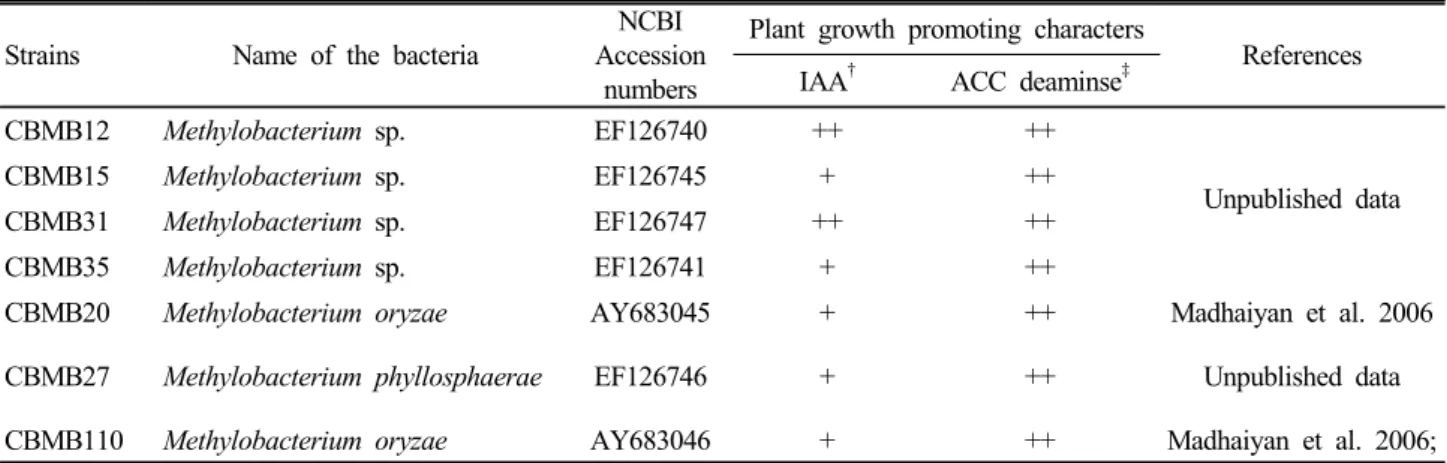
Table 1. Methylobacterium strains used in this study.
Strains Name of the bacteria
NCBI Accession
numbers
Plant growth promoting characters
References IAA† ACC deaminse‡
CBMB12 Methylobacterium sp. EF126740 ++ ++
Unpublished data
CBMB15 Methylobacterium sp. EF126745 + ++
CBMB31 Methylobacterium sp. EF126747 ++ ++
CBMB35 Methylobacterium sp. EF126741 + ++
CBMB20 Methylobacterium oryzae AY683045 + ++ Madhaiyan et al. 2006
CBMB27 Methylobacterium phyllosphaerae EF126746 + ++ Unpublished data
CBMB110 Methylobacterium oryzae AY683046 + ++ Madhaiyan et al. 2006;
†+ = <5.0 ㎍ ml-1, ++ = >5.0 ㎍ ml-1 but less then <10.0 ㎍ ml-1; ‡++ = >50 nmol α-keto butyrate mg-1 protein h-1 but less then <100 α-keto butyrate mg-1 protein h-1.
that promote plant growth. The plant growth promotion effects of Methylobacterium have attracted increasing interest in recent years.
The Methylobacterium strains used in this study were isolated from rice (Madhaiyan et al. 2006). Production of plant growth regulators like indole-3-acetic acid, cytokinins and ACC deaminase which is involved in modulation of ethylene levels in plants and plant growth promotion by these Methylobacterium strains under gnotobiotic condition have been investigated previously (Madhaiyan et al. 2006, 2007). Similarly, Hong et al. (2009) reported the inoculation with these Methylobacterium strains enhanced healthy seedling development in various crops. In this study, inoculation of Methylobacterium strains significantly enhanced root elongation (5.4 to 32.6%) and dry biomass accumulation (9.7 to 78.3%) in tomato seedlings (Hong et al. 2009). Moreover, Methylobacterium strains with IAA and ACC deaminase, have characteristic effects on different aspects of growth of red pepper and tomato seedlings which is comparable or better than exogenous applications of synthetic IAA under gnotobiotic and greenhouse conditions (Deka Boruah et al. 2010).
In previous studies, Methylobacterium strains were found to possess ACC deaminase activity and tested for their potential in plant growth promotion traits in various crops (Deka Boruah et al. 2010; Hong 2009;
Madhaiyan et al. 2006, 2007; Ryu et al. 2006). This current study evaluated the inoculation effect of seven strains of ACC deaminase producing Methylobacterium on seedling ethylene emission of tomato and red pepper plants under greenhouse condition.
Materials and Methods
Bacterial strains The Methylobacterium strains used in this study are listed in Table 1. Stock cultures were stored at -80℃ in 50% glycerol. The isolates from rice (stem, leaf, and rhizosphere soil) were obtained previously by plating the aliquots onto ammonium mineral salts (AMS) minimal medium, with 0.5%
methanol as the sole carbon source, as described by Holland and Polacco (1992).
Greenhouse bioassay The effect of inoculation of seven Methylobacterium strains (CBMB12, CBMB15, CBMB20, CBMB27, CBMB31, CBMB35, CBMB110) on ethylene emission of plants were evaluated under greenhouse condition. Bacterial cells of 72-h-old cultures of Methylobacterium strains were harvested by centri- fugation at 10,000 g for 10 min at 4℃, washed twice and suspended in 0.03 M MgSO4. Homogenous bacterial suspensions were adjusted to O.D. 600 nm = 1.0 (108 c.f.u. ml-1). Surface sterilized seeds (first with 70%
ethanol for 1 min followed by 2% sodium hypochlorite for 1 min) were immersed in bacterial cell suspensions prepared as mentioned above, for 4 h at 60 rpm.
Bacterized tomato and red pepper seeds were sown in seedling trays (50 holes tray-1 and one seed hole-1) containing Biosangto-Mix bed soil [Heung Nong Co., Ltd, Incheon, Gyeonggi-do, Republic of Korea; it contains 65-70% coco peat, 15-20% peat moss, 8-10%
perlite and macronutrient (mg L-1) NH4-N, 80-100;
NO3-N, 150-200; available P2O5, 230-330; K2O, 80-120;
pH 5.5 to 6.5; moisture content 50-60% and water
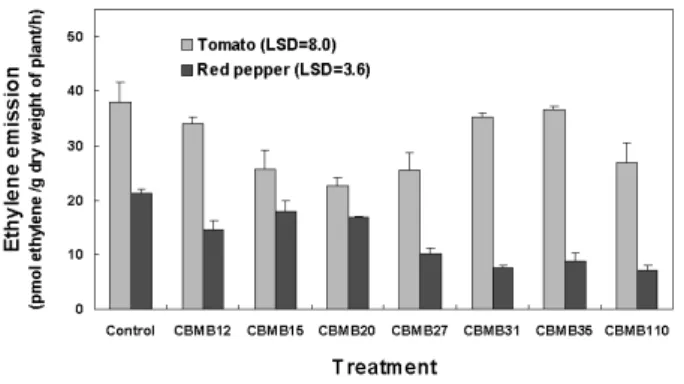
Fig. 1. Effect of Methylobacterium spp. inoculation on ethylene emission of plant leaves under greenhouse condition (47 DAS). Data are means of three replicates per treatment. Error bars represent standard error means of treatment values. Significance at P ≦ 0.05 was tested by least significant difference (LSD).
holding capacity 35-40%] and incubated in a growth chamber (DS 54 GLP, DASOL Scientific Co., Ltd., Korea) at 25℃ with 14/10 h day/night photoperiod.
Twenty one day old tomato and red pepper seedlings were transplanted into 300 ml plastic pots containing Biosangto-Mix bed soil fertilized with 10 ml of Hoagland’s nutrient solution. After transplanting, pots were transferred to the greenhouse and plants were allowed to grow under natural illumination.
Methylobacterium spp. (O.D. 600 nm = 1.0, 108 cfu ml-1) inoculation was performed with a hand-held pneumatic sprayer until run-off and applied to the soil (10 ml) weekly after transplanting.
Effect of Methylobacterium spp. inoculation on the ethylene emission of tomato and red pepper For ethylene analysis, harvested tomato and red pepper leaves and whole plants were placed in 120 ml and 500 ml vials, respectively. One ml sample of the headspace was injected into a Gas Chromatograph (dsCHROM 6200, Donam Instruments Inc., Republic of Korea) packed with Poropak-Q column at 70℃
and equipped with a flame ionization detector. The amount of ethylene emission was expressed as nmol of ethylene h-1 g dry weight-1 by comparing to a standard curve generated with pure ethylene (Praxair, Praxair Korea Co., Ltd).
Statistical analysis Data were subjected to analysis of variance (ANOVA). Significance at P ≦ 0.05 was tested by least significant difference (LSD) using SAS package, Version 9.1 (SAS, 2009).
Results
Effect of Methylobacterium spp. inoculation on the ethylene emission of plant leaves under greenhouse condition The influence of Methylobcterium spp.
inoculation on the ethylene emission of tomato and red pepper seedlings was studied under greenhouse conditions. The ethylene emission of plant leaves at 47 days after sowing (DAS) is given in Fig. 1. In general, ethylene emission in ACC deaminase producing Methylobacterium inoculated plant leaves remained low compared to control. The reduction in ethylene emission in Methylobacterium spp. pretreated tomato leaves compared to control ranged from 7.3 to 40.0%.
The lowest ethylene emission of 22.9 pmol of ethylene h-1 g dry weight-1 was recorded in tomato leaves inoculated with CBMB20. Inoculation with Methylobacterium spp.
CBMB12, CBMB31 and CBMB35 recorded reduced ethylene emissions of 34.0, 35.3 and 36.7 pmol of ethylene h-1 g dry weight-1, however, these were not significantly different to control. Similarly, reduced ethylene emissions were also observed in ACC deaminase producing Methylobacterium strains pretreated red pepper leaves as depicted in Fig. 1. Methylobacterium strains pretreatment reduced ethylene emission in red pepper leaves by 15.5 to 65.7% compared to control.
The lowest ethylene emission of 7.3 and 7.7 pmol of ethylene h-1 g dry weight-1 was recorded in red pepper leaves pretreated with CBMB110 and CBMB31 strains.
Except for Methylobacterium strain CBMB15 inoculation which recorded 18.0 pmol of ethylene h-1 g dry weight-1 inoculation with Methylobacterium strains significantly reduced ethylene emission in red pepper leaves.
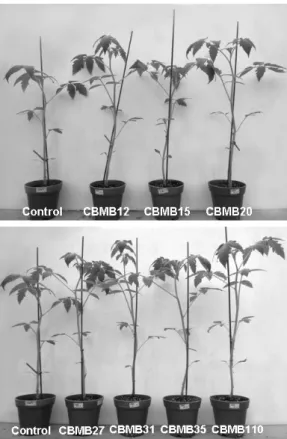
Effect of Methylobacterium spp. inoculation on the ethylene emission of whole plants under greenhouse condition Effects of Methylobacterium strains on tomato and red pepper growth are shown in Fig. 2, 3.
Compared to control, in all Methylobacterium inoculated treatments significant increase in plant growth were observed. The influence of ACC deaminase producing Methylobacterium strains on the ethylene emission of red pepper and tomato plants at 58 DAS is presented in Fig 4. Inoculation with Methylobacterium strains significantly (P ≦ 0.05) reduced ethylene emission in tomato and red pepper plants compared to control.
Fig. 2. Comparison of effect of inoculation with Methylobacterium strains on seedling development of tomato under greenhouse condition.
Fig. 3. Comparison of effect of inoculation with Methylobacterium strains on seedling development of red pepper under greenhouse condition.
Fig. 4. Effect of Methylobacterium spp. inoculation on ethylene emission of plants under greenhouse condition (58 DAS). Data are means of three replicates per treatment. Error bars represent standard error means of treatment values. Significance at P ≦ 0.05 was tested by least significant difference (LSD).
Interestingly, the reduction in ethylene emission is more pronounced in whole tomato and red pepper plants samples compared to leaf samples. Ethylene emission was reduced by 51.0 to 70.2% in whole tomato plants as influenced by Methylobacterium spp. pretreatment compared to control. The lowest ethylene emission of 7.3 pmol of ethylene h-1 g dry weight-1 was recorded in tomato plants inoculated with CBMB20. In red pepper plants, Methylobacterium inoculation reduced ethylene emission by 56.3 to 88.9% compared to control. The lowest ethylene emission of 3.5 pmol of ethylene h-1 g dry weight-1 was recorded in red pepper plants inoculated with CBMB110.
Discussion
Healthy seedling emergence is an important prerequisite for the growth and development of vegetable crops.
However, various factors hinder crop growth during the seedling stage especially due to the prepriming ability of weed seeds (Baskin and Baskin 1989; Koger et al. 2004; Christopher et al. 2006; Main et al. 2006).
Therefore, the assurance of a healthy seedling in crop production starts from radicle emergence. This is particularly true for transplanted and bedding plants where sufficient root-shoot ratio is important for higher rate of survival and better field performance (Zandstra and Liptay 1999).
In this study, the effect of Methylobacterium strains inoculation on ethylene emission of crops was investigated under greenhouse condition. Three of Methylobacterium strains (CBMB20, CBMB27 and CBMB110) have been
previously evaluated for their plant growth promoting properties (Madhaiyan et al. 2006; Lee et al. 2006;
Madhaiyan et al. 2009). All the tested Methylobacterium strains produced indole-3-acetic acid and ACC deaminase activity. Ryu et al. (2006) reported the synthesis of plant growth substances by Methylobacterium spp.
Lee at al. (2006) also reported the effect of methy- lotrophic bacteria on the physiological enhancement of early rice seedling growth.
In the present study, plant leaves and whole plants treated with ACC deaminase producing Methylobacterium strains showed reduced ethylene emissions. ACC deaminase is mostly responsible for controlling stress ethylene level of plants, thereby, influencing root elongation (Glick et al. 1998; Ma et al. 1998). The plausible reason may be due to the ACC deaminase in Methylobacterim, which cleaves the ACC into α- ketobutyrate and ammonia (Glick et al. 1998; Madhaiyan et al. 2006). This mechanism effectively reduces the amount of ethylene evolved by the plant. Thus, the ability to promote plant growth by plant growth promoting rhizobacteria (PGPR) is a direct consequence of the presence of ACC deaminase and more and more experimental evidence indicates that ACC deaminase is one of the key mechanisms by which rhizobacteria promote the growth of plants (Madhaiyan et al. 2006).
In a previous study, the effect of ACC deaminase producing Methylobacterium on ethylene levels and root elongation of Brassica campestris was reported by Madhaiyan et al. (2006). All these studies also corroborate with the present findings. Moreover, when the PGPR contains the enzyme ACC deaminase, the bacterial cells act as a sink for ACC, the immediate biosynthetic precursor of ethylene thereby lowering plant ethylene levels and decreasing the negative effects of various environmental stresses (Stearns et al. 2005).
The greenhouse study conducted showed that inoculation with Methylobacterium significantly reduced ethylene emission in tomato and red pepper. Healthy seedling development resulting from inoculation of Methylobacterium may be due to the cumulative activity of the plant growth promoting characteristics of the strains tested.
More extensive field studies on the inoculation of Methylobacterium can lead to the development of an efficient bioinoculum for improved seedling development of transplanted horticultural crops and bedding plants.
Acknowledgements
This research was supported by Korea Institute of Planning & Evaluation for Technology in Food, Agriculture, Forestry and Fisheries (iPET), Republic of Korea.
References
Abeles, F.B., P.W. Morga and M.E. Saltveit. 1992. Ethylene in plant biology. Academic, San Diego.
Baskin, J.M. and C.C. Baskin. 1989. Physiology of dormancy and germination in relation to seed bank ecology; In:
Leach M.A., Parker V.T. and Simpson R.L. (eds) Ecology of soil seed banks. Acad. Press, San Diego, California p.53-66.
Christopher, L.M., E.L. Steckel, R.M. Hayes and T.C. Mueller.
2006. Biotic and abiotic factors influence horseweed emergence. Weed Sci. 54:1101-1105.
Deka Boruah, H.P., P.S. Chauhan, W.J. Yim, G.H. Han and T.M. Sa. 2010. Comparison of Plant Growth Promoting Methylobacterium spp. and Exogenous Indole-3-Acetic Acid Application on Red Pepper and Tomato Seedling Development, Korean J. Soil Sci. Fert. 43(1):96-104.
Glick, B.R., D.M. Penrose and J. Li. 1998. A model for the lowering of plant ethylene concentrations by plant growth- promoting bacteria. J. Theor. Biol. 190:63-68.
Green, P. N. 1992. The genus Methylobacterium. In The Prokaryotes, 2nd edn, pp. 2342-2349. Edited by A. Balows, H. G. Truper, M. Dworkin, W. Harder & K. H. Schleifer.
New York: Springer.
Greenwood, D.J., J.M.T. Mckee, D.P. Fuller, I.G. Burns and B.J. Mulholland. 2007. A novel method of supplying nutrients permits predictable shoot growth and root: shoot ratios of pre-transplant bedding plants. Ann. Bot. 99:171- 182.
Holland, M.A. and J.C. Polacco. 1992. Urease-null and hydrogenase-null phenotypes of a phylloplane bacterium reveal altered nickel metabolism in two soybean mutants.
Plant Physiol. 98:942-948.
Hong, I.S., J.S. Kim, M.K. Lee, W.J. Yim, M.R. Islam, H.P. Deka Boruah, P.S. Chauhan, G.H. Han and T.M.
Sa. 2009. Effect of Methylotrophic Bacteria in Seedling Development of Some Crops under Gnotobiotic study.
Korean J. Soil Sci. Fert. 42(4):317-322.
Koger, C.H., K.N. Reddy and D.H. Poston. 2004. Factors affecting seed germination, seedling emergence, and survival of texas weed (Caperonia palustris). Weed Science 52(6):
989-995.
Lehman, A., R. Black and J.R. Ecker. 1996. HOOKLESS1, an ethylene response gene, is required for differential cell elongation in the Arabidopsis hypocotyl. Cell 85:183-194.
Lee, H.S., M. Madhaiyan, C.W. Kim, S.J. Choi, K.Y. Chung and T.M. Sa. 2006. Physiological enhancement of early
growth of rice seedlings (Oryza sativa L.) by production of phytohormone of N2-fixing methylotrophic strains. Biol.
Fertil. Soils 42:402-408.
Mattoo, A.K. and J.C. Suttle. 1991. The plant hormone ethylene. CRC Press, Boca Raton, p.337.
Ma, J.H., J.L. Yao, D. Cohen and B. Morris. 1998. Ethylene inhibitors enhance in vitro root formation from apple shoot cultures. Plant Cell Rep. 17:211-214.
Madhaiyan, M., S. Poonguzhali, S.W. Kwon and T.M. Sa.
2009. Methylobacterium phyllosphaerae sp. nov., a pink- pigmented, facultative methylotrophs from the phyllosphere of rice. Int. J. of Syst. and Evo. Microbiol. 59:22-27.
M adhaiyan, M ., S. Poonguzhali and T.M . Sa. 2007.
Characterization of 1-aminocyclopropane-1-carboxylate (ACC) deaminase containing M ethylobacterium oryzae and interactions with auxins and ACC regulation of ethylene in canola (Brassica campestris). Planta 226:867-876.
Madhaiyan, M., S. Poonguzhal, J.H. Ryu and T.M. Sa.
2006. Regulation of ethylene levels in canola (Brassica campestris) by 1-amino cyclopropane-1-carboxylate deaminase- containing Methylobacterium fujisawaense. Planta 224:268- 278.
Main, L.C., L.E. Steckel and R.M. Hayes. 2006. Biotic and abitic factors influence horseweed emergence. Weed Sci.
54:1101-1105.
Mayak, S., T. Tirosh and B.R. Glick. 1999. Effect of wild- type and mutant plant growth-promoting rhizobacteria on the rooting of mung bean cuttings. J. Plant Growth Regul.
18:49-53.
Poonguzhali, S., M. Madhaiyan, W.J. Yim, K.A. Kim and T.M. Sa. 2008. Colonization pattern of plant root and leaf surfaces visualized by use of green-fluorescent-marked strain of Methylobacterium suomiense and its persistence in rhizosphere. Appl Microbiol. Biotechnol. 78:1033-1043.
Ryu, J.H., M. Madhaiyan, S. Poonguzhali, W.J. Yim, P.
Indiragandhi, K.A. Kim, R. Anandham, J.C. Yun, K.H.
Kim and T.M. Sa. 2006. Plant growth substances produced by Methylobacterium spp. and their effect on tomato (Lycoperison esculentum L.) and Red Pepper (Capsicum annum L.) growth. J. Microbiol. Biotechnol. 16:1622-1628.
Schaller, G.E. and J.J. Kieber. 2002. Ethylene. The Arabidopsis book. American Society of Plant Biologists, USA.
Scoggins, H.L., D.A. Bailey and P.V. Nelson. 2002. Efficacy of the press extraction method for bedding plant plug nutrient monitoring. Hort. Sci. 37:108-112.
Sonesson, L.K. 1994. Growth and survival after cotyledon removal in quercus rabur seedlings, grown in different natural soil types. Oikos. 69:65-70.
Stamps, R.H. 2000. Management of nutrients in ornamental plant production systems in Florida: an overview. Soil.
Sci. and Crop. Sci. Soc. of Florida Proc. 59:27-31.
Stearns, J.C., S. Shah, B.M. Greenberg, D.G. Dixon and B.R.
Glick. 2005. Tolerance of transgenic canola expressing 1- aminocyclopropane-1-carboxylic acid deaminase to growth inhibition by nickel. Plant Physiol. Biochem. 43(7):701-708.
Suzanne, K. 1998. Effect of seed damage on germination in common vetch (Vicia sativa L.). The Am. Mid. Natural.
140:393-396.
Sy, A., A.C.J. Timmers, C. Knief and J.A. Vorholt.
2005. Methylotrophic metabolism is advantageous for Methylobacterium extorquens during colonization of Medicago truncatula under competitive conditions. Appl. Environ.
Microbiol. 71:7445-7252.
Van Iersel, M. 1999. Fertilizer concentration affects growth and nutrient concentration of subirrigated pansies. Hort.
Sci. 34:660-663.
Zandstra, J.W. and A. Liptay. 1999. Nutritional effects on transplant root and shoot growth-a review. Acta. Hort.
504:23-31.