Introduction
Even after almost 200 years since humans realized the benefits of supplying chemical fertilizers, such as superphosphate and inorganic nitrogen (N), their full potential for maximizing crop yield on farms is rarely realized. Field crops like wheat and rice, and horticultural crops like red pepper and tomato may fail to respond to supplements of phosphorus (P) or N under field conditions because of a complex interplay of factors including inadequate moisture or ineffective rates of mobilization of nutrients required for plant growth (Kennedy et al., 2004). This is disappointing considering that studies on the success of plant growth in hydroponics
suggest that inorganic fertilizers (N, P, K, Fe, S, Mg, Ca, trace elements) when supplied adequately should be capable of supporting maximum growth. For crops grown in soil however, this is rarely true.
It has been estimated that among the three major staple food crops of world, around 16-17 kg N is assimilated to produce 1 t dry weight of rough rice, including straw (Ponnamperuma and Deturck, 1993; Sahrawat, 2000) about 26-28 kg N is needed to produce 1 t of rough wheat grain including straw (Bhuiyan, 1995) and maize plants require 9-11 kg N to produce 1 t biomass (Anuar et al., 1995). Horticultural crop s red pepper and tomato require about 60-120 kg of N to achieve adequate yield (Balemi, 2008). Ironically, most of the soils of the world are deficient in N and thus, application of N fertilizer is essential for good yields of such crops. Generally, urea is the most convenient N source. Unfortunately, less than Received : May 7. 2009 Accepted : July 22. 2009
*Corresponding author: Phone : +82432612561, E-mail : [email protected]
Pepper under Different Levels of Organic and Chemical Fertilizers
Min-Kyoung Lee, Gil-Seung Lee, Woo-Jong Yim, In-Soo Hong, Pitchai Palaniappan,
Md. Ashaduzzaman Siddikee, Hari P. Deka Boruah, Munusamy Madhaiyan, Ki-Sup Ahn1, and Tongmin Sa*
Department of Agricultural Chemistry, Chungbuk National University, Cheongju, Chungbuk, 361-763, Republic of Korea
1Department of Health and Environment, Baekseok culture University, Cheonan, Chungnam 330-705, Republic of Korea
Use of plant growth promoting symbiotic and non-symbiotic free-living beneficial bacteria as external source of nitrogen is a major research concern for sustainable crop production in the 21stcentury. In view of this, an experiment was conducted under controlled conditions to determine the effects of inoculation with Methylobacterium suomiense CBMB120, a plant growth promoting (PGP) root and shoot colonizer on red pepper, for the purpose of reducing external chemical nitrogen fertilization. Amendments with organic fertilizer and chemical fertilizer in the form of NPK were made at dosages of 50%, 75% and 100%, at 425 and 115 kg/ha-1measurements. The soil type used was loam, with a pH of 5.13. The growth responses were measured as plant height at 19, 36 and 166 days after transplantation and final biomass production after 166 days. It was found that inoculation with M. suomiense CBMB120 promotes plant height increase during the active growth phase at 19 and 36 days by 14.17% and 10.03%, respectively. Thereafter, the bacteria inoculated plantlets showed canopy size increment. A highly significant inoculation effect on plant height at p<0.01 level was found for 100% level of organic matter and chemical amendment in red pepper plantlets after 36 days and 19 days from transplantation. Furthermore, there was a significantly higher (10.30% and 6.84%) dry biomass accumulation in M. suomiense CBMB120 inoculated plants compared to un-inoculated ones. A 25% reduction in the application of chemical nitrogen can be inferred with inoculation of M. suomiense CBMB120 at with comparable results to that of 100% chemical fertilization alone. Enumeration of total bacteria in rhizosphere soil confirms that the introduced bacteria can multiply along ther hizosphere soil. Large scale field study may lead to the development of M. suomiense CBMB120 as an efficient biofertilizer.
Key words: Methylobacterium, organic fertilizer, chemical fertilizers, plant growth, biofertilizer, colonization
50% of the applied urea is actually used by plants (Choudhury and Khanif, 2001; Garabet et al., 1998;
Halvorson et al., 2002; Bhattacharjee et al., 2008). This low efficiency of use is mainly caused by NH3
volatilization, denitrification, and losses from leaching (Bijay-Singh et al., 1995; DeDatta and Buresh, 1989). To make things worst, volatilization and denitrification pollute the atmosphere through the evolution of greenhouse gases like N2O, NO and NH3 (Kennedy et al., 2004). Leaching of NO3-N also causes groundwater toxicity (Shrestha and Ladha, 1998). In addition to these environmental problems, tillage systems that make long- term use of urea may deplete the soil's organic matter (Wairiu and Lal, 2003).
There is a need therefore to consider alternative sources of N in order to overcome these problems, which also greatly concern environmentalists. These may include the use of plant growth promoting symbiotic and non- symbiotic N fixers as well as free living N fixers.
Moreover, the effective use of organic wastes and chemical fertilizers along with plant growth promoting N fixers may lessen the depletion of soil organic-N content (Jeyabal and Kuppuswamy, 2001; Rivera-Cruz et al., 2008). This can provide an alternative solution to the problem by sustaining organic-N as a buffer for fluctuations in inorganic N concentration in the soil plant system. However, the success of biological nitrogen fixation (BNF) along with reduction of chemical N depends on the nature of the bacterial strain used, the soil edaphic factors, and the method of application. Use of carrier based materials including various clays, poultry manure, banana waste etc. to enhance the BNF efficiency has been reported (Stephens and Rask, 2000; Rivera- Cruz et al., 2008). Foliar application, as well as soil drenching with liquid bacterial formulations have also been reported by many researchers using different bacterial strains (Kannaiyan et al., 1980; Singh et al., 1999; Islam and Bora, 1998; Nguyen et al., 2003).
Similar studies on plant growth promoting activity of the pink pigmented facultative methylotrophic bacteria, Methylobacterium have been reported earlier by several workers (Trotsenko et al., 2001; Holland and Polacco,
1992; Indiragandhi et al., 2008). Methylobacterium species are ubiquitous on plant surfaces as well as in the rhizosphere (Corpe and Rheem, 1989; Idris et al., 2006).
However, the efficacy of crop growth with the application of Methylobacterium in situ as affected by the nature of plants and edaphic factors is yet to be evaluated. In view of this, an experiment was conducted to evaluate the inoculation efficacy of M. suomiense CBMB120 on the growth and yield of red pepper (Capsicum annum L.) in combination with doses of organic matter and chemical nitrogen fertilizer under green house conditions.
Materials and Methods
Soil Soil used for this study was collected from Chungbuk National University (CBNU) experimental field. Soil characteristics are presented in Table 1.
Bacterial strain M. suomiense CBMB 120 was taken from laboratory stock cultures at the Agricultural Chemistry Department, CBNU and maintained in ammonium mineral salt (AMS) medium with 0.5%
methanol. The strain produces plant growth promoting substances indole-3-acetic acid and cytokinin, possesses quorum sensing signals (Poonguzhali et al., 2007), and promotes root elongation in different crops (Ryu et al., 2006; Madhaiyan et al., 2006). Besides these, the strain is able to colonize the root, leaf and stem of tomato (Poonguzhali et al., 2008). On the basis of these characteristics, the strain was selected for evaluation of external-N management in green-house condition.
Test plant and fertilizer Red pepper (Capsicuannum L.) wasusedasa test plant. The seedlings of Capsicum annum were grown in a nursery for 30 days. Oil cake used as organic N source was purchased from KG Chemicals in Bucheon, Gyeongi-do. The N : K : P ratio in the organic fertilizer was 4 : 2 : 1 with 70% organic matter. Complex fertilizer containing urea as a N source was used and the ratio of N : P2O5: K2O was 46 : 2 0 : 60.
Texture
K+ Mg2+
Ca2+
Ex. cations
--- cmol+kg-1--- --- mg kg-1---
dS/m 1:5
Loam 5.1 0.14 3.9 2.0 7.1 1.26 0.73 0.12
P2O5 NH4+
-N NO3-
EX -N pH
Table 1. Physico-chemical properties of soil used in the experiment.
diameter 15 cm x height 30 cm x width 24.5 cm) were filled with 11.5 kg soil. For organic fertilizer treatment oil cake was added at 4.683 g kg-1soil, and for chemical fertilizer treatment 222 mg urea kg-1soilwasadded.These levels of fertilizer treatment were based on the recommended amount of N for red pepper, and considered as 100% dosage of N application. Organic and chemical nitrogen were added accordingly from the original calculation to come up with 50%, 75%, and 100% dosages of application. One week of acclimatization was allowed after addition of organic matter and chemical nitrogen, separately. Thirty days old red pepper seedlings were transplanted to the pots and allowed to grow in green house at a temperature cycle of 28℃/22℃ (day/night) and under natural illumination.
Each treatment consisted of six pots and each pot contained a single plant, and these were arranged following a completely randomized design.
Preparation and application of bacterial inoculums M. suomiense CBMB120, grown in ammonium mineral salt medium for 72 h was centrifuged at 10,000 rpm for 10 min and the cell pellets collected. From the cell pellets, bacterial cell suspension in sterile distilled water was prepared, maintaining the OD600at 0.8 (1x10⁶ CFU mL-1).
The M. suomiense CBMB120 bacterial suspension maintained at an OD600of 0.8 was sprayed on red pepper plants until run-off using a hand-held pneumatic sprayer at 1, 15, 40, 70, 90, 120 and 140 days after transplantation.
Effect of M.suomiense CBMB120 on growth of red pepper Effect of M. soumiense CBMB120 on growth and development of red pepper was recorded as increase in plant height at 16, 36 and 166 days after transplantation. Effect of organic matter, total nitrogen and M. suomiense CBMB120 on total biomass production expressed as dry matter was recorded at final harvest on day 166.
Colonization of M. suomiense CBMB120 Colonization by M. suomiense CBMB120 and other non introduced methylotrophic bacteria of rhizosphere soi lplanted with red pepper was determined in AMS medium with 0.5% sodium succinate as sole carbon source. Total aerobic bacteria (TAB) count was done in nutrient agar (NA) media. In this procedure, 10.0 g rhizosphere soil in 90 mL distilled water was placed in a
then serially diluted to 10-6, 10-7and 10-8. From these suspensions, 100 µL was transferred to AMS plates for growth of M. suomiense CBMB120 and to NA plates for TAB. Total number of bacterial colony was measured after 4 to 5 days of incubation and expressed as CFU of log10.
Statistical analysis Total of 12 treatments, each containing 6 replicates, were assigned using the completely randomized block design. The inoculation effect was analyzed by paired comparison. The effect of the different doses of chemical and organic fertilizers was compared by simple t-test and total effect was analysed by two way ANOVA analysis and level of significance was compared by Duncans Multiple Range Test (DMRT) at p<0.05. All the analyses were done using SAS Version 9.1.
Results and Discussion
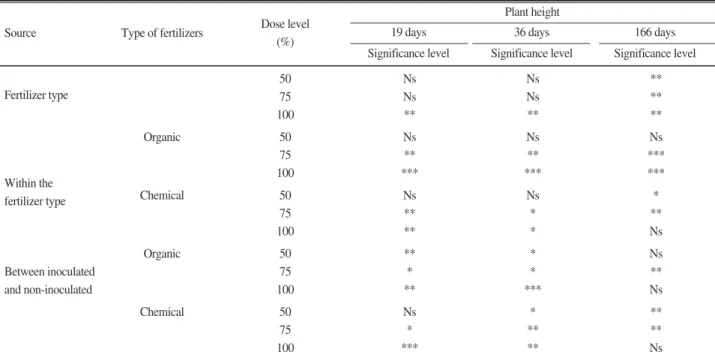
Inoculation effect of M. suomiense CBMB120 on red pepper growth Effects of fertilizer type and level of fertilizer application, with and without inoculation of M.
suomienseCBMB120 on the height of red pepper plants are presented in Table 2 and Fig.1. Organic fertilizer had a significant dose dependent effect on the plant height at r-square value 0.506 while in chemical fertilizer treated plants, no dose dependent effect was found at r-square value 0.091 after 19-days from transplantation. A significant height increase was recorded however at higher doses. The dose dependent effect on plant height was true for 36 and 166 days old organic fertilizer treated red pepper plants at r-square value 0.398 and 0.506, respectively. In contrast, no significant dose dependent effect on height was found with chemical fertilizer treated plants at r-square values 0.398 (36 days), and 0.093 (166 days) although, significant height increase (r-square value 0.142) was recorded after 36 days from transplantation at 100% level of treatment.
The effect of different levels of inoculation with M.
suomiense CBMB120 was also analyzed. Significant difference in plant height increment was seen between bacteria inoculated and non-inoculated plants after 19 days from transplantation, except the 50% chemically treated group at r-square 0.051. After 36 days from transplantation, M. suomiense CBMB120 treated plants showed significantly greater increase in height at p<0.01 to p<0.10 level than those not inoculated. Plants grown
with bacterial inoculation in addition to 100% organic matter amendment showed the highest increase at p<0.01l evel. This pattern was not maintained however after 166 days of transplantation. After 166 days, only those treated with 75% organic matter in combination with M. suomiense CBMB120 showed a significant increase in plant height at p<0.05 level. O n the other hand, at 50% and 75% dose of chemical fertilization, bacteria inoculated plants showed significant increase in height at p<0.05 level with r-square value of 0.065 and 0.051, respectively.
Dry biomass accumulation in red pepper plants treated with organic fertilizer and chemical fertilizer, with and without M. suomiense CBMB120 inoculation is presented in Table 3. Similar to that of plant height, a dose dependent effect on dry matter accumulation was found for both the organic fertilizer and chemical fertilizer treated red pepper plants. Dry biomass accumulation was shown to be almost equal between 75% chemical fertilizer treated plants in combination with inoculation of M. suomiense CBMB120 and those that received 100% chemical fertilizer alone. No significant effect on dry matter accumulation was found in plants treated with organic matter and M. suomiense CBMB120. Dose wise comparison shows that plants that received chemical N and M. suomiense CBMB120 accumulated a significantly higher biomass.
Source
Significance level Significance level
Significance level
19 days 36 days 166 days
Plant height Dose level
(%)
50 75 100
50 75 100
50 75 100
50 75 100
50 75 100 Organic
Chemical
Organic
Chemical Fertilizer type
Within the fertilizer type
Between inoculated and non-inoculated
Comparison of effect different levels of fertilizer within the group, paired comparison between inoculation of Methylobacterium suomiense CBMB120 and un-inoculated red pepper growth was done by t test. Duncan's multiple range test (DMRT) was done for total comparison and fertilizer type. *=significant at p<0.1; ** = significant level at p<0.05; *** = significant level at p<0.01; Ns= not significant.
Ns Ns
**
Ns
**
***
Ns
**
**
**
*
**
Ns
*
***
Ns Ns
**
Ns
**
***
Ns
*
*
*
*
***
*
**
**
**
**
**
Ns
***
***
*
**
Ns Ns
**
Ns
**
**
Ns Type of fertilizers
Table 2. Effect of different fertilizers, fertilizer levels and M. suomiense CBMB120 inoculation on red pepper plant height.
Fig. 1. Inoculation effect of M. suomiense CBMB120 on plant height of red pepper grown in different levels of organic and chemical fertilizers. All the data are the means of six replications; error bars = standard error means of observed values; bars followed by similar letters are not significantly different from each other, LSD values 19 days =1.609; 36 days
= 2.487; 166 days = 8.527; A= 19 days after transplantation;
B= 36 days after transplantation; C= 166 days after transplantation.
The primary objective in using plant growth promoting bacteria (PGPB) in agricultural crop production is the reduction of external N application while maintaining plant growth. With use of PGPB, minimal application of chemical nitrogen fertilizers can ensure sufficient supply of N for optimum yield in a sustainable eco-friendly crop production management system (Dobereiner and Pedrosa, 1987). Kennedy et al. (2004) proposed this reduction of external N application with use of PGPB.
This is consistent with the results of this present investigation where optimization of external nitrogen supply with use of PGP bacteria is seen.
In summary, 75% chemical fertilizer amendment in combination with M. suomiense CBMB120 treatment produces a near 100% level of biomass accumulation.
Furthermore, M. suomiense CBMB120 treatment promotes significant increase of plant height during active growth phase, thereafter promoting significant higher biomass accumulation in red pepper. This promotion of early apical dominance by M. suomiense CBMB120 may be through rationalizing N metabolism and arresting the lateral growth.
Colonization of M. suomiense CBMB120 Population count of inoculated M.suomiense CBMB120 and total heterotrophic bacteria is given in Table 4. The results confirm the ability of M. suomiense CBMB120 to
multiply along roo tsurfaces of red pepper. No methylotrophic bacteria was detected in organic matter treated red pepper plantlets, where no M. suomiense CBMB120 was inoculated while in 75% and 100%
chemical nitrogen amended plantlets, 0.3 to 1.0 log cfu g-
1 dry soil was recorded. On the other hand, total population of M. suomiense CBMB120 was recorded at 3.5 to 4.1 log cfu g-1dry soil where the bacterial was introduced. The results also show that inoculation of M.
suomiense CBMB120 had no effect on total indigenous bacteria population. This corroborates an earlier finding reported by Poonguzhali et al. (2008) where the authors confirmed bacterial colonization of rice rhizosphere and tomato plants using gfp tagged mutant strain of M.
suomiense CBMB120. The ability of introduced bacteria to influence growth and yield of test plants is dependent on the colonization ability of the bacteria along with the inability to cause deleterious effects on indigenous beneficial microbes (Bhattacharjee et al., 2008; Kennedy et al., 2004). This finding further reinforces the importance of M. suomiense CBMB120 as a potential inoculum when growing red pepper.
Conclusion
From this investigation, it can be concluded that M.
suomiense CBMB120 can reduce the need for external
Fertilizer Type
g plant-1 35.9 ± 2.5 39.6 ± 2.0 31.3 ± 2.3 31.8 ± 2.1 26.7 ± 1.3 26.9 ± 1.3 40.9 ± 2.2 43.7 ± 1.6 39.7 ± 2.4 39.2 ± 2.2 30.8 ± 0.9 33.2 ± 1.0 No"
Yes‡ No"
Yes‡ No"
Yes‡ No"
Yes‡ No"
Yes‡ No"
Yes‡ 100%
100%
75%
75%
50%
50%
100%
100%
75%
75%
50%
50%
Organic Organic Organic Organic Organic Organic Chemical Chemical Chemical Chemical Chemical Chemical
LSD value
2.1 2.6 2.1 Between fertilizer type
Between the dose
Between M. suomiense CBMB120 inoculated and un-inoculated
Each value represents mean of six replications; ±1.0 = standard error means of observed values; "NO = red pepper plantlets grown without inoculation of M. suomiense CBMB120; ‡Yes = red pepper plantlets grown with the inoculation of M. suomiense CBMB120.
Plant dry weight CBMB120 inoculation
Fertilizer level Treatment
fertilizers.
application of chemical fertilizers by up to 25%. This is evidenced by the comparable growth effects on red pepper plants treated with 100% chemical fertilizer alone to those inoculated with M. suomiense CBMB120 at lower doses of chemical fertilizer. Further, M. suomiense CBMB120 promotes early apical dominance in red pepper plant by rationalizing nitrogen metabolism and arresting vegetative growth. M. suomiense CBMB120 may consequently be able to promote early fruit set and yield. Besidesthese, M. suomiense CBMB120 possesses the added advantage of being able to colonize root surfaces of red pepper plant without affecting indigenous bacterial populations. Inoculation effect of M. suomiense CBMB120 was found to be most effective from early growth stage to mid growth stage in red pepper. Large scale field trials should be conducted to test the most effective biofertilizer formulation that can be developed from the strain M. suomiense CBMB120.
Acknowledgement
This work was supported by the research grant of the Chungbuk National University in 2008.
References
Anuar, A. R., Z. H. Shamsuddin and O. Yaacob. 1995. Contribution
of legume-N by nodulated groundnut for growth of maize on an acid soil. Soil Biol. Biochem. 27:595 601.
Balemi, T. 2008. Response of tomato cultivars differing in growth habit to nitrogen and phosphorus fertilizers and spacing on vertisol in Ethiopia.ActaAgric. Slovenica. 91:103-119.
Bhattacharjee, B. R., A. Singh and S. N. Mukhopadhyay. 2008. Use of nitrogen-fixing bacteria as biofertiliser for non-legumes:
prospects and challenges. Appl. Microbiol. Biotechnol. 80:199- 209.
Bhuiyan, N. I. 1995. Intensive cropping and soil nutrient balance in Bangladesh.p.61 71. In M. S. Hussain, S. M. I. Huq, M. A. Iqbal and T. H. Khan (ed.) Improving soil management for intensive cropping in the tropics and sub-tropics. Bangladesh Agricultural Research Council, Dhaka.
Bijay-Singh, Yadvinder-Singh and G. S. Sekhon. 1995. Fertilizer-N use efficiency and nitrate pollution of groundwater in developing countries. J. Contam. Hydrol. 20:167 184.
Choudhury, A. T. M. A. and Y. M. Khanif. 2001. Evaluation of the effects of nitrogen and magnesium fertilization on rice yield and fertilizer nitrogen efficiency using 15Ntracertechnique.J. Plant Nutr. 24: 855 871.
Corpe, W. A. and S. Rheem. 1989. Ecology of the methylotrophic bacteria on living leaf surfaces. FEMS Microbiol. Ecol. 62:243- 250.
De Datta, S. K. and R. J. Buresh. 1989. Integrated nitrogen management in irrigated rice. Adv. Soil Sci. 10:143 169.
Döbereiner, J. and F. O. Pedrosa. 1987. Nitrogen-fixing bacteria in non leguminous crop plants. Science Tech, Madison.
Garabet, S., J. Ryan and M. Wood. 1998. Nitrogen and water effects Fertilizer type
Treatment
--- log cfu g-1dry soil --- Total bacteria Methylotrophic
bacteria CBMB120 inoculatio
No"
Yes‡ No Yes No Yes No Yes No Yes No Yes 100%
100%
75%
75%
50%
50%
100%
100%
75%
75%
50%
50%
Organic Organic Organic Organic Organic Organic Chemical Chemical Chemical Chemical Chemical Chemical LSD value
Each value represents mean of six replications; ±1.0 = standard error means of observed values;
"
No = red pepper plantlets grown without inoculation of M. suomiense CBMB120;
‡Yes = red pepper plantlets grown with the inoculation of M. suomiense CBMB120.
Fertilizer type Dose CBMB120 inoculation
0.3 0.4 0.3
0.2 0.2 0.2 -
3.9 ± 0.2 - 4.1 ± 0.2
- 4.1 ± 0.1 1.0 ± 0.6 3.9 ± 0.1 0.3 ± 0.3 3.5 ± 0.3
- 2.8 ± 0.2
8.30 ± 0.1 8.30± 0.1 8.30 ± 0.1 8.42 ± 0.1 8.37 ± 0.1 8.16 ± 0.1 8.35 ± 0.1 8.18 ± 0.1 7.90 ± 0.4 8.16 ± 0.1 8.39 ± 0.4 8.07 ± 0.15 Fertilizer level
Table 4. Enumeration of total bacteria and inoculated M. suomiense CBMB120 from rhizosphere soil of red pepper grown in different levels of organic and chemical fertilizers.
efficiency with labeled nitrogen. Field Crops Res. 58:213 221.
Halvorson, A. D., R. F. Follett, M. E. Bartolo and F. C. Schweissing.
2002. Nitrogen fertilizer use efficiency of furrow-irrigated onion and corn. Agron. J. 94:442 449.
Holland, M. A. and J. C. Polacco. 1992. Urease-null and hydrogenase-null phenotypes of phylloplane bacterium reveal altered nickel metabolism in two soybean mutants. Plant Physiol.
98:942-948.
Indiragandhi, P, R. Anandham, K. A. Kim, W. J. Yim, M.
Madhaiyan and T. M. Sa. 2008. Induction of defense responses in tomato against Pseudomonas syringae pv. tomato by regulating the stress ethylene level with Methylobacterium oryzae CBMB20 containing 1-aminocyclopropane-1-carboxylate deaminase. World J. Microbiol. Biotechnol. 24:1037-1045.
Idris, R., M. Kuffner, M. Puschenreiter, S. Monchy, W. W. Wenzel and A. Sessitsch. 2006. Characterization of Ni-tolerant methylobacteria associated with the hyperaccumulating plant Thlapsi goesingense and description of Methylobacterium goesingense sp. Nov. Syst. Appl. Microbiol. 29:634-644.
Islam, N. and L. C. Bora. 1998. Biological management of bacterial leaf blight of rice (Oryza sativa) with plant growth promoting rhizobacteria. Ind. J. Agric. Sci. 68:798-800.
Jeyabal, A. and G. Kuppuswamy. 2001. Recycling of organic wastes for the production of vermicompost and its response in rice- legume cropping system and soil fertility. Eur. J. Agron. 15:153- 170.
Kannaiyan, S., K. Govindarajan and H. D. Lewin. 1980. Effect of foliar spray of Azotobacter chroococcum on rice crop. Plant Soil 56:487-490.
Kennedy, I. R., A. T. M. A. Choudhury and M. L. Kecskes. 2004.
Non-symbiotic bacterial diazotrophs in crop-farming systems: Can their potential for plant growth promotion be better exploited? Soil Biol. Biochem. 36:1229-1244.
Madhaiyan, M., S. Poonguzhali, J. Ryu, and T. M. Sa. 2006.
Regulation of ethylene levels in canola (Brassica campestris) by 1- aminocyclopropane-1-carboxylatedeaminase-containing Methylobacterium fujisawaense. Planta 224:268-278.
Nguyen, T. H., R. Deaker, I. R. Kennedy and R. J. Roughley. 2003.
The positive yield response of field-grown rice to inoculation with a multi-strain biofertiliser in the Hanoiarea,Vietnam.Symbiosis
Ponnamperuma, F. N. and P. Deturck. 1993. A review of fertilization in rice production. Int. Rice Commission Newsletter 42:1-12.
Poonguzhali S., M. Madhaiyan, W. J. Yim, K. A. Kim and T. M. Sa.
2008. Colonization pattern of plant root and leaf surfaces visualized by use of green-fluorescent-marked strain of Methylobacterium suomiense and its persistence inrhizosphere.
Appl. Microbiol. Biotechnol. 78:1033-1043.
Poonguzhali S, M. Madhaiyan and T. M. Sa. 2007. Production of Acyl-homoserine lactone quorum-sensing signals is wide spread in Gram-negative Methylobacterium. J. Microbiol. Biotechnol.
17:226-233.
Ryu, J., M. Madhaiyan, S. Poonguzhali, W. J. Yim, P. Indiragandhi, K. A. Kim, R. Anandham, J. Yun, K. H. Kim, and T. M. Sa. 2006.
Plant growth substances produced by Methylobacteriumspp.and their effect on tomato (Lycopersicon esculentum L.) and red pepper (Capsicum annum L.) growth. J. Microbiol. Biotechnol.
16:1622-1628.
Rivera-Cruz, M. C., A. T. Narcia, G. C. Ballona, J. Kohler, F.
Caravaca and A. Roldan. 2008. Poultry manure and banana waste are effective biofertilizer carriers for promoting plant growth and soil sustainability in banana crops. Soil Biol. Biochem. 40:3092- 3095.
Sahrawat, K. L. 2000. Macro and micronutrients removed by upland and lowland rice cultivars in WestAfrica.Commun. Soil Sci. Plant Anal. 31:717-723.
Shrestha, R. K. and J. K. Ladha. 1998. Nitrate in groundwater and integration of nitrogen-catch crop in rice-sweet pepper cropping system. Soil Sci. Soc. Am. J. 62:1610-1619.
Singh, M. S., R. K. T. Devi and N. I. Singh. 1999. Evaluation of methods for Azotobacterapplicationontheyieldofrice.Ind. J. Hill Farming 12:22-24.
Stephens, J. H. G. and H. M. Rask. 2000. Inoculant production and formulation. Field Crops Res. 65:249-258.
Trotsenko Yu, A., E. G. Ivanova and N. V. Doronina. 2001. Aerobic methylotrophic bacteria as phytosymbionts. Mikrobiologiia 70:
725-736.
Wairiu, M. and R. Lal. 2003. Soil organic carbon in relation to cultivation and topsoil removal on sloping lands of Kolombangara, Solomon Islands. Soil Tillage Res. 70:19-27.
화학비료와 유기질비료를 시비 수준 및 Methylobacterium suomiense CBMB120의 접종이 고추 생육에 미치는 영향을 확인하기 위하여 유기질비료와 화학비료의 시비량을 권장시용수준의 100%, 75% 및 50%로 처리하고 Methylobacterium suomiense CBMB120을 접종 한 후 정식 후 19, 36, 및 166일에 작물의 높이를 측정하였으며 이식 후 166일에 건물량 측정하였다. 균주를 접종한 처리구의 식물체 높이는 정식 후 19, 36일에 각각 14.17%, 10.03% 증가하였다. 건물 중 역시 10.30%, 6.84% 증가하여 유의성 있는 차이를 나타내었다. 또한 균주 접종은 유기질 비료 100% 시용구는 36일 후 고도의 유의성(p<0.01)을 갖는 차이를 보였으며 화학 비료 100% 시용구 는 19일 후 고도의 유의성(p<0.01)을 갖는 차이를 나타내었다. 화학비료 100% 시용구에 균주를 접종하지 않은 처리 구와 화학비료 75% 시용구에 균주를 접종한 처리구의 생육을 분석한 결과 유의성 있는 차이가 없는 것 으로 나타났다. 이는 향후 다양한 처리량 및 처리방법의 연구를 통하여 Methylobacterium suomiense CBMB120 균주의 접종이 화학비료를 일정 부분 감비 할 수 있다는 가능성을 시사한다.
화학비료와 유기질비료의 시용수준 및 Methylobacterium suomiense CBMB120의 처리가 고추 생육에 미치는 영향
이민경·이길승·임우종·홍인수·Pitchai Palaniappan·Md. Ashaduzzaman Siddikee Hari Prasanna Deka Boruah·Munusamy Madhaiyan·안기섭1·사동민*
충북대학교 농화학과, 1백석문화대학 보건환경학과