120
Foliar Colonization and Growth Promotion of Red Pepper (Capsicum annuum L.) by Methylobacterium oryzae CBMB20
Minkyoung Lee1†, Puneet Singh Chauhan1, Woojong Yim1, Gyeongja Lee2, Young Sang Kim2, Keewoong Park3,and Tongmin Sa1*
1Department of Agricultural Chemistry, Chungbuk National University, Cheongju, Republic of Korea
2Chungbuk Agricultural Research and Extension Services, Cheongweon 361-883, Republic of Korea
3Bio-Evaluation Center, KRIBB, Cheongwon, Republic of Korea Received April 8, 2011; Accepted May 13, 2011
In order to exploit Methylobacterium oryzae CBMB20 as of plant growth promoting agent, different inoculation methods have been evaluated. The present study aimed to evaluate soil, foliar, and soil+foliar inoculations of M. oryzae CBMB20 to improve the growth, fruit yield, and nutrient uptake of red pepper (Capsicum annuum L.) under greenhouse conditions. The population range of green fluorescent protein (gfp)-tagged M. oryzae CBMB20 using the three inoculation methods was 2.5-2.9 log10 cfu/g in the rhizosphere and 4.5-6.0 log10 cfu/g in the phyllosphere of red pepper plants. Confocal laser scanning microscopy results confirmed the colonization of M. oryzae CBMB20 endophytically on leaf surface. Plant height, fruit dry weight, and total biomass were significantly higher (p≤0.05) in all M. oryzae CBMB20 inoculation methods as compared to non- inoculated control. Furthermore, uptake of mineral nutrients such as N, P, K, Ca, and Mg in red pepper plants in all M. oryzae CBMB20 inoculation methods was higher than in non-inoculated control. Comparative results of inoculation methods clearly demonstrated that soil+foliar inoculation of M. oryzae CBMB20 lead to the highest biomass accumulation and nutrient uptake which may be due to its efficient colonization in the red pepper rhizosphere and phyllosphere.
Key words: colonization, foliar inoculation, Methylobacterium, nutrient uptake, red pepper, soil inoculation
Extensive use of chemical fertilizers in farming assures high yield but causes various environmental problems. Because of this, there has been a recent resurgence of interest in environmentally friendly sustainable and organic agricultural practices [Esitken et al., 2006]. The relationship between these microorganisms and plants is symbiotic, wherein both partners benefit from each other. So far considerable number of bacterial species, mostly associated with the plant rhizosphere, have been tested and found to be beneficial to plant growth, yield, and crop quality [Pýrlak and Kose, 2009]. These groups of bacteria are known as plant growth promoting rhizobacteria (PGPR) and include strains from genera Azospirillium, Azotobacter, Bacillus, Burkholderia, Erwinia, Methylobacterium, Pseudomonas, Rhizobium, and Serratia etc. Among them the members of the genus Methylobacterium are versatile in nature and ubiquitous
on plant surfaces, potentially dominating the phyllosphere population. Their association with plants extends from free- living to epiphytic, endophytic and symbiotic and their presence has been detected by cultivation-independent methods [Sy et al., 2001; Jackson et al., 2006].
The association between PGPR and plants benefits plant growth through one or more mechanisms that includes production of phytohormones like indoleacetic acid or cytokinins and vitamins, synthesis of enzymes such as urease or 1-aminocyclopropane-1-carboxylate deaminase (ACCD) that modulates plant growth, production of siderophores and enhance uptake of nutrients [Babalola, 2010]. The beneficial effect of application of PGPR on plant growth is determined by the efficiency of colonization of the bacteria. Several studies have reported rhizosphere and intercellular colonization of plant tissues by Methylobacterium species [Madhaiyan et al., 2007b;
Poonguzhali et al., 2008].
Colonization of the plant root system is the very first step in nearly all interactions between plants and soil borne microbes and it is essential to establish the application methods so that introduced microbe can achieve successful colonization with host plant [Chauhan and Nautiyal, 2010]. For the PGPR, various methods of application, seed, soil and foliar application, on
†Present address
OBT, Jincheon, Republic of Korea E-mail: [email protected]
*Corresponding author
Phone: +82-43-261-2561; Fax: +82-43-271-5921 E-mail: [email protected]
doi:10.3839/jabc.2011.021
different crops have been investigated [Madhaiyan et al., 2005;
Esitken et al., 2006; Poonguzhali et al., 2008]. Esitken et al.
[2006] reported that floral and foliar applications of Pseudomonas and Bacillus species to sweet cherry significantly increased yield per trunk cross-sectional area, fruit weight and shoot length compared to the untreated control. Madhaiyan et al.
[2005] reported that foliar application of pink-pigmented facultative methylotrophic bacteria (PPFM) increased plant height and specific leaf area of sugarcane, and resulted to a yield increase of 9.8% over the control. Nonetheless, effect of PGPR on plant growth is more directly determined by successful colonization on plant. Colonization of PGPR has been traced using green fluorescent protein (gfp) tagging to determine the area of localization by the bacteria in the plant [Esitken et al., 2006; Poonguzhali et al., 2008]. Colonization and persistence of Methylobacterium suomiense in the rhizosphere of tomato and rice was assessed using dilution plating and confocal laser scanning microscopy (CLSM) studies under gnotobiotic conditions [Poonguzhali et al., 2008].
As colonization of PGPR to host plant plays an important role for its maximum exploitation to enhance growth, yield and nutrient uptake. Very less work has been carried out to compare the mode of PGPR application for establishing the beneficial interactions with host plant. Presented study was aimed to compare the Methylobacterium oryzae CBMB20 inoculation methods for red pepper plants.
Materials and Methods
Bacterial strain and mutant preparation. M. oryzae CBMB20 was isolated from stem tissues of rice. M. oryzae CBMB20 utilizes 1-aminocyclopropane 1-carboxylate (ACC) as nitrogen source and produces ACC deaminase [Madhaiyan et al., 2007a]. To observe survival and colonization of M. oryzae CBMB20 on red pepper plant, the strain was tagged with gfp as described earlier [Poonguzhali et al., 2008]. The strain was routinely cultured in ammonium mineral salts minimal broth or agar (AMS) with 0.5% sodium succinate and 20 mg/mL kanamycin for 4 days at 30oC. Broth culture was grown under shaking condition at 120 rpm at 30oC.
Plant growth condition and bacterial inoculation. Plastic pots (bottom diameter 25 cm, height 30 cm, width 28 cm) were filled with 15 kg soil. Oil cake as an organic nutrient source (N:P:K ratio 4:2.1:1 with 70% organic matter) was amended to
soil at 2.54 g/kg.Chemical fertilizer K2O was added at 42 g/kg soil, and compost prepared with saw dust 30%, cow dung 40%, pig dung 10%, chicken dung 10%, and rice bran 10% was added (14.93 g/kg soil). Chemical properties of soil have been tabulated in Table 1. Thirty days old red pepper (Capsicum annum L. cv. Daetong) seedlings grown in a nursery were transplanted to pots.
The inoculum of M. oryzae CBMB20 (8 log10 CFU/mL) was applied to soil, to foliage, or to both soil and foliage at the time of transplantation. Soil inoculation was done with a pipette (20 mL/plant near the root zone), foliar inoculation with a hand held pneumatic sprayer (20 mL/plant on leaves and stem) and soil+foliar inoculation (40 mL/plant) by a combination of both.
Inoculation effect of gfp tagged M. oryzae CBMB20 on plant height, dry weight of fruit and total biomass was recorded 111 days after transplantation. The pots were arranged in a completely randomized design with four replications per treatment. The experiment was conducted under greenhouse conditions at Chungbuk Agricultural Research Institute.
Visualization of CBMB20 by confocal laser scanning microscopy (CLSM). Colonization of gfp tagged M. oryzae CBMB20 on leaf surface, leaf samples were randomly collected 50 days after transplantation from soil, foliar and soil+foliar treated plant. The leaves were cut into three parts (tip, blade and petiole) and fixed in glass slide under a cover slip [Poonguzhali et al., 2008]. Microscopic observations were performed using Leica TCS SP2 confocal system (Leica Microsystems Heidelberg GmbH, Manheim, Germany) equipped with excitation wavelength of 488 nm (Ar laser). Emission light was collected in a range of 510-580 nm for green fluorescence, and 620-660 nm for red fluorescence. Image acquisitions were carried out using a 63×oil immersion objective with a numerical aperture (NA) of 1.4, and processed using the standard software package with the CLSM system (version 2.5.1227a).
Nutrients uptake by red pepper plant. Nitrogen (N) concentration in plant roots and shoots was measured in a Kjeldahl Auto1030 analyzer after digestion with sulphuric acid and potassium sulphate. The concentration of phosphorus (P) was measured according to Jackson [1973] after digesting the plant samples with concentrated sulfuric acid and perchloric acid and using the ammonium metavanadate reagent. Standards were prepared with potassium dihydrogen phosphate (Sigma, St.
Louis, MO). For analysis of other nutrients, the plant sample (0.5 g) was digested with perchloric acid, sulphuric acid and
Table 1. Chemical properties of soil used in the study pH
(1:5) EC Organic-C
content
Available P2O5
Exchangeable cation
CEC
K Ca Mg Na
dS/m g/kg mg/kg --- cmolc /kg---
7.8 0.9 17.2 287 0.3 8.3 1.5 0.2 9.4
distilled water (10:1:2), then filtered twice (No. 6, Advantec Toyo, Tokyo) and the volume was made to 100 mL. A 10 mL sample was used for the analysis by inductively coupled plasma optical emission spectroscopy (ICP-OES, Optima 5300DV, Perkin Elmer, Waltham, MA). Quality Control Standard 21 stock solution (100 µg/mL of 5% HNO3/tr.Tart./tr.HF) from PerkinElmer Life and Analytical Sciences (710 Bridge Port Avenue, Shelton, CT 06484) was used. The working solutions were prepared from primary stock solution using deionized distilled water.
Enumeration of M. oryzae CBMB20 in rhizosphere soil and leaf. To assess the bacterial population in the rhizosphere, soil tightly adhered to the roots and randomly selected leaves were collected from the each red pepper plant at 111 days after transplantation. Serial dilutions of the respective suspensions were then plated on medium amended with kanamycin (20 µg/
mL) for gfp tagged M. oryzae CBMB20 [Poonguzhali et al., 2008]. The plates were then incubated at 30oC, and total methylotrophic bacterial population was counted and expressed as log10 cfu/g of dry soil and leaf.
Statistical analyses. The data were subjected to analysis of variance (ANOVA) using the SAS package, Version 9.1, SAS Institute Inc., Cary, North Carolina, USA. An ANOVA protected least significant difference (LSD) test was applied to test the significance of treatment means at p≤0.05. Data related to CFU were transformed in logarithmic values, before statistical analysis.
Results and Discussion
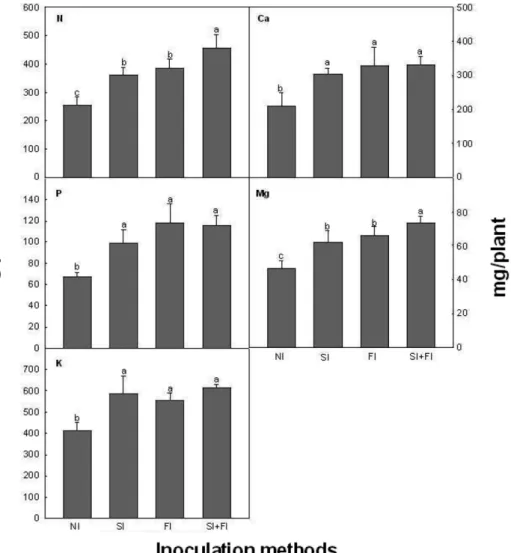
Effect of M. oryzae CBMB20 on plant growth. Microbial inoculants have promising roles in integrated solutions to agro- environmental problems because inoculants possess the capacity to promote plant growth, enhance nutrient availability and uptake, and support the health of plants [Adesemoye et al., 2008]. Beneficial effects of PGPR strains include enhancing phosphorus availability, fixing atmospheric nitrogen, producing plant hormones such as gibberellins, cytokinins, and auxins, and synthesizing the enzyme ACCD, which lowers plant levels of ethylene, thereby reducing environmental stress effects on plants [Omer et al., 2004]. Since the discovery of the roles of PGPR in the improvement of plant health, inoculation methods for PGPR have been investigated for their use in sustainable crop production [Madhaiyan et al., 2005]. In presented study, soil, foliar and soil+foliar application methods for Methylobacterium oryzae CBMB20 was evaluated with respect to plant growth promotion, nutrient uptake, and yield of red pepper (Capsicum annum L.) under greenhouse conditions (Fig. 1 and 3). Among all tested application methods total plant biomass was significantly higher (p≤0.05) in M. oryzae CBMB20 soil+foliar inoculated as compared to non-inoculated control red pepper
plants. Earlier also soil+foliar application were reported more effective mode of PGPR application as compared to the soil or foliar application alone [Esitken et al., 2006; Vijayan et al., 2007]. Recently, Madhaiyan et al. [2010] and Kim et al. [2010]
have reported that soil+foliar application of PPFMs increased the host plant height, specific leaf area and yield.
Effect of M. oryzae CBMB20 inoculation on nutrient uptake of red pepper plant. These results were further evident by significantly higher uptake of all macro-nutrients was found for M. oryzae CBMB20 soil+foliar inoculated plants. Overall increases in uptake of inorganic nutrients by M. oryzae Fig. 1. Effect of M. oryzae CBMB20 inoculation methods on red pepper plant growth. Values in each column are the means of four replications±Standard deviation (SD). Values in each column followed by same letters are not significantly different using ANOVA protected least significant difference test (at p=0.05). Data were recorded at 111 days after transplanting. NI (non-inoculated); SI (soil inoculated); FI (Foliar inoculated), SI+FI (Soil+foliar inoculated)
CBMB20 inoculated plants were N (41-79%), P (46-71%), K (45-48%), Ca (45-58%), and Mg (33-57%) as compared to non- inoculated control (Fig. 3). Highest uptake was observed in M.
oryzae CBMB20 soil+foliar inoculated as compared to non- inoculated control red pepper plants. Higher uptake of macro- nutrient with inoculation of Methylobacterium spp. alone and as a co-inoculant in red pepper, rice and canola were earlier reported [Kim et al., 2010; Madhaiyan et al., 2010]. Among the application methods used, soil+foliar application was found to be more effective than soil or leaf application alone.
Enumeration of M. oryzae CBMB20 in rhizosphere and phyllosphere. Efficiency of plant growth promotion by PGPR is determined by effective colonization of the inoculated bacteria.
M. oryzae CBMB20 colonized with 2.51 to 2.91 log cfu/g and 4.47 to 6.00 log cfu/g in the rhizosphere soil and phyllosphere of red pepper plant, respectively (Fig. 2). Highest population in red pepper rhizosphere was observed in soil+foliar inoculation followed by soil and foliar alone. Colonization of M. oryzae
Fig. 3. Effect of M. oryzae CBMB20 inoculation methods on nutrient uptake in red pepper plant. Values in each column are the means of four replications±Standard deviation (SD). Values in each column followed by same letters are not significantly different using ANOVA protected least significant difference test (at p=0.05). Nutrient analysis was carried out at 111 days after transplantation. NI (non-inoculated); SI (soil inoculated); FI (Foliar inoculated), SI+FI (Soil+foliar inoculated)
Fig. 2. Rhizosphere and phyllosphere colonization of M. oryzae CBMB20 inoculation methods on red pepper plant. Values in each column are the means of four replications±Standard deviation (SD).
Values in each column followed by same letters are not significantly different using ANOVA protected least significant difference test (at p=0.05). Data were recorded at 111 days after transplanting. NI (non- inoculated); SI (soil inoculated); FI (Foliar inoculated), SI+FI (Soil+foliar inoculated)
CBMB20 in the red pepper rhizosphere soil of foliar alone treatment was observed with 2.51 log10 cfu/g which may be due to the dripping of inoculums in the soil while saturating the phyllosphere. Several studies reported rhizosphere and endophytic colonization of roots and leaves in various plants by Methylobacterium [Holland and Polacco, 1994; Poonguzhali et al., 2008; Benediktyova and Nedbal, 2009]. Colonization of M.
oryzae CBMB20 in red pepper phyllosphere in only soil inoculated treatment was also observed with 4.47 log10 cfu/g, which was in agreement to the earlier report by Omer et al., [2004] they showed the colonization of seed treated PPFM in the clover phyllosphere. The role of humidity droplets or air-borne soil granules carrying PPFMs as a way of intra- and inter plant spreading of PPFMs [Kinkel, 1997; Romanovskaia et al., 2001]
is well in line with our results. Higher population of M. oryzae CBMB20 was observed in all inoculation methods in phyllosphere as compared to rhizosphere. The endophytic colonization of inoculated M. oryzae CBMB20 on the red pepper plants leaves were also confirmed by the detection of fluorescent bacterial cells using CLSM (Fig. 4). The leaves of
non-inoculated plants showed no fluorescent bacterial cells.
Fluorescent bacterial cells were observed in all the inoculated plant leaves. Most of the fluorescent bacterial cells were localized near the stomata and throughout the blade part of inoculated leaves. Chlorophyll autofluorescence was also observed in all the leaf samples, but this could easily be differentiated from bacterial fluorescence. The chlorophyll autofluorescence originated mostly from the stomata and mesophyll chloroplasts, whereas the gfp emission from the bacterial cells was found dominantly in intercellular spaces.
Green photons are absorbed by chlorophyll less strongly than red light and penetrate deep into the plant tissue [Vogelmann and Evans, 2002] cause chlorophyll autofluorescence, but fluorescence from M. oryzae CBMB20 originated mostly by stomata and mesophyll chloroplasts and a combination with red light made it easily distinguishable [Benediktyova and Nedbal, 2009].
Efficient colonization by PGPR in the rhizosphere and phyllosphere leads to significant improvement in host plant growth, fruit yield and nutrient uptake. For exploiting the maximum output from any introduced PGPR, first step should Fig. 4. CLSM images showing colonization of gfp-tagged M. oryzae CBMB20 on leaves (at 50 days after transplantation). (A) Non-inoculated;
(B) Soil inoculated; (C) Foliar inoculated, (D) Soil+foliar inoculated; (1) Green fluorescence; (2) Red fluorescence; (3) Green and red fluorescence overlapping.
be checked is the mode of its application. Our results demonstrated that soil+foliar inoculation of M. oryzae CBMB20 leads to the highest biomass accumulation and nutrient uptake that may be due to its efficient colonization in the red pepper rhizosphere and phyllosphere. From our results we can conclude that after selection of efficient PGPR, mode of its application for different host crops should be checked for its maximum exploitation.
Acknowledgment. This work was supported by the Korea Institute of Planning and Evaluation for Technology in Food, Agriculture, Forestry and Fisheries (IPET) of the Ministry of Food, Agriculture, Forestry and Fisheries, Republic of Korea.
References
Adesemoye AO, Torbert HA, and Kloepper JW (2008) Enhanced plant nutrient use efficiency with PGPR and AMF in an integrated nutrient management system. Can J Microbiol 54, 876-886.
Babalola OO (2010) Beneficial bacteria of agricultural importance.
Biotechnol Lett 32, 1559-1570.
Benediktyova Z and Nedbal L (2009) Imaging of multi-color fluorescence emission from leaf tissues. Photosynth Res 102, 169- 175.
Chauhan PS and Nautiyal CS (2010) The purB gene controls rhizosphere colonization by Pantoea agglomerans. Lett Appl Microbiol 50, 205-210.
Esitken, A, Pirlak L, Turan M, and Sahin F (2006) Effects of floral and foliar application of plant growth promoting rhizobacteria (PGPR) on yield, growth and nutrition of sweet cherry. Sci Horti 110, 324- 327.
Holland MA and Polacco JC (1994) PPFMs and other contaminants:
Is there more to plant physiology than just plant? Annu Rev Plant Physiol Plant Mol Biol 45, 197-220.
Jackson EF, Echlin HL, and Jackson CR (2006) Changes in the phyllosphere community of the resurrection fern, Polypodium polypodioides, associated with rainfall and wetting. FEMS Microbiol Ecol 58, 236-246.
Jackson ML (1973) In Soil Chemical Analysis. pp 54-56, Prentice-Hall of India Pvt. Ltd., New Delhi, India.
Kim KA, Yim WJ, Trivedi P, Madhaiyan M, Deka Boruah HP, Islam MR, Lee GS, and Sa TM (2010) Synergistic effects of inoculating arbuscular mycorrhizal fungi and Methylobacterium oryzae strains on growth and nutrient uptake of red pepper (Capsicum annuum L). Plant Soil 327, 429-440.
Kinkel LL (1997) Microbial population dynamics on leaves. Annu Rev Phytopathol 35, 327-347.
Madhaiyan M, Kim BY, Poonguzhali S, Kwon SW, Song MH, Ryu JH, Go SJ, Koo BS, and Sa TM (2007a) Methylobacterium oryzae sp. nov, a novel aerobic, pink-pigmented, facultatively methylotrophic, ACC deaminase producing bacterium isolated from field grown rice (Oryza sativa L. cv. Nam-Pyeoung). Int J Syst Evol Microbiol 57, 326-331.
Madhaiyan M, Poonguzhali S, Kang BG, Lee YJ, Chung JB, and Sa TM (2010) Effect of co-inoculation of methylotrophic Methylobacterium oryzae with Azospirillum brasilense and Burkholderia pyrrocinia on the growth and nutrient uptake of tomato, red pepper and rice. Plant Soil 328, 71-82.
Madhaiyan M, Poonguzhali S, Lee HS, Hari K, Sundaram SP, and Sa TM (2005) Pink-pigmented facultative methylotrophic bacteria accelerate germination, growth and yield of sugarcane clone Co86032 (Saccharum officinarum L). Biol Fertil Soils 41, 350- 358.
Madhaiyan M, Poonguzhali S, and Sa TM (2007b) Metal tolerating methylotrophic bacteria reduces nickel and cadmium toxicity and promotes plant growth of tomato (Lycopersicon esculentum L).
Chemosphere 69, 220-228.
Omer ZS, Tombolini R, and Gerhardson B (2004) Plant colonization by pink-pigmented facultative methylotrophic bacteria (PPFMs).
FEMS Microbiol Ecol 47, 319-326.
Pýrlak L and Kose M (2009) Effects of plant growth promoting rhizobacteria on yield and some fruit properties of strawberry. J Plant Nut 32, 1173-1184.
Poonguzhali, S, Madhaiyan M, Yim WJ, Kim KA, and Sa TM (2008) Colonization pattern of plant root and leaf surfaces visualized by use of green-fluorescent-marked strain of Methylobacterium suomiense and its persistence in rhizosphere. Appl Microbiol Biotechnol 78, 1033-1043.
Romanovskaia VA, Stoliar SM, Malashenko IR, and Dodatko TN (2001) The ways of plant colonization by Methylobacterium strains and properties of these bacteria. Microbiol 70, 221-227.
Sy A, Giraud E, Jourand P, Garcia N, Willems A, de Lajudie P, Prin Y, Neyra M, Gillis M, Boivin-Masson C, and Dreyfus B (2001) Methylotrophic Methylobacterium bacteria nodulate and fix nitrogen in symbiosis with legumes. J Bacteriol 183, 214-220.
Vijayan K, Chakraborti SP, and Ghosh PD (2007) Foliar application of Azotobactor chroococcum increases leaf yield under saline conditions in mulberry (Morus spp). Sci Horti 113, 307-311 Vogelmann TR and Evans CJ (2002) Profiles of light absorption and
chlorophyll within spinach leaves from chlorophyll fluorescence.
Plant Cell Environ 25, 1313-1323.