㡆ῂ㦮 ⳿㩗ὒ ⺆ἓ: 㞪㦒⪲ 㰚┾㦖 䢮㧦⓪ 㦮䞯㩗 䂮⬢㈦Ⱒ 㞚┞⧒ ⽊㢚╖㼊㣪⻫㦚 Ⱔ㧊 㧊㣿䞮ἶ 㧞⓪ 㔺㩫㧊┺. ⁎⩂⋮ 㤆Ⰲ⋮⧒ 㞪䢮㧦㠦 ╖䞲 ⽊㢚╖㼊㣪⻫ 㧊㣿㩫☚㢖 㧊㥶 ❇㠦 ╖ 䞲 㡆ῂ⓪ Ⱔ㰖 㞠㦖 㔺㩫㧊┺. 㧊㠦 㧊 㡆ῂ⓪ 㞪㦒⪲ 㰚┾ 㦖 䢮㧦㦮 ⽊㢚╖㼊㣪⻫ 㧊㣿㟧㌗
ὒ ὖ⩾㣪㧎㦚 㫆㌂䞮₆ 㥚䞮㡂 㔲䟟♮㠞┺.
㡆ῂ╖㌗ ⻫: 3Ṳ㦮 ╖☚㔲㢖 2Ṳ㦮 ☚½ ⏣ ⽋䞿䡫 ☚㔲㦮 9Ṳ ⼧㤦㠦㍲ 㞪㦒⪲ 㰚┾ 㦖 䤚 1⎚㧊 㰖⋲ 㧛㤦䢮㧦 2 6 7ⳛὒ 㣎⧮䢮㧦 1 5 5ⳛ 㽳 4 2 2ⳛ㦚 ╖㌗㦒⪲ 2 0 0 2⎚ 8㤪䎆 9㤪₢
㰖 2Ṳ㤪 Ṛ 㫆㌂⯒ 㔲䟟䞮㡖┺.
ἆὒ: ⽊㢚╖㼊㣪⻫ 㧊㣿⮶㦖 6 3 . 7 %㡖㦒Ⳇ, 㡆⪏㧊 ⌄㦚㑮⪳, ᾦ㥷㑮㭖ὒ ㏢✳㧊 ⏨㦚㑮⪳ 㧊 㣿⮶㧊 ⏨㞮┺. 㞪 㫛⮮⼚ ⽊㢚╖㼊㣪⻫ 㧊㣿⮶㦖 Ṛ㞪㧊 7 1 . 7 %⪲ Ṗ㧻 ⏨㞮ἶ, 㩫⽊㦮 䣣✳ἓ⪲
⓪ Ṗ㫇㧊 4 1 . 3 %⪲ Ṗ㧻 Ⱔ㞮ἶ, 䂲ῂ⋮ 䂲㰖Ṗ 3 9 . 8 %㡖┺.
⽊㢚╖㼊㣪⻫ 㧊㣿 㔲㧧 㔲㩦㦖 㰚┾㔲㩦ὒ 㑮㑶 㧊䤚Ṗ ṗṗ 3 5 . 7 %⪲ Ṗ㧻 Ⱔ㞮ἶ, ┺ゞ☚ ⽊ 㢚╖㼊㣪⻫㦮 㫛⮮⓪ ⻚㎅⮮Ṗ 1 3 7ⳛ( 5 0 . 9 % )㦒⪲ Ṗ㧻 Ⱔ㞮ἶ, ⏏㯯 4 4ⳛ( 1 6 . 4 % )㧊 ┺㦢㧊㠞┺.
㞪 㫛⮮⼚ ⽊㢚╖㼊㣪⻫ 㧊㣿㫛⮮⓪ 㫆㌂ ╖㌗㧊 ♲ ⳾✶ 㞪 㫛⮮㠦㍲ ⻚㎅⮮Ṗ Ṗ㧻 Ⱔ㞮┺. 㧊 㣿 ὖ⩾ Ⱒ㌂䟃㦖˄ Ṗỿ㧊 ゚㕎┺˅Ṗ 9 9ⳛ( 3 6 . 8 % )⪲ Ṗ㧻 Ⱔ㞮ἶ, ˄ ὒ䞯㩗 ⁒Ệ㫇˅㧊 6 2ⳛ (23.0%), ˄ 䣾ὒ ⹎䦷˅㧊 4 8ⳛ(17.8%) 㑲㧊㠞┺. 㭒䂮 㦮⬢㰚ὒ㦮 ὖἚ㠦㍲⓪ 㦮⬢㰚ὒ ⽊㢚╖㼊㣪
⻫㠦 ╖䞮㡂 ㌗㦮䞮⓪ ἓ㤆Ṗ 3 3 . 5 %㡖ἶ, ㌗㦮䞮㰖 㞠⓪ 㧊㥶⓪ 5 2 . 5 %Ṗ˄ ㌗㦮䞶 䞚㣪㎇㦚 ⴑⓦ
⅊㍲˅㡖┺. 㡆Ṛ ⽊㢚╖㼊㣪⻫ 䘟‶ 㧊㣿㧒㑮⓪ 1 0 5㧒㧊㠞ἶ, 㡆 䘟‶ 㧊㣿゚㣿㦖 8 1 1 , 0 0 0㤦㧊㠞
┺.
ἆ⪶: 䟻䤚 ⽊㢚╖㼊㣪⻫㦮 䣾⓻ὒ 㧧㣿㠦 ╖䞲 ⌊㣿㦚 䢮㧦⋮ ⽊䢎㧦㠦Ợ ㍺ⳛ䞮ἶ ㌗╊䞮
⓪ 㞞㦚 Ⱎ⩾䞮㡂㟒 䞶 ộ㧊┺. 㧊⯒ 㥚䞮㡂 䢮㧦㢖 ⽊䢎㧦 㦮㌂⯒ 㥚䞲 Ṗ㧊✲⧒㧎㦚 Ṳ
䞮㡂 䢲㣿䞾㦒⪲㖾 䢮㧦✺㧊 㫖 ▪ 㩗㩞䞲 ⽊㢚╖㼊㣪⻫㦚 㧊㣿䞶 㑮 㧞☚⪳ 䟊㟒 䞶 ộ㧊┺.
Key words:
Complementary and Alternative Medicine, Cancer Patient암환자의보완대체요법이용양상
ₖⳛ䢪
1 ), ṫ⽋㑮
2 ), 㧊ἓ㑮
2 ), 䢿䌲㥺
2 ), Annette E. Maxwell
3 )㡗⋾╖䞯ᾦ 䢮ἓ⽊Ị╖䞯㤦
1 ), 㡗⋾╖䞯ᾦ 㦮ὒ╖䞯 㡞㦮䞯ᾦ㔺
2 ),
Jonsson Comprehensive Cancer Center, UCLA
3)Utilization of Complementary and Alternative Medicine of Cancer Patient in Korea
Myung-Hwa Kim
1 ), Pock-Soo Kang
2 ), Kyeong-Soo Lee
2 ), Tae-Yoon Hwang
2 )Annette E. Maxwell
3 )D e p a rtment of Health, Graduate School of Enviornmental and Public Health Studies Yeungnam University
1 ), Department of Preventive Medicine and Public Health, College of Medicine,
Yeungnam University
2 ), Jonsson Comprehensive Cancer Center, UCLA
3 ) ῃⶎ㽞⪳
J Agri Med & Community Health 2 0 0 7 ; 3 2 ( 3 ) : 1 5 5 ~ 1 6 7
* ᾦ㔶㩖㧦: Pock-Soo Kang, Daemyeong-dong Nam-gu Deagu 707-717, Tel: 053)620-4372 Fax: 053)653-2061 E-mail: [email protected]
I n t r o d u c t i o n
There are multiple definitions of CAM but CAM is generally describes as group of diverse medical and health care system, practices, and products that are not presently considered to be part of conventional medicine by the National Center for Complementary and Alternative M e d i c i n e [ 1 ]
Large proportion of the cancer patients in Korea, regardless of the severity of disease, are found to be using Complementary and Alternative Medicine(CAM) despite the lack of scientific study to fully prove their effectiveness and safety level. The use of CAM is more prevalent in Korea due to its historic reliance on traditional medicine.
Individuals in Korea are often found to be using CAM that has no scientific bases[2].
Twenty nine percent of Korean citizens have had experienced CAM including the use of traditional medicine according to the survey performed at 1999[3]. In a other study pertaining to Korean urban population, 34.8% of the respondents indicated that they had used CAM[4].
The use of CAM is higher among the patients compared to that of the general population. 42% of the cancer patients were reported to be using CAM according to a study conducted by Ministry of Health and Welfare on 1997[5]. Research done by Lee showed that 53% of the patients use CAM[6]. Works done by Choi, on the other hand, showed that 63% of the cancer patients used CAM[7].
* 1 US dollar =1,200 Won (basic year:
2 0 0 2 )
According to a study pertaining to American cancer patients, 54% of the cancer patients were reported to have used CAM[8]. In a separate study by Eisenberg[9] that was published on 1993, 34% of all Americans were shown to have used CAM on the year of 1990.
In the same period, 38,800,000 patients have visited the general medical doctor.
Thus the study concluded that that more patients used CAM then they have visited a doctor to use conventional medicine.
The study reported ages between 25 and 49 have the highest usage rate of CAM among the age groups. Demographically, non-African American who has both high level of education and high level of income were the greatest user of CAM. Moreover, the study found that most patients used CAM in attempt to treat terminal diseases.
Many of the terminally ill patients were found to be using CAM along with the conventional medicine. 79% of the patients who were using both conventional medicine and CAM didn˅ t report their use of CAM to their physician. Thirty percent of the patients who are currently having no sign of illness are reported to use CAM to improve their health. The studies also indicate that usage of CAM grew from 33.8% to 42.1% between 1991 and 1997.
The report also projects the usage of CAM will continually increase. The combined cost of all CAM used during 1997 reached 21 billion US Dollars[10].
In a internet survey targeting 785 Korean doctors, 39% of the doctors showed ˄ I trust CAM very much (7%)˅ or ˄ I trust CAM up to a degree (32%)˅ while 61% of the doctors indicated either ˄ I cannot trust
CAM for most cases (44%)˅ or ˄ I do not trust in them at all (17%)˅ [11]. This polls show a general negative attitude towards CAM among the Korean doctors. American doctor, on the other hand, 50% of the physicians reported that they have consulted their patients with the use of C A M [ 1 2 ] .
Despite the negative attitude towards CAM from the doctors in Korea, the reality is that significant proportion of the cancer patients use CAM and most of them use it without consulting their physician.
Therefore it is necessary to assess the current situation regarding the use of C A M .
This study was conducted to analyze the utilization rate of CAM among the cancer patients and to provide information regarding the use of CAM to the medical provider of the patients. The purpose of this study is to first, find out the utilization pattern of CAM and second, find out the satisfaction with the hospital˅ s service and performance level of the CAM users and third, analyze the costs of using CAM.
Materials and Methods
The study subject was patients who were diagnosed with cancer at least a year prior to the survey. The survey was held at three highly developed metropolitan cities and two medium sized urbanizing cities.
Total of 9 hospitals located within the three metropolitan cities (Seoul, Busan, Daegu) and two medium cities (Gimchon, Gumi) were designated by convenience sampling for this research. Total study subject were 422 cancer patients consisting
of 267 in patients and 155 out patients.
The all subject were 429 cancer patients, so response rate was 98.4%. The study period was for two months during August 2002 to September 2002. Patients with more than one type of diagnosed cancer were excluded from the study.
The subjects were chosen for the study was determined by mortality rate of the cancer in 2001. Male cancer patients with gastric cancer, liver cancer, or lung cancer were chosen for study while female patients with gastric cancer, cervical cancer, or breast cancer were targeted.
The questionnaire for the patients was developed by the researcher and went through pre-test with 20 patients who were diagnosed with cancer who live in Daegu city on April 2002. The questionnaire was revised according to the pre-test results.
The structured questionnaire was administered in person by researcher and three nurses who worked in their hospital.
About twenty patients couldn't effectively communicate with the researchers, the researcher interviewed the closest guardian together the patient. The average length of time it took about thirty minutes for completing survey. Training sessions and survey guidelines were given to all the interviewers in order to minimize the difference between the interviewers.
Data retrieval content included general characteristics, socioeconomic status, smoking and drinking status, satisfaction of the hospital˅s treatment, type of cancer, time of diagnosis, surgery or chemotherapy or not, utilization of CAM (usage of CAM), information sources regarding CAM, duration of usage and its costs. Researcher
refer to the classification system of National Center for Complementary and Alternative Medicine(NCCAM) in the U.S. because there is no standardized classification for CAM in Korea due to its immense diversity and complexity. The NCCAM system classifies CAM in 5 different categories: alternative medical systems, mind-body intervention, biologically based therapies, manipulative and body-based methods, energy therapies. This study adopted the 5 categories from the NCCAM. And add one category that the Korean traditional remedies and massage and touch therapy.
The following is the breakdown of the CAM classification used in this study.
1 .Alternative (Whole) Medical Systems:
Korean Oriental Medicine (KOM;
including in acupuncture), Traditional Chinese Medicine (CTM), herbal medicine, health guides,
2 .Mind-body interventions: prayer, meditation, shamanistic ritual (a shaman ritual to exorcise evil spirits from a person), picture therapy, music therapy, aromatherapy, hypogastric breathing techniques, brain respiration, yoga, relaxation therapy
3 . Biologically Based Therapies: multi- vitamins, iron supplements, calcium supplements, blood circulation supplements, vegetable diet, fasting, whole-grain food, corn beard, mushrooms, fruits, flowers, ginseng, arrowroot, gingko nut, royal jelly, blended vegetables, graph diet, squalene, chitosan, um-yang and five phases diet, melatonin
4 . Manipulative and Body-Based Methods:
Koryo Hand Therapy(KHT, called Koryo
Sooji Chim, Korea Hand Acupuncture), b e e˅ s sting therapy, Tui Na (acupoints), cupping, moxa cautery, chiropractic manipulation, massage therapy
5 .Energy therapies: magnetic treatment, jade treatment, qi therapy, qi gong 6 . Korean traditional remedy: canine
alcohol, black goat, snake alcohol, bear foot, deer blood, penis of seal, frog, toad, earthworm broth, silkworm, canine soup, carp soup, mullet soup
7 .Others: enema, charcoal powder, therapeutic tapping
The data analysis was performed with SPSS version 11.0 Statistical Package.
Descriptive statistics were analyzed and the significance of association in response between subjects characteristics and CAM u t i l i z a t i o n .
R e s u l t s
There were 192 males (45.5%) and 230 females (54.5%) in the subjects group.
The classification of the cancer types is as follows: 168 gastric cancer patients (39.8%), 87 breast cancer patients (20.6%), 63 lung cancer patients (14.9%), 53 liver cancer patients (12.6%), 51 cervical cancer patients (12.1%). About two hundreds (201 patients) of the patients (47.7%) were above the age of 60. Three hundreds eleven patients (74.8%) were already married and lived with a partner. One hundred fifty two of the patients (36%) were Buddhist while 118 patients (27.9%) had graduated from elementary school. The study found that there is a correlation (p<0.01) between age and education level with the usage of CAM. Seventy percent
of patients (69.9%) said their subjective economic status is ˄ a v e r a g e˅ in a subjective self-report. Family income distribution was as follows; 122 patients (28.9%) earned less then 100 thousands Won per month and 141 patients (31.4%) earned between 100 thousands - 199 thousands Won per month(Table 1).
Two hundred twenty eight patients
(54.0%) were a non-smoker while 153 patients (36.3%) smoked in the past.
Forty one patients (9.7%) were still smoking regularly. The 191 patients (45.3%) did not drink alcohol while 171 patients (40.5%) reported that they drank alcohol in the past. Sixty patients (14.2%) said they still consume alcoholic beverages.
Also, subjective quality of life evaluation Table 1. Difference in utilization of CAM by sociodemographic characteristics
V a r i a b l e s No. of CAM utilization
subjects (%) Y e s N o X2( p ) S e x
M a l e 1 9 2 1 2 2 ( 6 2 . 9 ) 7 2 ( 3 7 . 1 )
0 . 1 1 4 ( 0 . 7 3 5 ) F e m a l e 2 3 0 1 4 7 ( 6 4 . 5 ) 8 1 ( 3 5 . 5 )
A g e ( y r s )
< 40 3 0 20(66.7) 1 0 ( 3 3 . 3 )
8 . 3 8 4 ( 0 . 0 3 9 ) 40-49 9 5 7 2 ( 7 5 . 8 ) 2 3 ( 2 4 . 2 )
5 0 - 5 9 9 6 56(58.3) 4 0 ( 4 1 . 7 )
60 or more 2 0 1 1 2 1 ( 6 0 . 2 ) 8 0 ( 3 9 . 8 ) Marital status
Married(live with a partner) 3 0 7 200(65.1) 1 0 7 ( 3 4 . 9 )
W i d o w e d 1 0 2 6 3 ( 6 1 . 8 ) 3 9 ( 3 8 . 2 ) 1 . 8 8 5 ( 0 . 3 9 0 ) Never married or divorced 9 4(44.4) 5 ( 5 5 . 6 )
R e l i g i o n
Buddhist 1 5 2 89(58.6) 6 3 ( 4 1 . 4 )
4 . 9 5 8 ( 0 . 1 7 5 ) C h r i s t i a n i t y 7 1 5 0 ( 7 0 . 4 ) 2 1 ( 2 9 . 6 )
C a t h o l i c 6 0 4 3 ( 7 1 . 7 ) 1 7 ( 2 8 . 3 )
N o n e 1 3 1 81(61.8) 5 0 ( 3 8 . 2 )
Educational background
No education 6 1 3 4 ( 5 5 . 7 ) 2 7 ( 4 4 . 3 ) Elementary school 1 1 8 6 8 ( 5 8 . 1 ) 4 9 ( 4 1 . 9 )
Middle school 6 8 4 2 ( 6 1 . 8 ) 2 6 ( 3 8 . 2 ) 9 . 9 6 1 ( 0 . 0 4 1 ) High school 8 9 59(66.3) 3 0 ( 3 3 . 7 )
College or more 8 6 66(76.7) 2 0 ( 2 3 . 3 ) Subjective economic status
H i g h 33( 7.8) 2 6 ( 7 8 . 8 ) 7 ( 2 1 . 2 )
Middle 2 9 5 ( 6 9 . 9 ) 2 0 5 ( 7 0 . 0 ) 8 8 ( 3 0 . 0 ) 3 4 . 4 0 0 ( 0 . 0 0 0 ) L o w 9 4 ( 2 2 . 3 ) 3 6 ( 3 8 . 3 ) 5 8 ( 6 1 . 7 )
Family income(10,000Won)
Less than 100 1 2 2 ( 2 8 . 9 ) 6 0 ( 4 9 . 2 ) 6 2 ( 5 0 . 8 ) 1 0 0 - 1 9 9 1 4 1 ( 3 1 . 4 ) 91(68.4) 4 2 ( 3 1 . 6 )
2 0 0 - 2 9 9 9 8 ( 2 3 . 2 ) 69(70.4) 2 9 ( 2 9 . 6 ) 1 7 . 0 3 4 ( 0 . 0 0 1 ) 300 or more 6 1 ( 1 4 . 5 ) 45(73.8) 1 6 ( 2 6 . 2 )
T o t a l ( n = 4 2 2 ) T o t a l ( n = 4 2 2 ) 2 6 9 ( 6 3 . 7 ) 1 5 3 ( 3 6 . 3 )
Exclude non respondents.
and family income level were found to be correlated (p<0.01) with CAM utilization.
Health behaviors such as smoking and drinking were shown to have no correlation with the use of CAM (Table 2).
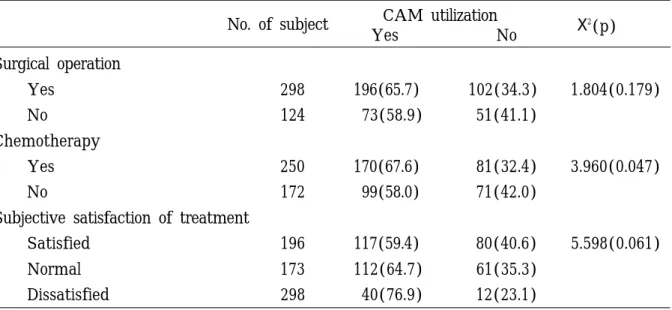
The result showed 298 patients (70.6%) went through surgery as part of the treatment and 250 patients (59.2%) went through chemotherapy. In a survey asking for the level of satisfaction towards the
h o s p i t a l˅ s service and performance, 194 patients (46.4%) responded that they were
˄ s a t i s f i e d˅ and 173 patients (41.0%) responded that it was ˄ n o r m a l˅ while 53 patients (12.6%) said they were
˄ d i s s a t i s f i e d˅ with the hospital. When CAM usage was compared with types of treatment, analysis found a correlation (p<0.05) between CAM use and chemotherapy as well as CAM use and
Table 2. Difference in utilization of CAM by Health behaviors
C h a r a c t e r i s t i c s No. of CAM utilization
s u b j e c t s ( % ) Y e s N o X2( p ) S m o k i n g
Current smoker 41( 9.7) 26(63.4) 15(36.6) 4 . 4 5 4 ( 0 . 1 0 8 ) Former smoker 1 5 3 ( 3 6 . 3 ) 8 8 ( 5 7 . 5 ) 65(42.5)
Never smoker 2 2 8 ( 5 4 . 0 ) 152(68.2) 7 1 ( 3 1 . 8 ) D r i n k i n g
Current drinker 6 0 ( 1 4 . 2 ) 3 9 ( 6 5 . 0 ) 2 1 ( 3 5 . 0 ) 2 . 7 2 5 ( 0 . 2 5 6 ) Former drinker 1 7 1 ( 4 0 . 5 ) 1 0 1 ( 5 9 . 1 ) 7 0 ( 4 0 . 9 )
Never drinker 1 9 1 ( 4 5 . 3 ) 126(67.4) 61(32.6)
Exclude non respondents.
Table 3. Difference in utilization of CAM by treatment and its satisfaction No. of subject CAM utilization
Y e s N o X2( p )
Surgical operation
Y e s 298 196(65.7) 1 0 2 ( 3 4 . 3 ) 1 . 8 0 4 ( 0 . 1 7 9 ) No 1 2 4 7 3 ( 5 8 . 9 ) 5 1 ( 4 1 . 1 )
C h e m o t h e r a p y
Yes 250 170(67.6) 8 1 ( 3 2 . 4 ) 3 . 9 6 0 ( 0 . 0 4 7 )
No 172 99(58.0) 7 1 ( 4 2 . 0 )
Subjective satisfaction of treatment
S a t i s f i e d 196 117(59.4) 8 0 ( 4 0 . 6 ) 5 . 5 9 8 ( 0 . 0 6 1 ) N o r m a l 173 1 1 2 ( 6 4 . 7 ) 6 1 ( 3 5 . 3 )
D i s s a t i s f i e d 298 4 0 ( 7 6 . 9 ) 1 2 ( 2 3 . 1 )
Exclude non respondents.
p a t i e n t˅ s satisfaction level with the hospital (Table 3).
CAM utilization rate among different cancer types are as follows: liver cancer (71.7%), cervical cancer (66.8%), gastric cancer (66.1%), breast cancer (58.6%), lung cancer (55.6%) (Table 4).
The source of information regarding CAM came mostly from patient˅ s family.
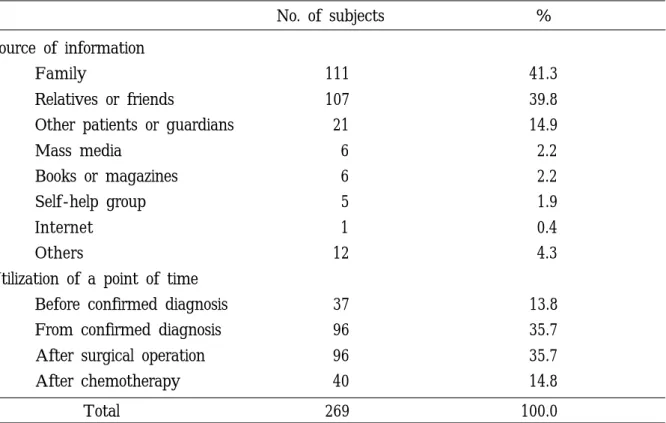
Out of the 269 CAM users, 41.3% received
their information from their immediate family while another 39.8% of the patients received their information from their close friends or relatives. 14.9% of the patients received their information from other patients or their guardians. Only 11.0% of the patients received information about CAM from mass media, boos or magazines, self-help group, internet and others. The 35.7% of the patients started to use CAM
Table 4. CAM utilization rate according to cancer type
Cancer type No. of the subjects No. of user Utilization rate(%)
Stomach cancer 168 111 6 6 . 1
Breast cancer 8 7 5 1 5 8 . 6
Lung cancer 63 35 5 5 . 6
Liver cancer 5 3 3 8 7 1 . 7
Cervical cancer 51 3 4 6 6 . 8
Total 4 2 2 2 6 9 6 3 . 7
Table 5. Source of information about CAM and a point of time of the CAM utilization
No. of subjects %
Source of information
F a m i l y 111 4 1 . 3
Relatives or friends 1 0 7 3 9 . 8
Other patients or guardians 21 1 4 . 9
Mass media 6 2 . 2
Books or magazines 6 2 . 2
Self-help group 5 1 . 9
I n t e r n e t 1 0 . 4
O t h e r s 12 4 . 3
Utilization of a point of time
Before confirmed diagnosis 37 1 3 . 8
From confirmed diagnosis 9 6 3 5 . 7
After surgical operation 96 3 5 . 7
After chemotherapy 40 1 4 . 8
Total 2 6 9 1 0 0 . 0
right after either the diagnosis or surgery for cancer. About fifteen percent (14.8%) of the patients started their use of CAM after the chemotherapy and 13.8% of the patients were using CAM even before they had any known illness (Table 5).
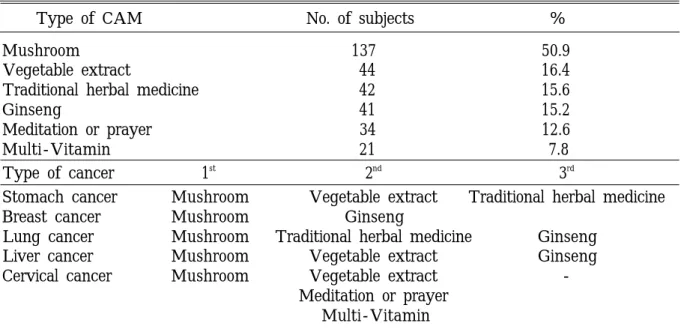
When asked what type of CAM the patients were using, 137 patients (50.9%)
indicated that they were using mushroom.
44 patients (16.4%) were shown to use blended vegetables and 42 patients (15.6%) answered with traditional herbal medicine.
41 patients (15.2%) were shown to take ginseng for their health. When the use of CAM was reevaluated with respect to type of cancer, mushroom was shown to be the
Table 6. Type of CAM utilization in the order of frequency (multiple responses) and use of CAM accroding to type of cancer
Type of CAM No. of subjects %
M u s h r o o m 1 3 7 50.9
Vegetable extract 44 16.4
Traditional herbal medicine 4 2 1 5 . 6
G i n s e n g 4 1 1 5 . 2
Meditation or prayer 3 4 1 2 . 6
M u l t i - V i t a m i n 2 1 7 . 8
Type of cancer 1s t 2n d 3r d
Stomach cancer M u s h r o o m Vegetable extract Traditional herbal medicine Breast cancer M u s h r o o m G i n s e n g
Lung cancer M u s h r o o m Traditional herbal medicine G i n s e n g Liver cancer M u s h r o o m Vegetable extract G i n s e n g Cervical cancer M u s h r o o m Vegetable extract -
Meditation or prayer M u l t i - V i t a m i n
Table 7. Level of communication regarding the use of CAM with doctors
Communication with medical personnel No. of respondent % Communication with doctors(n=269)
Yes 90 3 3 . 5
N o 179 6 6 . 5
Reason for not discussing with their doctors (n=179)
Seems like don˅ t like 55 3 0 . 7
D i d n˅ t feel the need to consult 94 5 2 . 5
H a v e n˅ t got a chance or time to consult 15 8.4
Others 15 8 . 4
Medical personnel who knew about the use of the CAM(n=252)
D o c t o r 87 3 4 . 5
Nurse 36 1 4 . 3
Other personnel 16 1 . 2
None 113 4 4 . 8
n: eligible number of subjects
most commonly used CAM across all cancer types. Vegetable extract was second commonly used CAM for gastric cancer, breast cancer, liver cancer, and cervical cancer. For lung cancer patients, traditional herbal medicine took second most commonly used CAM (Table 6).
When surveyed about the level of communication regarding the use of CAM with doctors, 33.5% of the patients said they have consulted their physician while 66.5% of the patients didn˅ t talk to their doctors regarding their use of CAM.
When asked about the reason for not discussing the use of CAM with their physicians, 52.5% responded that they
˄ d i d n˅ t feel the need to consult.˅ Out of the professional medical personnel who knew about the use of CAM in their patients, 34.5% were doctor sand 14.3%
were nurses (Table 7).
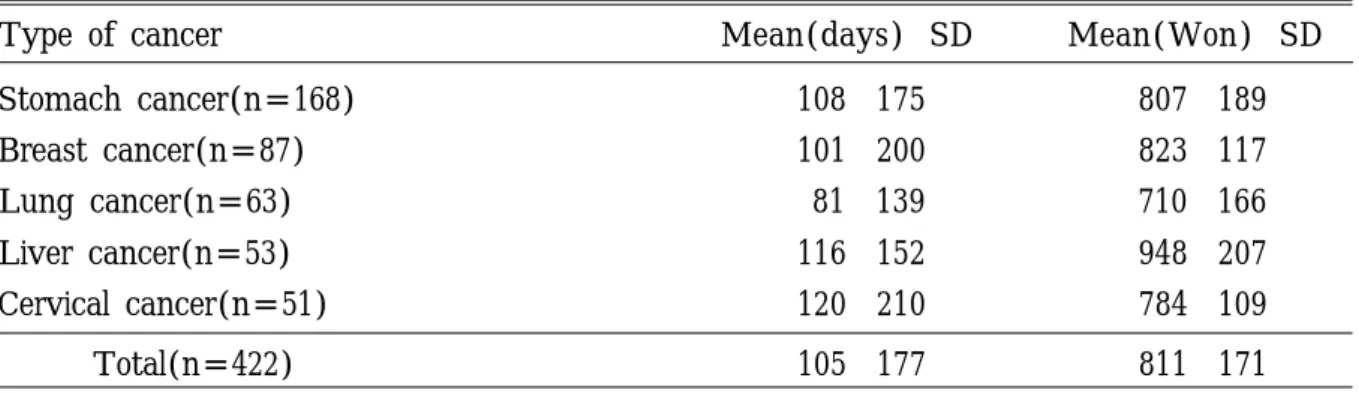
The average CAM utilization period was highest for cervical cancer-which was 120 days per year. Liver cancer patients averaged at about 116 days while gastric cancer patients were using CAM for 108 days. Breast cancer came in next with 101
days and lung cancer patients were using CAM for average of 81 days out of the year. The average cost of using for CAM of 5 cancers per year was 811 thousands Won. The average total cost for CAM per year was highest for liver cancer. Liver cancer patients spent average of 948 thousands Won per year while breast cancer patients spent around 823 thousands Won per year. Stomach cancer patients were spending around 807 thousands Won and 784 thousands Won for cervical cancer.
Lung cancer patients spent least on CAM per year at around 710 thousands Won (Table 8).
D i s c u s s i o n
The leading cause of death in Koreans is cancer. Other top causes of death are cerebral vascular diseases, heart-related problems, diabetes, and liver problem.
Among cancer, lung cancer has the highest fatality rate and it˅ s followed by gastric cancer and liver cancer. Lung cancer is the most frequent death caused by cancer for males while gastric cancer is the most
Table 8. Annual average utilization days and cost using CAM by type of cancer
Type of cancer M e a n ( d a y s )· S D M e a n ( W o n )· S D
Stomach cancer(n=168) 1 0 8· 1 7 5 8 0 7· 1 8 9
Breast cancer(n=87) 1 0 1· 2 0 0 8 2 3· 1 1 7
Lung cancer(n=63) 8 1· 1 3 9 7 1 0· 1 6 6
Liver cancer(n=53) 1 1 6· 1 5 2 9 4 8· 2 0 7
Cervical cancer(n=51) 1 2 0· 2 1 0 7 8 4· 1 0 9
Total(n=422) 1 0 5· 1 7 7 8 1 1· 1 7 1
n=eligible respondents.
SD: Standard deviation
frequent cause of cancer-related death for females[13]. In addition, according to ˄ Y e a r 2000 Korea Central Cancer Registration P r o j e c t˅ conducted by Ministry of Health and Welfare, there were 80,384 new cancer patients who were diagnosed at 131 teaching hospitals[14]. Male patients who were diagnosed with cancer had following types of cancer: gastric cancer (24.5%), liver cancer (16.3%), lung cancer (16.3%), intestine cancer (10.2%), bladder cancer (3.5%), esophagus cancer (2.9%), hematogenous cancer (2.3%). For female patients, the break down of cancer is as follows; GI cancer (15.8%), breast cancer (15.1%), cervical cancer (10.6%), GI cancer (10.5%), thyroid cancer (6.9%), lung cancer (6.8%), liver cancer (6.7%).
This study also selected the top three types of cancer for each gender as the target g r o u p .
This study showed 63.7% utilization rate for CAM. The figures were similar to C h o i˅ s study conducted in 1998 but shows generally higher CAM utilization numbers.
The cause of the increase is difficult to determine but it still shows that interest and use of CAM is rising.
Due to the fact that many patients have quit smoking and drinking after they were diagnosed with cancer, the figure of previously smoked (36.3%) and previously consumed alcohol (40.5%) are high.
However, there were still 9.7% of the patients who continued to smoke and 14.2% of the patients who continued to drink even after they became cancer patient. This indicates the need to educate patients about the need to cut smoking and drinking when being treated with
c a n c e r .
This study showed that younger, highly educated and high income patients were showing increased utilization rate for CAM.
This result is also shown by Yoon Jung C h o i˅ s study[7] and Risberg˅ s study[15].
Most frequent complaint toward CAM was its high cost. Thus, it is reasonable to see cost as the greatest barrier of using CAM and that is why highly educated and high income patients show greater utilization rate then other patients. Reason that the younger, richer patient use CAM at a higher rate due to their stronger incentive to survive and live on. Due to this increased chance of using CAM among this group of patients, There need to give guidelines and allow consultations with doctors to take place by educating those who are pondering about using CAM.
There seem to be only a negligible difference in the utilization rate of CAM between genders. This study showed 64.5%
utilization among females and 62.9%
utilization rate among males. This is similar finding to that of Choi˅ s study[8] that showed 62.8% utilization rate for females and 63.1% utilization rate for males. This result is consistent with the result of study by Bernstein and Shuval[16], which was targeting Israel people as well as Thomas˅ s study[17] conducted in Great Britain in 2 0 0 1 .
There were no significant association between satisfaction level towards the hospital and the use of CAM. However, there was still an observable trend that showed lower the satisfaction level of the treatment, the higher the rate of utilization for CAM became. This shows the need to
educate the professional medical staffs to communicate and explain the medical conditions to the patients in order to also consult the patients with the use of CAM.
Also, noting the fact that 50% of the Korean professional medical personnel have negative perspective on CAM while there are increase in the use of CAM among the patients, there needs to be openly available resources regarding the side effects and understanding regarding CAM in order to allow education and consultation to occur between doctors and patients.
There was difference between utilization rates of CAM depending on the type of cancer. Generally, this study points to increased use of CAM for patients who have cancer in digestive system compared to having cancer in other organs like breast and lungs. This finding is different from C h o i˅s research[7].
The information acquisition regarding CAM showed family was the most frequent source of CAM information.
Following the immediate family, friends and relatives were second most frequent source for CAM information and this finding is consistent with other study in this field. In addition to those close to the patients, 14.9% of the patients showed they acquired CAM information from other patients or family of other patients. Choi˅ s research[7] showed 43.5% of the CAM users receiving information from their neighbors and other patients. This results show the need for patient education that will provide guidelines and consultation to both the patients and their immediate f a m i l i e s .
About fifty percent (49.5%) of the CAM
users indicated that they started to use CAM after the diagnosis while 50.5% of the CAM users started to use CAM after chemotherapy or surgery. This shows the need to provide resources and consultation to those who are being diagnosed with c a n c e r .
There were about 20 different types of CAM used by target group of this study.
This study showed that mushrooms were the top CAM item regardless of the cancer type. This is slightly different from Choi˅ s study which showed elm tree as the top item for CAM. Also the usage of blended vegetables and ginseng shown in this study were higher compared to previously published studies. In general terms, Koreans are using CAM that are more directly tied to diet and nutrition while Americans and Europeans are showing higher usage of physical CAM usages such as acupuncture, massage, pressure therapy, and bio- feedback therapy[7, 8, 18]. This study˅ s result is also very different from similar study conducted in America. Most commonly used CAM for America during year 2002 was prayer[1].
This study clearly indicated cost of CAM as the highest complaints towards CAM use in general. It˅ s largely due to the extraordinarily expensive mushrooms and dietary products advertised to have cancer- healing agents within them. Also, 40.8% of the complaints towards CAM were either lack of scientific evidence or lack of results.
Thus, for the betterment of health and welfare of the general public, national research organizations and scientist have responsibility to find scientific evidences for the CAM and actively educate cancer
patients and their families of the results.
Only 33.5% of the CAM users were consulting with their doctor sand 52.5% of the patients ˄ felt no need to consult˅ t h e i r doctors. The 53.5% of the American pediatric doctors, however, responded that they consulted with the patients and their family about the use of CAM. The 20%
lower average of the Korean doctors indicates that there is a problem of communication between the patient and the medical provider. This also means that education regarding CAM need to happen immediately following the diagnosis[8].
Average days out of the year utilizing CAM were about 105 days. In comparison, average length of stay for cancer patients was 19 days while average days spent in hospital while being an outpatient was around 36 days[19]. This shows that average patient spends about twice the days on CAM then 55 days spent in h o s p i t a l .
Average annual cost of CAM was around 811 thousands Won. This is about 2.6 times the average annual cost spent on hospitals, which was around 307 thousands Won[19].
CAM is shown to be more costly in terms of both time and money compared to conventional medical cares. This shows the possibility of CAM acting as a financial burden to the patients and that is supported by the fact that patients considers financial burden the biggest barrier of using CAM.
This study didn˅ t limit the time of diagnosis and relied upon the memory of patients and their guardians. Thus, there is a possibility that CAM usage period and costs would have been under estimated.
Also, it limits the researcher from correlating the stage and progress of cancer to the usage level of CAM.
There is a need to develop guidelines for both patients and doctors and facilitate a productive consultation session in order to minimize reckless usage of CAM.
R e f e r e n c e s
1 .URL: http://nccam.nih.gov/health/
whatiscam/access Oct.27 2007.
2 .Eisenberg DM. Complementary and alternative medicine in the United States: Over-view and patterns of use.
In the Proceedings of the international symposium commemorating the10th anniversary of Asan Medical Center.
1 9 9 9 ; 4 2 A - 4 2 J
3 .Song MS, Chun KH, Song HJ, Park IW, Yoo SC. Attitudes toward C o m p l e m e n t a r y and Alternative Medicine in Suwon City.
Korean J Prev Med 1 9 9 9 ; 3 2 ( 2 ) : 1 6 2 - 1 6 9 ( K o r e a )
4 .Lee SI, Khang YH, Lee MS, Koo HJ, Kang WC, Hong DG. Complemetnary and Alternative Medicine Use of Korea : Prevalence, Pattern of Use, and Out-of- pocket Expenditures. Korean J Prev Med 1 9 9 9 ; 3 2 ( 4 ) : 5 4 6 - 5 5 5 ( K o r e a )
5 .⽊Ị⽋㰖, 䞲ῃ⽊Ị㦮⬢ὖⰂ㡆ῂ㤦. ῃṖ 㞪ὖⰂ㼊Ἒῂ㿫㡆ῂ. 1997.
6 .Lee KS, Ahn HS, Hwang LI, Lee YS, Koo BH. Utilization of Alternative Therapies in Cancer Patients. J Korean Cancer Assoc 1 9 9 8 ; 3 0 ( 2 ) : 2 0 3 - 2 1 3 ( K o r e a ) 7 .Choi YJ, Chung HW, Choi SY. A Study
on the Use of Alternative Medicine for Cancer Patients Admitted at a Hospital.
J Korean Public Health Assoc 1 9 9 8 ;
2 4 ( 1 ) : 1 6 7 - 1 8 1 ( K o r e a )
8 .Cassileth BR, Chapman CC. Alternative and complementary cancer therapies.
C a n c e r 1 9 9 6 ; 7 7 ( 6 ) : 1 0 2 6 - 1 0 3 4
9 .Eisenberg DM, Kessler RC, Foster C, Norlock FE, Calkins DR, Delbanco TL.
Unconventional medicine in the United States. N Engl J Med 1993;328:246-52 1 0 .Eisenberg DM, Davis RB, Ettner SL,
Appel S, Wilkey S, Van Rompay M, Kessler RC. Trends in alternative medicine use in the United States.
J A M A 1 9 9 8 ; 2 8 0 ( 1 8 ) : 1 5 6 9 - 1 5 7 5
1 1 .URL: http://poll.medigate.net / poll_
view Accessed 2002 Dec.
1 2 .Berman BM, Singh BK, Kao L, Singh BB, Ferenz KS, Hartnoll SM. P h y s i c i a n ' s attitude toward complementary medicine or alternative medicine: A regional survey. J Am Board Fam Prac 1 9 9 5 ; 3 9 : 5 4 5 - 5 5 0
1 3 .䐋Ἒ㼃. 2001 ㌂ⰳ㤦㧎 㽳Ἒ. 2002.
1 4 .⽊Ị⽋㰖. ˄ 2 0 0 0⎚☚ 䞲ῃ㭧㞯㞪❇⪳ ㌂ 㠛˅ ἆὒ. 2001.
1 5 .Risberg T, Lund E, Wist E, Kaasa S, Wilsgaard T. Cancer patients use of nonproven therapy: A 5-yaer follow-up study. J Clin Oncol 1 9 9 8 ; 1 6 : 6 - 1 2
1 6 .Bernstein JH, Shuval JT.
Nonconventional medicine in Israel:
Consultation patterns of the Israel population and attitudes of primary care physicians. Soc Sci Med 1 9 9 7 ; 4 4 ( 9 ) : 1 3 4 1 - 1 3 4 8
1 7 .Thomas KJ, Nicholl JP, Coleman P. Use and expenditure on complementary medicine in England: A population based survey. Complement Ther Med 2 0 0 1 ; 9 ( 1 ) : 2 - 1 1
1 8 .Sikand A, Laken M. Pediatricians' experience with and attitudes toward complementary / alternative medicine.
Arch Pediatr Adolesc Med 1998;152:
1 0 5 9 - 1 0 6 4
1 9 .ῃ⹒Ịṫ⽊䠮Ὃ┾. 2001 Ịṫ⽊䠮䐋Ἒ. 2002.