Satellite-detected red tide algal blooms in Korean and neighboring waters during 1999-2004
Yu-Hwan Ahn and Palanisamy Shanmugam Ocean Satellite Research Group
Korea Ocean Research and Development Institute Email: [email protected]
Abstract: Measurements of ocean color from space since 1970s provided vital information with reference to physical and biogeochemical properties of the oceanic waters. The utility of these data has been explored in order to map and monitor highly toxic/or harmful algal blooms (HABs) that affected most of coastal waters throughout the world due to accelerated eutrophication from human activities and certain oceanic processes. However, the global atmospheric correction and bio-optical algorithms developed for oceanic waters were found to yield false information about the HABs in coastal waters. The present study aimed to evaluate the potential use of red tide index (RI) method, which has been developed by Ahn and Shanmugam (2005), for mapping of HABs in Korean and neighboring waters. Here we employed the SSMM to remove the atmospheric effect in the SeaWiFS image data and the achieved indices by RI method were found more appropriate in correctly identifying potential areas of the encountered HABs in Korean South Sea (KSS) and Chinese coastal waters during 1999-2004. But the existence of high absorbing and scattering materials greatly interfered with the standard OC4 algorithm which falsely identified red tides in these waters. In comparison with other methods, the RI approach for the early detection of HABs can provide state managers with accurate identification of the extent and location of these blooms as a management tool.
1. Introduction
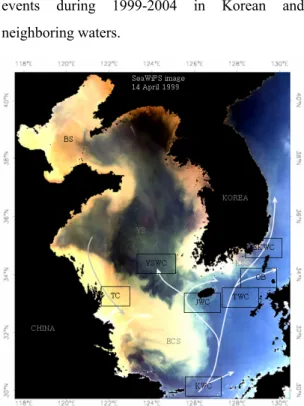
Harmful algal blooms (HABs) (also termed as red tides) have been found to occur frequently in optically complex Case-2 waters of the Korean South Sea (KSS) (Fig. 1) (Kim et al., 1990; Ahn et al., 2005), and neighboring waters of East China Sea (ECS) (Chen et al., 2003), Yellow Sea (YS) (Ahn et al., 2004), Bohai Sea (BS) (Tang et al., 2005) and Japanese Sea (JS) (Fukuyo et al., 1990), dominated mostly by Cochlodinium polykrikoides (C. polykrikoides), Alexandrium tamarense, Prorocentrum dentatum and Ceratium
furca, causing massive mortalities of aquaculture fish and numerous ecological and health impacts since the last few decades. In order to mitigate the impacts of these blooms, it is therefore very essential to accurately detect, monitor and forecast their development and movement, using the currently available remote sensing technology because traditional ship-based field sampling and analysis are very limited in both space and temporal frequency. Major satellite ocean color sensors, such as Sea-viewing Wide Field-of-view Sensor (SeaWiFS), can be ideal instruments for
estimating global phytoplankton biomass, especially in episodic blooms, because they provide relatively high frequency synoptic information over large areas (Hooker and McClain, 2000). In the present study, we evaluate the potential use of RI method and standard pigment algorithm, the OC4, for detecting and delineating potential areas of recent red tide events during 1999-2004 in Korean and neighboring waters.
Fig. 1. Characteristics of Korean and neighboring waters.
2. Results and conclusions 2.1. Application of RI method using in-situ data
Figs. 2a-c show the spectral variations of the observed water-leaving radiance signals with respect to water properties of KSS, Korean southwest sea and YS. The initiation of C.
polykrikoides bloom that discolored waters off the KSS coast diminished the water-leaving radiance
signal in the lower green and blue wavelengths part of the spectrum and increased the prominent signal in the green and red wavelengths part of the spectrum, attributable to respective pigment backscattering around 550-565nm and natural chlorophyll fluorescence around 685nm, for Chl = 6–70 mg m-3; SS = 4–16 g m-3; DOM 0.41–0.79 m-1 (Morel and Prieur, 1977) (Fig. 2a). The water- leaving radiance spectra collected from highly turbid waters along the Korean southwest coastal areas increased with increasing SS concentrations 4–95 g m-3 (Fig. 2b), where the concentrations of Chl and DOM ranged from 0.56 to 12.22 mg m-3 and 0.38 to 1.88 m-1 respectively. High concentrations of SS occurred as a result of river discharge and the process of resuspension caused by strong tidal currents. In case of relatively clear and blue waters, the high Lw values occurred in the blue wavelength region and low Lw values in the longer wavelength region suggestive of profound absorption by water itself, when Chl ranged from 0.43–1.32 mg m-3, SS from 3.33–10 g m-3 and DOM from 0.04–0.15 m-1 (Fig. 2c).
The table (below) describes the values of RI, Chl, SS and DOM for the above waters. Note that the RI increases with increasing Chl concentrations in red tide waters of KSS and apparently decreases with the increase of SS and DOM, yielding negative values in highly turbid waters of Korean SW coastal areas. This suggests that red tide detection can be achieved by both the direct use of RI method and quantitative method that can be established from the RI-Chl relationship (Ahn and Shanmugam, 2006).
Figs. 2a-c. Variations in the water-leaving radiance signals observed from the KSS red tide waters during August 2003 (a), Korean southwest sea turbid waters during September 2002 (b), and relatively clear southern YS waters during February 2003 (c). The below table describes the values of RI, Chl, SS and DOM.
Figs. 3a and b. Results of atmospheric correction based on SSMM and SAC algorithms. YS – Yellow Sea, KSS – Korean South Sea.
Turbid waters b
Clear waters c
Red tide a
a b
2.2. Red tide detection using SeaWiFS data Overall, the shape and magnitude of Lw spectra retrieved from the SSMM were comparable with in-situ spectra (Fig. 3a), but inappropriate atmospheric correction performed with the standard SeaWiFS atmospheric correction (SAC) algorithm revealed an underestimation of Lw and frequently yielded negative Lw values in the red tide dominated KSS/YS waters during 27 March 2002/ 28 September 2003 (Fig. 3b).
This is primarily because the waters containing large accumulations of red tide species would have a significant water-leaving radiance in the red and near infrared bands, which could lead to possible errors in the atmospheric correction and underestimation of Lw in the blue and green bands of SeaWiFS. Moreover, the SAC algorithm tended to produce similar spectra for both red tides and non-red tide blooms, which are not realistic. This was in contrast with the result of SSMM demonstrating large differences in the Lw spectral values for these blooms, i.e., the KSS/YS red tide bloom would have higher magnitude of Lw(555) and lower magnitude of Lw(443), Lw(490) and Lw(510), whereas diatom bloom increased the values of Lw(412), Lw(443), Lw(490), Lw(510) and Lw(555) and thereby the spectral shape became nearly flattened in the blue and green region and steepened towards the red and near infrared regions (Fig. 3a). The Lw spectra of the KSS red tide appeared to be similar to those of YS red tide, but with absence of shoulder at Lw(490) (dotted line) shown in Ahn et al. (2005). This may be attributed to differences in the composition of diatom and dinoflagellate species.
Figs. 4a-d show a couple of examples of red tide detection by RI method and standard bio- optical algorithms applied to the SeaWiFS images of 23 April 2000 and 8 August 2004 collected over Korean and neighboring waters.
Note that due to the inference of dissolved organic and particulate inorganic matter concentrations along the coastal areas the retrieved Chl by OC4 algorithm do not support correct identification of red tides and yielded large errors in the coastal areas of Korean Sea and ECS. Besides, the OC4 algorithm failed to detect the weak signal produced by red tide algal bloom which extended to include the clear water areas of SW Japanese Sea (Fig. 4c). The RI approach, in contrast with standard methods, gave us unprecedented information with enhanced understanding of spatial and temporal aspects of the recent red tide blooms in these waters.
The potential sources of errors in red tide detection with the standard methods must be addressed here: Firstly, it is critical to use the spectrally distorted and negative water-leaving radiances resulted from an inappropriate atmospheric correction by the SAC algorithm.
The overcorrection of atmospheric effects was already observed to be severe in the blue spectral region and increased progressively for productive waters with higher Chl concentration (>2 mg m-3) (Siegel et al., 2000). Secondly, the use of standard bio-optical algorithms that are specifically developed for the oceanic waters remains problematic in optically complex waters, because the simple blue and green band ratio used in the regression analysis is not only
sensitive to phytoplankton but also to other associated water constituents such as DOM and SS (perhaps bottom effects), which lead to large errors in the satellite Chl retrieval for coastal waters (Darecki and Stramski, 2004). Finally, the combination of these errors ultimately
limited the potential utility of satellite ocean color data for mapping likely areas of HABs associated with an extensive economic loss in many coastal waters around the world (Cannizzaro et al., 2002).
Figs. 4a-d. Comparison of red tide detection by RI method and standard bio-optical algorithm applied on SeaWiFS ocean color imagery of 23 April 2000 and 8 August 2004 in the Korean and neighboring waters.
b
c d
a
References
Ahn, Y.H., and P. Shanmugam, 2004. New methods for correcting the atmospheric effects in Landsat imagery over turbid (Case- 2) waters. Korean Journal of Remote Sensing, 20, 289-305.
Ahn, Y.H., P. Shanmugam., J.H. Ryu., and J.C.
Jeong, 2005. Satellite detection of harmful algal bloom occurrences in Korean waters.
Harmful Algae, 5, 213-131.
Cannizzaro, J.P., K.L. Carder., F.R. Chen., J.J.
Walsh., Z. Lee., C. Heil., and T. Villareal, 2002. A novel optical classification technique for detection of red tides in the Gulf of Maxico; Application to the 2001- 2002 bloom event. Proceedings of the Xth International Conference on Harmful Algae, St. Pete Beach, Florida, 21-25 October 2002, pp. 43.
Darecki, M., and D. Stramski, 2004. An evaluation of MODIS and SeaWiFS bio- optical algorithms in the Baltic Sea. Remote Sensing of Environment, 89, 326-350.
Chen, C., J. Zhu., R.C. Beardsley and P.J.S.
Franks, 2003. Physical-biological sources for dense algal blooms near the Changjiang River.
Geophysical Research Letters, 30, doi:
10.1029/2002GL016391.
Fukuyo, Y., H. Takano., M. Chihara., and K.
Matsuoka., 1990. Red Tide Organisms in Japan. An Illustrated Taxonomic Guide.
Uchida Rokakuho, Co., Ltd., Tokyo. pp. 407.
Hooker, S.B., and C.R. McClain, 2000. The
calibration and validation of SeaWiFS data.
Progress in Oceanography, 45, 427-465.
Kim, H.G., J.S. Park., and S.G. Lee, 1990.
Coastal algal blooms caused by the cyst- forming dinoflagellates. Bulletin Korean Fisheries Society, 23, 468-474.
Morel, A., and L. Prieur, 1977. Analysis of variations in ocean color. Limnology and Oceanography, 22, 709-722.
Siegel, D.A., M. Wang., and S. Maritorena., and W. Robinson, 2000. Atmospheric correction of satellite ocean color imagery: The black pixel assumption. Applied Optics, 39, 3582- 3591.
Stumpf, R.P., M.E. Culver., P.A. Tester., M.
Tomlinson., G.J. Kirkpatrick., P.A. Pederson., E. Turby., V. Ransibrahmanakul., and M.
Soracco, 2003. Monitoring Karenia brevis blooms in the Gulf of Mexico using satellite ocean color imagery and other data. Harmful Algae, 2, 147-160.