
IEG 환경지질연구정보센터
4
0
0
전체 글
(2) 224. Jin-Han Ree and Sung-Tack Kwon. Outcrop photograph of the Wangsan Fault. UC: unconformity. QD: Quaternary deposit. Fig. 2.. 2. STRUCTURE OF THE WANGSAN FAULT The Wangsan Fault is well exposed about 12 km northeast of the city of Gyeongju. The fault cross-cuts the unconformably overlying Quaternary fluvial deposits as well as the Late Cretaceous to early Tertiary basement andesite (Fig. 2). The lower part (3−4 m thick) of the Quaternary deposits is dominated by poorly sorted, subrounded to subangular clasts (several to tens of cm) with sandy matrix. The clasts are mostly diorite and andesite with lesser amount of leucocratic granite. In contrast, the upper part (up to 5 m thick in the footwall) consists of sandy layers. The fault strikes N38°E and dips to southeast with an angle of 42°. A ridge-in-groove slickenside lineation (Means, 1987) on the slip surface trends N75°E with a plunge angle of 35°. The fault zone (40 to 50 cm thick) consists of fault breccia, micro-breccia and fault gouge (Fig. 3a). The fault gouge shows an S/C composite foliation indicating reverse slip-sense (Fig. 3b). The throw of the unconformity between the basement and the overlying Quaternary deposits is 16 m. The net slip calculated from the throw and slip direction is about 28 m.. 3. AGE OF THE WANGSAN FAULT Lee and Yang (2003) reported the ESR age data (550 ka in average) of the fault gouge from the Wangsan Fault and interpreted that this ESR age represents a faulting event prior to the deposition of the Quaternary deposits. On the other hand, Cheong et al. (2003) obtained the OSL age data (a) Fault gouge layer along the surface of the Wangsan of the Quaternary deposits cut by the Wangsan Fault. They Fault. (b) Fault rock slab with S/C composite foliation indicating analyzed three samples of the sand unit taken at different reverse slip-sense (east-side up). Fig. 3..
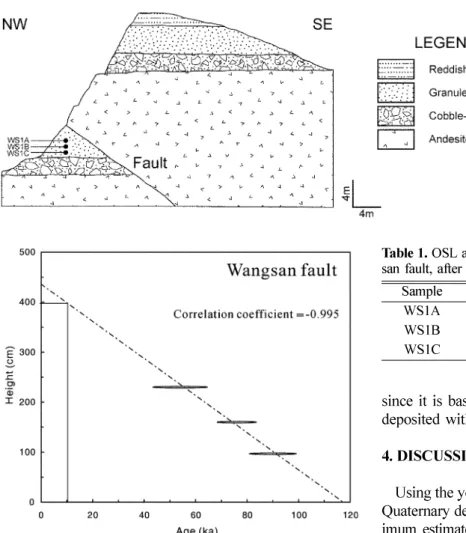
(3) Wangsan Fault. 225. Schematic line drawing of the Wangsan Fault and position of OSL samples in the footwall. After Cheong et al. (2003). Fig. 4.. OSL ages for the sandy unit in the footwall of the Wangsan fault, after Cheong et al. (2003). Sample Height from the bottom (cm) Age (ka) WS1A 230 54±7 WS1B 160 76±5 WS1C 97 90±6 Table 1.. since it is based on the assumption that the sand unit was deposited with a uniform sedimentation rate.. 4. DISCUSSION Using the youngest OSL age (54 ± 7 ka) measured for the Quaternary deposits, Cheong et al. (2003) calculated a minimum estimate of time-averaged slip rate to be 0.52 mma and estimated a maximum recurrence interval of the fault movement to be about 50 ka. However, the characteristics of the fault movement can be reevaluated with the youngest estimated age of this work. If we assume a uniform sedimentation rate of 0.04 mma− , the time-averaged slip rate of the Wangsan Fault should be 2.80 mma− which is more than five times higher than that of Cheong et al. (2003). Considering the fact that the Sumatra-Andaman earthquake with a magnitude of 9.3 on 26 December 2004 produced an average slip of 13 m (maximum slip of about 20 m) and a rupture length of about 1,200 km (McCloskey et al., 2005; Ni et al., 2005; Sieh, 2005; Stein and Okal, 2005), the slip of 28 m along the Wangsan Fault occurred most likely during more than a single earthquake event. If we assume a magnitude 6.6 earthquake as in Kyushu earthquake on 20 March 2005 that generated a maximum slip of 3.2 m (average slip of 0.8 m) and rupture length of about 26 km (http:/ /sms.dpri.kyoto-u.ac.jp/k-asano/050320inv_e.html), at least eight earthquake events of magnitude 6.6 may have occurred along the Wangsan Fault to accumulate the total slip of 28 m after about 10 ka. Evidently, all these estimates are based on the assumed uniform sedimentation rate of the Quaternary deposits cut by the Wangsan Fault. For a better estimation of the characteristics of the Wangsan Fault, additional OSL age data from those samples closer to the top of the sand -1. Stratigraphic height vs. OSL age diagram for the sand unit of the Quaternary deposits cut by the Wangsan Fault. Note a welldefined correlation between the stratigraphic height and OSL age, suggesting a uniform sedimentation rate. The regression line suggests that the top (at about 400 cm) of the sand unit has an age of about 10 ka. Error ellipses represent 1σ confidence level. Fig. 5.. horizons in the footwall block (Fig. 4). The results are reproduced in Table 1. When the ages are plotted against the stratigraphic height, they show a well-defined negative correlation with a correction coefficient of −0.995 (Fig. 5). The regression line was calculated with the provided error for the OSL ages (Table 1) and assumed 1 cm error for the stratigraphic height. If we extrapolate the linear relationship to the stratigraphic height of 400 cm which is almost the top of the sand unit, we have an age of about 10 ka. This estimated age indicates that the sand unit was deposited approximately from 100 to 10 ka, with an average sedimentation rate of about 0.04 mma− . This also suggests that the net slip of 28 m along the Wangsan Fault occurred at least after 10 ka, and that the Wangsan Fault might be one of the most ‘active’ faults in South Korea. Obviously, the estimated age should be checked by additional OSL age data from those samples closer to the top of the sand unit, 1. 1. 1.
(4) 226. Jin-Han Ree and Sung-Tack Kwon. unit are needed. ACKNOWLEDGEMENTS: We acknowledge a fruitful discussion with D.G. Hong on OSL age data and figure drawings by B. Song. We also thank Y.K. Sohn and C.-E. Baag for the improvement of the manuscript and H. Kim for the editorial work. This work was supported by KOSEF grant R02-2002-000-00022-0 to JHR.. REFERENCES. Lee, H.-K. and Schwarcz, H.P., 2001, ESR dating of the subsidiary faults in the Yangsan fault system, Korea. Quaternary Science Reviews, 20, 999−1003. Lee, H.-K. and Yang, J.-S., 2003, ESR dating of the Wangsan fault, South Korea. Quaternary Science Reviews, 22, 1339−1343. McCloskey, J., Nalbant, S.S. and Steacy, S., 2005, Earthquake risk from co-seismic stress. Nature, 434, 291. Means, W.D., 1987, A newly recognized type of slickenside lineation. Journal of Structural Geology, 9, 585−590. Ni, S., Kanamori, H. and Helmberger, D., 2005, Energy radiation from the Sumatra earthquake. Nature, 434, 582. Okada, A., Watanabe, M., Suzuki, Y., Kyung, J.B., Jo, W.-R., Kim, S.-K., Oike, K. and Nakamura, T., 1998, Active fault topography and fault outcrops in the central part of the Ulsan fault system, southeast Korea. Journal of Geography, 107, 644−658. (in Japanese with English Abstract) Park, Y., Ree, J.-H. and Yoo, S.-H., in press, Fault-slip analysis of Quaternary faults in southeastern Korea. Gondwana Research. Ree, J.-H., Lee, Y.-J., Rhodes, E.J., Park, Y., Kwon, S.-T., Chwae, U., Jeon, J.-S. and Lee, B., 2003, Quaternary reactivation of Tertiary faults in the southeastern Korean Peninsula: Age constraint by optically stimulated luminescence dating. The Island Arc, 12, 1−12. Sieh, K., 2005, Aceh-Andaman earthquake: What happened and what’s next? Nature, 434, 573−574. Stein, S. and Okal, E.A., 2005, Speed and size of the Sumatra earthquake. Nature, 434, 581−582.. Angelier, J., 1994, Fault slip analysis and paleostress reconstruction. In: Hancock, P.L. (ed.), Continental Deformation. Pergamon, Oxford, p. 53−100. Cheong, C.S., Hong, D.G., Lee, K.S., Kim, J.W., Choi, J.H., Murray, A.S., Chwae, U., Im, C.B., Chang, C.J. and Chang, H.W., 2003, Determination of slip rate by optical dating of fluvial deposits from the Wangsan fault, SE Korea. Quaternary Science Reviews, 22, 1207−1211. Kim, Y.-S., Park, J.Y., Kim, J.H., Shin, H.C. and Sanderson, D.J., 2004, Thrust geometries in unconsolidated Quaternary sediments and evolution of the Eupchon Fault, southeast Korea. The Island Arc, 13, 403−415. Kyung, J.B., 1997, Paleoseismological study on the mid-northern part of Ulsan Fault by trench method. Journal of Engineering Geology, 7, 81−90. Kyung, J.B. and Chang, T.W., 2001, The latest fault movement of the northern Yangsan Fault Zone around the Yugye-ri area, southeast Manuscript received June 9, 2005 Korea. Journal of the Geological Society of Korea, 37, 563−577. Manuscript accepted August 23, 2005 (in Korean with English Abstract).
(5)
수치


관련 문서
Modern Physics for Scientists and Engineers International Edition,
The purpose of this paper is to show that financial reforms can be endogenous responses to economic growth and changes in political constraints rather
웹 표준을 지원하는 플랫폼에서 큰 수정없이 실행 가능함 패키징을 통해 다양한 기기를 위한 앱을 작성할 수 있음 네이티브 앱과
_____ culture appears to be attractive (도시의) to the
이하선의 실질 속에서 하악경의 후내측에서 나와 하악지의 내측면을 따라 앞으로 간다. (귀밑샘 부위에서 갈라져 나와
When Pr is small, it means that heat diffuses very quickly compared to the velocity (momentum). This means the thickness of the thermal boundary layer is much bigger than
The index is calculated with the latest 5-year auction data of 400 selected Classic, Modern, and Contemporary Chinese painting artists from major auction houses..
1 John Owen, Justification by Faith Alone, in The Works of John Owen, ed. John Bolt, trans. Scott Clark, "Do This and Live: Christ's Active Obedience as the
