내도복성 및 내수발아성 고품질 가공밥 적성 벼 ‘중모1017’
양창인1・ 조영찬1・ 최임수1・ 김명기1・ 김연규2・ 홍하철3・ 김정주1・ 이점호1・ 서정필1・ 정종민1・ 원용재1* ・ 안억근1・ 장재기1・ 최인배1・ 이상복1・ 윤미라1・ 정지웅1・ 이정희1
1농촌진흥청 국립식량과학원, 2농촌진흥청 국립농업과학원, 3농촌진흥청
Lodging and Pre-harvest Sprouting Tolerant, High Quality and Suitable for Processing Cooked Rice ‘Jungmo1017’
Chang-Ihn Yang
1, Young-Chan Cho
1, Im-Soo Choi
1, Myeong-Ki Kim
1, Yeon-Gyu Kim
2, Ha-Cheol Hong
3, Jeong-Ju Kim
1, Jeom-Ho Lee
1, Jung-Pil Suh
1, Jong-Min Jeong
1, Yong-Jae Won
1*, Eok-Keun Ahn
1,
Jae-Ki Chang
1, In-Bae Choi
1, Sang-Bok Lee
1, Mi-Ra Yoon
1, Ji-Ung Jeung
1, and Jeong-Heui Lee
11
National Institute of Crop Science, RDA, Suwon 441-857, Republic of Korea
2
National Academy of Agricultural Science, RDA, Jeonju 560-500, Republic of Korea
3
Rural Development Administration, Jeonju 560-500, Republic of Korea
Abstract : The ‘Jungmo1017’ is a japonica rice variety developed from a cross between Suweon462 which has a good plant architecture, cold tolerance, moderately tolerant to leaf blast and bacterial blight and medium maturing habit, and Yeongdeog34 which has translucent milled rice and good milling properties, by the rice breeding team at NICS, RDA in 2011. The heading date of ‘Jungmo1017’ is August 16 and it is six days later than ‘Hwaseong’. ‘Jungmo1017’ has 65 cm of culm length which is 18 cm shorter than those of ‘Hwaseong’ and 93 spikelet per panicle. The pre-harvest sprouting rate of ‘Jungmo1017’ is 8.6%
that is lower than 27.7% of ‘Hwaseong’ on local adaptability test (LAT). It showed resistance to blast diseases and moderately resistant to bacterial blight (K1 race) and stripe virus, but susceptible to other races (K2, K3 and K3a) of bacterial blight, viruses and planthoppers. The milled rice of this variety exhibits translucent, clear non-glutinous endosperm and medium short grain shape. It has better palatability index of cooked rice (0.53) than that of ‘Hwaseong’. ‘Jungmo1017’ showed lower protein content (6.4%) and amylose content (18.0%). ‘Jungmo1017’ could use aseptic-packaged cooked rice or processing cooked rice because its hardness of cooked rice is soft, setback and balance is low and palatability of cold and aseptic rice showed high score. The characters related to milling is better than those of ‘Hwaseong’. ‘Jungmo1017’ showed 5.01 MT/ha of milled rice productivity at 7 sites of middle plain, southern mid-mountainous and south-east coastal area in ordinary cultivation. ‘Jungmo1017’ could be adaptable to the middle plain area in Korea.
Keywords : Rice, Mid-late maturing, High eating quality, Processing cooked rice, Jungmo1017
*Corresponding author (E-mail: [email protected], Tel: +82-31- 290-6702, Fax: +82-31-290-6704)
(Received on August 25, 2014. Revised on September 22, 2014.
Accepted on September 24, 2014.)
463
http://dx.doi.org/10.9787/KJBS.2014.46.4.463 Print ISSN: 0250-3360
Copyright ⓒ 2014 by the Korean Society of Breeding Science
This is an Open-Access article distributed under the terms of the Creative Commons Attribution Non-Commercial License (http://creativecommons.org/licenses/by-nc/3.0) which permits unrestricted non-commercial use, distribution, and reproduction in any medium, provided the original work is properly cited.
서 언
최근 3년 동안 쌀 자급률은 80%대에 머물면서 점차 사회 적인 이슈로 떠오르고 있다. 2008년의 애그플레이션 이후 곡 물가격은 지속적으로 상승하고 있고, 세계적인 곡물생산국인
미국, 러시아 등의 생산량도 하락하고 있어 식량부족이 점차 현실화되고 있다. 우리나라 식량자급률 또한 2012년 44.5%, 곡물자급률은 22.6%로 가장 낮은 수치를 보이고 있다. 벼 재 배면적은 2013년 83만3천 ha로 1990년 124만 ha 대비 67%
에 불과한 실정이다. 또한 지구온난화 등 기상이변에 따른 기 상재해 및 병해충 발생 양상이 변화하고, 벼 흰잎마름병을 일 으키는 K3균계에서 새로운 균계인 K3a가 분화되어 기존의 저항성 품종이 이병화되고 있고(Noh et al. 2003), 등숙기 집 중 강우로 인한 수발아 발생으로 쌀 품질이 저하되고 있다.
수발아는 출수 후 25~30일이 경과하여 발아할 수 있는 능력 을 가진 종자가 휴면성이 없거나 약한 경우 집중호우나 태풍 등으로 침・관수 또는 도복에 의하여 발생하는데, 약한 휴면성 을 가지고 있어도 계속된 강우에 의하여 왕겨에 있는 수용성 휴면 물질이 용해되어 발생하기도 한다(Lee 2010). 수발아 발생 정도는 조생종이 중생종이나 중만생종 보다 높다는 것 이 일반적이었으나 2009년 개발된 ‘조운’(Won et al. 2010) 은 극조생종 이면서도 수발아에 강하여 내재해성을 갖춘 품 종으로 평가되었고, 최근 육성된 세계진미, 소다미 등 수발아 에 강한 품종들이 개발되고 있다. 한편 기상재해는 1980년과 같이 저온 또는 냉해로 인하여 생산량이 급감하였으나 최근 100년 동안 우리나라는 연평균 기온이 1.5℃ 상승하였고 (NIMR 2007), 기후온난화의 생산성 변화 기여도는 59.8%로 가장 크고, 재배시기가 고정되었을 때 등숙률이 생산성에 53.1~86.2% 기여하여(Lee et al. 2012) 결과적으로 품질저 하와 수량 감소가 예상되고 있다. 기후변화에 대응하는 적극 적인 방법은 교배 후 10년 정도 변화하는 기후 속에서 선발되 는 품종 육종이 한 예가 될 것이다. 밥쌀용 품종은 고품질 쌀 을 선호하는 추세에 부응하고자 수량성이 높고 내재해성이면 서 쌀 외관품위와 밥맛이 우수한 최고품종이 2003년 ‘삼 광’(Hwang et al. 2004)을 시작으로 2013년 ‘해품’까지 13품 종이 개발되었다. 그러나 간편식이나 외식을 선호하는 사회적 인 변화와 아울러 1인당 연간 쌀 소비량도 1995년 106.5 kg 에서 2013년 67.2 kg으로 37%가 감소되어 쌀 소비 증대가 큰 화두가 되고 있다. 우리나라의 곡물자급률 제고와 주식인 쌀 소비량 증대를 위하여 가공식품 분야가 확대되고 있는데, 가공용 쌀 소비는 2012년 약 42만톤으로 생산량 대비 10.6%
수준이고(Park 2013), 이 중 떡 20만톤, 주류 6만6천톤, 쌀가 루 5만6천톤, 면 또는 과자류가 2만2천톤으로 주된 사용처이 다. 용도별 가공적성 품종은 무균포장밥 가공적성이 높은 ‘주 안’이 선발(Oh et al. 2010)된 이후 쌀국수용 ‘고아미’, ‘팔방 미’, 주정용 ‘설갱’, 가공 원료가 절감을 위한 초다수성 ‘보람 찬’, ‘한아름2호’, ‘다산1호’ 등과 다수성 찰벼인 ‘한강찰1호’, 발아현미 적성 ‘큰눈’ 등이 새롭게 재조명되고 있다. 이러한 사회적인 요구에 대응하여 쌀 가공산업 발전과 농민들의 소 득을 올릴 수 있는 계통 육성을 시도하여 밥쌀용으로 밥맛이 우수하면서 가공용으로도 활용이 가능한 ‘중모1017’을 육성 하였기에 육성 경위 및 주요특성을 보고하고자 한다.
재료 및 방법
본 시험은 ‘수원529호’를 2009∼2011년 3년간 중부평야 지 4개소, 남부중산간지 2개소 그리고 동남부해안 1개소 등 7개소에서 보통기 보비재배하여 대비품종 ‘화성’(Moon et al.
1986)과 비교 검토하였다(RDA 2010a, 2011a, 2012). 중부 평야지와 동남부해안지에서는 4월 25일에 파종하여 5월 25 일에 재식거리 30 × 15 cm로 주당 3본씩, 남부중산간지에서 는 4월 20일에 파종하여 5월 20일에 재식거리 30 × 12 cm로 주당 5본씩 이앙하였다. 시비는 중부평야지 및 동남부해안에 서는 질소, 인산, 가리를 성분량으로 각각 9, 4.5, 5.7 kg/10a, 남부중산간지에서는 10, 6.4, 7.8 kg/10a을 기비, 분얼비, 수 비 각각 50%, 25%, 25%의 비율로 분시하였다. 기타 재배관 리는 농촌진흥청 표준재배법에 준하여 재배관리를 하였고, 농 업형질, 수량구성요소 및 수량성, 생리장해 및 병해충 저항성, 도정특성 조사는 농촌진흥청 신품종개발 공동연구사업 과제 수행계획서 조사기준에 준하여 실시하였다(RDA 2009, 2010b, 2011b).
결과 및 고찰
육성 경위
‘중모1017’은 중부지역 적응 고품질 품종을 육성할 목적으 로 2002년 하계에 중생이고 내도열병 및 흰잎마름병 저항성 인 수원462호와 쌀의 외관 품위가 좋고 도정특성이 좋은 영 덕34호를 교배하여 교배번호 SR27934를 부여한 후, F1세대 17개체를 양성하였다. F2세대에서 950개체를 시험하여 이삭 선발 후 F3세대는 집단으로 온실에서 재배하였다. 집단에서 선발된 72개체를 F4~F5세대에서 계통으로 전개하여 주요 병 해충 및 미질검정을 병행한 결과 유망한 SR27934-GH1-29-1 계통을 선발하였다. 선발된 우량계통에 대해 2007~2008년 2년간 생산력검정시험을 실시 한 결과 중만생종이고 도열병 저항성 및 내도복성이면서 쌀 외관과 백미완전립률이 우수하 여 수원529호로 계통명을 부여하였다. 2009년부터 2011년 까지 지역적응시험 3년을 실시한 결과 그 우수성이 인정되어 2011년 12월 농촌진흥청 농작물 직무육성 신품종선정위원회 에서 신품종으로 선정됨과 동시에 ‘중모1017’로 명명되었다.
‘중모1017’의 육성과정과 계보도는 Fig. 1 및 Fig. 2와 같다.
Year ’02 ’02/’03 ’03 ’04 ’05 ’06 ’07 ’08 ’09 ’10 ’11
Generation Cross F1 F2 F3 F4 F5 F6 F7 F8 F9 F10
Suweon462
× Yeongdeog34
→ SR27934 → →
1
⋮
⋮ 17
→ 1
⋮
⋮
⋮
⋮
⋮ 950
B →
1
⋮
⋮
⋮
⋮ 72 29) →
1) →
⋮ 3
SR27934-GH1
-29-1 → Jungmo1017
(Suweon529)
Lines
(Individuals) (17) (950) Bulk 72 3 PYT RYT LAT
Remarks Pedigree nursery Yield trials Local Adaptability
Test Fig. 1. Pedigree diagram of ‘Jungmo1017’.
Fuji280
BL1
BL1
Fuji280
YR4565
Milyang64 Samnam
HR1702-65-3-4
SR3-1-68
Kuiku90
Samnam
Kuroka
Suweon224/
Inabawase Cheolweon21
Chukei830
YR4811-ACP8
SR11878-14-4-1
Suweon345
Milyang101
Kinuhikari
Suweon462
Yeongdeog34
Suweon529
Fig. 2. Genealogical diagram of ‘Jungmo1017’.
주요특성
주요 농업적 특성
‘중모1017’은 중부평야지 보통기 재배에서 평균 출수기가 8월 16일로 ‘화성’보다 6일 늦은 중만생종이다(Table 1). 간 장은 65 cm로 ‘화성’의 83 cm보다 18 cm작은 단간 내도복 성이고, 이삭길이, 주당 이삭수 그리고 이삭당 입수는 20 cm, 14개 그리고 93개로 ‘화성’과 같았다. 등숙비율은 81.0%로
‘화성’보다 약간 낮고, 현미 천립중이 22.0 g으로 ‘화성’과 비 슷한 중립종이다(Table 1).
병해충 저항성
‘중모1017’은 전국 14개소에서 실시한 잎도열병 밭못자리 검정 결과 평균 4.5로 ‘화성’의 6.3보다 강한 중강 정도의 반 응을 보였고, 이삭도열병 포장검정에서도 ‘화성’보다 강한 반 응을 보였다. 도열병 내구저항성 검정결과 내구성이 ‘0’이고 접종한 23개 균주 중 10개 균주가 친화성을 보여 안정적인 저항성을 나타냈다(Table 2). 흰잎마름병에는 K1균계에만 중 정도의 반응을 보이고 나머지 균계(K2, K3, K3a)에는 저항 성이 없었다. 줄무늬잎마름병에도 중정도의 반응을 보였으나
Table 1. Major agronomic traits and yield components.
Variety
Heading date (mm.dd)
Culm Lengthz (cm)
Panicle length
(cm)
No. of panicles
/hill
No. of spikelets /panicle
Ratio of ripened grain (%)
1000-grain weight of brown rice (g) Jungmo1017
Hwaseong
08.16* 08.10
65**
83
20ns 20
14 ns 14
93 ns 93
81.0 ns 84.7
22.0 ns 22.6
zlength from soil surface to panicle neck
*, **: significant at 5% and 1% level, respectively
ns: not significant
Table 2. Reaction to blast disease.
Variety
Reaction to leaf blast
at nursery test (0-9) Area ratio to leaf lesion of Piricularia grisea of sequential plantings (%)
Reaction to neck blast No. of tested sites (14) (%)
Rz M S Mean 1 2 3 4 5 6 7 Persistence
(0-7)
No. of susceptible
race (23)
Ichon Je-cheon
Jungmo1017 4 8 2 4.5 35 5 15 20 10 0 0 0 10 0.3 0.8
Hwaseong 0 8 6 6.3 50 50 20 45 45 20 10 7 21 3.9 4.5
zR: resistant(0~3); M: moderately resistant(4~6); S: susceptible(7~9) N fertilizer: Blast nursery test = 240kg/ha, Neck blast = 220 kg/ha
Table 3. Reaction to bacterial blight, virus disease and insect pests.
Variety
Bacterial blight Virus diseases Resistance to insects
K1 K2 K3 Field
(0-9)
Stripe
(%) Dwarf Black-
streak dwarf BPHz SBPH
Jungmo1017 My S S 5 M(62.3) S S S S
Hwaseong S S S 7 R(11.5) S S S S
zBPH: brown planthopper; SBPH: small brown planthopper
yM: moderately resistance, S: susceptible, R: resistance
오갈병 및 벼멸구에 대한 저항성은 없었다(Table 3).
생리장해 저항성
‘중모1017’은 불시출수 현상을 보이지 않았고, 성숙기 하 엽노화가 느리며 위조현상은 없었다(Table 4). 냉수처리 내랭 성 검정 결과 출수지연이 16일로 ‘화성’대비 4일 길었고, 냉 수구 임실률은 34%로 ‘화성’보다 낮았으며, 적고는 ‘화성’보 다 강한 반응을 보였지만 종합적인 내랭성은 ‘화성’보다 다소 약한 정도였다. 수발아율은 2009년~2011년 3개년 평균 8.6%로 ‘화성’보다 강한 반응을 보였다. ‘중모1017’은 도복 특성검정에서 ‘화성’보다 벼 키가 작고 3절간장도 작으며, 지 상부 총생체중은 무겁고 모멘트가 낮지만 좌절중이 무거워 도복지수가 낮아 도복에 강한 특성을 보였다(Table 5).
미질 및 도정특성
‘중모1017’의 입형은 현미 장폭비가 1.71로 단원형이고, 백미외관은 심복백이 거의 없어 맑고 투명하였고, 알칼리 붕 괴도는 6.5로 ‘화성’과 비슷하였다. 단백질함량은 6.4%, 아밀 로스함량은 18.0%로 ‘화성’의 7.1% 및 20.8%보다 낮아 밥 이 부드러워 식미관능검정 결과 0.53으로 ‘화성’의 -0.12보다 월등히 밥맛이 우수하였다(Table 6). 특히 Table 7과 같이
‘중모1017’은 아밀로그램 특성에서 ‘추청’ 대비 밥의 경도가 부드럽고 찰기는 강하면서 치반점도와 균형도가 낮으며, 식미 치가 대조품종과 비교하였을 때 더운밥 < 식은밥 < 무균포장 밥 순으로 뚜렷한 차이를 보여 무균포장밥 및 가공밥으로 활 용이 가능할 것으로 판단되었다(NICS, 2013). 제현율과 도정 률은 ‘화성’보다 약간 낮으나 현백률은 비슷하고, 도정된 쌀의
Table 4. Response to physiological and abiotic stresses.
Variety
Premature heading
(%)
Occurrence of wilting
Leaf senescence at maturing
Cold tolerancey
Viviparousw germination
(%) Discol-
oration (1-9)z
Heading delay (day)
Grain fertility
(%)
PAx
Jungmo1017 0.0 Strong Late 3 16 34 5 8.6**
Hwaseong 0.0 Strong Late 4 12 43 5 27.7
zEvaluation at maximum tillering stage (1: tolerance; 9: susceptible)
yCold tolerance was evaluated in Chuncheon cold-water (17℃) irrigated nursery
xPhenotypic Acceptability
wGermination rate at 7 days after incubation in 25℃ chamber
**: significant at 1% level
Table 5. Some characteristics related with lodging.
Variety
Culmz length (cm)
Third internode length
(cm)
Top fresh weight
(g)
Breaking strength
(g)
Moment (g.cm)
Lodging index
Lodging in the field
(0~9)
Jungmo1017 88** 8.3* 14.4 ns 966** 1,278* 132* 1
Hwaseong 105 10.9 13.5 360 1,423 394 1
zlength from upper part of root to panicle neck
*, **: significant at 5% and 1% level, respectively
ns: not significant
Table 6. Characteristics related to grain shape and grain quality.
Cultivar
Brown rice
White core/velly
Alkali digestive value
(1~7)
Protein content
(%)
Amylose content
(%)
Palatability of cooked rice
(-3~3) Length
(mm)
Width (mm)
L/W ratio
Jungmo1017 4.77 2.79 1.71 0/0 6.5 6.4 18.0 0.53
Hwaseong 4.94 2.75 1.80 2/0 6.6 7.1 20.8 -0.12
Table 7. Characteristics related to processing cooked rice.
Cultivar
Amylogram (RVA)
Hardness (g/sec)
Palatability of cooked rice (-3~3) Tough-
ness
Break down
Sticki- ness
Adhesive-
ness Setback Balancez) Hot Cold Aseptic
Jungmo1017 33.2 107.8 55.4 63.9 -21.8 52.0 4,360 0.50 0.88 1.23
Chucheong 45.1 97.6 43.8 65.6 -9.3 68.8 6,370 0.05 -0.06 -0.19
zbalance = toughness/adhesiveness x 100
Table 8. Characteristics related to milling quality.
Cultivar
Milling recovery ratio (%) Head rice milling
recovery ratio Brown/rough Milled/brown Milled/rough Head rice (%)
Jungmo1017 82.5 92.1 75.9 98.8 75.0
Hwaseong 84.2 92.3 77.7 94.7 73.6
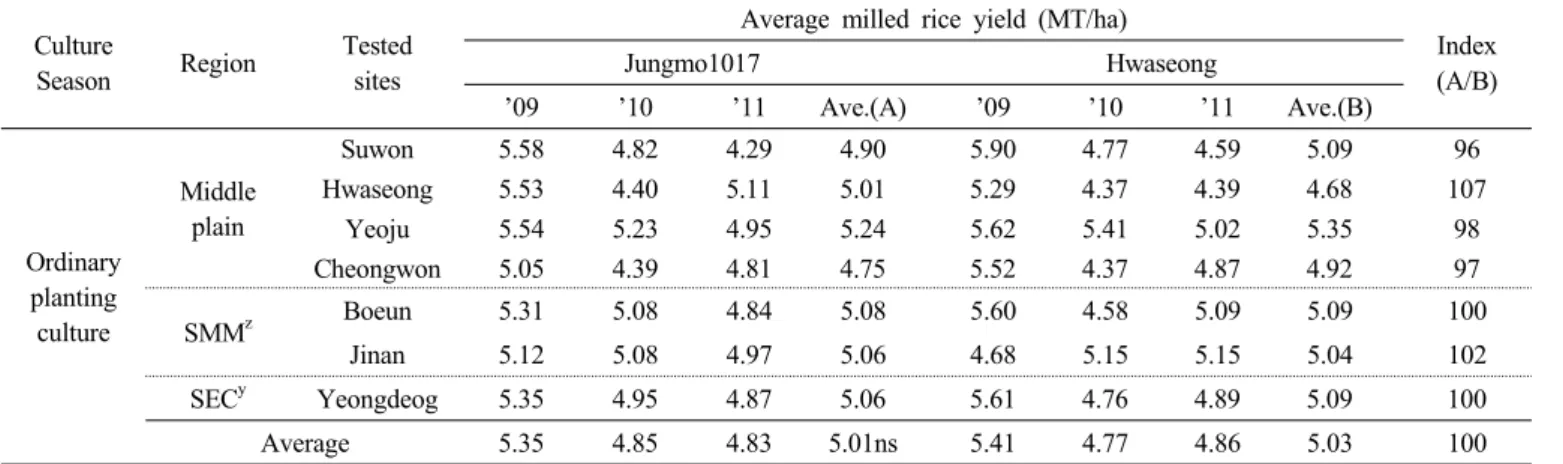
Table 9. Results of yield potential of ‘Jungmo1017’ on local adaptability test.
Culture
Season Region Tested
sites
Average milled rice yield (MT/ha)
Index (A/B)
Jungmo1017 Hwaseong
’09 ’10 ’11 Ave.(A) ’09 ’10 ’11 Ave.(B)
Ordinary planting
culture
Middle plain
Suwon 5.58 4.82 4.29 4.90 5.90 4.77 4.59 5.09 96
Hwaseong 5.53 4.40 5.11 5.01 5.29 4.37 4.39 4.68 107
Yeoju 5.54 5.23 4.95 5.24 5.62 5.41 5.02 5.35 98
Cheongwon 5.05 4.39 4.81 4.75 5.52 4.37 4.87 4.92 97
SMMz Boeun 5.31 5.08 4.84 5.08 5.60 4.58 5.09 5.09 100
Jinan 5.12 5.08 4.97 5.06 4.68 5.15 5.15 5.04 102
SECy Yeongdeog 5.35 4.95 4.87 5.06 5.61 4.76 4.89 5.09 100
Average 5.35 4.85 4.83 5.01ns 5.41 4.77 4.86 5.03 100
zSMM: Southern mid-mountainous area
ySEC: South-east coastal area
ns: not significant
완전미율이 98.8%로 ‘화성’(94.7%)보다 높아 완전미 도정수 율은 ‘화성’보다 높은 75.0%로 도정특성이 우수하였다(Table 8).
수량성
백미수량은 ‘09∼’11년 3개년 간 실시한 지역적응시험 결 과 중부평야지 4개소, 남부중산간지 2개소 및 동남부해안지 1 개소에서 보통기 보비재배 평균 쌀수량은 5.01 MT/ha로 ‘화 성’과 비슷한 수량성을 보였다(Table 9).
재배상의 유의점
‘중모1017’은 질소질 비료 과용 시 미질저하, 등숙저하, 숙 색불량 및 병해충 발생이 우려되므로 적정 균형시비가 필요 하다. 특히 흰잎마름병, 줄무늬잎마름병, 오갈병, 검은줄오갈 병 및 멸구류에 저항성이 없으므로 적기 기본방제가 필요하 며, 고품질 쌀을 생산하기 위하여 적기 수확을 하여야 한다.
적 요
‘중모1017’은 중부지역 적응 고품질 품종을 육성할 목적으 로 2002년 하계에 중생이고 내도열병 및 흰잎마름병 저항성 인 수원462호와 쌀의 외관 품위가 좋고 도정특성이 좋은 영 덕34호를 교배하여 SR27934-GH1-29-1계통을 선발하고, 수 원529호로 계통명을 부여하여 2009~2011년 3개년간 지역 적응시험을 실시한 결과 그 우수성이 인정되어 2011년 12월 농촌진흥청 농작물 직무육성 신품종선정위원회에서 ‘중모 1017’로 선정되었다.
‘중모1017’은 중부평야지 보통기 재배에서 평균 출수기가 8월 16일로 ‘화성’보다 6일 늦은 중만생종이다. 간장은 65 cm로 ‘화성’의 83 cm보다 18 cm작은 단간 내도복성이고, 이 삭길이, 주당 이삭수 그리고 이삭당 입수는 20 cm, 14개 그 리고 93개로 ‘화성’과 같았다. 등숙비율은 81.0%로 ‘화성’보 다 약간 낮고, 현미 천립중이 22.0 g으로 ‘화성’과 비슷한 중 립종이다.
‘중모1017’의 도열병저항성은 잎도열병, 이삭도열병 및 내 구저항성 검정 결과 ‘화성’보다 강한 저항성을 보였지만, 흰 잎마름병, 줄무늬잎마름병, 오갈병 및 멸구류에 대한 저항성 이 없었다. ‘중모1017’은 도복과 수발아에 강한 반응을 보였 지만 내랭성은 ‘화성’보다 약한 반응을 보였다, 입형은 현미 장폭비가 1.71로 단원립이고, 백미외관은 심복백이 거의 없어 맑고 투명하였다. 단백질함량은 6.4%, 아밀로스함량은 18.0%
로 ‘화성’의 7.1% 및 20.8%보다 낮아 식미관능검정 결과 0.53으로 ‘화성’보다 밥맛이 월등히 우수하였다. 또한 밥알의 경도가 부드럽고 치반점도와 균형도가 낮고 식은밥과 무균포 장밥의 식미가 우수하여 무균포장밥 또는 가공밥용으로 활용 이 가능할 것으로 판단되었다. 제현율과 도정률은 ‘화성’보다 약간 낮고 현백률은 비슷하였지만 도정된 쌀의 완전미율이 98.8%로 화성(94.7%)보다 높아 완전미 도정수율은 75%로
‘화성’보다 우수하였다. ‘중모1017’의 쌀수량은 ‘09∼’11년 3 개년 간 7개소에서 실시한 지역적응시험 결과 보통기 보비재 배 평균 5.01 MT/ha로 대비품종 ‘화성’과 비슷한 수량성을 보였다. ‘중모1017’의 재배적지는 중부 평야지 이다.
사 사
‘중모1017’을 육성함에 있어 적극 협력하여주신 국립식량 과학원 벼맥류부, 기능성작물부 벼 육종 연구팀 및 각 도농업 기술원 지역적응시험 담당자들과 농촌진흥청 연구정책국 관 계관 여러분께 깊이 감사 드립니다. 본 논문은 농촌진흥청 작 물시험연구사업(ATIS 과제번호: PJ009325012014)의 지원으 로 수행된 결과의 일부입니다.
REFERENCES