─ 60 ─ https://doi.org/10.11614/KSL.2018.51.1.060
ISSN: 2288-1115 (Print), 2288-1123 (Online)
ⓒ The Korean Society of Limnology. All rights reserved.
This is an open-access article distributed under the terms of the Creative Commons Attribution Non-Commercial License (http://creativecommons.org/licenses/by-nc/3.0/), which permits unrestricted non-commercial use, distribution, and reproduction in any medium, provide the original work is properly cited.
서 론
하천 생태계에 서식하는 생물 중 저서성 대형무척추 동물은 가장 다양하고 풍부한 군집구성을 이루고 있으 며(Rosenberg and Resh, 1993), 분류군과 종에 따라 선호 하는 서식환경이 뚜렷하게 차이를 보인다(Shearer et al.,
우리나라 주요 하천 수계에서 저서성 대형무척추동물의 분포 특성
곽인실
1
·이대성2
·홍 철1
·박영석2,3,
*1
전남대학교 환경해양학전공,2
경희대학교 생물학과,3
경희대학교 나노의약생명과학과Distribution Patterns of Benthic Macroinvertebrates in Streams of Korea. Kwak, Ihn-Sil
1(0000-0002- 1010-3965), Dae-Seong Lee
2(0000-0001-7288-0156), Cheol Hong
1(0000-0002-5444-7743) and Young-Seuk Park
2,3,* (0000-0001-7025-8945) (
1Department of Fisheries and Ocean Science, Chonnam National University, Yeosu 59626, Republic of Korea;
2Department of Biology, Kyung Hee University, Seoul 02447, Republic of Korea;
3Department of Life and Nanopharmaceutical Sciences, Kyung Hee University, Seoul 02447, Republic of Korea)
Abstract The distribution of benthic macroinvertebrates was investigated at 1,157 sites of 7 main water
systems in Korea, including 442 sites of Han River system (Namhan River, Bukhan River, Han River main stream, Anseongcheon, etc.), 305 sites of Nakdong River system(Nakdong River, Hyeongsan River, Taehwa River, etc.), 199 sites of Geum River system(Geum River, Sapgyocheon, Mangyeong River, Dongjin River, etc.) 102 sites of Seomjin River system(Seomjin River), 102 sites of Yeongsan River system(Yeongsan River, Tamjin River, etc.), and 7 sites of Jeju stream system. A total of 151 families were found in the whole survey sites, including 141 families in Han River, 122 in Nakdong River, 115 in Geum River, 106 in Seomjin River, 113 in Yeongsan River, and 50 in Jeju. Chironomidae(20.8%) was the most dominant species in Korea, followed by Hydropsychidae(17.1%), Baetidae(12.6%), Tubificidae(10.3%), Heptageniidae(8.6%), Ephemerellidae(6.3%), Asellidae(2.7%), Leptophlebiidae(2.4%), Planariidae(1.7%), and Tipulidae(1.6%). Substrates compositions consisted of large sand(22.6%), large gravel(18.4%), silt(10.5%), and boulder(8.2%). The mean stream width was 133.5m and the mean watercourse width was 61.7m. The mean water depth and velocity were 30.2 cm and 33.1cm s- 1
, respectively. Results of cluster analysis based on distributional characteristics of benthic macroinvertebrates were divided into six groups according to the frequency of benthic macroinvertebrate taxa which appeared in the study area. Finally, altitude, current velocity and substrate composition were the most influencial factors determining the distribution patterns of macroinvertebrate communities.Key words: benthic macroinvertebrates, community distribution patterns, biodiversity
Manuscript received 5 January 2018, revised 31 January 2018, revision accepted 11 March 2018
* Corresponding author: Tel: +82-2-961-0946, Fax: +82-2-961-0244,
E-mail: [email protected]
2015). 또한 긴 생활사, 낮은 이동성, 채집의 용이성 등의 특성으로 수생태계 평가를 할 수 있는 좋은 지표생물이다 (Piggott et al., 2015; Graeber et al., 2017).
우리나라의 하천은 인위적인 교란뿐만 아니라 집중 강 우 등 단기적이고 강한 교란에 하천 전체가 노출되어 있으 며, 강우 등과 연관되어진 하상의 전단유속(shear velocity) 과 하상 불안정(substrate instability)의 증가, 하상표면 (substrate surface)의 유실은 저서성 대형무척추동물에게 불안정한 서식환경을 제공한다(Boulton et al., 1992; Cobb
et al., 1992; Lancaster and Hildrew, 1993; Scarsbrook and
Townsend, 1993; Flecker and Feifarek, 1994; Robertsonet al., 1995). 그럼에도 저서성 대형무척추동물 군집은 교
란된 후 빠르게 회복된다(Bae and Park, 2009; Bae et al., 2014). 이러한 회복속도는 은닉처에 생존한 개체의 분 산(Brooks and Boulton, 1991), 하류로의 표류(Williams and Hynes, 1976)와 성충의 산란에 의해(Gray and Fisher, 1981) 영향을 받는 것으로 보고되었다. 또한, 지형적 위치 에 따른 온도변이는 저서성 대형무척추동물의 서식여부 와 풍부도에 영향을 미치며, 수서곤충의 생활사는 온도 에 크게 영향을 받는다(Magnuson et al., 1979; Neil, 1979;Vannote and Sweeney, 1980; Cossins and Bowler, 1987).
우리나라의 경우 집중 강우와 함께 여름이 시작되어 생 산성이 가장 높은 여름에 밀도는 크게 감소되는 경향을 보 여 일차생산성을 파악하기가 쉽지 않다. 이런 기후적인 특 성으로 우리 나라의 저서성 대형무척추동물은 수생태계에 서 먹이원으로 차지하는 가치를 제대로 평가하기 어렵다. 따라서 먹이사슬 중간 단계로서의 저서성 대형무척추동물 의 기능적인 역할을 평가하기 위한 연구가 필요하다.
우리 하천에 서식하는 저서성 대형무척추동물의 분포에 대한 연구는 1984년부터 1995년까지 국내 주요 학술지에 게재된 논문자료를 정리하여 Kwak et al.(2000)에 의해 보 고되었으며, 1997년부터 2002년까지 환경부에서 수행한 전국자연환경조사 자료를 이용하여 저서성 대형무척추동 물의 전국적인 분포특성에 대한 연구를 Park et al.(2007) 이 하였다. 한편, 환경부에서는 2007년부터 “전국 수생태 계 건강성 조사와 평가” 과제를 통해 우리나라 전국 하천 생태계를 5대 강(한강, 낙동강, 금강, 섬진강, 영산강)을 중 심으로 1,100여 지점에 저서성 대형무척추동물상의 분포 에 대하여 연구가 진행되고 있다. 2009년 조사된 자료를 이용하여 저서성 대형무척추동물의 분포 특성(Bae et al., 2011, 2014; Li et al., 2012, 2013), 온도변화의 영향(Li et
al., 2013, 2014), 수생지렁이 분포 특성
(Kang et al., 2017) 등에 대한 연구가 있었다. 이에 본 연구에서는 우리나라 전국 하천에서 조사된 자료를 활용하여 저서성 대형무착추동물의 분포 특성을 파악하고자 하였다.
재료 및 방법
1. 생물상 및 환경 조사
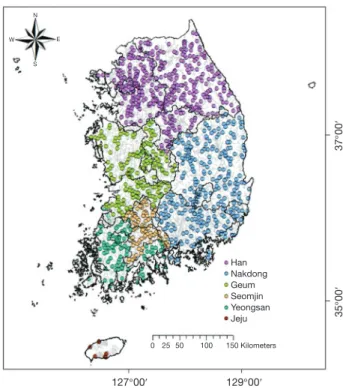
저서성 대형무척추동물 자료는 환경부에서 2007년부터 수행하고 있는 “하천 수생태계 현황 조사 및 건강성 평가 조사” 사업으로 구축한 데이타베이스로부터 2009년부터 2016년까지 자료를 추출하여 사용하였다. 선택된 자료는 전국 하천에서 총 1,157개 조사지점으로 구성되었다(Fig.
1). 한강 수계(남한강, 북한강, 한강본류, 안성천, 기타) 442 지점, 낙동강 수계(낙동강, 형산강, 태화강, 기타) 305지점, 금강 수계(금강, 삽교천, 만경강, 동진강, 기타) 199지점, 섬 진강 수계 102지점, 영산강 수계(영산강, 탐진강, 기타) 102 개 그리고 제주 수계 7개 등 조사가 이루어졌다.
각 조사지점에서는 분류군별 개체수 및 이화학적 환경 인자를 수집하였다. 저서성 대형무척추동물 군집 조사는 조사 지침에 따라 여울(riffle)에서 Surber net(30cm×30 cm, 1mm mesh size)을 사용하여 총 3회 정량 채집하였다 (MOE/NIER 2009). 채집된 시료는 플라스틱 병에 담아 현 장에서 포름알데하이드 용액으로 10% 고정한 후 실험실로 운반하여 생물시료를 골라낸 다음 70% 에틸알코올에 보관
127 °00ʹ 129°00ʹ
37 °00 ʹ 35 °00 ʹ
Han Nakdong Geum Seomjin Yeongsan Jeju
0 25 50 100 150 KilometersW E
N
S
Fig. 1. The sampling sites of each water system in Korea.
하였다. 동정과 분류는 Yoon(1995), Merritt and Cummins (1996), Won et al.(2008), Kwon et al.(2013)을 참고하였다.
하상 재료는 생물시료 조사와 병행하여 입자의 크기에 따라 진흙 이하(<0.063mm), 모래(0.063~2mm), 굵은 모 래(2~16mm), 자갈(16~64mm), 큰 자갈(64~256mm), 큰 돌(>256mm)로 구분하여 측정하였다(MOE/NIER, 2009). 또한 조사지점의 고도, 하폭, 수폭, 수심 그리고 유 속을 측정하였다. 조사된 군집 자료와 환경 자료는 지점별 평균 값을 사용하였다.
2. 자료 분석
저서성 대형무척추동물 군집 자료는 분류 동정의 한계 성 때문에 분류군에 따라 종, 속, 과 등 다양한 수준에서 분 류 동정되어 있다. 따라서 본 연구에서는 분류군의 특성을 전반적으로 나타내 줄 수 있는 과(family) 수준으로 자료 를 정리하여 분류군별, 수계별 구성 비율을 분석하였다. 조 사지점 수(A)에 따른 분류군(과) 수(F)를 평가하기 위하 여 다음의 식으로 평가하였다(Preston, 1962; Rosenzweig, 1995).
F=cA
z
여기서 c는 상수, z는 A와 F 사이의 계수로 표현된다.
하천의 이화학적 환경 특성뿐만 아니라 그 곳에서 서식 하는 생물들도 고도에 따라 크게 영향을 받는다(Li et al.,
2012). 이에 따라 고도 구배에 따라 주요분류군의 분포 특 성을 분석하였다.
그리고 저서성 대형무척추동물의 조사지점별 특성을 분 석하기 위하여 다변량분석법으로 집괴분석(cluster analysis) 과 비계량다차원척도법(non-metric multidimensional scaling, NMDS)을 수행하였다. 자료는 조사지점별로 기록된 저서 성 대형무척추동물의 과별 개체수를 이용하였다. 집괴분 석은 Ward linkage 방법과 Bray-Curtis 거리를 적용하였다.
과별 개체수의 변이가 크기 때문에 변이를 줄이기 위하여 개체수를 로그 변환하여 이용하였다. 로그 0의 불능 문제 를 피하기 위하여 각 과별 개체수에 1을 더하여 변환하였 다(Park et al., 2007) 집괴분석 결과 얻어진 그룹들 간에는 군집구성 및 환경변수의 차이를 분석하였으며, NMDS의 결과에는 환경 인자를 biplot으로 투과하여 조사지점, 생 물 분류군, 환경 인자 간의 관계를 분석하였다. 집괴분석은 R 프로그램(version 3.3.3)에서 운용되는 cluster package (Maechler et al., 2017)를 이용하였으며, NMDS는 vegan package(Oksanen et al., 2017)를 이용하였다.
결 과
1. 서식지 하상 재료 구성
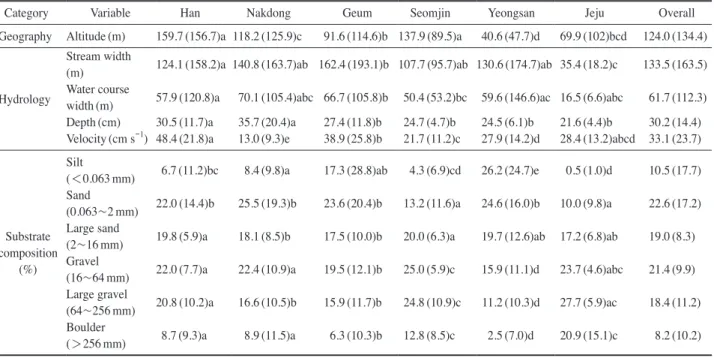
전체적으로 저서성 대형무척추동물 조사지점의 하상 재
Table 1. Summary of environmental factors in each water system in Korea (mean±SD). The different alphabets present significant differ- ence among water systems according to the Dunn test (P < 0.05). The substrate composition ratio is classified into 6 levels.
Category Variable Han Nakdong Geum Seomjin Yeongsan Jeju Overall Geography Altitude (m) 159.7 (156.7)a 118.2 (125.9)c 91.6 (114.6)b 137.9 (89.5)a 40.6 (47.7)d 69.9 (102)bcd 124.0 (134.4)
Hydrology
Stream width
(m) 124.1 (158.2)a 140.8 (163.7)ab 162.4 (193.1)b 107.7 (95.7)ab 130.6 (174.7)ab 35.4 (18.2)c 133.5 (163.5) Water course
width (m) 57.9 (120.8)a 70.1 (105.4)abc 66.7 (105.8)b 50.4 (53.2)bc 59.6 (146.6)ac 16.5 (6.6)abc 61.7 (112.3) Depth (cm) 30.5 (11.7)a 35.7 (20.4)a 27.4 (11.8)b 24.7 (4.7)b 24.5 (6.1)b 21.6 (4.4)b 30.2 (14.4) Velocity (cm s
-1) 48.4 (21.8)a 13.0 (9.3)e 38.9 (25.8)b 21.7 (11.2)c 27.9 (14.2)d 28.4 (13.2)abcd 33.1 (23.7)
Substrate composition
(%) Silt
( < 0.063 mm) 6.7 (11.2)bc 8.4 (9.8)a 17.3 (28.8)ab 4.3 (6.9)cd 26.2 (24.7)e 0.5 (1.0)d 10.5 (17.7) Sand
(0.063~2 mm) 22.0 (14.4)b 25.5 (19.3)b 23.6 (20.4)b 13.2 (11.6)a 24.6 (16.0)b 10.0 (9.8)a 22.6 (17.2) Large sand
(2~16 mm) 19.8 (5.9)a 18.1 (8.5)b 17.5 (10.0)b 20.0 (6.3)a 19.7 (12.6)ab 17.2 (6.8)ab 19.0 (8.3) Gravel
(16~64 mm) 22.0 (7.7)a 22.4 (10.9)a 19.5 (12.1)b 25.0 (5.9)c 15.9 (11.1)d 23.7 (4.6)abc 21.4 (9.9) Large gravel
(64~256 mm) 20.8 (10.2)a 16.6 (10.5)b 15.9 (11.7)b 24.8 (10.9)c 11.2 (10.3)d 27.7 (5.9)ac 18.4 (11.2) Boulder
( > 256 mm) 8.7 (9.3)a 8.9 (11.5)a 6.3 (10.3)b 12.8 (8.5)c 2.5 (7.0)d 20.9 (15.1)c 8.2 (10.2)
료 구성은 모래(22.6±17.2%, 평균±표준편차), 자갈(21.4±
9.9%), 굵은 모래(19.0±8.3%), 큰 자갈(18.4±11.2%), 진 흙 이하(10.5±17.7%)와 큰 돌(8.2±10.2%)로 이루어졌 다(Table 1). 수계에 따라 하상 구성은 다소 차이를 보였는 데, 한강은 다른 수계에 비하여 진흙 이하(6.7%)의 비율 이 낮았으며 큰 자갈(20.8%)이 차치하는 비율은 상대적으 로 높았다. 낙동강 수계는 모래(25.5%)가 차지하는 비율이 높았다. 금강 수계는 모래(23.6%)와 자갈(19.5%)의 비율 이 매우 높았다. 섬진강 수계는 비교적 하상 입자가 큰 자 갈(25.0%), 큰 자갈(24.8%)과 굵은 모래(20.0%)의 비율이 높았다. 영산강 수계는 큰 돌(2.5%)의 비율이 가장 낮은 수계였으며, 모래(24.6%)와 진흙 이하(26.2%)의 하상 비 율이 높았다. 제주는 큰 자갈(27.7%)과 자갈(23.7%)의 비 율이 높았다.
조사지점의 고도는 평균 124.0(±34.4)m이었으며 평균 하폭은 133.5(±163.5)m, 수폭은 61.7(±112.3)m였으며, 평균 수심과 유속은 각각 30.2(±14.4)cm, 33.1(±23.7) cm s
-1
이었다. 전반적으로 환경 인자들은 수계에 따라 통 계적으로 유의한 차이를 보였다(Dunn test, p<0.05)(Table 1).2. 저서성 대형무척추동물의 분포
전체 조사지점에서 저서성 대형무척추동물은 총 151과 가 기록되었으며, 한강 141과(442지점), 낙동강 122과(305 지점), 금강 115과(199지점), 섬진강 106과(102지점), 영산 강 113과(102지점), 제주 50과(7지점)가 조사되었다. 조사 지점 수에 따른 분류군(과) 수의 변화는 잘 알려진 종수-면 적의 관계를 보여준다(R
2
=0.9709)(Fig. 2). 조사지점 수가 증가함에 따라 분류군(과) 수가 증가하지만 어느 이상에서 는 크게 증가하지 않는다.수계별로 출현한 과의 개체수를 서열에 따라 정리하였 을 때(Fig. 3), 수계별로 전체 출현 분류군 수에 차이가 있 음을 보여주고 있다. 한강 수계가 종수 및 개체수가 가장 높으며, 섬진강이 상대적으로 가장 낮았다. 수계 간 분류군 수는 차이가 있으나 각 곡선의 기울기(변이)는 유사함을 보이고 있다.
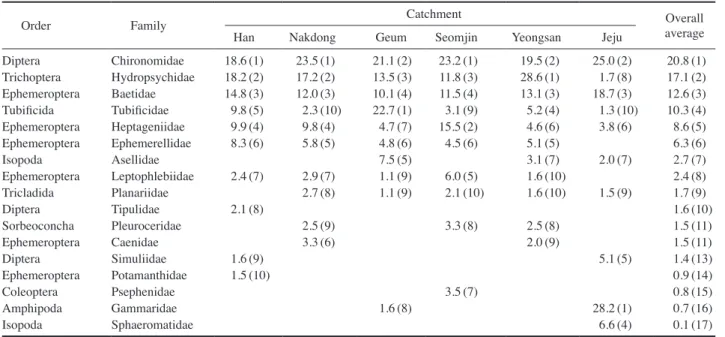
우리 나라 주요수계의 저서성 대형무척추동물 분포현황 을 살펴보면, 파리목의 깔다구과(Chironomidae)가 전체 개 체수의 20.8%를 차지하여 가장 우점하였으며, 날도래목 의 줄날도래과(Hydropsychidae)는 17.1%, 하루살이목의 꼬마하루살이과(Baetidae)는 12.6%, 원시빈모목에 속하는 실지렁이과(Tubificidae)는 10.3%를 차지하였다. 그 외 하 루살이목의 납작하루살이과(Heptageniidae) 8.6%, 알락하
루살이과(Ephemerellidae) 6.3%, 딱정벌레목의 물벌레과 (Asellidae) 2.7% 순으로 많이 채집되었다(Table 2).
대권역별로 분류군별 분포현황을 살펴보면, 한강, 낙동 강, 섬진강 대권역은 깔다구과가 가장 우점하였다. 먼저 한 강은 깔다구과가 18.6%를 차지하였으며, 다음으로 줄날 도래과가 18.2%, 꼬마하루살이과 14.8% 순으로 높았다 (Table 2). 그리고 낙동강에서는 깔다구과 23.5%, 줄날도래 과 17.2%, 꼬마하루살이과 12.0% 순으로 10% 이상의 비 율을 차지하였다. 섬진강은 깔다구과가 23.2%로 우점하였 으며, 납작하루살이과 15.5%, 줄날도래과 11.8%, 꼬마하루 살이과 11.5% 순으로 출현하였다. 한편, 금강은 실지렁이 과가 22.7%로 우점하였으며, 깔다구과 21.1%, 줄날도래과
Number of taxa (Family)
150 120 90 60 30 0
y=20.865ln(x)+11.325 R
2=0.9709
0 100 200 300 400 500 Number of sampling sites
Fig. 2. Changes of number of taxa as a function of number of sam- pling sites.
Abundance
1,000,000
100,000
10,000
1,000
100
10
1
0 1 7 13 19 25 31 37 43 49 55 61 67 73 79 85 91 97 103 109 115 121 127 133 139 145 151
Rank family
Fig. 3. The Family rank abundance curve for each water system in Korea.
Nation Han
Nakdong Geum
Yeongsan Seomjin
13.5%, 꼬마하루살이과 10.1% 순으로 높았다. 그리고 영산 강은 줄날도래과가 28.6%로 가장 우점하였으며, 깔다구과 19.5%, 꼬마하루살이과 13.1% 순으로 높았으며 실지렁이 과, 알락하루살이과 등은 5% 이하로 낮았다. 제주 수계는 옆새우과(Gammaridae)가 가장 우점하여 28.2%를 차지하 였으며, 깔다구과 25.0%, 꼬마하루살이과 18.7%를 차지하 였고, 잔벌레과(Sphaeromatidae), 먹파리과(Simulidae) 등 은 낮은 비율로 서식하였다. 특히 실지렁이과는 1.3%로 매 우 낮았다.
분류군 간 상관관계는 대체적으로 낮은 값을 보였으 며, 줄날도래과와 알락하루살이과가 가장높은 상관관계 (r =0.55, p<0.001)를 보였다. 다음으로는 납작하루살 이과와 물날도래과(r =0.47, p<0.001), 갈래하루살이과 (Leptophlebiidae)와 물삿갓벌레과(Psephenidae)(r=0.45, p<0.001)가 높은 상관관계를 보였다(Fig. 4).
3. 군집 다변량 분석
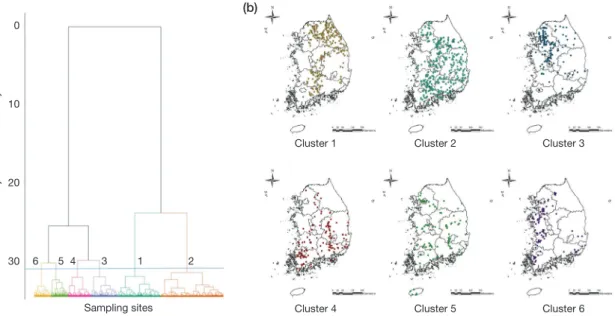
저서성 대형무척추동물의 분포 특징을 파악하고자 집괴 분석을 한 결과, 조사지점은 6개의 그룹으로 나뉘어졌다 (Fig. 5a). 그룹 1은 한강(164지점, 남한강, 북한강, 한강본 류), 낙동강(47지점), 금강(26지점), 섬진강(22지점)의 다수 지역이 포함되었으며, 깔따구과, 줄날도래과, 꼬마하루살이 과의 출현빈도가 상대적으로 낮았고 납작하루살이과의 출 현 빈도는 높았다(Fig. 5b). 그룹 2는 한강(116지점, 남한
강, 한강본류), 낙동강(132지점), 금강(26지점, 만경강 등), 섬진강(57지점)의 조사지점을 포함하였으며, 알락하루살 이과의 출현빈도가 높았다. 그룹 3은 한강(99지점, 남한강, 북한강, 한강본류), 낙동강(13지점), 금강(44지점, 삽교천, 만경강), 섬진강(1지점), 영산강(4지점)의 조사지점들로 구
Fig. 4. The result of correlation analysis for 20 selected taxa of ben- thic macroinvertebrates. The box which is closer to black indicate the meaning of positive correlation and the closer to white indicate the negative correlation means.
Table 2. The proportion (%) of the top 10 dominant families of benthic macroinvertebrates in each water system in Korea (Dominant ranks).
Order Family Catchment Overall
average Han Nakdong Geum Seomjin Yeongsan Jeju
Diptera Chironomidae 18.6 (1) 23.5 (1) 21.1 (2) 23.2 (1) 19.5 (2) 25.0 (2) 20.8 (1) Trichoptera Hydropsychidae 18.2 (2) 17.2 (2) 13.5 (3) 11.8 (3) 28.6 (1) 1.7 (8) 17.1 (2) Ephemeroptera Baetidae 14.8 (3) 12.0 (3) 10.1 (4) 11.5 (4) 13.1 (3) 18.7 (3) 12.6 (3) Tubificida Tubificidae 9.8 (5) 2.3 (10) 22.7 (1) 3.1 (9) 5.2 (4) 1.3 (10) 10.3 (4) Ephemeroptera Heptageniidae 9.9 (4) 9.8 (4) 4.7 (7) 15.5 (2) 4.6 (6) 3.8 (6) 8.6 (5) Ephemeroptera Ephemerellidae 8.3 (6) 5.8 (5) 4.8 (6) 4.5 (6) 5.1 (5) 6.3 (6)
Isopoda Asellidae 7.5 (5) 3.1 (7) 2.0 (7) 2.7 (7)
Ephemeroptera Leptophlebiidae 2.4 (7) 2.9 (7) 1.1 (9) 6.0 (5) 1.6 (10) 2.4 (8) Tricladida Planariidae 2.7 (8) 1.1 (9) 2.1 (10) 1.6 (10) 1.5 (9) 1.7 (9)
Diptera Tipulidae 2.1 (8) 1.6 (10)
Sorbeoconcha Pleuroceridae 2.5 (9) 3.3 (8) 2.5 (8) 1.5 (11)
Ephemeroptera Caenidae 3.3 (6) 2.0 (9) 1.5 (11)
Diptera Simuliidae 1.6 (9) 5.1 (5) 1.4 (13)
Ephemeroptera Potamanthidae 1.5 (10) 0.9 (14)
Coleoptera Psephenidae 3.5 (7) 0.8 (15)
Amphipoda Gammaridae 1.6 (8) 28.2 (1) 0.7 (16)
Isopoda Sphaeromatidae 6.6 (4) 0.1 (17)
성되었다. 그리고 실지렁이과의 출현빈도가 매우 높았으 며, 납작하루살이과의 출현빈도는 낮았다. 그룹 4는 한강 (13지점, 남한강, 북한강), 낙동강(65지점), 금강(15지점, 금 강, 만경강), 섬진강(9지점), 영산강(23점, 영산강, 탐진강) 의 조사지점들로 구성되었며, 물벌레과의 출현빈도가 매우 높았다. 그룹 5는 한강(24지점, 한강본류, 남한강), 낙동강 (37지점), 금강(13지점, 금강), 섬진강(13지점), 영산강(3점, 영산강, 탐진강)의 조사지점으로 구성되었으며, 플라나리 아과(Planariidae)의 출현빈도가 매우 높았다. 그룹 6은 한 강(28지점, 한강본류, 북한강, 안성천, 남한강 일부), 낙동강 (11지점), 금강(45지점, 금강, 삽교천, 만경강, 동진강), 영산
강(17점, 영산강)의 조사지점으로 구성되었으며, 깔따구과, 실지렁이과, 물벌레과(Corixidae)가 매우 높은 출현빈도를 보였다. 그리고 줄날도래과, 알락하루살이과가 낮은 출현 빈도를 보이는 경향이 뚜렷하였다.
집괴분석 결과 얻어진 6개 그룹은 NMDS 상에서도 그 룹의 특성을 반영하여 구분되었다(Fig. 6). 그룹 1, 2는 NMDS 1 축의 왼쪽, 그룹 5, 6은 오른쪽에 위치하였으며, 그룹 3, 4는 그 중간에 위치하여 그룹 1, 2는 그룹 5, 6과 는 군집 구성이 매우 큰 차이가 있었다. 그룹 1, 2는 대체 로 납작하루살이과, 각다귀과(Tipulidae), 줄날도래과 등이 높은 밀도를 보였으며, 그룹 5, 6은 물벌레과, 실지렁이과,
0
10
20
30
Bray-curtis dissimilarity
6 5 4 3 1 2
Sampling sites
Cluster 1 Cluster 2 Cluster 3
Cluster 4 Cluster 5 Cluster 6 (a) (b)
Fig. 5. (a) A dengrogram of cluster analysis based on benthic macroinvertebrates abundance by Ward’s linkage method, (b) distribution maps for different clusters.
MDS2 MDS2
2
1
0
- 1
- 2
2
1
0
- 1
- 2
- 3 - 2 - 1 0 1 2 3
MDS1
- 3 - 2 - 1 0 1 2 3
MDS1 Cluster 1
Cluster 2 Cluster 3 Cluster 4 Cluster 5 Cluster 6
Cluster 1 Cluster 2 Cluster 3 Cluster 4 Cluster 5 Cluster 6
Fig. 6. (a) Ordination of NMDS based on benthic macroinvertebrates abundance, (b) differences of environmental factors on NMDS.
(a) (b)
깔다구과 등이 높은 밀도를 보였다. 이러한 군집의 특성은 그들의 환경특성을 잘 반영해 주었다. 그룹 1에 속하는 조 사지점은 고도가 높으면서 유속이 빠르고 하상입자의 크 기가 큰 곳이었으며, 이에 비해 그룹 5, 6에 속하는 조사지 점은 고도가 낮고 수심이 깊고, 수폭이 넓은 곳으로 하상 이 모래, 진흙 등 입자의 크기가 작은 것들로 구성되어 있 었다.
4. 고도에 따른 군집 특성
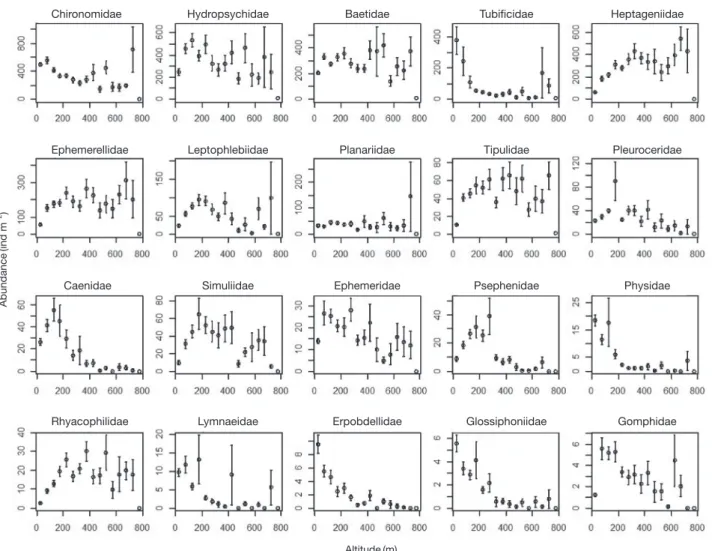
자료에 포함된 전체 분류군 중에서 밀도가 높은 상 위 20개 분류군(과)의 밀도 변동을 고도에 따라 나타내 었을 때(Fig. 7), 깔다구과, 실지렁이과, 등딱지하루살이 과(Caenidae), 강하루살이과(Potamanthidae), 여울벌레과 (Elmidae), 물삿갓벌레과, 물벌레과, 옆새우과, 왼돌이물달
팽이과(Physidae)는 낮은 고도에서는 높은 밀도를 보이지 만 고도가 증가함에 따라 밀도가 감소하였다. 특히 물벌레 과는 주로 100m 이하의 고도에서 밀도가 높았다. 반면 납 작하루살이과, 각다귀과, 알락하루살이과 등은 낮은 고도 에서 밀도가 낮지만 고도가 증가함에 따라 밀도가 증가하 였다. 한편 분류분에 따라 특정 범위의 고도에서 가장 높 은 밀도를 보이고 그 전후에서는 밀도가 감소하는 특성을 보였다. 예를 들어 줄날도래과, 갈래하루살이과, 다슬기과 (Pleuroceridae), 물삿갓벌레과는 200m 전후에서 가장 높 았다.
고 찰
생물 종다양성과 군집의 변화를 정밀하게 평가하기 위
Chironomidae Hydropsychidae Baetidae Tubificidae Heptageniidae
Ephemerellidae Leptophlebiidae Planariidae Tipulidae Pleuroceridae
Caenidae Simuliidae Ephemeridae Psephenidae Physidae
Rhyacophilidae Lymnaeidae Erpobdellidae Glossiphoniidae Gomphidae
Altitude (m) Abundance (ind m
-2)
Fig. 7. Changes of abundance of 20 selected taxa of benthic macroinvertebrates as a function of altitude. The vertical bars indicate standard
division.
해서는 종 수준에서 분류 동정하여 분석하여야 한다(Park
et al., 2016). 그러나 이를 위해서는 많은 시간과 비용이 소
요되며, 분류 동정 전문가가 필요하다. 분류 동정 전문가 는 특정 분류군에 대해서는 전문성이 있으나 다른 분류군 에는 한계가 있다. 특히 저서성 대형무척추동물은 종 수가 매우 많고 종들 사이에 형태적 유사성이 높아 정확한 분류 동정에 한계가 있다. 이에 따라 저서성 대형무척추동물 전 체를 연구하기 보다는 특정분류군을 종 수준으로 분류 동 정하여 분석하는 경우가 많다(Chon et al., 2000; Tang etal., 2010; Li et al., 2014). 한편, 생물 군집의 특성을 분석하
여 환경변화를 평가하는 경우 특정 분류군을 종 수준으로 정밀하게 분류 동정하여 평가하는 것도 필요하지만 과, 목 등 상위 분류군을 이용한 평가도 유용하게 이용될 수 있 다(Park et al., 2016). 다양한 상위 분류군으로 구성된 자료 는 환경변화에 대해 종 수준에서 일어나는 섬세한 변화는 반영해 주지 못하지만 환경 교란에 대해 보다 명확한 정 보를 제시해 줄 수 있다(Ricotta et al., 2002; Baldi, 2003;Cardoso et al., 2004; Kwon et al., 2016).
전국 1,157개 지점에서 조사된 저서성 대형무척추동물 의 분포 특성과 환경 인자와의 관계를 분석하였다. 자료는 과(분류군) 수준에서 정리하여 이용하였다. 전체 조사지점 을 집괴분석한 결과, 6개 그룹으로 구분되었다. 각 그룹은 조사지점의 지리적 분포, 특히 고도에 따른 특성을 잘 반 영해 주었다. 또한 유속 등 수리수문학적 변수와 하상 구 성이 크게 작용함을 보였다. 고도가 높은 지역은 평균 유 속이 빠르고 상대적으로 입자가 큰 하상으로 구성되었다. 이는 그룹 1을 대변해 주는 환경 특성이었으며, 그룹 6은 이와 상반되는 환경 특성으로 구성되었다. 그리고 그룹 1 은 납작하루살이과, 갈래하루살이과 등이 우점한 반면 그 룹 6은 물벌레과, 실지렁이과 등이 대표 분류군으로 평가 되었다. 이러한 결과는 저서성 대형무척추동물의 분포 특 성이 유속과 함께 하상구성이 매우 중요하게 작용한다는 것을 제시해 준다. 이는 이전의 연구 결과를 잘 지지해 준 다. Bae et al.(2011)은 2009년 조사된 “수생태계 건강성 조사 및 평가” 자료를 이용하여 다양한 환경 인자가 부착 돌말, 저서성 대형무척추동물, 어류의 군집분포에 미치는 영향을 평가하였다. 그 결과 어류는 지형적인 특성, 저서성 대형무척추동물은 하상구성 및 유속, 부착돌말류는 이화학 적 인자에 크게 영향을 받으며 이는 각 생물이 갖는 생물 의 이동성을 반영해 주는 것이라 하였다. 한편, Park et al.
(2007)은 환경부에서 조사한 전국자연환경조사 자료를 활 용하여 우리나라 저서성 대형무척추동물 군집의 분포를 유형화하였다. 그 결과, 조사지역의 지리적 위치가 중요하 게 작용하여 저서성 대형무척추동물 군집의 지역적 특성
을 잘 반영해 주었다. 또한 이화학적 수질오염 및 환경교 란의 영향도 잘 반영해 주었다. 이를 통해 저서성 대형무 척추동물의 분포 특성에 따른 생태지역(ecoregion) 설정을 할 수 있는 가능성을 제시하였다.
한편, 분류군 수와 조사지점 수의 관계분석에서는 조자 지점 수가 증가함에 따라 분류군 수가 멱함수 법칙(power law)을 따라 증가하며 유의성이 매우 높음을 보였다(Fig.
2). 이는 우리나라 하천에서 조사지점의 수에 따라 예상되 는 저서성 대형무척추동물 분류군 수가 얼마인지를 예상 할 수 있게 해준다. 이러한 관계는 종-면적의 관계에서 일 반적으로 관찰되는 특성으로(Rosenzweig, 1995) 생물 종 다양성을 평가하는 데 유용하게 사용된다.
Kwak et al.(2000)과 Chon et al.(2002)은 우리나라 전역 의 하천에서 조사된 자료를 수집하여 각각 571종과 644종 이 기록되었다고 보고하였으며, 분류학적인 문제로 실제로 는 더 많은 종이 분포할 것으로 예상하였다. 그러나 여전 히 분류학적인 한계로 종 수준의 자료를 검정하는 단계를 거치지 못한 상태에서 조사와 평가가 이루어지고 있는 경 우가 많은 실정이다. 최근 생물지표를 이용하여 생태계 건 강성 평가가 많이 실시되고 있다. 생태계의 건강성 평가는 빠른 판별이 요구된다. 이를 위해서는 시간과 노력이 많이 필요한 종 수준의 분류 동정보다는 상위분류군에서 분류 동정하여 시간을 줄이는 것이 필요하다. US EPA에서는 빠 른 평가를 위하여 하루살이목(E), 강도래목(P), 날도래목 (T)를 이용한 EPT 평가 지수를 개발하였으며(Barbour et
al., 1999), 영국에서는 과 수준에서 분류 동정된 자료를 이
용하여 생물학적 수질을 평가하는 Biological Monitoring Working Party(BMWP) score system(Walley and Hawkes, 1996, 1997)을 개발하여 다양한 지역에서 활용하고 있으 며, 지속적으로 개선되고 있다(Paisley et al., 2014). 그 외 에 다양한 연구자들이 과 수준의 동정 자료를 이용하는 수 생태계 건강성을 평가하는 방법이 연구되었다(Hilsenhoff, 1988; Hawkes, 1998; Višinskien and Bernotien , 2012). 이 러한 점에서 과 수준에 기반한 생물지수는 환경변화에 대 한 수생태계 건강성 평가에 효과적으로 사용될 수 있다. 우리나라에서도 이에 대한 연구 개발이 요구된다.적 요
주요 수계를 중심으로 한강 수계(남한강, 북한강, 한강본 류, 안성천, 기타) 442지점, 낙동강 수계(낙동강, 형산강, 태 화강, 기타) 305지점, 금강 수계(금강, 삽교천, 만경강, 동진 강, 기타) 199지점, 섬진강 수계(섬진강, 기타) 102지점, 영
산강 수계(영산강, 탐진강, 기타) 102개 그리고 제주 수계 7개를 합쳐 총 1,157지점에 대하여 저서성 대형무척추동 물의 분포현황을 정리하여 데이터화하였다. 전체 조사지 점에서 한강 141과, 낙동강 122과, 금강 115과, 섬진강 106 과, 영산강 113과 그리고 제주 수계에서 50과 조사되어, 총 151과가 출현한 것으로 나타났다. 저서성 대형무척추동 물의 출현을 살펴보면, 깔다구과가 가장 우점하여 20.8%
를 차지하였으며, 줄날도래과는 17.1%, 꼬마하루살이과는 12.6%, 실지렁이과는 10.3%, 납작하루살이과는 8.6%, 알 락하루살이과는 6.3%, 물벌레과는 2.7%, 갈래하루살이과 는 2.4%, 플라나리아과는 1.7%, 그리고 각다귀과는 1.6%
를 차지하였다. 저서성 대형무척추동물이 서식하는 하상 은 모래(22.6%), 자갈(21.4%), 굵은 모래(19.0%), 큰 자갈 (18.4%), 진흙 이하(10.5%)와 큰 돌(8.2%)로 이루어졌다.
수계의 평균 하폭은 133.5m, 수폭은 61.7m로 조사되었다.
수계의 평균 수심과 유속은 각각 30.2cm, 33.1cm s
-1
이었 다. 수계에 분포하는 저서성 대형무척추동물의 분포특징을 집괴분석으로 살펴본 결과 조사지에 출현한 저서성 대형 무척추동물의 분류군의 출현빈도에 따라 6그룹으로 나뉘 어졌다. 이는 조사지역의 고도, 유속, 및 하상구성 특성과 밀접한 관계를 가지고 있었다.사 사
본 연구는 환경부 “수생태건강성 조사와 평가” 및 한 국연구재단의 지원을 받아 중견연구지원사업(NRF-2016 R1A2B4011801)의 일부로 수행되었습니다
REFERENCES
Bae, M.J. and Y.S. Park. 2009. Changes in benthic macroinver- tebrate communities in response to natural disturbances in a stream. Journal of Ecology and Environment 32(3):
197-206.
Bae, M.J., F. Li, Y.S. Kwon, N. Chung, H. Choi, S.J. Hwang and Y.S. Park. 2014. Concordance of diatom, macroinver- tebrate and fish assemblages in streams at nested spatial scales: Implications for ecological integrity. Ecological
Indicators 47: 89-101.
Bae, M.J., T.S. Chon, and Y.S. Park. 2014. Characterizing differential responses of benthic macroinvertebrate com- munities to floods and droughts in three different stream types using a Self-Organizing Map. Ecohydrology 7(1):
115-126.
Bae, M.J., Y.S. Kwon, S.J. Hwang, T.S. Chon, H.J. Yang, I.S.
Kwak, J.H. Park, S.A. Ham and Y.S. Park. 2011. Rela- tionships between three major stream assemblages and their environmental factors in multiple spatial scales. An-
nales de Limnologie-International Journal of Limnology 47: S91-S105.
Báldi, A. 2003. Using higher taxa as surrogates of species richness: a study based on 3700 Coleoptera, Diptera and Acari species in Central-Hungarian reserves. Basic and
Applied Ecology 4: 589-593.
Barbour, M.T., J. Gerritsen, B.D. Snyder and J.B. Stribling.
1999. Rapid Bioassessment Protocols for Use in Streams and Wadeable Rivers: Periphyton, Benthic Macroinver- tebrates and Fish, Second Edition. EPA 841-B-99-002.
U.S. Environmental Protection Agency; Office of Water;
Washington, D.C.
Boulton, A.J., C.G. Peterson, N.B. Grimm and S.G. Fisher.
1992. Stability of an aquatic macroinvertebrate communi- ty in a multiyear hydrologic disturbance regime. Ecology
73(6): 2192-2207.
Brooks, S.S. and A.J. Boulton. 1991. Recolonization dynamics of benthic macroinvertebrates after artificial and natural disturbances in an Australian temporary stream. Austra-
lian Journal of Marine and Freshwater Research 42: 295-
Cardoso, P., I. Silva, N.G. de Oliveira and A.R.M. Serrano. 308.2004. Higher taxa surrogates of spider (Araneae) diversity and their efficiency in conservation. Biological Conserva-
tion 117: 453-459.
Chon, T.S., I.S. Kwak and Y.S. Park. 2000. Pattern recognition of long-term ecological data in community changes by us- ing artificial neural networks: Benthic macroinvertebrates and chironomids in a polluted stream. Korean Journal of
Limnological Society 23(2): 89-100.
Cobb, G.G., T.D. Galloway and J.F. Flannagan. 1992. Effects of discharge and substrate stability on density and species composition of stream insects. Canadian Journal of Fish-
eries and Aquatic Sciences 49: 1788-1795.
Cossins, A.R. and K. Bowler. 1987. Temperature biology of ani- mals. Chapman and Hall, London.
Flecker, A.S. and B. Feifarek. 1994. Disturbance and the tempo- ral variability of invertebrate assemblages in two Andean streams. Freshwater Biology 31: 131-142.
Graeber, d., T.M. Jensen, J. Rasmussen, T. Riis, P. Wiberg-Lars- en and A. Baattrup-pedersen. 2017. Multiple stress re- sponse of lowland stream benthic macroinvertebrates is dependent on habitat type. Science of the Total Environ-
ment 599: 1517-1523.
Gray, L.J. and S.G. Fisher. 1981. Postflood recolonization path- ways of macroinvertebrates in a lowland Sonoran Desert stream. American Midland Naturalist 106: 249-257.
Hawkes, H.A. 1998. Origin and development of the biological monitoring working party score system. Water Research
32: 964-968.
Hilsenhoff, W.L. 1988. Rapid field assessment of organic pollu- tion with a family-level biotic index. Journal of the North
American Benthological Society 7(1): 65-68.
Kwak, I.S., G. Liu, Y.S. Park and T.S. Chon. 2000. Community Patterning of Benthic Macroinvertebrates in Streams of South Korea by Utilizing an Artificial Neural Network.
Korean Journal of Ecology and Environment 33: 230-
Kwon, S.J., Y.C. Jeon and J.H. Park. 2013. Checklist of organ-243.isms in Korea 7. Benthic macroinvertebrates. Eco and Nature, Seoul.
Kwon, T.-S., Y.S. Kim, S.W. Lee and Y.-S. Park. 2016. Changes of soil arthropod communities in temperate forests over 10 years(1998-2007). Journal of Asia-Pacific Entomology
19(1): 181-189.
Lancaster, J. and A.G. Hildrew. 1993. Characterizing instream flow refugia. Canadian Journal of Fisheries and Aquatic
Sciences 50(8): 1663-1675.
Li, F., M.J. Bae, Y.S. Kwon, N. Chung, S.J. Hwang, S.J. Park, H.K. Park, D.S. Kong and Y.S. Park. 2013. Ecological exergy as an indicator of land-use impacts on functional guilds in river ecosystems. Ecological Modelling 252: 53- Li, F., N. Chung, M.J. Bae, Y. Kwon and Y.S. Park. 2012. Re-62.
lationships between stream macroinvertebrates and envi- ronmental variables at multiple spatial scales. Freshwater
Biology 57: 2107-2124.
Li, F., N. Chung, M.J. Bae, Y. Kwon, T.S. Kwon and Y.S. Park.
2013. Temperature change and macroinvertebrate biodi- versity: assessments of organism vulnerability and poten- tial distributions. Climatic Change 119(2): 421-434.
Li, F., Y.S. Kwon, M.J. Bae, N. Chung, T.S. Kwon and Y.S.
Park. 2014. Potential impacts of global warming on the diversity and distribution of stream insects in South Ko- rea. Conservation Biology 28: 498-508.
Maechler, M., P. Rousseeuw, A. Struyf, M. Hubert and K.
Hornik. 2017. cluster: Cluster Analysis Basics and Exten- sions. R package version 2.0. 1. 2015.
Magnuson, J.J., L.B. Crowder and P.A. Medvick. 1979. Tem- perature as an ecological resource. American Zoologist 19:
331-343.
Merritt, R.W. and K.W. Cummins. 1996. An Introduction to the Aquatic Insects of North America. 3rd ed. Kendall/ Hunt Publishing Company, Dubuque, Iowa.
MOE/NIER. 2009. The Survey and Evaluation of Aquatic Eco- system Health in Korea. The Ministry of Environment/
National Institute of Environmental Research, Incheon, Korea (in Korean with English summary).
Neil, W.H. 1979. Mechanisms of fish distribution in heterother- mal environments. American Zoologist 19: 305-317.
Oksanen, J., F.G. Blanchet, M. Friendly, R. Kindt, P. Legendre, D. McGlinn, P.R. Minchin, R.B. O’Hara, G.L. Simpson, P. Solymos, M.H.H. Stevens, E. Szoecs and H. Wagner.
2017. vegan: Community Ecology Package.
Paisley, M.F., D.J. Trigg and W.J. Walley. 2014. Revision of the biological monitoring working party(BMWP) score system: derivation of present-only and abundance-related scores from field data. River Research and Applications
30(7): 887-904.
Park, Y.S., M.Y. Song, Y.C. Park, K.H. Oh, E. Cho and T.S.
Chon. 2007. Community patterns of benthic macroinver- tebrates collected on the national scale in Korea. Ecologi-
cal Modelling 203: 26-33.
Park, Y.-S., Y.-K. Park and H.-M. Yang. 2016. Effects of clear- cutting on forest arthropod communities at two different vertical levels(crown and ground surface). Korean Jour-
nal of Ecology and Environment 49(4): 271-278. https://
doi.org/10.11614/KSL.2016.49.4.271
Piggott, J.J., C.R. Townsend and C.D. Matthaei. 2015. Climate warming and agricultural stressors interact to determine stream macroinvertebrate community dynamics. Global
Change Biology 21(5): 1887-1906.
Preston, F.W. 1962. The canonical distribution of commonness and rarity: Part I. Ecology 43: 185-215.
Ricotta, C., M. Ferrari and G. Avena. 2002. Using the scaling behavior of higher taxa for the assessment of species rich- ness. Biological Conservation 107: 131-133.
Robertson, A.L., J. Lancaster and A.G. Hildrew. 1995. Stream hydraulics and the distribution of macrocrustacea: a role for refugia? Freshwater Biology 33: 469-484.
Rosenberg, D.M. and V.H. Resh. 1993. Freshwater biomonitor- ing and benthic macroinvertebrates. Chapman & Hall, New York, 488pp.
Rosenzweig, M.L. 1995. Species Diversity in Space and Time.
Cambridge University Press, Cambridge.
Scarsbrook M.R. and C.R. Townsend. 1993. Stream community structure in relation to spatial and temporal variation: a habitat templet study of two contrasting New Zealand stream. Freshwater Biology 29: 395-410.
Shearer, K.A., J.W. Hayes, I.G. Jowett and D.A. Olsen. 2015.
Habitat suitability curves for benthic macroinvertebrates from a small New Zealand river. New Zealand Journal of
Marine and Freshwater Research 49(2): 178-191.
Tang, H., M.Y. Song, W.S. Cho, Y.S. Park and T.S. Chon. 2010.
Species abundance distribution of benthic chironomids and other macroinvertebrates across different levels of pollution in streams. Annales de Limnologie-International
Journal of Limnology 46: 53-66.
Vannote, R.L. and B.W. Sweeney. 1980. Geographic analysis of thermal equilibria: a conceptual model for evaluating the effect of natural and modified thermal regimes on aquatic insect communities. American Naturalist 115: 667-695.
Višinskien , G. and R. Bernotien . 2012. The use of benthic macroinvertebrate families for river quality assessment in Lithuania. Open Life Sciences 7(4): 741-758.
Walley, W.J. and H.A. Hawkes. 1996. A computer-based reap-
praisal of Biological Monitoring Working Party scores us- ing data from the 1990 River Quality Survey of England and Wales. Water Research 30(9): 2086-2094.
Walley, W.J. and H.A. Hawkes. 1997. A computer-based devel- opment of the Biological Monitoring Working Party score system incorporating abundance rating, biotope type and indicator value. Water Research 31(2): 201-210.
Williams, D.D. and H.B. Hynes. 1976. The ecology of tempo- rary streams I. The faunas of two Canadian streams. In-
ternational Review of Hydrobiology 61(6): 761-787.
Won, D.H., S.J. Kwon and Y.C. JUN. 2008. Aquatic insects of Korea. Korea Ecosystem Service, Seoul.
Yoon, I.B. 1995. Aquatic Insects of Korea. Junghaengsa, 262pp.