서 론
1975년 2월에 국립공원으로 지정된 오대산 국립공원
(총면적 326.348 km
2)은 백두대간 축에 위치하고 있으며, 국도 6호선을 경계로 서쪽에는 비로봉 (해발고도 1,563 m)을 주봉으로 두로봉(해발고도 1,422 m), 상왕봉(해발 고도 1,491 m), 호령봉 (해발고도 1,561 m), 동대산 (해발 고도 1,338 m) 등이 말발굽 형태를 이루고 있는 오대산 지구 (월정사지구)가 위치하고 동쪽은 노인봉 (해발고도 1,338 m)을 중심으로 황병산 (해발고도 1,407 m), 매봉 (해발고도 1,173 m), 천마봉(해발고도 999 m) 등으로 둘
─ 103 ─
오대산 국립공원 노인봉 일대 삼림식생의 군락분포에 관한 연구
김창환*・오장근 1 ・강은옥 2 ・최영은
전북대학교 생태조경디자인학과, 1국립공원관리공단, 2전북대학교 대학원 생태조경디자인학과
Community Distribution on Mountain Forest Vegetation of the Noinbong Area in the Odaesan National Park, Korea. Kim, Chang-Hwan*, Jang-Geun Oh
1, Eun-Ok Kang
2and Young-Eun Choi (Department of Ecology Landscape Architecture-Design, Chonbuk National University;
1Korea National Park Ser- vice, Gondeok-dong, Mapo-gu, Seoul 121-717, Korea;
2Department of Ecology Landscape Architec- ture-Design, Graduate School of Chonbuk National University)
Abstract
Forest vegetation of Noinbong (1,338 m) in Odaesan National Park is classified into mountain forest vegetation. Mountain forest vegetation is subdivided into deciduous broad-leaved forest, mountain valley forest, coniferous forest, subalpine coniferous forest, subalpine deciduous forest, shrub forest, riparian forest, afforestation and other vegetation. Including 196 communities of mountain forest vegetation and 7 communities of other vegetation, the total of 203 communities were researched; mountain forest vegetation classified by physiognomy classification are 62 communities deciduous broad-leaved forest, 85 communities of mountain valley forest, 18 communities of coniferous forests, 3 communities of subalpine coniferous forests, 4 commu- nities of subapine deciduous forests, 2 communities of shrub forests, 1 communities of riparian forests, 21 afforestation and 7 other vegetation. As for the distribution rate for surveyed main communities, Quercusmongolica, Quercus serrata, Quercus variabilis communities account for 54.856 percent of deciduous broad-
leaved forest, Fraxinus mandshurica - Cornus controversa community takes up 15.482 percent of mountain valley forest, Pinus densiflora community holds 78.091 percent of mountain coniferous forest holds. In con- clusion, minority species consisting of Quercus mongolica, Pinus densiflora, Tilia amurensis, Fraxinusmandshurica, Cornus controversa, Quercus serrata, and Quercus variabilis are distributed as dominant species
of the uppermost part in a forest vegetation region in Odaesan National Park. In addition, because of vegetation succession and climate factors, numerous colonies formed by the two species are expected to be replaced byQuercus mongolica, Carpinus laxiflora and Fraxinus mandshurica which are climax species in the area.
Key words: classification, forest vegetation, Odaesan, physiognomy, Quercus mongolica, Pinus densiflora
ISSN: 2288-1115 (Print), 2288-1123 (Online)
Manuscript received 26 May 2014, revised 3 June 2014, revision accepted 5 June 2014
* Corresponding author: Tel: +82-63-850-0736, Fax: +82-63-850-0735, E-mail: [email protected]
ⓒ The Korean Society of Limnology. All rights reserved.
This is an open-access article distributed under the terms of the Creative Commons Attribution Non-Commercial License (http://creativecommons.org/licenses/by-nc/3.0/),
which permits unrestricted non-commercial use, distribution, and reproduction in any medium, provide the original work is properly cited.
러싸인 소금강지구가 위치하고 있다(Heo et al., 2005).
오대산 국립공원은 식물구계로 보면 한반도 중부아구 에 속하며 식물군계로 보면 냉온대 낙엽활엽수림대에 속 한다 (Kil et al., 1998). 신갈나무, 물푸레나무, 난티나무, 거제수나무, 까치박달 등이 주요 군집을 이루고 있으며 해발 700 m 이상의 고지대 능선부 및 계곡부에 전나무, 잣나무, 분비나무, 주목 등 침엽수종이 분포하고 있다 (Lee et al., 1996).
오대산국립공원 일대의 식물상 및 식생에 관한 조사 및 연구는 주로 주봉인 비로봉 일대에서 이뤄졌기 때문 에(Lee, 1971; Park and Oh, 1971; Lee et al., 1998; Kil et
al., 1998; Lee, 2000a, b; Yun et al., 2010) 노인봉의 조사
는 많지 않다.노인봉을 중심으로 하는 식물상 및 식생에 관한 조사
∙연구는 Choi et al. (1996), Kim et al. (1996), Ministry of Environment (2010) 등에서 조사∙보고되었으나 이는 정밀조사를 실시한 것이 아니기 때문에 자세한 조사∙보 고가 이뤄지지 않았다.
또한, Ministry of Environment (2010)에서의 전국자연 환경조사 조사결과는 노인봉을 중심으로 이뤄지지 않았 기 때문에 비로봉, 계방산 등 오대산 국립공원내 주요 봉우리를 중심으로 분포하는 식생의 천이, 교란, 미세지 형 등을 포함하고 있는 지역적 특성을 반영한 식물상 및 식생조사에 대한 분석이 이뤄지지 않았다.
따라서 국립공원관리공단에서는 1 : 5,000 축척의 생태 자연도 정밀화 사업의 일환으로 국립공원 자원모니터링
기본조사 자료의 활용성을 높이고 국립공원 의사결정 도구로써 신뢰성을 높이기 위한 고축척 식생 전자지도 의 필요성에 의하여 식생에 대한 정밀조사 및 현존식생 도 제작을 실시하였다. 정밀식생도 제작은 국립공원 경 계 1 : 5,000 정밀임상도, 특별보호구역지도, 수치지도, 항 공영상의 원시자료를 연구 목적에 맞게 가공 변환하여 사용하였다. 따라서 기존 식생연구 및 식생도 제작에서 주로 사용한 1 : 25,000의 지형도를 이용한 조사에 비해 보다 정밀한 조사가 수행된 결과 중 상관대분류로 세분 한 식물군락에 대한 현존식생도 및 식물군락 분포 현황 에 따른 식생의 특징을 분석한 것이다.
따라서 본 연구는 오대산국립공원의 노인봉 일대 현 존 삼림식생에 대한 정밀조사를 실시하여 식생천이 등 을 분석함으로써, 노인봉 일대 자연생태계 보전을 위한 기초자료로 제공하고자 한다.
재료 및 방법
1.
조사범위오대산 국립공원의 식생을 비로봉 일대, 노인봉 일대, 계방산 일대의 3개 주봉을 중심으로 하여 보다 정밀한 분석을 위하여 현존식생을 세분하였다 (Fig. 1). 본 연구 에서는 세분된 3개 지역 중 노인봉 일대를 조사지역으 로 설정한 후 현존식생도와 군락의 분포현황을 분석 하 였다(Fig. 2).
Fig. 1. Location of Noinbong area in the Odaesan National Park.
Durobong Birobong
Noinbong Dongdaesan
Gyebangsan
0 2 4 6 8 km
Sowhangbyungsan Maebong
N
S
W E
Cheonmabong
Fig. 2. Actual vegetation map of Noinbong area in the Odaesan National Park.
2.
식생조사도면 제작1)
식생조사도면 제작(1) 식생조사도면
영상자료 및 수치지형도 등 참조자료를 활용하여 삼 림과 비삼림 지역, 삼림 내 활엽수림, 침엽수림, 혼효림 등 대분류 수준의 식생 상관분류를 실시하였다. 이를 정 밀식생조사 시 참고할 수 있도록 식생조사도면을 작 성∙출력하였으며, 국립공원 경계 1 : 5,000 정밀임상도, 특별보호구역, 수치지도, 항공영상의 원시자료를 목적에 맞게 가공 변환하여 중첩하여 제작하였다. 좌표계는 GRS80 중부원점으로 통일하여 작성하였다.
(2)
작성기준 및 분류체계본 연구에서 식생조사도면 작성기준은 환경부∙국립 환경과학원 정밀현존식생도 제작사업 수행 시 적용한 작 성 기준에 따라 식생조사도면을 작성하였으며 (Ministry of Environment∙National Institute of Environmental Research, 2006) 식생조사도면 작성 시에는 영상 및 수 치지도를 활용하여 분류 가능한 범위 내에서 활엽수림, 침엽수림, 혼효림, 암벽식생, 기타식생의 5가지 내용으로 분류하였다.
3.
현존식생도 제작1)
위치보정 및 자료변환입수한 참조자료 중 Bessel 타원체 기준 좌표체계로 되어 있는 데이터는 세계측지계로 좌표변환을 실시하여 활용하였고, 영상자료는 국토지리정보원에서 제공받은 정사편위 완료 영상으로 위치보정 없이 사용하였다. 또 한 참조자료를 활용한 식생 외곽경계 및 내부경계를 분 류한 후 기 작성된 내장산 국립공원 정밀식생도 GIS- DB 속성을 참고로 하여 식생속성을 입력하였다.
2)
현장식생조사용 도면식생대분류 결과와 항공사진, 수치지형도 및 참조자료 를 이용하여 식생조사도면 출력용 이미지 파일작성을 실시하였다. 도면은 식생조사도면, 참고도면, GPS 도면 등으로 구분하여 작성하였다.
4.
식생조사2013년 4월부터 2014년 1월까지 1 : 5,000의 지형도 및 항공영상자료를 참고하여 오대산 국립공원 지역을 Braun-Blauquet (1964)의 식물사회학적 조사방법과 환 경부의 제3차 전국자연환경조사의 식생조사 지침을 참
고하여 조사하였다(Ministry of Environment, 2009).
결과 및 고찰
1.
상관대분류에 따른 군락 분포오대산 국립공원내 노인봉(해발고도 1,338 m)에서 소 황병산(해발고도 1,338 m), 황병산(해발고도 1,407 m)으 로 이어지는 노인봉 일대의 삼림식생은 입지의 지형적 특성에 따라 산지삼림식생, 평지삼림식생, 기타식생으로 나타났다.
이 지역 일대의 산지삼림식생은 산지낙엽활엽수림, 산 지습성림, 산지침엽수림, 아고산침엽수림, 아고산활엽수 림, 산지관목림, 식재림으로 세분되었으며, 평지삼림식생 은 하반림, 기타식생은 암벽식생, 경작지 등으로 세분되 었다. 상관대분류에 의하여 구분된 각각의 삼림식생을 구성하고 있는 분포군락수는 산지낙엽활엽수림 62개 군 락, 산지습성림 85개 군락, 산지침엽수림 18개 군락, 아 고산침엽수림 4개 군락, 아고산활엽수림 4개 군락, 산지 관목림 2개 군락, 식재림 21개 군락, 하반림 1개 군락, 기 타식생 7개 군락이 조사되었다(Tables 2~10).
노인봉 일대 삼림식생의 197개 군락 중 주요 상관대분 류 별 분포면적 1% 이상은 21개 군락으로 전체 83.745
%를 차지하고 있으며(Table 1), 군락분포 면적은 1% 이 하 군락은 전체 면적 16.255%, 176개 군락으로 조사되 었다(Tables 2~10). Table 1의 상관대분류별로 볼 때 활 엽수림은 산지낙엽활엽수림과 아고산활엽수림으로 대별 되는데 산지낙엽활엽수림은 분포면적 1% 이상 군락이 12개로 조사되었으며, 대부분 신갈나무가 우점종으로 분 포하고 있다. 또한 신갈나무-피나무, 신갈나무-소나무, 신 갈나무-사스래나무 등이 분포하고 있는 것으로 조사되었 다. 아고산활엽수림은 분포면적이 1% 미만의 군락이 4개 조사되었으며, 사스래나무와 이와 혼생하는 군락이 분포 하고 있다.
산지습성림은 들메나무-층층나무군락, 층층나무-들메나 무군락, 가래나무-층층나무군락, 층층나무-물푸레나무군 락, 가래나무군락 5개 군락이 1% 이상 분포 면적을 차지 하고 있어 노인봉 일대 산지 계곡은 대부분이 들메나무- 층층나무군락, 층층나무-들메나무 등에 의하여 우점되어 있음을 알 수 있다.
침엽수림은 산지침엽수림과 아고산침엽수림으로 대별
되는데 산지침엽수림은 대부분 소나무가 우점종으로 분
포하고 있다. 또한 소나무-신갈나무, 소나무-졸참나무, 소
나무-굴참나무 등 소나무와 상층부 식피율이 비슷한 혼
생림의 경우 천이의 진행과 함께 참나무속 수종으로 빠 르게 군락이 대체 될 것으로 보이며, 소나무군락 역시 시간의 경과와 함께 분포면적은 크게 감소할 것으로 판 단된다. 그러나 아고산침엽수림은 기후적 영향을 크게 받아 천이경향에 의한 군락 대체보다는 기후적 요인의 변화에 따라 낙엽활엽수와 혼생할 것으로 보여 낙엽활 엽수림의 분포면적은 증가할 것으로 예상된다.
한편 노인봉 일대의 식재림은 사면 저지대의 마을, 경 작지, 도로와 연접된 부분에 일본잎갈나무가 식재되어 있다.
결론적으로 오대산 국립공원 노인봉 일대의 산림식생 은 신갈나무, 피나무, 소나무, 사스래나무, 굴참나무, 졸참 나무, 물푸레나무 등 소수의 수종들이 최상층부의 우점 종으로 구성되어 있으며, 이들 종들과 혼생군락을 이루 고 있는 군락들은 천이 및 기후적 요인들에 의하여 군 락 대체가 매우 빠르게 일어날 것으로 보인다. 산지낙엽 활엽수림은 신갈나무, 산지습성림은 들메나무와 층층나 무군락, 산지낙엽활엽수림과 산지습성림의 경계부 중 습
도가 높은 계곡부는 층층나무, 들메나무, 사면부는 피나 무, 신갈나무로 대체가 빠르게 일어날 것으로 보인다.
그러나 아고산 식생은 기후온난화 등에 의하여 점차적 으로 낙엽활엽수의 분포 비율이 증가할 것으로 보인다 (Chun et al., 2011).
2.
산지삼림식생1)
산지낙엽활엽수림노인봉 일대 산지낙엽활엽수림은 능선부, 산지사면 상부 와 중부에 분포하고 있으며, 전체 조사면적 146,623,181.349 m2중 76,796,471.744 m2으로 약 52.377%를 차지하고 있어, 상관대분류에 의한 산지산림식생 중 가장 넓은 면 적을 차지하고 있다.
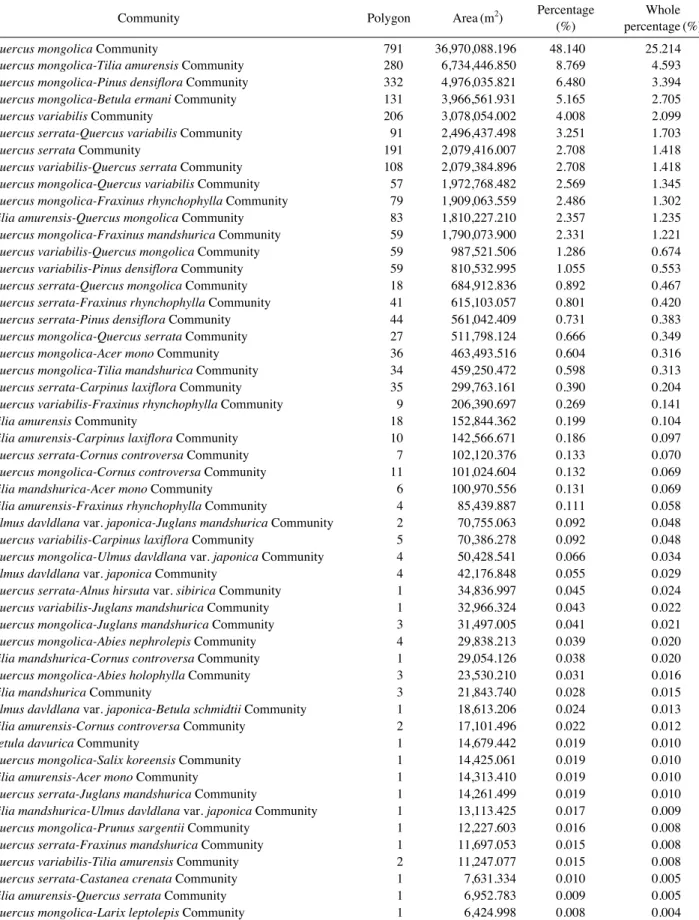
이 일대는 신갈나무, 굴참나무, 피나무, 느릅나무, 찰피 나무, 물박달나무, 사시나무, 산뽕나무와 혼생하여 군락을 형성한 것은 총 62개 군락으로 구분되어졌다(Table 2).
조사된 62개 군락 중 최상층에 1개 종이 우점하는 군
Table 1. Communities of ›1% distribution area in the 196 communities of Noinbong area in the Odaesan National Park.
Physiognomy
Community Polygon Area (m2) Percentage Whole
classification (%) percentage (%)
Quercus mongolica Community
791 36,970,088.196 48.140 25.214Quercus mongolica-Tilia amurensis Community
280 6,734,446.850 8.769 4.593Quercus mongolica-Pinus densiflora Community
332 4,976,035.821 6.480 3.394Quercus mongolica-Betula ermani Community
131 3,966,561.931 5.165 2.705Quercus variabilis Community
206 3,078,054.002 4.008 2.099Eciduous
Quercus serrata-Quercus variabilis Community
91 2,496,437.498 3.251 1.703 broad-leavedQuercus serrata Community
191 2,079,416.007 2.708 1.418 forestQuercus variabilis-Quercus serrata Community
108 2,079,384.896 2.708 1.418Quercus mongolica-Quercus variabilis Community
57 1,972,768.482 2.569 1.345Quercus mongolica-Fraxinus rhynchophylla Community
79 1,909,063.559 2.486 1.302Tilia amurensis-Quercus mongolica Community
83 1,810,227.210 2.357 1.235Quercus mongolica-Fraxinus mandshurica Community
59 1,790,073.900 2.331 1.221Total 2,408 69,862,558.352 90.972 47.647
Pinus densiflora Community
1235 31,140,435.675 78.091 21.238Coniferous forest
Pinus densiflora-Quercus mongolica Community
326 4,875,296.048 12.226 3.325Pinus densiflora-Quercus serrata Community
129 1,638,481.259 4.109 1.117Total 1,690 37,654,212.982 94.426 25.680
Fraxinus mandshurica-Cornus controversa Community
92 3,090,256.780 15.482 2.108Cornus controversa-Fraxinus mandshurica Community
73 2,592,370.786 12.988 1.768Juglans mandshurica-Cornus controversa Community
36 1,960,266.485 9.821 1.337 Mountain valleyCornus controversa-Fraxinus rhynchophylla Community
53 1,567,077.299 7.851 1.069 forestJuglans mandshurica Community
85 1,531,723.614 7.674 1.045Total 339 10,741,694.964 53.816 7.327
Larix kaempferi afforestation
332 4,532,062.186 72.222 3.091Afforestation Total 332 4,532,062.186 72.222 3.091
Total 4,769 122,790,528.500 - 83.745
Table 2. Plant communities of deciduous borad leaved forest by physiognomy classification of Noinbong area in the Odaesan National
Park.Community Polygon Area (m2) Percentage Whole (%) percentage (%)
Quercus mongolica Community
791 36,970,088.196 48.140 25.214Quercus mongolica-Tilia amurensis Community
280 6,734,446.850 8.769 4.593Quercus mongolica-Pinus densiflora Community
332 4,976,035.821 6.480 3.394Quercus mongolica-Betula ermani Community
131 3,966,561.931 5.165 2.705Quercus variabilis Community
206 3,078,054.002 4.008 2.099Quercus serrata-Quercus variabilis Community 91
2,496,437.498 3.251 1.703Quercus serrata Community
191 2,079,416.007 2.708 1.418Quercus variabilis-Quercus serrata Community
108 2,079,384.896 2.708 1.418Quercus mongolica-Quercus variabilis Community
57 1,972,768.482 2.569 1.345Quercus mongolica-Fraxinus rhynchophylla Community
79 1,909,063.559 2.486 1.302Tilia amurensis-Quercus mongolica Community
83 1,810,227.210 2.357 1.235Quercus mongolica-Fraxinus mandshurica Community
59 1,790,073.900 2.331 1.221Quercus variabilis-Quercus mongolica Community
59 987,521.506 1.286 0.674Quercus variabilis-Pinus densiflora Community
59 810,532.995 1.055 0.553Quercus serrata-Quercus mongolica Community
18 684,912.836 0.892 0.467Quercus serrata-Fraxinus rhynchophylla Community
41 615,103.057 0.801 0.420Quercus serrata-Pinus densiflora Community
44 561,042.409 0.731 0.383Quercus mongolica-Quercus serrata Community
27 511,798.124 0.666 0.349Quercus mongolica-Acer mono Community
36 463,493.516 0.604 0.316Quercus mongolica-Tilia mandshurica Community
34 459,250.472 0.598 0.313Quercus serrata-Carpinus laxiflora Community
35 299,763.161 0.390 0.204Quercus variabilis-Fraxinus rhynchophylla Community
9 206,390.697 0.269 0.141Tilia amurensis Community
18 152,844.362 0.199 0.104Tilia amurensis-Carpinus laxiflora Community
10 142,566.671 0.186 0.097Quercus serrata-Cornus controversa Community
7 102,120.376 0.133 0.070Quercus mongolica-Cornus controversa Community
11 101,024.604 0.132 0.069Tilia mandshurica-Acer mono Community
6 100,970.556 0.131 0.069Tilia amurensis-Fraxinus rhynchophylla Community
4 85,439.887 0.111 0.058Ulmus davldlana var. japonica-Juglans mandshurica Community
2 70,755.063 0.092 0.048Quercus variabilis-Carpinus laxiflora Community
5 70,386.278 0.092 0.048Quercus mongolica-Ulmus davldlana var. japonica Community
4 50,428.541 0.066 0.034Ulmus davldlana var. japonica Community
4 42,176.848 0.055 0.029Quercus serrata-Alnus hirsuta var. sibirica Community
1 34,836.997 0.045 0.024Quercus variabilis-Juglans mandshurica Community
1 32,966.324 0.043 0.022Quercus mongolica-Juglans mandshurica Community
3 31,497.005 0.041 0.021Quercus mongolica-Abies nephrolepis Community
4 29,838.213 0.039 0.020Tilia mandshurica-Cornus controversa Community
1 29,054.126 0.038 0.020Quercus mongolica-Abies holophylla Community
3 23,530.210 0.031 0.016Tilia mandshurica Community
3 21,843.740 0.028 0.015Ulmus davldlana var. japonica-Betula schmidtii Community
1 18,613.206 0.024 0.013Tilia amurensis-Cornus controversa Community
2 17,101.496 0.022 0.012Betula davurica Community
1 14,679.442 0.019 0.010Quercus mongolica-Salix koreensis Community
1 14,425.061 0.019 0.010Tilia amurensis-Acer mono Community
1 14,313.410 0.019 0.010Quercus serrata-Juglans mandshurica Community
1 14,261.499 0.019 0.010Tilia mandshurica-Ulmus davldlana var. japonica Community
1 13,113.425 0.017 0.009Quercus mongolica-Prunus sargentii Community
1 12,227.603 0.016 0.008Quercus serrata-Fraxinus mandshurica Community
1 11,697.053 0.015 0.008Quercus variabilis-Tilia amurensis Community
2 11,247.077 0.015 0.008Quercus serrata-Castanea crenata Community
1 7,631.334 0.010 0.005Tilia amurensis-Quercus serrata Community
1 6,952.783 0.009 0.005Quercus mongolica-Larix leptolepis Community
1 6,424.998 0.008 0.004락은 신갈나무가 791개 polygon, 산지삼림식생 전체면 적의 25.214%로 가장 분포역 및 분포비율이 높았으며, 굴참나무군락이 206개 polygon, 산지삼림식생 전체면적 의 2.099%, 졸참나무가 191개 polygon, 산지삼림식생 전 체면적의 1.418% 등 9개 군락이 분포하고 있다. 2종이 최상층에서 혼생하고 있어 혼생군락을 형성하고 있는 군 락 중 1% 이상의 분포 비율을 나타내고 있는 군락은 신 갈나무-피나무군락이 6,734,446.850 m2, 4.593%, 신갈나 무-소나무군락이 4,976,035.821 m2, 3.394%, 신갈나무- 사스래나무군락이 3,966,561.931 m2, 2.705%, 졸참나무- 굴참나무군락이 2,496,43.498 m2, 1.703%, 굴참나무-졸 참나무군락이 2,079,384.896 m2, 1.418%, 신갈나무-굴참 나무군락이 1,972,768.482 m2, 1.345% 등이 조사되었다.
전체 산지낙엽활엽수림 62개 중 2개 이상의 수종이 비 슷한 식피율로 혼생하고 있는 혼생군락은 53개 군락이 조사되었다.
1개 종이 우점하는 9개 군락은 신갈나무군락이 36,970,088.196 m2의 48.410%로 가장 높은 분포 비율로 조사되었고, 굴참나무군락이 3,078,054.002 m2의 4.008%, 졸참나무군락 2,079,416.007 m2, 2.708% 등으로 전체의 55.171%를 차지하고 있었으며, 2종이 혼생하는 군락은 44.829%로 조사되었다. 2종이 혼생하는 군락은 신갈나 무-피나무군락이 6,734,446.850 m2, 8.769%로 가장 높 은 비율을 보였으며, 신갈나무-소나무군락이 6.480%, 신 갈나무-사스래나무군락 5.165%, 졸참나무-굴참나무군락 이 3.251%, 신갈나무-굴참나무군락 2.569%, 신갈나무- 물푸레나무군락 2.486%, 피나무-신갈나무군락 2.357%, 신갈나무-들메나무군락 2.331%, 굴참나무-신갈나무군락 1.286% 등의 순으로 분포하였다.
전체 62개 군락 중 신갈나무와 혼생림을 구성하는 군 락은 19개 군락으로 30.035%를 차지하고 있어 신갈나
무 1종이 우점하는 신갈나무군락을 포함하면 노인봉일 대 산지낙엽활엽수림의 78.175%는 신갈나무가 우점 또 는 차우점종으로 분포하고 있음을 알 수 있다. 굴참나무 군락과 혼생하는 군락은 9개 군락, 9.482%, 피나무와 혼생하는 군락은 9개 군락, 2.914%로 나타났다.
2)
산지습성림노인봉 일대의 산지습성림은 산지사면 하부와 계곡에 주로 분포하고 있으며 전체 조사면적 146,623,181.349 m2중 19,960,050.950 m2으로 약 13.613%를 차지하고 있어 상관대분류에 의한 산지삼림식생 중 산지낙엽활엽 수림 분포면적에 이어 두번째로 넓은 면적을 차지하고 있다.
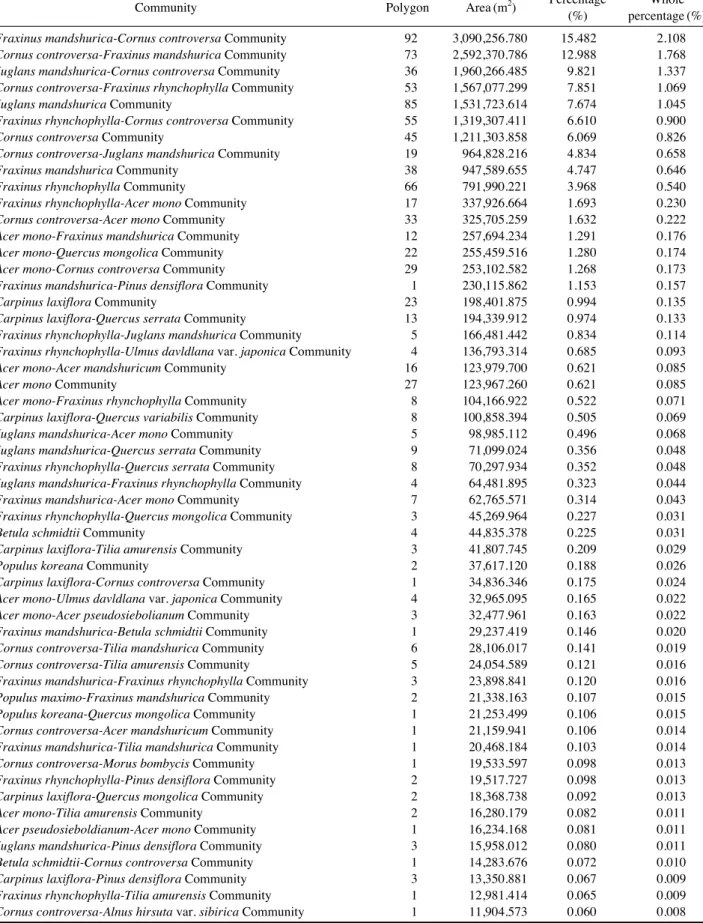
조사된 군락은 들메나무군락, 층층나무군락, 가래나무, 물푸레나무와 이들 군락의 혼생군락 등 총 85개 군락이 조사되었다(Table 3).
85개 군락 중 2개 이상의 수종이 군락을 이루는 혼생 군락은 76개 군락으로 조사되었다. 산지습성림을 구성 하는 85개 군락의 분포비율을 보면 들메나무-층층나무 군락이 전체의 15.482%를 차지하고 있으며, 들메나무와 상층부의 식피율이 비슷하여 혼생군락을 이루고 있는 군락은 8개 군락으로 전체의 17.368%를 차지하고 있 다. 따라서 들메나무 군락과 관련된 군락은 산지습성림 전체의 22.115%로서 노인봉 일대 산지습성림 군락은 대부분 들메나무가 우점하고 있거나 군락의 우점종으로 분포하고 있다. 또한 이외 산지습성림에서 층층나무-들 메나무군락 12.988%, 가래나무-층층나무군락 9.821%, 층층나무-물푸레나무군락 9.821% 등이 조사되었다.
3)
산지침엽수림노인봉 일대의 산지침염수림은 산의 능선부 및 사면 상부와 산의 저지대에 주로 분포하고 있으며, 노인봉 조
Morus bombycis Community
1 6,287.551 0.008 0.004Quercus mongolica-Pinus koraiensis Community
1 5,782.103 0.008 0.004Quercus serrata-Tilia amurensis Community
1 5,740.824 0.007 0.004Quercus mongolica-Betula schmidtii Community
1 5,495.204 0.007 0.004Tilia mandshurica-Juglans mandshurica Community
1 4,760.804 0.006 0.003Tilia amurensis-Abies holophylla Community
1 4,689.303 0.006 0.003Quercus variabilis-Tilia mandshurica Community
1 4,664.128 0.006 0.003Populus davldlana Community
3 4,319.538 0.006 0.003Tilia amurensis-Fraxinus mandshurica Community
1 3,947.659 0.005 0.003Ulmus davldlana var. japonica-Quercus serrata Community
1 3,449.321 0.004 0.002 Total 2,884 76,796,471.744 100.000 52.378Table 2. Continued.
Community Polygon Area (m2) Percentage Whole (%) percentage (%)
Table 3. Plant communities of mountain valley forest by physiognomy classification of Noinbong area in the Odaesan National Park.
Community Polygon Area (m2) Percentage Whole (%) percentage (%)
Fraxinus mandshurica-Cornus controversa Community
92 3,090,256.780 15.482 2.108Cornus controversa-Fraxinus mandshurica Community
73 2,592,370.786 12.988 1.768Juglans mandshurica-Cornus controversa Community
36 1,960,266.485 9.821 1.337Cornus controversa-Fraxinus rhynchophylla Community
53 1,567,077.299 7.851 1.069Juglans mandshurica Community
85 1,531,723.614 7.674 1.045Fraxinus rhynchophylla-Cornus controversa Community
55 1,319,307.411 6.610 0.900Cornus controversa Community 45
1,211,303.858 6.069 0.826Cornus controversa-Juglans mandshurica Community
19 964,828.216 4.834 0.658Fraxinus mandshurica Community
38 947,589.655 4.747 0.646Fraxinus rhynchophylla Community
66 791,990.221 3.968 0.540Fraxinus rhynchophylla-Acer mono Community
17 337,926.664 1.693 0.230Cornus controversa-Acer mono Community
33 325,705.259 1.632 0.222Acer mono-Fraxinus mandshurica Community
12 257,694.234 1.291 0.176Acer mono-Quercus mongolica Community
22 255,459.516 1.280 0.174Acer mono-Cornus controversa Community
29 253,102.582 1.268 0.173Fraxinus mandshurica-Pinus densiflora Community
1 230,115.862 1.153 0.157Carpinus laxiflora Community
23 198,401.875 0.994 0.135Carpinus laxiflora-Quercus serrata Community
13 194,339.912 0.974 0.133Fraxinus rhynchophylla-Juglans mandshurica Community
5 166,481.442 0.834 0.114Fraxinus rhynchophylla-Ulmus davldlana var. japonica Community
4 136,793.314 0.685 0.093Acer mono-Acer mandshuricum Community
16 123,979.700 0.621 0.085Acer mono Community
27 123,967.260 0.621 0.085Acer mono-Fraxinus rhynchophylla Community
8 104,166.922 0.522 0.071Carpinus laxiflora-Quercus variabilis Community
8 100,858.394 0.505 0.069Juglans mandshurica-Acer mono Community
5 98,985.112 0.496 0.068Juglans mandshurica-Quercus serrata Community
9 71,099.024 0.356 0.048Fraxinus rhynchophylla-Quercus serrata Community
8 70,297.934 0.352 0.048Juglans mandshurica-Fraxinus rhynchophylla Community
4 64,481.895 0.323 0.044Fraxinus mandshurica-Acer mono Community
7 62,765.571 0.314 0.043Fraxinus rhynchophylla-Quercus mongolica Community
3 45,269.964 0.227 0.031Betula schmidtii Community
4 44,835.378 0.225 0.031Carpinus laxiflora-Tilia amurensis Community
3 41,807.745 0.209 0.029Populus koreana Community
2 37,617.120 0.188 0.026Carpinus laxiflora-Cornus controversa Community
1 34,836.346 0.175 0.024Acer mono-Ulmus davldlana var. japonica Community
4 32,965.095 0.165 0.022Acer mono-Acer pseudosiebolianum Community
3 32,477.961 0.163 0.022Fraxinus mandshurica-Betula schmidtii Community
1 29,237.419 0.146 0.020Cornus controversa-Tilia mandshurica Community
6 28,106.017 0.141 0.019Cornus controversa-Tilia amurensis Community
5 24,054.589 0.121 0.016Fraxinus mandshurica-Fraxinus rhynchophylla Community
3 23,898.841 0.120 0.016Populus maximo-Fraxinus mandshurica Community
2 21,338.163 0.107 0.015Populus koreana-Quercus mongolica Community
1 21,253.499 0.106 0.015Cornus controversa-Acer mandshuricum Community
1 21,159.941 0.106 0.014Fraxinus mandshurica-Tilia mandshurica Community
1 20,468.184 0.103 0.014Cornus controversa-Morus bombycis Community
1 19,533.597 0.098 0.013Fraxinus rhynchophylla-Pinus densiflora Community
2 19,517.727 0.098 0.013Carpinus laxiflora-Quercus mongolica Community
2 18,368.738 0.092 0.013Acer mono-Tilia amurensis Community
2 16,280.179 0.082 0.011Acer pseudosieboldianum-Acer mono Community
1 16,234.168 0.081 0.011Juglans mandshurica-Pinus densiflora Community
3 15,958.012 0.080 0.011Betula schmidtii-Cornus controversa Community
1 14,283.676 0.072 0.010Carpinus laxiflora-Pinus densiflora Community
3 13,350.881 0.067 0.009Fraxinus rhynchophylla-Tilia amurensis Community
1 12,981.414 0.065 0.009Cornus controversa-Alnus hirsuta var. sibirica Community
1 11,904.573 0.060 0.008사지역 전체의 27.197%를 차지하고 있다. 조사된 군락 은 18개 군락으로 소나무 군락이 전체의 78.091%로서 대부분의 산지침염수림은 소나무 1종이 상층부에서 우 점종으로 나타나는 군락의 양상을 나타내고 있다. 2종이 상층부에서 비슷한 식피율로 혼생하고 있는 군락은 소 나무-신갈나무군락(12.226%), 소나무-졸참나무(4.109%), 소나무-굴참나무군락 (3.158%) 등이 조사되었다 (Table 4). 이러한 혼생림은 향후 천이의 진행과 함께 참나무속 수종으로 매우 빠르게 군락이 대체 될 것으로 보인다.
4)
아고산침엽수림우리나라 아고산대수림은 아고산활엽수림과 아고산침 엽수림으로 대별되며, 제4차 전국자연환경조사 지침서 상의 현존식생도 상관명 범례 (Ministry of Environment
∙National Institute of Environmental Research, 2012)에
는 아고산활엽수림은 사스래나무군락, 사스래나무-전나 무군락, 사스래나무-굴참나무군락, 사스래나무-분비나무 군락, 분비나무-사스래나무군락, 꽃개회나무군락의 6개 군락과 아고산침엽수림은 구상나무, 주목, 전나무, 잣나 무, 노간주나무, 눈향나무, 분비나무, 눈측백나무, 눈잣나 무 등과 관련된 군락 등 19개 군락이 표기되었다.
본 연구대상지인 오대산 노인봉 일대의 아고산 침엽 수림은 전나무-신갈나무군락, 분비나무군락, 전나무군락 총 3개 군락이 조사되어, 우리나라 중부지역의 아고산 침엽수림의 식생 특징을 나타내고 있다. 이들 4개 군락 은 오대산 국립공원의 전체 식생면적의 0.005%를 차지 하고 있으며, 노인봉과 황병산 정상부에 집중적으로 군 락을 이루고 있다. 4개 군락 중 전나무-신갈나무군락이 47.304%를 차지하고 있으며, 분비나무군락이 47.323%, 전나무군락이 5.781%로 조사되었다(Table 5). 그 중 분
Cornus controversa-Quercus serrata Community
1 11,819.246 0.059 0.008Betula schmidtii-Tilia amuTilia amurensisrensis Community
1 11,807.048 0.059 0.008Juglans mandshurica-Quercus variabilis Community
1 11,522.020 0.058 0.008Populus maximo-Acer mono Community
1 11,165.775 0.056 0.008Phellodendron amurense-Cornus controversa Community
1 10,376.370 0.052 0.007Fraxinus mandshurica-Betula ermani Community
1 8,526.402 0.043 0.006Juglans mandshurica-Castanea crenata Community
1 8,482.622 0.043 0.006Acer mono-Pinus densiflora Community
1 8,047.292 0.040 0.005Fraxinus rhynchophylla-Betula schmidtii Community
1 7,836.375 0.039 0.005Juglans mandshurica-Ulmus davldlana var. japonica Community
1 7,713.140 0.039 0.005Carpinus laxiflora-Fraxinus rhynchophylla Community
3 7,551.282 0.038 0.005Populus maximo-Pinus densifiora Community
1 7,432.097 0.037 0.005Betula schmidtii-Quercus serrata Community
1 6,843.087 0.034 0.005Acer mono-Juglans mandshurica Community
1 6,734.337 0.034 0.005Cornus controversa-Ulmus davldlana var. japonica Community
1 6,652.096 0.033 0.005Ulmus laclnlata-Acer mono Community
1 6,368.109 0.032 0.004Alnus hirsuta var. sibirica-Acer mono Community
1 5,271.599 0.026 0.004Acer pseudosibolianum Community
1 5,237.125 0.026 0.004Fraxinus rhynchophylla-Carpinus laxiflora Community
1 4,459.806 0.022 0.003Acer mono-Phellodendron amurense Community
1 4,339.748 0.022 0.003Carpinus laxiflora-Fraxinus mandshurica Community
1 3,857.466 0.019 0.003Ulmus laclnlata-Cornus controversa Community
1 3,797.813 0.019 0.003Ulmus laclnlata-Juglans mandshurica Community
1 3,435.380 0.017 0.002Populus koreana-Juglans mandshurica Community
1 3,370.439 0.017 0.002Juglans mandshurica-Populus maxim Community
1 3,335.258 0.017 0.002Phellodendron amurense-Pinus densifiora Community
1 3,274.726 0.016 0.002Alnus hirsuta var. sibirica-Cornus controversa Community
1 2,866.167 0.014 0.002Ulmus laclnlata-Fraxinus mandshurica Community
1 2,768.972 0.014 0.002Fraxinus mandshurica-Betula costata Community
1 1,416.906 0.007 0.001Carpinus laxiflora-Ulmus davldlana var. japonica Community
1 1,353.095 0.007 0.001Populus koreana-Acer mono Community
1 1,313.128 0.007 0.001Total 903 19,960,050.950 100.000 13.614
Table 3. Continued.
Community Polygon Area (m2) Percentage Whole (%) percentage (%)
비나무군락은 향후 시간이 지남에 따라 기후변화에 따 른 영향으로 생육상태가 쇠퇴하고 면적이 감소할 것으 로 예상된다.
5)
아고산활엽수림아고산활엽수림은 사스래나무군락, 사스래나무-신갈나 무군락, 사스래나무-피나무군락, 사스래나무-층층나무군
락 총 4개 군락이 조사되어, 우리나라 중부지역의 아고 산활엽수림의 식생 특징을 나타내고 있다. 이들 4개 군 락은 오대산 국립공원의 전체 식생면적의 0.443%를 차 지하고 있으며, 노인봉과 소황병산 정상부에 군락을 이 루고 있다. 4개 군락 중 사스래나무군락이 76.016%로 우점하고 있으며, 사스래나무-신갈나무군락이 10.370%, 사스래나무-피나무군락이 9.687%, 사스래나무-층층나무
Table 4. Plant communities of coniferous forest by physiognomy classification of Noinbong area in the Odaesan National Park.
Community Polygon Area (m2) Percentage Whole (%) percentage (%)
Pinus densiflora Community
1235 31,140,435.675 78.091 21.238Pinus densiflora-Quercus mongolica Community
326 4,875,296.048 12.226 3.325Pinus densiflora-Quercus serrata Community
129 1,638,481.259 4.109 1.117Pinus densiflora-Quercus variabilis Community
134 1,259,455.498 3.158 0.859Pinus densiflora-Fraxinus rhynchophylla Community
26 366,963.380 0.920 0.250Pinus densiflora-Juglans mandshurica Community
6 169,406.597 0.425 0.116Pinus densiflora-Betula ermani Community
5 101,890.190 0.256 0.069Pinus densiflora-Cornus controversa Community
2 67,114.577 0.168 0.046Pinus densiflora-Carpinus laxiflora Community
7 60,124.222 0.151 0.041Pinus densiflora-Fraxinus mandshurica Community
2 44,896.309 0.113 0.031Pinus densiflora-Plnus koralensls Community
1 44,628.305 0.112 0.030Pinus densiflora-Tilia mandshurica Community
2 33,622.519 0.084 0.023Pinus densiflora-Castanea crenata Community
4 24,947.520 0.063 0.017Pinus densiflora-Alnus hirsuta Community
2 19,430.835 0.049 0.013Pinus densiflora-Larix leptolepis Community
3 11,892.685 0.030 0.008Pinus densiflora-Tilia mandshurica Community
2 10,021.051 0.025 0.007Pinus densiflora-Alnus hirsuta var. sibirica Community
1 5,874.838 0.015 0.004Pinus densiflora-Ginkgo biloba Community
2 2,750.559 0.007 0.002Total 1,889 39,877,232.068 100.000 27.197
Table 5. Plant communities of subalpine coniferous forest by physiognomy classification of Noinbong area in the Odaesan National
Park.Community Polygon Area (m2) Percentage Whole (%) percentage (%)
Abies holophylla-Quercus mongolica Community
1 3,476.137 47.304 0.002Abies nephrolepis Community
2 3,477.591 47.323 0.001Abies holophylla Community
1 424.825 5.781 0.000Total 4 7,348.553 100.000 0.005
Table 6. Plant communities of subalpine deciduous forest by physiognomy classification of Noinbong area in the Odaesan National
Park.Community Polygon Area (m2) Percentage Whole (%) percentage (%)
Betula ermani Community
26 494,065.793 76.016 0.337Betula ermani-Quercus mongolica Community
3 67,399.146 10.370 0.046Betula ermani-Tilia amurensis Community
6 62,958.305 9.687 0.043Betula ermani-Cornus controversa Community
3 25,530.114 3.928 0.017Total 38 649,953.358 100.000 0.443
군락이 3.928%로 조사되었다(Table 6).
6)
산지관목림산지관목림은 주요군락은 철쭉꽃군락, 싸리군락으로 구분되어졌다. 철쭉꽃군락은 64.430%를 차지하고 있으 며, 싸리군락은 35.570%로 조사되었다(Table 7). 이들 2 개 군락은 오대산 국립공원의 전체 식생면적의 0.010%
를 차지하고, 대부분이 노인봉 정상과 능선부에 분포하 고 있다. 이는 정상부와 능선부의 낮은 기온, 강한 바람, 강한 태양 등 환경요인에 의한 것으로 예상된다.
7)
식재림 및 기타 식생연구대상지역내 식재림은 주로 집단시설지구 주변, 마 을, 농경지, 도로 부근 등 국립공원 경계선에 집중되어 있다. 조시된 식재림 중 일본잎갈나무가 식재림 전체의 72.222%로 가장 많이 식재되었으며, 식재림이 17.721%,
잣나무가 2.613%, 자작나무가 1.802%로 3개 수종이 전 체의 92.556%로 차지하고 있어 식재된 대부분의 수종 은 이들 3종 및 3종과 혼생림을 이루는 것으로 조사되 었다 (Table 8). 21개 식재군락은 오대산 국립공원 일대 에서 자생군락을 형성하고 있는 신갈나무, 졸참나무, 소 나무 등과 혼생하고 있어 향후 천이가 진행되면 자연군 락으로 빠르게 군락 대체가 예상된다.
평지산림식생은 하반림식생으로 버드나무군락 (21,207.637 m2)로 오대산 국립공원의 전체 식생면적의 0.014%로 분포하고 있어 소규모 면적에 군락을 이루고 있으나 산지습지식생의 우점종임을 고려할 때 매우 중 요한 식생학적 가치가 있는 것으로 보인다(Table 9).
기타 식생으로는 벌채지, 암벽식생, 2차 초지, 농경지, 조경식재지 등으로 약 3,021,019.927 m2로서 오대산 국 립공원 전체 식생면적의 2.059%를 차지하고 있다
Table 7. Plant communities of shrub forest by physiognomy classification of Noinbong area in the Odaesan National Park.
Community Polygon Area (m2) Percentage Whole (%) percentage (%)
Rhododendron schllppenbachii Community
1 9,452.988 64.430 0.006Lespedeza bicolor Community
1 5,218.653 35.570 0.004Total 2 14,671.641 100.000 0.010
Table 8. Plant communities of afforestation by physiognomy classification of Noinbong area in the Odaesan National Park.
Community Polygon Area (m2) Percentage Whole (%) percentage (%)
Larix leptolepis afforestation
332 4,532,062.186 72.222 3.091afforestation 117 1,112,050.592 17.721 0.758
Plnus koralensls afforestation
34 163,978.753 2.613 0.112Betula platyphylla var. japonica afforestation
12 113,084.833 1.802 0.077Alnus hirsuta afforestation
13 83,426.736 1.329 0.057Abies holophylla afforestation
13 66,088.347 1.053 0.045Castanea crenata afforestation
18 63,667.158 1.015 0.043Pinus rigida afforestation
6 47,092.551 0.750 0.032Robinia pseudoaccacia afforestation
7 24,572.895 0.392 0.017Jugians sinensis afforestation
3 12,891.978 0.205 0.009Castanea crenata-Pinus densiflora afforestation
1 8,244.887 0.131 0.006Castanea crenata-Robinia pseudoaccacia afforestation
1 8,209.218 0.131 0.006Larix leptolepis-Quercus serrata afforestation
1 8,113.630 0.129 0.006Larix leptolepis-Zelkova serrata afforestation 2
5,655.209 0.090 0.004Alnus hirsuta-Quercus serrata afforestation
2 5,603.695 0.089 0.004Plnus koralensls-Pinus densiflora afforestation
1 5,400.537 0.086 0.004Plnus koralensls-Larix leptolepis afforestation
1 3,680.266 0.059 0.003Alnus hirsuta-Pueraria thunbergiana afforestation
2 3,531.083 0.056 0.002Pinus rigida-Quercus mongolica afforestation
1 3,390.996 0.054 0.002Ailanthus altlsslma afforestation
1 2,532.207 0.040 0.002Phyllostachys bambusoides afforestation
3 1,947.247 0.031 0.001Total 571 6,275,225.004 100.000 4.280
(Table 10).
결론적으로 오대산 국립공원 노인봉 일대의 산림식생 은 신갈나무, 소나무, 피나무, 들메나무, 층층나무, 졸참나 무, 굴참나무 등 소수의 수종들이 최상층부의 우점종으 로 구성되어 있으며, 이들 종들과 관련된 수많은 군락들 은 식생천이 및 기후적 요인들에 의하여 군락 대체가 매우 빠르게 일어날 것으로 보인다. 따라서 주요종들의 천이에 의한 군락 대체가 이뤄질 경우 노인봉 일대는 산지낙엽활엽수림 중 고도가 높은 지역에서는 신갈나무 군락, 산의 저지대 및 사면 하부에서는 서나무, 개서나 무, 산지습성림은 들메나무, 층층나무가 우점하는 식생 유형을 나타낼 것이다.
적 요
오대산 국립공원 노인봉(해발고도 1,338 m) 일대의 산 지삼림식생은 산지낙엽활엽수림, 산지습성림, 산지침엽수 림, 아고산침엽수림, 아고산활엽수림, 산지관목림, 식재림 으로 세분되었으며, 평지삼림식생은 하반림, 기타식생으 로 암벽식생, 농경지 등이 조사되었다.
상관대분류에 의하여 구분된 각각의 산지삼림식생을 구성하고 있는 분포군락수는 산지낙엽활엽수림은 62개 군락, 산지습성림 85개 군락, 산지침엽수림 18개 군락, 아고산침엽수림 4개 군락, 아고산활엽수림 4개 군락, 산 지관목림 2개 군락, 식재림 21개 군락, 하반림 1개 군락, 기타식생 7개 군락이 조사되었다.
조사된 주요 군락의 분포 비율을 보면 산지낙엽활엽 수림은 신갈나무군락이 36,970,088.196 m2의 48.140%로 가장 높은 분포 비율로 조사되었고, 굴참나무군락이 3,078,054.002 m2의 4.008%, 졸참나무군락 2,079,416.007 m2, 2.708%를 차지하고 있으며, 노인봉일대 산지낙엽활 엽수림의 78.175%는 신갈나무가 우점 또는 차우점종으 로 분포하고 있다. 산지습성림은 들메나무-층층나무군락 이 전체의 15.482%를 차지하고 있으며, 들메나무와 상 층부의 식피율이 비슷하여 혼생군락을 이루고 있는 군 락은 8개 군락으로 전체의 17.368%를 차지하고 있다.
산지침엽수림은 소나무 군락이 전체의 78.091%로서 대 부분의 산지침염수림은 소나무 1종이 상층부에서 우점 종으로 나타나는 군락의 양상을 나타내고 있다. 기타식 생에서 아고산침엽수림은 전나무-신갈나무군락 등 총 3 개 군락이 조사되었으며 오대산 국립공원 전체 식생면 적의 0.005%를 차지하고 있다. 아고산활엽수립은 사스 래나무군락 등 총 4개 군락이 조사되었으며 오대산 국 립공원 전체 식생면적의 0.443%를 차지하고 있다. 식재 림은 일본잎갈나무가 식재림 전체의 72.222%로 가장 많 이 식재되었으며, 식재림이 17.721%, 잣나무가 2.613%
로 3개 수종이 전체의 92.556%로 대부분이 이들 3종에 의하여 식재되어졌다.
결론적으로 오대산 국립공원 노인봉 일대의 산림식생 은 신갈나무, 소나무, 피나무, 들메나무, 층층나무, 졸참나 무, 굴참나무 등 소수의 수종들이 최상층부의 우점종으 로 구성되어 있으며, 이들 종들과 관련된 수많은 군락들 은 식생천이 및 기후적 요인들에 의하여 군락 대체가
Table 9. Plant communities of riparian forest by physiognomy classification of Noinbong area in the Odaesan National Park.
Community Polygon Area (m2) Percentage Whole
(%) percentage (%)
SSalix koreensis Community
4 21,207.637 0.697 0.014Total 4 21,207.637 0.697 0.014
Table 10. Plant communities of other areas by physiognomy classification of Noinbong area in the Odaesan National Park.
Community Polygon Area (m2) Percentage Whole
(%) percentage (%)
Secondary meadow 37 2,257,072.239 74.712 1.539
Agricultural 66 558,382.910 18.483 0.381
bare ground 42 139,699.721 4.624 0.095
residential area 4 48,144.999 1.594 0.033
water 2 8,052.750 0.267 0.005
Rock 3 8,019.747 0.265 0.005
Selaginella rossii Community
1 1,647.561 0.055 0.001Total 155 3,021,019.927 100 2.059
매우 빠르게 일어날 것으로 보인다. 따라서 이 지역 일 대 잠재 자연 식생의 주요종은 산지낙엽활엽수림은 신 갈나무, 산지습성림은 들메나무, 산지낙엽활엽수림과 산 지습성림의 경계부 중 습도가 높은 계곡은 층층나무, 들 메나무, 사면부는 피나무, 신갈나무 등에 의하여 우점 될 것으로 보인다. 그러나 아고산의 침염수림은 기후온 난화 등에 의하여 점차적으로 낙엽활엽수의 분포비율이 증가할 것으로 보인다.
사 사
본 연구 논문은 국립공원관리공단 국립공원 정밀식생 도 제작사업 (오대산 국립공원, 2013)의 일부 결과를 반 영하여 작성되었습니다.
REFERENCES
Braun-Blanquet, J. 1964. Pflanzensoziologie. Grundzuge der Vegetationstunde. Wien. 865p.
Choi, S.H., J.O. Kwon and S.H. Min. 1996. Plant community structure analysis in Noinbong area of Odaesan National Park. Korean Journal of Environment and Ecology 9(2):
156-165.
Chun, Y.M., J.K. Ahn, M.P. Hong, J.T. Shin, H.J. Won and S.H.
Lee. 2011. The Korean association of professional geogra- phers. Structure and Dynamics of Abies nephrolepis Com-
munity in Odaesan National park 45(4): 559-570.
Heo, C.H., S.Y. Kim and S.T. Yun. 2005. Value promotion for tourism geology through survey on geological and geomor- phological landscape resources in the Odaesan National Park; Public understanding of earth science. Korean Earth
Science Society 26(3): 218-231.
Kil, B.S., C.H. Kim., Y.S. Kim., H.K. Yu and B.S. Kim. 1998.
The Flora of the north-western slope on Odaesan National Park; Comprehensive report. Korea Nature Conservation
Research Report 38: 47-91.
Kim, Y.S., S.H. Chon and K.H. Kang, 1996. Floristic study of Odaesan National Park. Korean Journal of Environment
and Ecology 9(2): 77-98.
Korea National Park Service. 2013. A detailed actual vegetation map project of Odaesan National Park.
Lee, C.B. 1971. The vegetation of Odaesan and Sogeumgang.
Korea Nature conservation research. Preliminary Research
Report on Sogeunmgang and Odaesan 99-115.
Lee, K.J., W. Cho and B.H. Han. 1996. Plant community struc- ture of Pinus densiflora Forests in Odaesan National Park.
Korean Journal of Environment and Ecology 9(2): 115-
125.Lee, S. 2000a. A study on characteristic of forest vegetation and site in Mt. Odae ( I ) -Site of plant community in Ton- dgaesan-. Journal of Korean Forest Society 89: 173-184.
Lee, S. 2000b. A study on characteristic of forest vegetation and site in Mt. Odae (II) -Site of plant community in Ton- dgaesan-. Journal of Korean Forest Society 89: 552-563.
Lee, U.C., Y.S. Kim, Y.B. Lee and Y.G. Park. 1998. The Flora of the north-western slope on Odaesan National Park. Korea
Nature Conservation Research Report 38: 13-45.
Ministry of Environment. 2009. Survey methods and classifica- tion criteria of National Environment.
Ministry of Environment. 2010. The third national survey natu- ral environment-Kangnung, Jeongseon.
Ministry of Environment∙National Institute of Environmental Research. 2006. 3rd National natural environment research guidelines. Ministry of Environment∙National Institute of Environmental Research.
Ministry of Environment∙National Institute of Environmental Research. 2012. Workshop Source Book of Detail Actual Vegetation Mapping in 2012.
Prak, B.K. and J.Y. Oh. 1971. The Vegetation of Odaesan. Korea Nature Conservation Research. Preliminary Research Re-
port on Sogeunmgang and Odaesan. 131-138p.
Yun, C.W., S.H. Lee, H.J. Kim, H.S. Sin, H.G. Park, M.S. Yu and C.H. Lee. 2010. Classification of Forest. Vegetation and Physiognomy Type in Mt. Odea. Korean Forest Soci-