• 검색 결과가 없습니다.

Mycobacterium abscessus Lung Disease in a Patient with Kartagener Syndrome

N/A
N/A
Protected

Academic year: 2021

Share "Mycobacterium abscessus Lung Disease in a Patient with Kartagener Syndrome"

Copied!
5
0
0

로드 중.... (전체 텍스트 보기)

전체 글

(1)

Mycobacterium abscessus Lung Disease in a Patient with Kartagener Syndrome

Jung Hoon Kim, M.D.

1,

*, Won Jun Song, M.D.

1,

*, Ji Eun Jun, M.D.

1

, Duck Hyun Ryu, M.D.

1

, Ji Eun Lee, M.D.

1

, Ho Jung Jeong, M.D.

1

, Suk Hyeon Jeong, M.D.

1

, Hyung Koo Kang, M.D.

1

, Jung Soo Kim, M.D.

1

, Hyun Lee, M.D.

1

, Hae Ri Chon, M.D.

1

, Kyeongman Jeon, M.D.

1

, Dohun Kim, M.D.

2,†

, Jhingook Kim, M.D.

2

and Won-Jung Koh, M.D.

1

1

Division of Pulmonary and Critical Care Medicine, Department of Medicine,

2

Department of Thoracic Surgery, Samsung Medical Center, Sungkyunkwan University School of Medicine, Seoul, Korea

Primary ciliary dyskinesia (PCD) is characterized by the congenital impairment of mucociliary clearance. When accompanied by situs inversus, chronic sinusitis and bronchiectasis, PCD is known as Kartagener syndrome. The main consequence of impaired ciliary function is a reduced mucus clearance from the lungs, and susceptibility to chronic respiratory infections due to opportunistic pathogens, including nontuberculous mycobacteria (NTM). There has been no report of NTM lung disease combined with Kartagener syndrome in Korea. Here, we report an adult patient with Kartagener syndrome complicated with Mycobacterium abscessus lung disease. A 37-year-old female presented to our hospital with chronic cough and sputum. She was ultimately diagnosed with M. abscessus lung disease and Kartagener syndrome. M. abscessus was repeatedly isolated from sputum specimens collected from the patient, despite prolonged antibiotic treatment. The patient’s condition improved and negative sputum culture conversion was achieved after sequential bilateral pulmonary resection.

Keywords: Kartagener Syndrome; Primary Ciliary Dyskinesia; Bronchiectasis; Nontuberculous Mycobacteria;

Mycobacterium Infections, Nontuberculous

Introduction

Primary ciliary dyskinesia (PCD) is associated with abnor- mal ciliary structure and function, which results in the reten- tion of mucus and bacteria in the respiratory tract, leading to chronic oto-sino-pulmonary disease, situs abnormalities and abnormal sperm motility

1

. The initial recognition of this syndrome in 1933 was based on the triad of chronic sinusitis, bronchiectasis, and situs inversus, known as Kartagener syn- drome

2

. About 55% of PCD patients present with situs inver- sus

2

.

PCD causes abnormal and permanent dilatation of the bronchi, known as bronchiectasis, which is caused by inflam- mation and destruction of the structural components of the bronchial walls. Most experts accept that a “vicious cycle” of in- fection and inflammation is created by this basic defect in host airway defenses. This generates airway damage and further impairs airway clearance; eventually chronic microbial colo- nization/infection develops, leading to further infection and Copyright © 2014

The Korean Academy of Tuberculosis and Respiratory Diseases.

All rights reserved.

Address for correspondence: Won-Jung Koh, M.D.

Division of Pulmonary and Critical Care Medicine, Department of Medicine, Samsung Medical Center, Sungkyunkwan University School of Medicine, 81 Irwon-ro, Gangnam-gu, Seoul 135-710, Korea

Phone: 82-2-3410-3429, Fax: 82-2-3410-3849 E-mail: [email protected]

*Jung Hoon Kim and Won Jun Song contributed equally to this work.

Present address: Department of Thoracic Surgery, Chungbuk National University Hospital, Cheongju, Korea

Received: May 3, 2014 Revised: May 27, 2014 Accepted: Jun. 17, 2014

cc

It is identical to the Creative Commons Attribution Non-Commercial

License (http://creativecommons.org/licenses/by-nc/3.0/).

(2)

inflammation with subsequent destruction of the conducting airways

1,2

. Airway infections with Haemophilus influenzae, Staphylococcus aureus, and Streptococcus pneumoniae are common, infections with Pseudomonas aeruginosa have also been reported, usually in adults

1

. Approximately 15% of adult patients with PCD have positive sputum cultures of non- tuberculous mycobacteria (NTM); however, the prevalence in children with PCD is lower

3

.

To the best of our knowledge, there has been no report of NTM lung disease combined with Kartagener syndrome in Korea, although the number of patients with NTM lung dis- ease has been increasing in recent years

4,5

. Here, we report an adult case of Kartagener syndrome complicated with My- cobacterium abscessus lung disease who was successfully treated with bilateral pulmonary resection combined with antibiotic therapy.

Case Report

A 37-year-old female was referred to our hospital for further management of NTM lung disease. During the 4 months be- fore the patient arrived at our hospital, she had a productive cough and hemoptysis. She was initially diagnosed as having

“smear-positive pulmonary tuberculosis,” and received anti- tuberculosis drugs. During treatment, her symptoms did not improve and NTM were repeatedly isolated from her sputum specimens. She was then referred to our hospital.

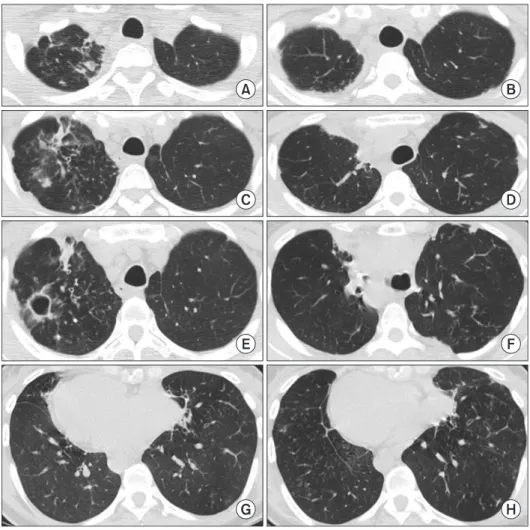
The patient was a nonsmoker. Twenty years earlier, the pa- tient had undergone surgery for chronic rhinosinusitis. Chest radiography showed dextrocardia and situs inversus and pa- ranasal sinus radiography showed total opacification involv- ing the bilateral ethmoid sinus and bilateral maxillary sinus (Figure 1A, B). Chest high-resolution computed tomography (HRCT) scans showed multiple cavitary lesions in both upper

lobes, bronchiectasis, and multiple nodules in the left middle lobe and the lingular segment of the right upper lobe (Figure 2A, C, E, G). The patient’s sputum was positive for acid-fast bacilli (AFB) stain, and M. abscessus (sensu stricto) was re- peatedly isolated from sputum specimens collected from the patient. The identification of M. abscessus (sensu stricto) was performed using a polymerase chain reaction-restriction frag- ment length polymorphism analysis of rpoB and sequence analysis of rpoB and hsp65

6

. Drug susceptibility test showed the isolate was susceptible amikacin (minimum inhibitory concentration [MIC], 16 μg/mL) and imipenem (MIC, 4 μg/

mL), intermediate to cefoxitin (MIC, 32 μg/mL), and resistant to ciprofloxacin (MIC, >16 μg/mL), moxifloxacin (MIC, 8 μg/

mL) and doxycycline (MIC, >32 μg/mL). The isolate had inducible resistance to clarithromycin, as it was susceptible (MIC, ≤0.5 μg/mL) to clarithromycin at day 3 but resistant to clarithromycin (MIC, >64 μg/mL) at day 14.

The patient received oral clarithromycin and fluoroquino- lone antibiotics (initially ciprofloxacin, later moxifloxacin), along with an initial 4-week course of intravenous amikacin and cefoxitin

7

. Although the cavitary lesion in the right upper lobe improved after 20 months of antibiotic therapy, the size of the multiple cavities in the left upper lobe increased (Figure 2B, D, F, H). The patient’s symptoms worsened and follow-up AFB staining of sputum and sputum cultures were persistently positive.

Considering the patient’s age, persistent symptoms, and aggravation of cavitary lesions in the left lung after antibiotic therapy, we decided to perform surgical resection. Preop- erative pulmonary function test revealed that forced vital capacity was 2.82 L (95% predicted) and forced expiratory volume in one second was 1.46 L (63% predicted). The patient underwent a left upper bilobectomy (left upper lobectomy plus left middle lobectomy). She was discharged 8 days after surgery without postoperative complications. After surgery,

Figure 1. (A) Chest radiography showed

dextrocardia and situs inversus. Note the

cavitary lesions in the right upper lobe

and nodulostreaky opacity, suggesting

bronchiectasis in the left middle lung

zones. (B) Paranasal sinus radiography

showed total opacification involving the

bilateral ethmoid sinus and bilateral max-

illary sinus.

(3)

her symptoms improved. However, cultures of the patient’s sputum were persistently positive for M. abscessus, although AFB staining of sputum showed negative conversion.

At 9 months after surgery, an AFB-positive sputum smear was obtained, and the cavitary lesion in the right upper lobe was aggravated (Figure 3A, C, E, G). Thus, a right upper lo- bectomy was performed and the patient was discharged 8 days after surgery without postoperative complications. Soon after the second operation, the patient’s symptoms improved and negative sputum smears and culture conversion were achieved. The patient was maintained on oral antibiotic treat- ment with clarithromycin and moxifloxacin. Antibiotic thera- py was successfully discontinued 24 months after the second operation. At 2 years since the second surgery, the patient is doing well: sputum AFB smears and cultures are consistently negative and follow-up chest HRCT scans indicate no new le- sions (Figure 3B, D, F, H).

Discussion

PCD is a genetically heterogeneous recessive disorder of

motile cilia that leads to oto-sino-pulmonary disease

1,2

. Karta- gener syndrome, which consists of situs inversus totalis, bron- chiectasis and sinusitis, is a well-known but less common pre- sentation of PCD. In patients with PCD, recurrent and chronic bacterial infections in the lower airways inevitably occur, and there is age-dependent development of bronchiectasis, which is a nearly universal complication of PCD in adults

3

.

Initially, sputum cultures are positive for H. influenzae, S.

pneumoniae, and S. aureus. Once bronchiectasis is evident on chest HRCT, P. aeruginosa and other opportunistic patho- gens may be present. NTM may also be isolated; a previous study from the United States reported that NTM infections are not uncommon, especially in older patients, and that NTM were present in 8 of 59 patients (14%) with PCD in whom spu- tum for microbiologic testing was obtained (Mycobacterium avium complex [n=3], M. abscessus [n=2], M. gordonae [n=2], and mixed M. avium complex/M. gordonae [n=1])

3

.

The prevalence of lung diseases caused by NTM is in- creasing worldwide, affecting both immunocompetent and immunocompromised individuals

8

. In Korea, M. abscessus complex is the second most common pathogen responsible for lung diseases caused by NTM, after M. avium complex

6,7,9

. Figure 2. (A, C, E, G) Chest high-reso- lution computed tomography showed multiple cavities in both upper lobes.

Note the severe bronchiectasis in the left

middle lobe and the lingular segment of

the right upper lobe. (B, D, F, H) Although

the cavitary lesion in the right upper lobe

improved after 20 months of antibiotic

treatment, the size of the multiple cavities

in the left upper lobe increased.

(4)

M. abscessus complex (M. abscessus sensu lato) are divided into three closely related subspecies: M. abscessus (sensu stricto), Mycobacterium massiliense, and Mycobacterium bolletii

6,10,11

. Within the M. abscessus complex, M. abscessus (44−53%) and M. massiliense (45−55%) are equally distrib- uted, while M. bolletii is a relatively rare pathogen (1−2%) in Korea

6,10,11

.

M. abscessus (sensu stricto) is resistant in vitro to many antibiotics and thus is very difficult to treat

6,7

. Isolates are usually susceptible in vitro to some parenteral agents (e.g., amikacin, cefoxitin, and imipenem) and to macrolides (e.g., clarithromycin and azithromycin)

8

. Combination therapy with intravenous amikacin and cefoxitin or imipenem and an oral macrolide has been recommended by the American Thoracic Society/Infectious Diseases Society of America and many other experts

8

. However, treatment response rates are not satisfactory and optimal therapeutic regimens and treat- ment durations are not well established

6,7

.

Curative therapy for M. abscessus lung disease is more likely to be obtained with limited disease and a combination of sur- gical resection of the involved lung and chemotherapy

8

. Pa-

tients with focal lung disease and symptoms that significantly impair their quality of life who can withstand lung resection should be treated surgically after an initial period on antimi- crobials to lessen the microbial burden

8,12

. Some patients who have bilateral disease could undergo staged sequential sur-

gery

13-15

. The fact that sputum conversion was obtained only

after the second pulmonary resection underscores the neces- sity of bilateral resection in this patient.

In summary, this is the first reported case of NTM lung disease in a patient with Kartagener syndrome in Korea. AFB smear cannot differentiate between Mycobacterium tuber- culosis and NTM. The recovery rate of NTM from respiratory specimens and the number of patients with NTM lung disease has been rapidly increasing in Korea. An early differential di- agnosis of NTM lung disease from pulmonary tuberculosis is important, as the therapeutic regimen differs from that of pul- monary tuberculosis. This case also suggests that if medical treatment fails for NTM lung disease, resection of the diseased lobes should be considered, even in patients with bilateral le- sions.

Figure 3. (A, C, E, G) At 9 months after the

left-sided surgery, chest high-resolution

computed tomography showed an aggra-

vation of the cavitary lesion in the right

upper lobe. (B, D, F, H) At 24 months of

the right-sided surgery, follow-up chest

high-resolution computed tomography

scans indicate no new lesions.

(5)

Conflicts of Interest

No potential conflict of interest relevant to this article was reported.

Acknowledgements

This study was supported by a grant of the Korean Health technology R&D Project, Ministry for Health & Welfare, Re- public of Korea (A120647).

References

1. Barbato A, Frischer T, Kuehni CE, Snijders D, Azevedo I, Bak- tai G, et al. Primary ciliary dyskinesia: a consensus statement on diagnostic and treatment approaches in children. Eur Respir J 2009;34:1264-76.

2. Knowles MR, Daniels LA, Davis SD, Zariwala MA, Leigh MW.

Primary ciliary dyskinesia. Recent advances in diagnostics, genetics, and characterization of clinical disease. Am J Respir Crit Care Med 2013;188:913-22.

3. Noone PG, Leigh MW, Sannuti A, Minnix SL, Carson JL, Ha- zucha M, et al. Primary ciliary dyskinesia: diagnostic and phe- notypic features. Am J Respir Crit Care Med 2004;169:459-67.

4. Yoo JW, Jo KW, Kim MN, Lee SD, Kim WS, Kim DS, et al. In- creasing trend of isolation of non-tuberculous mycobacteria in a tertiary university hospital in South Korea. Tuberc Respir Dis 2012;72:409-15.

5. Koh WJ, Chang B, Jeong BH, Jeon K, Kim SY, Lee NY, et al.

Increasing recovery of nontuberculous mycobacteria from respiratory specimens over a 10-year period in a tertiary re- ferral hospital in South Korea. Tuberc Respir Dis 2013;75:199- 204.

6. Koh WJ, Jeon K, Lee NY, Kim BJ, Kook YH, Lee SH, et al. Clini-

cal significance of differentiation of Mycobacterium massil- iense from Mycobacterium abscessus. Am J Respir Crit Care Med 2011;183:405-10.

7. Jeon K, Kwon OJ, Lee NY, Kim BJ, Kook YH, Lee SH, et al. An- tibiotic treatment of Mycobacterium abscessus lung disease:

a retrospective analysis of 65 patients. Am J Respir Crit Care Med 2009;180:896-902.

8. Griffith DE, Aksamit T, Brown-Elliott BA, Catanzaro A, Daley C, Gordin F, et al. An official ATS/IDSA statement: diagnosis, treatment, and prevention of nontuberculous mycobacterial diseases. Am J Respir Crit Care Med 2007;175:367-416.

9. Koh WJ, Jeong BH, Jeon K, Lee NY, Lee KS, Woo SY, et al. Clini- cal significance of the differentiation between Mycobacte- rium avium and Mycobacterium intracellulare in M avium complex lung disease. Chest 2012;142:1482-8.

10. Koh WJ, Stout JE, Yew WW. Advances in the management of pulmonary disease due to Mycobacterium abscessus com- plex. Int J Tuberc Lung Dis 2014;18:1141-8.

11. Lee SH, Yoo HK, Kim SH, Koh WJ, Kim CK, Park YK, et al. The drug resistance profile of Mycobacterium abscessus group strains from Korea. Ann Lab Med 2014;34:31-7.

12. Koh WJ, Kim YH, Kwon OJ, Choi YS, Kim K, Shim YM, et al.

Surgical treatment of pulmonary diseases due to nontuber- culous mycobacteria. J Korean Med Sci 2008;23:397-401.

13. Mitchell JD, Bishop A, Cafaro A, Weyant MJ, Pomerantz M.

Anatomic lung resection for nontuberculous mycobacterial disease. Ann Thorac Surg 2008;85:1887-92.

14. Yu JA, Pomerantz M, Bishop A, Weyant MJ, Mitchell JD. Lady Windermere revisited: treatment with thoracoscopic lobec- tomy/segmentectomy for right middle lobe and lingular bronchiectasis associated with non-tuberculous mycobacte- rial disease. Eur J Cardiothorac Surg 2011;40:671-5.

15. Lee SH, Min JW, Um SW, Han SS, Han SK, Shim YS, et al. Se- quential bilateral lung resection in a patient with Mycobacte- rium abscessus lung disease refractory to medical treatment.

Yonsei Med J 2010;51:141-4.

수치

Figure 1. (A) Chest radiography showed  dextrocardia and situs inversus. Note the  cavitary lesions in the right upper lobe  and nodulostreaky opacity, suggesting  bronchiectasis in the left middle lung  zones
Figure 3. (A, C, E, G) At 9 months after the  left-sided surgery, chest high-resolution  computed tomography showed an  aggra-vation of the cavitary lesion in the right  upper lobe

참조

관련 문서

Conclusions: Recurrence of MAC after successful treatment was associated with longer in- terval between diagnosis and treatment initiation, bronchiectatic form, increased number

CT scan at the level of aortic arch shows irregular lobulated thickwalled eccentric located cavitary mass in peripheral portion of anterior segment of right upper lobe with

Multiple metastases in left frontal lobe in adenocarcinoma NECT scan shows mixed density.. Multiple metastases in left frontal and right frontoparietailobes in

Computed tomographic scan of the chest showing herniation (arr- owhead) of the right middle lobe (A) and the left upper lobe (B).. Intercostal Lung Hernia after Pectus

CT scan- ning revealed mild bronchial dilatation, oligemia, and air trapping lesions on the left upper lobe anterior segment, the right middle lobe medial segment, the right

(C) After 6 months of IFN- inhalation therapy, computed tomogr- aphic scan showed reduction in the size of cavitary lesions in the right upper lobe and improvement of

These findings, 1) initial profound Hanja alexia with a de- structive lesion involving the left frontal lobe and 2) improved Hanja alexia with increased fMRI activation in both middle

Chest radiography (A) and chest CT (B-D) after 6 months showing aggravation of the multiple pulmonary infiltrates in the left lingular division and left lower