.ac.kr/medsci/The Journal of Medicine and Life Science
서 론
질병관리본부에서 발행한 ‘2018 감염병 감시연보’에 따르 면, 2012년 이후 국내 감염병 신고 건수가 해마다 증가하고 있다.1) 2015년 중동호흡기증후군(MERS)의 국내 유행 이후 감염병 위기대응을 위한 국가 방역체계를 지속적으로 개편하 고 있지만,2) 교통이 발달하고 국제적 교류가 확대되면서 해외 감염병의 유입이 더 늘어나고 있는 실정이다. 또한 지구온난 화 등 기후변화로 인해 매개체 감염병, 수인성 매개 감염병의 발생 위험이 높아지고,3,4) 최근 오염된 식재료 및 가공식품의 수입으로 인한 감염병 유행 사례도 보고되고 있어, 다분야에 서 철저한 감염병 관리가 요구되고 있다.
한편, 제주도는 연중 온난 습윤한 기후를 보이며 아열대 지 역으로 구분되고 있다.5) 특히 서귀포시의 경우 2000년대에 들어서 1월 평균 기온이 7.1℃이고, 겨울을 제외한 나머지 9 개월의 월평균기온도 10℃ 이상으로 국내에서 가장 따뜻하 고, 연평균 약 2000mm의 합계강수량을 기록하여 서울과 비 교했을 때 500mm 이상 많은 강수량을 보이는 지역이다.6) 제 주도는 우리나라 최남단에 위치하여 기후변화로 인한 생태환 경의 변동이 가장 먼저 이루어지는 곳이기 때문에, 모기 및 진 드기매개 감염병 등 아열대성 감염질환의 발생 가능성이 높 다.7) 또한 제주도 내 외국인 등록인구가 늘어나고 있고,8) 공 공, 민간, 대학 등에서 국제 교류가 활발히 진행되고 있어 해 외감염병의 유입 차단이 필요하다. 이에 도내 주요 감염병의 발생 현황을 상시 감시하고, 기후, 인구, 지역적, 사회적 변동 등 다양한 위험요인으로부터 감염병을 예방, 관리할 수 있는 종합적인 방역대책을 마련할 필요성이 제기되어 2016년 이후 제주도 법정감염병 신고현황 연구가 수행되었다.7,9,10) 본 연구 https://doi.org/10.22730/jmls.2020.17.2.53
eISSN: 2671-4922
제주도 법정감염병 신고 현황: 2001~2019
김미나1, 장성률1, 김미야2, 배종면1,
1제주감염병관리지원단, 2제주도청 보건복지여성국
Status of national notifiable infectious diseases in Jeju Province, Korea: 2001~2019 by Mi Na Kim1, Sungryul Jang1, Mi Ya Kim2, Jong-Myon Bae1 (1Jeju Center for Infectious Disease Control and Prevention, Republic of Korea; 2Bureau of Health-Welfare-Women, Jeju Special Self-Governing Province, Jejudo, Republic of Korea)
Abstract Jeju Province has unique geographical and climatologic characteristics compared with other areas in Korea. Thus it needs to evaluate the status of nationwide notifiable infectious diseases(NND) continuously. The aim was to conduct a descriptive study for NNDs in Jeju Province, 2001~2019. The source of data was on the Infectious Disease Statistics System operated by Centers for Diseases Control & Prevention in Korea between 1 September 2001 and 31 August 2019. When calculating the proportion of the sum of years showing a higher incidence in Jeju province than nationwide divided by the sum of comparing years, the NDD with the proportion of the sum of years over 75% in 2001~2019 included varicella and syphilis. The results support significant evidence to plan strategies and distribute community resources for the control and prevention of NND in Jeju Province, Korea.
Key words: Infection control, Sentinel surveillance, Prevention and control, Mandatory reporting, Jeju Province
Received: May 15, 2020; Revised: August 3, 2020; Accepted: August 6, 2020 Correspondence to : Jong-Myon Bae
Jeju Center for Infectious Disease Control and Prevention, Republic of Korea Tel: 82-64-755-5567
E-mail: [email protected]
Original Article
.ac.kr/medsci/The Journal of Medicine and Life Science .ac.kr/medsci/The Journal of Medicine and Life Science 에서는 2001년 9월부터 2019년 8월까지 신고된 제주도의 감
염병 신고 현황을 전국과 비교하여 발생 추이가 높은 감염병 을 선정하고 분석하고자 한다.
대상 및 방법
감염병 발생 신고 현황을 분석하기 위해 질병관리본부 감염 병 포털(Infectious Disease Portal)에서 제공하는 통계자료에 서 2001년 9월 1일부터 2019년 8월 31일을 기준으로 전국과 제주도에서 신고된 법정 감염병 60종을 비교 분석하였다. 법정
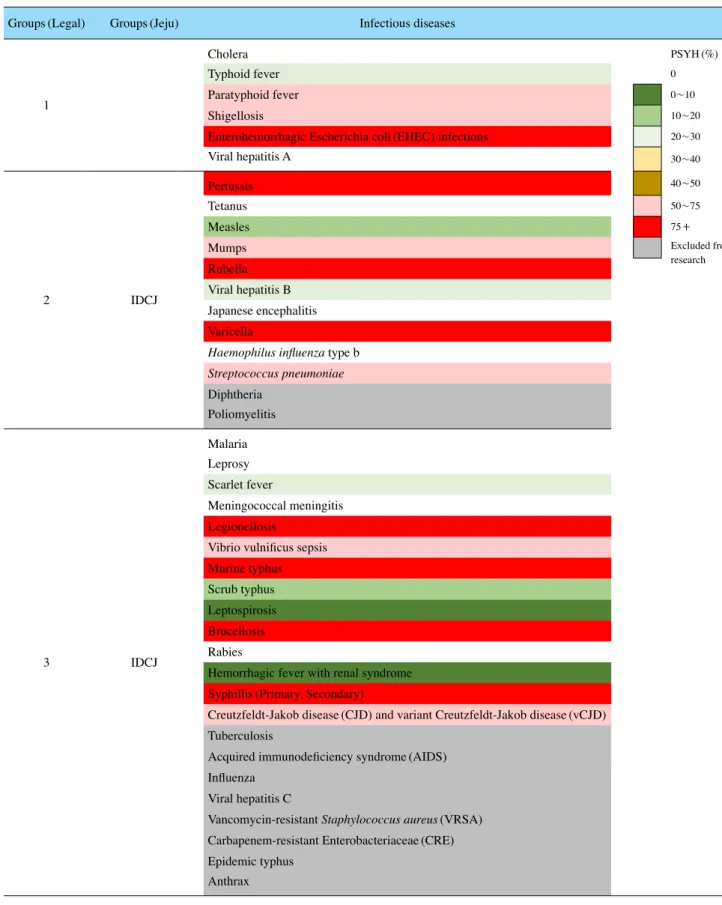
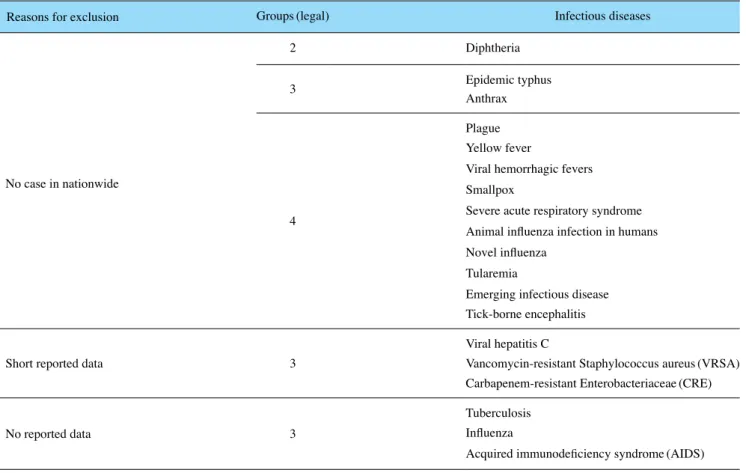
감염병 분류 기준이 ‘급’ 체계로 변경된 2020년 이전의 신고 자 료를 대상으로 하였기 때문에, 제1군부터 제4군까지 이전의 분 류에 따라 기술하였다(Table 1). 그중에서 별도의 시스템을 통 해 통계가 제공되는 결핵과 에이즈, 표본감시로 관리되고 있는 인플루엔자, 2017년 6월 이후 전수감시되어 신고자료가 충분 하지 않은 C형 간염, 반코마이신내성황색포도알균(VRSA) 감 염증, 카바페넴내성장내세균속균종(CRE) 감염증, 2001년부터 2019년까지 전국적으로 신고가 전무한 감염병 14종을 포함한 총 20종의 감염병을 분석 대상에서 제외하였다(Table 2).
1년의 단위를 매년 9월 1일부터 이듬해 8월 31일까지로 하 여, 각 감염병별로 전국 평균 신고율이 인구 십만 명당 0.1 이
Figure 1. IDCJ(Infectious Diseases for Control in Jeju Province) Comparison of incidence of the Nationwide and Jeju Province in 2001~2019.
.ac.kr/medsci/The Journal of Medicine and Life Science
Table 1. Distribution of the cases of national notifiable infectious disease in Jeju Province, 2001~2019
Groups(Legal) Groups(Jeju) Infectious diseases
1
Cholera PSYH(%)
Typhoid fever 0
Paratyphoid fever 0~10
Shigellosis 10~20
Enterohemorrhagic Escherichia coli(EHEC) infections 20~30
Viral hepatitis A 30~40
2 IDCJ
Pertussis 40~50
Tetanus 50~75
Measles 75+
Mumps Excluded from
research Rubella
Viral hepatitis B Japanese encephalitis Varicella
Haemophilus influenza type b Streptococcus pneumoniae Diphtheria
Poliomyelitis
3 IDCJ
Malaria Leprosy Scarlet fever
Meningococcal meningitis Legionellosis
Vibrio vulnificus sepsis Murine typhus Scrub typhus Leptospirosis Brucellosis Rabies
Hemorrhagic fever with renal syndrome Syphillis(Primary, Secondary)
Creutzfeldt-Jakob disease(CJD) and variant Creutzfeldt-Jakob disease(vCJD) Tuberculosis
Acquired immunodeficiency syndrome(AIDS) Influenza
Viral hepatitis C
Vancomycin-resistant Staphylococcus aureus(VRSA) Carbapenem-resistant Enterobacteriaceae(CRE) Epidemic typhus
Anthrax
.ac.kr/medsci/The Journal of Medicine and Life Science .ac.kr/medsci/The Journal of Medicine and Life Science 상인 횟수를 분모, 각 연도별로 전국 평균 신고율에 비하여
제주도의 신고율이 높았던 횟수를 분자로 백분율(%)을 산 출하였다. 산출 결과는 전국 신고율 대비 제주도 신고율 상 회연도(the Proportion of Sum of Years showing a Higher notification in Jeju Province than Nationwide divided by sum of comparing years, PSYH)로 나타낸다.7,9,10) 그 결과가 75%
이상인 경우를 전국에 비해 제주도에서 신고율이 높은 ‘제주 도 관리대상 감염병(Infectious Diseases for Control in Jeju Province, IDCJ)으로 정의하였고, 75% 이상이면서 최근 3 년 동안 증가하는 추세를 보이는 경우를 ‘제주도 우선 관리 대상 감염병(Priorities among Infection Diseases for Control in Jeju Province, PIDCJ)으로 정의하였다. 추가로 2년 연속으 로 50% 이상 증가하는 감염병을 ‘제주도 집중 관리대상 감염 병’(Sudden increase Infectious Diseases for Control in Jeju Province, SIDCJ)으로 정의하였다.7,9,10)
결 과
연구 대상 법정감염병 40종의 PSYH(%) 산출 결과를 군
에 따라 나눈 후 백분율의 범주별로 정리하였다(Table 1). 0%
인 감염병 15종, 0~10% 2종, 10~20% 2종, 20~30% 3종, 30~40% 1종, 40~50% 0종, 50~75% 6종이었다. 75% 이상 10종 중 실제 발생 건이 15건 이하인 1군 장출혈성대장균 감 염증, 2군 백일해, 풍진, 3군 레지오넬라증, 발진열, 브루셀라 증, 4군 라임병, 중증혈소판감소증후군을 포함한 총 8종은 분 석에서 제외하였다. 분석 결과를 통해 선정된 IDCJ는 수두, 1 기 매독, 2기 매독이었다.
수두와 1기 매독은 전수감시가 시작된 이후 전국에 비해 제주도에서 지속적으로 발생률이 높았고, 2기 매독도 2012년 9월부터 2014년 8월까지 2개년도를 제외하고 꾸준하게 높은 발생률을 보였다(Fig. 1). 수두는 2009년 9월에서 2010년 8 월 사이 제주도 발생률이 10만 명당 172.53명이었고, 전국에 비해 4.67배 높아 가장 많은 차이가 있던 기간이었다. 2018 년 9월부터 2019년 8월까지의 최근 수두 발생률은 10만 명 당 278.19명으로 전년보다 감소하였다. 1기 매독은 2010년 9 월부터 2011년 8월까지 제주도 발생률이 10만 명당 5.12명 으로 전국 발생률 대비 5.57배로 가장 높았으며, 2018년 9월 부터 2019년 8월까지는 2.57명으로 전국과 비슷한 양상을 보 Table 1. Distribution of the cases of national notifiable infectious disease in Jeju Province, 2001~2019
Groups(Legal) Groups(Jeju) Infectious diseases
4
Dengue fever PSYH(%)
Botulism 0
Q fever 0~10
West Nile fever 10~20
Lyme disease 20~30
Melioidosis 30~40
Chikungunya fever 40~50
Severe fever with Thrombocytopenia syndrome(SFTS) 50~75
Middle east respiratory syndrome(MERS) 75+
Zika virus infection Excluded from
research Plague
Yellow fever
Viral hemorrhagic fevers Smallpox
Severe acute respiratory syndrome Animal influenza infection in humans Novel influenza
Tularemia
Emerging infectious disease Tick-borne encephalitis Table 1. Continued
.ac.kr/medsci/The Journal of Medicine and Life Science
였다. 2기 매독은 2010년 9월부터 2011년 8월까지 제주도 발 생률이 1.94명으로 전국대비 5.88배로 가장 높았으나, 2012 년 9월부터 2013년 8월, 2013년 9월부터 2014년 8월까지의
기간에는 각각 전국 대비 0.94배, 0.71배로 낮은 발생률을 보 였다.
한편 최근 3년 동안 증가하는 추세를 보이는 PIDCJ와 2년 Table 2. The excluded national notifiable infectious disease in Jeju Province, 2011~2019
Reasons for exclusion Groups(legal) Infectious diseases
No case in nationwide
2 Diphtheria
3 Epidemic typhus
Anthrax
4
Plague Yellow fever
Viral hemorrhagic fevers Smallpox
Severe acute respiratory syndrome Animal influenza infection in humans Novel influenza
Tularemia
Emerging infectious disease Tick-borne encephalitis
Short reported data 3
Viral hepatitis C
Vancomycin-resistant Staphylococcus aureus(VRSA) Carbapenem-resistant Enterobacteriaceae(CRE)
No reported data 3
Tuberculosis Influenza
Acquired immunodeficiency syndrome(AIDS)
Table 3. Comparison of the infectious diseases for concentrating management in Jeju Province, 2016~2019
Categories* Year
2016 2017 2018 2019
IDCJ
Varicella Varicella Varicella Varicella
Syphilis(primary) Syphilis(primary) Syphilis
(primary, Secondary) Syphilis
(primary, Secondary)
SFTS SFTS Streptococcus pneumoniae
PIDCJ EHEC
Pertussis
SIDCJ Streptococcus pneumoniae
Scarlet fever
*IDCJ: infectious diseases for control in Jeju Province compared to nationwide
*PIDCJ: Infectious diseases showing an increasing trend in the last 3 years among IDCJ
*SIDCJ: Sudden Infectious diseases showing an increasing trend in the last 2 years in a row
.ac.kr/medsci/The Journal of Medicine and Life Science .ac.kr/medsci/The Journal of Medicine and Life Science 연속으로 50% 이상 증가하는 SIDCJ에는 해당되는 감염병은
없었다.
고찰 및 제언
2001년에서 2019년 사이 전국 대비 제주도에서 높은 발생 수준을 보인 감염병은 수두, 1기 매독, 2기 매독이다. 2016년 이후 제주도 관리대상 감염병으로 연이어 선정되었던 수두와 1기 매독의 발생률은 최근 감소하는 반면, 2018년 이후 관리 대상으로 선정된 2기 매독은 점점 증가하는 양상을 보이고 있 다.
수두는 유일하게 사람이 병원소이며, 잠복기의 사람이 감수 성이 있는 사람들에게 발병할 확률이 높은 감염력을 가지고 있다.11) 공기매개 감염으로 백신접종으로 관리되고 있지만,12) 현재 국내에서는 만 0~9세에서 호발하고 있는 양상을 보이고 있어1) 영유아기의 접종 분석이 필요한데, 제주도 수두발생과 관련하여 연령-기간-코호트(age-period-cohort, APC) 분석을 한 연구에서 현재의 접종 백신은 부분적으로 효과가 있다고 주장하고 있다.13) 수두에서의 예방은 영유아기의 아동을 관리 하고 있는 어린이집에서의 감염병 발생 시의 조치사항에 대 한 매뉴얼을 수립하고, 지속적으로 발생 현황을 관찰하고 파 악하는 것이 중요하다.
매독은 매독균의 감염에 의한 성기 및 전신 질환으로, 2019 년까지 제3군감염병으로 전수감시되었으나 감염병 분류체계 가 개편된 이후 현재는 제4급감염병으로 분류되어 표본감시 가 이루어지고 있다.14) 2016년 이후 제주도에서는 보건소 및 의료기관에 신속검사키트 보급하고, 익명검사 홍보, 성매개감 염병 예방교육 자료 개발하는 등 매독 예방관리 사업을 수행 하였고, 최근 1기 매독의 발생률의 감소를 확인할 수 있었다.
그러나 같은 시기 2기 매독이 증가했다는 점은 실질적인 환자 감소가 아니라 1기 매독 환자의 신고가 누락되었거나 적기에 치료하지 못한 결과로 추측해 볼 수 있겠다. 1기 매독은 통증 이 없는 궤양이 발생하고 이는 대부분 자연소실되기 때문에 적절한 치료가 동반되지 않으면 2기 매독으로 진행할 가능성 이 높지만,15) 최근 표본감시체계로 전환되어 환자 감시와 치 료, 관리를 어렵게 하고 있다. 지역사회에서는 매독 관리를 위 해 매독 의심증상자가 즉시 검사받을 수 있도록 교육 및 홍보 활동을 강화하고, 이후 발생한 매독환자 치료, 성 접촉자에 대 한 검사, 치료, 상담 등이 이루어지는 통합적 관리체계를 구축 할 필요가 있다.
본 연구는 2001년부터 2019년도까지의 제주도 내 감염병
발생 현황에 대해 분석한 2차 자료 연구로서, 효율적이고 효 과적인 제주도 감염병 예방대책을 수립하고 사업을 수행하기 위한 근거자료로 활용될 것이다. 또한, 제주도가 전국에 비하 여 낮은 법정 감염병들에 있어 관련한 가설들을 규명하는 연 구의 근거로 활용되기를 기대한다.
REFERENCES
1. Korea Centers for Disease Control and Prevention. Infectious Diseases Surveillance Yearbook, 2018 [cited 2019 28 Novem- ber]. Available from: http://www.cdc.go.kr/npt/biz/npp/portal/
nppPblctDtaView.do?pblctDtaSeAt=1&pblctDtaSn=1873(Kore- an).
2. Jeong EK. Public health emergency preparedness and response in Korea. J Korean Med Assoc 2017;60:296-9.(Korean)
3. World Health Organization. Climate Change and Human Health:
Risks and Responses. Summary. Geneva: World Health Organiza- tion; 2003. p.103-32.
4. Kim SH, Jang JY. Correlations Between Climate Change-Related Infectious Diseases and Meteorological Factors in Korea. Prev Med Public Health 2010;43:436-44.
5. Kwon YA, Kwon WT, Boo KO, Choi YE. Future Projections on Subtropical Climate Regions over South Korea Using SRES A1B Data. J Korean Geography Soc 2007;42:355-67.(Korean) 6. Korea Meteorological Administration. Statistics of Meteorological
Observation[cited 2020 30 July]. Available from: http://kosis.kr/
statHtml/statHtml.do?orgId=141&tblId=DT_14102_B001&vw_
cd=MT_ZTITLE&list_id=T_4&seqNo=&lang_mode=ko&lan- guage=kor&obj_var_id=&itm_id=&conn_path=MT_ZTITLE 7. Park JE, Kim SY, Yang DH, Bae JM. Status of National Notifi-
able Infectious Diseases in Jejudo, Korea: 2001-2016. J Med Life Sci 2017;6:29-34.(Korean)
8. Ministry of Justice. Statistics of Arrivals and Departures [cited 2019 28 November]. Available from: http://kosis.kr/statHt- ml/statHtml.do?orgId=111&tblId=DT_1B040A11&conn_
path=I2&language=en
9. Kim MN, Han YJ, Yang DH, Bae JM. Status of National Notifi- able Infectious Diseases in Jejudo, Korea: 2001-2017. J Med Life Sci 2017;14:51-6.(Korean)
10. Kim MN, Cho ES, Kim MY, Bae JM. Status of National Notifi- able Infectious Diseases in Jejudo, Korea: 2001-2018. J Med Life Sci 2018;15:79-83.(Korean)
11. Korea Center for Disease Control and Prevention. Varicella[cited 2020 30 July]. Available from: https://nip.cdc.go.kr/irgd/index.
html(Korean)
12. Korea Center for Disease Control and Prevention. 2020 Guide- line of Vaccine Control Infectious Disease[cited 2020 30
.ac.kr/medsci/The Journal of Medicine and Life Science
July]. Available from: https://www.cdc.go.kr/board/board.es-
?mid=a20507020000&bid=0019(Korean)
13. Kim JH, Kim JE, Bae JM. Incidence of varicella in children in Jeju-do, Korea, 2005-2016: age-period-cohort analysis. Epidemi- ol Health 2018;40:1-7.
14. Korea Centers for Disease Control and Prevention. Guideline for sexual transmitted disease management 2020[cited 2020 30 July].
Available from: https://is.cdc.go.kr/upload_comm/syview/doc.
html?fn=157862027210300.pdf&rs=/upload_comm/docu/0019/
(Korean).
15. The New York City, Department of health and mental hygiene bureau of sexually transmitted infection. The diagnosis, manage- ment and prevention of syphilis. New York: 2019. p.3-10.