OPEN ACCESS
*Corresponding author:
Phone. +82-42-821-5726 Fax. +82-42-822-2631 E-mail. [email protected] Phone. +82-63-238-5362 Fax. +82-63-238-5356 E-mail. [email protected]
† These authors contributed equally to this work.
Received: August 10, 2017 Revised: August 23, 2017 Accepted: August 29, 2017
Ⓒ 2017 The Korean Society of Weed Science and The Turfgrass Society of Korea.
This is an Open Access article distributed under the terms of the Creative Com- mons Attribution Non-Commercial License (http:
//creativecommons.org/licenses/by-nc/4.0/) which permits unrestricted non-commercial use, distribution, and reproduction in any medium, provided the original work is properly cited.
Research Note
Glyphosate Resistant Conyza canadensis Occurring in Tangerine Orchards of Jeju Province of Korea
Aung Bo Bo
1†, Ok Jae Won
1†, In Kon Park
2, Sug-Won Roh
3*, and Kee Woong Park
1*
1
Department of Crop Science, Chungnam National University, Daejeon 34134, Korea
2
Syngenta Korea Jincheon Station, Jincheon 33011, Korea
3
Rural Development Administration Food Crop Industry Technology Service Division, Jeonju 54875, Korea
Abstract
Conyza canadensis is the weed species which most frequently develops resistance to glyphosate in many agricultural crop fields. The continuous use of glyphosate has resulted in the spontaneous occurrences of resistant biotypes. This research was conducted to investigate the response of suspected C. canadensis biotypes to glyphosate. Seeds of C.
canadensis were collected from 18 sites in tangerine orchards in Jeju province of Korea. In the preliminary screening, 6 resistant and 12 susceptible biotypes were found at the recommended glyphosate rate (3.28 kg a.i. ha
-1). The susceptible biotypes were completely killed at the field application rate whereas the resistant biotypes were initially injured but recovered 14 days after glyphosate application. This is the first case of glyphosate resistance found in Korea despite the national ban on genetically modified glyphosate tolerant crops cultivation. Extended monitoring should be conducted to understand how widely spread the glyphosate resistant C. canadensis is and to estimate the severity of this weed problem in the tangerine orchards of Korea.
Keywords: Conyza canadensis, Glyphosate, Herbicide resistance, Tangerine orchard
INTRODUCTION
Glyphosate is a broad-spectrum, non-selective herbicide with the advantages of low soil persistence and low mammal toxicity (Atkinson, 1985). The use of glyphosate has significantly increased since the introduction of Roundup-Ready crops including soybeans, maize, cotton, and canola, which are genetically modified to have resistance to glyphosate. These Roundup-Ready crops have been a major driving force of glyphosate sales growth, and it is currently estimated that approximately 10% of arable lands in the world are now planted with glyphosate tolerant crops (Lee et al., 2015; Lee, 2017).
This extensive use of glyphosate has unfortunately resulted in the spontaneous occurrence and
spread of resistant weeds; there have been 37 glyphosate resistant weed species reported worldwide
(Heap, 2017; Park et al., 2014). Conyza canadensis is an annual or biennial broadleaf weed
species which frequently develops resistance to glyphosate in many agricultural crops. The first
glyphosate resistant C. canadensis in North America was found in Delware in 2000 (Bo et al., 2017; Lee et al., 2016).
In Korea, although glyphosate has been frequently used in many crop production areas including orchards and non-crop lands, glyphosate resistant weed species were not reported until now. C. canadensis in tangerine orchards in Korea has been successfully controlled by glyphosate. Growers have been applying glyphosate to control C.
canadensis at least five times a year for more than 10 years in the tangerine orchards of Jeju. Consequently, the growers noticed that C. canadensis was no longer effectively controlled with glyphosate in tangerine orchards (Fig. 1).
Fig. 1. Glyphosate resistant Conyza canadensis occurred in tangerine orchards of Jeju province of Korea.
To investigate the response of the suspected C. canadensis biotypes to glyphosate, a field experiment was conducted in the tangerine orchards in Jeju province of Korea. The recommended rate of glyphosate (3.28 kg a.i. ha
-1) was applied to C. canadensis at the five to seven leaf stage in the infested area. Responses of individual C. canadensis plants were evaluated visually 20 days after treatment (DAT). Seeds of suspected glyphosate-resistant C. canadensis biotypes were collected from 18 tangerine orchards, located in Haean-dong and Gujwa-eup of Jeju-si and Andeok-myeon of Seogwipo-si in Jeju province, where glyphosate had failed to control this weed species. Seeds of each biotype were sown in plastic trays and covered with transparent film until plant emergence. Seedlings at the two to three leaf stage were individually transplanted to pots filled with a commercial potting mix. The recommended rate of glyphosate (3.28 kg a.i. ha
-1) was applied two weeks after transplanting (8-10 leaf stage). A completely randomized design was used with four replications. Plants were harvested 14 DAT and resistance to glyphosate was evaluated by both dry weight reduction and visual rating.
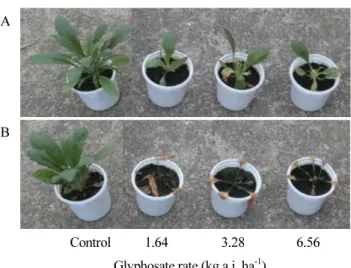
From the experiment described above, seeds of Sample ID 14 collected from Sugwang-ri, Andeok-myeon, Seogwipo-si exhibited the highest resistance response and were used for a dose response test. The resistant and susceptible biotypes were grown in a glasshouse according to the methods described previously. Plants at the 8-10 leaf stage were treated with glyphosate at 1.64, 3.28, and 6.56 kg a.i. ha
-1. A completely randomized design was used with four replications. The above ground fresh weight was measured 14 DAT and expressed as a percentage of untreated control.
In the field experiment, some of C. canadensis plants survived after glyphosate application at the recommended
rate. Fig. 2 shows C. canadensis before and after glyphosate application in a tangerine orchard located in Sugwang-ri
of Andeok-myeon in Seogwipo-si.
Fig. 2. Surviving Conyza canadensis plants 20 days after 3.28 kg a.i. ha
-1glyphosate application.
Seeds of C. canadensis were collected from 18 tangerine orchards in Jeju province. In the greenhouse experiment, it was found that six biotypes were resistant and 12 biotypes were susceptible to the recommended rate of glyphosate (Table 1). Resistant biotypes were not found in two locations, Haean-dong of Jeju-si and Kimnyung-ri of Gujwa-eup.
Six biotypes of eight tangerine orchards in Sugwang-ri, Andeok-myeon, Seogwipo-si showed resistance to glyphosate.
Although plants showed 44-77% of aboveground dry weight reduction and were visually scored as having severe to
Table. 1. Response of Conyza canadensis biotypes to a field rate of glyphosate (3.28 kg a.i. ha
-1) collected from 18 tangerine orchards of Jeju province of Korea.
Sample ID Location Control value (%) Survival
yResistance
z1 Haean-dong, Jeju-si 95 D S
2 79 D S
3 83 D S
4 87 D S
5 87 D S
6 83 D S
7 Sugwang-ri, Andeok-myeon, Seogwipo-si 83 D S
8 70 S R
9 70 S R
10 82 D S
11 64 S R
12 59 S R
13 52 S R
14 43 S R
15 Kimnyung-ri, Gujwa-eup, Jeju-si 80 D S
16 95 D S
17 89 D S
18 87 D S
y
D: dead, S: survival.
z