− 14 − DOI:10.5720/kjcn.2012.17.1.14
여대생에서 비타민 A 섭취 현황 및 급원식품 조사
연 지 영·배 윤 정1)†
숙명여자대학교 식품영양학과,
1)한북대학교 식품영양학과
Vitamin A Intakes and Food Sources of Vitamin A in Female University Students
Jee-Young Yeon, Yun-Jung Bae
1)†Department of Food and Nutrition, Sookmyung Women's University, Seoul, Korea
1)
Department of Food and Nutritional Sciences, Hanbuk University, Gyeonggi, Korea
Abstract
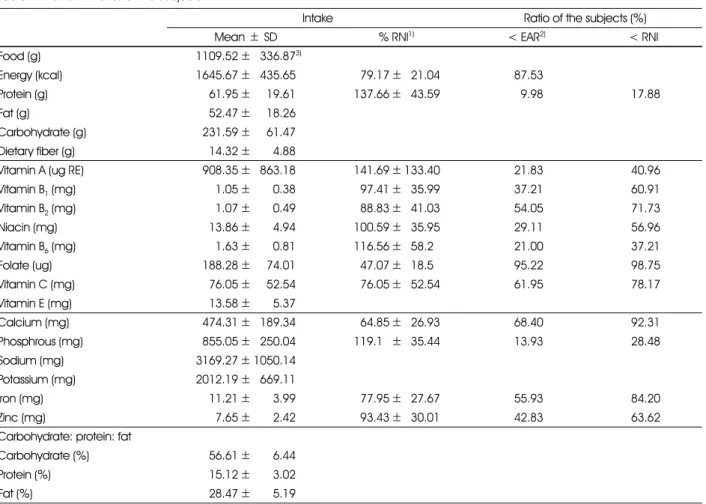
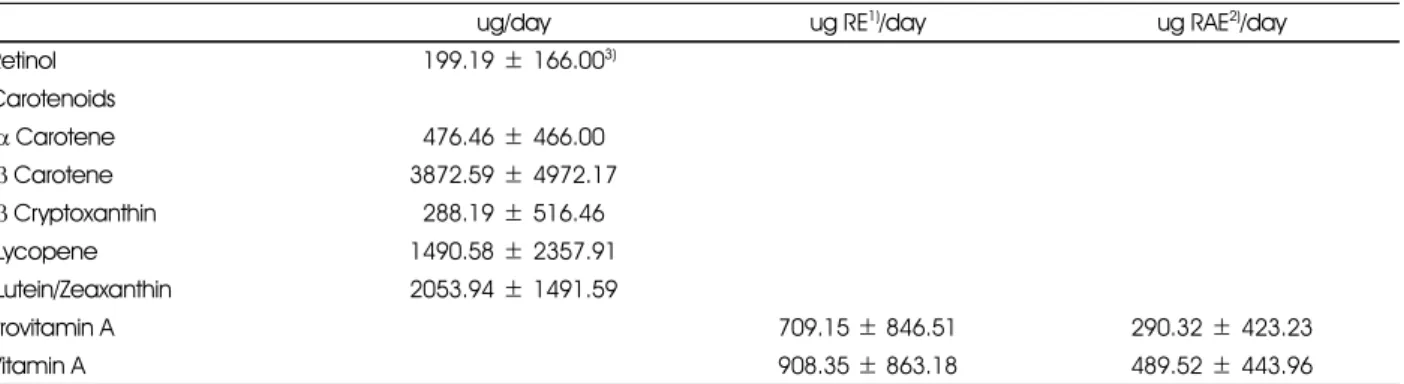
The purpose of this study was to estimate the daily intake of vitamin A in Korean female university students. Vitamin A intake was estimated using an inconsecutive 3-day dietary intake survey from 481 young women. Vitamin A intake values were calculated based on the data in USDA database. Average age, height, and weight of the subjects were 20.05 years, 162.13 cm and 54.38 kg, respectively. The subject's average intake of energy was 1645.67 kcal. The mean vitamin A, retinol and β carotene intakes were 908.35 ± 863.18 ug retinol equivalent/day, 199.19 ± 166.00 ug/day and 3872.59 ± 4972.17 ug/day, respectively. The 21.83% of the subjects consumed less than the Estimated Average Requirement (EAR) for vitamin A. And subjects consumed 141.69% of the Recommended Nutrient Intake (RNI) for vitamin A. Food groups consumed with high vitamin A content in our subjects included vegetables (423.96 ug RE/
day), potato and starches (213.64 ug RE/day), cereals (62.60 ug RE/day), eggs (55.17 ug RE/day) and milks (53.45 ug RE/day). The major food sources of vitamin A were sweet potato, carrot, spinach, egg, and cereal, and the top 30 foods provided 89.57% of total vitamin A. Also animal-derived food provided 9.65% of the vitamin A intake from the top 30 foods. In conclusion, judging from RNI, the vitamin A intake of the Korean female university students in this study was generally adequate. The result of our study may be used as a basis for follow-up studies of vitamin A intake like assessment of vitamin A nutritional status or evaluation of carotenoid food sources in Korean young women. (Korean J Community Nutr 17(1) : 14~25, 2012)
KEY WORDS : vitamin A intake·carotenoids·retinol·food sources·female university students
—————————————————————————
서 론
—————————————————————————
비타민 A는 비타민 A의 기본 구조를 가진 화합물인 레티 노이드(retinoids)와 비타민 A 활성을 갖는 카로티노이드 (carotinoids)를 총칭하며, 천연 카로티노이드 중 베타-카 로틴, 알파-카로틴, 베타-크랩토잔틴 등 약 50여 종만이 비 타민 A의 생물학적 활성을 가진다. 비타민 A와 카로티노이 드는 조직 내 지방산의 산화나 과산화물의 형성을 막아 세포 와 세포막 사이 유리기의 연쇄반응 차단을 통해 세포막을 보
호하는 기능 이외에 세포성장, 상피세포의 정상적인 분화 및 증식, 시각기능, 생식, 면역기능의 유지와 증진, 염증반응 억 제 기능 등을 가지고 있다(Wintergerst 등 2007; Nagao 2009).
2009 국민건강통계에 의하면 19세 이상 성인 여성에서 비타민 A 섭취량은 1일 732.2 ug RE로, 권장섭취량 대비 섭취율은 114.0%였고, 평균필요량에 부족되게 섭취하는 비 율은 45.3%로 나타났다(Ministry of Health, Welfare and Family Affairs [MOHWFA] & Korea Center for Disease Control and Prevention [KCDCP]
2010). 또한 19~29세 성인 여성에서의 비타민 A 섭취 상 태를 살펴보면, 섭취량은 1일 718.2 ug RE였으며, 권장섭 취량 대비 섭취율은 106.9%, 평균필요량 미만으로 섭취하 는 비율은 47.1%로 나타나 성인 여성 중 성인기 초반 여성 의 비타민 A 섭취 상태는 다른 연령대 여성에 비해 부족한
접수일: 2011년 11월 10일 접수수정일: 2012년 51월 19일 수정 채택일: 2012년 51월 30일 채택
†Corresponding author: Yun Jung Bae, Hanbuk University, 233-1 Sangpae-dong, Dongducheon-si, Gyeonggi-do 483-120, Korea Tel: (031) 860-1445, Fax: (031) 860-1449
E-mail: [email protected]