Copyright ⓒ Korean Academy of Dental Technology
This is an Open Access article distributed under the terms of the Creative Commons Attribution Non-Commercial License (http://creativecommons.org/licenses/by-nc/4.0) which permits unrestricted non-commercial use, distribution, and reproduction in any medium, provided the original work is properly cited.
INTRODUCTION
치과용 보철물의 제작을 위해서 높은 강도를 지닌 하부 금속과 심미 적인 요소를 위한 상부 도재로 구성된 금속도재관이 전통적으로 이용 되어 왔다[1]. 하지만 심미적인 요인에 관련한 환자의 요구가 상승함에 따라 합금을 이용한 수복재보다 심미성과 물리적 강도를 모두 만족시 킬 수 있는 세라믹 소재 수복물의 사용이 크게 증가하였다[2,3]. 특히 세라믹 소재는 전통적인 금속도재관과 비슷한 생체 친화성을 가지고 금속 고유의 비심미적 요인을 해결할 수 있으며 색조 안정성이 우수하
고 자연치와 유사한 색조를 지니므로 치과용 수복재료로 많이 사용되 어 왔다[4,5].
세라믹 소재는 기존의 전통적인 납형 제작 방식으로 제작할 수 있지 만 컴퓨터 기반 가공 방식으로 대체하여 치과용 CAD/CAM (comput- er-aided design/computer-aided manufacturing) 시스템을 이용 하면 수복물의 재현성이 향상되고 제작 시간 및 비용을 절약할 수 있을 뿐만 아니라 전용 소재의 균질성에 의해 내구성이 우수한 수복물을 제 작할 수 있다[6]. 하지만 세라믹을 단일 소재로 사용할 경우 취성으로 인해 쉽게 깨지거나 높은 경도로 인해 대합치의 심한 마모를 발생시켜
Purpose:
This study aimed to assess and compare the marginal fit of ceramic-based hy- brid resin restoration (HYB) and zirconia restoration (ZIR) for dental computer-aided design/computer-aided manufacturing systems.
Methods:
A stainless steel master model was produced. The impression was first made with silicone, and then stone working models were produced. A total of twenty restorations were fabricated with two different materials: ZIR and HYB. The silicone film thickness of the marginal gap was measured using a digital microscope; digital photos were taken at a magnification of ×160, and then analyzed using a measurement software. The values of the result were evaluated with the independent-sample t-test (α=0.05). All statistical analyses were performed with a statistical software.Results:
The mean values for the marginal gap was 37.14±2.96 μm for HYB, compared with 40.37±5.26 μm for ZIR. No significant difference was found between ZIR and HYB (p=0.107).Conclusion:
As a result, the marginal fit of the restoration fabricated using the hybrid resin was better than that of the restoration fabricated using zirconia. Also, the marginal fit of all groups was below the clinical acceptable range of 120 μm. Thus, HYB for dental CAD/CAM system in this study is expected to be suitable for clinical use in dentistry.Key Words:
CAD-CAM, Composite resin, Dental marginal adaptation, Dental prosthesis, Y-TZP ceramicArticle Info
Received July 31, 2020 Revised August 11, 2020 Accepted August 14, 2020
Corresponding Author Jong-Kyoung Park
Department of Dental Technology, College of Health Care, Gimcheon University, 214 Daehak-ro, Gimcheon 39528, Korea E-mail: [email protected]
https://orcid.org/0000-0001-7508-7823
https://doi.org/10.14347/jtd.2020.42.3.228 pISSN: 1229-3954 eISSN: 2288-5218
J Tech Dent 2020;42(3):228-233 Original Article
치과용 CAD/CAM 전용 세라믹기반 하이브리드 레진 수복물의 변연 적합 연구
정창섭1,2, 박종경3
1
원광보건대학교 치기공과,
2원광대학교 치과대학 치과생체재료학교실,
3김천대학교 치기공학과
A study on marginal fit of the ceramic-based hybrid resin restoration for dental CAD/CAM systems
Chang-Seop Jeong
1,2, Jong-Kyoung Park
31Department of Dental Laboratory Technology, Wonkwang Health Science University, Iksan, Korea
2Department of Dental Biomaterials, College of Dentistry, Wonkwang University, Iksan, Korea
3Department of Dental Technology, College of Health Care, Gimcheon University, Gimcheon, Korea
JOURNAL OF TECHNOLOGIC DENTISTRY
J TD
Chang-Seop Jeong, Jong-Kyoung Park: Marginal fit of the ceramic-based hybrid resin restoration
교합의 불균형을 유발할 수 있고, 절삭 시 두께가 얇은 변연 부위에서 파절이 발생할 수 있다는 단점이 있다[7]. 또한 레진으로 구성된 단일 소재는 기계적 강도가 낮다는 한계점이 있다[8]. 이러한 이유로 내구성 과 심미성이 우수한 간접 수복물용 재료로서 세라믹과 레진의 장점을 결합한 새로운 복합 소재의 개발에 대한 필요성이 점차 증가하였다. 따 라서 세라믹과 레진을 결합하여 각각의 장점을 극대화시킨 CAD/CAM 전용 하이브리드 재료가 개발되어 소개되고 있다[9].
한편, 수복물의 성패를 결정하는 매우 중요한 임상적 요소 중 하나는 정확한 변연 적합이다[10]. 변연 적합이 불량할 경우 응력이 집중되는 영역이 생성되어 수복물의 수명을 매우 단축시킬 뿐만 아니라 치태가 축적되어 치아 우식증과 치은염 및 지각 과민증을 유발시켜서 수복물 의 실패를 초래하는 원인이 된다[11,12]. 따라서 우수한 변연 적합도는 장기적인 수복물의 안정성에 기여한다고 알려져 있다[13].
CAD/CAM 시스템을 이용한 임상 적용이 폭넓게 증가함에 따라 다 양한 유형의 CAD/CAM 전용 하이브리드 소재들이 개발되었지만 이러 한 소재를 선택할 때 참고가 될 만한 기본 자료들이 많이 부족한 실정이 다. 따라서 본 연구의 목적은 최근에 시판된 CAD/CAM 전용 세라믹기 반 하이브리드 레진 수복물의 변연 적합도를 평가하여 임상적 자료로 활용하고자 함이다. 본 연구의 귀무가설은 ‘서로 다른 두 가지의 소재로 제작한 수복물 간의 변연 적합도는 서로 유의한 차이가 없다‘이다.
MATERIALS AND METHODS
본 연구는 Fig. 1에서 나타난 흐름에 따라 실험을 진행하였다.
1. 주모형 및 작업모형의 제작
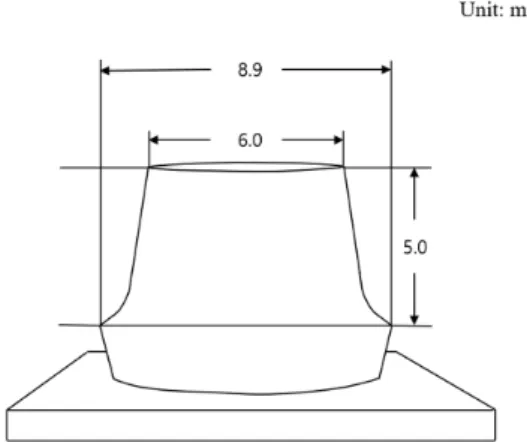
본 연구를 위해 상부 직경 6.0 mm, 하부 직경 8.9 mm, 높이 5.0
mm, 16°의 total occlusal convergence로 chamfer margin을 갖는 금속 주모형(stainless steel, UNS S30400)을 제작하였다(Fig. 2).
작업모형의 제작을 위해서 복제용 실리콘(Deguform; DeguDent GmbH, Hesse, Germany)을 이용하여 금속 주모형을 복제하였다. 최 종 경화된 실리콘 몰드 내면에 type IV 석고(Neo Plumstone; Mut- sumi Chemical Industries Co. LTD., Mie, Japan)를 주입하여 그룹 별로 10개씩 제작한 후 분류하였다(Fig. 1). 모든 과정은 제조회사의 지 시에 따라 제작되었다.
2. 수복물 시편의 제작 1) 지르코니아 수복물의 제작
10개의 석고 작업모형을 3차원(three-dimensional, 3D) laser scanner (D750; 3Shape A/S, Copenhagen, Denmark)를 이용하 여 각각 스캔하였고, CAD software program (Dental DesignerTM; 3Shape A/S) 상에서 수복물을 3D 디자인하였다. 수복물의 두께는 0.5 mm, 내면 공간은 변연(margin)을 기준으로 1.0 mm 떨어진 지점부 터 전체 30 μm를 부여하였다. 디자인이 완료된 디지털 데이터를 CAM software (Zenotec CAM V3; Wieland Dental, Pforzheim, Ger- many)에서 import하였고, 블록의 등록은 블록명, 색조(shade), 수축 률 등의 정보가 포함된 블록의 바코드를 Wieland CAD/CAM 시스템 에 내장된 RFID를 이용하여 자동 등록하였다. 등록된 블록의 수축률 은 1:1.22였고, 블록 내 절삭 가공할 디자인 데이터의 위치설정 및 바 생성 후 NC 파일을 형성하였다. 이어서 밀링장비(Zenotec select S2;
Wieland Dental)에 적용하여 지르코니아 블록(IPS e.max ZirCAD MT Multi A2; Ivoclar Vivadent, Schaan, Liechtenstein) (Table 1) 을 절삭 가공하였으며 제조회사 소성 스케줄에 따라 소결로(Fire P1;
Thermo-star, Berlin, Germany)에서 최종 소결 처리하여 완성하였 다(n=10) (Fig. 1).
Figure 1.
Figure 1. Flowchart showing manufacturing and evaluating process
of two groups. 3D: three-dimensional, ZIR: zirconia restoration, HYB:
ceramic-based hybrid resin restoration. Figure 2.
Figure 2. Schematic diagram of dimension on the master model.JOURNAL OF TECHNOLOGIC DENTISTRY
J TD
2) 세라믹기반 하이브리드 레진 수복물의 제작
지르코니아 수복물의 제작과 마찬가지로 디자인이 완료된 데이터 를 이용하여 NC 파일을 생성한 후 그 파일을 밀링장비에 적용하였고 세라믹기반 하이브리드 레진 블록(DISK HC A2-HT; Shofu, Kyoto, Japan) (Table 1)을 절삭 가공하여 완성하였다(n=10) (Fig. 1).
3. 변연 적합도 측정
절삭 가공이 완료된 수복물의 내면에 연질 실리콘 인상재료(Aquasil Ultra XLV; Dentsply Caulk, Milford, DE, USA)를 주입한 후, 석고 작업모형 상에 적합시켰다. 균일한 압력이 가해지도록 만능재료시험 기(OTU-05D; Oriental TM, Siheung, Korea) 상에서 5분간 50 N 의 압력이 유지되도록 하였다. 연질 실리콘 인상재료가 경화되면 석 고 작업모형에서 수복물을 분리시키고, 경질 실리콘 인상재료(Aquasil Ultra monophase; Dentsply Caulk)를 수복물을 대체하여 포매하였 다. 최종 경화된 실리콘 인상재료는 면도날(razor blade)을 이용하여 십자 형태로 분할하였고, 160 배율의 디지털현미경(KH-7700; Hirox, Tokyo, Japan)으로 분할된 단면을 디지털 이미지화하였다.
측정 지점은 선행 연구에서 정의된 변연 간격을 참고하여 지정하 였다(Fig. 3) [14]. 그 후 디지털현미경에 내장된 측정 프로그램(KH- 7700 software ver. 2.10c; Hirox)을 이용하여 간격을 측정하였다 (Fig. 4).
4. 통계 분석
측정 지점에 따라 기록된 수치의 평균 및 표준편차 값을 산출하였
고, 모집단이 정규성 및 등분산성 가정을 만족하였기 때문에 독립표본 (independent-samples) t-test를 시행함으로써 각 그룹 간의 통계 적 차이와 유의성을 분석하였다(Fig. 1). 통계 검증에 필요한 유의 수준 (α)은 0.05 (5%)로 설정하였다. 본 연구에서의 모든 통계 분석은 IBM SPSS Statistics ver. 22.0 프로그램(IBM Corp., Armonk, NY, USA) 을 사용하였다.
RESULTS
본 연구에서의 실험을 통해 지르코니아 수복물 그룹(zirconia resto- ration group, ZIR group)과 세라믹기반 하이브리드 레진 수복물 그 룹(ceramic-based hybrid resin restoration group, HYB group)에 나타난 변연 간격의 평균과 표준편차는 Table 2에 나타내었다. 이것을 그래프를 이용하여 Fig. 5와 같이 나타내었다.
변연 적합도에 대해서 평균값은 ZIR 그룹에서 40.37 μm, HYB 그 룹에서 37.14 μm를 나타내었다. HYB 그룹이 ZIR 그룹보다 더 좁은 변연 간격을 나타내었지만, 이 두 그룹 간에는 통계적으로 유의한 차이 가 존재하지 않았다(p=0.107).
DISCUSSION
본 연구에서는 새롭게 개발된 CAD/CAM 전용 세라믹기반 하이브리 드 레진 수복물이 변연 적합도에 미치는 영향을 파악하기 위해 기존의
Table 1.
Table 1. Materials used in this study
Group code Brands (composition) Characteristic Lot number Manufacturer
ZIR IPS e.max ZirCAD MT Multi A2
(ZrO
2, Y
2O
3, HfO
2, Al
2O
3) Zirconia ceramics Y29536 Ivoclar Vivadent, Liechtenstein HYB DISK HC A2-HT (UDMA, TEGDMA with 61% SiO
2,
Zirconium silicate) Ceramic-based hybrid resin 031801 Shofu, Japan ZIR: zirconia restoration, HYB: ceramic-based hybrid resin restoration.
Figure 3.
Figure 3. Measurement point for evaluation of marginal gap.
Figure 4.
Figure 4. Measurement of the marginal area silicone thickness by digitalmicroscope.
Chang-Seop Jeong, Jong-Kyoung Park: Marginal fit of the ceramic-based hybrid resin restoration
지르코니아 단일소재 수복물을 제작한 후 실리콘 복제법을 이용하여 변연 간격을 측정하여 비교 평가하였다.
61%의 지르코늄 실리케이트를 기반으로 구성된 하이브리드 레진 소 재는 UDMA (urethane dimethacrylate), TEG-DMA (triethylene glycol dimethacrylate)로 밀집된 나노 필러로 인해 저작력을 균일 하게 흡수하고 분해 현상에 대한 내성을 증진시키는 골격을 형성한다 [15]. 본 소재는 기타 CAD/CAM 재료와 비교할 때 제작 시간 감소, 파 절 저항성 향상, 절삭 공구의 마모 절감 및 손쉬운 가공성 등에서 장점 을 나타낸다. 또한 191 MPa의 높은 굴곡 강도와 66 HV0.2의 비커스 경도로 인해 상아질에 가까운 경도 값을 나타내므로 과도한 대합치 마 모를 방지할 수 있다[16].
치과용 수복물의 성공적인 제작을 위해서 내구성, 심미성, 결합력, 적합도 등이 고려되어야 한다[17]. 특히 CAD/CAM 시스템이 개발되 어 절삭 기술의 발전으로 인해 내구성이 강한 소재로 제작된 수복물을 제작할 수 있게 되었다[6]. 하지만 절삭 가공 시 공구의 마모 또는 장비 에 내재된 오류 발생 가능성은 중요한 매개 변수로 간주되고 있다. 따 라서 수복물을 절삭 가공 후 거칠지 않은 연속적인 변연 부위를 생성할 수 있도록 CAD/CAM 전용 소재의 특성을 이해하는 것이 중요하다고 할 수 있다. 즉, 재료의 특성상 얇은 변연을 생성하기 어려울 수 있다는
것이다. 따라서 절삭 가공 방식은 최종 보철물의 변연에 악영향을 줄 수 있다[18]. 한편, 우수한 변연 적합도를 가진 수복물은 2차 우식 및 치주 질환의 발생을 감소시킬 수 있지만 치아와 수복물의 변연 간 적합 이 불량하면 박테리아성 치태의 침착을 유발하게 된다[19,20]. 침착된 치태들은 치주 조직의 질환이 발생하게 되고 밀착되지 않은 수복물과 치아 사이의 변연 간격은 시멘트의 용해를 촉진시키며, 이때 발생한 변 연부 미세누출은 치수 조직의 건강에 악영향을 미치게 된다[21,22].
선행 연구를 통해 CAD/CAM 수복물의 변연 적합과 관련하여 긍정 적인 결과값을 보고하였지만[23,24], 새롭게 개발된 소재는 이러한 변 연부의 결함을 생성할 가능성을 내재하고 있다. 특히 Tsitrou 등[25]의 연구에서는 글라스 세라믹 소재를 절삭 가공할 때, 변연 부위에 심각한 갈라짐(chipping) 현상이 발생한다는 것을 보고하였다. 이것은 재료 고 유의 특성과 관련이 있다고 하였다. 본 연구에서 ZIR 그룹의 변연 간격 은 40.37±5.26 μm를 나타내었고, HYB 그룹의 변연 간격은 37.14±
2.96 μm를 나타낸 결과로 볼 때, Awada와 Nathanson [26]의 연구에 서 레진 기반 소재가 기존의 CAD/CAM 소재와 비교할 때 더 부드럽고 더 정확한 변연 부위를 제작할 수 있다는 것과 일치한다고 볼 수 있다.
수복물과 지대치 사이의 변연 적합도를 측정하는 방법으로는 시편 절단 관찰법, 인상 채득을 통한 복제법(silicone replica method), 탐 침을 이용한 시각적 관찰법, 컴퓨터를 이용한 3D 분석법 등이 소개되 었다[27-30]. 시편 절단 관찰법은 절단된 단면을 직접 분석할 수 있으 므로 가장 정확한 방법으로 제시되지만,시편을 파괴하기 때문에 많은 측정 부위를 관찰하는 것이 어렵고, 많은 측정 부위를 위해 그에 상응 하는 개수의 시편이 필요하다는 단점이 있다. 이에 비해 비파괴적 측 정법인 silicone replica method는 다른 측정 방법과 비교하였을 때 에도 그 결과를 신뢰할 수 있다고 하였다[28,31]. 이에 따라 본 연구에 서는 반복측정이 가능하고 결과 값을 신뢰할 수 있는 silicone replica method를 선택하였다. 수복물과 지대치의 간격을 나타내주는 포매된 silicone film을 십자 형태로 절단 분할 후, digital microscope를 이 용하여 변연 부위에서의 적합도를 관찰하였다.
수복물의 변연 적합도에 대한 임상적 허용 수치는 여전히 합의되 지 않았다. Assif 등[32]은 변연 부위에 대한 평균적인 적합 간격이 약 140 μm라고 제시하였고, Hung 등[33]은 약 50~75 μm의 간격이 임 상적 허용 범위라고 하였다. Moon 등[34]에 따르면 이렇게 측정된 변 연 간격은 실험으로 판단하는 기준 수치일 뿐 임상적으로 허용할 수 있 는 기준으로 두기에는 무리라고 하였다. 따라서 많은 선행 연구에서는
Table 2.
Table 2. Mean and standard deviation (SD) of marginal gap for two different groups
Group Number Mean±SD (μμm) 95% confidence interval
p-value
Lower bound Upper bound
ZIR 10 40.37±5.26 37.11 43.63 0.107
HYB 10 37.14±2.96 35.30 38.98
ZIR: zirconia restoration, HYB: ceramic-based hybrid resin restoration.
Figure 5.
Figure 5. Box plot for median and range values of marginal gap fabri-
cated by two materials for restoration. ZIR: zirconia restoration, HYB:
ceramic-based hybrid resin restoration.
JOURNAL OF TECHNOLOGIC DENTISTRY
J TD
McLean과 von Fraunhofer [35]의 연구에서 제시하였던 120 μm의 변연 한계를 허용 기준으로 선정하고 있다. 본 연구에서 분석된 변연 간격은 두 그룹 모두 50 μm 이내의 측정값을 나타내었으므로 임상적 인 허용 기준 내에 존재하였다.
본 연구에서는 실제 치아가 아닌 체외 실험용 표준 형태의 시편을 절 삭하여 제작하였고, 절삭 공구의 마모 변수 및 장비의 오류가 내재되어 있을 가능성을 배제하였기 때문에 실제 임상적인 상황과 차이점을 가 지는 한계가 있었다. 또한, green state 또는 반소결 지르코니아 블록 을 이용한 수복물은 최종 소결과정 중 발생할 수 있는 선형 수축을 보 상하기 위해 최종 크기보다 조금 크게 제작하는데, 소결로의 열선 상태 등 결과에 영향을 미칠 수 있는 제3의 변수가 작용할 수 있으므로 통제 되어야 할 것이다. 향후 후속 연구에서는 이러한 한계점을 극복하여 실 제적인 임상 유효성을 평가하기 위한 지표가 필요할 것으로 생각된다.
CONCLUSIONS
본 연구에서는 CAD/CAM 전용 세라믹기반 하이브리드 레진 수복물 과 지르코니아 단일소재 수복물 간의 변연 적합도에 차이가 있는지 규 명하기 위하여 실리콘 복제법을 이용한 비교 평가를 통해 다음과 같은 결론이 도출되었다.
첫째, HYB 소재로 제작된 단일 치관 수복물의 변연 적합이 ZIR 소 재로 제작된 단일 치관 수복물보다 더 우수하였다.
둘째, ZIR 소재와 HYB 소재로 제작된 단일 치관 수복물의 변연 적합에 대한 통계적 유의성 검증을 위한 independent-samples t- test 결과, 두 그룹 간에는 통계적으로 유의한 차이가 존재하지 않았다 (p=0.107). 따라서 본 연구에서 설정한 귀무가설은 기각되지 않았다.
셋째, ZIR 소재와 HYB 소재로 제작된 단일 치관 수복물은 모두 현재 임상적으로 허용 가능한 변연 간격 범위인 120 μm 이내에 존재하였다.
따라서 우수한 내구성, 심미성, 그리고 가공성을 가진 세라믹기반 하 이브리드 레진 소재로 제작된 수복물은 환자의 요구와 술자의 선택에 따라 기존의 세라믹 단일 소재로 제작된 수복물을 대체하여 사용할 수 있다고 판단된다.
CONFLICT OF INTEREST
No potential conflict of interest relevant to this article was reported.
ORCID
Chang-Seop Jeong, https://orcid.org/0000-0001-8631-1819 Jong-Kyoung Park, https://orcid.org/0000-0001-7508-7823