서 론
진단은 질병을 범주화하고 치료계획을 수립하며 환자의 예후를 추적하기 위한 도구이다. 진단에서 전문가의 지식과 경험은 필수적 인 요소1)이지만, 공통된 진단이 필요한 상황에서 복수의 전문가 간 진단 불일치(inter-expert diagnosis discrepancy)는 의료의 질과 효율을 저하시킬 수 있다는 문제가 지속적으로 제기되어 왔다2). 이 에 대하여 2015년 미국 IOM(Institute of Medicine) 위원회와 NAS(The National Academies of Science·Engineering·Medicine) 에서는 진단을 ‘협동적인 노력(collaborative effort)’으로 정의하였 다3). IOM에 따르면 진단은 그 불일치 현황과 요인에 대해 파악하 고 이를 해결하기 위해 전문가 집단 안에 폭넓은 합의를 구축하는 종합적인 과정이다3). Trese(2015)는 진단에서 주관적 요소를 제거 할 수는 없다고 하더라도 전문가의 판단과 객관적인 정보가 결합되 었을 때 진단 불일치 정도를 줄이고 환자에 대한 보다 나은 의료가 가능하다고 하였다4). 따라서 전문가 간 진단 일치도를 파악하여 향 후 전문가 합의의 정도 및 진단 정확도를 향상시키고 의료의 질과 효율을 제고할 필요가 있다.
한편 사상체질의학에서는 ‘동의수세보원(東醫壽世保元) 사상인
변증론(四象人辨證論)’에 기록된 신체적 요소(체형기상(體形氣像)과 용모사기(容貌祠記)), 심리적 요소(성질재간(性質才幹)·항심(恒心)·심 욕(心欲)), 병리적 증상과 처방약에 대한 반응(병증약리(病證藥理)) 의 각 내용을 종합적으로 평가하여 진단하고 있다5). 하지만 최근까 지도 체질 진단시 객관적이고 표준적인 판단 지표로 구성되어 전문 가 간 진단 일치도를 향상시키고 임상 활용도를 높일 수 있는 가이 드라인에 대한 수요가 반복적으로 보고되고 있다6).
사상체질 진단시 전문가의 판단을 보조하기 위해 다양한 수단 이 개발되었다. 환자가 기입하는 자기보고식 설문지(QSCCII), 의사 용 설문지(SDQ-S), 이 외 문진에 의존하지 않는 안면 형상 분석, 체형 계측, 음성 분석 등이 활용되고 있다7). 그런데 새롭게 개발되 는 진단도구의 신뢰성을 판단하기 위하여 사상체질 전문가의 진단 을 참고 표준(reference standard)으로 보고하는 경우가 있다8). 전문가의 진단만을 참고 표준으로 사용할 경우에도 전문가 간 일치 도의 파악이 필요하다. 하지만 사상체질 진단 연구에서는 복수의 전문가 간 일치도를 파악할 수 없는 경우가 많으며, 일치도가 보고 된 연구에서는 그 정도가 다양하다. 함 등9)은 전문가의 자격 및 판 단의 주관성이 사상체질 진단시 전문가 간 일치도에 영향을 미쳤다 고 보고하였다.
사상체질 진단 연구의 전문가 일치도와 진단 정확률
한은경·권영규1*
채영한의원, 1 : 부산대학교 한의학전문대학원 양생기능의학부
Inter-expert Agreement and Diagnostic Accuracy of Sasang Constitution Medicine
Eunkyung Han, Young Kyu Kwon
1*
Chae-Young Primary Care Center of Korean Medicine, 1 : Division of Longevity and Biofunction Medicine, School of Korean Medicine, Pusan National University The purpose of this study is to evaluate the current inter-expert agreement of Sasang Constitution Medicine (SCM), to expand the current knowledge on the causes of imperfect inter-expert agreement, and to explore possible solutions for improving inter-expert agreement. A literature search was conducted to gather data on the studies on diagnosis of SCM. The 127 articles included in this analysis had a mean 4.1 publications per year, 56.0% published in the Journal of Sasang Constitutional Medicine between the year of 1987 and 2017. SCM specialist participated in 96.3%
of all the expert judgment cases. Inter-expert agreement was reported in 14.8% of the cases that had two or more experts. We recommend that expert panels integrate the results of current status of diagnostic consensus into guideline development and strengthen expert education and training with the aim of improving SCM diagnostic accuracy.
keywords : Inter-expert agreement, Diagnostic accuracy, Sasang Constitution Medicine
* Corresponding author
Young Kyu Kwon, Division of Longevity and Biofunction Medicine, School of Korean Medicine, Pusan National University, 49, Busandaehak-ro, Mulgeum-eup, Yangsan-si, Gyeongsangnam-do, Korea
·E-mail : [email protected] ·Tel : +82-51-510-8471
·Received : 2018/05/08 ·Revised : 2018/07/23 ·Accepted : 2018/08/06
ⓒ The Society of Pathology in Korean Medicine, The Physiological Society of Korean Medicine pISSN 1738-7698 eISSN 2288-2529 http://dx.doi.org/10.15188/kjopp.2018.08.32.4.185
Available online at https://kmpath.jams.or.kr
이상으로부터 사상체질 진단시 전문가 간 진단 일치도 현황 및 전문가 간 진단 일치도에 영향을 미치는 요소를 파악하고 이를 개 선하기 위한 기초 자료가 필요함을 알 수 있으나, 현재까지 관련 연구가 부족한 상황이다.
따라서 이 연구의 목적은 다음과 같다.
1. 사상체질 진단 연구에서 전문가 간 진단 일치도의 현황을 파악 하는 것
2. 진단 일치도가 낮은 주요 요인이 연구되어 있는지 알아보는 것 3. 진단 일치도 향상을 위한 논의나 방안이 마련되어 있는지 알아 보는 것
이를 통해 사상체질 진단에서 전문가 간 일치도 향상 방안을 논의하고자 한다.
연구대상 및 방법
학술데이터베이스 KISS(Korean studies Information Service System), RISS(Research Information Sharing Service), DBPia, NDSL(National Discovery for Science Leaders)를 사용하여 분석대상 논문을 검색하였다. 2017년 12월까 지 출판된 모든 국내 학술지 논문을 대상으로 하였다. 제목 또는 초록에 ‘사상’, ‘체질’, ‘진단’을 포함한 연구로 한정하였다. 검색식 은 “제목 : 사상 체질 진단 <OR> 초록 : 사상 체질 진단”으로 하 였다. 검색된 논문의 참고문헌 수기검색을 통해 누락된 문헌을 추 가 확인하였다. 중복 검색을 제외하고 총 187건의 논문이 검색되었 다. 이 중에서 제목이 같으면서 1, 2부로 나누어 게재된 경우이거 나 제목이 같으면서 세부 내용의 차례를 달리하여 2편 이상의 논문 으로 출판된 경우는 1편으로 간주하였다. 또, 주제가 체질진단 방 법이 아닌 임상연구, 치험례, 임상진료지침을 제외하였다. 이 외, 논문 제목과 초록 검토를 통하여 연구주제와 직접 관련이 없는 것 을 제외하였다. 127편의 논문을 최종 분석대상으로 하였다.
결 과
1 연도별 출판논문 수
사상체질 진단 연구로 매년 평균 4.1편의 논문이 국내 학술저 널에 게재되었다. 사상체질 진단 연구의 논문 발행편수가 가장 많 은 연도는 2007년으로 18편이었다(Fig. 1).
Fig. 1. Distribution of Sasang Constitution(SC) diagnosis studies between the year of 1987 and 2017.
2. 학술지별 출판논문 수
분석대상 논문은 사상체질의학회지(舊 사상의학회지, 71편), 한 국자료분석학회지(16편), 동의생리병리학회지(10편), 한국한의학연 구원논문집(6편), 전자공학회 소속 학술지(5편), 정보처리학회지(2 편), 대한침구의학회지(2편), 대한한의학회지(2편) 외 대한예방한의 학회지, 한국콘텐츠학회지, 한국정보통신학회지, 동서간호학연구지, 한국정신과학학회지, 한국전자통신학회지, 지역사회간호학회지, 성 인간호학회지, 전통의학지, 한국통신학회지, 한국통계학회지, 경희 대학교대학원 고황론집, 대한전기학회학술대회논문집에서 각 1편이 출판되었다. 분석대상 기간내 사상체질 진단 연구를 2편 이상 출판 한 학회는 8개였다(Fig. 2).
Fig. 2. Distribution of SC diagnosis studies in peer-reviewed journals.
* Journals including two or more studies between the year of 1987 and 2017 are displayed.
3. 사상체질 진단 연구의 주제별 분류
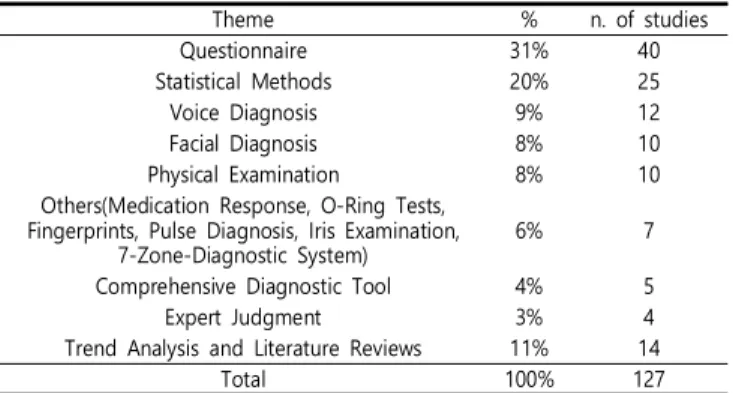
분석대상 논문의 주제 중 가장 빈도수가 높은 것은 설문지의
개발7,8,10-47)로 40편이었고, 통계분류 방법에 관한 것48-72)이 25편이
었다. 체형분석(12편)93-104), 음성진단73-82) 및 안면계측83-92)(각 10 편), 문헌고찰 및 동향분석 연구(7편)127-133), 전문가 진단(5
편)123-126), 통합진단시스템 SCAT(4편)119-122), 이 외에 기타 진단방
법(약리반응, 오링테스트, 지문, 맥진, 홍채, 7구역진단기)의 개발에 관한 연구가 총 14편105-118)이었다(Table 1).
Table 1. Key contents of SC diagnosis studies in peer-reviewed journals
Theme % n. of studies
Questionnaire 31% 40
Statistical Methods 20% 25
Voice Diagnosis 9% 12
Facial Diagnosis 8% 10
Physical Examination 8% 10
Others(Medication Response, O-Ring Tests, Fingerprints, Pulse Diagnosis, Iris Examination,
7-Zone-Diagnostic System) 6% 7
Comprehensive Diagnostic Tool 4% 5
Expert Judgment 3% 4
Trend Analysis and Literature Reviews 11% 14
Total 100% 127
4. 사상체질 진단 연구 동향
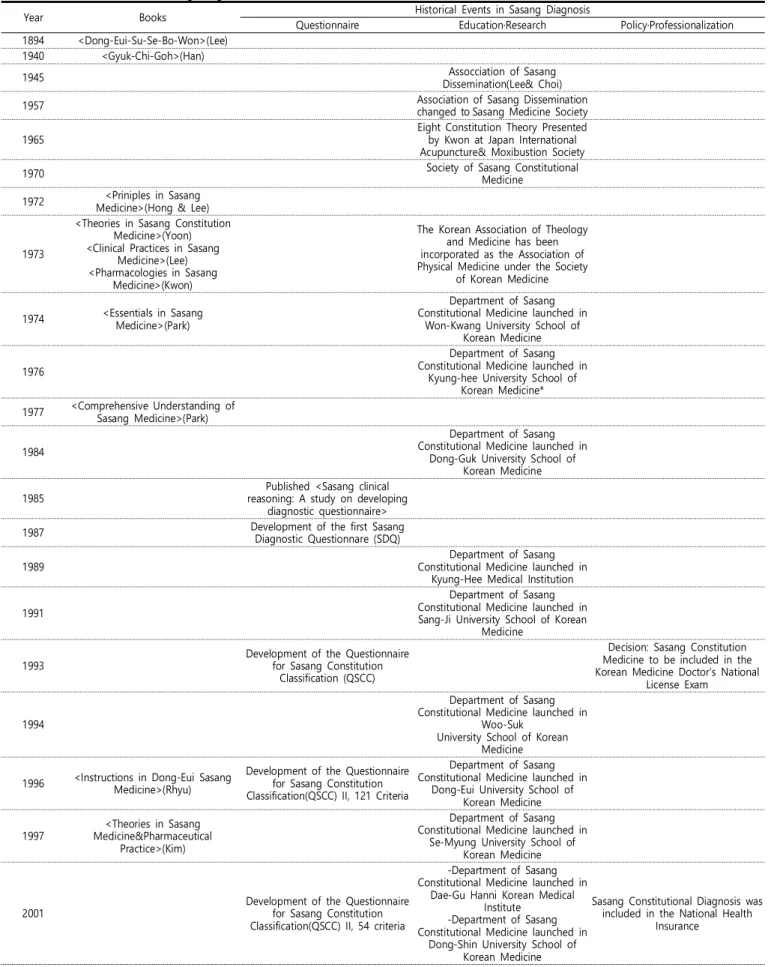
사상체질 진단 연구는 1995년 QSCCII의 개발 이후와 2007년 과 학기술부-한국학의학연구원의 이제마 프로젝트 출범 이후에 각각 논
문의 출판빈도와 출판주제의 종류가 증가하는 경향을 보였다. 진단연 구 내용 분석을 통하여 관련 동향을 표로 정리하였다(Table 2).
Table 2. Historical Events in Sasang Diagnosis
Year Books Historical Events in Sasang Diagnosis
Questionnaire Education·Research Policy·Professionalization
1894 <Dong-Eui-Su-Se-Bo-Won>(Lee) 1940 <Gyuk-Chi-Goh>(Han)
1945 Assocciation of Sasang
Dissemination(Lee& Choi)
1957 Association of Sasang Dissemination
changed to Sasang Medicine Society
1965 Eight Constitution Theory Presented
by Kwon at Japan International Acupuncture& Moxibustion Society
1970 Society of Sasang Constitutional
Medicine 1972 <Priniples in Sasang
Medicine>(Hong & Lee)
1973
<Theories in Sasang Constitution Medicine>(Yoon)
<Clinical Practices in Sasang Medicine>(Lee)
<Pharmacologies in Sasang Medicine>(Kwon)
The Korean Association of Theology and Medicine has been incorporated as the Association of Physical Medicine under the Society
of Korean Medicine
1974 <Essentials in Sasang Medicine>(Park)
Department of Sasang Constitutional Medicine launched in
Won-Kwang University School of Korean Medicine
1976
Department of Sasang Constitutional Medicine launched in
Kyung-hee University School of Korean Medicine*
1977 <Comprehensive Understanding of Sasang Medicine>(Park)
1984
Department of Sasang Constitutional Medicine launched in
Dong-Guk University School of Korean Medicine
1985 Published <Sasang clinical
reasoning: A study on developing diagnostic questionnaire>
1987 Development of the first Sasang
Diagnostic Questionnare (SDQ)
1989 Department of Sasang
Constitutional Medicine launched in Kyung-Hee Medical Institution
1991
Department of Sasang Constitutional Medicine launched in Sang-Ji University School of Korean
Medicine
1993 Development of the Questionnaire
for Sasang Constitution Classification (QSCC)
Decision: Sasang Constitution Medicine to be included in the Korean Medicine Doctor’s National
License Exam
1994
Department of Sasang Constitutional Medicine launched in
Woo-Suk University School of Korean
Medicine
1996 <Instructions in Dong-Eui Sasang Medicine>(Rhyu)
Development of the Questionnaire for Sasang Constitution Classification(QSCC) II, 121 Criteria
Department of Sasang Constitutional Medicine launched in
Dong-Eui University School of Korean Medicine
1997 <Theories in Sasang Medicine&Pharmaceutical
Practice>(Kim)
Department of Sasang Constitutional Medicine launched in
Se-Myung University School of Korean Medicine
2001 Development of the Questionnaire
for Sasang Constitution Classification(QSCC) II, 54 criteria
-Department of Sasang Constitutional Medicine launched in
Dae-Gu Hanni Korean Medical Institute
-Department of Sasang Constitutional Medicine launched in
Dong-Shin University School of Korean Medicine
Sasang Constitutional Diagnosis was included in the National Health
Insurance
1) 개요
체질진단 방법으로 문진(問診)수단인 설문지를 개발하고 그 활 용도를 높이기 위한 방법에 관한 논문이 지속적으로 출판되었다.
1987년 ‘사상체질 변증내용 설문조사지 연구’47)이후, 1995년 경희 대학교 한의과대학에서 개발한 사상체질분류검사지 QSCCⅡ (Questionnaire for Sasang Constitution Classification Ⅱ)의 표준화, 타당화, 문항분석 및 개정에 대한 연구45)가 진행되었다. 환 자의 자기기입식 설문지인 QSCCII 응답의 신뢰도와 재현성에서 한 계를 보완하기 위하여, 의사의 신체계측 정보를 포함하는 의사용 체질진단지와 새롭게 개발된 환자용 체질진단지를 종합적으로 평가 하는 시스템21,22)이 개발되었다. 2006년에는 이전 설문에서의 진단 단계와 달리 양인과 음인을 먼저 구분하고, 이후에 4개 체질로 다 시 감별하는 환자용 설문지인 TS-QSCD13)가 개발되었다. 또, 설문 문항의 숫자 가 최대 229문항에 이르러 불편한 점을 보완하기 위 해 단축형 설문지인 KS-15(환자용)와 SDQ-S(의사용)11,12)가 개발되 었다.
비설문 진단도구 중 안면 형상 분석기를 사용한 연구에서는 안 면의 형태와 안색을 기계를 통해 판별84)하였다. 체형 분석법에 관 한 연구에서는 체간과 사지의 계측값을 진단에 사용93)하였다. 음성 분석에 관한 연구는 서로 다른 음성의 주파수 등을 이용하여 체질 을 구분할 수 있는 근거를 찾기 위한 성음분석78), 음향분석79,80), 성 문분석81)을 실시하였다. 기타의 비설문 진단도구는 한약 복용 후의 환자 반응105), O-Ring 경근계측112), 양도락115), 홍채116)의 활용을포 함하였다.
2011년 이후에는 안면 분석, 음성 분석, 체형 계측, 설문조사 결과를 종합적으로 체질진단에 활용하는 통합형 체질진단 시스템
1) 사상의학 40년사. 사상체질의학회 편저.
SCAT119-122)이 개발되었다. 진단 도구의 개발 및 활용에서 공통적
인 경향성은 도구를 보조적으로 사용하고 전문가의 판단에 의해 확 진한다는 점이다. 또, 다른 진단 도구의 활용을 명시하지 않고 전문 가의 정성적 판단에 의해 체질을 판단하거나, 환자가 체질 처방을 복용한 후에 나타내는 ‘약리반응’을 통해서 체질을 확진하는 방법에 관한 연구들도 보고되고 있다. 백 등의 논문123)에서 체질진단의 참값 은 ‘일정 수준의 약리기준을 바탕으로 5년 이상 임상경력의 사상체 질 전문가 또는 사상체질 전문의에 의해 진단된 것’으로 정하였다.
2) 체질진단시 사용된 전문가의 조건
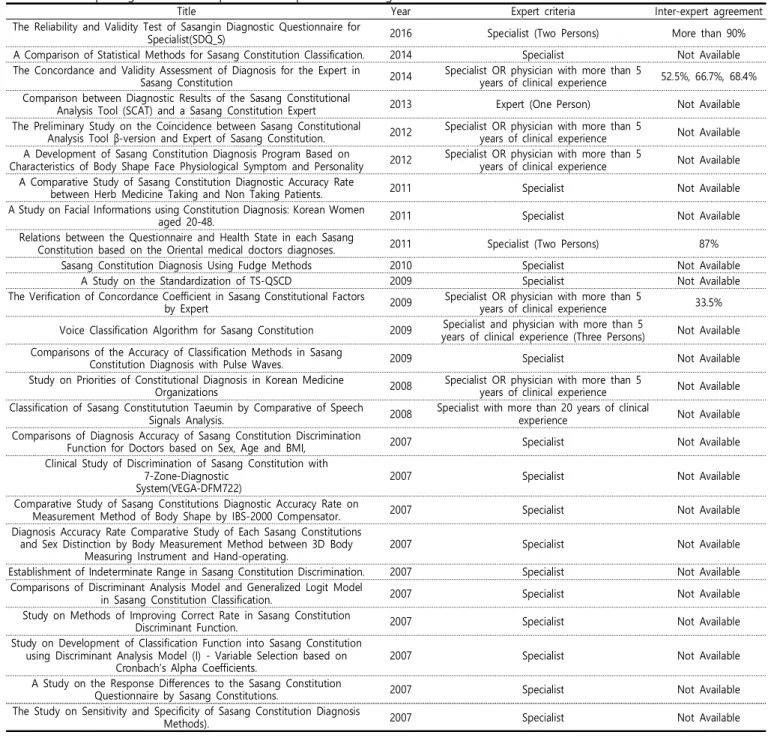
2007년 이후 출판된 사상체질 진단 연구를 재분류해 살펴보았 다. 전문가를 통해 체질을 진단한 연구는 총 26편이었으며, 이 중 25편(96.3%)에서 ‘사상체질 전문의’가 진단하였다. 기타의 전문가 자격으로서 ‘인정의로서 5년 이상의 체질 임상 경력이 있고 체질처 방사용 비율이 90% 이상인 한의사’120), ‘5년 이상의 체질의학 활용 한의사’16)가 있었다. 복수의 전문가가 진단하였다고 보고된 연구는 4편으로 총 26편 중 14.8%였다. 관련 결과는 Table 3과 같다.
3) 사상체질 전문가 간 진단 일치율의 추정
사상체질을 복수의 전문가가 진단하였다고 보고한 4편의 연구 중 3편은 전문가간 진단결과 일치율을 각각 “90%이상”11), “3인 2 조의 진단에서 각 52.5%(kappa 0.248), 66.7%(kappa 0.458), 68.4%(kappa 0.501)”123), ”87%”124) 로 보고하였다. 1편의 연구에 서는 진단시 우선적으로 사용하는 항목의 전문가간 일치도(33.5%) 를 보고124)하였다.
사상체질을 진단한 전문가가 있었던 나머지 22편의 연구에서 는 복수의 전문가가 진단하였는지 여부를 알 수 없었고, 복수의 전 문가가 진단하였을 때 진단 일치율에 대하여 알 수 없었다. 관련 결과는 Table 3과 같다. 분석대상 논문 중 제목에 ‘진단 정확률’을
2002 Dae-jeon University Medical Center
includes Constitutional Diagnosis
Medical Board had the first Specialist Exam on Sasang
Constitution Medicine
2003
<Sasang Constitution Medicine> published as the official
textbook of School of Korean Medicine
Development of Sasang Constitution Questionnaire for Patients (SSCQ-P)
2004 Development of Sasang Constitution
Questionnaire for Doctors (SSCQ-D)
Sasang Constitution Medicine was included in the Korean Medicine Doctor’s National License Exam
2006 Development of Two Step
Questionnaire for the Sasang Constitution Diagnosis (SQSCD)
2007 <New Sasang Medicine>(Rhyu) Lee Jema Project run by Ministry of
Science & Technologies and KIOM
2008
Department of Sasang Constitutional Medicine launched in Pusan National University School of
Korean Medicine
2009
Department of Constitutional Medicine Research launched in
Korean Institute of Oriental Medicine (KIOM)
2012 Development of Sasang Constitution
Analysis Tool (SCAT)
2015 Development of Sasang Personality
Questionnaire (SPQ) Development of Korea Sasang
Constitutional Diagnostic Questionnaire (KS-15)
*Based on the time point when the faculty member is appointed, unless otherwise indicated.1)
포함한 논문은 6편15,20,93-95,105)으로 모두 2007년 이후에 출판되었 다. 이 중 5편의 연구에서는 전문가의 정성적 진단을 포함하고 있
었으며, 1편에서는 사용된 진단 도구에 대한 언급이 없었다. 6편의 논문 중 복수의 전문가에 대한 진단 일치율의 보고는 없었다.
고 찰
본 연구는 사상체질 진단의 객관성을 확보하기 위해 전문가 간 진단 일치도를 파악하고 이를 향상시킬 수 있는 전문가 집단 차원 에서의 방안을 논의하기 위한 기초 연구이다.
체질 진단 연구에서 복수의 전문가 간 진단 일치도를 보고한 경우는 14.8%에 불과했다. 이것은 분석 대상 논문에서 사상체질 진단시 복수의 전문가를 활용하지 않거나, 복수의 전문가를 활용하 더라도 해당 전문가 간 진단 불일치 정도를 보고하지 않는 경향을 드러낸다. 이는 김 등8)이 체질 진단 연구의 53.5%에서는 전문가 1
인이 진단한 것으로 보고하였던 경향에서 벗어나지 않는 것으로 생 각된다. 전문가간 합의를 향상시키기 위한 기본 조건으로 복수의 전문가를 포함한 진단 연구 설계가 필요하다. 또, 복수의 전문가간 진단 일치도를 Kappa 값 등134)을 사용하여 체계적인 연구방법에 따라 보고한 연구의 숫자가 늘어날 필요가 있다. 연구에 따라 사상 체질의학 전문의 또는 일반의인 경우 일정기간 이상의 사상의학 임 상경험과 체질처방 사용 경력 등을 자격요건으로 포함하였는데, 김 등8)이 제안하였듯이 전문가의 숫자와 포함방법 등에 관한 기준도 좀 더 세밀한 가이드라인을 세워 향후 체질진단 연구에서 동일한 설계를 따를 필요가 있다.
Table 3. Inter-expert agreement and expert criteria reported in SC diagnosis studies
Title Year Expert criteria Inter-expert agreement
The Reliability and Validity Test of Sasangin Diagnostic Questionnaire for
Specialist(SDQ_S) 2016 Specialist (Two Persons) More than 90%
A Comparison of Statistical Methods for Sasang Constitution Classification. 2014 Specialist Not Available The Concordance and Validity Assessment of Diagnosis for the Expert in
Sasang Constitution 2014 Specialist OR physician with more than 5
years of clinical experience 52.5%, 66.7%, 68.4%
Comparison between Diagnostic Results of the Sasang Constitutional
Analysis Tool (SCAT) and a Sasang Constitution Expert 2013 Expert (One Person) Not Available The Preliminary Study on the Coincidence between Sasang Constitutional
Analysis Tool β-version and Expert of Sasang Constitution. 2012 Specialist OR physician with more than 5
years of clinical experience Not Available A Development of Sasang Constitution Diagnosis Program Based on
Characteristics of Body Shape Face Physiological Symptom and Personality 2012 Specialist OR physician with more than 5
years of clinical experience Not Available A Comparative Study of Sasang Constitution Diagnostic Accuracy Rate
between Herb Medicine Taking and Non Taking Patients. 2011 Specialist Not Available
A Study on Facial Informations using Constitution Diagnosis: Korean Women
aged 20-48. 2011 Specialist Not Available
Relations between the Questionnaire and Health State in each Sasang
Constitution based on the Oriental medical doctors diagnoses. 2011 Specialist (Two Persons) 87%
Sasang Constitution Diagnosis Using Fudge Methods 2010 Specialist Not Available
A Study on the Standardization of TS-QSCD 2009 Specialist Not Available
The Verification of Concordance Coefficient in Sasang Constitutional Factors
by Expert 2009 Specialist OR physician with more than 5
years of clinical experience 33.5%
Voice Classification Algorithm for Sasang Constitution 2009 Specialist and physician with more than 5
years of clinical experience (Three Persons) Not Available Comparisons of the Accuracy of Classification Methods in Sasang
Constitution Diagnosis with Pulse Waves. 2009 Specialist Not Available
Study on Priorities of Constitutional Diagnosis in Korean Medicine
Organizations 2008 Specialist OR physician with more than 5
years of clinical experience Not Available Classification of Sasang Constitutution Taeumin by Comparative of Speech
Signals Analysis. 2008 Specialist with more than 20 years of clinical
experience Not Available
Comparisons of Diagnosis Accuracy of Sasang Constitution Discrimination
Function for Doctors based on Sex, Age and BMI, 2007 Specialist Not Available
Clinical Study of Discrimination of Sasang Constitution with 7-Zone-Diagnostic
System(VEGA-DFM722) 2007 Specialist Not Available
Comparative Study of Sasang Constitutions Diagnostic Accuracy Rate on
Measurement Method of Body Shape by IBS-2000 Compensator. 2007 Specialist Not Available
Diagnosis Accuracy Rate Comparative Study of Each Sasang Constitutions and Sex Distinction by Body Measurement Method between 3D Body
Measuring Instrument and Hand-operating. 2007 Specialist Not Available
Establishment of Indeterminate Range in Sasang Constitution Discrimination. 2007 Specialist Not Available Comparisons of Discriminant Analysis Model and Generalized Logit Model
in Sasang Constitution Classification. 2007 Specialist Not Available
Study on Methods of Improving Correct Rate in Sasang Constitution
Discriminant Function. 2007 Specialist Not Available
Study on Development of Classification Function into Sasang Constitution using Discriminant Analysis Model (I) - Variable Selection based on
Cronbach's Alpha Coefficients. 2007 Specialist Not Available
A Study on the Response Differences to the Sasang Constitution
Questionnaire by Sasang Constitutions. 2007 Specialist Not Available
The Study on Sensitivity and Specificity of Sasang Constitution Diagnosis
Methods). 2007 Specialist Not Available
본 연구의 분석대상 논문에서 보고된 전문가간 진단 일치도는 다양하였다. 이것은 사상체질 진단요소 중에서 전문가간 일치도가 특히 낮은 항목을 탐색하고 그 원인을 파악하는 연구들이 추가될 필요를 시사한다. 최근 연구에서 임상연구의 편향성(bias)을 판별하 는 데 이른바 전문성을 표방한 대상자들이 실제 편향성 판별에서는 다양한 불일치를 보였다는 결과135)를 참조하면, 이러한 노력이 한 층 강화될 필요가 있다. 사상체질 진단 연구에서도 장 등125)은 여 러 명의 전문가가 동일인의 체질을 진단할 때 진단항목의 우선순위 에는 차이가 있으며, 전문가의 체질진단 소견이 달라지는 원인을 규명할 필요가 있다고 하였다. 백 등123)은 전문가 간 체질 진단 결 과가 일치할수록 전체 진단의 타당도가 향상되었음을 보고하였다.
본 연구 결과는 전문가간 진단 일치도를 체계적인 방법을 통해 파악하고 그 원인을 탐색하는 연구뿐 아니라 진단 일치도를 향상시 키기 위해 집단 차원에서의 노력이 필요함을 시사한다. 최근의 선 행연구를 참조하면 전문가간 진단 일치도 현황 파악을 통해 얻어진 사실들을 진단 가이드라인 정립 및 개정에 활용하는 것과 진단 정 확도 향상을 목표로 전문가 집단의 교육 및 훈련과정을 강화하는 것136) 등이 공통적으로 제안되고 있다.
진단 가이드라인의 정립 및 개정에는 전문가 패널이 필요하다
1). Nakhleh 등의 연구137) 에서 전문가 패널은 해석이 필요한 진단 에서 불일치율을 줄일 수 있는 효과적인 검토방법을 언급한 최신의 연구를 평가하여 권고등급을 제안하였다. 또 이 연구에서는 권고등 급을 결정할 때 각 연구에서 사용한 검토방법으로 얻어진 불일치율 의 측정값이 ‘매우 불확실’ 한 것으로부터 ‘추후의 연구에 의해 바 뀌기 어려울 정도로 확실함’에 이르는 4단계의 권고등급(grade)으 로 구성된 GRADE Framework138)를 사용했다. Clark 등139)은 정 신건강의학 진단편람(DSM-5), 국제질병분류(ICD-11), 그리고 National Institute of Mental Health’s Research Domain Criteria(RDoC)의 개정과정을 논의하면서 전문가가 식별하는 증상 과 징후에 기반한 진단체계에 대해 설명하고, 분류체계의 다양성에 도 불구하고 공통의 목적은 환자의 불편을 줄이는 것임을 강조했 다. Appelbaum140)은 앞으로의 과제로 현재 사용되고 있는 정신장 애의 진단체계에는 전문가의 경험적 지식뿐 아니라 잘 짜여진 연구 설계를 통해 만들어진 근거의 역할이 균형적으로 필요하다는 것을 언급했다.
진단 정확도 향상을 목표로 전문가 집단의 교육 및 훈련과정을 강화하는 것은 IOM 권고안3)의 주요 내용 중 하나인데, 이에 따르 면 진단 교육과정 안에 임상적 추론, 다른 전문가·환자·보호자와의 효과적인 의사소통, 적절한 진단도구의 사용에 따른 의사 결정, 정 보기술(Health Information Technology, HIT)의 사용3) 등을 포함 하도록 권하고 있다. 이러한 각각의 요소들은 사상체질 진단의 전 문가 일치도 향상을 통한 진단 정확도 향상 노력시 지속적으로 고 려될 필요가 있다. Graber 등141)은 진단 정확도 향상을 향한 일련 의 노력들이 의료의 질과 관련된다고 하면서 진단과 치료가 환자 안전 및 의료의 질 제고에 동일한 비중으로 강조되어야 한다고 제 안했다.
사상체질 진단 정확률에 관한 기존 연구에서 가장 많은 것은 판별함수에 관한 연구였다. 판별함수란 집단을 구분할 수 있는 설
명변수를 통하여 각 집단에 대한 판별식을 도출하고, 연구대상자가 소속된 집단을 예측하는 목적으로 사용하는 통계적 기법42)으로서, 적절한 판별함수를 개발하면 진단검사의 타당성을 높일 수 있다는 의미가 있다. 그러나 판별함수 개발의 전제가 되는 체질진단 항목 에서 전문가간 불일치 경향이 관리되지 않을 경우 판별함수의 타당 성에는 지속적인 의문이 제기될 여지가 있다. 박 등11)이 판별함수 의 정확률을 보정하기 위하여 평가자간 차이가 없어야 함을 지적하 고 있는데, 이에 앞서 평가자간 불일치 원인을 파악하는 과정이 필 요하다고 생각된다.
한편, 사상체질의 참값 진단을 약리반응(藥理反應) 관찰 시점 이후로 두는 경우가 있는데, 장 등122)이 지적하듯이 임상적 반응을 관찰하기 이전에 복수의 전문가가 관여된 사상체질 진단의 정확도 를 높이는 방법에 대해 초점을 둘 필요가 있다. 백 등123)의 연구에 서 “약리기록에 기반한 참값에 대한 전문가의 진단 타당도는 다소 낮은 결과를 보인 것”을 참고할 필요가 있다. Gschlieber 등2)는 치료방법을 정하기 전에 가능하면 2인 이상의 전문가를 두어 진단 할 것을 권하고 있다.
결 론
복수의 전문가 간 진단 불일치(inter-expert diagnosis discrepancy)는 의료의 질과 효율을 저하시킬 수 있다는 문제가 지속적으로 제기되어 왔다. 전문가 간 진단 일치도를 파악하여 향 후 전문가 합의의 정도 및 진단 정확도를 향상시키고 의료의 질과 효율을 제고할 필요가 있다.
체질 진단 연구에서 복수의 전문가 간 진단 일치도를 보고한 경 우는 14.8%였다. 향후 사상체질 진단연구 설계 시 복수의 전문가를 참여시키고 전문가 간 진단 일치도를 Kappa 값등을 사용하여 체계 적인 연구방법에 따라 보고한 연구의 숫자가 늘어날 필요가 있다.
분석대상 논문에서 보고된 전문가간 진단 일치도는 ‘33.5%’에 서 ‘90% 이상’에 이르기까지 다양하였다. 사상체질 진단요소 중에 서 전문가간 일치도가 특히 낮은 항목을 탐색하고 그 원인을 파악 하는 연구들이 추가될 필요가 있다.
진단 일치도를 향상시키기 위해 집단 차원에서의 노력이 필요 하다. 전문가간 진단 일치도 현황 파악을 통해 얻어진 사실들을 진 단 가이드라인 정립 및 개정에 활용하는 것과 진단 정확도 향상을 목표로 전문가 집단의 교육 및 훈련과정을 강화하는 것을 고려할 수 있다.
감사의 글
이 논문은 2018년도 정부(교육부)의 재원으로 한국연구재단의 지원을 받아 수행된 기초연구사업임(No. 2017R1D1A1B03036344).
References
1. Brush JE Jr, Sherbino J, Norman GR. How Expert Clinicians Intuitively Recognize a Medical Diagnosis. Am
J Med. 2017;130(6):629-34.
2. Gschließer A, et al. Inter-expert and intra-expert agreement on the diagnosis and treatment of retinopathy of prematurity. Am J Ophthalmol. 2015 Sep;160(3):553-60.e3.
3. National Academies of Sciences, Engineering, and Medicine. 2015. Improving Diagnosis in Health Care.
Washington, DC: The National Academies Press.
https://doi.org/10.17226/21794.
4. Trese MT. Subjectivity in Retinopathy of Prematurity Screening. Am J Ophthalmol. 2015;160(3):406-7.
5. Song I. Sasang Constitutional Medicine. Jibmoondang;
2008.
6. Yoo J, Jang E, Lee H, Kim Y, Kim H, Lee S. Knowledge and Attitude of Sasang Constitution Investigatorson the Sasang Constitution Clinical Study in Korea. J Sasang Constitut Med. 2008;20(3):118-32.
7. Park D, Park K, Jin H. The Web Application to Improve Utilization of Sasang Constitutional Diagnosis Questionnaire - KS-15(Korea Sasang Constitutional Diagnostic Questionnaire). J Sasang Constitut Med.
2017;29(3):224-31.
8. Kim S, Jang E, Koh B. The Methodological Review on the Accuracy Study of Questionnaire for Sasang Constitution Diagnosis. J Sasang Constitut Med.
2012;24(3):1-16.
9. Hahm T, Hwang M, Lee T, Kim S, Lee S, Koh B. A Study on the Concordance Rate of the Diagnostic Results Among Sasang Constitutional Medicine(SCM) Specialists. J Sasang Constitut Med. 2006;18(3):124-30.
10. Kim Y, Jang E. Test-Retest Reliability of Brief KS-15 - Korean Sasang Constitutional Diagnostic Questionnaire.
J Sasang Constitut Med. 2016;30(3):177-83.
11. Pak Y, Kim J, Park B, Yoo J, Lee J, Koh B, et al. The Reliability and Validity Test of Sasangin Diagnostic Questionnaire for Specialist(SDQ_S). J Sasang Constitut Med. 2016;18(2):110-22.
12. Baek Y, Jang E, Park K, Yoo J, Jin H, Lee S.
Development and Validation of Brief KS-15 (Korea Sasang Constitutional Diagnostic Questionnaire) Based on Body Shape, Temperament and Symptoms. J Sasang Constitut Med. 2015;27(2):211-21.
13. Shin D, Song J. A Study on the Standardization of TS-QSCD. J Sasang Constitut Med. 2009;21(1):99-126.
14. Kim KK, Kang CW, Kim JW. Stabilization of Sasang Constitution Discrimination Function using Check List Data with Mixed Measurement Scale. Journal of the Korean Data Analysis society. 2008;10(5):2471-85.
15. Jeon S, Jeong S, Kwon S, Park S, Kim K, Kim J. A Study on the Diagnostic Accuracy Rate of the Sasang Constitution Questionnaire for Doctors Used in the On-line System. J Sasang Constitut Med. 2008;20(3):82-93.
16. Lee S, Joo J, Lee S, Lee H, Jang E. A Study on the Response Differences to the Sasang Constitution Questionnaire by Sasang Constitutions. J Sasang Constitut Med. 2007;19(3):89-98.
17. Kim J, Choi M, Jung W, Shin W, Kim S, Yoo J. A Study on the Sasang Constitutional Checkup List and Inspection Diagnosis of Face and Tongue. J Sasang Constitut Med. 2007;19(3):156-75.
18. Lee J, Kim Y, Hwang M, Kim J, Lee E, Song I, et al.
Survey Study about Sasangin's Characteristics of Face, Voice, Skin and Pulse Diagnosis. J Sasang Constitut Med. 2007;19(3):126-43.
19. Shin D, Kim J, Choi D, Lim M, Lee K, Song J, et al. A Development of the Two Step Questionnaire for the Sasang Constitution Diagnosis (TS-QSCD). J Sasang Constitut Med. 2006;18(1):75-90.
20. Kim J, Lee E, Kim K. Comparisons of Diagnosis Accuracy of Sasang Constitution Discrimination Function for Doctors based on Sex, Age and BMI, Journal of the Korean Data Analysis society.
2007;9(3):1077-88.
21. Sul Y, Jeon S, Kwon S, Kim H, Lee E, Kim K, et al.
Importance Analysis of Questionnaire for Doctors and Questionnaire for Patients. J Sasang Constitut Med.
2006;18(3):94-123.
22. Kim J, Jeong S, Kim K, Lee E, Kim J, Lee Y. Validity Study of the Questionnaire for Doctors for Sasang Constituion Diagnosis. J Physiol & Pathol Korean Med.
2006;20(1):209-14.
23. Kim K, Kim J, Lee E. Comparative Study on Categorical Error Rate of Check List used in Sasang Constitution Discrimination. Journal of the Korean Data Analysis Society. 2005;7(5):1571-81.
24. Kim J, Jung S, Choi M, Kim K, Lee E, Kim J, Lee Y.
Study on Golden Standard for Sasang Constitution Diagnosis. J Physiol & Pathol Korean Med.
2005;19(6):1504-12.
25. Lee E, Kim J, Kim K, Kim JY, Kwak C, Yoo J, et al. The test for the item-branch of Sasangin Diagnosis Questionnaire-on the differences of 2 item-branch and 3 item-branch questionnaire. Journal of the Korean Data Analysis society. 2005;7(1):101-11.
26. Kim J, Lee E, Kim K, Kim JY, Lee Y. Study on Methods for Sasang Constituion Diagnosis. J Physiol & Pathol
Korean Med. 2005;19(6):1471-4.
27. Park J, Wang M, Kim J. A Study on the Simplification of Questionnaire for Sasang Constitution Classification(QSCC 2). Journal of Korean Academy of Community Health Nursing. 2003;14(2):334-50.
28. Lee E, Choi S, Kim J, Jung S, Lee H, Kim J, et al. The Study About The QSCC II For The Diagnosis Of Sasang Constitution (Around The Analysis of subjects). J Sasang Constitut Med. 2003;15(3):11-21.
29. Yoo J, Lee E, Koh B, Song I, Kim T. The Study on the Upgrade of QSCC II (I). 2003;15(1):27-38.
30. Choi J, Park S. The Characteristics of Questionnaire Response Using decision tree method. J Sasang Constitut Med. 2003;15(3):177-86.
31. Kim S, Lee S, Lee E, Choi S, Koh B, Song I, et al.
Revision of the Questionnaire for the Sasang Constitution Classification. J Sasang Constitut Med.
2003;15(3):100-17.
32. Kim Y, Lee E, Choi S, Jung S, Lee Y, Jo H, et al. The Study About The QSCC II For The Diagnosis Of Sasang Constitution (Around The Analysis of subjects). J Sasang Constitut Med. 2003;15(3):1-10.
33. Choi S, Yoon Y, Nam B, Moon J, Kang B, Yoo Y. Ⅰ.
Study on development of Sasang Constitution Diagnosis Questionnaire. KIOM Report. 2003;12:2-147.
34. Park J. Comparison of the Results of Clinical Diagnostic Assay according to Sasang Constitution Classification.
The Journal of Korean Academic society. of Adult Nursing. 2003;15(2):215-25.
35. Jang H, Lee E, Goh B, Song I. Validation Study on Diagnosis of Taeeum-In in Sasang Constitutional Medicine. J Sasang Constitut Med. 2001;13(1):45-50.
36. Park E, Park S. A Study on Comparison of responses to the questionnaire based on Sasang institution's differences-Questionnaire of Sasang Constitution Classification II (QSCCII). J Sasang Constitut Med.
2000;12(2):78-93.
37. Kim T, Kim J. The Study for clinical application of the New Sasang Constitution Questionnaire. J Sasang Constitut Med. 2000;12(1):173-85.
38. Lee S, Lee E, Goh B, Song I, Kim S. Validation Study on Diagnosis of Soeum-In in Sasang Constitutional Medicine. J Sasang Constitut Med. 2000;12(1):94-103.
39. Kim Y, Kim j. A CLINICAL STUDY OF THE TYPE OF DISEASE AND SYMPTOM ACCORDING TO SASANG CONSTITUTION CLASSIFICATION II. J Sasang Constitut Med. 1999;11(1):119-35.
40. Park S, Park E, Choi J. Analysis of Inter-Questionnaire
Agreement in Determining Sasang Constitution. J Sasang Constitut Med. 1999;11(1):103-17.
41. Kim Y, Kim J,. The Study in Objectification of the diagnosis of Sasang Constitution(According to Analysis of the Past Questionnaires). J Sasang Constitut Med.
1999;11(2):151-83.
42. Kim S, Go B, Song I. A Study on the Standardization of QSCCII (Questionnaire for the Sasang Constitution Classification II). J Sasang Constitut Med. 1996;8(1):187-246.
43. Kim S, Go B, Song I. A Study on the Standardization of QSCCII (Questionnaire for the Sasang Constitution Classification II). J Sasang Constitut Med.
1996;8(1):187-246.
44. Kim Y, Kim j. A CLINICAL STUDY OF THE TYPE OF DISEASE AND SYMPTOM ACCORDING TO SASANG CONSTITUTION CLASSIFICATION II. J Sasang Constitut Med. 1999;11(1):119-35.
45. Lee EJ, Ko BH, Song IB. The Study on The Validity of
"Questionnaire of Sasang Constitution Classification(I). J Sasang Constitut Med. 1995;7(2):89-100.
46. Kim S, Go B, Song I. A Validation Study of Questionnaire of Sasang Constitutional Classifìcation (QSCC). J Sasang Constitut Med. 1993;5(1):67-85.
47. Goh B. Study on Sasang Constitution medicine. Method.
Journal of Korean medicine. 1987;8(1):139-60.
48. Kim D, Lee J, Kim K. A Comparison of Statistical Methods for Sasang Constitution Classification. Journal of the Korean Data Analysis society. 2014;16(3):1249-58.
49. Jin H, Lee H, Kim M, Kim H, Kim J. Two-Stage Decision Tree Analysis for Diagnosis of Personal Sasang Constitution medicine. Type. J Sasang Constitut Med.
2010;22(3):87-97.
50. Shin SS, Beum S, Kim KK, Cho JC, Woo YW. Sasang Constitution Classification Using Fuzzy Method. The Journal of the Korea Institute of Electronic Communication Sciences. 2010;4:224-7.
51. Chae H, Hwang S, Eom I, Kim B, Kim Y, Kim B, Kwon Y. Development of Sasang Type Diagnostic Test with Neural Network. J Physiol & Pathol Korean Med.
2009;23(4):765-71.
52. Hwang SM, Park SP, Gang K, Kwon Y, Chae H.
Generalized Analysis on Validity of Sasang Type Diagnosis. J Physiol & Pathol Korean Med.
2009;23(5):950-7.
53. Hong JW, Kim YI, Park SJ, Kim BC, Eom IK, Hwang MW, et al. Data mining Algorithms for the Development of Sasang Type Diagnosis. J Physiol & Pathol Korean Med.
2009;23(6):1234-40.
54. Lee SJ, Kim M, Chae H. Multi-facet Analysis on Validity of Sasang Type Diagnostic Test. Journal of Korean Medicine. 2008;29(1):7-14.
55. Beom S, Kim K, Kim JW. Study on Implementation of Diagnosis System of Sasang Constitution Using Discriminant Analysis Model. Journal of the Korean Data Analysis Society. 2007;9(2):585-95.
56. Jin H, Moon J, Go S, Ku I, Lee S, Lee D, et al.
Preliminary Study to Establish a Decision Support System in Sasang Constitutional medicine with Clinical Data. Korean Journal of Oriental Medicine.
2007;13(2):75-81.
57. Jang ES, Baek YH, Kim HS, Lee SW. The Study on Sensitivity and Specificity of Sasang Constitution Diagnosis Methods). Korean Journal of Oriental Medicine. 2007;13(3):125-31.
58. Kim K, Kang C, Kim J. Comparisons of Discriminant Analysis Model and Generalized Logit Model in Sasang Constitution Classification. Journal of the Korean Data Analysis Society. 2007;9(1):2173-81.
59. Kim K. Study on Methods of Improving Correct Rate in Sasang Constitution Discriminant Function. Journal of the Korean Data Analysis Society. 2007;9(6):2689-702.
60. Kim J, Lee E, Kim K. Establishment of Indeterminate Range in Sasang Constitution Discrimination. Journal of the Korean Data Analysis Society. 2007;9(4):1639-52.
61. Lee Y, Kim H. The Development of Constitution Classification Model at Oriental medicine. Using the Data Mining Techniques -Focus on Ordinary Symptoms.
Journal of the Korean Data Analysis Society.
2007;9(2):597-609.
62. Jang E, Kim H, Lee S, Kim J. The research on agreement statistics analysis between factors of diagnosis. Korean Journal of Oriental Medicine.
2006;12(2):103-13.
63. Kim K, Kim J, Lee E. Comparative Study on Discriminant and Cluster Analysis used in Development of Sasang Constitution Classification Function. Journal of the Korean Data Analysis Society. 2006;8(1):93-104.
64. Choi S, Lee S, Yoon Y, Kim J. The Study of Data Factors for SCIB(Sasang Constitution Information Bank.
2005;17(1):45-55.
65. Kim K, Kim J, Lee E. Transformation Methods of Anthropometric Data used in Sasang Constitution Classification. Journal of the Korean Data Analysis Society. 2005;7(4):1175-85.
66. Kim K, Kim J, Lee E. Development Methods of Sasang Constitution Discrimination Function When Sample Size
are Very Different. Journal of the Korean Data Analysis society. 2005;7(6):1957-69.
67. Kim KK, Kim JW, Lee EJ, Kim JY, Choi S. Study on Classification Function into Sasang Constitution Using Data Mining Techniques. Korean Journal of Oriental Physiology & Pathology. 2004;18(6):1938-44.
68. Kim K, Cho M. Study on Development of Classification Function into Sasang Constitution. Journal of the Korean Data Analysis Society. 2004;6(1):303-15.
69. Kim K, Kim J, Lee E, Choi S, Cho M, Kim D, et al.
Study on Development of Classification Function into Sasang Constitution using Discriminant Analysis Model (I) - Variable Selection based on Cronbach's Alpha Coefficients. Journal of the Korean Data Analysis society. 2004;6(2):493-504.
70. Kim K. Study on Development of Classification Function into Sasang Constitution using Decision Trees Model (I) - Variable Selection based on Cronbach's Alpha Coefficients. Journal of the Korean Data Analysis Society. 2004;6(3):751-66.
71. Lee Y, Park S, Park E. A study of constitution diagnosis using decision tree method. J Sasang Constitut Med. 2001;13(2):144-55.
72. Kim DY, Lee JW. A Statistical Study on Generalization of Sasang Constitution Medicine. Journal of Korean Statistics Society. 1999:228-33.
73. Park HJ, Kim J, Jang J. A Study about Reliability of Sasang Constitutional Voice Diagnosis according to Operator Presence. J Sasang Constitut Med.
2016;28(4):309-19.
74. Kim Y, Nam J, Kim JY, Jang J. Robustness Evaluation of Sasang Constitutional Voice Diagnosis System in Different Recording Environments. Journal of Institute of Electronics and Information Engineers. 2013;7:1817-9.
75. Kang JK, Lee H,. Voice Classification Algorithm for Sasang Constitution. Journal of Korean Institute of Electrical Engineers. 2009;7:1982-3.
76. Kim BH, Lee SH, Cho DU. Classification of Sasang Constitutution Taeumin by Comparative of Speech Signals Analysis. The KIPS Transactions : Part B.
2008;15(1):17-24.
77. Kim BH, Lee SH, Cho DU, Park SA, Ka MK. Generation Sasang Constitution Diagnosis and Classification Using Acoustics Analysis Element. The Journal o fKorea Information and Communications Society.
2006;11(614):617.
78. Yoo J, Kim D. A Study on the Sasang Constitutional Diagnosis by Perceptual Voice Analysis. J Sasang
Constitut Med. 2004;16(3):46-58.
79. Kim S, Shin M, Kim D, Kwon K. A study on the correlation between Sound Characteristic and Sasang Constitution by Laryngograph, EGG. J Sasang Constitut Med. 2000;12(1):144-56.
80. Shin M, Kim D. An Study on the Correlation between Sound Characteristics and Sasang Constitution by CSL.
J Sasang Constitut Med. 1999;11(1):137-57.
81. Kim D, Park S, Gun G. An objective study of sasang constitution diagnosis by sound analysis. J Sasang Constitut Med. 1998;10(1):65-80.
82. Jun J, Jin Y. Relations Between Sasang Constitution and Human Vocal Signals. Korean Journal of the society. of Body·Mind·Spirit Science. 1998;8:37-46.
83. Roh M, Kim J, Do J. A Preliminary Study on the Repeatability of Facial Feature Variables Used in the Sasang Constitutional Diagnosis. J Sasang Constitut Med. 2017;29(1):29-39.
84. Lee S, Koh B, Lee E, Lee J, Hwang M. Systematic Review on Researches of Sasang Constitution Diagnosis Using Facial Feature. J Sasang Constitut Med.
2012;24(4):17-27.
85. Do J, Kim JY. Technologies in Sasang Constitution Diagnosis through Recognizing Human Facial Information. Magazine of the IEEK. 2010;37(7):53-61.
86. Jang K. Facial Impression Classification for Sasang Constitution Diagnosis. Journal of the Korea Institute of Maritime Information and Communication Engineering.
2008;12(1):196-204.
87. Cho DU, Kim BH, Lee SH. Image Processing : Sasang Constitution Classification System Using Face Morphologic Relation Analysis. The KIPS Transactions : Part B. 2007;14(3):153-62.
88. Seok J, Yoon J, Lee J, Hwang M, Cho Y, Kho B, et al.
The Upgrade of Sasangin Classification System by the Morphologic Study of Head and Face : Facial Differences on Sex and Age. J Sasang Constitut Med.
2007;18(3):30-50.
89. Kwak C, Seok J, Song J, Kim H, Hwang M, Yoo J, et al.
An Error Analysis of the 3D Automatic Face Recognition Apparatus (3D-AFRA) Hardware. J Sasang Constitut Med. 2007;19(2):22-9.
90. Park H, n Kim H, Kim K, Lee S. The Suggestion of the clinical application of Sasang Constitutional Diagnosis. J Sasang Constitut Med. 2001;13(2):138-43.
91. Hong S, Lee E, Lee S, Han G, Kho B, Song I. A Morphological Study On The Upper Face Of Moire According To The Sasang Constitution. J Sasang
Constitut Med. 1998;10(2):271-81.
92. Ko B, Song I, Cho Y, Choi C, Kim J, Hong S, et al. A Morphologic Study of head and face for Sasang Constitution. J Sasang Constitut Med. 1996;8(1):101-86.
93. Kim JW, Sul YK, Choi JJ, Kwon SD, Kim KK, Lee YT.
Comparative Study of Diagnostic Accuracy Rate by Sasang Constitutions on Measurement Method of Body Shape. Korean Journal of Oriental Physiology &
Pathology. 2007;21(1):338-46.
94. Sul Y, Lee E, Kim K, Kim J. Comparative Study of Sasang Constitutions Diagnostic Accuracy Rate on Measurement Method of Body Shape by IBS-2000 Compensator. J Sasang Constitut Med. 2007;19(1):71-85.
95. Kwon S, Sul Y, Lee E, Kim K, Kim J. Diagnosis Accuracy Rate Comparative Study of Each Sasang Constitutions and Sex Distinction by Body Measurement Method between 3D Body Measuring Instrument and Hand-operating. J Sasang Constitut Med. 2007;19(1):60-77.
96. Jeon S, Sul Y, Kim K, Lee E, Kim J. A Study on the Body Shape Classified by Sasang Constitutions and Gender Using Physical Measurements. J Sasang Constitut Med. 2006;18(1):54-61.
97. Park E, Park S. A Morphological Study of Hand and Foot according to the Sasang Constitution. J Sasang Constitut Med. 1999;11(2):195-208.
98. Hong S, Lee S, Lee E, Han G, Chou Y, Choi C, et al. A Study on the morphologic characteristics of each constitution's trunk. J Sasang Constitut Med.
1998;10(1):101-42.
99. Choi S, Hong J, Chi S, Jung B, Ahn K. A Study on the Association between Sasang Constitutions(QSCCⅡ)and Huh's Morphological Diagramming). Korean Journal of Oriental medicine. 2002;8(1):75-92.
100. Choi S, Chi S, Jung B, Sung H, Ahn K, Koh B. A Study on the Association between Sasang Constitutions and Body Composition. J Sasang Constitut Med.
2001;13(1):24-34.
101. Lee S, Lee U, Hong S, Ko B. An analysis on the characteristics of Sa-sang constitution - centering on the body measures and diagnosis results. J Sasang Constitut Med. 1996;8(1):349-76.
102. Huh MH, Song J, Kim D, Go B. A Study on the Morphological Diagrgmmings of Four Constituents. J Sasang Constitut Med. 1992;4(1):107-48.
103. Hong S, Lee U, Lee S, Han G, Go B, Song I1. A Morphological Study for Generalization of Sasang Constitution Diagnosis: So-Eum-In Type. J Sasang Constitut Med. 1998;10(1):171-80.