• 검색 결과가 없습니다.

G1 Arrest of the Cell Cycle by Gomisin N, a Dibenzocyclooctadiene Lignan, Isolated from Schizandra chinensis Baill in Human Leukemia U937 Cells

N/A
N/A
Protected

Academic year: 2021

Share "G1 Arrest of the Cell Cycle by Gomisin N, a Dibenzocyclooctadiene Lignan, Isolated from Schizandra chinensis Baill in Human Leukemia U937 Cells"

Copied!
6
0
0

로드 중.... (전체 텍스트 보기)

전체 글

(1)

G1 Arrest of the Cell Cycle by Gomisin N, a Dibenzocyclooctadiene Lignan, Isolated from Schizandra chinensis Baill in Human Leukemia U937 Cells

Cheol Park, Hye Jin Hwang

1

, Byung Tae Choi

2

, Tae Hyun Choi

3

, Byung-Woo Kim

4,5

, Young-Whan Choi

6

and Yung Hyun Choi

5,7

*

Blue-Bio Industry Regional Innovation Center,

1

Department of Food and Nutrition, College of Human Ecology,

4

Department of Life Science and Biotechnology, College of Natural Sciences,

5

Department of Biomaterial Control, Graduate School,

7

Department of Biochemistry, College of Oriental Medicine and Research Institute of Oriental Medicine, Dongeui University, Busan 614-052;

2

Division of Meridian and Structural Medicine, School of Korean Medicine, Pusan National University, Yangsan 626-770;

3

Department of Ophthalmic Optics, Daegu Technical University, Daegu 704-742;

6

Department of Horticultural Bioscience, Pusan National University, Miryang 627-706, Republic of Korea Received March 23, 2010 /Accepted July 15, 2010

We investigated the anti-cancer effects of two dibenzocyclooctadiene lignans, gomisin A and gomisin N, isolated from Schizandra chinensis Baill, in human promyelocytic U937 cells. Gomisin N, but not gomisin A, inhibited cell growth in a concentration-dependent manner, which was associated with the induction of G1 arrest of the cell cycle. G1 arrest induced by gomisin N was correlated with down-regulation of cyclin E, cyclin-dependent kinase (Cdk) 2 and Cdk4, and a concomitant up-regu- lation of Cdk inhibitors such as p16 (INK4A) and p21 (WAF1/CIP1). Furthermore, gomisin N in- hibited phosphorylation of retinoblastoma protein (pRB) and p130, and expression of transcription fac- tor E2Fs. The results indicated that growth inhibition by gomisin N is related to cell cycle arrest at G1 in U937 cells and these findings suggest that gomisin N may be a useful chemotherapeutic agent.

Key words : Gomisin N, U937, cell cycle, G1 arrest

*Corresponding author

*Tel:+82-51-850-7413 , Fax:+82-51-853-4036

*E-mail : [email protected]

Introduction

The progression of eukaryotic cells through the cell cycle is orchestrated by sequential activation and inactivation of the cyclin-dependent kinases (Cdks), which is associated with their respective cyclin subunits [5,18,21]. Early G1 phase is regulated by complexes of D-type cyclins and Cdk4/6, and the G1/S transition is controlled by a complex of cyclin E and Cdk2 [18]. On the other hand, Cdk inhibitors play a key role in negative regulation of cell cycle pro- gression by binding to cyclin/Cdk complexes [18,21].

Furthermore, retinoblastoma protein (pRB) family proteins such as pRB and p130 are also important for cell cycle pro- gression during the G1 to S phase transition [5,18].

Accumulating data have shown that many chemopreventive and/or chemotherapeutic agents can cause cell cycle arrest, which is the preferred method of managing cancer.

Therefore, the induction of cell cycle arrest is an important mechanism in the anti-cancer properties of many drugs [6,11].

Schizandra chinensis Baill, a member of the Magnoliaceae

family, has been used as a useful material in the regulation of various pathological conditions over the last several deca- des in Korea, China, and Japan [9,16]. The seeds and fruits of S. chinensis are enriched in lignans belong to the dibenzo- cyclooctadiene type, and more than 40 lignans have been isolated from this plant [1,16,19]. Some lignans have pre- viously been reported to induce cell cycle arrest and apopto- sis in human cancer cell lines including leukemia cells [4,8,14,17]. However, the underlying molecular mechanisms for their putative therapeutic effects are not clear. As part of an ongoing study to isolate chemopreventive or ther- apeutic compounds from S. chinensis, we isolated several li- gnans from the fruit of this plant and compared their an- ti-cancer properties. In this study, we compared the anti-pro- liferative activities of two dibenzocyclooctadiene lignans, go- misin N and gomisin A, as potential anticancer agents. To this end, we examined whether these lignans affected cell cycle progression in human leukemia U937 cells.

Materials and Methods Cell culture and cell viability study

Human leukemia U937 cells were obtained from the

American Type Culture Collection (Rockville, MD) and cul-

(2)

Fig. 1. Growth inhibition of U937 cells by gomisin N treatment. (A) Chemical structures of gomisin A and gomisin N. (B) U937 cells were plated at a concentration of 1x10

5

cells per 60-mm plate and then incubated for 24 hr, after which they were treated with various concentrations of gomisin A and gomisin N for 48 h. Cell viability was determined by MTT assay.

Results are expressed as percentage of control±SD and represent the average of three separate experiments. (C) After treating the cells with gomisin A and gomisin N for 48 hr, they were observed using an inverted microscope (original magnification 200×).

tured in RPMI1640 medium (Gibco BRL, Gaithersburg, MD) supplemented with 10% heat-inactivated fetal bovine serum (FBS, Gibco BRL), 2 mM gutamine, 100 U/ml penicillin, and 100 μg/ml streptomycin in a humidified environment with 5% CO

2

at 37°C. Gomisin A and gomisin N isolated from dried fruits of S. chinensis were prepared as described pre- viously (Fig. 1A,) [2], dissolved in dimethyl sulfoxide (DMSO) as a stock solution at 100 mM concentration, and stored in aliquots at -20

o

C. Cell viability was assessed using the MTT [3-(4,5-dimethyl-2-thiazolyl)-2,5-diphnyl-2H-tetra- zolium bromide] assay, which is based on the conversion of MTT to MTT-formazan by mitochondrial enzymes. For morphological study, the cells were treated with gomisin A and gomisin N for 48 hr and directly photographed with an inverted microscope (Carl Zeiss, Germany).

DNA flow cytometric analysis

After treatment with gomisin A and gomisin N for 48 h, cells were harvested, washed twice with ice-cold PBS, fixed with 75% ethanol at 4°C for 30 min, and stained using a DNA staining kit (CycleTEST PLUS Kit, Becton Dickinson,

San Jose, CA) with propidium iodide (PI). Flow cytometric analyses were carried out using a flow cytometer (FACS Caliber, Becton Dickinson) and CellQuest software was used to determine the relative DNA content based on the presence of a red fluorescence.

Protein extraction and Western blot analysis

Treated cells with gomisin A and gomisin N were col-

lected with ice-cold PBS, and immediately lysed with lysis

buffer (20 mM sucrose, 1 mM EDTA, 20 μM Tris–Cl, pH

7.2, 1 mM DTT, 10 mM KCl, 1.5 mM MgCl

2

) containing pro-

tease inhibitors (5 μg/ml pepstatin A, 10 μg/ml leupeptin,

and 2 μg/ml aprotinin). Protein concentrations were de-

termined using a Bio-Rad protein assay kit (Bio-Rad,

Hercules, CA). After normalization, total proteins were sub-

jected to sodium dodecyl sulfate (SDS)-polyacrylamide gels

and then transferred to a nitrocellulose membrane

(Schleicher & Schuell, Keene, NH) by electro-blotting. The

membranes were blocked with 5% skim milk, probed with

the desired antibodies for 1 hr, incubated with the diluted

enzyme-linked secondary antibodies and visualized by

(3)

Fig. 2. Induction of G1 arrest of the cell cycle by gomisin N treatment in U937 cells. (A and C) Cells grown under the same conditions as Fig. 1 were collected, fixed, and stained with PI for flow cytometry analysis. (B and D) The percentages of cells in each cell cycle phase are presented. The data represent the average of two independent experiments.

enhanced chemiluminescence (ECL) according to the recom- mended procedure (Amersham Corp., Arlington Heights, IL). The primary antibodies were purchased from Santa Cruz Biotechnology Inc. (Santa Cruz, CA) and Cell Signaling Technology, Inc. (Boston, MA). The peroxidase-labeled don- key anti-rabbit immunoglobulin and peroxidase-labeled sheep anti-mouse immunoglobulin were purchased from Amersham Corp.

Statistical analysis

All data are presented as the mean±SD. The results shown in each of the figures in this article are representative of at least two or three independent experiments.

Results Growth inhibition by gomisin N

In order to investigate whether gomisin A and gomisin N inhibit cell growth, U937 cells were treated with various concentrations of gomisin A and gomisin N for 48 hr and the MTT assay was used to assess cell viability. As shown in Fig. 1B, treatment with gomisin N decreased the viability of U937 cells in a concentration-dependent manner, whereas

gomisin A did not inhibit the growth of U937 cells under the same conditions. Under the inverted microscope, gomi- sin N-treated cells, but not gomisin A, exhibited granulated morphology, and eventually degraded after treatment with 75 mM gomisin N (Fig. 1C).

Induction G1 arrest by gomisin N

To determine whether gomisin N treatment of cells re- sulted in the alteration of cell cycle progression, the cell cycle patterns of the U937 cells were examined. As shown in Fig.

2, the growth inhibiting action of gomisin N was the con- sequence of a G1 phase arrest. At a concentration of 75 μM, 69.26% of cells were in G1 phase and far fewer cells were in S and G2/M phases (16.41% and 14.33%, respectively) compared with the control. At the same concentration of go- misin A, there was no significant increase in the proportion of U937 cells in G1 phase. These results suggest that the growth inhibitory effect of gomisin N, but not gomisin A, in U937 cells is the result of G1 arrest.

Effects of gomisin N on the expression of cell cycle-regulated proteins

To more clearly characterize the G1 phase arrest induced

by gomisin N, we examined changes in the expression of

(4)

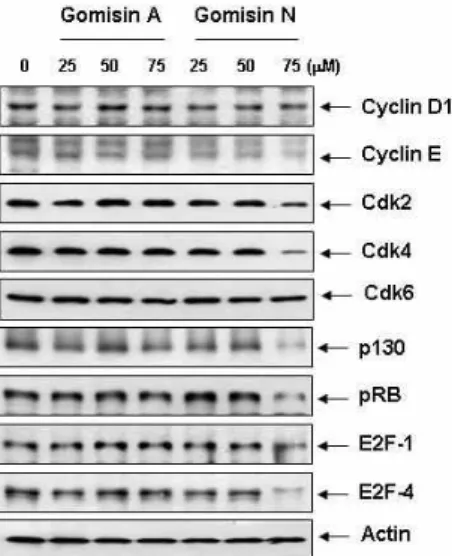
proteins that have been known to control G1 cell cycle phase transition in U937 cells. In comparison to control cells, cells treated with gomisin N exhibited a dose-dependent decrease in the levels of cyclin E, Cdk2 and Cdk4 (Fig. 3), which is consistent with the role of these proteins in the regulation of the G1 to S phase transition. Since the pRB family gene products such as pRB and p130 are also important check- point proteins in the G1 phase of the cell cycle, we next de- termined the kinetics between phosphorylation of pRB and p130 and the transcription factors, E2F-1 and E2F-4. Total levels of E2F-1 and E2F-4 were down-regulated in gomisin N-treated cells, and pRB and p130 expression decreased re- markably and changed from the hyperphosphorylated form to the hypophosphorylated form after gomisin N treatment.

This effect of gomisin N was dose-dependent (Fig. 3).

Furthermore, incubation of U937 cells with gomisin N re- sulted in a concentration-dependent increase in expression of the Cdk inhibitors such as p16 (INK4A) and p21 (WAF1/CIP1), but not p27 (KIP1), whereas gomisin A did not significantly affect expression levels of Cdk inhibitors (Fig. 4). Because the tumor suppressor p53 gene is deleted in U937 cells [3], it is most likely that the induction of p21 (WAF1/CIP1) by gomisin N is mediated in a p53-in-

Fig. 3. Effect of gomisin A and gomisin N on the expression of cyclins, Cdks and pRB family proteins in U937 cells.

U937 cells were treated with the indicated concentrations of gomisin A and gomisin N for 48 hr. The cells were lysed and proteins were separated by electrophoresis on SDS–polyacrylamide gels and transferred to nitro- cellulose membranes. Next, the membranes were probed with the indicated antibodies and the proteins were vi- sualized using an ECL detection system. Actin was used as an internal control.

Fig. 4. Induction of Cdk inhibitors p16 (INK4A) and p21 (WAF1/CIP1) expression by gomisin N in U937 cells.

U937 cells were treated with the indicated concentrations of gomisin A and gomisin N for 48 hr. The cells were lysed and proteins were separated by electrophoresis on SDS–polyacrylamide gels and transferred to nitro- cellulose membranes. Next, the membranes were probed with the anti-p16 (INK4A), anti-p21 (WAF1/CIP1) and anti-p27 (KIP1) antibodies and the proteins were vi- sualized using an ECL detection system. Actin was used as an internal control.

dependent fashion. These data suggest that gomisin N in- duces G1 arrest via the modulation of cell cycle-regulating proteins.

Discussion

Many previous studies indicated that lignans isolated from S. chinensis Baill have revealed anti-cancer properties, anti-hepatocarcinogenesis, anti-oxidant and anti-in- flammatory activities [2,10,17,13,22]. In particular, some li- gnans restored cytotoxic activities of anticancer agents in multidrug-resistant human cancer cells, and enhanced cyto- toxic and proapoptotic effects of anti-cancer drugs [7,15,20].

In addition, other lignans including gomisin N, schisanther- in C and G and propinquanin E were selectively cytotoxic in human cancer cells [2,12,23], suggesting the anticancer and cancer chemopreventive potential of lignans. However, the mechanisms underlying antiproliferative effects of li- gnans in human cancer cells have not been thoroughly studied.

In the present study, we found that gomisin N, but not gomisin A, strongly suppresses the proliferation (Fig. 1) and causes G1 phase arrest in human leukemia U937 cells (Fig.

2), which appeared to account for its anti-proliferative

activity. Progression from G1 to S phase of the cell cycle

is regulated by D-type cyclins and cyclin E, and their cognate

kinases, Cdk2, 4 and 6, which act by phosphorylating and

(5)

inactivating pRB family proteins such as pRB and p130 prior to the restriction point at which cells commit to DNA syn- thesis, and by cyclin E-Cdk2, which acts later in G1 phase [18,21]. Therefore, any factor affecting the activity of these kinases could abrogate the normal inactivation of pRB and/or p130 and cause an accumulation of cells in G1 phase.

Under normal conditions, pRB and p130 proteins bind to the members of the E2F family of transcription factors.

However, growth factors induce phosphorylation and dis- sociation of the pRB and/or p130 from E2F, which triggers G1 cell cycle progression [18,21]. Therefore, the complex be- tween cyclin D or cyclin E and Cdks is an obvious candidate for control of pRB and p130 phosphorylation. If decreased levels of either protein or the association between respective binding partners were observed, a concomitant decrease in the degree of pRB phosphorylation would be expected [18,21]. The data generated in this study demonstrate that in U937 cells, gomisin N, but not gomisin A, blocks phos- phorylation of pRB and p130 proteins and decreases levels of E2F-1 and E2F-4 (Fig. 3). Furthermore, gomisin N inhibits Cdk2 and Cdk4 expression in association with enhanced ex- pression of the Cdk inhibitor p16 (INK4A) and p21 (WAF1/CIP1) (Fig. 3 and 4). Additionally, our data suggest that gomisin N-induced p21 (WAF1/CIP1) upregulation in- volves a p53-independent pathway because U937 cells lack functional p53 [3].

In conclusion, these results provide the first evidence that gomisin N induces abnormal cell cycle transitions at G1 phase. Although further studies are needed, we believe that gomisin N is a promising candidate for cancer chemo- prevention and/or chemotherapy.

Acknowledgement

This work was supported by Blue-Bio Industry RIC at Dong-Eui University as a RIC (08-06-07) program of ITEP under Ministry of Knowledge Economy.

References

1. Cho, J. Y., A. R. Kim, E. S. Yoo, K. U. Baik, and M. H. Park.

1999. Immunomodulatory effect of arctigenin, a lignan com- pound, on tumour necrosis factor-a and nitric oxide pro- duction, and lymphocyte proliferation. J. Pharm. Pharmacol.

51, 1267-1273.

2. Choi, Y. W., S. Takamatsu, S. I. Khan, P. V. Srinivas, D.

Ferreira, J. Zhao, and I. A. Khan. 2006. Schisandrene, a di-

benzocyclooctadiene lignan from Schisandra chinensis : struc- ture-antioxidant activity relationships of dibenzocycloocta- diene lignans. J. Nat. Prod. 69, 356-359.

3. Danova, M., M. Giordano, G. Mazzini, and A. Riccardi. 1990.

Expression of p53 protein during the cell cycle measured by flow cytometry in human leukemia. Leuk. Res. 14, 417-422.

4. Hausott, B., H. Greger, and B. Marian. 2003. Naturally occur- ring lignans efficiently induce apoptosis in colorectal tumor cells. J. Cancer Res. Clin. Oncol. 129, 569-576.

5. Kastan, M. B. and J. Bartek. 2004. Cell-cycle checkpoints and cancer. Nature 432, 316-323.

6. Khan, N., V. M. Adhami, and H. Mukhtar. 2008. Apoptosis by dietary agents for prevention and treatment of cancer.

Biochem. Pharmacol. 76, 1333-1339.

7. Li, L., Q. Lu, Y. Shen, and X. Hu. 2006. Schisandrin B enhan- ces doxorubicin-induced apoptosis of cancer cells but not normal cells. Biochem. Pharmacol. 71, 584-595.

8. Lin, S., M. Fujii, and D. X. Hou. 2008. Molecular mechanism of apoptosis induced by schizandrae-derived lignans in hu- man leukemia HL-60 cells. Food Chem. Toxicol. 46, 590-597.

9. Liu, G. T. 1988. Biochemical and pharmacologic effects of wuweizi ( Schizandra chinensis (Turcz.) Baill.) and its chemical contents on animal livers. Sheng Li Ke Xue Jin Zhan 19, 197-203.

10. Lu, H. and G. Liu. 1992. Anti-oxidant activity of dibenzocy- clooctene lignans isolated from Schisandraceae . Planta Med.

58, 311-313.

11. Meiler, J. and M. Schuler. 2006. Therapeutic targeting of apoptotic pathways in cancer. Curr. Drug Targets 7, 1361-1369.

12. Min, H. Y., E. J. Park, J. Y. Hong, Y. J. Kang, S. J. Kim, H. J. Chung, E. R. Woo, T. M. Hung, U. J. Youn, Y. S., Kim, S. S. Kang, K. Bae, and S. K. Lee. 2008. Antiproliferative effects of dibenzocyclooctadiene lignans isolated from Schisandra chinensis in human cancer cells. Bioorg. Med. Chem.

Lett. 18, 523-526.

13. Ohtaki, Y., T. Hida, K. Hiramatsu, M. Kanitani, T. Ohshima, M. Nomura, H. Wakita, M. Aburada, and K. I. Miyamoto.

1996. Deoxycholic acid as an endogenous risk factor for hep- atocarcinogenesis and effects of gomisin A, a lignan compo- nent of Schizandra fruits . Anticancer Res. 16, 751-755.

14. Pan, M. H. and C. T. Ho. 2008. Chemopreventive effects of natural dietary compounds on cancer development. Chem.

Soc. Rev. 37, 2558-2574.

15. Pan, Q., Q. Lu, K. Zhang, and X. Hu. 2006.

Dibenzocyclooctadiene lingnans: a class of novel inhibitors of P-glycoprotein. Cancer. Chemother. Pharmacol. 58, 99-106.

16. Panossian, A. and G. Wikman. 2008. Pharmacology of Schisandra chinensis Bail.: an overview of Russian research and uses in medicine. J. Ethnopharmacol. 118, 183-212.

17. Park, C., Y. W. Choi, S. K. Hyun, H. J. Kwon, H. J. Hwang,

G. Y. Kim, B. T. Choi, B. W. Kim, I. W. Choi, S. K. Moon,

W. J. Kim, and Y. H. Choi. 2009. Induction of G1 arrest and

apoptosis by schisandrin C isolated from Schizandra chinensis

Baill in human leukemia U937 cells. Int. J. Mol. Med. 24,

(6)

초록:오미자에서 분리된 dibenzocyclooctadiene lignan의 일종인 gomisin N에 의한 인체혈구암세 포의 세포주기 G1 arrest 유발

박 철․황혜진

1

․최병태

2

․최태현

3

․김병우

4,5

․최영환

6

․최영현

5,7

*

(동의대학교 블루바이오소재개발센터,

1

생활과학대학 식품영양학과,

4

자연과학대학 응용생물학과,

5

대학원

바이오물질제어학과,

7

한의과대학 생화학교실 및 한의학연구소,

2

부산대학교 한의학전문대학원 경락구조의

학부,

3

대구공업대학 안경광학과,

6

부산대학교 생명자원과학대학 원예학과)

본 연구에서는 오미자에서 분리된 dibenzocyclooctadiene lignan의 일종인 gomisin A와 gomisin N에 대한 항 암효능을 U937 인체혈구암세포를 대상으로 조사하였다. Gomisin N은 처리농도의 증가에 따라 U937 세포의 증 식을 억제하였으나 동일조건에서 gomisin A는 세포독성 효과를 나타내지 못하였으며, gomisin N에 의한 U937 세포의 증식억제는 세포주기 G1 arrest 유발에 의한 것이었다. Gomisin N에 의한 G1 arrest는 cyclin E, cyclin-de- pendent kinase (Cdk) 2 및 Cdk4의 발현 억제와 Cdk inhibitor인 p16 (INK4A) 및 p21 (WAF1/CIP1)의 발현 증가 와 연관성이 있었으나, gomisin A는 세포주기 인자들의 발현에 유의적인 변화를 유발하지 않았다. 또한 gomisin N은 retinoblastoma 단백질군인 pRB 및 p130의 인산화를 억제하였으며, 전사조절인자인 E2F 단백질들의 발현을 억제하였다. 본 연구의 결과에서 gomisin N에 의한 U937 세포의 증식억제는 세포주기 조절인자들의 발현 변화 를 통한 G1 arrest 유발에 의한 것임을 알 수 있었으며, gomisin N은 암예방 및 항암활성 후보불질로서의 개발 가능성이 있음을 알 수 있었다.

495-502.

18. Sherr, C. J. and J. M. Roberts. 1995. Inhibitors of mammalian G1 cyclin-dependent kinases. Genes Dev. 9, 1149-1163.

19. Slanina, J., E. Táborská, and L. Lojková. 1997. Lignans in the seeds and fruits of Schisandra chinensis cultured in Europe. Planta Med. 63, 277-280.

20. Wan, C. K., G. Y. Zhu, X. L. Shen, A. Chattopadhyay, S.

Dey, and W. F. Fong. 2006. Gomisin A alters substrate inter- action and reverses P-glycoprotein-mediated multidrug re- sistance in HepG2-DR cells. Biochem. Pharmacol. 72, 824-837.

21. Weinberg, R. A. 1995. The retinoblastoma protein and cell

cycle control. Cell 81, 323-330.

22. Wu, M. D., R. L. Huang, L. M. Y. Kuo, C. C. Hung, C. W.

Ong, and Y. H. Kuo, 2003. The anti-HBsAg (human type B hepatitis, surface antigen) and anti-HBeAg (human type B hepatitis, e antigen) C18 dibenzocyclooctadiene lignans from Kadsura matsudai and Schizandra arisanensis . Chem.

Pharm. Bull. 51, 1233-1236.

23. Xu, L., F. Huang, S. Chen, S. Chen, and P. Xiao. 2006. A new triterpene and dibenzocyclooctadiene lignans from Schisandra propinqua (WALL.) BAILL. Chem. Pharm. Bull.

(Tokyo) 54, 542-545.

수치

Fig. 1. Growth inhibition of U937 cells by gomisin N treatment. (A) Chemical structures of gomisin A and gomisin N
Fig. 2. Induction of G1 arrest of the cell cycle by gomisin N treatment in U937 cells
Fig. 4. Induction of Cdk inhibitors p16 (INK4A) and p21 (WAF1/CIP1) expression by gomisin N in U937 cells.

참조

관련 문서

Caffeic acid phenethyl ester induces E2F-1-mediated growth inhibition and cell-cycle arrest in human cervical cancer cells.

All values were mean ± SD(n=3).. Gram staining of the isolated strains except Lb. plantarum EM from fermented fruit-vegetable juice using stored apple.. Changes in the

Concentration-Dependent inhibition of cell viability by adenosine in human oral fibroblast and FaDu human head and neck squamous cell carcinoma · · ·

It also suggest that cell proliferation inhibits by a novel signal transduction for adenosine effect in human FaDu hypopharynx squamous cell carcinoma cells....

In vitro cell migration in APE or JAG1 siRNA-treated M059K cell line Fig,11 Down-regulation of JAG1 induces S phase arrest in

Results: The human breast cancer cell subline MCF-7/MX5 cells selected in the presence of 5 µg/ml mitoxantrone (MX) were more resistant to MX (15.7... Western blot and

Particularly, after selecting a specific cycle by collecting HWC data and primary system-related data from Gori NPP Unit 1 and comparatively analyzing

tricuspidata on the production of proinflammatory cytokines in TNFα+IFNγ-stimulated HaCaT cells ...15 Fig.5: The cell viability of sub-fractions from 70% EtOH